Your ShelfYour Projects

Signs of the Times, Vol. 41, No. 8.

Health Principles or Health Fads
Earlier text: Our Eternal Abode Most Glorious

WHY THE EARTH WAS CURSED

FOR the creation was subjected to vanity.” Thus does inspiration through Paul state over again what was declared when sin entered the world. The record of that curse is found in Gen. 3:17-19: “Cursed is the ground for thy sake; in toil shalt thou eat of it all the days of thy life; thorns also and thistles shall it bring forth to thee; and thou shalt eat the herb of the field; in the sweat of thy face shalt thou eat bread, till thou return unto the ground; for out of it wast thou taken: for dust thou art, and unto dust shalt thou return.”
Then we know from this that the creation was subjected to vanity by the will of God on account of sin. It was not the plan of God that sin should enter, and creation be lowered in the scale of power until decay and death should mar its fair and glorious aspects. But when man by his own choice inexcusably and unreasonably had sinned, God saw, in His infinite wisdom and goodness, that it was necessary to place within man’s dominion that same rebellion which man had brought into the dominion of God.
It was to help him see what he had done, and to show him that he could not transgress the law of God with impunity, and that having once transgressed it, he could not escape its just and certain penalty. He was to eke his existence from the earth by toil and labor, until he returned again to it. Therefore, in his hard work and in the various aspects of nature, he had constant reminders that dust he was and to dust would he return.
Before man sinned, the earth was under his dominion, and obeyed him perfectly. He was in complete harmony with the laws of God, and his obedience to God was pictured in nature by the obedience of the animals and the perfect response of the growing world about him. He found everywhere perfect sympathy to his slightest touch. After sin had come, all was changed. His fear of God in consequence of his sin was repeated by the fear of every creature about him. As he had not trusted God, the birds and the animals could not trust him. The fear of man and the dread of man was upon every beast of the earth, and upon every bird of heaven. Gen. 9:2. And this fear increased with man’s deeper abandonment to sin and crime.
Thus the creation was subjected to vanity by God Himself, as a means of redeeming man from his sin. It pictures in its various phenomena the deranged condition of man, mirrored in its own imperfection and decay. This is the explanation of death wherever we find it. It is but the wages of sin; and the preliminaries of death are vanity, vexation of spirit, waste, unprofitableness, and corruption generally. The signs of death in creation are the omen to man that dust he is and to dust will he return, because he has sinned. The wages of sin is death.
Every sign of fear among the creatures of this world is but a token of that fear which has come within the heart of man himself since he turned away from God, his rightful Lord and Protector.
L. A. R.

KNOW THE TRUTH FOR OURSELVES

THE Master says, "Ye shall know the truth, and the truth shall make you free." John 8: 32. And again He says, "If the Son therefore shall make you free, ye shall be free indeed." Verse 36. Each individual is to know the truth for himself. "It is written in the prophets, And they shall be all taught of God." John 6: 45.
God's only plan of teaching is to teach men through His word, and He has arranged to have it so that the weakest and the feeblest of the human family may understand and know for himself the teachings of that Word.
We are not to take things merely because men supposedly wise and good are teaching them, but we are to know the truth for ourselves. We are to see it in God's own word by the guidance of His Spirit. We are to take nothing for granted just simply because some good man in whom we have confidence said it. "Put not your trust in princes, nor in the son of man, in whom there is no help," is the divine admonition. Ps. 146: 3. Even though the man be a prince and a great character, yet he may be mistaken or misguided. Our faith and confidence and trust must be anchored in the infallible Word itself. "It is better to trust in the Lord than to put confidence in man. It is better to trust in the Lord than to put confidence in princes." Ps. 118: 8, 9.
The prophet Jeremiah even goes so far as to affirm that a curse will be reaped by the man who places his trust in men instead of in the living God.
"Thus saith the Lord; Cursed be the man that trusteth in man, and maketh flesh his arm, and whose heart departeth from the Lord. For he shall be like the heath in the desert, and shall not see when good cometh; but shall inhabit the parched places in the wilderness, in a salt land and not inhabited. Blessed is the man that trusteth in the Lord, and whose hope the Lord is. For he shall be as a tree planted by the waters, and that spreadeth out her roots by the river, and shall not see when heat cometh, but her leaf shall be green; and shall not be careful in the year of drought, neither shall cease from yielding fruit." Jer. 17: 5-8.
One of the commonest mistakes is for people to place their faith in supposedly good men in the place of understanding for themselves the truth of the living God as revealed in His word. God designs that you, as well as the most influential, useful, and devout minister, are to know for yourself the living truth of the living God. You are to know it not because you see it in the teaching of the minister, but because it is clear to you from the Bible itself. The minister may be a great help to you in understanding the word of God, but he must not become your god.

The Destructive Power of Alcohol

THIRTY-FIVE years ago we were affirming that alcohol was taking down into drunkards’ graves 60,000 people a year in this country alone, but now the figures given out are that it is destroying from 600,000 to 700,000 a year. Much evidence is accumulating on every hand to show the destructive powers of alcohol, and tell of the miseries it brings into the world; but where is the individual who can tell of a single benefit that may be derived from it?

Evolution: Theories Versus Biblical Truth

SOME uninstructed people have the idea that creation by evolution is an exact science, and that it teaches definite, positive truth, whereas they ought to understand that it is no such thing. Evolution is nothing more nor less than a mass of theories and speculations, these theories being about as numerous as the prominent teachers of the so-called science. And it is this jargon of contradictory speculations they would ridicule us into accepting instead of the soul-comforting and soul-restful truth of the word of God.

4270 — EATING FLESH

Some claim that man was allowed to eat flesh in order to shorten his sinful life, but I have found no such statement in the Bible. Can you tell me on what this claim is founded? Luke 22: 15, 16 seems to indicate that the Passover will be eaten in the kingdom of God.
From the fact that flesh was not given to man to eat when he was first created, but he was told that his diet should consist of herbs and fruits, it is apparent that flesh was not intended to be used for food, and therefore that it is not the ideal diet. The fact that after man began to eat flesh, his life was shortened, would indicate that it produced this effect. And after the children of Israel were led out of Egypt, the Lord's evident intention was, to remove flesh from their diet, for He did not permit them to eat it until they were insistent in their demands for it. God might as easily have given them flesh to eat as manna, but He withheld it for their good. "It was His purpose to supply them with food better suited to their wants than the feverish diet to which many had become accustomed in Egypt. The perverted appetite was to be brought into a more healthy state, that they might enjoy the food originally provided for man,—the fruits of the earth, which God gave to Adam and Eve in Eden." "Had they been willing to deny appetite, in obedience to His wise restrictions, feebleness and disease would have been unknown among them." ("Patriarchs and Prophets.") But they murmured persistently, and so God gave them that which was not for their greatest good, because they would not be satisfied with that which would prove most beneficial to them. However, they were obliged to suffer the results of their intemperance. The fact that up to that time there was not a diseased or infirm one among them, proved that their diet was suited to their needs.
Our Lord's statement in Luke 22: 15, 16 does not refer to eating the Passover in the kingdom of God. At the crucifixion, the Passover service was done away. The type met the antitype when Christ, the real Passover, was sacrificed, and the typical service lost its significance.

4272—THE WARNING MESSAGE TO SODOM

From Matt. 11:23 it seems that God did not do all He could to save Sodom. Can God be negligent?
It was impossible that the same works should have been done in Sodom that were done in Capernaum, for Capernaum had the Saviour dwelling in person right in its gates. He could not have come to Sodom in the same way that He came to Capernaum, and still have carried out His plan of salvation. Why He planned as He did will be one of the themes for study throughout eternity.
But the Lord is not negligent. He is "merciful and gracious, slow to anger, and plenteous in mercy." Ps. 103:8. He is "not willing that any should perish, but that all should come to repentance" (2 Peter 3:9), and He uses every means in divine power to save men; and in the great day of Judgment the light that men have received, and also the light that they have rejected, will be taken into account. Therefore He says, "It shall be more tolerable for the land of Sodom in the day of Judgment," than for Capernaum.
Questions of this character may sometimes puzzle us, but it is not vital that we learn how to solve all of them now. The individual who connects with Christ has all eternity before him in which to see and understand the depths of God's wisdom in His great plan of salvation.

4267 — EVENTS OF EZE. 39: 17-20 AND REV. 19: 17-21

Does Eze. 39: 17-20 have reference to the same event as Rev. 19: 17-21?
Yes, the same event is evidently referred to. These are both prophecies of the last great battle that will be fought prior to our Lord's return, otherwise spoken of as the war of Armageddon. The bodies of those slain in that war, together with all the wicked who are destroyed by the brightness of Christ's appearing, will be left to be devoured by the wild beasts and the birds of prey during the thousand years that the earth lies desolate, as foretold in numerous prophecies.

4268—DECEIVED BY THE TONGUE

In what way does an unbridled tongue deceive the heart, and make religion vain? James 1: 26. A. K.
The text reads: "If any man among you seem to be religious, and bridleth not his tongue, but deceiveth his own heart, this man's religion is vain." Examine the text carefully, and you will see that it does not say that the unbridled tongue is that which deceives the heart; but rather, the man who thinks he is religious, and yet does not bridle his tongue, has deceived himself. That is plainly what the text says. Study it closely, and you will see that this is so. In our minds, or in our imagination, we often read things into texts that are not there. The greatest thing in Bible study is to examine the text attentively for what it says.

4269 — FIRST TRUSTED IN CHRIST

Please explain Eph. 1: 12. Who was it that first trusted in Christ? J. W. R.
In the Revised Version this text reads, "To the end that we should be unto the praise of His glory, we who had before hoped in Christ." The King James Version reads, "who first trusted in Christ." The Revised Version says, "we who had before hoped in Christ." The reference seems to be to Paul and his fellow Jewish Christians, who, before the Christ came, looked forward to His coming through the light of prophecy, "waiting for the consolation of Israel." Luke 2: 25. Acts 26: 6, 7 says, "I stand and am judged for the hope of the promise made of God unto our fathers: unto which promise our twelve tribes, instantly serving God day and night, hope to come." Acts 28: 20 speaks of the "hope of Israel," that is, the Saviour Himself, for whom Paul was bound with chains.

4271 — MOSAIC SACRIFICIAL SYSTEM

Do you think the Mosaic sacrificial system was inspired of God? Why was animal slaughter necessary?
Certainly it was inspired of God. The instruction for this service came to Moses direct from God Himself. In Col. 2:16, 17, Paul speaks of meats and drinks and holy days and new moons and sabbaths, "which are a shadow of things to come; but the body is of Christ." Christ was the real substance, and these sacrifices and offerings were a shadow pointing forward to Him. The first part of the tenth chapter of Hebrews makes it very clear that God had a purpose in instituting that sacrificial system. There could be nothing plainer than that God required those things in the old dispensation, and that some of the people understood their meaning.
But the fact that one may not understand God's reason for doing certain things is no justification for his discrediting those things. In the very nature of the case, it is impossible that finite man should be able to comprehend all the ways of the infinite God. Yet one may be sure that He gave no ordinance to man but what was needful to his salvation, and we may always trust His judgment.
An understanding of God's truth and of God's plan of salvation can not be grasped by finite human reasoning. It must be grasped by an experience. "O taste and see that the Lord is good," is the divine suggestion. Ps. 34:8. We must taste in order that we may see. A basket of the most delicious fruit may be placed before us, and an individual who has been accustomed to eating it may tell us with great enthusiasm how good it is; but we must taste if we would see for ourselves. And thus it is with the experience of the blessed truth that is in God's divine word. The individual may be earnestly invited to come; but before he can see, he must taste.

4273 — KING SAUL OFFERING SACRIFICES

From 1 Sam. 13: 12, 13, it seems that God was displeased that Saul offered the burnt offerings. How could that be, as Saul was not the only one outside of the priesthood that offered offerings?
The direction of God was that the priesthood was to be committed to Aaron and his sons. Read chapters 27-30 of Exodus. After that time, no one else was to perform the rites of a priest unless especially directed of the Lord. In 1 Sam. 10: 8, Samuel had instructed Saul to go to Gilgal, and to wait there till he came, when he would offer sacrifices. But Saul became impatient because of the delay, and presumptuously offered them himself, in his self-exaltation after his victory over the Ammonites, and this in face of the fact that he had been instructed to wait, and had not been ordained for any such service. Surely all the circumstances and all the dangers of the time and the occasion were as well known to God as they were to Saul, and God had told him to wait till Samuel came. Why did he not wait?
In perplexing situations, men often entangle themselves more and more by using sinful means of relief. Impatience to help ourselves, and unwillingness to leave our concerns in God's hands, serve only to involve us in new troubles.

SYSTEMATIC BIBLE STUDY

THOSE who followed the reading suggested for last week, among other most helpful promises, found this one: "What time I am afraid, I will trust in Thee." Ps. 56:3. Who has not been tortured with fear? And in the midst of those tortures, those who have learned to trust in God have found perfect freedom from every such desolating torment. And who has not been made fearful because of some threatened danger from his fellow men? And under such circumstances, with what assurance come promises like this one: "In God have I put my trust: I will not be afraid what man can do unto me." Ps. 56:11. It is only when we are reading the Bible through by course that we are sure of finding all these "exceeding great and precious promises." We are to be fortified by "every word" that proceeds out of the mouth of God. And we can not overemphasize the fact that an important part of our Bible study is, to read carefully again and again every portion of the Sacred Scriptures.
SCHEDULE FOR THE WEEK ENDING MARCH 7 Exodus 19-26 Psalms 60-66 John 1-8
Read a chapter in each of these books on weekdays, and on the Sabbath read two chapters in Exodus and two in John.
The reading in Exodus this week gives the account of that most wonderful event in human history, the giving of the law of Ten Commandments upon Mount Sinai. "The Lord's Day the Test of the Ages," by Wilcox, and "The History of the Sabbath," by Conradi, which were suggested as helps last week, will be valuable also in the understanding of the portion of the book of Exodus that we are to read this week. The chapter in "Patriarchs and Prophets" on the giving of the law will be found not only interesting but inspiring.
In the reading of the first part of the book of John, chapter 14 of "The Desire of Ages," as well as other portions of this valuable book, will be very helpful.

Question Corner

WE can not answer repeatedly in the same volume questions upon the same scripture. The name and address must accompany question. It is well always to enclose stamp for reply.

TREKKING THROUGH AFRICA

A NIGHT MADE HIDEOUS BY DEMON-WORSHIP—

CLAIMING TO PASS TO AND FROM HEAVEN
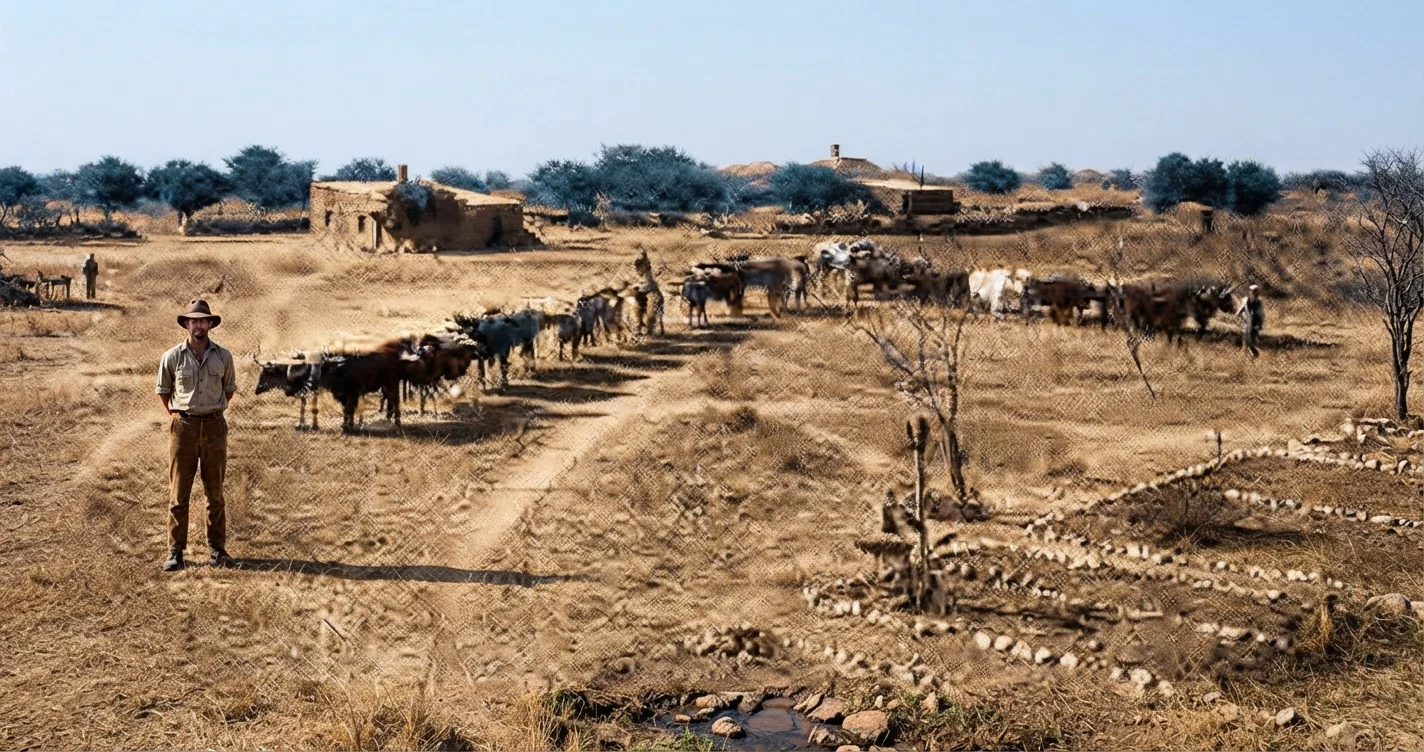
ELDER A. BOEKHOUT gives an interesting account of a recent itinerating trip which he made through the jungles of Africa, among a number of native villages, for the purpose of obtaining pupils for the Barotseland Mission school, South Africa. We condense from his article as follows:
He and one of the mission boys started the first of July, taking with them their blankets, and food for two months. They went a hundred miles by train, and then trekked in ox wagons the rest of the journey. He gives a touching account of his visit to some of the villages, and the eagerness of the people to have schools started among them. “Yes, they wanted a school very badly, but ours was too far away.” So the women began to argue. “What if their children died so far from home? Would I not come and build a school near?” As Brother Boekhout returned to the wagons, he was followed by some who were eager to go to school; but their mothers called them back, being afraid to let them go, and kept close watch that none should leave.
He encountered difficulties and discomforts all along the road. There were many lions in the forests, and he saw a number of fresh lion tracks on the trip. He sometimes went for miles without finding water, and what he found was not fit to drink. In one place he found just a little black water dripping from a stony place, but it was all they had, and being thirsty, he was glad for a sip of even this.
After traveling several days, Brother Boekhout was seized with an attack of black-water fever, and suffered considerably from the jolting of the wagon. His mission boy came up alongside of the wagon, and said: “Missionary, we are troubled. We are praying much for you.” He was carried in his blankets to a small village, by the native boys that had joined him at the different villages, and was laid down on the outskirts of the village, where they had a meeting every evening, and his mission boy preached to the villagers.

IN THE THRALDOM OF DEMONS

We quote his own words relating some incidents of the trip, as follows:
“On the march, we arrived one evening at a village off the road. After our evening meal we had hymn-singing and service. As we were all tired, we soon spread our beds. It is a rather funny experience to travel as we did. There the boys lay, some with blankets, some without any covering, but all closely huddled together around a huge fire. Yet, as I watched them, the thought came to me how the Lord Jesus watched them too, how He yearned to rescue them. O, wonderful love of God! And that we should be the channels of that love, coworkers with God—is not that wonderful too?
“We had very little rest that night. In one of the huts there was a sick woman. The chief told me how the spirit of a great induna ‘Murandu,’ who died lately, had entered that woman. In honor of the fact, many women were singing praises to that spirit, in front of the sick woman’s hut. ‘He had come down in their midst again. He would give them fruitful seasons again. O, praise him!’ Such and many more exaggerated expressions I caught as I listened. By midnight it was quiet.
“At four o’clock in the morning I awoke, and heard a shrill voice crying out: ‘Why don’t they praise me? Why are all the people lost in slumber? Go and wake them.’ Up came a man armed with a spear. He returned to that hut. And again that voice sang out those same words, but with anger this time. At this the boys awoke, and did not lie down again, but sat around the fires. Were they afraid? I could not make it out. Soon the whole village was astir, and the old singsongs of praise to that spirit started again. Does not the word of God truly say that they are taken captive by the devil at his will? 2 Tim. 2: 26.
“Passing that hut next morning, I went in to see what old hag had thus disturbed the night. To my surprise I found a young girl sitting on a mat. She was adorned with beads, and looked like a queen. Out of her eyes shone that weird light for which I can find no word, but which convinced me that the poor girl was indeed ‘captive at his will.’ I asked her what ailed her. She answered, ‘Jesu,’ that is, ‘Jesus.’ So I told her about Jesus.

CLAIMED TO GO TO HEAVEN AND RETURN AGAIN

“It is a remarkable fact that the natives call everything supernatural by the name of ‘Jesus.’ Here is another instance. I had noticed the absence of grown-up boys of say from twenty to twenty-five years; and while I was staying at Mpiri, some eight were going on the march to a place one hundred and fifty miles west. There, so they told me, a man went up into heaven and down along a wire. That man had told them all to come and bring a few mealies, Kafir-corn, and peanuts, then they would have a fruitful season. If they refused to come, surely their crops would be a failure next year. And that man they also called ‘Jesus.’ And nothing could keep them from going. I argued half an hour with twenty-five boys that had come all the way from Broken Hill, but to no purpose. Go they must. And from nearly every village on the road some had gone or were going to see this wonderful ‘Mwami Jesu,’ that is, ‘the Lord Jesus.’ This story afforded me an excellent opportunity to speak freely about the true Lord Jesus and His coming. Let us pray that some have not been forgetful hearers.
“More boys joined us, even from that village of the sick woman, bringing our number up to twenty. Next we had to pass a stretch of eighteen miles without water. We walked it in one afternoon, arriving after sunset at the village of Kabwenga. Hardly had I sent the boys off to fetch wood and water, when the chief came. Old Kabwenga sat down, clapped his hands, and offered a big basketful of meal. He had heard that the missionary was coming, and ordered his women to grind meal that day. He was so pleased that we had come to visit him too! O, how well the Lord cares! Our supply of meal was just exhausted, and there were twenty hungry mouths to be fed. But here was the provision. Praise Him! Supper finished, we had a grand service; for many, many came, and the songs were good, and our hearts were glad.
“The old induna was very obliging, and brought something every day—peanuts, sweet potatoes, pumpkins, etc. They wanted a school very badly there.

HEATHEN EAGER TO LEARN

“At Makusa’s the induna besought me to stop. He would build me a house and a schoolhouse, help me with the gardens—in one word, do everything to please us—if we would only build a school there. I had not seen such eagerness before. But we had to go on. Three of the chief’s sons joined us, with full consent of their father. From another village a family entrusted three sons to me, but O, the pitiful tears that ran over that mother’s cheeks when we left!”
Brother Boekhout taught the boys a number of gospel hymns, and in his services they assisted him with their songs, and people came from other villages around to hear them sing.
On the evening of their arrival at Lusaka, where they took the train for the mission, the boys sang hymns, and the white people gathered from all around to listen, and they would not believe that the boys who sang without hymn-books were a fortnight ago “raw” in the villages.
They arrived at the mission on August 13, all in good health, and with hearts filled with gratitude and praise to God, who so marvelously cares for us all.
We who live in lands surrounded with all the blessings of Christian civilization can scarcely realize what a “trekking” expedition of this sort involves, nor what hardships and sacrifices the participants are obliged to endure; but we can give substantial aid in procuring for the natives not only temporal but eternal benefits, in extending the light of the gospel to their darkened but receptive hearts.

Am I a Debtor?

WE read in Rom. 1:14 these words: "I am debtor both to the Greeks, and to the barbarians; both to the wise, and to the unwise." But why was Paul a debtor? — Just because the God of heaven had entrusted him with a soul-saving message, and Paul felt the weight, the responsibility, of that which had been entrusted to him, like a great debt — not a debt of property, that could be paid with money alone, but a debt wherein the eternal life of man is involved. This very fact is what caused Paul to give his life for soul-winning.
As I study the life of this man of God, the thought comes to me, What part of this great debt rests on me? In view of the soul-saving message due the world at this very time, and the fact that God in His goodness and great mercy has caused the light of this last great soul-saving advent message to shine into my sin-darkened life, I am forced to say with Paul, "I am a debtor," not only to the nations of men, but to the great and mighty God, and I greatly fear that nothing less than the winning of the souls of men will pay the debt. Therefore, with this new year has come a greater sense of the weight of this debt, and with it a new consecration for soul-winning. And now I wish to ask you, dear fellow ministers, how is it with you? And you, dear teachers, one and all, are you simply marking time, or are you in the schoolroom as a soul-winner? And you, dear colporteur, dear Bible worker, dear secretaries in our several offices, are you going the daily rounds just as a mechanic fits joint to joint, or are you there sending out the precious truth in printed form with the sweet breath of prayer accompanying every package and every letter with the tenderness that will be as springs of pure water in a thirsty land?
Dear ones all, let us set this great world aglow with this last message of our God, sent forth in love to a sin-cursed world, for the one grand purpose of saving lost men. Who will be a soul-winner for God?
Yours for service, G. F. WATSON.

God's Power Alone Can Restrain the Devil

Some Diabolical Work in Honan, China — Remarkable Cases of Divine Protection

By JOHN J. WESTRUP
WHAT a power the devil has over the poor deluded people of this world! In some countries he hides himself under an outwardly fine civilization, but his power to lead people away from God and to deceive is fearful. Here in China, being worshiped in order to appease his wrath, he works more openly and frightfully.
The awful devil-possessions, I have written about before. But there is another form of torture, the victims of which come to our dispensary nearly every day.

THEIR BODIES SWELL UP IN A FIT OF ANGER

When they become angry, it seems that the grace of God, which everywhere restrains the devil, has hardly any chance to manifest its protecting power, and the devil eggs them on to a fearful fit of anger. They ruin their voices for lifetime, their bodies swell up and stay swelled, and this slowly gives rise to other diseases. How terrible it will be when the grace of God is withdrawn from the unbelievers all over this wicked world! The whole world is under great obligation to God for the restraining influence of the Holy Spirit. O that men everywhere would thank the Lord for His goodness!

PRONOUNCED VICTORIES OVER EVIL POWER

No one in this country can doubt the existence of the devil. At the same time, the power of God to save is plainly manifested. The great change at conversion is more marked here than in many places. Their faith in God is more childlike, prayers more earnest, and they expect and do get victory over the devil and the flesh. We see many clear evidences of answer to prayer.

KEPT FROM THE ROBBERS

Only yesterday a colporteur told me how God continually protected him and his family and the brethren, while others around [[FIGURE]]
them constantly suffered from robbers, who are robbing and burning up houses and property at a great rate about us. One day he passed through a thousand of the White Wolf Robbers, and to his joy they did not molest him. Another time he was approaching a very dangerous place infested by fearful robbers; but he and the man who wheeled his papers, books, and other things, kneeled in the road and prayed earnestly for the Lord's protection, then went forward in faith, and passed through without being harmed.

PRESERVED THROUGH TWO-YEAR DANGER PERIOD

We have had many such instances these two years. The more dangers around, the more genuine is the faith. And having faith in God, He is able to show His power and love. Our brethren are scattered over Honan, and not one of them has lost property or life these two awful years, during and after the revolution. We daily praise God for His protecting love. Our one desire is to get nearer to Him and become more like Him. The more we become like Him, the more peace, joy, and blessing we have in our lives. Praise the dear Lord for His love and for His goodness to the children of men.
Evangelist F. E. Stafford and native evangelist Tze in front of our new tract society office in Shanghai, China

Accomplished by One Tract

ELDER H. W. COTTRELL is in receipt of a letter, under date of January 26, 1914, from a man in the state of Washington, from which we quote the following interesting extract:
"The tracts were duly received, and a few pages read in 'We Would See Jesus,' but it was only the present week that I read 'The Christian Sabbath,' completing it Friday evening.
"It makes clear the question of the first day of the week, and shows that it is but a common day; and the custom of Christ and the disciples to observe the seventh day as the Sabbath; and that the seventh day (Saturday), not the first day, is the Lord's day; and other passages in the New Testament which I had understood differently. . . .
"To my mind, it covers the subject, and makes plain the duty of every one who hopes to see Jesus and live in His kingdom. . . .
"Consequently, the Sabbath was observed as never before in our house."
Is not this a striking testimony to what a truth-filled tract will do when read by an honest seeker after light? Note that the reader of this one tract on the "Christian Sabbath," which he finished reading Friday evening, January 23, who only a few days before, as he stated to the author of the tract, considered the Sabbath question of little consequence, was thoroughly convinced of the truth it contained, and obeyed by keeping the following day as the Sabbath.
In the letter above mentioned, this brother enclosed some change, and said, "Please send a few copies of 'The Christian Sabbath,' and I will mail the same to some of my friends. . . . May God bless you in spreading the message to those who need to know God's will in this matter."
Reader, does this not serve to illustrate what you may do for God through the medium of a little tract, a crum from His great table of truth? Let the printed page be sown as the leaves of autumn, or as the falling of the manna, and all who faint not shall reap.
M. H. ST. JOHN.

The Tongue Is a Fire

The tongue is a fire, a world of iniquity: so is the tongue among our members, that it defileth the whole body, and setteth on fire the course of nature; and it is set on fire of hell.—James.

Cooperation Corner

"I am a Bible worker for the — Conference, and use a great deal of literature in my work. I find the SIGNS OF THE TIMES one of the best pioneer papers. Were I able, I would put it in the hands of all my interested readers; but my limited means forbids this. I am writing to know if you have some back numbers in stock you would send me free, post-paid. I see you have a Cooperation Corner, where persons have the privilege of donating to such a work, that would enable you to furnish papers to those who would use them to good advantage."
Our friends who are donating to the Cooperation Corner Fund enable us to answer such earnest appeals as this with supplies of our excellent literature. It is certainly a pleasure to do this, and those who have a part in this work may feel assured that much good is accomplished. Others desiring to send in donations to the Cooperation Corner may do so by addressing Cooperation Corner, SIGNS OF THE TIMES, Mountain View, Cal.

Wanted for Missionary Work

A CONTINUOUS supply of any of our denominational literature, including tracts, to the following:
W. B. Jenkins, Box 65, Wildwood, Florida.
Mrs. Stella Wise, 738 Center St., Shelbyville, Indiana.
C. A. Van Clefe, 1540 N. Front St., Salem, Oregon.
Mrs. Lelia Ray, 414 Pluss Court, Laurens, South Carolina.
J. E. Patterson, Fort Stanton, New Mexico.
J. S. Killen, 102 N. 10th St., Wilmington, North Carolina.

Notice

"SHILOH, THE MAN OF SORROWS," published three years ago in the Signs, will soon be published in book form, if enough additional advance subscribers can be obtained to warrant it. I wish to thank those who have already sent in orders. The book will be neatly bound in cloth, 350-400 pages. Price, from $1.00 to $1.50. Agents wanted. Send no money, but address the author, quick. Mrs. L. D. Avery-Stuttle, 1215 Vermont Ave., Lansing, Mich.
Continue reading: Treatment of Tuberculosis