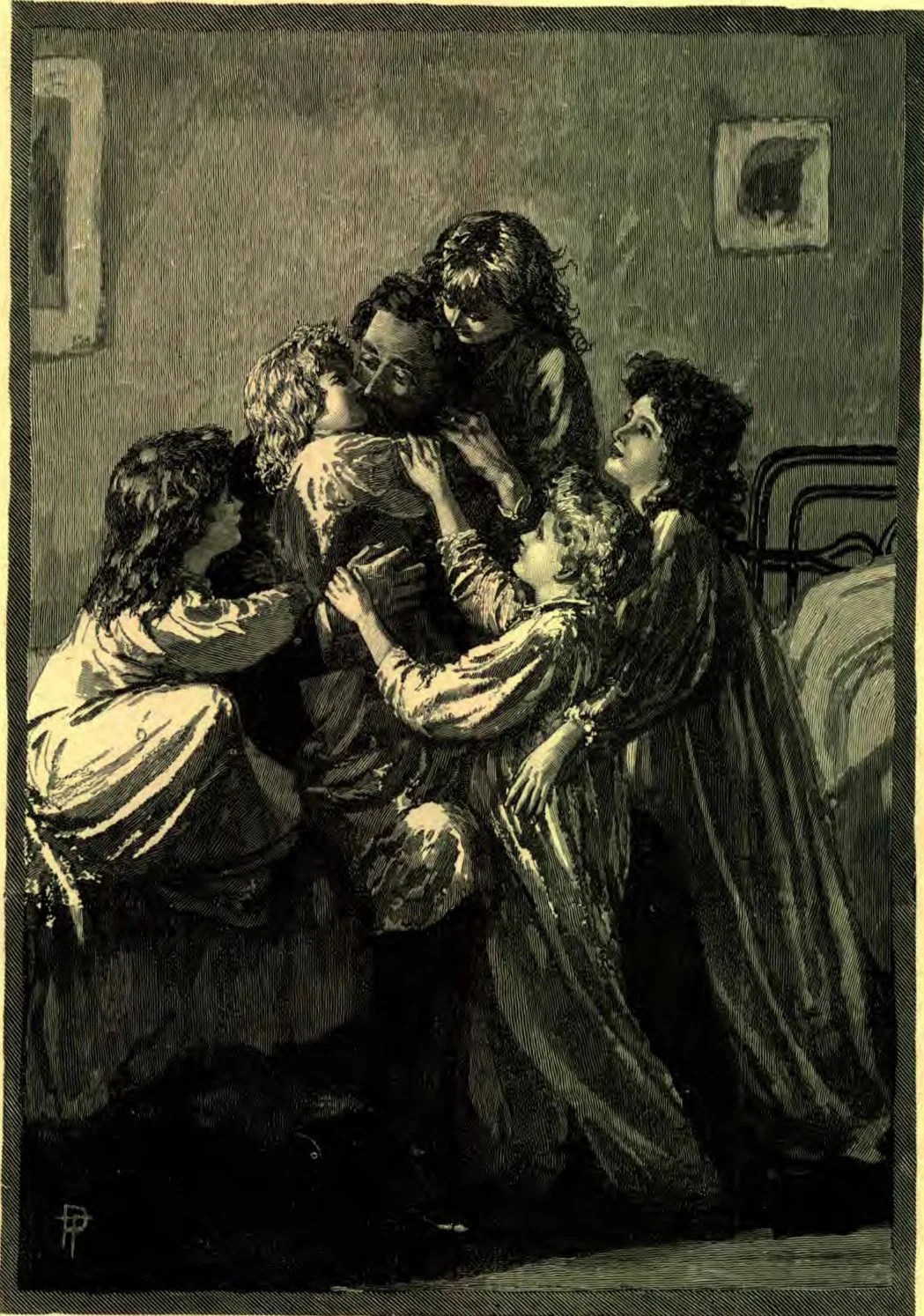
WITH little tasks accomplished,
And little duties done,
The children gather round me,
At setting of the sun.
In the soft falling twilight,
Their childish faults confessed,
Consoled, kissed, and forgiven,
They seek their guileless rest.
“Good-night, good-night, my children,
Sweet rest, and peaceful dreams.
May angels guard your bedside
Until the morning beams.”
So when shall fall life’s twilight,
May I near my long rest,
With every duty finished,
And every fault confessed;
And may my loving Father,
In accents sweet and mild,
Above me bending, whisper,
“Good-night, good-night, my child.”
AUNT BETTY.
“THE CHILDREN GATHER ROUND ME”
THE WINDOW BEHIND THE BRANCHES
By Frances Elliott
It was a great trial to Kenneth that he was not so big and strong as his brother Harry. It would have been strange if he had been, for Harry was four years older, and those four years counted for a good deal. But Kenneth was anxious to do whatever Harry did, and to do it in the same way. He did not like to ride a smaller wheel; he had tired himself all out one day when the boys were going for a long walk by trying to keep up with Harry and his friends, and he made himself lame for days by insisting on using his brother’s dumb-bells, instead of the lighter ones that had been bought especially for him. His father laughed at his eagerness.
“Have patience, laddie,” he often said. “Nobody expects you to have strength beyond your years. I am sure the time will come when you will catch up with Harry, and be quite as strong as he is.” And Kenneth tried to be content with that prophecy, though he took every opportunity of testing his strength.
There came a day in school that brought a test of another sort. Kenneth went out into the yard one bright spring afternoon to get a drink of water, and as he passed back into the building again, shied a stone that he had picked up into the branches of a big tree in the next yard.
Before school began the next morning, the principal had a call from the man who lived in the house next to the school building. He reported with some indignation that one of his windows, on the side toward the school-yard, had been broken by a stone, and he wanted to have the boy punished who had done it.
“Do you know at what time of the day it was done?” the principal asked.
“No, I don’t,” was the reply. “My family were away all day, and it wasn’t until night that we discovered it.”
The principal shook his head. “I am afraid it will be hard work to find the boy,” he said.
“According to your statement, it may have been done at any time of the morning or afternoon, and any boy in the school, from the first grade up to the eighth, may be the one who threw the stone. However, I’ll do my best.”
That was how it happened that the principal went into every room that day, asking if any boy had thrown the stone which had broken the window. In every room there were denials from all the boys, until the principal reached Kenneth’s room.
Kenneth had never thought that his stone might break a window, but when the principal told what had happened, he had an uncomfortable certainty that he was the boy who was to blame. Evidently there was a window behind the branches of the big tree.
“But you’re not sure of that,” a voice whispered to him, adding, a moment later, “And nobody saw you do it. If you say No, they’ll never know the difference.”
Kenneth heard the voice, but he did not obey its suggestion. He knew what honor was, and he stood up and told his story bravely and manfully.
“I didn’t know there was a window behind the150tree, or I wouldn’t have thrown the stone,” he said, with evident honesty. “I’ll ask my father to let me earn money to pay for a new pane.”
The owner of the broken window had come in with the principal, and had looked very fierce while the questions were being asked. But at Kenneth’s last words, his face changed suddenly. “I guess we won’t bother about that,” he said. “I was pretty angry at first, because I’ve had windows broken before when I couldn’t find out what boy did it, and I thought this was going to be another case of the same sort. I hope you’ll all try to be careful after this.”
When Kenneth told the story at home that evening, he added, proudly, “And teacher said that something a good deal like it happened when Harry was in the room, and that he owned up just as quick as I did. She said it was good to see a strong sense of honor running through a family that way.”
“It is good, Kenneth,” his father said, gravely. “And I am glad to know that though you may not be as strong of muscle as Harry, you are as strong in honor.”
Kenneth’s face lighted up at his father’s words. “O papa!” he said, joyfully, “I can be as strong as Harry in something, can’t I? I never thought about that, but I’m so glad!” And the pleasure of that thought wiped out many disappointments. —Frances Elliott.
THE SONG OF THE UMBRELLA
By Maggie Wheeler Ross
Drip,
drip,
drip! The
April days
have come, And
me you'd better
always take, Whenever you leave home.
For when the sun is
shining bright, And down
the street you trip, An April shower may come up,
Drip,
drip,
drip!
— Maggie Wheeler Ross, in Little Folks.
FOUR BED-QUILTS
Four bedquilts are ready to fold and spread
On Mother Earth's old trundle-bed.
The first, a brown-and-white old thing,
She puts on in the early spring;
The summer one is green and bright,
With daisies nodding left and right;
And when the winds begin to blow,
She spreads the red quilt on, you know;
She sews it through with yellow thread —
It makes an autumn-leaf bedspread;
And by and by, all in a night,
She spreads her quilt of snowy white.
6. Where did the golden candlestick stand? Ex. 40:24; note 4.
7. How many lamps were upon this candlestick? What was the object of the lamps? Ex. 25:37.
8. Of what was the golden candlestick a type, or figure? Rev. 4:5.
9. How often were the lamps to be filled and lighted? Ex. 30:7, 8; note 5.
10. How long were they to be kept burning? Ex. 27:20; note 6.
11. What instruments were used in caring for the candlestick? Ex. 25:38.
NOTES
1. The Lord led his people out of Egypt to take them away from the sinful idolatry which they saw in that country. The Egyptians worshiped the sun,—a kind of worship which was very pleasing to the sinful heart. The Lord therefore did all he could to help the children of Israel to get as far away from it as possible. One way he took to aid them was to have them kneel, in their worship, with their faces to the west. (Sun-worshipers knelt and faced the east.) The sanctuary faced the east, so that when one came with his offering, and bowed before God, he did just the opposite of what he would do if he was worshiping the sun. The plan was like this:— As the priest entered the sanctuary, the table of shewbread, which was on the north side, was therefore at his right hand.
2. There were twelve tribes of the children of Israel, so there was one loaf for each tribe. The word “shewbread” means “presence-bread;” that is, bread set in Jehovah’s presence. And151it was to be always before God. All God’s people, every tribe, were always in God’s presence, never forgotten by him for a moment. But better than this, the bread represented Jesus, our Saviour. He is the bread that cometh down from heaven (John 6:51), to give life to the world. He is always in God’s presence, pleading for his people; and when God looks upon Jesus, he sees in him all the world, and especially all his trusting, obedient children.
3. The bread was to be changed each Sabbath, and was to be placed upon the table “hot.” It was therefore baked each Sabbath day. On each Sabbath day it was brought, fresh and sweet, into the presence of the Lord. And let us remember that it was unleavened bread; there was no yeast in it. Yeast, or leaven, is a type of sin. Like Jesus, who is free from all sin, the bread was free from all leaven. And may we not learn a lesson from the fact that it needed to be prepared fresh every Sabbath? It was a figure of Jesus, and is he not to give us a new, fresh blessing in himself every Sabbath day? These are wonderful lessons. Let us be careful to receive the precious truth they contain.
4. Since the sanctuary faced the east, the south side was at the left. The candlestick therefore stood upon the left of the entrance.
5. Every morning and every evening the lamps were to be refilled and relighted. They were to be kept carefully trimmed and brightly burning. They were to give light to the room, and cause the gold to show forth its beauty and richness. The seven lamps were figures of God’s Holy Spirit, “seven” meaning completeness, or fullness. The Spirit of God is the light of the temple of the heart, driving away all the darkness of sin, and causing the gold of our faith to shine forth in true, living beauty. But it must be renewed every morning and every evening. Each morning we need to go before God, and ask him to give us his Spirit,—to fill our lamp and cause it to shine bright and clear,—and before we close our eyes in sleep, the same blessing must be sought and found again. Those who do this will never walk in darkness, but will have the light of life.
6. The light of the sanctuary never went out. The lamps burned “always.” So the Spirit of the Lord is always to shine in our hearts, and always will shine if we will let it. Oh, let us cherish that good, tender Spirit, and may it continue to shine in our hearts until all the dark places of life are passed, and we reach home, where the same light, in all its glory, will shine on forever.
BEREAN LIBRARY STUDY
Revelation 21: “Thoughts on the Revelation,” pages 702–715
(May 12–18)
All Things New.—In the beginning God made the earth perfect; he placed animal life upon it, clothed it with verdure, and furnished it complete; then he gave the beautiful earth to man for a home. God did not form man's character: he was made pure, but he himself must develop a noble character. In this he failed; and now, surrounded by sin and vice, he must develop a character that will meet the mind of God. When the characters are all formed, God will create the perfect surroundings again. The order is now reversed; instead of the perfect earth first, the character must stand the test of the Judgment, and then will come the perfect earth. God says, “Behold, I make all things new.” He calls to the redeemed to witness the work. From the city of God they will look out upon the earth, and see the transformation take place,—see it changed from a desolate, dreary waste to more than its edenic beauty. Will you behold it?
The New Jerusalem.—On account of sin, man was not able to carry out the original plan of God on the earth. But Christ, the second Adam, will do for man what he would have done if sin had never marred the universe of God. Mankind is unable to build a city free from sin upon the earth, so Christ prepares for his children a city, and brings it to the earth in all its heavenly beauty. It is called the bride, the Lamb’s wife (Rev. 21:9, 10), also the mother of us all. Gal. 4:26. The prophet Isaiah uses the figure of a mother when speaking of the heavenly Jerusalem. “Then shall ye suck; ye shall be borne upon her sides, and dandled upon her knees. As one whom his mother comforteth, so will I comfort you; and ye shall be comforted in Jerusalem.” Isa. 66:10–14. The city will not be complete without the redeemed; they will add to its beauty, and be an ornament to it.
Description of the City.—It is not a city of brick and mortar; but the city is pure gold, the streets are also of gold. There is no need of pavements, for the streets are gold. In this life many sell honor, virtue, and even life itself for a paltry sum of gold, while they reject the offer of a free inheritance in the city of God, where even the houses are of gold. Each of the twelve gates is one immense pearl, hung in the wall of jasper. Over the gates are written the names of the twelve tribes of Israel, while on the resplendent foundations are written the names of the twelve apostles. How John, the beloved disciple, must have felt when he saw his name written on those beautiful stones, garnished with all manner of precious stones! On the books of the Roman government, his name was inscribed as an outlaw; in heaven, it is inscribed as the honored of God. His heart must have overflowed with love and praise when he beheld it.
Size of the City.—The city lieth foursquare, 375 miles on each side—larger than some of our States.
No Need of the Sun.—The sun will shine seven times brighter than now. Isa. 30:26. All impurities will be removed from the atmosphere; there will be nothing to obstruct its rays. But the glory of God so far outshines the sun that the sun will be ashamed “when the Lord of hosts shall reign in Mount Zion, and in Jerusalem, and before his ancients gloriously.” Isa. 24:23. There will be no more need of the sun's rays in the city than of our burning lamps at midday, in clear sunshine; for Christ's glory will be far brighter than the sun.
Nations of the Saved.—The redeemed will form nations, and there will be kings ruling. We are so accustomed to think of bloodshed and injustice in connection with the reign of kings, that we can not fully comprehend how they will reign in righteousness, and all to glorify the Lord. There is order in heaven. Commanding angels are in charge of legions of angels. Why should there not be order and government upon the new earth?
Chinese Mothers and the Toe-Counting Rhyme
THE mother of a Chinese baby enjoys counting the little one's toes, just as American mothers do. When the gay, embroidered shoes are taken off, she pinches one tiny toe and then another, as she sings:—
“This little cow eats grass,
This little cow eats hay,
This little cow drinks water,
This little cow runs away,
This little cow does nothing
But just lie down all day.
We'll whip her!”
Best Stories FROM THE Best Book
since its publication, has met with a most gratifying reception. It grows in favor day by day. Everyone is delighted with the book upon first sight, but the more thoroughly they become acquainted with it, the more they realize its inestimable value. We know it is appreciated from the many kind words our friends have to say concerning it.
AN EXCELLENT HELP FOR CANVASSERS
Paw Paw, Mich.
The truths presented in “Best Stories” certainly make it a work that can not fail to bring much-needed light to many who have been reading the Bible for years. It is an excellent help for canvassers.
Geo. Matteson.
A READY SELLER
Elliott, Penn.
I like “Best Stories” very much. It is a ready seller, and an excellent book for young persons to sell.
F. E. Painter.
Pennsylvania State Agent.
AN INSPIRATION TO THE CHILDREN
South Lancaster Academy,
South Lancaster, Mass.
I find “Best Stories” very attractive to the children, as the illustrations are so beautiful, and the story so simply and impressively told. We are using it as a reader for beginners, with much enthusiasm and inspiration on their part.
Susie Sisley.
This is just the book for children and young people to sell. It is a beautiful book, pleasing to the eye, and contains many fine illustrations. The fifty pages of “Easy Lessons” are a drawing feature of the work. It is a volume of which the children never tire.
Heavy paper, cloth back covers...............75c
Heavy paper, board covers.....................50c
Thin paper, edition, limp paper covers.......25c
For particulars, address your—
Tract Society; the Review and Herald Pub. Co., Battle Creek, Mich.; or the Pacific Press Pub. Co., Oakland, Cal.
BETHEL, WIS
DEAR YOUTH’S INSTRUCTOR: I am a little girl eleven years old. I enjoy reading the INSTRUCTOR. I go to Sabbath-school every Sabbath. I go to school at Woodland Academy. My studies are Bible, arithmetic, physiology, language, reading, spelling, writing, and music.
Upon our Saviour we must lean,
And he will make us pure and clean;
He will lead our steps aright,
And make our moments pure and bright.
EDNA TRAVIS.
BETHEL, WIS.
DEAR YOUTH’S INSTRUCTOR: I know you would be glad to hear about our school. The Lord is giving us trials to test our faith. Every Friday night we have a meeting, and that is where I first learned to love and serve my Saviour. I like the INSTRUCTOR very much. We long for the time when our characters will be perfect. Next time I will tell more about the school.
Whenever we are called away,
Our Master’s call we must obey;
And when at last our work is o’er,
We’ll meet upon the golden shore.
VERA E. TENNEY (age 11).
KEENE, TEX.
DEAR YOUTH’S INSTRUCTOR: I am very glad of the opportunity to write for our paper. I have enjoyed reading the letters which have been printed. I should like to have Elmer Pruett write again.
I suppose a great many of our readers have heard of the little school we have here. It is located in about the center of Johnson County, five miles northeast of Cleburne. It is in a very fine fruit country, and has most excellent water. We have both a college and a free school, also a sanitarium, which we hope will be successful.
The school is progressing nicely, and our teachers are excellent. We have a good Sabbath-school and church, which I attend.
MINERVA H. HARPER.
PRATUM, ORE.
DEAR YOUTH’S INSTRUCTOR: Here on the Pacific Coast some of the fir-trees have been killed by fire. Then they decay and fall to the ground, and another growth of fir, hemlock, and cedar comes up. Sometimes a seed is lodged on an old log, takes root, and grows. Hemlock trees are seen more commonly than other trees. One of these logs which had been blown over was sound enough to make stakes of. It rested over a ravine, and a big hemlock tree was growing on it. Another log over a narrow ravine had a young hemlock tree growing on it, with its top hanging down. The big hemlock on the sound log was about two feet through. The little tree with its top hanging down is about eight feet tall. Birds carry huckleberry seeds up and drop them on decayed snags, and they grow there as well as if they were on the ground.
CLYDE ROSSER (12 years old).
This is an excellent letter, Clyde. It is a pleasure to read it. Keep your eyes open, and write to us again.
BRUSHVILLE, WIS.
DEAR YOUTH’S INSTRUCTOR: Berlin is nearly seventeen miles from my home, and my sister Grace and I were to go there to meet our brother at the train. The day was cold, so I put on papa’s fur overcoat and Grace put on mama’s cape, then we were ready to start. Clifford rode to Poy Sippi, where he is attending church school.
The first little village on the road was Brushville, where we used to go to school. Then came Poy Sippi, where we left Clifford. This name is of Indian origin, signifying Pine River, which we crossed at this place. The town is sometimes called the village of churches, as it contains five, and also an Adventist church school.
As we rode on, we passed a pretty wooded hill, and I am told that by climbing the trees, Berlin can be seen, although it is nearly thirteen miles away.
When we had ridden ten miles, we came to the village of Aronville, where we stopped and watered the horses. To our left we could see large cranberry marshes. These marshes are among the largest in the world.
ANNA BELLE NELSON.
MILWAUKEE, WIS.
DEAR YOUTH’S INSTRUCTOR: At my home in the village of Pewaukee, in Wisconsin, there is a Seventh-day Adventist Sabbath-school of sixteen members. I am the only young member of the church, but there are thirteen young people in the school, who do not belong to the church. My grandmother thought it would be nice to have a Sabbath-school picnic, so a number promised to come, and with my grandmother as leader, we boarded the “Arrow,” a little steamer about forty feet long by eight feet wide, and puffed up the Pewaukee Lake, about seven miles to the west end, and landed at a little place named Beulah.
For about three hours we had a class in nature study, with the real plan of nature all around us. Here were lilies, and there a few fox-gloves; here a plot of green grass, and there, in a damper place, bright-yellow buttercups, with trees above us, and the water lying at our feet. It was a beautiful picture.
After we had run around a while, we gathered in a circle, each one looking something like a bunch of flowers, with a lapful of ferns. We sat quietly awhile, listening to the singing of the birds, and looking at the scene before us, and we thought that when we live on this earth as it will be renewed, it will be much brighter than this.
After we had sat a while, we ate our simple but satisfying lunch, finishing just in time to catch the last day-boat bound for home. As we left that beautiful place, we carried with us thoughts which we shall keep for a long time.
ELLEN B. HEMMINGS.
GRAND TRUNK R’y. SYSTEM.
By W. C. Cunliffe
Taking Effect Dec. 16, 1900.
Trains leave Battle Creek.
WEST-BOUND.
No. 9, Mail and Express, to Chicago 12.15 P. M.
No. 1, Chicago Express, to Chicago 8.30 A. M.
No. 3, Lehigh Valley Express, to Chicago 3.50 P. M.
No. 5, International Express 2.17 A. M.
No. 75, Mixed, to South Bend 8.30 A. M.
Nos. 9 and 75, daily, except Sunday.
Nos. 1, 3, and 5, daily.
EAST-BOUND.
No. 8, Mail and Express, East and Detroit 3.45 P. M.
No. 4, Lehigh Express, East and Canada 8.22 P. M.
No. 6, Atlantic Express, East and Detroit 2.10 A. M.
No. 2, Express, East and Detroit 6.50 A. M.
No. 74, Mixed starts from Nichols yard 7.15 A. M.
Nos. 8 and 74, daily, except Sunday.
Nos. 4, 6 and 2, daily.
W. C. CUNLIFFE, Agent,
BATTLE CREEK
WATER CHANGED INTO WINE
By W. S. Sadler
II
“Jesus Was Called and His Disciples.”—It appears that both Jesus and his disciples were invited to attend this simple marriage ceremony in the little village of Cana of Galilee. Although Jesus had but thirty-three short years in which to live and do his work,—in which to show forth his Father’s character to a fallen world,—nevertheless he found time to attend this marriage feast. Thus we are taught that while we should be careful to see that our time is not wasted, yet, as his co-workers, we may find plenty of time to attend to those every-day courtesies which have so much to do with human happiness and pleasure.
Jesus did not begin his great life-work in Jerusalem, in the presence of the chief priests and rulers, but rather chose this quiet little village, with its humble inhabitants, as the place where he would first manifest himself as a miracle worker. Here he met his mother, after a separation of some time. She had no doubt heard of the remarkable manifestation at his baptism, and was rejoiced to know that the long-cherished hopes of her son were about to be fulfilled. There was, no doubt, mingled with this gladness some human mother-pride. This accounts for the manner in which the Saviour afterward addressed her, saying: “Woman, what have I to do with thee?”
Jesus began his public ministry by coming into close touch and sympathy with the common people in their daily life. He was an invited guest at this wedding. What a beautiful thought! How grand to have the Lord Jesus Christ present at the marriage. But oh, how many a wedding is celebrated in these last days, and Jesus is not only absent from the marriage ceremony, but hardly a thought of him is in the minds of those who are united in the bonds of what should be holy matrimony. The true Christian will allow Jesus to preside over the affections, to control the thoughts, and arrange all life’s plans; and on all occasions, small and great, the Man of Nazareth will be an invited and honored guest.
Jesus was bidden to this wedding, and he came. The Master never refused to accept an invitation that was given in sincerity. He longs to enter into the human heart as an invited guest, there to take up his abode, to fashion the character, and control the life. Without an invitation you can not expect him; but he says, “Behold, I stand at the door, and knock; if any man hear my voice, and open the door, I will come in to him, and will sup with him, and he with me.” Rev. 3:20. This is a feast within the soul. The tables are spread with the bounties of the eternal world, and the Master himself has said that he will sup with you, if you will only bid him enter. Not only upon the great occasions of life, but even in the smallest things of every-day life, let Jesus of Nazareth be present as an invited guest to grace your doings, guide your way, and make your life a blessing to other lives.
“And When They Wanted Wine.”—Before the festivities of the occasion were over, it was discovered that the supply of wine was exhausted. So we find the mother of Jesus coming to him, and saying, “They have no wine.” Undoubtedly she was anxious to give the Saviour an opportunity to work a miracle. But the time had come when Mary must look upon Jesus as one who had a great work to accomplish for the whole world; she must henceforth regard him as the world’s Redeemer. She must recognize that although she was his human mother, she, with all other sinful creatures, must look to this sinless One for saving grace and life eternal.
“They Have No Wine.”—The lot of man in this sinful world is largely one of want, need, and disappointment. The marriage in Cana of Galilee was characterized by want ere the festivities were over. Even in the happiest and most prosperous times of life, we are reminded of our poverty and shortcomings, both physical and spiritual; but we should learn the lesson of taking all our wants and wishes to Jesus, and awaiting his time and manner of supplying our needs. We often blunder in mistaking our notions of mind for the real needs of the soul. No doubt every possible provision had been made for the success of the wedding and its accompanying feast, and yet these provisions failed to meet the demand. The supply of wine ran short. And we may learn a lesson from this. When we have done our best to provide all things necessary for success in the service of God, there is sure to arise a deficiency, something is sure to fail; but we must remember that his strength is made perfect in weakness. Our shortcomings are met in his perfection, and whatever the nature of our deficiencies and failures, we should let them draw us closer to Jesus. In him we shall find that which we so much need, even as on that day he was found to be the one who could make up the lack in the supply of wine. Mary, in telling Jesus of the lack of wine, undoubtedly presented the matter to him in such a way as to lead the Master to recognize that she expected him to supply the need in some extraordinary and miraculous manner.
“Woman, What Have I to Do with Thee?”—The Saviour, in addressing his mother on this occasion, used the term “woman.” This was her highest and most sacred name. He spoke to her in like manner while hanging on the cross (John 19:26); and, indeed, this seems to have been his customary mode of address. See Matt. 15:28; John 4:21; 20:15. The term “lady,” which is used so much in modern times, is far less expressive of woman’s true position than the name which God originally gave her. The majority of the more than six thousand saloons in the city of Chicago bear over their side-doors the sign, “Ladies’ Entrance;” but not once do we find, “Woman’s Entrance.” Women do not go there.
In addressing his mother at this time, Christ called her simply “woman,” not “mother.” He desired her to understand that the miracle he was about to perform would not be wrought for the purpose of glorifying either himself or her; and that the time had come for him to stand out before this world and the universe as “the Lamb of God, which taketh away the sin of the world.” The form of the Saviour’s address did not in any way show disrespect or lack of courtesy; for it was the ordinary mode of address in those days.
The circumstances connected with this, the first miracle of Christ, are such as forever to banish the idea of Mary’s becoming the mediator between Christ and sinful men. Christ’s words to his mother at this time were of a nature forever to prevent and forestall the arising of erroneous teaching on this point. It seems very evident that Mary possessed no power to influence or persuade Christ to act against the dictates of his own will and choice, which was to “do the will of him that sent” him.
The apparent severity of Christ with his mother contains a most valuable lesson for us; namely, we sometimes make mistakes in expressing our best intentions and most sincere motives to our Lord, and in order to teach us the lesson that would enable us to recognize our error, it is sometimes necessary for him to disappoint us by apparently refusing to grant our request. We shall best learn the lesson he seeks to teach us by being immediately reconciled to his plan, knowing that he does all things well, and works for our best good. W. S. SADLER.
(To be continued)
A BRAVE LOOK FORWARD
By Frank Walcott Hutt
A sure look forward! Never mind
How oft the pathway twists and turns;
He that is truly sorry learns
To pray, and never look behind.
A bright look forward! Much, you know,
Depends upon a sunny sky.
Then let us purpose, you and I,
To keep our way with smiles aglow.
A brave look forward! Let us dare
To plant our standards for the right;
And, let whoever may take flight,
Let's firmly stand, like soldiers, there.