The Youth’s Instructor, Vol. 49, No. 19.

CRATER LAKE

The Youth’s Instructor

May 9, 1901

Review and Herald Publishing Company · Battle Creek, Mich. · May 9, 1901

CRATER LAKE

III

The Rogue River and Ager Routes
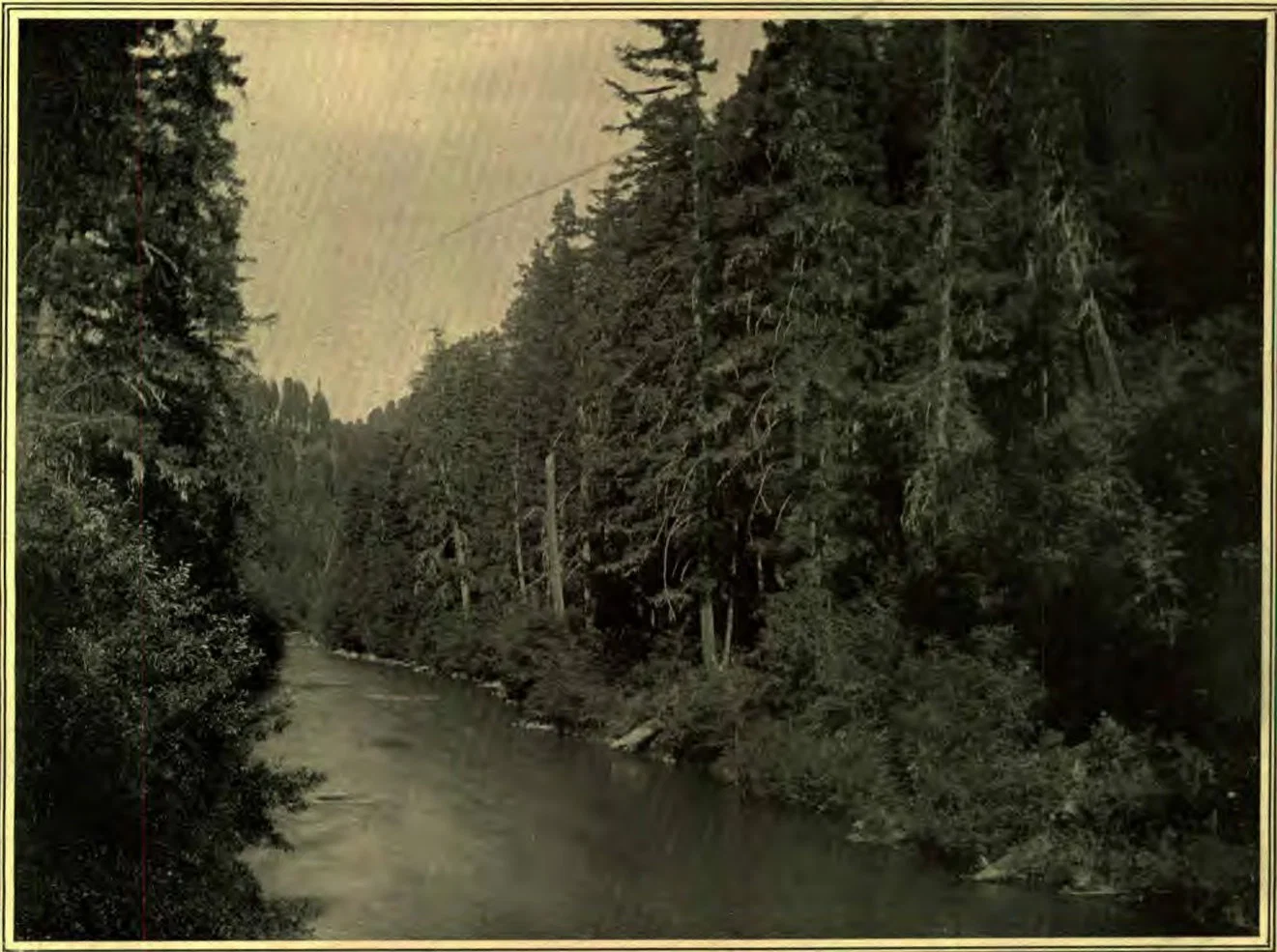
“THE ROGUE RIVER FLOWED SILENTLY AND PEACEFULLY”
There are three routes by which one may go to Crater Lake from the railroad. The shortest and most picturesque is the Rogue River route. Another leads from Ashland, Ore., along what is called “the Dead Indian road,” through a rough and rugged country. This road is often chosen because of its famous hunting and fishing reserves. By the third route one leaves the railroad at Ager, Cal. This is the longest road of the three, but it is the easiest to travel,—though that is not saying much.
By the Rogue River route the traveler leaves Central Point, a little flag-station near Medford, Ore., and for a few miles passes through a fertile farming country. Then the road crosses mile after mile of sandy chaparral desert, until Big Butte Creek is crossed, some thirty-five miles from the starting-point. Here the mountains are entered, and the scenery rapidly becomes picturesque.
For five or six miles the road leads through open forests, then down into a deep cañon, at the bottom of which the Rogue River flows silently and peacefully,—deep enough to float a steamboat, and wide enough for one to turn around in. In this cañon the white pumice dust was so deep that it came up over my shoe-tops, and I had hard work pushing my wheel through it up the long, steep grade to the divide on the other side. From there to Prospect, another ten miles, the road climbs a gentle grade through a forest where madroña, oak, fir, and pine struggle for the ascendancy.
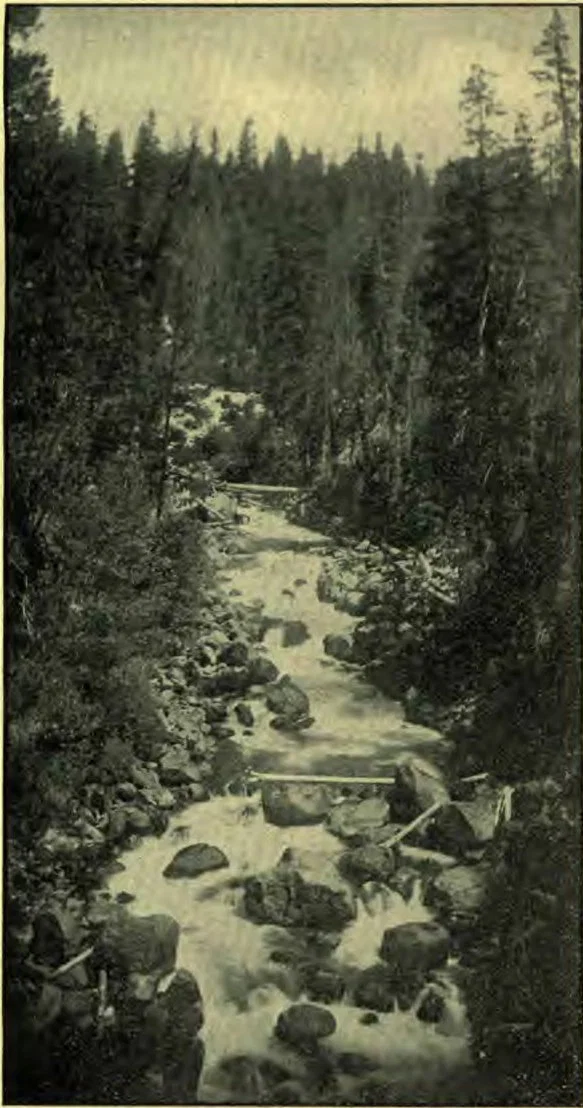
At Prospect the road again crosses the river,—not here a peaceful, sluggish stream, but a succession of foaming rapids and roaring cascades, which carry the water down hundreds of feet in a distance of less than half a mile. These rapids are called the Lower Falls of Rogue River. Just below the rapids, Mill Creek, a fair-sized stream, tumbles over the rocky wall of the cañon in a sheer fall of nearly two hundred feet. A short distance below is still another fall of equal height, but smaller in volume.
Beyond Prospect the road passes through a magnificent forest of sugar pines (Pinus Lambertiana), the most beautiful tree of the pine family. Specimens of this tree often measure ten feet in diameter, and two hundred feet in height. There is little undergrowth in these forests; and where the fires have not swept them clean, the ground is thickly carpeted with fallen needles, and strewn with giant cones, that often measure more than a foot in length.
Another ten miles, and the road passes near the Natural Bridge, where the river rushes under a natural arch of basalt to reappear at several openings a few hundred feet below. A few miles beyond, the road again passes close to the river, which here flows through a deep, narrow gorge, to plunge over an abrupt precipice one hundred and eighty feet high.
Beyond that point the road is steep and sandy. It leads through a forest of young fir-trees that struggle bravely on, though the half-burned remains of their predecessors constantly point to the fate in store for them.
The Rogue River road is the old military road, which in early days connected Jacksonville with Fort Klamath. Just at the foot of the last steep grade leading to the divide, the summit of the Cascade Range, a dim and little-traveled road branches off to the north. Nailed to a tree near by is a weather-beaten sign-board, on which are painted the words, TO CRATER LAKE.
When I visited the lake last summer, I chose the Ager route, and went back to the railroad by the Rogue River. But whether one goes to Crater Lake, or from it, along this road, he will see the same noble forests, the same rushing, plunging waters, the same rugged mountains, that I saw; and he would be well repaid for his journey, even though he never saw Crater Lake.
Ager, Cal., is not a city nor even a village; but it is a stopping-place on the railroad, and a starting-place for those who go by stage or wagon to Klamath, Hot Springs, or Klamath Falls. The distance from Ager to Crater Lake is one hundred and twenty miles; but I chose that route because I had been told that it was the only practical one for a wheelman to travel. That was a bit of misleading information, for there is no road to Crater Lake that is practical for a wheelman. But of three evils, I undoubtedly chose the least.
On my wheel I carried a load that weighed more than half as much as myself, and I found the roads so steep, rocky, and dusty that I was compelled to walk nearly all of the way.
The first ten miles of the road led across a desert, where only sage-brush and scrubby cedar-trees grow. Then I followed up the banks of quite a large creek, past its principal source,—a great spring bursting from a mountain rock,—and soon entered the heavy timber of the Klamath River Valley. The remainder of that day, and half the next, I trudged along the sandy road, seldom more than a stone’s throw from the turbid, rushing river, which seemed to be waging constant and noisy warfare against its rockbound, boulder-strewn channel. Often I would pass a farmhouse standing in a clearing in the narrow valley between the river and the mountains; and sometimes a small irrigating ditch, which carried water from some spring or stream on the mountain-side to an orchard, garden, or hay-field near by.
About noon on the second day I passed Klamath Hot Springs, a well-known summer resort, beyond which the road left the river-bank, and led up the steep mountain-side to the divide above. It was a long, steep climb, and I was four hours in traveling three miles. But when I reached the summit, I was rewarded with a magnificent view of the river cañon at my feet, the valley through which I had come, and the mountains, with a glorious sunset beyond. But it was still five miles to a camping-place, so I did not dare stop long to admire the view.
That five miles of the road was good, and I would have ridden the distance in short order, but an accident had left me with a flat tire, which resisted my best efforts at repair. I walked rapidly, but it soon grew dark in the dense pine forest through which the road led, and I was beginning to think I should have to camp without water, when I came to the cabin near which I had been told I would find a spring.
ROGUE RIVER IN ANOTHER MOOD
I camped that night in the deserted cabin, but it gave me the blues. I never like to see a home, upon which some one has expended thought, care, and patient labor, deserted and going to ruin. I can not help but sympathize with the disappointment some one must have felt when he found that his labor was wasted. Then I think of the bitter disappointments and heart-aches that go to make up this life, and long for the time when there shall be no more sorrow, neither crying nor pain,—the time when “they shall build houses, and inhabit them; and they shall plant vineyards, and eat the fruit of them.”
Early next morning I crossed the line that separates Oregon and California, and at noon I left the pine forest at the little village of Keno, which lies just at the edge of the broad plateau called Klamath Plains. There I crossed the river. It was hard to believe that it was the same stream up whose banks I had been trudging for two days. Below, it was a roaring, tumbling mountain stream; here, I found a river, wide, deep, and sluggish, with rank tule growing along its banks, and half hiding an old scow and small steamboat that lay there idle.
I reached Klamath Falls that night, having walked fifty-six miles in two and one-half days. There I secured another tire for my wheel, and next day I rode, and walked, forty-five miles farther,—through another stretch of pine forest; along the shore of the beautiful Klamath Lake; and across the scorched plains of the Indian reservation to old Fort Klamath, where many substantial buildings, that cost the people of the United States much good coin, have been slowly going to ruin since 1890, when the fort was abandoned.
I did very little riding next day. Mile after mile I waded through the deep sand along the brink of the wild, romantic Anna Creek cañon. I could hear, and sometimes see, the water at the bottom; but it was impossible to reach it, and I nearly famished for want of a drink before I reached the head of the cañon, near the summit of the range, where the water of Anna Creek flows from a mammoth spring.
From there to the summit was only a short, though very steep, climb; and just at dark I came to the road that branches off for Crater Lake. I was too tired to climb Mount Mazama that night, so I camped by the roadside, having been four and one-half days in traversing the one hundred and seventeen miles that lay between me and my starting-point.
J. EDGAR ROSS.

The Making of a Stenographer

Nothing, perhaps, is more true than that stenographers are born, not made. A course taken at a business college to learn shorthand and typewriting does not always result in producing a competent stenographer. Without doubt such a series of lessons is of great value, and is highly to be recommended; but it must be borne in mind that unless a boy or a girl has a certain natural aptitude for the work of a stenographer, all the business colleges in the world can never impart such an aptitude.
The first thing to be settled, if one meditates adopting the career of a stenographer, is whether he possesses the essential qualifications in this direction. One of the most essential qualifications is the ability to hear accurately. The mere ability to understand what a person says, without asking for a remark to be repeated, is perhaps possessed by practically all except deaf persons; but it is of the highest advantage to be able to understand what a speaker says, even if he does not enunciate his words in the clearest tones. Moderate intelligence will usually enable a stenographer to perceive what the speaker says, although he speaks indistinctly. Here is shown the inestimable value of a fairly comprehensive vocabulary. And such a vocabulary can be obtained only by a wide range of reading, and the free use of a reliable dictionary. The reader of this article who intends or hopes to become a successful and well-paid stenographer, will never have cause to regret the time spent in acquiring a large number of words and their meanings. The would-be stenographer, then, should be well-read.
Even in such prosaic work as typewriting there is great scope for artistic work. What a contrast there is between a page of typewriting that is carefully and sensibly paragraphed, in which few or no words are divided at the end of the lines, and one which shows on its face the marks of a careless operator. Spacing between words, lines, and paragraphs is also worthy of attention, and a little thought on the part of the operator will well repay his efforts. Then the stenographer should cultivate the artistic side of his nature, so as to turn out attractive work.
While every occupation in life demands accuracy, how much more indispensable is this requirement in the shorthand world. As in writing shorthand characters the least deviation from symmetry of form, correct slope and thickness, and the size of the outline, may cause the copyist to be perplexed as to what was intended to be traced upon the paper, it is of paramount importance to be scrupulously accurate. Slipshod work in shorthand inevitably brings its own penalty—that of being unable to translate one’s notes.
At the very outset of the study of shorthand, particular care should be paid to exactness in forming outlines, because the habit of nicety in form and certainty of tracing will be of inestimable value later on. Lack of pains in this direction during the early stages of the student’s labors, will lead to severe “pains” in the writer’s mind when he finds at some critical moment that he can not read his notes, and has to incur the mortification of turning out absurd work or being obliged to confess incompetency. Scarcely anything can be more humiliating to a stenographer, beginner or veteran, than to have to admit that his work is so badly done that it can not be deciphered.
The stenographer who expects to reach the top rounds of the shorthand ladder, will have to exert all his energy to write his shorthand at a high rate of speed, and yet be able to translate his notes with freedom and without the loss of time. Much hard work and patience may be necessary in acquiring this very desirable skill, but conscientious effort is sure to meet with good results, provided the foundation has been well laid.
A word may be said with reference to stenographers who are able to read their notes only within a few hours after taking them. Is it not apparent that such shorthand writers do not in reality read their notes at all? They may have good memories, or may guess at a good deal of what was in their note-books, but it is very doubtful if they can interpret the signs on their pages. It may be said without fear of contradiction that the stenographer who can not translate his notes as easily five years after taking them as five days, does not possess the ability to do responsible work. Let no such man be trusted. The crowning triumph of every shorthand writer is the ability to translate his notes instantly, no matter how rapidly they were written.
There can be little doubt that a large proportion of the young men and women who call themselves stenographers are not as competent as they might reasonably be expected to be. The stenographer who, in taking an ordinary letter from an employer, has to write from ten to thirty words in longhand, is hardly worthy of the name stenographer. Such a display of incompetency should make any so-called stenographer ashamed of himself, yet how frequently does it happen that the average graduate from a shorthand school does not know enough of the system to be able to construct the outline of a new word, however simple in its elements. There is an urgent demand for competent stenographers all over this country. True, the land is flooded with persons who know a little shorthand, but not every boy or girl who has paid a hundred dollars to go to a shorthand school can be trusted to turn out a decent letter, spelled and punctuated in a creditable way.
A word now as to some rudimentary qualifications, which are so commonplace as scarcely to be mentioned, yet whose very commonness, perhaps, causes them to be generally overlooked or passed by with contempt. Not one in a hundred stenographers knows how to punctuate a piece of prose properly. The same number can be trusted to spell all the words likely to occur in the average newspaper leading article. The days of the week and the months are seldom spelled correctly. Grammar, too, is worthy of a little study—if not more. The stenographer who talks to friends in such terms as, “I seen him,” or, “We was over there yesterday,” should not disgrace the calling by remaining in it, even at five dollars a week.
“There is always room at the top,” says the proverb. That this is pre-eminently true of the shorthand profession is evident. If stenographers would become so thoroughly competent, so genuinely capable, as to be really worth a good salary, the days of underpaid and starving shorthand scribes and typewriter operators would be at an end.
H. W. R.

AT A TENEMENT WINDOW

Sometimes my needle stops with half-drawn thread (Not often though,—each moment’s waste means bread, And missing stitches leave the little mouths unfed). I look down on the dingy court below: A tuft of grass is all it has to show, A broken pump, where thirsty children go. Above, there shines a bit of sky so small That it might be a passing bluebird’s wing. One tree leans up against the high brick wall, And there the sparrows twitter of the spring, Until they waken in my heart a cry Of hunger, that no bread can satisfy.
Always before, when Maytime took her way Across the fields, I followed close. To-day I can but dream of all her bright array. My work drops down. Across the sill I lean, And long, with bitter longing, for unseen, Rain-freshened paths, where budding woods grow green.
The water trickles from the pump below Upon the stones. With eyes half shut, I hear It falling in a pool where rushes grow, And feel a cooling presence drawing near. And now the sparrows chirp again. No, hark!— A singing as of some far meadow-lark.
It is the same old miracle applied Unto myself, that on the mountain-side The few small loaves and fishes multiplied. Behold how strange and sweet the mystery! The birds, the broken pump, the gnarled tree, Have brought the fullness of the spring to me; For in the leaves that rustle by the wall All forest finds a tongue, and so that grass Can, with its struggling tuft of green, recall Wide, bloom-filled meadows where the cattle pass. How it can be but dimly I divine, These crumbs, God-given, make the whole loaf mine.
—Mrs. Annie Fellows Johnston.

The Father's Tender Care for His Children

No language is too strong or intensive to express the greatness and tenderness of the Father's affection for his children. He is the fountain of life, and light, and joy to all his intelligent creatures. By day and by night he cares for us; from the cradle to the grave, he watches over us, and suffers no real evil to come nigh to us. Our sorrows and trials are not evil, but ministers of good to us, though for a little they walk with us in disguise. All that we suffer is ordered in a love whose tenderness is equaled only by its wisdom. —Thomas B. Thayer, D. D.

THE COCKLE IN THE WHEAT.

The weary winter wore away, With wind and snow and sleet; A cockleseed unnoticed lay Among the golden wheat.
Spring shook her soft green skirts abroad, About her dancing feet; With lavish hand upon the clod The farmer cast his wheat.
Down came the rain, the sun, the dew, The budding earth to greet. Up grew the tender blade; up grew The cockle with the wheat.
The cockle flung her blossoms wide, The summer wind was sweet; The flaunting blooms the farmer spied, And plucked them from the wheat.
The cockle withered lay and brown, Beneath the reapers’ feet; But ere the autumn rain came down, Safe garnered was the wheat.
ELIZABETH ROSSER.

THUNDER

As long ago as 1750 it was ascertained that the phenomena of thunder-storms were due to electrical charges and discharges, but as to the actual source of atmospheric electricity, nothing absolutely certain has as yet been discovered. This may be because of the fact that any discovery must necessarily be through experiments made on a larger scale than individuals can engage in, and such as no nation has, so far, been willing to undertake.
Previously to 1750, Benjamin Franklin demonstrated that all the phenomena of electricity had their counterpart in lightning. In 1752 he made a kite, covering the sticks with a silk handkerchief, so that as he raised it into a cloud, the moisture would not destroy it; and on the first suitable occasion when a thunder-storm was threatening, sent it up into the storm. At the top of the upright stick he inserted a nail, and a short distance from his hand tied a large iron key to the string, using a silk ribbon from the key to his hand as a non-conductor, taking the further precaution to stand in a doorway, in order to keep the silk dry. After a cloud had passed over his kite without visible effect, Dr. Franklin at first supposed the experiment to be a failure; but noticing that the fiber of the string was standing out from the body of the cord, he touched the key, and an answering spark was given off. Afterward, when the twine had become thoroughly saturated with moisture by the rain, a Leyden jar was quickly charged, and other electrical phenomena were produced.
Having succeeded in drawing electricity from the clouds, Dr. Franklin conceived the idea of protecting buildings from lightning by erecting rods at their highest points with their bases in the earth, thus preventing a pathway over which the bolts would pass safely, and escape through the moisture in the soil. This was the origin of the lightning-rod.
It is the commonly accepted idea that thunder is produced by explosions of electricity, which, it is said, occur at every angle and point the flash may have and make in its passage. If a person happens to be stationed at one end of the passing line of electricity, each report will come to his ear as would the successive discharges of muskets in the hands of a line of soldiers, each discharge being fainter than the preceding, making a prolonged roll of sound. If, however, the beginning and ending points of the phenomena encircled the person, as a half-circle, all the explosions would reach the ear at the same instant, and with equal force, combining as a loud peal of thunder. But if he stood at a central point of a straight line of lightning, the separate reports of the two wings would reach him simultaneously, and become a loud crash.
W. S. CHAPMAN.

The Grasses Are Clothed and the Ravens Fed

“THE grasses are clothed, And the ravens are fed From His store; But you, who are loved, And guarded, and led, How much more Will he clothe you, and feed you, and give you his care! Then leave it with him; he has, everywhere, Ample store.”

SMELL AND BEAUTY OF WOODS

One may pass a lifetime and never notice that pungent odor of green forest lumber, fresh sawn from the log. It is easiest to acquire this experience by visiting a house in building; but there the lumber is already dry, or should be, and its smell, though fresh and good, is faint, and but the ghost of the stalwart and resolute aroma of the newly cut tree.
In the clearing, or better, at the sawmill in the woods, the freshly cut or newly stacked pile of boards, discloses its essential life-character in generous, satisfying whiffs. People in want of an appetite will ever find it here, in the smell of the green timber, though it may vary medicinally as much as in tone or character. But in variation resides much of its delight, and the variation is as wide as the list.
Pine has its well-known aromatic, resinous smell; but oak, and especially white and black or Spanish oak, has, as I remember, with its searching fragrance, a sour, almost acrid, but new and fresh aroma, peculiar to its kind. Cherry has a pleasant, individual odor, with a bitter tang, which one also tastes on the seed of the black-heart and wild cherry. One can also notice it in rubbing smoothly the varnished surface of the gum which exudes from the worm-hole or sun-crack in the tree in the yard, and hardens there. The walnuts, black and white, have a rare and positive odor, and are woods of choice spirit. The hickories have a suggestion of the nut hull. Birch and sassafras and spice-wood have each its own fragrance, residing largely in bark and leaf and root.
No art can describe the elusive richness of the wood odors of all sorts, and the love of them grows with the use, until the sense of smell becomes one of the used senses, and lies no longer dormant and employed for dinners merely, but advances to the rank of sight as a caterer to the wants of the spirit. It is a great mistake for grown people to turn over the woodland and the wood-smells to children, who range and enjoy them with unthinking delight. I sometimes think that, as to the sweetest uses of the sense, many a man and woman dies without having fully lived.
— Friend's Intelligencer.

A PRINCE’S PLAYTHING

The emperor of Germany has a toy that would gladden the heart of the most exacting boy. It is a miniature frigate, a full-rigged, three-masted war-ship, fifty-five feet in length, drawing but four feet of water, and having a capacity of thirty tons. The ship is an heirloom in the imperial family of Germany, having been presented by William IV, king of England, to the present German emperor’s great-grandfather, Frederick William III. It gave the reigning monarch his first taste of life on the wave; and in his boyhood days one of his favorite amusements was to sail on the watery Potsdam, in company with his brother, Henry, in this tiny man-of-war. At a distance the ship’s dimensions are very deceptive; but a man at the rail, or a boat moving alongside, soon brings out, by contrast, the smallness of the craft. The frigate can be sailed in the same manner as the largest ship, but the crew must be Lilliputians in size and scanty in number. A seaman of ordinary build would be totally out of place on the yards of this vessel. He would probably be in grave danger, of bringing the spars down to the deck with his own weight. “Royal Louise” is the name of the kingly toy. She was christened after Prussian Queen Louise. The little frigate was built on the Thames River, at Woolwich, England, in 1832, and was towed down the river and across the North Sea by a steamer to Hamburg. From this place a flat barge floated her up the Elbe and into the Havel at Potsdam, where she still remains.—Woman’s Home Companion.

Love for Neighbors Before Distant Nations

“If you love not your brother whom you have seen, how can you love your brother whom you have not seen? If you want to get Christians to work for nations on the other side of the world, set them to work for the families in their back alleys.”

SOWING AND REAPING

“Be not deceived; God is not mocked: for whatsoever a man soweth, that shall he also reap. For he that soweth to his flesh shall of the flesh reap corruption; but he that soweth to the Spirit shall of the Spirit reap life everlasting.”
The choice we make in this life will be our choice through all eternity. We shall receive either eternal life or eternal death. There is no middle ground, no second probation. God calls upon us to overcome as Christ overcame, that we may sit down with the Saviour in his throne. He has provided us with abundant opportunities and privileges, making it possible for us to overcome. But in order to do this, there must be in our lives no petting of self. All selfishness must be cut out by the roots.
When a man accepts Christ, he promises to represent him in this world. To him the words are spoken, “Ye are God’s husbandry, ye are God’s building.” “Work out your own salvation with fear and trembling. For it is God which worketh in you both to will and to do of his good pleasure.” Those engaged in the work of character-building should educate themselves to acknowledge the workmanship of God. Have faith that you can use every intrusted capability to God’s glory. He has not given us talents to hide away in a napkin. We are to impart as we receive. Thus we are sowing seed which will bring forth a harvest of joy.
When God gives many talents to one person, it is not that he shall exalt himself, as if he had not received these talents from God. He who depends on his own merits, placing great confidence in his knowledge and judgment, is not accepted by God. Only the faith that works by love and purifies the soul is acceptable to him. No amount of profession can take the place of honesty and fidelity.
Fraud in any line is a grievous sin in God’s sight; for the goods we are handling belong to him; and if we would be pure and clean in his sight, we must use them to the glory of his name. The religion that carries in its hand the scant measure and the deceitful balance is an abomination in the sight of God. He who cherishes such a religion will be brought to confusion; for God is a jealous God.
God’s law is the standard of character. To it we are required to conform, and by it we shall be judged in the last great day. In that day men will be dealt with according to the light they have received. The number of talents intrusted will determine the returns expected. The sinner’s guilt will be measured by the opportunities and privileges which he failed to improve. He will not be punished merely for his own rejection of the offer of salvation. He will be called to account for the influence he has exerted in encouraging others in sin. He was given ability to use for the Lord. He was given opportunity to co-operate with the Redeemer. Had he been true and faithful, he would not only have won eternal life for himself, but would have drawn others to the kingdom.
Those who reject Christ place themselves on the side of the great apostate. Those who do not accept the offer of salvation show open contempt for the Saviour, and their conduct makes others more bold and defiant. The punishment of the sinner will be measured by the extent to which he has influenced others in impenitence. He refused to wear the yoke of restraint and obedience, to surrender all to God, and thus he placed himself on the side of the enemy of Christ. His refusal to wear the yoke of Christ himself, kept others from seeing their wrong.
MRS. E. G. WHITE.

A VISIT TO THE SMELTER

BEING curious to learn something of the process of separating gold, silver, and the various precious metals from the solid rock in which they are hidden, and in which they seem to the inexperienced eye to be hopelessly buried, I lately visited a smelter.
The great chimneys were belching out clouds of smoke, and various pipes from whose noisy throats vast volumes of hissing steam and pungent vapors clamored to escape, bore witness to the activity of the workmen and the wondrous mechanism of the machinery within the huge building.
Having obtained a pass from the courteous foreman, we first visited the room where the assays are made,—that is, skillful workmen here determine the exact amount and value of the different metals in a given amount of rock,—in other words, this is the room where the rock is analyzed.
From here we passed on to a room in which are huge, oven-like structures, in which the precious rock is placed to be baked. As you may be sure, the fire required for baking rock is much hotter than that which your mothers build for baking bread and cake.
We next found ourselves in a long apartment so filled with suffocating gases that we were glad enough to hasten through where we could again get a breath of pure mountain air. This room was filled with workmen, as well as all the other rooms, but the poor fellows appeared to be having a hard tussle with the poisonous fumes, the weaker-lunged among them having sponges and handkerchiefs bound about their noses.
I will not undertake to describe all the strange sights and sounds we heard and saw in this truly wonderful place, but I must not fail to speak of the huge furnace which supplied heat enough to melt the hardest rock.
Into a large vat below the furnace a bright-red stream was constantly pouring. This was the precious metal, mixed with the rock. As this stream falls into the vat, the valuable metal sinks to the bottom, and is drained off into a large trough through an opening in the side of the vat. Sometimes this opening gets clogged up, and the metal can not flow out. The workman then inserts an iron spike, and pounds it with a heavy hammer until he has forced a passage from the molten mass, which, as soon as the pike is withdrawn, hurries out, like a fiery serpent, into the trough. When this trough is full, a plug of clay is inserted, to fill the cavity until another trough is made ready.
The precious metal, being heavier than the rock, sinks to the bottom, while the rock arises to the top of the vat, and passes off through a spout into a great kettle standing to receive it. This kettle is then drawn away, having been replaced by another, and the contents poured down a high inclined bank — a crimson, fiery, molten mass. Woe to the small boy, dog, horse, or other living animal who should cross the track of the fiery meteor as it goes hissing and sparkling to the bottom.
The mountain roadway winds along to the very foot of this incline, and timid horses are often badly frightened if they happen to be passing with their riders at the time when one of these burning rockets goes bounding and tearing down the hill.
As I saw this, to me, wonderful sight — rivers of molten rock — I could not help thinking of that day which we are so rapidly nearing, when the very elements shall melt with fervent heat, and the mighty rocks and the towering, snow-capped hills shall melt, before the consuming fire which comes from the presence of the everlasting God. What must be the paralyzing terror of those who, in that fearful moment, shall call to the shaking, trembling, fiery masses of rocks above them, “Fall on us, and hide us from the face of him that sitteth on the throne!”
How important — indeed, more vastly important than anything else — is the work of preparing for that great day, that we may not fear, but rejoice as we cry, “Lo, this is our God!”
MRS. L. D. AVERY-STUTTLE.

Thou Hast the Words of Endless Life

Thou hast the words of endless life; Thou givest victory in the strife; Thou only art the changeless Friend, On whom for aye we may depend; In life, in death, alike we flee, O Saviour of the world! to thee. — Frances Ridley Havergal.

HOW TO LOSE FRIENDS

The Bible has furnished us a divine recipe for making friends in the statement, “He that hath friends must show himself friendly.” It has also given us the recipe for losing them after we have once gained them. “A whisper separateth confident friends.” Prov. 16:28, Jewish translation. It takes dynamite to blow up a mine, but an insinuating whisper has in it the power to separate persons who have been lifelong, confidential friends. The stirring up of strife and suspicion between intimate friends, particularly when they are bound together in work for God, originates nowhere but in the councils of Satan.
Occasionally a worker for God, who has spent nearly all his life in painstaking effort to help humanity, will, under some peculiar circumstances, drop an indiscreet word, and then those who should have been his true friends take the attitude pointed out in the scripture, “All that watch for iniquity are cut off: that make a man an offender for a word.” Isa. 29:20, 21. Frequently such a man learns by sad experience the reality of Zech. 13:6: “One shall say unto him, What are these wounds in thine hands? Then he shall answer, Those with which I was wounded in the house of my friends.”
Frequently roommates, whom Providential circumstances have brought together, allow the enemy to come in on account of some trifling, unpleasant incident, and the grand work that God intended they should accomplish as a result of their being brought together, is absolutely spoiled. Human society at best is unstable, and therefore it behooves us to study as never before how to make friends, and also to learn how to avoid losing those whom God has sent to us.
DAVID PAULSON, M. D.

TELL ME ABOUT THE MASTER

Tell me about the Master, I am weary and worn to-night; The day lies behind me in shadow, And only the evening is light— Light with a radiant glory, That lingers about the west; But my heart is aweary, aweary, And I long like a child for rest.
Tell me about the Master— Of the hills he in loneliness trod, When the tears and the blood of his anguish Dropped down on Judea’s sod; For to me life’s weary milestones But a sorrowful journey mark; Rough lies the hill country behind me, The mountains before me are dark.
Tell me about the Master— Of the wrongs he freely forgave, Of his mercy and tender compassion, Of his love that was mighty to save; For my heart is aweary, aweary, Of the woes and temptations of life, Of the error that stalks in the noonday, Of falsehood and malice and strife.
Yet I know that whatever of sorrow, Or pain, or temptation befall, The infinite Master has suffered, And knoweth and pitieth all; So tell me the sweet, old story, That falls on each wound like a balm, And the heart that was bruised and broken Grows patient and strong and calm.
— The Advance.
Continue reading: GOOD NIGHT