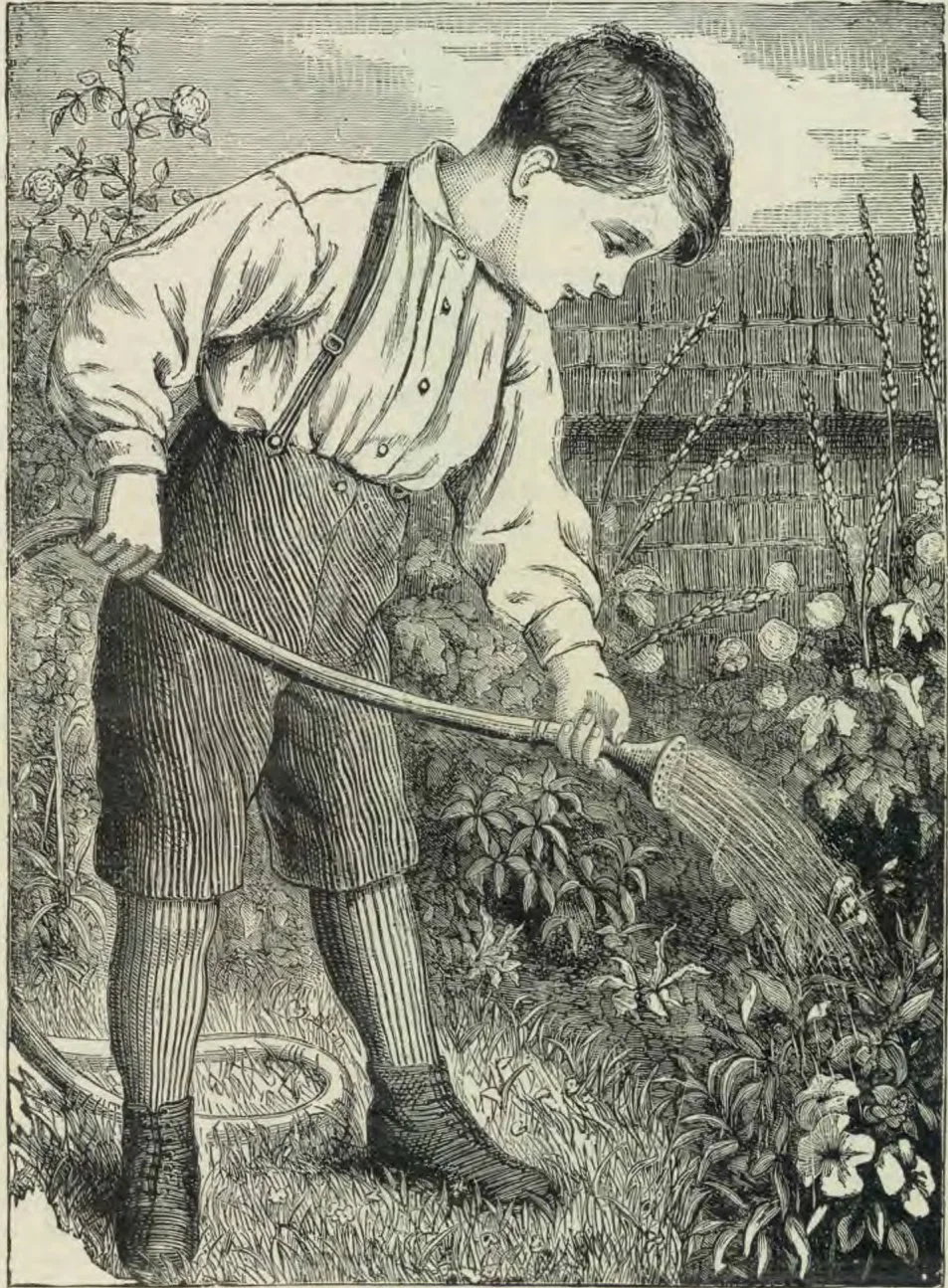
A TIDY boy, and a thrifty garden! The picture represents an orderly boy, from head to foot. His garments, neatly arranged, have no missing buttons, and are held in place by their proper fastenings. His shoes are nicely laced, his hair neatly brushed, and in appearance he is ready to be introduced in almost any society.
James, as we will call the lad, has just returned from school. Having been faithful there, he is happy here, and enters upon his home duties with the same energy and cheerfulness that he engaged in his studies. Would you know what class of work he is in the habit of doing, a glance at his person, and a peep into his flower garden will tell you that he is no shirk. “Thoroughness” is his watchword, and his motto, “Whatever is worth doing at all, is worth doing well.”
This is the class of boys that make the world's best men; and it is such that are needed to-day. It is upon such that you can depend, and upon their learning too; for they are not contented with a little smattering of this and of that study. Instead, they go to the very root of the matter, and so know what they claim to know. True, it takes time and hard work to become men of usefulness and ability, but while your time is thus employed, you are shielded against the temptations that beset the idler.
But some boy will say, “All cannot have clothes to appear as well as James; and many have work to do that soils the garments and smuts the face and hands. Neither can all have the advantages of school,” etc.
The boy in the picture is not the son of rich parents. He has to help father do many disagreeable jobs; but he never neglects duty for fear of soiling his clothes. He has his working dress, and by careful habits he avoids much of the smut with which most boys cover themselves. When the dirty work is done, he takes a bath, and exchanges the soiled garments for cleanly ones. One does not need costly garments to make a good appearance; but all may have what is necessary,—clothes clean and whole.
There are but few instances in these days where one cannot have the benefit of school privileges. Generally, it is not because one has no chance to become learned and good and useful that he is of so little worth to the world; but it is because he does not wake up to the importance of knowing and being something. He does not know what talent is sleeping within his breast until he can be aroused from his listless dreaming.
Where there is a will, boys, there is a way. You may possess noble characters, and may exert an influence for good that will result in a harvest of souls when the sheaves are garnered. Educate yourselves to live noble lives, filled with good deeds, and thus secure a crown of life which shall endure when all else has perished. To begin with, make this boy's motto yours, “Whatever is worth doing at all, is worth doing well,” and then be thoroughly thorough in every undertaking. M. J. C.
KILLING THE DRAGON.
A LITTLE boy about four years old was much impressed by the story of “St. George and the Dragon,” which his mother had been reading to him and his sister, and the next day he said to his father:—
“Father, I want to be a saint.”
“Very well, John,” said his father; “you may be a saint if you choose, but you will find it very hard work.”
“I don’t mind,” replied John. “I want to be a saint and fight a dragon. I am sure I could kill one!”
“So you shall, my boy.”
“But when can I be one?” persisted the child.
“You can begin to-day,” said his father.
“But where is the dragon?”
“I will tell you when he comes out.”
So the boy ran off contentedly to play with his sister.
In the course of the day some presents came for the two children. John’s was a book, and his sister Catharine’s a beautiful doll. Now John was too young to care for a book, but he dearly loved dolls, and when he found that his sister had what he thought a much nicer present than his own, he threw himself on the floor in a passion of tears.
His father, who happened to be there, said quietly:—
“Now, John, the dragon is out.”
The child stopped crying and looked quickly around the room, and then up at his father’s face, but said nothing.
That evening, however, when he bade his father “good-night,” he whispered: “Papa, I’m very glad Catharine has the doll. I did kill the dragon!”—Michigan Churchman.
LITTLE HELPERS.
“I WILL be a little helper,” Lisps the brook. On its silvery way it goes, Never stopping for repose, Till it turns the busy mill, In some nook.
“I will be a little helper,” Smiles the flower. By the wayside, in the field, All its beauty is revealed, Unto sad and weary hearts Though skies lower.
“I will be a little helper,” Sings the bird. And it carols forth a song, Though the cheerless day be long, Bringing to some helpless one Some sweet word.
You can be a little helper, Child so fair! And your kindly deeds can make, For the Heavenly Father's sake, Sunshine, love, and happiness Everywhere!