The Youth’s Instructor, Vol. 36, No. 26.

ONE STITCH AT A TIME

The Youth’s Instructor

Jun 27, 1888

S. D. A. Publishing Association · Battle Creek, Mich. · Jun 27, 1888

ONE STITCH AT A TIME.

“WHAT is the secret by which you do your work so beautifully?” The questioner held in her hand an exquisite piece of crochet work, wrought by the lady to whom the question was addressed.
“There is no secret about it,” replied the lady; “I only make every stitch as perfect as I can, and am careful to put it in exactly the right place. There isn’t one wrong or careless stitch in all that work. If I make a mistake, I ravel it out and correct it.”
One perfect stitch at a time! So the marvelous fabrics of lace at fabulous prices are made. So the intricate and exquisite embroideries are wrought. So the costly garments of men and women are put together. One perfect stitch at a time.
The noblest lives are lived—one moment at a time. No moments wasted; no moments carelessly spent; no moments viciously spent. Wrong stitches in crochet can be raveled out and made right. Wrong stitches in garments can be picked out and put in again right. But who can reverse the tide of time, and undo a wrong act, and make it right?
Some unknown friend left a card on our desk on which was printed this: “I shall pass through this world but once! Any good thing, therefore, that I can do, or any kindness that I can show to any human being, let me do it, now, in His name, and for His sake! Let me not defer or neglect it, for I shall not pass this way again.”
Is there a better secret than that for making the whole fabric of life perfect? “Any good thing that I can do”—that covers all our duty to God and to ourselves. “Any kindness that I can show to any human being”—that covers all our duty to our neighbor. Love to God and to our neighbor is the fulfilling of the law.
One stitch at a time! Sometimes we allow ourselves to become confused with the thought or feeling that we have a dozen things to do at once. But that is a mistake. We can do but one thing at a time, think one thing at a time, speak one word at a time, see one thing at a time. For every duty really required of us, we have time given to do it in. We may pass rapidly from one task to another, we may construct enginery by which much of our work may be done simultaneously, and we thus multiply our executive power; but to live two minutes at once no mortal can do, any more than we can recall one act or one moment of the past.
“Let us then be up and doing, Heart within and God o’erhead.” —Sel.

THE VALUE OF PRAYER.

EVERYBODY has more or less trouble in this world. True, some do not have so much as others, yet it is nevertheless trouble whenever and to whomsoever it comes. But all do not escape trials as easily as some who seem to us to be highly favored,—those persons of a more cheerful disposition, upon whom trouble apparently sits lightly. There must be some secret about this that the more unfortunate ones ought to know, so that they, too, may pass more smoothly through the world.
There is a way by which this may be done by all. The Psalmist says: “The righteous cry, and the Lord heareth, and delivereth them out of all their troubles.” Ps. 34:17. This is indeed a wonderful recipe, and a precious promise as well. And best of all, it is within the reach of every one, even the very poorest and most despised in the world. But the one to whom the promise is realized must cry to Him who is able to save to the uttermost all who call upon him. He must also cry to him in faith, from a humble heart. When this is done, be the suppliant high or low, rich or poor, free or bond, the Lord will regard his petition.
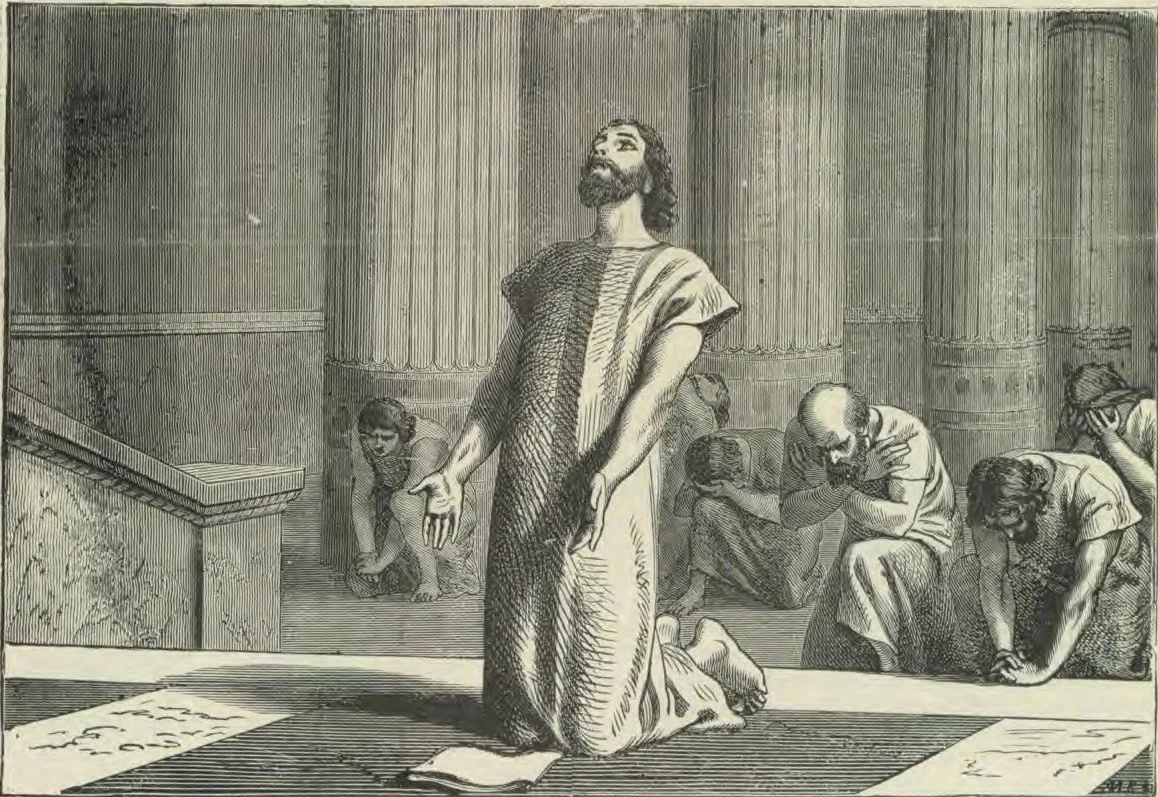
The accompanying picture presents one who fulfilled these conditions, and was not only himself brought out of trouble, but relief came to a whole nation as the consequence. A little more than 700 years before Christ, King Hezekiah ruled over the Jewish nation in Jerusalem. About 500 miles north-east from there, at Nineveh, reigned Sennacherib, the king of Assyria, who had succeeded in conquering most of the kingdoms around Assyria, including Babylon, a country south of Assyria. He then went to Egypt and conquered a portion of that, putting over it an Assyrian king. But in time the Ekronites revolted, and placed their Assyrian king in the hands of Hezekiah for safe keeping. This made Sennacherib angry, and “in the fourteenth year of Hezekiah did Sennacherib king of Assyria come up against all the fenced cities of Judah, and took them.” 2 Kings 18:13. When Hezekiah found that most all of his kingdom was taken, he sent to his enemy at Lachish, begging pardon for what he had done, and gave to the Assyrian king all the silver in the Lord’s treasury, and besides cut off from the doors and pillars of the temple all the gold with which they were overlaid, and sent that also to the king of Assyria.
This much the Bible tells; but the king of Assyria left a record that tells more. He says of the expedition that he “took forty-six strong fenced cities” and of smaller towns “a countless number.” Hezekiah was also compelled to give up the king he held as prisoner, and a portion of his own kingdom was attached to the territories of neighboring kings.
After thus weakening the kingdom of Judah, Sennacherib returned to Nineveh; and two years later Hezekiah formed an alliance with the Egyptian king, and threw off the yoke of Assyria. At this, Sennacherib went toward Egypt and subdued again Libnah and Lachish. From the latter place he sent Rabshakeh (the meaning of the word is “chief cup-bearer”), and Rabsaris (chief eunuch) with Tartan (general) to Jerusalem, to summon that city to surrender. In their appeal to the Jewish people to submit again to the authority of their master, these men talked very insultingly, and laughed at the simplicity and folly of Judah’s trusting in Egypt for help, or even in the name of the Lord.
But Hezekiah was not to be so easily intimidated this time, and the Assyrian ambassadors returned to tell Sennacherib of their ill-success. They found him then warring against Libnah, having probably by that time taken Lachish. Upon hearing the report of his ambassadors, the king determined to try once more to subdue the obstinacy of Hezekiah. He accordingly wrote a letter to the Jewish king, in which he reminded him of the fate of all other kings who had resisted Assyrian arms, and urged him to submit without further delay.
It was this letter that Hezekiah took into the temple, and spread out before the Lord, while he and some of his associates bowed to call upon God. In the prayer offered, the king appeals for the Lord to hear all the words of defiance that Sennacherib has spoken against the honor of God; and also how that king has laid waste the nations all around. He then says: “O Lord our God, save us from his hand, that all the kingdoms of the earth may know that thou art the Lord, even thou only.” Isa. 37:20.
The result of that humble prayer was that God sent out among the Assyrian host that night, an angel who destroyed 185,000 of their mighty men of war. Sennacherib was obliged to retreat to Nineveh without overthrowing the king of Judah, and he never returned to renew the conflict. So strong is God in behalf of those who call upon him in sincerity and truth.
We do not always appreciate the power and willingness of God to help. But he is the same God now that he was in the days of Hezekiah, and is just as willing to send help to the needy. Those who trust him will not do so in vain; but will be able to say, with another, that he is “a very present help in trouble.”
J. O. CORLISS.

SO NEAR TO THEE.

“THE Lord is nigh unto all them that call upon him, to all that call upon him in truth.” Ps. 145:18.
So near to thee, dear Saviour, I would be, That rays of holy light might fall on me; So very near, so guided by thy word, My life would be a pattern of my Lord.
So near to thee! Above the sins of earth,— Those transient joys at best of little worth,— Upon a plane of holiness and love, Pressing straight forward to the land above.
So near to thee! So sheltered by thy grace, To find in thee a perfect hiding-place; So sheltered by thy wing from storm and tide, A cleft secure in Jesus’ riven side.
So near to thee! O Christ, I too would find In thee my all; my powers all resigned, Nay, consecrated wholly, Lord, to thee, For present time, and for eternity.
So near to thee! Uplifted be my hands, My heart. While in this stranger land, Thy Spirit’s guiding power, O Christ, I crave; For thou alone hast power to bless and save.
So near to thee! Help me, O Christ, like thee Ever unselfish in my life to be; Devoted to the work which thou hast given, Till safe at last at home with thee in heaven.
J. M. HOPKINS.

HEROISM IN DAILY LIFE.

“He is such a plain, honest, unobtrusive young man that you would not think he had a grain of heroism in his composition; but he is a real hero, for all that,” remarked one young man of a friend.
“A few years ago,” he continued, “his father, who was a first-class mechanic, and could earn his three dollars a day, took to drink, and in a comparatively short time the family was reduced to utter poverty. Then John learned shorthand, and undertook the support of the family. One after another, the children married, and left home, but John staid by; and as his income increased, he made his parents still more comfortable, and began to improve himself in various ways. He stands by his mother, and has made for her and for his father, who is now an invalid, a pleasant, cozy home. And in a great many respects he really surpasses his brothers and sisters, who, all these years, have been doing only for themselves. His filial piety has been its own reward.
“Tim Sloan is another I remember. We attended the preparatory school together, and I used to help him get his arithmetic lessons. He was a man of twenty-seven years, with the mental development of a boy of twelve. When he was at the latter age, his father, from some injury, became insane, and though he had lucid intervals, his paroxysms of insanity came on without warning, and he became at once violent and unmanageable. He refused to stay in an asylum, and his family at length gave up trying to keep him there. Tim became so worn by the care of his father that he had a paralytic stroke, and when I knew him, he could with difficulty use his right hand in writing and ciphering. After many years, the father seemed to recover entirely, and Tim started for school. It was very hard work; for his mind seemed to have stiffened into habits opposed to study; but he was diligent and painstaking, and really progressed quite well. He had been at school about six weeks, when he received a peremptory call home. His father had another attack, and no one could manage him but Tim. He did not return to school during my stay there, and I lost sight of him. But his steady self-denial and burden-bearing during those long years from boyhood to manhood impressed me as no narration of deeds of heroism on the battle-field has ever done. I think Tim has earned a place among the angels who stand nearest the throne.”
This narration from my young friend called to mind a girl whose mother died when she was only ten years old, leaving her to assume the care of four younger children. She had been her mother’s household assistant almost from her earliest years, and was by nature and training a care-taker, so she knew what was necessary to be done, and did it as well as a child could. When she was woman-grown, and the younger children were able to spare her, she attended a writing school, so she could have some means of support. While studying as best she could, and trying to make up her lack of early school training, she had taken care that her brothers and sisters should have the benefit of such educational advantages as her neighborhood afforded, she herself staying at home to do the housework and cooking for the laborers on her father’s farm. When she had become a skilled penman, she obtained a situation as teacher of this branch in a large academy; and here she applied herself not only to her teaching, but to the mastery of the common branches first, and afterward of the higher English branches. Accustomed to caring for others, and to bearing responsibilities, she soon became an invaluable helper in looking after the students as to their health and their habits in their rooms, and especially in prescribing for them when sick from ordinary derangements. She remained in this institution until she had accumulated enough to meet her expenses in a three-years’ course at a Woman’s Medical College, where she graduated with honor. The day after her diploma was conferred, she received letters from two of her brothers who owed so much to her, containing handsome checks for money amply sufficient for her needs until she should be settled in practice. She applied for a hospital situation, and her examination entitled her to the highest position for a woman in a city hospital, where she has wide opportunities for becoming familiar with the various details of her profession, and where she may have consultation with other physicians eminent in the different departments of medicine and surgery. The little housemother of ten years old has developed a wise, kindly, and accomplished woman physician.
In every neighborhood may be found these unconscious heroes, whose deeds of self-sacrifice pass unnoticed on earth, but are recorded in the books above. To do cheerfully and faithfully any homely work that God gives us to do calls into exercise the best faculties of our being; and it is only by the daily exercise of these qualities that we may attain to that noble manhood and womanhood so pleasing to the Creator.
“Let no one despair because he cannot have all the ‘advantages’ that fall to the lot of his neighbor. Overcoming obstacles lends strength to the character. The will often finds the way. Patient and persistent endeavor wins in the end. No opportunity for improvement should be allowed to pass because it is small. We could do more and be more by heeding the injunction, ‘Despise not the day of small things.’”
—Selected.

THE NEW EMPEROR OF GERMANY.

Now is a good time to study European affairs. The serious illness of Frederick, who is now Emperor of Germany, makes his accession to the throne an event of far less importance than it would naturally be otherwise, since his eldest son, Prince William, is likely so soon to succeed him. It is a pity, since Unser Fritz is a noble gentleman in every respect.
He has received a thorough scientific education and a doctor's diploma from the University of Königsberg, of which he was for many years rector. In accordance with a good old German custom, he also learned a trade. He is a first-class cabinet-maker, and Prince William, his son, worked two years at type-setting and imposing, and a year in the hand-press room.
He is a thorough soldier, and proved his bravery during the great Franco-Prussian War, when he was in command of the Third German Army Corps, composed of 200,000 men and 500 guns. He is very popular with the army, and fully as popular in the social circles of Berlin.
He is an encourager of the arts and sciences, and his palace has always been open to men of letters, savants, and artists, irrespective of their political opinions.
He is, moreover, fond of farm life, and has been known to follow the plow like any farmer. His habits, as befits a farmer, are very simple. He is generally up in the morning before six, and busily writing by seven o’clock, and ten o’clock rarely finds him out of bed, except on state occasions. He is also a tolerant man, and has a vigorous antipathy to intolerance in others.
This is the man, who, if he lives, will rule the empire. If he dies, his son will succeed him, and no one knows what to expect.
The situation of affairs in Europe is very interesting. France is restless, Russia is not satisfied with the condition of affairs in Bulgaria, Turkey is in a troubled state, and England, jealous of her power, is watching every move with interest.
War taxes are enormously oppressive in France, Germany, and Russia, and the great armies are every year becoming greater. The last act of Emperor William was to sign an army bill which added 700,000 men to the German soldiery, so now the Fatherland has a force of 2,250,000 soldiers! This is indeed a good time to study geography, boys.—Golden Days.

AT SUNSET.

’Tis too late to work, sweet sister, Sit beside me here and rest, While we watch the changing heavens At the portals of the West. All the clouds, like wind-blown flowers, Flush and crimson as they fly In the meadows of the heavens, In the blue fields of the sky.
Now the clouds are stately vessels In a rippling, radiant sea. How they sail, touched rose and purple, With their wing-like sails all free, Toward a haven calm as heaven’s, On they sail, like birds abreast, Straight toward the golden gateway And the islands of the blest!
And it often seems a pity That men pass the street below With no eye for all this beauty, With no thought of love aglow, With no stir of inspiration, On, intent on earth, they plod. Though displayed in yonder sunset Is the majesty of God.
Oh, how good the Lord is to us, Though we’ve sinned; through all our gloom, He has left us paths to Eden,— Hints suggestive of its bloom: And when we are weary stitching For the bread and coal and meat, Suddenly he drops a love-flower In his sunshine at our feet.
So it seems to me at sunset That He’d close the toilers’ day With great thoughts of Him and heaven As they fold their work away, And he floods the world with beauty, Opens heaven’s gateways wide, Says, “Look up, tired eyes!” and, looking, We may catch sweet views inside.
See, within the swinging portals Are the meadows infinite, And the towers of a city Glistening with celestial light,— Domes of gold, and towers of crystal, In a radiant flood of mist, Jasper, sardonyx, and sapphire, Emerald and amethyst.
Now the gate is closing, sister, All the clouds are growing pale; Angel hosts have marched and vanished; All the ships have furled the sail: Eye hath not seen, nor heart conceived yet, What the Lord hath laid away For the hearts of those who love him: We shall see it some sweet day.
FANNIE BOLTON.

TEMPER AND TONGUE.

A LONDON merchant had a dispute with a Quaker about a bill. The merchant said he would go to law about it; the Quaker tried all means to keep him from doing so. One morning the Quaker resolved to make a last attempt, and he called at the merchant’s house and asked the servant if his master was at home. The merchant heard him, and knowing his voice, called out from the stairs: “Tell that rascal I am not at home.” The Quaker looking up at him, calmly said: “Well, friend, God grant thee a better mind.” The merchant was struck with the meekness of the reply, and he looked into the disputed bill, and found that the Quaker was right and he was wrong. He called to see him, and after confessing his errors, he said: “I have one question to ask you: How were you able so often to bear my abuse with patience?” “Friend,” said the Quaker, “I will tell thee. I had once as bad a temper as thou hast; I knew that to yield to this temper was sinful, and I found that it was unwise. I noticed that men in a passion always spoke loud, and I thought that if I could control my voice, I should keep my passion. I have therefore made it a rule never to let my voice rise above a certain key, and by carefully observing this rule I have, by God’s help, mastered my temper.”—Selected.

Deeds Speak Louder Than Words

The world does not judge you so much by what you say of yourself as by what you do. Acts, rather than words, are your witnesses. Though you may talk for a year of your excellences, a single bad act, seen by the world, will make a deeper impression and be longer remembered than all you have said of yourself. Let not good words, but good deeds, tell what you are. Works are the fruit, while words are only leaves.

THE THIRD ANGEL’S MESSAGE.

LESSON 2.—THE TIME OF THE MESSAGE.

(Continued.)
INTRODUCTION.—In the last lesson we were brought to the time when the deadly wound was given to the Papacy, A. D. 1798. Bearing in mind that the first purpose of this series of lessons is to establish the identity of the “beast and his image” of Rev. 14: 8, students will see the occasion for comparing the prophecies of Daniel and John that refer to these two features, with the evidences of history. In the present lesson attention is called to the fact that the earthly powers represented by the lion, the bear, the leopard, and the beast and its ten horns, covered all the Eastern Continent, and all that portion of the Western excepting the United States. This leads to the inevitable conclusion that the power signified by the prophecy of Rev. 13: 11-17 is the United States of America. The occasion for establishing with such definiteness the identity of this power, is the fact that it is the very power that is to form the image of the beast, against which warning is given by the third angel’s message.

QUESTIONS.

1. To what event and date were we brought in the previous lesson?
2. In this dealing with the Papacy, what additional prophecies were fulfilled? Rev. 13: 3, first part, and verse 10.
3. How may we know that this prophecy relates to the same power as that in the previous lesson? Compare Dan. 7: 4-8 with Rev. 13: 1, 2; and Dan. 7: 8, 25, with Rev. 13: 5-7.
4. Was this captivity and deadly wound to put a total end to the Papacy? Rev. 13: 3.
5. When was it that this captivity occurred? Ans.—A. D. 1798.
6. At that time, what else did the prophet see? Rev. 13: 11.
7. Is it for us to know what this means? Deut. 29: 29.
8. Is this a revelation? Rev. 1: 1, 3.
9. What part of the world was represented by the symbol of the leopard? Ans.—Grecia. What by the bear? Ans.—Media and Persia. What by the lion? Ans. Babylonia. What by the beast and the ten horns? Ans.—Western Europe and North Africa.
10. Then as the characteristics of all these are found in the first beast of Rev. 13, what parts of the world are covered by the description of this first beast? Ans.—The principal parts of Europe, Asia, and Africa.
11. Whence was this other beast seen coming up? Ans.—“Out of the earth.” Rev. 13: 11.
12. Whence had the first beast risen? Rev. 13: 1.
13. What is meant by “sea” when used as a symbol? Rev. 17: 15.
14. What, then, is represented by a power coming up out of the sea? See note.
15. What by a power coming out of the earth? See note.
16. In 1798, how much of Europe, Asia, and Africa, was occupied by peoples, multitudes, and established and organized nations? Ans.—All the known parts of them.
17. How long had it been so? Ans.—For ages.
18. Therefore, as the symbols which are directly connected with the beast, embrace the principal parts of Europe, Asia, and Africa; as all the rest of the known parts of the Eastern Continent had been for ages occupied by established nations; and as the other beast was to arise where this had not been so, where must this “other beast” arise? Ans.—In the Western Continent.
19. Did the dominion of the first beast or any of the ten kingdoms extend to any part of the Western Continent in 1798? Ans.—It did. Spain, France, Portugal, and Britain then owned all except the possessions of what had been the thirteen British colonies, but which then formed the United States of America.
20. What position, then, did the Government of the United States occupy in 1798? Ans.—It was the only independent nation then on the earth, which had arisen where there had not formerly been, for ages, peoples, multitudes, and established nations.
21. What, then, is the inevitable conclusion? Ans.—That the United States Government is the power signified in the prophecy of Rev. 13: 11-17.
22. What is to be said to the people of this Government? Verse 14, last part.
23. When they shall have made an image to the beast what will he do? Verses 14, 15.

NOTES AND COMMENTS.

QUESTION 3.—Regarding the identity of the leopard beast of Rev. 13: 2, and the little horn of Dan. 7: 8, 20, the following is quoted from “Thoughts on Daniel and the Revelation,” pp. 680, 681:—
“1. The little horn was a blasphemous power: ‘He shall speak great words against the Most High.’ Dan. 7: 25. The leopard beast of Rev. 13: 6 does the same: ‘He opened his mouth in blasphemy against God.’”
“2. The little horn made war with the saints, and prevailed against them. Dan. 7: 21. This beast also, Rev. 13: 7, makes war with the saints and overcomes them.”
“3. The little horn had a mouth speaking great things. Dan. 7: 8, 20. And of this beast we read, Rev. 13: 5: ‘And there was given him a mouth speaking great things and blasphemies.’”
“4. The little horn arose on the cessation of the pagan form of the Roman empire. This beast arises at the same time; for the dragon, Pagan Rome, gives him his power, his seat, and great authority.”
“5. Power was given to the little horn to continue for a time, times, and the dividing of time, or 1260 years. Dan. 7: 25. To this beast also, power was given for forty-two months, or 1260 years. Rev. 13: 5.”
“6. At the end of that specified period, the dominion of the little horn was to be taken away, Dan. 7: 26. At the end of the same period the leopard beast was himself to be ‘led into captivity.’ Rev. 13: 10. Both these specifications were fulfilled in the captivity and exile of the pope, and the temporary overthrow of the papacy by France in 1798.”
QUESTION 6.—And I beheld another beast coming up out of the earth. Rev. 13: 11. “The two-horned beast comes up out of the earth, unlike most of the others, which are said to come up out of the sea; that is, arose by overturning the powers that preceded them, by means of a general war, and built themselves up by conquest. But this arose in a quiet, peaceful manner, instead of through strife and commotion. It does not arise by strife of the winds upon the sea, that is, by the overthrow of other nations and empires, but it arises where no other beast exists, and acts its part in the presence of its predecessors. This shows that it must arise from a new and previously unoccupied territory. This is true of our government, but not of any other to which we can look for a fulfillment of the two-horned beast of prophecy. Against the declared peaceful rise of this power, the war of the Revolution is no objection; as that was a war in which this nation simply stood on the defensive in support of its Declaration of Independence. As remarked by another writer on this subject, ‘It is worthy of notice that the ten kingdoms of the fourth empire were all complete long before the discovery of America. And the war of the Revolution was not for the purpose of overthrowing one of the ten kingdoms of the fourth empire; but it was to maintain the just rights of the American people.’”—Thoughts on Daniel and the Revelation, pp. 687, 688.
QUESTION 14, 15.—In his vision of the seventh chapter, Daniel says: “The four winds of the heaven strove upon the great sea. And four great beasts came up from the sea.” These four great beasts represented the four great kingdoms of Babylon, Medo-Persia, Grecia, and Rome. Each of these arose by overthrowing the one that had gone before it. And as a symbolic sea represents peoples, multitudes, nations, and tongues, it is easy to understand how these great powers came up from the sea. It is also plain that a power symbolized as coming up out of the earth would arise from a condition of things the opposite of that represented as the sea; that is, from a place where, before it, there had not been peoples, multitudes, nations, and tongues.

THE MOON.

If to any object distance lends enchantment, it certainly lends enchantment to the moon. When its silvery light is shed from the zenith over all terrestrial things on one half the earth, we feel its witchery and acknowledge its potent influence; and this spell is by no means dissolved when we learn that the heavenly body is really a frightful world, or would be to human beings if they were to visit it. Not a drop of water is in the moon. Not an atom of air. No clouds, no rivers, no seas, no twilight. For fourteen days the sun shines down on the rocky globe, heating it to a very high temperature, and then, for fourteen days, there is no sun, and for two weeks night reigns. There is no weather in the moon, only alternations of light and darkness, heat and cold. The darkness of lunar nights may possibly be illuminated by dull volcanic fires, for the moon is populous with volcanoes. Not such pretty affairs as Heckla, Vesuvius, Mt. Etna, the largest crater of which is only three miles in diameter. A baby volcano like one of these would be a mere “drop in the bucket,” and would be lost in the gigantic crater of “Copernicus,” which is about fifty miles in diameter.
The brightest moonlight must be increased several hundred thousand times before it is as bright as sunlight. “The most careful determination yet made is by Zollner, who finds the sun to give 619,000 times as much light as the full moon.”
One of the greatest benefits wrought by the moon upon the earth is its efficiency in cleaning out all the river mouths that open into the sea twice every day. It heaps up the water in the river, flushing it, and then draws it away again, carrying off the impurities contained in it to the ocean, where they are acted on by various agencies and rendered innocuous.
The moon is called a dead world. There can be no vegetation without air and water; neither can there be any animate life such as we have upon earth.—Christian Advocate.

A NOVEL SOCIETY.

A FAMOUS professor of hygiene, in a lecture before his class in one of our medical colleges, a few days ago, gave an account of a novel society formed at his table. It was called the “Chew-Your-Food Society.” Its object was to secure the proper mastication of food before its admission to the stomach. Penalties were affixed for neglect to do this, and the funds so accruing were bestowed upon the deserving poor. The inspiring cause in the formation of the society was dyspepsia suffered by a gentleman at the table alluded to, this malady being caused in his case, not by improper food, but by improperly eating or not eating his food. He swallowed it almost whole. The rule laid down by the society to govern its members was that of no less a man than William E. Gladstone, who is said to have required the children at his table to give each mouthful thirty-two bites, one bite for each of the thirty-two teeth that ought to be, but alas, are not, in the mouth of every adult. In this matter the illustrious statesman set them the example, and still sets this example.
One of the hardest working men in Europe, notwithstanding his advanced age, he still finds time to give each mouthful thirty-two bites, and because he does this, he can work hard and enjoy his labor; for he keeps the engine which manufactures his force in perfect working condition. Its furnace is not clogged with coal that it cannot burn, or with coal of too large a size to burn easily; he takes extraordinary care of his body, and so he is able to do an extraordinary amount of work.
Some years ago a pious Methodist clergyman bade his daughter good-bye, as she left on the train for a field of labor two thousand miles from home, to be absent many years. His parting salutation was simply and only this: “Be sure and chew your food well.” He was a wise man. He knew that if his daughter kept her stomach in perfect condition, her health would in all probability continue as it was then, perfect; and if her health were perfect, she would be free from innumerable temptations that find entrance in dyspeptic people; she wouldn’t be likely to have toothache, or nervous prostration, or eat too much, or not eat enough. Those who bolt their food eat about one-third more than they can digest comfortably, and the energy of the body is wasted in disposing of this surplus fourth, besides being wasted in exacting from the abused stomach the work the teeth and the saliva should perform. Thirty-two bites for every mouthful is a good rule, [and even more are required in the perfect mastication of some kinds of food].—Christian Advocate.

THE RAIN GOD.

WHEN a drought occurs in China, the people are obliged to fast, by proclamation issued by the local Mandarins, and every article of diet is prohibited, except vegetables. In addition, at every house, over the door, is suspended strips of yellow paper on which are printed images of the Dragon (or god) of rain, and invocations to him for mercy. If the drought continues, then collections are made to purchase material to erect a large scaffolding upon which players, hired for the occasion, perform a series of superstitious dramas. If this fails to amuse the god, they manufacture an immense paper dragon, and dressing in fantastic costumes, form in procession, and march to the sound of most discordant music. If, after all this display and expenditure of time and money, the dragon refuses to send rain, the people then reverse the order of exercises, and instead of honoring and trying to amuse the god, they curse and revile him, tearing the effigy in pieces at the same time. Once upon a time, while Kia-king, fifth emperor under Mantchow Tartar dynasty, was on the throne, a terrible drought occurred. He issued an edict against the dragon, and condemned the god to perpetual exile, in the province of Torgot on the river Ili. The people fell in line, and started to drag the effigy across the deserts of Tartary to the place of his exile on the borders of Turkestan. Did they go?—No; the supreme court of Pekin fell at the feet of the emperor, and implored him to pardon the god. So he was pardoned, and reinstated as the Dragon of rain provided he would behave in a more consistent manner thereafter. Of course you must understand that the people no more believe in the controlling power of such gods than you do; nor have they any faith whatever in any of their gods. They have no religion. Way back in the dim past it was different; but now observance of these “rites” is kept up simply because their ancestors did so before them. That, to a Chinese, is an all-sufficient reason for doing, or abstaining from doing, any particular act.
W. S. C.

Japanese Craftsmen Using Their Feet

A JAPANESE tailor holds his cloth with his toes; a carpenter holds and turns about his wood with his feet.

Letter Budget.

MYRTLE SHERMAN sends a letter from Altoona Co., Dak. She says: “I have seen letters other little girls write for the INSTRUCTOR, so I thought I would like to write too. We like the paper very much. We have no Sabbath-school here. I am living with my sister and her husband. I am ten years old, and go to day school. We had a very bad blizzard here, and many people were frozen to death. The storm was so bad that we could not see across the road. I have read the New Testament through, and am in Deuteronomy of the Old Testament. I hope to be one of God’s children. My sister joins me in love to all the little boys and girls.”
MABLE S. GUE, of Allegheny Co., Pa., writes: “I am a little girl ten years old. I have four sisters and one brother. I wrote last year, but it did not get printed, so I hope to see this in print. We do not go to Sabbath-school, as it is seven miles from us. I go to day school, am in No. 10, and read in fourth reader. Arthur and I have Sabbath-school to ourselves because mamma is sick. I am trying to be a good girl, so I can meet the Saviour at the resurrection. I hope you will pray for those who do not keep the Sabbath. I send my love to all.”
The next is a letter from Hopkins Co., Texas, written by BOVELL MANIS, a little boy six years old. He says: “I see so many nice letters in the INSTRUCTOR it makes me want to write some too. I walk to day school, a mile every morning, and home at night. I have missed but two Sabbaths from our Sabbath-school since it began last July. I study in Book No. 1. I have one brother, nine months old. I keep the Sabbath with pa and ma. Grandma lives with us, but she don’t keep it. Pa is leader in our church. I love my Sabbath-school teacher real well, because she takes such an interest in the little ones. I gave ten cents to the mission fund, and would like to give more, but my pa is a poor man, not able to give me but little at a time. We have a hard time trying to keep the Sabbath here; for everybody is opposed to us. Pray for us, that we may be faithful, and gain a home in the new earth.”
EDDIE E. MYERS, of Howard Co., Ind., writes “I am eight years old, and have a little sister five years old, and a brother ten years old. We have Sabbath-school at our house. I love to learn my lesson in Book No. 1. While I am writing, I am warming by a gas fire. It is very nice when the weather is very cold. I want to be a good boy so I can be saved when Jesus comes.”
JULIA A. CHAPIN writes from Keya Paha Co., Neb. She says: “I am a little girl that loves to read the INSTRUCTOR, and the letters in the Budget, so I thought I would write. I have four brothers, but no sisters. We all keep the Sabbath. They organized a Sabbath-school at our house last Sabbath. There are but three families of us, but we can have a school all the same. We all love the Sabbath-school. Please pray that it may prosper. We hope to meet you all on the new earth.”
Continue reading: THOROUGHNESS BRINGS A RICH REWARD