MORE than forty years have passed since the light and truth regarding Christian education first came to our people. Through the spirit of prophecy, messages of instruction have been coming to us during all these years. The first message received, entitled “Proper Education,” was published in 1873; and shortly after that our first college was established, at Battle Creek, Mich. Since then, slowly but steadily, this educational phase of our denominational work has grown and enlarged, until now we have an organized system of primary and intermediate schools, academies, and colleges, which provides courses of instruction for students of every grade.
In the messages that have come to us from time to time, the purpose and plan of God for these schools has been repeated many, many times. As a people, and especially as educators, we have had held up before us a model, a pattern, which was worked out in the days of ancient Israel.
The following are a few of the oft-repeated admonitions to conduct our schools according to the pattern given in the Scriptures.
“There are many parents who do not know how to train their children to be workers together with God. They have not in all things outgrown their childishness, and therefore they know not how to care properly for the church of God in their homes. Fathers and mothers have become indifferent to their obligations to God, and unmindful of their duty to their children. Therefore we must have established schools that will be as the schools of the prophets.”—Testimonies, MS., May 17, 1903.
“These words are spoken to the teachers in all our schools, which are established, as God designed they should be, after the example of the schools of the prophets, to impart knowledge of a high order, not mingling dross with silver.”—“Counsels to Teachers,” page 282.
“Our schools are to be more and more efficacious and self-reliant from a human standpoint, more like the schools of the prophets. The teachers should walk very near to God. The Lord calls for strong, devoted, self-sacrificing young men and women, who will press to the front, and who, after a short time spent in school, will go forth prepared to give the message to the world.”—Id., pages 548, 549.
“The youth are to be encouraged to attend our schools, which are to become more and more like the schools of the prophets. Our schools have been established by the Lord; and if they are conducted in harmony with his purpose, the youth sent to them will quickly be prepared to engage in various lines of missionary work. Some will be trained to enter the field as missionary nurses, some as canvassers, some as evangelists, some as teachers, and some as gospel ministers.”—Testimonies, MS., May, 1903.
“Just before Elijah was taken to heaven, he visited the schools of the prophets, and instructed the students on the most important points of their education. The lessons he had given them on former visits, he now repeated, impressing upon the minds of the youth the importance of letting simplicity mark every feature of their education. Only in this way could they receive the mold of heaven and go forth to work in the ways of the Lord. If conducted as God designs they should be, our schools in these closing days of the message will do a work similar to that done by the schools of the prophets.”—Testimonies, MS., Feb. 16, 1908.
“In all our churches there should be schools, and teachers in these schools who are missionaries. It is essential that teachers be trained to act well their part in the important work of educating the children of Sabbath keepers, not only in the sciences, but in the Scriptures. These schools, established in different localities and conducted by God-fearing men or women, as the case demands, should be built on the same principles as were the schools of the prophets.”—“Counsels to Teachers,” page 168.
“Schools should be established, not such elaborate schools as those at Battle Creek and College View, but more simple schools with more humble buildings, and with teachers who will adopt the same plans that were followed in the schools of the prophets.”—“Testimonies for the Church,” Vol. VI, page 139.
“When I look upon the scenes presented before me; when I consider the schools established in different places, and see them falling so far below anything like the schools of the prophets, I am distressed beyond measure.”—“Special Testimonies on Education,” pages 189, 190.
These, and many similar quotations which might be given, show conclusively that the Lord through his servant is constantly holding before his people the “schools of the prophets” as the pattern which is to be followed in the education of their youth. In this instruction is the Lord not saying to us, “See . . . that thou make all things according to the pattern showed to thee in the mount”?
The counsel given to pattern our schools after the schools of the prophets has caused the writer to feel his lack of knowledge regarding “the pattern,” and led him to study what the Lord has revealed regarding the purpose and work of these schools, both in the Bible and through the spirit of prophecy. Surely we are not called upon to follow, and strongly urged to adhere to, a pattern, or plan, which has not been revealed and explained, and which cannot be made practical in its outworkings.
The results of the study of these “pattern schools” will be given under the general heading, “The Schools of the Prophets.” The titles of the articles that will appear are as follows:—
“The Pattern Schools.”
“Purpose and Establishment.”
“The Word of God — the Bible.”
“The Works of God — Science.”
“The Study of History.”
“The Study of Literature.”
“The Study of Music.”
“Industrial Training.”
“Some of the Students.”
Berkeley, Cal.
Improving the Present Moment
I AM not careful for what may be a hundred years hence. He who governed the world before I was born will take care of it likewise when I am dead. My part is to improve the present moment. — John Wesley.
The Power of the Church
THE power of the church of Christ does not consist in a large membership, but in a living connection with the divine Lord. The church may employ various agencies for carrying forward its work. Its efforts may be directed by thorough organization. It may make use of the material and the concrete, but it cannot place dependence upon these auxiliaries for motive power. The danger of the church in every age has been in trusting in human devisings and in material resources. Its power today, the same as in the days of Christ and his apostles, is that which comes from a connection with Heaven. “Christ in you, the hope of glory,” this is Christianity. Christ filling the heart of every believer, and all the believers united in Christ to do his will and to carry forward his work in the earth,—in this union there is power; and in this union will the church reach its highest efficiency and achieve its greatest results. Let us thank God that in connection with this movement the Lord has furnished us with a splendid organization, with excellent facilities, with well-equipped institutions; but let us remember that these, after all, are but auxiliaries, and that the power of this movement will be found in a living connection with Christ. Our help comes from the Lord, and in direct proportion as we seek that help and place ourselves in such relationship to Heaven that the Holy Spirit can use us and work through us, will this message be attended with the power of the living God as it goes forth to the nations of men.
Faith Demonstrated by Works
NOAH condemned the world by obeying God, not by denunciation of his fellows. He manifested his faith by his works. By the sacrifice of all that he had in the world he demonstrated his faith in the word of the Lord. The record is: “By faith Noah, being warned of God of things not seen as yet, moved with fear, prepared an ark to the saving of his house; by the which he condemned the world, and became heir of the righteousness which is by faith.” Heb. 11:7. It is for us who are engaged in this movement to manifest our faith in the same way. Our lives preach more potently than do our words. A profession of faith in the soon coming of the Lord, and a course of conduct diametrically opposed to this profession, serve only to bring the truth of God into disrepute. He who believes with all his heart that we are living in the closing days of earth’s history, and that soon Christ will come to take his children home, will be seeking by every means in his power not to lay up treasure here, but to transfer his treasure to the heavenly kingdom. He will not be engaged in eating and drinking with the ungodly; he will not be found plunging into the world’s pleasures; his chief ambition will not be to secure for his children a competence; but his whole life will be ordered to the one end of meeting his soon-coming Lord. Let us manifest our love not in word only, but in deed and in truth.
Russia and Constantinople
By F. M. W.
“But tidings out of the east and out of the north shall trouble him: therefore he shall go forth with great fury to destroy, and utterly to make away many. And he shall plant the tabernacles of his palace between the seas in the glorious holy mountain; yet he shall come to his end, and none shall help him. And at that time shall Michael stand up, the great prince which standeth for the children of thy people: and there shall be a time of trouble, such as never was since there was a nation even to that same time: and at that time thy people shall be delivered, every one that shall be found written in the book.” Dan. 11: 44, 45; 12: 1.
By the striking events of the last few days in the war zone of Europe, our attention is directed with new interest to the fulfillment of prophetic prediction concerning the future of Turkey as brought to view in the eleventh chapter of Daniel. Advices from Europe tell us that a concerted attack is being made by more than half a hundred battleships of the Allied fleet upon the naval defenses of Constantinople. The Russian Black Sea fleet is endeavoring to penetrate the Bosporus from the north, while the combined fleets of England and France have already entered the Dardanelles from the south. The strong forts at the entrance of this southern strait have fallen; several of the interior forts have likewise been reduced; and at this writing, it seems only a matter of a few days when Constantinople will pass under the flags of the Allies.
Russia is now engaged in her tenth effort to secure possession of Constantinople. She has urged, for the welfare of her national growth and development, the necessity of an open warm-water port. Otherwise she must remain an insular nation, cut off from engaging in that trade and commerce with the outside world which the development of her great national resources demands. The intervention of other European powers has succeeded in the past in robbing Russia of her coveted prize. England for the most part has been the dominant influence in blocking the way to Russian aggression. Great Britain has felt that the possession of Constantinople by Russia would prove a menace to English Oriental trade, and that the integrity of English domination in the East would be threatened. Recently there has come a change in England’s attitude in respect to this question. This is most significant.
A recent editorial in the Spectator, a leading English journal, discusses the question of England’s attitude toward the designs of Russia in securing Constantinople. The editor holds that in event the war turns on the side of the Allies, the question of a reconstructed Ottoman government at Constantinople is unthinkable. He says:—
We think it must be admitted, however, that Turkey’s attitude means suicide for the Turkish Empire, and that if the Allies win there must not be any attempt to set up a reconstructed Ottoman Empire at Constantinople. . . . Ottoman power must cease at Constantinople, and, what is more, Constantinople must be placed in the hands of the Russians. That is a result of the war which we are free to confess will give us very special pleasure, for, as our readers know, the Spectator for the last twenty years has urged that the Russians are the appropriate successors of the Turks at Constantinople. Russia is by far the greatest of the Black Sea powers, and she ought to be given the key to her own back door—the possession of the Bosporus and the Dardanelles being conditioned, of course, by the guaranty of free access to the Black Sea for the shipping of other powers, on the lines that govern the Suez Canal and the Panama Canal.
He considers that England need have no fear that the possession of Constantinople will make Russia so formidable as to prove a menace to England’s future; that nations possessing great qualities are great without respect to their geographical position:—
Another fear which used to be entertained8here, but which we are glad to say has now died down, though it may still exist to some extent on the Continent, is that Russia will become too powerful by the possession of Constantinople. That is an entire delusion. Nations are great and powerful owing to the energy, ability, patriotism, and power of self-sacrifice of their inhabitants, and not because of geographical positions. Happily for Russia, she possesses those qualities in abundance, and they will make her and keep her great whether she is or is not at Constantinople. If she had not got them, the possession of Constantinople, as we see from the example of Turkey, would not make her great.
Russia he feels should not be charged with selfishness in her determination to possess Constantinople. He believes that her contention is a reasonable one, and that the Bosporus and Dardanelles afford her most natural outlet to the sea:—
The Russians, indeed, may be perfectly well excused from any charge of selfishness when they say that the possession of Constantinople is vital to them, and is vital to no other power, and that therefore the city and the double straits ought to be theirs. We, at any rate, as we have said, have always recognized the absolute soundness of this plea, and therefore have always desired that Russia should be at Constantinople. The result of the recent Balkan wars was a disappointment to us, because it seemed as if the presence of Russia at the Golden Horn was indefinitely postponed, and no doubt this disappointment was very strongly felt in Russia. An unexpected turn of the wheel of fate has, however, altered that.
In conclusion he assures the world in general, and Russians in particular, that the English people have experienced an entire change of heart with reference to this question; that their jealousies and suspicions of Russia have died; that this change is not a case of bowing to the inevitable, but is a genuine transformation of feeling:—
Indeed, our object in this article is not to make even partial suggestions for the disposition of the Ottoman Empire, but merely to point out to our Russian allies how entirely the British people have dropped any feeling of anxiety or dread at the idea of Russia being dominant on the Bosporus. We are, of course, well aware that the Russian government understands this, but there may be—there almost certainly are—a good many people in Russia who still think that their possession of Constantinople would meet with opposition here. They can be reassured on this point. There will be no more opposition in Britain than there will be in France. And let Russians remember that this will be no case of bowing to the inevitable, but will be due to a complete change of feeling. Our old jealousies and suspicions of Russia have died out, and at the same time the old superstitious idea that the balance of the world power would be upset by any one of the great powers possessing Constantinople has also passed away. We now see things from both points of view in their true perspective.
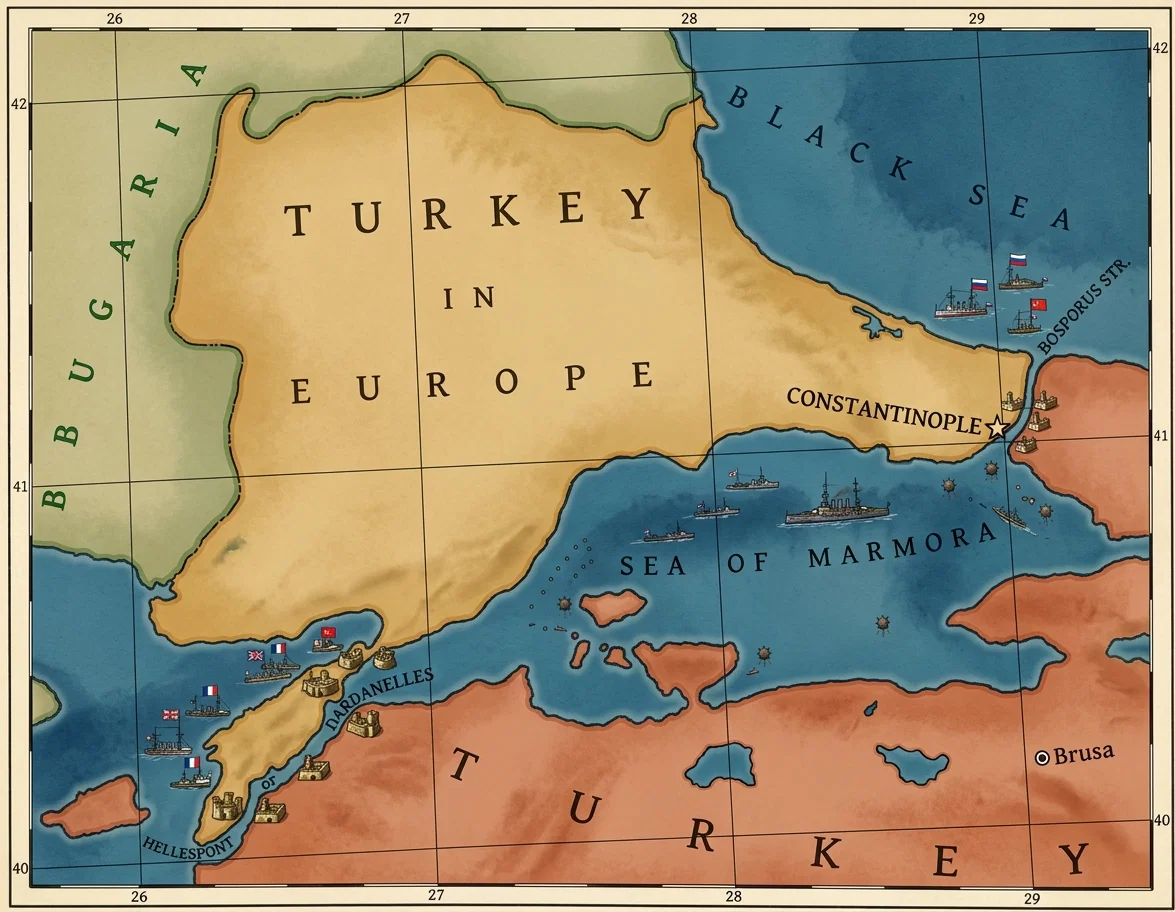
The above map shows the situation of Constantinople on the Bosporus. This strait connects the Black Sea with the Sea of Marmora. It is about seventeen miles long and is strongly fortified. The Russian Black Sea fleet is endeavoring to force its way through this strait. The Sea of Marmora is about one hundred and seventy-five miles long. It is heavily mined. The Dardanelles is a narrow strip of water connecting the Sea of Marmora with the Mediterranean. It has been strongly fortified at the Mediterranean entrance and at strategic points along the course of the waterway. The combined fleets of England and France have already reduced the forts at the entrance, and are now about halfway through the strait. Both the Russian and the Allied fleets have Constantinople as their objective.
That the view expressed by the editor of this London journal really represents the sentiment of the English people, and that the English government is in accord with this program, is further evidenced by the reports of a recent speech made by Sir Edward Grey in the House of Commons. Some days ago the Russian foreign minister, M. Sazonof, made a statement in the Duma to the effect that Russia hoped soon to realize her aspirations in the possession of Constantinople. Sir Edward was asked if England knew and approved of this statement of the Russian foreign minister. To this the English foreign secretary replied that Britain was in entire accord with Russia’s desire for access to the sea. “With these aspirations England is in sympathy. What form their realization will take will no doubt be settled in the terms of peace.” Thus according to the statement of English journals and of the secretary who has to do with the shaping of England’s foreign policy, the English nation has entirely changed front on this question, and now professedly stands in full sympathy with the aspirations of Russia, and ostensibly, by her warships in the Dardanelles cooperating with Russia in the Black Sea, is acting the part of an abetter of Russian designs. Of the statement from Sir Edward Grey the editor of the New York Times for February 27 says:—
There has been no more momentous declaration of policy since the war began than that of Sir Edward Grey in the House of Commons on Thursday, when he said that England was in sympathy with the aspirations of Russia to secure access to the sea.
It would seem from the human standpoint that in this action the last barrier had been removed which has hindered the expulsion of Turkey from Europe. In the opinion of practically the whole world, when Turkey entered the present European conflict she reached the most fateful hour in her history. This was expressed by leading writers and statesmen throughout the world. Voicing the sentiments of the Russian people, the Bourse Gazette declared:—
It is Russia’s opportunity. There is no general combination of powers such as several times saved Turkey from final destruction by the heavy hammer of Russian forces. With the blood of our sons we have shown the Allies our friendship, and therefore nothing will move them once more to hold back our hand. We shall for once receive only help and cooperation from the Anglo-French fleets in the Ægean. We will let them watch the enemy from the rear; we will tackle him in front by the sea and by land. Russia accepts the challenge thrown down by the mad hirelings of Germany, and marches to the fulfillment of her destiny with undimmed faith.
To this the Novoe Vremya adds:—
The day when the Turkish forces were handed over to the Germans was the day of virtual death of the once glorious Ottoman Empire. The commander of the German army and other German officials simply acted as the funeral guard.
The Courrier of Paris expresses the way the situation was regarded from a French standpoint, in these words:—
It is, alas, too late. Nothing will check the Allies in their task to settle once and forever the Turkish question. . . . Indeed, the last day of the Ottoman Empire is not very remote, and we can hardly pity the Turkish people for the sad fate that will be Turkey’s.
And the English journals voice the same sentiments. On the eve of the entrance of Turkey into the conflict, the Telegraph of London said:—
If Turkey chooses war, let her clearly understand that it will mean the end not only of Turkey in Europe, but of Turkey in Asia, and that the Allied powers will exact the fullest retribution.
And the statements of the English press presage the downfall of Turkey no matter how the conflict ends. They foresee that from every human standpoint, whether the Dual Alliance or the Triple Entente come off victorious, Turkey will be eliminated from the map of Europe. Says the editor of the London Times of November 6, weekly edition:—
Let us even suppose that Germany wins this war. What then will be the fate of Turkey? Will the Germans, who have so often explained their scheme for colonizing Asia Minor, release the grip in which they hold the Turks? A victorious Germany would forge fresh fetters for Turkey, and the kaiser would invite Islam to regard him as the guardian of the holy cities. Suppose the Germans lose. . . . What will then happen to Turkey? Great Britain, Russia, and France in alliance form the greatest Mohammedan power in the world. They will sweep Turkey out of Constantinople, and crush her forever because she has been false to her trust. . . . Turkey has betrayed the interests of Islam by making wanton war upon the Allies, and has thereby pronounced her own death sentence.
Nor have the journals in Europe been alone in the expression of such views. We have been surprised at the comments made by many leading journals in the United States, some of which have quoted the prophecy of Daniel 11 as referring to the present Turkish situation, predicting that the last hour in Turkish history had arrived.
To what place the Turkish government would first be removed in event of the fall of Constantinople we cannot say. Several Asiatic cities have been suggested as a possible choice. Brusa, Smyrna, Beirut, Konieh, and other places have been mentioned. The correspondent of the Daily News at Rome, under the date of March 1, telegraphed: “The prophetic mantle, together with all the important relics and treasures, has been removed to Brusa, where the sultan’s harem has also been sent. The decision of the Turks to transfer their capital to Brusa, in Asia Minor, is in direct opposition to Germany, which wished the transfer, if made, to be to Adrianople.”
The glorious holy mountain, between the two seas, according to the prophecy of Daniel 11, will be ultimately chosen for the seat of the government of the king of the north. Just how long after Constantinople is abandoned before Jerusalem will be reached, we have no means of knowing. Just how long after Jerusalem is made the seat of government before the king of the north is overthrown, prophecy does not indicate.
Some have wildly stated that the fall of Constantinople would mark the close of probation, but the prophecy does not warrant that interpretation. Indeed, so far as the Scriptures are concerned, nothing whatever is said about the surrender of Constantinople. We can see in the surrender of this city a significant and important link in the chain of events which leads us to the closing scenes in the drama of earth’s history, and as such the events now taking place should make to us earnest and sensible appeal.
We know that, even though a few months or a year or several years should intervene between the removal of the Turkish government from Constantinople and the final overthrow at Jerusalem, this will be none too long for the accomplishment of the work of God. Indeed, the time will be altogether too short for the careless and indifferent. (To those among our church members today who have not been moved to a new consecration and new endeavor by the stirring events of the last few weeks we feel the events of the future will make but small appeal.)
As we watch the record of unfolding events and note where we are on the stream of time, we must act the part of sane, sensible men. We must give the message of God free from the spirit of sensation or fanaticism. But let us realize as never before that this work is soon to close. A few more years and we shall witness the end of earth’s history and the coming of our Lord. Let us be diligent to make our calling and election sure, that we may be found of him in peace. And as we prepare our hearts for the coming of the Lord, let us sound abroad the message of his coming, making our fellows acquainted with the meaning of the things which are coming on the earth, that they, too, may find refuge under the banner of Christ the Lord.
F. M. W.
How the Lord Intervened
By W. A. S.
TIBET is still “the great closed land” in missionary annals; but there are signs of a breaking down of barriers. At various points on the Indian and Chinese borders, missionaries are camping and working, awaiting the time when they can enter.
Among the pioneers in Tibetan work was Miss Annie Taylor, who died some years ago in England. With a burden on her soul for Tibet, she lived among the Tibetans on the Indian side of the border till she learned the language. Then, in 1890, she pushed over the frontier in spite of regulations,—a young woman, and alone, taking her stand on the forbidden ground, by authority of the gospel commission, “Go ye into all the world.” Of her first experiences, Wm. Carey says in his “Adventures in Tibet:”—
Her presence was obnoxious to the authorities, and she was ordered to leave the valley. The captain of the guard of the Dong-Kya Pass came over from the Chinese fort at Khamba-jong to settle what should be done. Finally she was moved to Tumlong, and given a room in the monastery there. But the people had been told not to sell her any food, and she found it difficult to live. On one occasion she followed a caravan over the stony roads, and eased her hunger a little by picking up the grains of parched corn which dribbled through a small hole in one of the packs carried by a mule.
Again, in emergencies, women would secretly drop their popped corn in the roadway, and “she would pick it up like the birds of the air, thanking God for the timely supply.” Still she held on for Christ and Tibet, refusing to be driven out. At last it was determined to kill her. The Missionary Review (April, 1894) tells part of the story as follows:—
The natives would ask her frequently what they were to do with her body if she died. She told them she was not going to die just then. They have, however, a custom of “praying people dead,” and to this they resorted, taking care to help their prayers in a very effective manner. One day the chief’s wife invited the stranger to eat, and prepared rice and a mixture of eggs for her. Some conversation between the women as she was eating aroused Miss Taylor’s suspicion as to the eggs placed before her, and, sure enough, after she had partaken she became ill, with all the symptoms of aconite poisoning.
How she escaped has perhaps never been put in print, as Miss Taylor said little publicly of the most intimate experiences with the Lord’s delivering hand. But a friend of hers—one of our sisters in London, now dead—told us that Miss Taylor believed that God interposed in a miraculous way to save her from death by the poison. She felt her strength going; her heart was ceasing to act; and as she looked out, she saw a crowd gathering silently about. She knew then that she had been poisoned by deliberate and deadly design, and that the people were gathering in curiosity to see her die.
There she was, a young woman all alone in dark Tibet; yet not alone, for there was One who has promised his messengers, “Lo, I am with you alway.” His angels were there, and his Spirit in that moment brought to her mind the promise, “If they drink any deadly thing,10it shall not hurt them.” The conviction came that God would save her, and with strength ebbing she laid hold of that promise, and asked God to verify it just then, not for her own sake alone, but for Tibet’s sake. Immediately she felt the blood again tingling in her veins, the heart was working normally, strength came to her, and rising up in the strength of the Lord she took her Tibetan Scripture portion and went out to preach Jesus and his power to save to those who had come to see her die. W. A. S.
Miracles, True and False
By R. C. Porter
Having learned that God is the Creator of the universe and the Author of nature, it is natural that men should expect to trace through all of his operations in his revelation of his almighty acts what they term miracles. Man, by observing the animal creation below him, sees in it an inability to perform acts of knowledge and power equal to his own. But being himself the workmanship of an almighty Creator, it is but natural that he should recognize in God a being whose every act is a supernatural manifestation of wisdom and power.
If in giving his word of divine revelation to man, in which he reveals his rightful claim upon man's worship, he manifested no power superior to that possessed by man, the authenticity of such a revelation would at once be questioned. Man would expect that a revelation of a system of religion which came from God would be accompanied by miraculous manifestations in keeping with his character.
So generally is it recognized that a system of religion to be genuine must be attended by miracles, that every impostor who has arisen and undertaken to delude the world into following his religious system, from the days of Elymas, the sorcerer, to Joseph Smith and Brigham Young, of the Mormon system, has undertaken to associate evidence of miracles with his religious scheme. All heathen systems from the days of the Ephesians, who worshiped an image supposed to have fallen down from Jupiter, back to the first apostate system, were founded or supported by supposed miracles.
In giving a divine revelation to man, it was therefore necessary that God should manifest himself in miracles in connection with that revelation and the religious system it proclaimed. It must also present miracles of such a character as to make it possible to distinguish them from the jugglery of magicians of false systems.
In no other way could the Lord be recognized as the only true God, and his religious system the only true worship.
Thus, from the very beginning of the writing of the Bible in the days of Moses, God's religious system was arrayed against that of Egypt, and both systems were supported by miracles. Exodus 7 to 12.
God's first miracle in this instance was manifested in the destruction of the serpents, which in the Egyptian system were objects of worship.
The second miracle was directed against the river Nile, which was adored as an object of worship. Its refreshing waters, which they had regarded as sacred and life-giving, were turned to blood, and its fish, also regarded as deities, were turned to putrefaction.
The third miracle caused all their sacred waters to send forth multitudes of frogs to infest their whole land and become an annoyance, and caused the people to detest the conduct of their gods.
The fourth miracle brought lice in such abundance throughout the land as to prohibit all Egyptians from worshiping their gods. Gleig says, “No one could approach the altars of Egypt, upon whom so impure an insect harbored.” During this plague no act of Egyptian worship could be performed. It was this that caused their magicians to cry out, “This is the finger of God.”
The fifth miracle was designed to undermine the trust of the Egyptians in Beelzebub, or the fly god. He was worshiped as the protector against swarms of flies. This miracle of swarms of flies gave evidence of his inability to protect the people as they had believed him able to do, and it revealed the God of the Hebrews as the only God in whose protection men may safely trust.
The sixth miracle was directed against their debasing system of brute worship. By it their sacred bull, ram, heifer, goat, and many other sacred animals were destroyed. In this act was revealed the power of the living God in contrast to the impotence of their now dead brute deities.
The seventh miracle was directed against the custom of offering human sacrifices to propitiate the wrath of Typhon, the evil principle. The ashes of the sacrifice were taken up and strewn to the winds by the officiating priests in order that evil might be averted wherever a particle of the ashes fell. Moses took a handful of ashes from the furnace and threw it into the air, according to their custom, and it became boils and blains upon all the people of the land. Since neither king nor priest escaped, while Moses and Aaron stood among them protected, the supremacy of the God of the Hebrews was again vindicated.
The eighth and tenth miracles, like the two against the worship of the river Nile, were directed against the worship of false deities, Isis and Osiris. These two idols, next to the river Nile, were the supreme objects of Egyptian worship. They originally represented the sun and the moon, and were supposed to control light and darkness, and the elements of nature.
So great was the destruction by hail and so unusual the lightnings and the thunder that Pharaoh cried out, “Entreat the Lord (for it is enough) that there be no more mighty thunderings and hail.”
Then followed the ninth miracle, directed against Serapis, whose office was to protect the land of Egypt from locusts. At the word of Moses the land was filled with locusts, and the houses, from least to greatest throughout all the land, were invaded by the pest. Only upon the entreaty of Moses could they be removed. Again the true God gave the people of Egypt an evidence of his power over their god in whom they trusted for deliverance from locusts.
Then followed the tenth miracle, in which the gods, Isis and Osiris, were again assailed by three days of darkness that could be felt, spreading over all the land, so that the people saw not one another for three days. Thus the true God summoned nature, in which they trusted, to witness to him as the only true and living God.
The eleventh and last of this series of miracles was an exhibition of divine judgment upon the Egyptian nation for their mistreatment of the Israelites who had so long served as bondmen among them. They had slain the offspring of the Israelites at birth as the last high-handed outrage upon them, and God now, as an example of infinite justice, recompensed their evil course upon their own heads in righteous retribution.
That night the angel of death passed through every home, and from the lowliest cot to the kingly palace, the first-born in every house was slain. From every family in Egypt there arose such a wail of sorrow and defeat as their nation had never before witnessed. God had given ample evidence, to the Egyptians and to the Israelites, to teach them that he was not only a God of power, but a God of justice. Though he bears long with those who insult and abuse his people, the day of retribution awaits all injustice.
By these miraculous exhibitions of divine power the Lord says, When Pharaoh shall say, “Show a miracle” (Ex. 7:9), “against all the gods of Egypt I will execute judgment: I am the Lord.” Ex. 12:12. Reviewing these miracles, in which the power of all the gods of Egypt was challenged and ignominiously defeated, Jethro, Moses' father-in-law, said, “Now I know that the Lord is greater than all gods: for in the thing wherein they dealt proudly he was above them.” Ex. 18:11. Thus the true God was unquestionably vindicated.
R. C. PORTER.
Soonan, Chosen
By Riley Russell, M. D.
RILEY RUSSELL, M. D.
WE are just closing a district meeting for my part of the field. Our reports show 335 baptized members, sixty-nine of whom were baptized during 1914. We gained 258 Sabbath school students, which means new believers. We now have 715 Sabbath school students, or Sabbath keepers. Our tithe and offerings amounted to 1,322 yen for the year, making about four yen for each baptized member. We had 9,000 patients, old and new, during the year, and, best of all, quite a goodly number of conversions.
Our church members are taking hold of the work in a way that will make them strong, and I have not before seen such interest among the populace. Every place I go I preach on “Last-Day Conditions in the Political World;” “Last-Day Conditions in the Spiritual World;” “The Last Message, and the Close of Probation.” Everybody wants to hear. It makes me think of the early days when we first came to Korea, and I am firmly convinced that God’s Spirit is working on hearts and preparing the way for the message to close speedily. I think our present motto should be, “The Finishing of the Work.”