As we take a retrospective view of the past year's work in this field, we can see abundant evidence of the Lord's guidance and blessing. In fact, the results realized from our labors during this period have been more encouraging than ever before.
The believers at Naziang, where work was opened last spring, now number about thirty. These are faithfully living up to all the light they have received, and several of them expect soon to go forward in baptism.
Of this company, one man and his family, who have been Christians for years, accepted the third angel's message, and are now keeping the Sabbath and paying tithe. As a rule, the Chinese women are very fond of jewelry, and it is often quite a cross for them to take off these adornments; but when the truth on this subject was presented to the wife and daughter of this family, they immediately removed their rings, earrings, brooches, and all other ornaments of like nature.
Another woman who formerly was a devout idol worshiper, has also accepted the gospel, and her very appearance testifies to the blessing and joy she has received as a result. For years she has been a user of opium, sometimes smoking as much as a dollar's worth in one day, and this was in addition to one hundred cigarettes daily. She has used neither of these poisons since last spring, and has cast away the idols which she used to worship. However, her newfound faith has brought trials and persecution as well as happiness. Before her conversion, her sons gave her all the money she desired with which to buy opium and cigarettes, but they have recently threatened her with starvation if she does not renounce the truth which has freed her from these soul- and body-destroying habits. Her faith does not waver because of these things; and the last time we saw her, she was rejoicing that one of her sons had bought a Bible and was studying it.
In the same home lives a blind woman, who also has received the gospel message. Although she herself cannot read, it is her greatest delight to listen to the reading of God's Word.
Another interesting case is that of a young girl who has been suffering with tuberculosis for seven years. She is unable to walk, and was carried to the meetings by her father. The promise of eternal life is very precious to her, and she longs for the time when she can see her Saviour face to face. Her life is gradually ebbing away, but she wishes to be baptized and to prepare for the Lord's soon return.
Many interesting details might be given regarding other brethren and sisters who have recently come out of heathen darkness, but space will not permit.
A three hours' trip on the canal from Naziang takes us to the walled city of Kading, where we conducted meetings soon after the summer's heat was over. This is a very ancient city, and is quite an educational center. There are a great many private schools, and the government has opened several large ones in old, unused temples.
A pavilion constructed of bamboo poles and reed mats was erected for the meetings. Rough boards, supported by posts driven into the ground, served as seats for several hundred persons daily, and the crowds on the outside formed no small part of our audience.
In China there is no difficulty about drawing a crowd, but it is often just as easy to lose it. On one occasion the tent was full when a lamb outside began bleating. In a moment a large audience had left us to see what the excitement was about on the outside. However, there are always some interested ones whose attention is not so easily detracted from the stirring truths for this time, and quite a number are studying daily with our evangelist.
After the meetings had been in progress for some time, we planned to have a service in the chapel especially for inquirers. We had taken the organ, pulpit, and other articles from the tent to the chapel; but long before the hour for opening the meeting had arrived, the seats were full and a large number were standing, so we were compelled to return to the tent and have the meeting as usual for the company of three or four hundred who had assembled.
The persons whom we have met here are a very good class, and unusually well educated. This is especially true of the young men and women. We pray that the Lord will lead some of these young people to accept the third angel's message, and become efficient workers for those about them who are still in darkness.
The brethren and sisters who have recently accepted the gospel naturally desire that their children should attend Christian schools. To supply this need, we have opened schools in connection with our outstations. Most of the common branches are taught, and the evangelist at the station conducts a Bible class one period each day. We believe that the present plan will mean much to the future of our work.
The Social Life of Korea
A KOREAN
Some scattered fragments of Korean social customs have already appeared in the writings of our Western friends, especially Christian workers, who are interested in the rapid and marvelous movement of Christianity in Korea. There is, however, much misinformation and misunderstanding.
In the first place, some of the writers get their information from foreigners, not Koreans, whose knowledge is neither definite, accurate, nor true. Again, it is mixed with some diplomatic purpose or with national prejudice. Some obtain their information from insignificant stories told them by an ignorant class of the natives. They write this down hastily, and sometimes even venture to criticize before making a careful research. Finally, a few of them collect their material and criticize justly. Yet even among these, many, being fond of curiosity, put too much stress upon the dark side of life. Others, unfortunately, have not studied Korean history long enough to secure the true conception of Korean life. Since the subject of their writing is chiefly the movement of the religion of the cross, time and space will not allow them to give full accounts. Whether they are correct or incorrect, fair or unfair, we thank them just the same, for they make us able to think about our society more carefully, and find out the weaknesses, defects, and corruptions in it.
A Korean family of ancient type is based on Confucianism. It is almost entirely different from that of the Western world. The family is the best-organized and most fully developed of all social and political units in Korea. According12to our conception, a state is merely an enlarged form of a family. It is a self-governing body of several members, with fixed rights, duties, and division of function among themselves.
Besides these mentioned, there are numerous less important rules and minor principles about the family which are left unmentioned. All these things are strictly observed, not through fear of the law of the state, but because disobedience to these unwritten social customs would bring shame and dishonor upon the family. A Korean is carefully trained from the beginning to the end of his life to be obedient to the time-honored customs of society, to be sensible to honor and shame, and to love others in order to be loved by others. The family is crowded, but peaceful; for it is kept in order. Therefore, in planning to reform the Korean family, we are going to encourage a revival of old customs and introduce new principles from the Western world. We hope we shall then have an ideal form of society, a combination of all the best moral and social principles of ancient and modern times.
MRS. W. H. ANDERSON
By MRS. W. H. ANDERSON
The Native of the Kraals as I Know Him—No. 4
MRS. W. H. ANDERSON
One never knows what to expect. The missionary must be ready for all emergencies. One morning we got up and found that two herdboys had run off in the night, in the afternoon the police came and arrested two, and that night one went away, so we were left with only one herdboy. We had to send out to the villages. The natives are as “unstable as water.”
Mr. Anderson was getting some stone to build a house, and he had two boys, considerably larger than himself, with him. He asked them to put a stone on the wagon, and they would not lift it. He said, “I can put it on myself, and you are larger than I.” “Well,” they said, “it is your house you are building.” They have no interest in anything for any one else. We can always tell by the way a boy walks, wherever we see him, whether he is on business for himself or some one else.
These people cannot hide a mischief. One day a native hid himself in the house of a white woman for the purpose of stealing. She had been away for a while, and when she returned it was dusk. When she lighted the lamp, there he sat under the curtain, which was around a little table, with his feet out.
One time Elder Tripp missed some salt. The native loves salt. Elder Tripp did not know who the culprit was; but while he was about his work, he ran across one of a pair of socks which he had sold to a native, filled with salt. He called him up and asked him where those socks were that he had sold to him. “I don’t know, I can find only one this morning.” “Well, here it is: I found it with salt in it.” “O, yes, I remember now,” the native replied. “Yesterday a boy was coming from Bulawayo who had some salt, and he gave me some, and I had nothing to put it in, so I took off my sock and put it in that.” Elder Tripp was pretty sure that it was not that way, but what could he say? He resolved to investigate further. After all was quiet that night, he went to the salt bag and carefully put a piece of gunny sack over the salt, then put fresh red paint on it, and closed the bag again. Of course he was up early the next morning to see his salt bag. He called up all the boys and told them to hold their hands straight out in front of them, which they did. He began to look at each boy’s hands. One fellow began to put his behind him, but Elder Tripp insisted that all hold them out until he had a good look. Finally it came that fellow’s turn, and sure enough, there was the paint. He turned to the rest and said, “Do you see that?”—“Yes.” “Come with me.” He took them to the salt bag. “Do you see that?”—“Yes.” “Do you see where that fellow had his hand last night?” No, he had not been in the salt bag; the paint was there, but he did not know how it got there.
Another time Elder Tripp and Mr. Anderson were building some huts, and wanted some thatch grass with which to roof them. One day a girl brought a bundle of it, and when she received her pay she was told to take the bundle out and put it on the pile with the rest. She took it out and walked around the pile, and then came back in and had some more to sell. She knew that they could not identify the grass, but she forgot that she brought the same face back, and they could identify that.
You ask if there are no good qualities in our black brothers. Yes, there are, but it takes the gospel to bring them out. There is nothing in their dealings with one another or in their home life to bring out these qualities. So when they first come to us, we have to work hard and patiently with them. In general, the native mind is keen; and if the missionary can get the native before he begins to smoke native tobacco, which is far worse than what the white man smokes, he can usually make a good boy of him. After the natives smoke this for a year or so, it is almost impossible to teach them the simplest words and numbers. It is a common sight to see wee children and their mothers smoking, and of course this seriously affects the children, and accounts for so many imbeciles among them. We had a boy here in school two years, and at the end of that time he did not know one letter from another. There are many whom we cannot take above the second grade, and very few above the fourth. They simply have not the mental capacity. The face looks bright, and to teach them to work is not so difficult. But for so many generations past their forefathers have not studied that it is hard to stir up their minds to grasp ideas.
The natives as we find them here in the interior are very independent, shiftless, and improvident. They live to eat when there is plenty, and go without when there is famine. They like to abstain from work as long as they can, and when they think the mfundesa is not likely to appear on the scene, they have a “little time all their own.”
One day the herdboy lost a little calf, so Mr. Anderson with several boys went in search of it, after sending the other boys to their work. Chunga, for that was the lad’s name, was sent for the oxen with which we wished to cultivate. I must say that it was a warm day, and a pretty pool of water was tempting, but we were very busy and could hardly afford to spend the time. He did not expect the mfundesa that way, so off went his clothes for a swim. But to his great surprise the mfundesa appeared. Out he came, with clothes in hand, and ran for the place where he first started. He was called back, and this conversation followed: “Did I send you down here to swim?” “I have not been swimming.” Having had no time to dress himself, there he stood in nature’s garb. “What were you doing in the water?” “I wasn’t in the water.” “Where did that water come from that is on your back?” Looking up in the heavens and seeing no clouds, he replied, “I don’t know where it came from.” With that he was sent on his errand.
They think the white man is a very queer being because he wants so much work done. It is very interesting to sit where one can listen to them as they discuss him while sitting around the camp fire at night. Yes, the makua is a great person. He has so much wisdom.
When the British South African Company installed a cylinder saw for sawing trees into plank, it was so wonderful to the natives that they came day after day to see “how fast it sawed, and so smooth, too.” One day the curiosity of one boy got the better of him. He stepped around and put his finger on the saw, to see how fast it went, when to his utter astonishment he saw his finger fall to the floor. He ran as fast as his legs could carry him, and he was not seen there again. They always give the white man a new name, and every native, far and near, knows him by that name. It is always suggestive of some trait of character; as, Manyepa, baldhead; Atontola, quietness, one who talks but little. But they are ever talking of the makua’s wisdom.
Korea
By MIMI SCHARFFENBERG
MIMI SCHARFFENBERG
I LEFT home Aug. 5, 1914, for a trip among the companies, returning November 29. During this time I visited thirty places. In each place I had special meetings with the women, and tried to teach them to study their Sabbath school lessons. In many of our Sabbath schools we have no teacher to teach the women’s class, and a man cannot succeed in getting the women to answer him; so we have to do something to train women teachers. I hope to have a special institute for the women next February and March.13
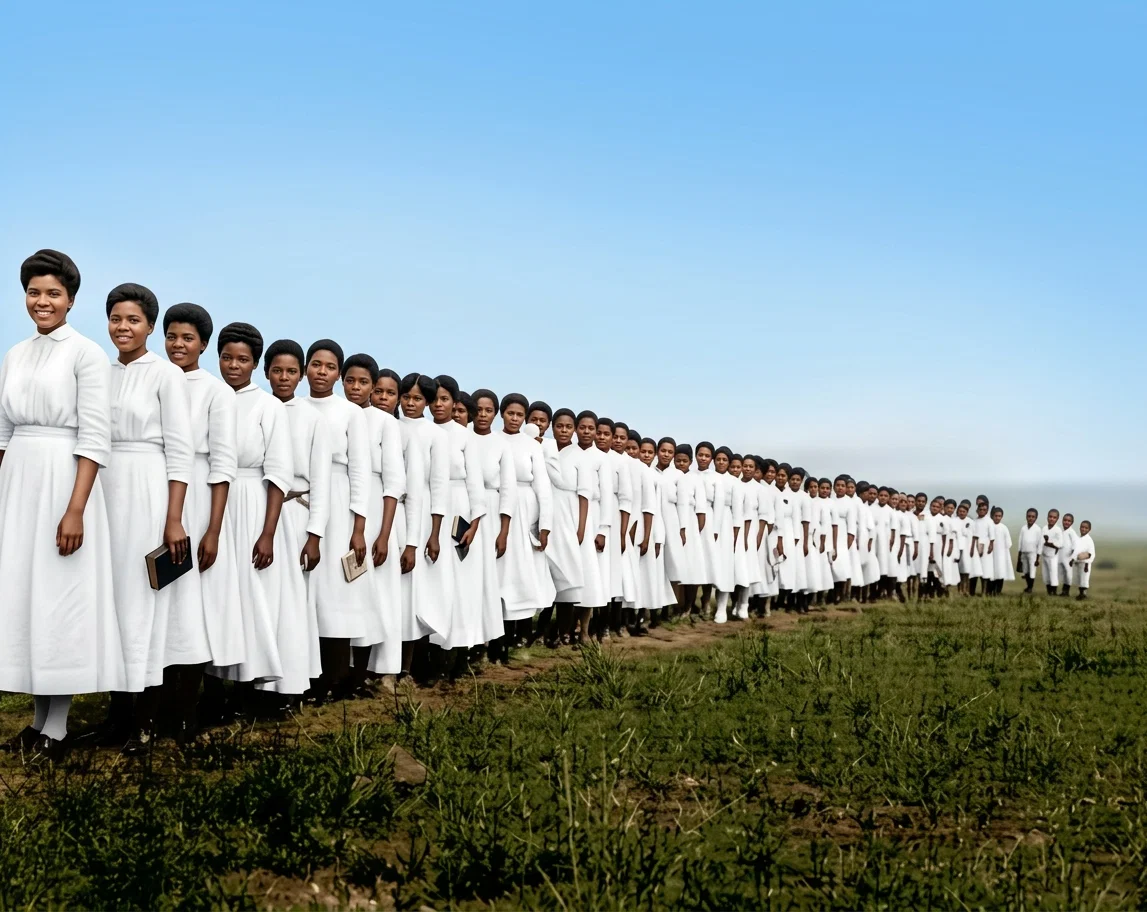
KAFIR STUDENTS, ALL SABBATH-KEEPING YOUNG PEOPLE
Our work here is strange in one way. We have a changing Sabbath school. Every quarter we have a large list of those who have left us, but with it all the real membership is constantly growing. In one place we may have thirty Sabbath school members perhaps for a whole year, and then the membership may dwindle down to seven or eight. But in general our membership does not decrease; for companies spring up in different places and take the place of those lost in other places. We have forty-five Sabbath schools and twenty-five places where only one or two are holding out alone. Every such place is a gospel lighthouse.
I was pleased to find an interest in the truth on the east coast. In one place, in a mining section, I met Americans who are anxious to know what we believe. They begged for a missionary to settle among them. I promised to send them literature. In another place I had an interesting experience with a wealthy Korean woman whose daughter had died just a few days before I arrived. The mother with her thirteen-year-old daughter had been attending our meetings for some time. One day her friends told her that if she made a Christian out of her daughter no one would want her for a daughter-in-law. This set the mother to thinking, and she said to herself: “That is so. If she should want to marry a Christian, she would have to become a poor man’s wife. No, I am going to see that she marries into a rich home.” So she forbade her daughter’s attending our meetings. Soon after that the girl was taken sick, and the mother called the necromancers. Of course, having gone to the necromancers for help, she lost all desire to pray; and her daughter began asking, “Mother, why do you not pray any more as you used to?” The mother took this to heart, but did not find freedom to pray. Shortly afterwards the daughter asked for the hymn book. She sang several hymns, recited the ten commandments, and a few minutes later passed away. This was too much for the mother, and in her grief she went to the Christians for help, and buried her daughter in a Christian way.
This is the story as the mother herself told me. She had found no comfort and wanted to pray constantly. She stayed with me all the time. On Sabbath after the meeting she asked me to come with her to the grave. I did so, and all the sisters accompanied us. The poor mother wanted an assurance that she would see her daughter again. Although we read to her all the Bible promises, she wanted me to write out an agreement on paper that she could meet her daughter again if she believed, and for this she was willing to give a large sum of money. We spent hours with the poor woman before we could persuade her to go home.
It was well that we went with her to the grave, for otherwise we should not have found out about the idols and spirits that she was still worshiping. That same night I talked with her, trying to persuade her to give up her spirit worship, but she denied having spirits in her house, saying that the few that were there belonged to the rest of the family. The next morning we were invited to her home for breakfast. After breakfast she asked how she could get rid of the spirits in her house. I told her to bring out what she had, and she did. After that we had a Bible study on how to destroy such things. She then wanted everything burned, so we made a bonfire in front of the house. She brought out a big stack of things, but I noticed that the stone crock in which the rice spirit dwells was missing. I had not seen it in that house, but I knew it was in every house. I asked her if she was still trying to keep some back. She said she was not; but when I asked what had happened to the rice spirit, she went and got him, and then the house cleaning began. I did not know that one household worshiped so many different spirits. After we had destroyed everything, we went into the house and had a prayer and praise meeting, which ended in another Bible study. It was a wonderful meeting to me, and I never heard any sweeter music than the music to which I listened in that house when these happy people read the promises in their quaint sing-song way.
This dear woman is now finding comfort. She gave some money for the church building in this place. Her letters are following me up, and she came to another place to see me several weeks later. I hope she will be the means of bringing some of her friends into the truth.
The Message in Kafirland
By W. B. WHITE
W. B. WHITE
The writer recently had the privilege of spending a week in the above-mentioned country, attending the closing exercises of our native school, and holding a council with our workers.
These exercises were held at Maranatha Mission, the central station, Thursday evening, November 26, three schools joining in the program. A large number attended, and the schoolhouse was crowded with brethren and sisters from Fish River, Pemba, and Maranatha. To give the writer the exercises were of great interest, as many of the young people and children present had only recently been brought into our schools from the heathen villages and the degrading influences of the kraal life. When brought under religious and educational influences, what a wonderful transformation is quickly wrought in the minds and hearts of these youth and children! The young people in the long row in the illustration were all present on this occasion, and took part in the exercises. They are all Kafirs, students in our schools, and, best of all, are all Sabbath-keeping children, and love God and his truth, and are as well behaved a company of young folks as the writer ever associated with. They love God, and we know God loves them, and it is a pleasure to work for them.
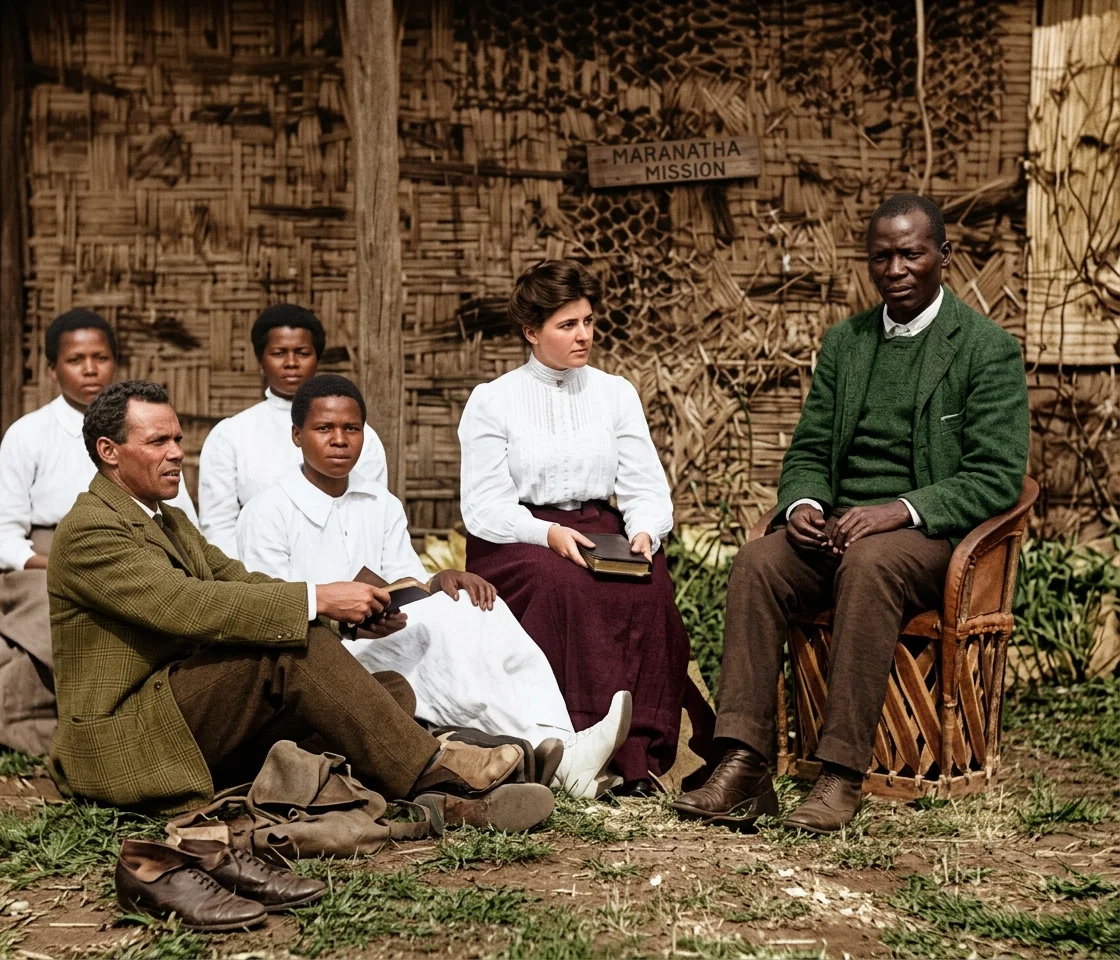
At the Maranatha Mission, Miss Victoria Sutherland, a graduate of our Claremont Union College and a teacher of experience, has been doing most excellent work, and her students are making good progress. She also frequently visits the schools which are conducted by native teachers, and gives them needed assistance.
OUR TEACHERS IN KAFIRLAND
On this visit to Kafirland the writer was led to an appreciation of the services of our teachers that he had never had before. Surely. these teachers in Africa are doing a great work for God, and our schools are the most effective means of getting the truth before young and old. We are finding that it is very difficult for the evangelist to accomplish a permanent work among the native tribes, in advance of the teacher; but in conjunction with him the evangelist's labor is valuable. What Africa needs14is more native schools, and, still more, taught by consecrated men and women. In this way thousands may be reached with the message of truth.
In the other illustration is seen a group of our teachers in Kafirland. Miss Sutherland, the principal, is seated in a chair. All these teachers are hard-working and faithful, and are leading the children and young people to God. At the time of our recent visit, eleven received baptism, Brother Charles Sparrow, one of the local elders of the church, performing the rite. Our church at Maranatha now has more than one hundred members, and is growing steadily.
Brother E. W. H. Jeffrey, who for a number of years has been the secretary of the International Tract Society at Cape Town, is now in the field, and has entered upon his duties as superintendent of our work. He was reared in Kafirland, his father being among the earliest Wesleyan missionaries to this people. Brother Jeffrey has a good command of the language, and can readily preach to the natives in their own tongue. This they greatly enjoy.
Calls are coming to us to establish our work farther in the interior in the darker regions of this country, and the local committee that has the work in charge is investigating to see what can be done. It is evident that the Holy Spirit is working on many hearts in this region, and now we feel is the time to press in and do a great work among them. More schools should be opened as God prepares the way before us.
Kafirland is as healthful a region as there is in the world, and is almost as dark and unenlightened as any portion of Africa that the writer has visited. This is the home of the Red Kafir, who is always seen with his red blanket about him, and his body plastered with red clay; and some of our brethren and sisters who have recently accepted the truth were formerly of this people. Now they are rejoicing in the new-found truth.
Good rains are falling at all our stations, greatly cheering the hearts of our workers, and we hope for a good year. Pray for the work in Africa.
Work Is the Salt of Life
WORK is the very salt of life; not only preserving it from decay, but also giving it tone and flavor.—Hugh Black.
Practical Problems of Home Makers
By MRS. C. C. LEWIS
MRS. C. C. LEWIS
Overtraining the Child
HERE is a mother who has just learned from the lessons in Early Education and from Mr. Trumbull's book on child training that there is danger of overtraining the child.
She says that the idea of overtraining a child is new to her, and not very clear. There are many children overtrained, or too highly trained. One of the most important things to learn is to let them alone much of the time, supplying them with blocks or other playthings, and leaving them to amuse themselves.
All the lessons and the reading can do is to furnish principles which have been found true in the experience of the writers of the book and of the lessons. The application of these principles must of necessity be left to each mother. I know that this is the most difficult part of the work.
It is very easy to read a book; it is more difficult to take the principles of that book and put them into practice. But that is nothing new, nor is it discouraging. It is easier to preach than to practice, always will be. Nevertheless, it is the mother's work to do the practicing and to apply these principles. She will have to try them again and again; she will have to try this way and that way and the other way, until she finally finds a successful way of her own for her child. Nobody can tell her how to do this. She must find it out for herself by prayer, by study, and by trying different plans with her child. This is her problem. No one else can solve it for her. It is for her and the Lord to work together to find the best way.
Willful, Crying Children
A mother says that her child is very determined to have his own way, and cries till he gets it. That is nothing new. Nearly every child tries that trick. It is all right for the mother to find some method that will, as much as possible, keep the child from crying; but she should not be alarmed at considerable crying. Children will stand a great deal of crying without injuring them. It is better for them not to cry much; but still, how quickly they can pass from a cry to a laugh! And the beauty of it is that their faces, though so crooked when crying, seem to straighten out suddenly. I never yet heard of any child's face being made permanently crooked by crying when he was young. From the artist's standpoint, the face probably presents a distressing picture, but the living picture has this advantage over the artist's picture: it can quickly change, and all the unpleasant features can pass away.
Delayed Training
Some one asks what to do if a child has reached the age of one or two years before the mother has taught him the lesson of self-control. There is only one thing to do, and that is for her to do just what she should have done at the beginning. The same principles apply. It will be more difficult, probably, to form right habits, but the habits must be formed in the same way, only the mother must be more patient and more persevering in forming them. It is not hopelessly discouraging if the child has come to be one or two years of age before the work of training is well begun. That is still quite early. Most children receive little training until a later age. There is no other way than to follow the principles that have been laid down in the lessons, and the mother will have to do the best she can, and trust in the Lord.15
The Rocking Habit
Again: you ask what you shall do if your child has the habit of wanting to be rocked to sleep or of having you lie down with him. This is the habit of most little children, but it is an unnecessary habit, as some mothers have demonstrated again and again. The child can just as well be taught to go to sleep in his little crib or bed without being rocked; but it is well for the mother to sit by the bed and sometimes sing a lullaby to the child until he goes to sleep. A little later this will be the most sacred and precious hour in the day. It will be the hour of prayer, the hour of confidential talks with the child, the hour when the deepest impressions for good are made.
“Crying It Out”
If the child wakes up in the night and screams on finding himself alone, it may be because he has had an unpleasant dream, and he may need to be comforted by his mother. But crying just from habit or spunk should be overcome, and there is only one way to overcome it, and that is to let the child cry until he gets tired of crying. We have let our children “scream it out” many a time, and “the folks in the house” had to stand it. There is no other way to break the habit. If “the folks in the house” will not endure it, then the habit will have to go on, probably, until the child outgrows it or gets rid of it in some other way.
Do the Best You Can
Now, all this talk may not seem very helpful. Some of us who have had considerable experience with children have learned that there is no cut-and-dried method of dealing with them. We have to read all the good books we can upon the subject, and we have to study our children for ourselves, and pray to the Lord to give us wisdom, and then do the very best we can, leaving the matter with him, and trusting that the child will in time overcome his unpleasant habits and make a true and useful man or woman.
Out for a Walk
By Strickland Gillilan
My tiny son walks out with me
Along the sweet suburban road—
Has many a cheery scout with me
While chattering in our own love code;
He finds a reddened leaf perchance,
A gaudy butterfly’s lost wing,
A stone from which the sun rays glance,
Or some such childish-cherished thing.
All these he bears to me and places
Within my hand (as I have halted
To reconcile our varied paces),
And says, with look and tone exalted:
“See, father, what I found back there;
You missed it when you sauntered by;
Your big, strong hand takes better care
Of these—my treasures—than can
I.”
We are but children, walking out
With Father. All the things we find—
Gems now, but later viewed with doubt—
We bear to him, love strong and kind,
And say: “These big, safe hands of thine
Can take much better care than we
Of these—our treasures, rare and fine.
Dear God, we trust our all with thee!”
—Strickland Gillilan, in Ladies’ Home Journal.
An Angel of Help
By Cuyler
God always has an angel of help for those who are willing to do their duty.
—Cuyler.
Progress of the Armenian Mission
BROTHER E. FRAUCHIGER, in charge of the Armenian Mission, with headquarters at Constantinople, on Dec. 9, 1914, wrote:—
“Besides our regular Sabbath meetings, we have two or three meetings in different parts of the city. We expect to have baptism in the near future. An Armenian professor has accepted the message. Brother Onnic reports that some have accepted the message in Eskishehr, and Brother Scior reports that some in Saloniki are waiting for baptism. Quite a number of our church members of Constantinople have moved to Saloniki, so that we are also able, as did Paul, to write to the church of Saloniki.”
Conducted by Mrs. C. C. Lewis, Takoma Park, Washington, D. C
By Mrs. C. C. Lewis; Miss Lora E. Clement
Assisted by Miss Lora E. Clement
Through the columns of this department, hints will be given on all matters pertaining to the home life. Short articles and letters are solicited from home makers, telling of their everyday experiences,—their joys and sorrows, their failures and successes.
The Burden
By Zella Margaret Walters
“My child, there is a burden to be carried. Will you take it?” said the King to one of his children.
Because she loved the King she took it, but she went away with bitterness in her heart.
“Why was I given a burden?” she said. “I desired to serve the King. I would have gone on an embassy for him to a far country. I would have run to do his bidding here. But this heavy thing bows my back, and makes my footsteps lag. Why should any one bear a burden? Why does the King have such things in his land?”
And she went on her way slowly and unwillingly.
Then one day she passed a company of the King’s soldiers. Many of them were sick and fainting by the wayside. But when they saw her, they cried out in thankfulness. “Here comes one bearing the jar of healing on her shoulder!”
They came to her, and took a certain dry herb from the jar, and put it in water. Then when they had drunk, they were strong and well again, and able to go on the King’s business.
“Why,” said the woman, “if this burden will furnish cups of healing to others, I will bear it right gladly.”
So she hastened to go among the poor and sick, and offer them herbs from her jar. And always the herbs healed the sick body and soul. And it came to pass that the woman with the burden did more service for the King than many who walked quite free.
There came a day when the King summoned his servants to court.
“Is the burden too heavy for you?” he asked the woman.
“It grows lighter each day,” she said, “and were it much heavier I would not have it taken away. What has been a burden to me has been a cup of healing to many. And since my great desire was to serve, I am well content to serve in this way.”
“Child!” said the King, “whenever I lay a burden upon one’s shoulders it is not for sorrow and despair, but for help and healing to the one who carries it, and to all the world.”—Zella Margaret Walters, in The Mother’s Magazine.