ONE of the first great cities of antiquity was Babylon, founded by Nimrod, the great "lawless warrior" of the family of Ham. The origin of its name was the sin of its founders. Rebelling against God, rejecting His law of beneficence in the peopling of the earth, they sought their own glory, and to perpetuate their own name. They declared that they would escape future deluges, concentrate their efforts, and become themselves the arbiters of men's destiny. They said, as recorded in sacred story, "Go to, let US build US a city and a tower, whose top may reach unto heaven; and let US make US a NAME, lest we be scattered abroad upon the face of the whole earth." Gen. 11:4. And they proceeded to build with their well-burned brick. Gen. 11:3. Upon some of those very bricks scholars have found the name they gave their city. It was "Bab-il," or "Bab-ilu," the "Gate of God," or the "Gate of Heaven."¹ It was man's attempt to improve upon God's plan; to put man's work in the place of God's free grace and Spirit; to exalt the creature to the throne of the Creator; and they called it, as have the children of Babylon their efforts ever since, "the Gate of God."
But the erecting of other standards, which must be universally and forever false, always leads to confusion. And God, who gives no names without purpose, thus called it "Babel," or "Babylon," meaning "confusion." Gen. 11:7-9. Perverse men named the city what they hoped it would be. God named the rebellious efforts of man just what they truly are. From that effort of man, from that false principle, has sprung every false system of religion, and every perversion of the true religion, which has cursed the nations and the world, and put to death millions of the children of God. "Babylon hath . . . made all the earth drunken: the nations have drunken of her wine; therefore the nations are mad." Jer. 51:7.
"In populousness and antiquity, Assyria was far exceeded by the southern kingdom of Babylonia. HERE WERE THE CENTER AND STARTING POINT OF THE CIVILIZATION which afterward spread through Western Asia."² "The earliest religious, scientific, and artistic traditions of our present civilization were cradled in Babylon."³
Babylonian perversion of the true, the exaltation of the human to the divine, did not originate in man. It was taught him by the true "king of Babylon,"—"Lucifer," the fallen angel. Isa. 14:4, 12-14. Here are his thoughts, purposes, and principles: "How art thou fallen from heaven, O day-star, son of the morning! how art thou cut down to the ground, that didst lay low the nations! And thou saidst in thy heart, I WILL ascend into HEAVEN, I WILL exalt MY throne above the stars [mighty angels] of God; and I WILL sit upon the mount of congregation [as one reigning], in the uttermost parts of the north; I WILL ascend above the heights of the clouds [of angels]; I WILL make myself LIKE the MOST HIGH." Self-exaltation is the spirit of Babylon. At its least it is the perversion of the truth; at its greatest it is open, active rebellion against God; in all it is confusion,
and its ultimate destruction. And God has given us the origin, history, and end of ancient Babylon, that we may discern the character and see the end of modern Babylon. The former is a prophecy of the latter.
For a time He who ruled over nations suffered the Babylon of Nimrod to remain. As long as God could get glory, even from her perverseness, she was a dominant city of earth. When He could no longer use her, she fell, and Assyria, with the capital city of Nineveh, became the ruling power of the Orient. And yet from the days of Hammurabi (Amraphel, Gen. 14:1), "the city of Babylon, which he had made great, so continued. Its supremacy there was none to question." "No capital in the world has ever been the center of so much power, wealth, and culture for a period so vast."
At the time of our lesson in Daniel 1, a change had again taken place. Babylon, no longer Hamitic, but decidedly Shemitic, had, under a king (Nabopolassar), appointed B.C. 626 by the Assyrian emperor, arisen from its ancient ruins and former vassalage to proud Nineveh. Babylon was again in the ascendency.⁵
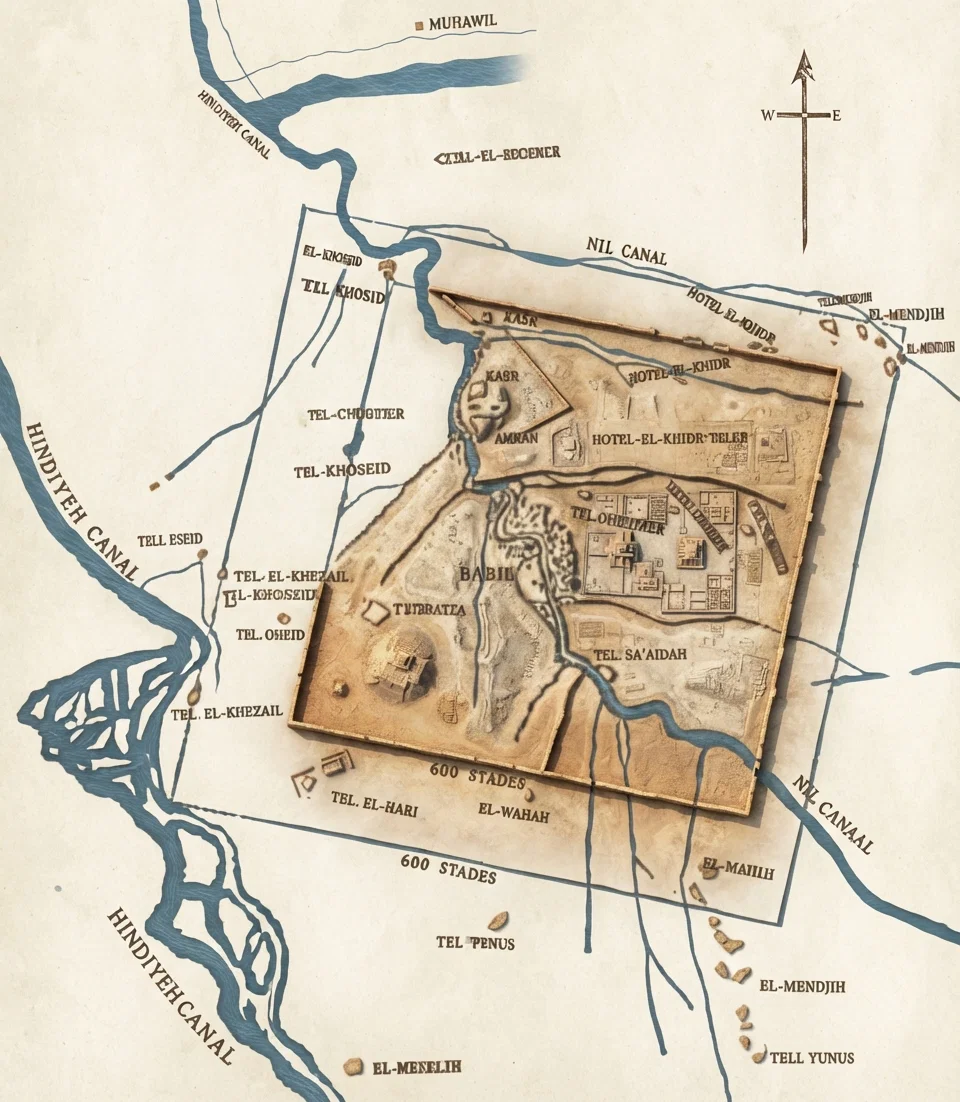
A map of the site of ancient Babylon and its environs
Assyria had yielded to the united and superior power of Media, Egypt, and Babylonia, her former dependencies, and Nineveh fell, as God had predicted. See Nahum, chapters 2 and 3. The kings of Babylon and Media had strengthened their mutual interests by marriage between the royal families. Egypt soon bowed her back to defeat. Proud and wealthy Tyre was humbled in the dust. Edom and Moab and Philistia had all passed under the rod of the mighty conqueror, Nebuchadnezzar, who in B.C. 607 was associated with his father, Nabopolassar, as joint ruler over the empire.
Babylon was just beginning to crown herself with her greater glory. Ancient public buildings and heathen temples were repairing, and new ones were projected on a much larger scale. Nebuchadnezzar, the son of Nabopolassar, was king. His wife was Amyitis, daughter of Cyaxares, king of the Medes.
Nebuchadnezzar was Babylon's greatest king. He seemed to possess neither the vanity nor the cruelty of some of the ancient Assyrian monarchs. He was progressive and enlightened. The very city in which he ruled had for
centuries been the seat of ancient learning. Even the kings of Assyria, who ruled over Babylon from Nineveh, acknowledged the traditional Babylonian greatness. Shalmaneser tells us, in his history of his expeditions, of his arrival in Babylon: "He entered also into Babylon, the bond of heaven to earth, the seat of life." The original name still held good among the heathen—"the Gate of God." Nebuchadnezzar's religious zeal was shown in repairing the ancient tower of Babel, which had fallen into decay. He himself tells this in one of his inscriptions, which have come down to us in one of the stone volumes.
He gathered around him as counselors those considered the wisest among the nations, and thus added luster to the glory of his reign. Education was fostered under royal patronage; astronomy flourished; universities great and ancient were maintained. Four classes of wise men are named in Daniel,—magicians, astrologers, ("enchanters," R.V.), sorcerers, and Chaldeans.
The astrologers were priests of the star worshipers, and pretended to foretell future events by the stars.
The sorcerers seem to be identical with soothsayers. They assumed to foretell the future by the examination of the entrails of animals, such a belief still prevailing among not a few in Christendom, who predict the winter's severity or mildness by the "melt," or spleen, of the swine.
The magicians, or magi, were a priestly class, highly educated, occupying a position of great influence between the ruler and the people. The originator of their religion was Zoroaster. They performed religious ceremonies, wore a peculiar dress, lived apart by themselves, and constituted a complete hierarchy. They were deeply versed, according to their times, in philosophy, the sciences, and especially in astronomy. They at times accompanied the king as his advisers, even in war. Jer. 39:3, 13. While there were doubtless many impostors among them, and the name through this class, in after-ages, assumed a low significance, there were also among them devout and wise men, who were doubtless worshipers of the true God. From this class came the wise men (magi) to see our Lord. Matt. 2:1. They were learned, influential, and wealthy, and Daniel was by the king placed at their head. Dan. 2:48.
The Chaldeans were the educated class, evidently including in their courses of instruction all the learning of the realm.
The promising royal youths of Judah, of good form and feature, and of royal bearing, were selected by the king as future servants, officers, and ministers of the government in Babylon. That they might be fitted for these responsibilities, the king placed them in his universities for a three-year course of special training. Here is the Bible account:
In the third year of the reign of Jehoiakim king of Judah came Nebuchadnezzar king of Babylon unto Jerusalem, and besieged it. And the Lord gave Jehoiakim king of Judah into his hand, with part of the vessels of the house of God; and he carried them into the land of Shinar to the house of his god: and he brought the vessels into the treasure-house of his god. And the king spake unto Ashpenaz the master of his eunuchs, that he should bring in certain of the children of Israel, even of the seed royal and of the nobles; youths in whom was no blemish, but well-favored, and skilful in all wisdom, and endued with knowledge, and understanding science, and such as had ability to stand in the king's palace; and that he should teach them the learning and the tongue of the Chaldeans. And the king appointed for them a daily portion of the king's dainties, and of the wine which he drank, and that they should be nourished three years; that7at the end thereof they should stand before the king. Now among these were, of the children of Judah, Daniel, Hananiah, Mishael, and Azariah. And the prince of the eunuchs gave names unto them: unto Daniel he gave the name of Belteshazzar; and to Hananiah, of Shadrach; and to Mishael, of Meshach; and to Azariah, of Abednego. Dan. 1:1-7, A.R.V.
Notes
1. THE THIRD YEAR OF JEHOIAKIM.—From Jer. 25:1 we learn that the first year of Nebuchadnezzar was the fourth year of Jehoiakim. Nebuchadnezzar, as the active force in the field, is spoken of as king two years before the death of his father Nabopolassar. His sole reign, therefore, after the death of Nabopolassar, began in the fourth year of Jehoiakim, as stated by Jeremiah. This captivity was in B.C. 606, the beginning of the seventy years' captivity of the Jews.
2. PART OF THE VESSELS.—Not all were taken by Nebuchadnezzar at this time. Jerusalem was taken twice subsequently to this by Nebuchadnezzar, B.C. 599 and 588, at which the last of the treasures were taken. See the last chapter of 2 Chronicles.
3. HOUSE OF HIS GOD.—These vessels were carried to Babylon (Shinar, Gen. 10:10; 11:2-9), were considered holy, and placed in the temple of his chief god, probably Bel-Merodach, the patron god of Babylon, to whom Nebuchadnezzar's inscriptions were addressed. This temple, says the king, "is the great temple of heaven and earth, the dwelling of Merodach, the master of the gods. I have restored its sanctuary, the place of repose of the deity, plating it with pure gold. I stored up inside silver and gold and precious stones, . . . and placed there the TREASURE-HOUSE of my kingdom," the very words which Daniel uses. At the base of the pyramid of this temple was a sanctuary of another noted deity, Nebo, the name of which enters into that of Nebuchadnezzar. This sad captivity of Judah came as the result of their repeated transgressions.
4. PRINCES.—Daniel and his fellows were evidently of the royal family, as indicated by Isaiah to Hezekiah a century and a half before. See Isa. 39:3-8. Nebuchadnezzar's judgment is shown in the character of the young men chosen, physically perfect and handsome, skilled in wisdom, endued with knowledge, understanding science, and having ability. That there were to be found such youths in Judah, speaks well of the schools of the prophets, founded by Samuel, and the advanced education given therein, notwithstanding Israel's apostasy.
5. THREE YEARS.—The university course, the advanced training which the king proposed to give to fit them for positions of usefulness in his government. They were to feed upon the king's dainties, the meats and wine of Babylon. Of this later.
6. NAMES.—From names which connected them with the true God they were to pass in their experience to names connecting them with the gods of Babylon or to the king. Daniel ("God is my Judge") was named Belteshazzar ("prince whom Bel favors"); Hananiah ("graciously given of Jehovah," a mother's thanksgiving) became Shadrach (rejoicing in the way, or little friend of the king); Mishael ("who is that which God is," a devoted mother's prayer) was changed to Meshach ("guest of the king"); Azariah ("helped of Jehovah," a prayer and prophecy) became Abednego ("servant of splendor, worshiper of the sun"). But they did not forget their God nor their people.
Of the ability of their instructors, the education Nebuchadnezzar proposed to give these youths, its real worth as compared with divine instruction, and the result of the trial between the two systems, we will consider in following articles.
The Hand
Constantinople, by its very location on the Bosporus, facing two continents and two great civilizations, will always be of political and commercial importance. All other factors which add to the glory of this metropolis are insignificant in comparison with its politico-religious importance in relation to the Moslem world. The position of Turkey and of the Ottoman Empire is unique among the Moslem countries of the world.
For centuries it has stood before the world as the one great temporal power of Islam, with its laws and usages built upon the tenets and traditions of the prophet. Here is the residence of the calif, the imam el Muslimin, the supreme pontiff of the church-state called Islam. The sultan of Turkey as the calif of the Moslem world is the custodian not only of the sacred cities, but of the sacred relics of Islam. In the hall of the Holy Garment on the Bosporus are kept the mantle of the prophet Mohammed, his staff, his saber, and his standard; and altho all Moslems pray toward Mecca, the vast majority of the Moslem world pray for the calif who resides at Stamboul.
Equal Rights
By E. F. Johnstone
By E. F. Johnstone
Believe or doubt, be saved or damned, take or reject the light,
Worship what, when, and where you will, you have a perfect right.
The infidel, my Christian friend, has rights as well as you;
And so has the Mohammedan; so also has the Jew.
Conscience is free in this fair land; and he who lifts a voice
To worship God or God deny, proclaims his right of choice.
This right is sacred, and the Lord Himself declares it so.
Then what is man, that he against the Word of God should go—
To build the thumbscrew and the rack and persecution's fire,
To make a man a hypocrite, a martyr, or a liar—
To make him praise, or claim to praise, against his own conviction?
My friend, this matter is beyond all human jurisdiction.
"Choose ye this day whom ye will serve"—yea, choose the good or evil;
'Tis ever man's God-given right, tho he may serve the devil.
Tho Heaven's love may fail to win a man from sin's dominion,
Jehovah never uses force to change a man's opinion.
The history of the world declares religious legislation,
Wherever found, has been a curse to every tribe and nation;
And yet to-day the bigot would be conscience for his brother,
And by a civil law would force his views upon another.
God's day of rest, His Sabbath day, the seventh from creation,
Some men religiously observe with praise and adoration;
Some men observe another day, if not by God directed,
In either case, men's equal rights should ever be respected.
Render to Cæsar what is his, and to Jehovah render
What He requires at thy hand, with conscience clean and tender.
Thus taught the Master when on earth, the same to-day and ever—
Use the compelling power of love, but use coercion never.
Islam's Three Centers
In view of the present situation of affairs in the Near East, Dr. S. M. Zwemer's description of the Mohammedan State is interesting. Writing in the Moslem World, he says:
The Mohammedan world has three capitals: Mecca, Cairo, and Constantinople. Mecca has been the heart of the Moslem world for many centuries. It is to-day the pulse that throbs with a religious life which finds an outlet to the farthest limits of the Moslem empire. Cairo is the head, where religious thought and education, controversy and Moslem propagandism through the press, have their center. And Constantinople has, since the Ottoman Turks made it their capital, been the hand, the center of Mohammedan political power; and not only of political power, but of grievous political persecution. These three capitals, knit together by the warp and woof of their cosmopolitan influence, weld the great Mohammedan world into a surprising solidarity.
The Heart
From Sierra Leone to Canton, and from Tobolsk to Singapore, the faithful spread their prayer-carpets, build their houses, and bury their dead toward the meridian of Mecca. In Russia, Moslems turn to the south to pray; at Zanzibar they look northward to the holy city; in Shensi and Yunnan, millions of Chinese Moslems pray toward the distant west; and in the wide Sudan, they look eastward to the Beit Allah and the Black Stone; one vast Moslem brotherhood kneeling in concentric circles toward the great religious capital of Islam.
The Head
No other city in the Moslem world has so many students of Moslem theology and law, or pours out such a flood of Moslem literature, as does Cairo. Millions of pages of the Koran, commentaries by the hundred thousand, and scores of books attacking the Christian faith, defending Islam or propagating its teaching, come ceaselessly year after year from the Moslem presses of this great center of Moslem learning.
Books printed in Cairo are read by the campfires of the Sahara, in the market-place of Timbuktu, under the very shadow of the Kaaba, and are treasured in the mosques of Java and Western China. "There is no speech nor language" in the Moslem world where the voice of the Cairo press "is not heard."
The One Book.
It is worth while, when so many who profess to be ministers of the Gospel of Jesus Christ, who have taken vows to preach the Word, are cutting and carving that Word to suit their own theories and so-called scientific hypotheses, are discarding and criticizing that great book, to find a noted educator and one who seems to be developing into a great statesman, expressing views of strong and extreme loyalty to the Bible. Here is one paragraph from an address by Professor Woodrow Wilson:
"Our present life, ladies and gentlemen, is a very imperfect and disappointing thing. We do not judge our own conduct in the privacy of our own closets by the standard of expediency by which we are daily and hourly governed. We know that there is a standard set for us in the heavens, a standard revealed to us in this Book, which is the fixed and eternal standard by which we judge ourselves; and as we read this Book it seems to us that the pages of our own hearts are laid open before us for our own perusal. This is the people's book of revelation—revelation of themselves not alone, but revelation of life and of peace. . . . He knows the kingdom for which he is bound, he has seen the revelation of himself, and his relations to mankind; he has seen the revelation of his relations to God his Maker; and therefore he has seen his responsibility to the world. This is the revelation of life and of peace."
Protecting Christians, Forsooth!
By Editor
Protecting Christians, Forsooth! — A daily paper, seemingly afflicted with hatred of Great Britain, says that the British were not willing, then (1854 to 1856) that Russia should "protect Christians," etc. Talk about Russia's protecting Christians! They do not know protection where Russia rules. A Baptist in Russia to-day can not legally or safely join a Mennonite Church, or vice versa if the government of Russia knows. A member of the orthodox church commits a great crime if he joins any other religious body. Men are sent to Siberia for religious opinion. They are imprisoned — a stronger term is needed to indicate the fearful incarceration in the filth-reeking jails of Russia. Russia does not know religious freedom or religious protection. But some day God will break her strong spirit and humble her in the very dust for the sake of His Gospel.
Why He Fell Out
By Martha V. Flory
WHEN a little boy was asked why he fell out of bed, he replied, "I 'spect, mama, it's 'cause I stay too close to the gettin'-in place." We need to move forward in our Christian life if we want to keep from falling.—Martha V. Flory.
Drawing Near to God
“THE closer you come to God’s altar, the more likely you are to be God’s missionary.”
Meaning of Christ's Coming to His Children
By C. P. Bollman
By C. P. Bollman
To His believing children the second coming of Christ will be the fruition of all their hopes. "Unto them that look for Him," declares the apostle, "shall He appear the second time without sin unto salvation." Heb. 9: 28. His coming will be therefore—
The dawn of that glad day so long foretold,
That day of holy inspiration known.
When earth with fervent, glowing heat shall melt,
And works of boastful men shall perish all
As withered flower of the summer field
Into the overheated furnace cast.
Enoch, "the seventh from Adam," spoke of "that day," saying, "Behold, the Lord cometh with ten thousands of His saints." Jude 14. The psalmist also looked forward to that day as the time of rewards. "The mighty God, even the Lord, hath spoken," writes the sweet singer of Israel, "and called the earth from the rising of the sun unto the going down thereof. Out of Zion, the perfection of beauty, God hath shined. Our God shall come, and shall not keep silence; a fire shall devour before Him, and it shall be very tempestuous round about Him. He shall call to the heavens from above, and to the earth, that He may judge His people. Gather My saints together unto Me; those that have made a covenant with Me by sacrifice." Ps. 50: 1-5.
Isaiah too spoke of the second coming of Christ as the time of the final deliverance of His people, saying: "He will swallow up death in victory; and the Lord God will wipe away tears from off all faces; and the rebuke of His people shall He take away from off all the earth. . . . And it shall be said in that day, Lo, this is our God; we have waited for Him, and He will save us: this is the Lord; we have waited for Him, we will be glad and rejoice in His salvation." Isa. 25: 8, 9.
Speaking to the prophet Daniel, the angel of God said of "that day," "And the kingdom and dominion, and the greatness of the kingdom under the whole heaven, shall be given to the people of the saints of the Most High, whose kingdom is an everlasting kingdom, and all dominions shall serve and obey Him." Dan. 7: 27.
Our Saviour Himself testified of that day, saying: "When the Son of Man shall come in His glory, and all the holy angels with Him, then shall He sit upon the throne of His glory: and before Him shall be gathered all nations: and He shall separate them one from another, as a shepherd divideth his sheep from the goats: and He shall set the sheep on His right hand, but the goats on the left. Then shall the King say unto them on His right hand, Come, ye blessed of My Father, inherit the kingdom prepared for you from the foundation of the world." Matt. 25: 31-34.
Rewards Are Given
That rewards will be given at His second coming is taught also by our Saviour in these words: "When thou makest a feast, call the poor, the maimed, the lame, the blind: and thou shalt be blessed; for they can not recompense thee: for thou shalt be recompensed at the resurrection of the just." Luke 14: 13, 14.
It is at His second coming that the dead in Christ "hear the voice of the Son of God: and they that hear shall live." John 5: 25. Of this time and of the resurrection of the righteous and of the change to immortality of the living saints, the apostle writes: "Behold, I show you a mystery; We shall not all sleep [or die], but we shall all be changed, in a moment, in the twinkling of an eye, at the last trump: for the trumpet shall sound, and the dead shall be raised incorruptible, and we shall be changed. For this corruptible must put on incorruption, and this mortal must put on immortality. So when this corruptible shall have put on incorruption, and this mortal shall have put on immortality, then shall be brought to pass the saying that is written, Death is swallowed up in victory. O death, where is thy sting? O grave, where is thy victory?" 1 Cor. 15: 51-55.
Not to Be Ignorant
Again the apostle says in 1 Thess. 4: 13-17: "I would not have you to be ignorant, brethren, concerning them which are asleep [or dead], that ye sorrow not, even as others which have no hope. For if we believe that Jesus died and rose again, even so them also which sleep in Jesus will God bring with Him [from the dead]. For this we say unto you by the word of the Lord, that we which are alive and remain unto the coming of the Lord shall not prevent [or go before] them which are asleep. For the Lord Himself shall descend from heaven with a shout, with the voice of the Archangel, and with the trump of God: and the dead in Christ shall rise first: then we which are alive and remain shall be caught up together with them in the clouds, to meet the Lord in the air: and so shall we ever be with the Lord."
In this scripture, as in 1 Cor. 15: 51-55, previously quoted, the apostle treats only of that which the second coming of Christ will bring to His own faithful children; namely, immortality, a crown of life, and a home with Jesus in His eternal kingdom.
With the testimony of the apostle Paul agree also other scriptures. To the elders of the churches of "Pontus, Galatia, Cappadocia, Asia, and Bithynia," the apostle Peter wrote: "Feed the flock of God which is among you, taking the oversight thereof, not by constraint, but willingly; not for filthy lucre, but of a ready mind; neither as being lords over God's heritage, but being ensamples to the flock. And when the Chief Shepherd shall appear, ye shall receive a crown of glory that fadeth not away." 1 Peter 5: 2-4.
Apocalyptic Benediction
Nor is this golden chain of promise which we have found running through both Testaments broken even as we reach the closing chapters of the sacred canon. Looking down the centuries to the last generation of His believing children, our Lord, by whom the Revelation was given to John through His angel, says to His waiting church: "Behold, I come quickly; and My reward is with Me, to give every man according as his work shall be. I am Alpha and Omega, the beginning and the end, the first and the last. Blessed are they that do His commandments, that [at His coming] they may have right to the Tree of Life, and may enter in through the gates into the city." "He which testifieth these things saith, Surely I come quickly." And again we say, with the beloved John, let every loyal loving heart respond, "Amen. Even so, come, Lord Jesus," bringing to Thy people eternal life, and an everlasting inheritance in the earth made new.
Our Bible Reading
The Law and the Gospel
1. What is the wages of sin?
For the wages of sin is death; but the gift of God is eternal life through Jesus Christ our Lord. Rom. 6: 23.
2. How is death destroyed, and the light of eternal life made manifest?
But is now made manifest by the appearing of our Saviour Jesus Christ, who hath abolished death, and hath brought life and immortality to light through the Gospel. 2 Tim. 1: 10.
3. Since it is the Gospel that brings "life and immortality" to light, what is the Gospel?
For I am not ashamed of the Gospel of Christ: for it is the power of God unto salvation to every one that believeth; to the Jew first, and also to the Greek. Rom. 1: 16.
4. Since the wages of sin is death, what is sin?
Whosoever committeth sin transgresseth also the law: for sin is the transgression of the law. 1 John 3: 4.
5. What was the only means the apostle Paul had of knowing sin in his life?
What shall we say then? Is the law sin? God forbid. Nay, I had not known sin, but by the law: for I had not known lust, except the law had said, Thou shalt not covet. Rom. 7: 7.
6. In what manner is sin made to appear exceeding sinful?
Was then that which is good made death unto me? God forbid. But sin, that it might appear sin, working death in me by that which is good; that sin by the commandment might become exceeding sinful. Rom. 7: 13.
7. What are Paul's conclusions, then, concerning the law?
Wherefore the law is holy, and the commandment holy, and just, and good.
For we know that the law is spiritual: but I am carnal, sold under sin. Rom. 7: 12, 14.
8. Should we gather, from any of these texts, that the law of God has been abolished through the Gospel?
Do we then make void the law through faith? God forbid: yea, we establish the law. Rom. 3: 31.
9. What was the infinite price that was paid to establish thus God's law?
For God so loved the world, that He gave His only-begotten Son, that whosoever believeth in Him should not perish, but have everlasting life. John 3: 16.
Punctuality Inspires Trust
“THERE are men who are always absolutely on time; they are the men the world trusts and believes in.”
PRESENT WORLD MOVEMENTS IN PROPHECY
The Need of a Message
WHAT there is need of a message for this time is demonstrated in so many ways that it would seem the ordinary observer of events would recognize it, and that the earnest, thinking soul who had at heart the good of humanity would long for it, and welcome it. Entirely apart from the great heathen world which must be evangelized before the Lord comes, the Christian world itself demands a great uplifting, converting, unifying message.
Consider the world theologically. The nominal Christian church is divided into three great parts, generally speaking, the Roman Catholic, the Greek, or Orthodox Church, and the Protestant churches. Leaving aside the great traditional churches — the Roman Catholic and the Greek — the Protestant churches themselves demand such a message.
Think of the vast number of denominations there are which have grown out of the Reformation, some of them divided on church government, some of them on State divisions, some of them separated for other reasons. It was not God's object that the Reformation should divide the remnants that were called out, but that it should bring them together. Men are endeavoring to force this union by a confederation, but the federation is making very slow progress, and at the very best it is not considered a vital union — that is, a life union.
It was the prayer of our Lord that His people should be one, "as Thou, Father, art in Me, and I in Thee, that they also may be one in Us;" and this unity would of itself be a demonstration to the world of the power and divinity of the religion of Christ, because this unity would prove to the world that God had sent Christ, "that the world may believe that Thou hast sent Me." The apostle Paul prayed, in his letter to the Corinthian church, that they all might "speak the same thing, and . . . be perfectly joined together in the same mind and in the same judgment." 1 Cor. 1:10. And yet we know, every one knows, that this is not the case at the present time. So manifestly has this been true for centuries that we are finding apologists for the divisions, who are endeavoring to induce people to believe that the very divisions of themselves are of God, when everything in Christianity speaks against it.
Take the differences between the denominations theologically. Note great, vital Bible doctrines upon which there is division. For instance we have the atonement, the virgin birth of our Lord, the resurrection. These three great, vital doctrines of Christianity are repudiated by many of the Higher Critics, and if nominally accepted, are shorn of their very strength by the quibbles which are raised over them.
Note the great differences regarding God's Word. Is the Bible the Word of God? Is the Bible inspired? And over this men are wrestling, with the tendencies toward the negative.
There is no agreement over the matter of regeneration. Theistic evolution possesses the minds of many at the present time. A prominent lady worker, not long ago, of the W. C. T. U., belonging to the church, who knew the tremendous influences which God exerted through such men as Wesley and Whitefield, told us that she could not believe that people could be changed in a moment from sin to righteousness, or regenerated at once by the power of God. It took years for such work to take place, — an emphatic denial of the doctrine of regeneration, and the substitution of the hypothesis of evolution.
The churches are divided over the nature of man. Is man immortal? or does his immortality depend upon the power of God at the coming of our Lord Jesus Christ?
There is division over God's law. Is the law of God summarily comprehended in the Ten Commandments of binding force and obligation? Is it immutable, as has been taught for centuries, or is it subject to change? And has it been changed? What is the strength of the fourth commandment, which enjoins the Sabbath day? Is that an ordinary ceremonial — an ordinance subject to change, so that the Sabbath, originated and sanctified by God, may be set aside and another day substituted in its place? Has man a right to do this? and is it right, and ought it to be right, to compel acquiescence to the substitute?
Is our Lord Jesus Christ coming to this earth again — materially, visibly? There is great diversity of opinion upon this.
Where shall the saints be rewarded? Will it be in some sphere "beyond the bounds of time and space"? or will it be, as has been averred again and again, upon this earth?
There is great division over the matter of church government — a minor thing as compared with these great doctrines. There are other great doctrines taught in the Scripture which we have not mentioned in this list. Not only are churches as denominations themselves divided, but members of the different denominations are divided; ministers of the same denomination are divided over some of these great fundamentals.
Is there not need of a message that will rend these walls which divide at the present time the various branches of the church of Christ? Surely if our Lord's prayer is to be fulfilled, His own people will stand united when He shall come. There will be the one Head and the one church, believing in all the fundamentals of God's truth alike.
Take the spiritual condition of the churches. Is this condition satisfactory? Every devout soul in Zion knows that it is not. We have it told us again and again by press and pulpit of various denominations that spirituality is at a low ebb. It is so easy for members of the church of Christ to attend parties of pleasure, to frequent the theater, to attend dances, to hold frequent card parties, to indulge in games of chance, to use every loose and questionable means for the raising of money for religious purposes. It is sad, indeed, that this is so, but these are facts recognized by all. There seems to be a moral obtuseness taking possession of professed Christians — a lack of moral sensitiveness. The Word of God is neglected, but there is time found for reading romances, novels, exciting and very questionable stories. Great ignorance of the Bible prevails. It is rare, indeed, that any of the members of Christian families read it regularly. A few belong to prayer bands, and the obligations of the prayer bands hold some of the members, but as a general thing there is very little reading of the Word of God.
Prayer is neglected in secret and by the family, and as prayer is neglected in the family it is neglected in the church. Many prayer-meetings have been discontinued, and others are sparsely attended. The fashionable circle claims the time, and so little things furnish excuses for absence from the devotional and prayer-meetings of the church of God.
The spirit of self-sacrifice has almost wholly departed. As a general thing men and women give what they can — what it is easy to give, what comes convenient; but how little is known of real sacrifice for the cause of Christ!
With this departure from God and His Word there has come a spirit of distrust, lack of confidence in each other, expressed in words and deeds; and this lack of confidence is not only extending out through all the various branches of trade and commerce, but it takes hold upon the national councils of the world. Treaties are made, confederations are formed, and yet it is again and again remarked that these are, in times of test and crisis, worth no more than the paper they are written upon. Surely is there not need of a message from the throne of God which will take hold upon the hearts of men, which will change hearts, which will mold lives, which will bring them, humble and prostrate, before God, which will lead them to reach out strong, yearning hands and hearts for the divine blessing, which will break down the walls that tradition has erected, the barriers which humanity has formed between the soul and God, and bring them together in the bonds of the Gospel of Christ, bound by the life of His Spirit! We believe that there are longing souls who see this, feel this, yearn for it. But, friends, God has the message which contains all the need — a remedy which meets all the ills. It is found in the everlasting Gospel of our Lord and Saviour Jesus Christ, and we appeal to you to read again the message which was printed last week.
The King's Example
By William Rounseville Alger
Once Sultan Nushirvan the just, hunting,
Stopped in an open field to take a lunch.
He wanted salt, and to a servant said,
"Go, get some at the nearest house, but pay
The price the peasant asks." "Great king," exclaimed
The servant, "thou art lord o'er all this realm;
Why take the pains to buy a little salt?"
"It is a little thing," said Nushirvan,
"And so, at first, was all the evil whose
Most monstrous load now presses so the world.
Were there no little wrongs, no great could be.
If I from off a poor man's tree should pluck
A single apple, straight my slaves would rob
The whole tree to its roots; if I should seize
Five eggs, my ministers at once would snatch
A hundred hens. Therefore strict justice must
I, even in unimportant acts, observe.
Bring salt, but pay the peasant what he asks."
—W. R. Alger.