Practical Benefits From the Ministerial Reading Course
By W. E. HOWELL
It is gratifying to note the benefits being received by members who are faithfully pursuing the Ministerial Reading Course. A letter just received from Elder E. R. Potter, of British Columbia, is a fair sample of many that are coming in from day to day, testifying to the practical value of thorough and systematic reading. He says:—
“It gives me pleasure to report that I have just completed reading the three books included in the 1914 Ministerial Reading Course. In reading the first book, ‘Preparing to Preach,’ I was captivated from the first, and read it through very carefully, marking the important points and lessons, all the time thinking to myself that there will be parts of the book which will not interest me so much and which I can read faster. But I never found the place where I could read ‘on the run,’ but was compelled to ‘take notice’ of every chapter and page. The help I received from the reading of this book exceeds my pretty-well-enlarged expectation as to means, manner, and methods.
“I read ‘The Monuments and the Old Testament’ next, and found it to cover the ground of that subject more thoroughly than anything I had read before. I appreciate the book very much as a reference book to use in my work in dealing with doubts and doubters.
“The last book read was the book I had read many parts of before, but now I can say I appreciate ‘The Acts of the Apostles’ as I had scarcely dreamed that I should. To me it seems providential that I was directed to read this book just at this time. In my work here in Vernon I have tried to sow the seeds of truth, and have been more than ever impressed that we have a chain of truth which overthrows all opposition from the standpoint of argument and facts. I have seen persons one after another acknowledge that we are right in doctrine, but fail to make the decision and act upon it. In reading this book I have discovered a message God has for me. The instruction concerning the ‘daily baptism of the Spirit,’ found on pages 50 and 362 and 363, is of such importance that all else sinks into insignificance compared to it.
“I have witnessed in the last few days the working of this Spirit in a marked manner. Persons for whom I have labored and prayed for months have been impressed by the Spirit of God to take their stand on the side of truth. The message of this book to me is, Press on with increasing zeal to present the clear-cut principles and arguments of the message, but far more than ever keep in mind that daily and hourly conscious communion with God is required to enable the Spirit of God to use your efforts in winning souls for him; for the statement is made, ‘Communion with God will impart to the minister’s efforts a power greater than the influence of his preaching.’—Page 362.”
“I need not tell you that I have enjoyed the part I have had in the Ministerial Reading Course. I shall order the books for the 1915 course in a few days.”
Finish the Course for 1914
We hope that all those who are still working back on the course for 1914 will persevere till they finish it. It will bless them and encourage others.
Register for 1915
Registrations for 1915 continue to come in, as also most gratifying reports on the first book. Our reading schedule for the year is as follows:—
“Medical Science of Today,” January to March.
“The Minister as Shepherd,” April to May.
The new “Gospel Workers,” June to August.
“History of the Ancient World,” September to December.
Christian Education magazine, all the year.
The way is still open for registrations.
W. E. HOWELL.
News and Miscellany
Notes and clippings from the daily and weekly press
— According to statistics which have been compiled, 85,000 babies have been born in Belgium since the start of the war, and these births have been under conditions which have caused a frightful mortality to mothers and offspring.
— At least seventy lives are believed to have been lost at sea in the storm that swept the Atlantic coast April 3. It is probable that full reports will add to the death list.
— Shrinkage in the net income of the Pennsylvania Railroad Company for 1914 as compared with 1913 amounted to $7,830,067. Unfavorable commercial and financial conditions accentuated by the war in Europe are the chief reasons assigned for the decline.
— Switzerland has a new president, Giuseppe Motta. There are three notable things about his accession to the presidency: he is the first Italian-speaking citizen and the first Roman Catholic who has held the office of president; he is also the youngest man who has ever held the office.
— The concentration of picked troops around the Chinese capital has been practically completed. A hundred thousand men with artillery reserves are now distributed along the railways, and the roads to Peking are completely barred. It is reported that Japan has occupied strategic positions at Mukden and Tsinan.
— On May 1, 1915, a party of fifty leading Chinese merchants, bankers, and officers are expected to arrive in San Francisco, Cal. They come to America to study our financial and political life. Their tour of this country will mean an 11,000-mile trip occupying seventy days and including every part of the United States.
— The State of Vermont has taken from the Carrara district, Italy, the honor of being the world's greatest marble-producing field. The vein of marble in Vermont is fifty-seven miles long and from 1,650 to 2,200 feet in width. The grade of marble is equal to earth's finest. Great quantities are being taken from the vein.
— A telegraph machine which is worked like a typewriter at the sending end and the message from which comes out on a printed sheet at the receiving end, has been installed in the offices of the Associated Press and the New York morning newspapers. The efficiency of the new machine is considered to be fifty per cent greater than the mere man operator.
— The siege of Przemysl was the longest in modern warfare. It began on Sept. 2, 1914, on the very day that the Russians defeated the Austrians before Lemberg, and with few intervals of rest, continued for 201 days—or for 100 days longer than the siege of Port Arthur in 1904; 71 days longer than the siege of Paris in 1870-71, and 51 days longer than the siege of Adrianople in 1912-13.
— Perhaps no other section of the world has felt so keenly the devastating effects of the European war on business as have the nations of South America. Customs revenues have fallen off two thirds, the personnel of governments has been reduced, salaries cut down, public works stopped, and other forms of retrenchment adopted. These facts have drawn South American governments to the United States as never before, and indicate that the Pan-American Financial Conference, which President Wilson has called for Washington on May 24, will prove a historic assembly for the nations of the Western Hemisphere.21
— The world's largest typewriter, an Underwood, is on exhibition at the Panama-Pacific Exposition, San Francisco, Cal. It is 1,728 times larger than the standard machine. It looks much more like a great organ than like the ordinary typewriter. The letters are three inches high and space two inches. The machine is twenty-one feet wide and fifteen feet high and weighs fourteen tons. Two years were required for its construction at a cost of $100,000.
— According to the statistics made public by the state department of mines, more than 1,000 miners lost their lives in the mines of Pennsylvania in 1914. Six hundred men and boys were killed in the anthracite mines, and 413 in the bituminous region. This loss of life, heavy and sad as it is, is a decrease of 198 over the year 1913. The total production of coal in the State of Pennsylvania for the year was 237,251,835 tons. The number of persons employed in and about the mines last year was 376,831.
— The total net revenue of all steam railroads of the United States with operating revenues of more than $100,000 for the fiscal year ended June 30, 1914, was given at $845,216,654, in a report made public last week by the Interstate Commerce Commission. Operating revenues for the same period were $3,047,019,908, and operating expenses $2,200,313,159, with a net deficit from outside operations of $1,490,095. The net corporate income was given at $347,206,000. Operating revenues for the same period in 1913 were $3,122,115,798, with operating expenses of $2,169,968,924.
— The Women's Council of St. Louis, Mo., composed of fifty-four organizations and clubs, will erect an office building in the down-town district from which men will be barred as tenants and employees. Women will run the elevators and officiate as window cleaners and janitors. If the announcement is accurate, they will also look after the boilers and the machinery in the cellar. The architect will be a woman, but the actual builders presumably will be men, since the feminine invasion has not yet extended to the occupations of steel frame erector, riveter, bricklayer, and carpenter. Excavating also is man's work, and the materials must be purchased from masculine firms. But the intention seems to be to construct, so far as possible, a monument to the new feminism.
— The brotherhood societies of London, of which there are 300, with a total membership of 66,000, have started a novel patriotic campaign, for which Lord Kitchener has supplied the watchword. Strictly following the lead of the field marshal secretary of war, the brotherhood council of war has drawn up the following pledge: "In order that I may be of the greatest service to my country at this time of national peril, I promise until the end of the war to abstain from all intoxicants, and to encourage others to do the same." It is pointed out that while the nation raised $15,000,000 in eight weeks for a relief fund, $17,500,000 is spent on drink in less than eight days. Every week brewers and distillers use up 73,000,000 pounds of grain, 3,000,000 pounds of rice or maize, and 9,500,000 pounds of sugar or sugar equivalent.
— King George of England has added his plea to that of the shipowners, and, in some cases, that of the laborers themselves, that some vigorous measures be adopted to cope with the question of drunkenness, which, it is urged, is having the effect of delaying the delivery of munitions of war. The king has volunteered, if it is considered advisable, personally to give up the use of all alcoholic liquors and to issue an order against their use in the royal household.
— President Wilson and former-President Taft were the central figures at the laying of the corner stone of an $800,000 marble home for the American Red Cross at Washington on March 27. The building will be erected as a memorial to the heroic women of the Civil War. The President did not deliver an address, but personally supervised the laying of the corner stone. The building is to be completed by April, 1916. Congress appropriated $400,000 for it, and the additional $400,000 was raised by private subscriptions.
— Fred E. Woodward, of Washington, D. C., contributes to the current number of the Scientific American an interesting chart showing the number of books published last year in the United States and England, classified according to subjects. Fiction and religion occupied the leading place, but Mr. Woodward points out that the demand for fiction has been falling off in recent years. The grand total for the year 1914 was 12,010, just 220 less than the total for the year 1913. Of this number 10,175 were actually new books and 1,835 were new editions. American authors contributed 8,563 of this total, and foreign authors, mostly English, the remainder.
— Foodstuffs are now being shipped to Germany by parcel post. By way of the Chicago post office over 1,000 packages containing edibles of all sorts have been sent in the past two weeks to Germany and Austria. The shipments are being sent by individuals here to individuals over there. The packages are said to contain tea, coffee, sugar, flour, and, in fact, about every kind of foodstuff except meats and sausage, and they are nearly all up to the legal limit of eleven pounds. They go by way of Amsterdam on the Holland-American line. There is no duty paid in the United States on such shipments. There is no violation of the neutrality laws in this, inasmuch as the goods are not sent to any administration or to the field of battle, but from individuals to individuals.
— At the Mexican Peace Conference held some weeks ago a permanent peace committee was appointed. The committee has proposed as a peace plan for Mexico, a form of commission government to have supreme power in Mexico until elections can be held and a constitutional president inaugurated. To secure the support of all factions this peace plan provides that the three supreme commissioners be selected by a board of directors, composed of representatives of each recognized party. The commission is "to have extraordinary facilities without other limit than the salvation of independence and national integrity, and is to be responsible to congress for its acts." The plan also provides for agrarian reforms which have been a central feature of every revolution in Mexico.
— The death of Nathan Mayer Rothschild, first Baron Rothschild, head of the British branch of the great banking firm, occurred at his London residence on March 31.
— Ohio wants a larger yield of farm products. So she induced about 1,300 of her farmers to attend classes in the State university in Columbus to help them bring about these results. President Thompson, of the university, prepared a program especially adapted to the farmers. He says that a few days spent in the classroom will mean more corn for Ohio. Among those in attendance was a man eighty years of age, who took every lecture on the program. In order to bring so large a number of agriculturists together, extensive advertising was carried on throughout the State, billboards, newspapers, and magazines being used to draw attention to what was called Farmers' Week. The only requisite for a seat in the lecture rooms and a place in the laboratories was the payment of a nominal fee. The experiment has proved successful.
— No longer will U. S. fleet commanders in foreign waters, with superior naval strength, be placed in the embarrassing position of being unable to take supreme command of a united force, owing to the presence of an admiral or vice admiral of some other navy. By passing a law creating the grade of admiral, Congress has made it possible for the navy to receive at all times the recognition it deserves—an act of especial importance just now, with the complicated international situation. President Wilson, acting under the provisions of this new law, designated as admirals, last week, Rear Admirals Fletcher, Howard, and Cowles, commanders in chief respectively of the Atlantic, Pacific, and Asiatic fleets, who rank in the above order also as to seniority. Aside from Admiral Dewey, the hero of Manila, who as "admiral of the navy" enjoys a unique rank in naval history, no other American naval officers have been privileged to hold the rank of admiral except Farragut from 1866 to 1870, and Porter from 1870 to 1891. Three vice admirals are also to be appointed under the provisions of the new law.
Educational Department
J. L. SHAW — General SecretaryF. GRIGGS — N. Am. Div. SecretaryW. E. HOWELL — N. Am. Div. Asst. Secretary
NOTICES AND APPOINTMENTS
Camp Meetings
CENTRAL UNION CONFERENCE
Wyoming ................................ June 8-15
Colorado, Boulder ........................ June 17-27
West Colorado, Grand Junction ........................ June 28 to July 5
Missouri ................................ Aug. 5-15
Nebraska ................................ Aug. 19-29
West Pennsylvania ........................ June 10-20
Eastern Pennsylvania ........................ June 17-27
Chesapeake, Hamilton Avenue Grove, Baltimore, Md. ........................ June 24 to July 4
New Jersey ........................ June 24 to July 4
Virginia ................................ Aug. 5-15
Ohio ................................ Aug. 19-29
West Virginia ........................ Aug. 26 to Sept. 5
NORTHERN UNION CONFERENCE
Iowa, Waterloo ........................ May 27 to June 6
Minnesota, Anoka ........................ June 3-13
South Dakota ........................ June 10-20
North Dakota, Jamestown ........................ June 17-27
Obituaries
SPECIAL NOTICE
In view of the constantly increasing demands made upon the columns of our general church paper by our rapidly growing work throughout the world, it will be necessary to limit obituary notices, in ordinary cases, hereafter to ten lines.
ELLIOTT.— Mattie Elliott was born in Cambridge, Md., Oct. 24, 1890, and died in Baltimore, Md., March 27, 1915. She accepted present truth in the summer of 1914, as a result of the tent effort held in Baltimore, and united with the Seventh-day Adventist Church. She was a faithful member, and fell asleep triumphant in the hope of soon meeting her Saviour. She is survived by her husband, two small children, a mother, and a sister.
GUSTAVUS P. RODGERS.
COOL.— Died in Hartland, Maine, March 28, 1915, Charles Cool, at the age of nearly ninety years. The deceased was a member of the Hartland church at the time of his death; and although for some time he had been unable to meet with the brethren and sisters in worship, yet his faith in the message remained firm, and we trust he will have a part in the first resurrection. He is survived by two sons and two daughters.
P. B. OSBORNE.
(Atlantic Union Gleaner please copy)
PETTIT.— J. C. Pettit was born in Allegheny, Pa., Oct. 16, 1839, and died in Alliance, Ohio, in March, 1915. He was a member of Company C, One Hundred and Forty-ninth Pennsylvania Volunteer Infantry, during the Civil War. During the last years of his life Brother Pettit was a great sufferer, but his courage and trust in God never faltered. He was a member of the Seventh-day Adventist Church in Alliance. His companion, one daughter, one brother, and one sister survive.
W. J. VENEN.
WILLIAMS.— Enos E. Williams died March 27, 1915, in Locust Point, Ohio, aged 81 years. He was a pioneer in the State. By request the writer conducted the funeral service. Brother Williams is survived by a wife, a daughter, and a son.
D. E. LINDSEY.
ASHLEY.— Philip George Ashley was born in Worton, Md., Aug. 9, 1835, and died at his home, in Rock Hall, Md., March 22, 1915. He was married to Mary C. Ayres in 1863, and to this union five children were born. The wife, two sons, and two daughters are left to mourn.
S. T. SHADEL.
SALTER.— Mrs. M. E. Salter was born in Indiana, Sept. 1, 1839, and died at her home, in Fresno, Cal., March 11, 1915. She accepted the third angel’s message many years ago, and was a faithful member of the Seventh-day Adventist Church at the time of her death. She is survived by her husband, one daughter, and a son.
N. P. NEILSEN.
GOODRICH.— Died in Auburn, Maine, March 24, 1915, Mrs. Phebe C. Goodrich, widow of the late Elder J. B. Goodrich, aged 69 years and 20 days. She accepted present truth more than thirty-five years ago, and we feel confident that she rests in hope. Interment took place in Dyer Brook. One nephew, three nieces, and other relatives are left to mourn.
P. B. OSBORNE.
(Atlantic Union Gleaner please copy)
CHAPMAN.— William Wallace Chapman was born in Minnesota, Nov. 10, 1869, and died March 19, 1915, in Upland, Cal. He was a resident of California for twenty years, and for some time practiced dentistry in Ontario, Cal. Brother Chapman was beloved by all who knew him. As the end drew near, the Lord gave him a special blessing, and his was indeed a triumphant death.
CLARENCE SANTEE.
O’REILE.— Maria L. Fell was born in Canada, near Niagara Falls, Oct. 23, 1835, and died at her home, near Onaway, Mich., March 28, 1915. Dec. 5, 1855, she was united in marriage with A. C. O’Reilly. In 1863 they moved to Michigan, and two years later heard and accepted present truth. Sister O’Reilly was a consistent Christian, and her faith was strong. She is survived by her aged husband, one son, and five daughters.
J. J. IRWIN.
FOGLE.— Michael W. Fogle was born in Frederick County, Maryland, Dec. 17, 1850, and died at his home, in Frederick, Md., March 19, 1915. His wife, three sons, three daughters, four sisters, and a host of relatives and friends are left to mourn. Although a great sufferer, our brother was patient and cheerful, and in him the church loses one of its most earnest members. He united with the company at Frederick as a charter member Nov. 15, 1913.
S. T. SHADEL.
BELTZ.— George C. Beltz passed away March 7, 1915, aged 89 years, 11 months, and 4 days, at the home of his son in Medford, Oregon. Brother Beltz was born in Russia in 1825, and in 1844 was married to Miss Mary Wagner. To this union seven children were born, four of whom, with their mother, have been laid to rest. In 1859 Mr. Beltz was united in marriage with Mrs. Mary Henegart, who is living. He united with the Seventh-day Adventist Church in 1844, while living in the State of Kansas, and was a member of that church until his death.
T. L. THUEMLER.
LINK.— Benjamin Franklin Link was born in Kinderhook, Columbia Co., N. Y., March 11, 1842, and died in Aberdeen, S. Dak., Nov. 22, 1914. He was married to Miss Estella Maria Farnham March 10, 1892. They made their home in Lyon County, Minnesota. Five children were born to them. Later the family moved to Marshall, Minn., and then to Aberdeen, S. Dak. In 1895 Brother Link embraced present truth, and at the time of his death was leader of the church where he held his membership. The funeral service was conducted by Elder C. L. Emmerson.
N. A. B.
BISEL.— Clement L. Bisel died at his home, near Bellville, Ohio, March 19, 1915, aged 50 years, 6 months, and 20 days. In 1888 he was united in marriage with Miss Elizabeth Burkholder, who, with three of their six children, is left to mourn. The aged father of the deceased also is living.
E. K. SLADE.
BAILEY.— Ellen Bailey fell asleep in Jesus at her home, in Pittsburgh, Pa., March 21, 1915, aged 81 years, 8 months, and 13 days. She accepted present truth about four years ago, and remained happy in the hope of a soon-coming Saviour until called by death. Funeral services were conducted by Elder F. H. Robbins and the writer.
JOHN P. GADE.
ANDERSON.— Laura Anderson was born in Lawrence County, Indiana, April 20, 1899, and died at her home, in Indianapolis, March 20, 1915. She attended the services in the Seventh-day Adventist Church and accepted all points of faith, but because of failing health was not able to be baptized. She is survived by her parents, three brothers, and five sisters.
H. M. KELLEY.
PETERSON.— Andrew P. Peterson died at his home, in Hawarden, Iowa, Dec. 10, 1914, aged 73 years. He was one of the pioneers of the third angel’s message in South Dakota, having accepted present truth through the labors of Elder E. W. Farnsworth, in 1876. His death is mourned by his wife, formerly Mary Rasmussen, and four daughters. Words of comfort and consolation were spoken by the writer.
P. T. MAGAN.
DEAN.— Died in White Lake, Mich., March 18, 1915, Mrs. Alonzo D. Dean. Elizabeth House was born in Pleasant Valley, Mich. She was united in marriage with Alonzo D. Dean June 3, 1871. Their five children and two brothers are left to mourn. Sister Dean accepted present truth in 1882, and was faithful to the message until the close of her life. We feel confident that she sleeps in Jesus.
J. G. LAMSON.
CLARKE.— Lewis C. Clarke was born Feb. 28, 1845, near Sandusky, Ohio, and lived in that vicinity until sixteen years of age, when he enlisted as a soldier in the Civil War. At the close of the war he was married to Lottie Maria Peck. In 1898 present truth came to him, and he gladly accepted the third angel’s message. He fell asleep in “the blessed hope” March 13, 1915, and we laid him away to await the call of the Life-giver.
F. A. WRIGHT.
Publications Wanted
THE following-named persons desire late, clean copies of our publications, sent post-paid, for use in missionary work:—
Fred M. Cock, R. F. D. 1, Box 49, Harrison, Ark.
Mrs. W. C. Mantley, 921 Eighth St., E., Fairbury, Nebr.
Lisbon Myers, Marengo, Iowa. All denominational papers except REVIEW.
F. W. Swan, 308 Lewis St., Frankfort, Ky. Signs, Instructor, and tracts, pamphlets, and magazines.
Mrs. N. L. Huling, Bartlesville, Okla. Continuous supply of Signs (weekly and monthly), Watchman, Instructor, Protestant Magazine, and tracts.
For Sale for Missionary Purposes
ONE store house 30 x 80 ft., Graysville, Tenn., one-half block from post office and across the street from the Graysville Bank. Has good tables and shelving in the inside, is located on one acre of land. One of the best business buildings in the town. Besides store building, there are good barn, shed for coal and wood, shop, chicken house, good well, large scales, etc. Price, $2,500.
Also eight and three-fourths acres, three blocks from Graysville post office, one block from the depot; two acres and an apple orchard, good land, lies level; good well; barn, 24 x 36 ft.; no dwelling. A splendid home place for some one desiring to locate in Graysville. Price for this piece of property and the above store building together, $4,000.
A portion of the price of these properties has been pledged to missionary work. Address W. H. Branson, President Cumberland Conference, Graysville, Tenn.
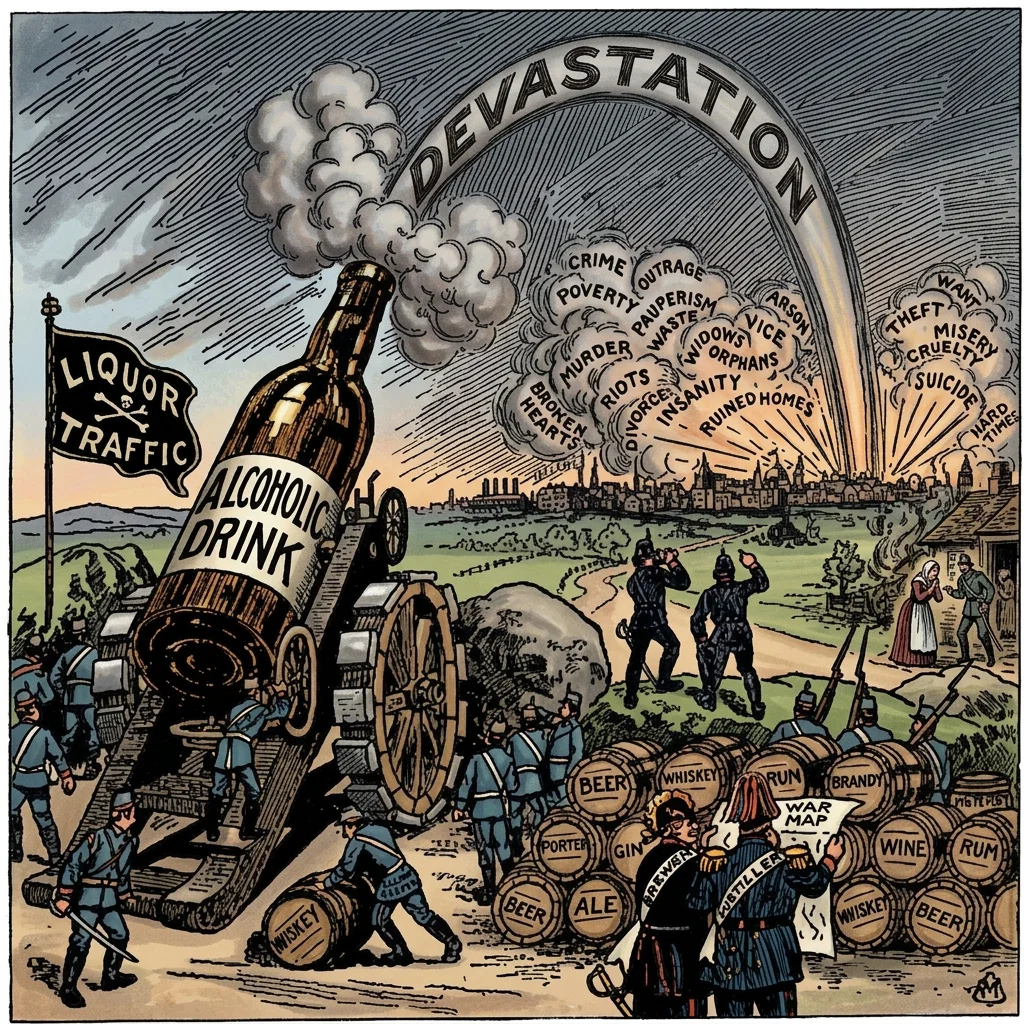
Our Besieged Cities
The Liquor Traffic has laid a perpetual siege to our cities and towns, and is bombarding them with “Bottle-guns,” which inflict more death and general destruction than the large siege guns of a modern army.
The ammunition used in the “Bottle-guns” is DEVASTATION, fired without detonation, at an annual national cost of $2,700,000,000, and produces crime, outrage, arson, poverty, pauperism, vice, murder, waste, widows, orphans, broken hearts, riots, divorces, insanity, ruined homes, want, theft, misery, cruelty, hard times, and suicide. For the raising of this Liquor Traffic siege
The Instructor Temperance Annual
MACHINE BALLOT-GUN
is mobilizing an army of millions, and equipping it with effective, rapid-firing “ballot-guns.” Every loyal man and woman who votes may enlist. Suffering humanity demands your services. Peace and prosperity depend upon your vote.
TWO BOOKS OF ART
“Pen Pictures of the Face of Jesus”
THIS attractive and inspiring book, by Wm. P. Pearce, is meeting with universal approval. To say that it was written by the author of “The Lover’s Love” and “The Master’s Greatest Monosyllables” is a sufficient testimonial to recommend it to the readers of those highly prized books.
It is well illustrated with reproductions of paintings of Hofmann, Raphael, and other famous artists, and has an art cover in three colors.
“Blessed Be Drudgery”
ONE of the most practical and helpful books for everyday life which we have ever printed. Every page is filled with helpful lessons, practical illustrations, and valuable suggestions.
The book indicates careful study and a wide range of knowledge on the part of the author, as well as a desire to improve the moral tone of the reader and benefit humanity. The purchaser of this book is sure to be pleased with it. Just the thing for a gift.
Both books are printed on heavy paper, each page having an art border. Bound in cloth; price, 50 cents a copy.
ORDER OF YOUR TRACT SOCIETY
REVIEW & HERALD PUB. ASSN., WASHINGTON, D. C.
The Work in Russia
THE superintendent of our West Russian Mission field, writing under date of February 23, says:—
“Last Monday I received a telegram from Tiflis giving notice that the superintendent of the Trans-Caucasian Mission field had been banished to Siberia. This leaves another important conference without a leader. From other parts of the country we hear that our workers are followed by the police constantly. Not only are a number of our workers banished, but those allowed to remain are restricted in every possible way in carrying on missionary work. We have not had a general meeting for years, and should hardly know how to conduct one here. All we are able to do is to visit the churches without giving notice of our coming, going from one to another if we are permitted to do so. This makes the work very hard, but the Lord has stood by us, and we are confident that our people are praying for the progress of the truth of God in Russia.”
“During the year 1914 we were able to take into the church 954 new members. This includes all Russia, with our small staff of workers. We are indeed grateful to our Heavenly Father for his wonderful love. We are not discouraged, for we see that our God is a mighty helper, and where the way is hardest he has more grace in store for us. But we are not satisfied with the past, and look for even greater blessings.
“The Lord will bring good out of this terrible war. I am sure some of the countries that have been practically closed to the message will receive more liberty after the war is over. God has a work on earth which will stand the storm, as did Noah’s ark. It carried him over from the old world into the new. So the truth will be able to uphold us when everything around us goes to destruction, and it will in the end land us in the kingdom of God. I am glad God bids us look up, knowing that our salvation draws nigh.”
Spicer Visits Southern Africa
ELDER W. A. SPICER writes from Cape Town, March 4, that he had a pleasant and safe voyage from England to the Cape. He was to leave there in a day or so to visit missions in Basutoland, Maranatha, and Spion Kop, prior to the union conference session at Durban.
Graduation at Soonan School
C. L. BUTTERFIELD writes that seven students will be graduated this month at our school in Soonan, Korea. All will go directly into the work of giving the third angel’s message in that field. He also mentions their annual meeting, appointed for Soonan, April 6-13, at which Brethren Daniells and Porter will be present.
A Message from Sister E. G. White
By Editor
THE article in this number from Sister E. G. White is a message which she dictated from her sick bed, and will be read with interest by all, particularly our young people. A letter from Elder W. C. White, written April 2, states that his mother has not been so well of late, and he feels that she is growing weaker. Her courage in God remains firm and steadfast, and she patiently awaits all that the future may have in store for her. Let us continue to pray that God may remember his aged servant, and give to her in her weakness the assurances of his grace.
Medical Convention at Loma Linda
ELDER I. H. EVANS writes of the excellent medical convention which was held in Loma Linda, Cal. He says, “I think it was the best medical council we have ever held.” A report of this meeting will appear in an early number of the REVIEW. Writing of the Boulder-Colorado Sanitarium, Brother Evans says: “I have never seen the sanitarium look any nicer outside and in than it does now. Everything looks well kept.” Elders Evans and Knox, and nearly all the other brethren attending meetings in the West, returned to their offices last week.
“The World’s Crisis”
By W. J. Stone
I HAVE read carefully the book recently published by the Review and Herald Publishing Association, entitled “The World’s Crisis,” and I cannot speak too highly of its merits and the great good that I believe it is destined to accomplish at this epoch in our work.
I believe that no other book ever sent out by our publishing houses, containing the same number of pages, has been laden with such a concise and clear exposition of our faith and message as this book. It covers nearly the whole field in a nutshell, and is just the book for busy men in this busy age.
It deals with the living issues in which all the world is interested. All its statements are clear-cut, and facts and scriptures are presented to substantiate them. The great lines of prophecy giving a history of the nations, and the signs of Christ’s coming, all focusing in this generation, should arrest the attention of every honest soul.
The scriptures cited pointing out the great Sabbath reform, the law of God, his eternal rule of right, the second coming of Christ and the setting up of his kingdom, the home of the redeemed, the destruction of sin and sinners, are so plain and pointed that they cannot be controverted. This book should be sold by the million. It is distinctively the message for this time.
W. J. STONE.
Series on Adventist Doctrines
By Editor
WE begin in this number of the REVIEW a series of articles by Elder W. A. Spicer. These articles will present in brief form the important doctrines held by Seventh-day Adventists. Many valuable facts and quotations will be presented. We believe that they will be read with interest.
Selling The World’s Crisis
ELDER J. W. HIRLINGER, president of the Virginia Conference, writes: “One of our new Sabbath keepers in Portsmouth, who lost his position on account of the truth, has been persuaded to canvass for ‘The World’s Crisis.’ In the hour he sold thirty copies of the book, and in five hours eighty-two copies. Most of these were sold for cash. No one seems to have any trouble selling this little book. The Portsmouth church has ordered six hundred copies, and our members hope to dispose of even more.”