Your ShelfYour Projects

Signs of the Times, Vol. 33, No. 51.

Signs of the Coming Son
Earlier text: Signs of the Coming Son

Present-Day Conditions Minutely Foretold

Great Spiritual Declension Predicted.

1. What does the apostle Paul tell us will be the general moral condition of the world in the last days?
"This know also, that in the last days perilous times shall come." 2 Tim. 3: 1.
2. What does he say will be the cause of these perilous times that are to come in the "last days"?
"For men shall be lovers of their own selves, covetous, boasters, proud, blasphemers, disobedient to parents, unthankful, unholy, without natural affection, truce-breakers, false accusers, incontinent, fierce, despisers of those that are good, traitors, heady, highminded, lovers of pleasure more than lovers of God." 2 Tim. 3: 2-4.
3. What does the apostle say further in regard to these people who will make the last days perilous because of the sins they are committing?
"Having a form of godliness, but denying the power thereof: from such turn away." 2 Tim. 3: 5.
NOTE.—Study closely what we are to "know" of the conditions that will obtain in "the last days." The foregoing texts from the apostle Paul make the matter too plain to need any special comment. First, he says that we are to "know" that the "last days" are to be perilous because of certain things. Secondly, he assures us that the things that will make the last days perilous are a great array of sins that will be general in the world. And, thirdly, he says that these sins will be among those who have "a form of godliness." The "form" of godliness is found only among professing Christians; the out-and-out worldling makes no pretension to any of the forms of religion. Hence these people who hold to the forms of godliness, but who deny its power, are base hypocrites. This is the clear teaching of the word of the Lord, and the responsibility of the utterance is with Him. Let the reader ask himself the question, "How many of my acquaintances who make a profession of godliness are living in harmony with their professions?" Not that it is expected that the professors of Christ will make no mistakes, but they should keep from being apparent and glaring hypocrites.
4. What does Christ say will result from a general condition of iniquity?
"And because iniquity shall abound, the love of many shall wax cold. But he that shall endure unto the end, the same shall be saved." Matt. 24: 12, 13.
5. What question does the Teacher ask concerning faith at the time of His coming?
"Nevertheless when the Son of Man cometh, shall He find faith on the earth?" Luke 18: 8.

Knowledge to Be Increased.

6. What does the prophet say in regard to knowledge at the end of time?
"But thou, O Daniel, shut up the words, and seal the book, even to the time of the end: many shall run to and fro, and knowledge shall be increased." Dan. 12: 4.
NOTE.—Various translators and commentators on this text quoted from Daniel make it quite evident that the prophet refers particularly to the increase of knowledge in regard to the Bible and its prophecies that are to specifically mark the "time of the end." But no matter in what direction we look in this time we see an almost bewildering array of the increase of knowledge. Bibles have been multiplied, and the knowledge contained in the Bible has been spread before this generation so that every one may have it if he wants it. And then general knowledge of the arts and sciences, covering every field of investigation, is prodigially abundant.

A Cry of Peace and Safety.

7. Will there be a time when men generally will be talking of peace and safety?
"But of the times and seasons, brethren, ye have no need that I write unto you. For yourselves know perfectly that the day of the Lord so cometh as a thief in the night. For when they shall say, Peace and safety; then sudden destruction cometh upon them, as travail upon a woman with child; and they shall not escape." 1 Thess. 5: 1-3.
NOTE.—They will be saying "peace and safety," and this talk of "peace and safety" is in connection with the time when the "day of the Lord" is the theme before the world. And "when they are saying, Peace and safety," as the American Standard Revised Version puts it, then it is that "sudden destruction cometh upon them," and they shall not escape from it. If people are saying "peace and safety" in the face of sudden destruction, it must be that they do not have sufficient ground on which to base their claim of "peace and safety."

Signs in the Heavens.

8. Will there be signs in the sun, moon, and stars to betoken the second coming of Christ?
"And there shall be signs in the sun, and in the moon, and in the stars; and upon the earth distress of nations, with perplexity; the sea and the waves roaring; men's hearts failing them for fear, and for looking after those things which are coming on the earth: for the powers of heaven shall be shaken. And then shall they see the Son of Man coming in a cloud with power and great glory." Luke 21: 25-27.
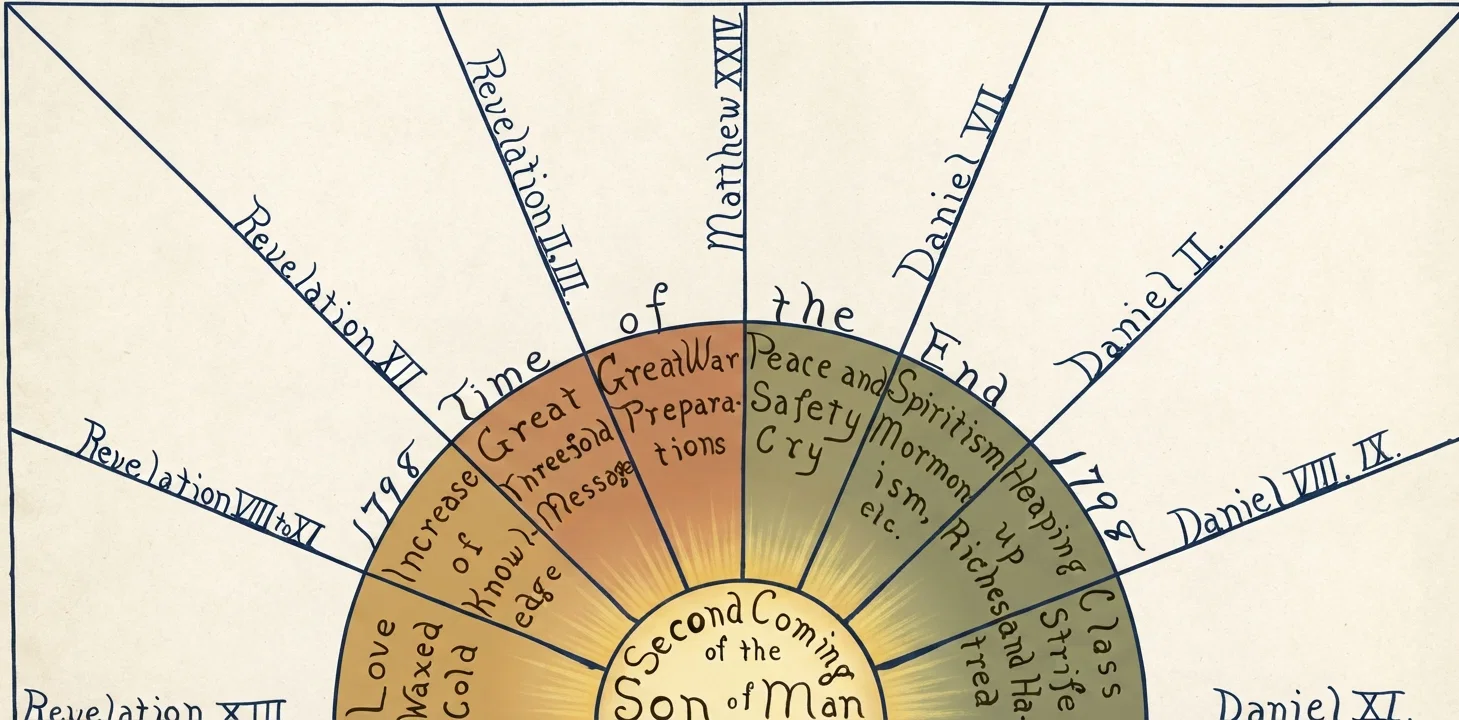
In this diagram are nine lines of prophecy, and eight special signs, there are many more), all showing unmistakably that Christ's coming is near. The Bible-reading above merely touches upon six of these signs. Study them, reader. "When ye see all these things, know ye that He is nigh, even at the doors." Matt. 24:33. A.R.V.

Last-Day Scoffers.

9. Will men scoff at the doctrine of the second coming of Christ?
"Knowing this first, that there shall come in the last days, scoffers, walking after their own lusts, and saying, Where is the promise of His coming? For since the fathers fell asleep, all things continue as they were from the beginning of the creation." 2 Peter 3: 3, 4.
NOTE.—Unless some one was preaching the second coming of Christ, and presenting evidence to show that the event is near, there would be no occasion for people to ask in derision, "Where is the promise of His coming?" And the people thus deriding the doctrine try to brush their convictions aside, and to quiet the convictions of others, by saying that everything is just as it was since the beginning of the world. The people that talk in this way are in themselves one of the signs of the times in which we live. It is wonderful that the Lord could tell so far in advance that the people would talk in this way.

Concerning Crime and Injustice.

10. What description does the prophet give in regard to the crimes and wickedness that would be in the world which call for the Lord to strike it with His vengeance of righteousness?
"For our transgressions are multiplied before Thee, and our sins testify against us: for our transgressions are with us; and as for our iniquities, we know them; in transgressing and lying against the Lord, and departing away from our God, speaking oppression and revolt, conceiving and uttering from the heart words of falsehood. And judgment is turned away backward, and justice standeth afar off: for truth is fallen in the street, and equity can not enter. Yea, truth faileth; and he that departeth from evil maketh himself a prey: and the Lord saw it, and it displeased Him that there was no judgment. And He saw that there was no man, and wondered that there was no intercessor: therefore His arm brought salvation unto Him; and His righteousness, it sustained Him. For He put on righteousness as a breastplate, and a helmet of salvation upon His head; and He put on the garments of vengeance for clothing, and was clad with zeal as a cloak. According to their deeds, accordingly He will repay, fury to His adversaries, recompense to His enemies; to the islands He will repay recompense. So shall they fear the name of the Lord from the west, and His glory from the rising of the sun. When the enemy shall come in like a flood, the Spirit of the Lord shall lift up a standard against him." Isa. 59: 12-19.
11. What is the apostle Paul's testimony in regard to the wickedness that will be in this world?
"Yea, and all that will live godly in Christ Jesus shall suffer persecution. But evil men and seducers shall wax worse and worse, deceiving, and being deceived." 2 Tim. 3: 12, 13.
NOTE.—Many important and plain scriptures are presented in this Bible study. These scriptures are the plain word of God. Study them carefully in all their connections. They mean much to the people of this generation.

More Truth to Break Forth.

On the occasion of the departure of the Pilgrims from Leyden to this country in the Mayflower, 1620, Robinson addressed them as follows:
“Brethren, we are now quickly to depart from one another, and whether I may live to see you face to face on earth any more the God of heaven only knows; but whether the Lord hath appointed that or not, I charge you before God and His blessed angels that you follow me no further than you have seen me follow the Lord Jesus Christ. If God reveals anything to you by another instrument, be as ready to receive it as you ever were to receive any truth by my ministry; for I am verily persuaded, I am very confident, THAT THE LORD HAS MORE TRUTH YET TO BREAK FORTH OUT OF HIS HOLY WORD. For my part, I can not sufficiently bewail the condition of the reformed churches, who are come to a period in religion, and will go at present no further than the instruments of their reformation. The Lutherans can not be drawn to go any further than what Luther saw, and the Calvinists, you see, stick fast where they were left by that great man of God, who yet saw not all things.
“This is a misery much to be lamented; for tho they were burning and shining lights in their time, yet they penetrated not into the whole counsel of God, but were they now living, would be AS WILLING TO EMBRACE FURTHER LIGHT AS THAT WHICH THEY FIRST RECEIVED. I beseech you, remember it is an article of your church covenant that you be ready to receive whatever truth shall be made known to you from the written word of God.
“But I must herewith exhort you to take heed what you receive as truth. Examine it, consider it, compare it with other scriptures of truth before you receive it; for it is not possible that the Christian world should come so lately out of such thick antichristian darkness, and that PERFECTION OF KNOWLEDGE SHOULD BREAK FORTH AT ONCE.”

Studies in the Book of Daniel

God the Teacher.

A Lesson for the Ages.
VIEWED from a temporal and politic standpoint, it was to no mean education that Nebuchadnezzar called the royal Judean youth. In many respects it would compare favorably with much of the education of to-day. In fact, some of the things then known in natural science are now lost to the world, and neither Yankee ingenuity nor European persistence have been able to restore them. Let us sketch briefly the educational evidences of that age which have come down to us in the histories they left behind.
Babylonia was the great educational world center. Great universities were established at Borsippa, a suburb of Babylon, and at Ur, or Orchoe. The great Babylonian libraries which existed were written by the Chaldeans and by the Magi.
“The contents of the inscriptions [in these libraries],” says the “Schaff-Herzog Encyclopedia,” “as well as the materials inscribed, are most various. Stone slabs, gems, clay tablets, glass, and metals are all employed; and the subject-matter is historical, mythological, religious, official, commercial, astronomical, and mathematical.”
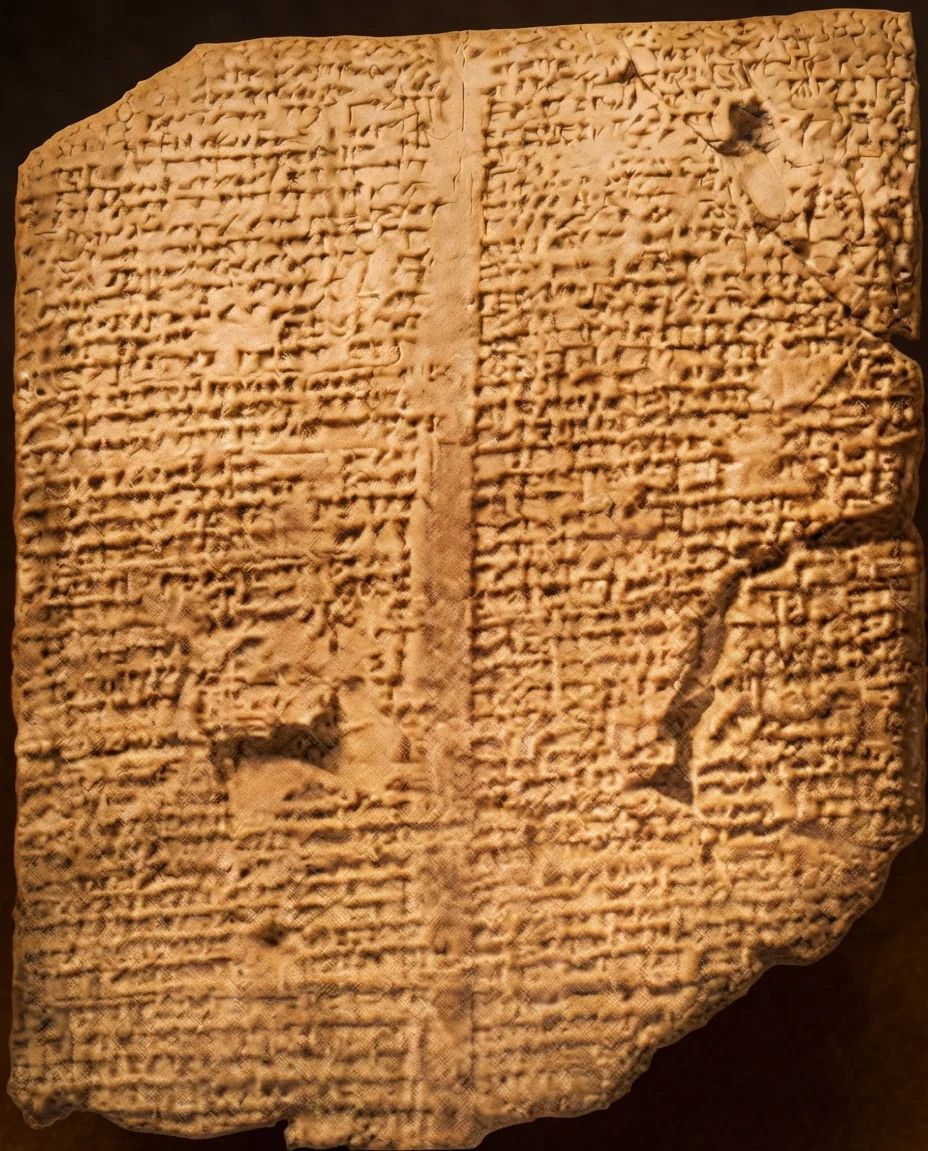
Clay tablet inscribed with the text of the Babylonian chronicle of chief events in the reigns of the kings who ruled in Babylon B.C. 744-669.
Art, the finest of which has perished, was manifest in various lines. Their sculpture, painting, and coloring shows them to have possessed no small knowledge of metallurgy and chemistry. The stones used in sculpture, which were bored, shaped, or engraved, were not merely the softer kind of rock, but the harder kinds, such as carnelian, agate, quartz, jasper, syenite, loadstone, and green feldspar. To cut these, emery must have been used, as well as rapidly revolving drills and disks, such as lapidaries now use. The work, “sometimes exceedingly delicate,” shows a complete mastery over
tools and material, and it indicates that either the eye was much better then than now, or else powerful magnifying glasses were used. In fact, a lens has been found in Assyria, and it is well-known that glass was used and cut into various shapes in Babylon.
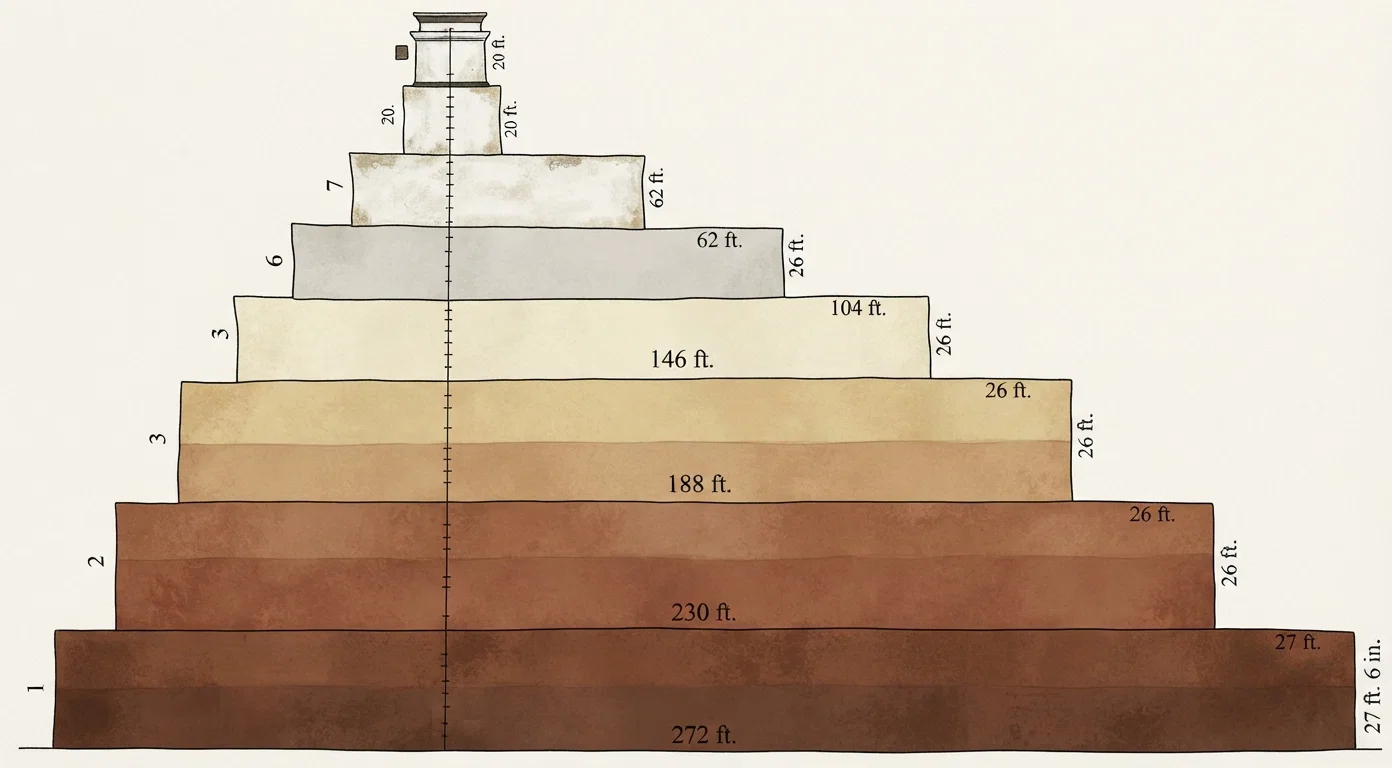
Temple of the Seven Spheres at Borsippa, Thought to Be the Tower of Babel.
In metals, gold and silver, bronze and copper, lead and iron, were used. Solid, massive gates were cast of bronze. The pottery is of excellent quality. Their textile fabrics were of great celebrity even as early as the days of Joshua (Joshua 7:21), standing in the ancient world as do the fabrics of Turkey and Persia now. These fabrics were in wool, cotton, and linen.
Rawlinson tells us that in mechanical art they “decidedly excel the Egyptians,” and “may challenge comparison with the most advanced nations of antiquity,” falling “little if at all short of the Greeks and Romans.”
In astronomy they distinguished between fixed stars and planets, mapped out the heavens into constellations as they exist to-day, computed eclipses, and learned the relative distances of moon and planets.
All these things were taught in their universities. The practical application of the wisdom of the wise men of Babylon is evidenced in the great works of the city of Babylon itself. The men who projected and directed in the construction of these works in that mighty city were not novices. In the days of Daniel, ancient sun-temples had been, or were being, repaired; golden royal palaces, exceeding imagination in their barbaric splendor, had been erected. Colossal and beautiful hanging gardens, containing rocks and forest trees, had been constructed by Nebuchadnezzar in the heart of the city, that his wife, a royal mountain maiden, might enjoy the beauties of the country in the midst of the most luxurious metropolitan life. By mighty moat and wall the city was fortified against all known weapons of war which might be wielded by an attacking foe. This wall was said to be sixty miles in length, fifteen miles on each side of the city, three hundred and fifty feet high, and eighty-seven feet thick. On either side of the Euphrates River, which flowed thru the city, was there a wall equal to one-half the cubic contents of the outer wall.

A Noble Purpose.

It was this city, “the glory of kingdoms, the beauty of the Chaldees’ excellency” (Isa. 13:19), that Nebuchadnezzar surveyed when

Studies in the Book of Daniel.

(Continued from Page 9.) in his pride of heart he exclaimed: “Is not this great Babylon, that I have built for the
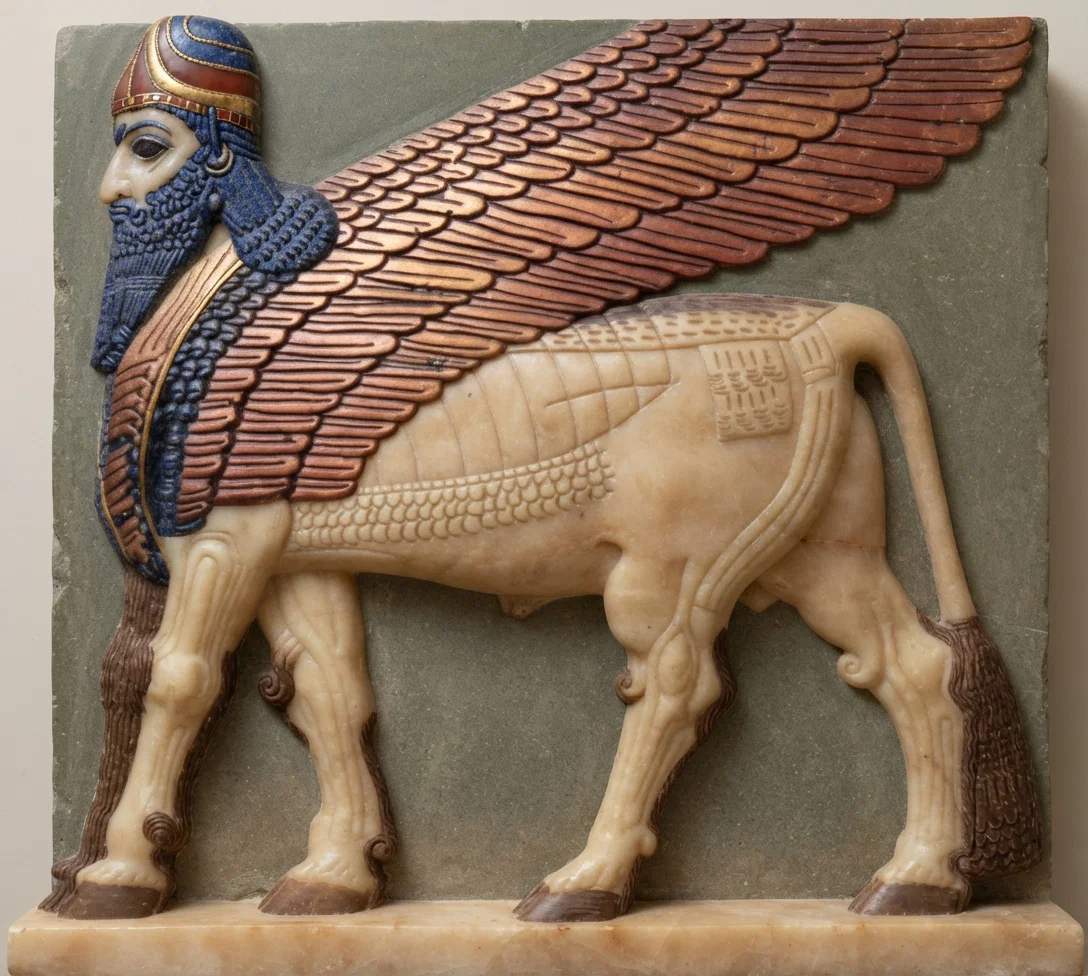
The Winged Man-Headed Ox from Nimrod.
house of the kingdom by the might of my power, and for the honor of my majesty?” Dan. 4:30. It was to this mighty city, teeming with works of art and grandeur, that the children of exile, mourning for desecrated Zion, were carried, there to witness, even in their humiliation, to the truth of God’s word. Nebuchadnezzar purposed that those he had selected should be educated in the best schools the world new. How the news of the king’s purpose struck the Judean youths is thus recorded:
“But Daniel purposed in his heart that he would not defile himself with the king’s dainties, nor with the wine which he drank; therefore he requested of the prince of the eunuchs that he might not defile himself. Now God made Daniel to find kindness and compassion in the sight of the prince of the eunuchs. And the prince of the eunuchs said unto Daniel, I fear my lord the king, who hath appointed your food and your drink: for why should he see your faces worse looking than the youths that are of your own age? so would ye endanger my head with the king. Then said Daniel to the steward whom the prince of the eunuchs had appointed over
Daniel, Hananiah, Mishael, and Azariah: Prove thy servants, I beseech thee, ten days; and let them give us pulse to eat, and water to drink. Then let our countenances be looked upon before thee, and the countenance of the youths that eat of the king’s dainties; and as thou seest, deal with thy servants. So he harkened unto them in this matter, and proved them ten days. And at the end of ten days their countenances appeared fairer, and they were fatter in flesh, than all the youths that did eat of the king’s dainties. So the steward took away their dainties, and the wine that they should drink, and gave them pulse.” Dan. 1: 8-16, A.R.V.
There were several reasons why Daniel and his fellows could not thoroly enter into the plans of the king: (1) They could not drink of the wine of the king, the wine of Babylon. Was it not typical of the spiritual wine of Babylon, which makes all the earth drunken? Rev. 14:8. (2) They could not be partakers of the unwholesome rich viands of which royalty was partaker. Service to God demanded strong, healthful bodies and clear minds; and the word of God had taught them, as doubtless their own observation, that the “dainties” of the ruler were “deceitful meat;” that “wine is a mocker,” and that princes should “eat in due season, for strength and not for drunkenness.” Prov. 23:1-3; 20:1; Eccl. 10:17. The school of the prophets, which at least in a perverted form they had doubtless attended, embraced within its compass the education of the whole man, physically, mentally, morally. In fact, the foundation of all was the word of God. Therein are found the best rules of sanitation and hygiene, the instruction as to the best dietary that was taught in the ancient world, and it is the wonder and guide of enlightened sanitarians to-day. And that people—the Hebrews—who have but blindly, superstitiously, half-heartedly followed those instructions, are among the healthiest peoples in the world.
Babylon knew but little of all this. Luxuriousness and lasciviousness reigned in her courts. Luxury fosters lasciviousness, weakness of body, grossness of mind, hardness of heart, and ultimate ruin and decay. These things were taught or countenanced or permitted in the Babylonian system of education, and the Judean princes, loyal to God, remembered the words of their wisest king: “Be not among wine-bibbers; among riotous eaters of flesh; for the drunkard and the glutton shall come to poverty [of both soul and body]; and drowsiness shall clothe a man with rags.” Prov. 23:20, 21. “Look not thou upon the wine when it is red, when it giveth his color in the cup, when it moveth itself aright. At last it biteth like a serpent, and stingeth like an adder.” Prov. 23:31, 32. Remembering this, they nobly refused to defile themselves with the king’s meat or with the wine which he drank.
[The study of chapter one will be concluded next week. The results of the two systems of education will be set forth.]

Increase of Knowledge.

“But thou, O Daniel, shut up the words, and seal the book, even to the time of the end: many shall run to and fro, and knowledge shall be increased.” Dan. 12:4. “Run to and fro”—not referring to the modern rapidity of locomotion, as some think, nor to Christian missionaries going about to preach the Gospel to the world at large, which the context scarcely admits, but, whereas now but few care for this prophecy of God, at “the time of the end,” that is, near its fulfilment, “many shall run to and fro,” that is, scrutinize it, running thru every page. Compare Hab. 2:2. It is thereby that the knowledge (namely, of God’s purposes as revealed in prophecy) shall be increased. This is probably being now fulfilled.—Critical and Explanatory Commentary.

Thinking and Acting Well

It is well to think well; it is divine to act well.—Horace Mann.

A Brother-Saviour.

"Of the Seed of David According to the Flesh."

SUCH Jesus Christ is declared to be by the apostle Paul. The words express much—much more than mere earthly descent. They declare Jesus to be of the brotherhood of man in the closest and most intimate sense.
What does it mean to be of "the seed of David according to the flesh"?
When man fell and dishonored his God, it seemed as tho the plan of God had failed and the adversary was successful. Then the divine prophecy was given that the Seed of the woman should bruise the serpent's head, or utterly triumph over him. The lineage of that Seed came thru Seth and Noah and Shem; thru Abraham and Isaac and Jacob; thru Judah and Boaz and Jesse; thru David and Solomon and Rehoboam; thru Ahaz and Hezekiah and Manasseh, and so on down to Mary, the mother of the promised Seed.
In Heb. 10:5, we read of the Christ, "Wherefore when He cometh into the world, He saith, Sacrifice and offering Thou wouldest not, but a body didst Thou prepare for Me." God filled, prepared, perfected, filled out, adjusted, a body for Him who became man's substitute. That body was perfectly prepared that Jesus Christ might meet all that man met; and therefore thru the line of "David according to the flesh" He came.
Think of David's seed. In his own life were great and grievous faults and strong tendencies of the flesh. In Solomon some of these tendencies were emphasized in his fearful marital record and lust of concubinage. In Rehoboam it was still worse. And with the exception of Abijah, Asa, Jehoshaphat, Uzziah, Jotham, Hezekiah, and Josiah, all of whom had their weaknesses, what a record we have. Read of the reigns of Jehoram, Ahaziah, Joash, Amaziah, Ahaz, Manasseh, and Zedekiah. Following the tendencies of the flesh of David, it was weakness and wickedness all the way. It was thru this lineage that Jesus came. Into this body of flesh came the Eternal Word.
But was not His flesh holy?—Not of itself, unless the flesh of the seed of David was holy. But was His flesh sinful?—Yes, in all its tendencies, the same as that of all the seed of David, so that if Jesus had followed the flesh, lived in and for the flesh, yielded to the clamorings of the flesh, He would have been a sinner. For "it behooved Him in all things to be made like unto His brethren;" yea, "He Himself hath suffered being tempted." Heb. 2:17, 18.
But did He sin? Was He a sinner?—No, a thousand times, no. "Who did no sin, neither was guile found in His mouth." 1 Peter 2:22. He came into the very citadel possessed and corrupted by Satan, the flesh, and there conquered. He asked for no different investment or environment than had His brethren. But not as Adam yielded did He yield. Adam was conquered in untried flesh not sinful; Jesus was Conqueror in sinful flesh. Sinful man yields the spirit to the flesh. Jesus Christ ruled the flesh by the spirit. In man the lower, fleshly life is often dominant. In Jesus Christ the spiritual life was always dominant over the flesh, victorious in every struggle. In the same battle where many fought and failed utterly, Jesus fought and never failed; fought and ever conquered, and conquered gloriously. He therefore became our Brother-Saviour—Brother with us in that He was one with us in the flesh; but Saviour in that He was for us the Conqueror of all sin. He turned every tendency of the flesh to the service of God. He took every faculty of the man, which Satan had controlled to a greater or less extent for four thousand years, and converted it to the service of God, led and controlled by the Spirit. He met every temptation alone with God that we might meet them with Him, and thru Him be "more than conquerors."
Therefore it is to the infinite, eternal glory of God's love and power that the Son of God came into the flesh of fallen man. It presents the full measure of hope to the poor, trembling sinner. As the Son of God conquered in that body prepared for Him, made "in all things" "like unto His brethren," so if we will let Him in, He will conquer in our sinful flesh, "subdue our iniquities," and be indeed Christ in us "the hope of glory."
And because He conquered, and never sinned, His resurrection "declared" Him "to be the Son of God with power according to the Spirit of holiness." Rom. 1:4.
Therefore he whose sins are covered by the righteousness of God, and in whom the Spirit of Christ dwells, will also be demonstrated to be a son of God, by a holy life here and by the first resurrection or translation when Jesus comes. Praise God for the Brother-Saviour.

Studies in Romans

THERE is a further truth that is worthy of special study in the first chapter of Romans—a truth that has not been mentioned in these articles thus far. The statement of this truth is found in the verses that follow:
"Paul, a servant of Jesus Christ, called to be an apostle, separated unto the Gospel of God, which He promised afore thru His prophets in the Holy Scriptures, concerning His Son, who was born of the seed of David according to the flesh, who was declared to be the Son of God with power, according to the spirit of holiness, by the resurrection from the dead." Rom. 1:1-4.
The foregoing verses inform us that the Son of God, our Saviour, "was born of the seed of David according to the flesh." Thus do we see that there is a human side to the nature of the Master. He was born "according to the flesh." And not only so, but He was born according to the kind of flesh that was in the line of descent of King David.
By studying the lineage of Christ "according to the flesh," as presented in the first chapter of Matthew, and also in the third chapter of Luke, it will be seen that the human ancestors of the Messiah were subject to all the iniquities that are common to the human race. The Lord Jesus Christ by His divine power entered human flesh to conquer sin in our behalf. "For what the law could not do, in that it was weak thru the flesh, God [did by] sending His own Son in the likeness of sinful flesh and for sin, condemned sin in the flesh." Rom. 8:3.
Man had fallen into sin, and could no more lift himself out of his condition than a man who has fallen over a precipice can lift himself back again. There must be a power from above that reaches down and lays hold of him if he is ever rescued. And hence our Saviour, while retaining His divine connection and power with His Father, not only reaches down to humanity, but actually comes down and enters humanity so that He may lay hold upon man and lift him back to God and righteousness. Sinful, human flesh can not of itself ever conquer sin. It can not resist the inborn tendencies and desires to give way to the demands of the flesh, to its passions, its appetites, its unholy cravings.
When Christ took upon Himself the nature of sinful man He became subject to all the temptations that mankind is subject to. Hear His own word upon this point. "Having then a great High Priest, who hath passed thru the heavens, Jesus the Son of God, let us hold fast our confession. For we have not a High Priest that can not be touched with the feeling of our infirmities; but One that hath been in all points tempted like as we are, yet without sin." Heb. 4:14, 15.
Christ came in the flesh. And to do this He had to come into the flesh. He was not in the likeness of sinful flesh before He came to this earth, but He entered into the flesh of humanity when He came here. He was a babe in human flesh; He was a little child in human flesh; He was a youth, and then a young man, and finally the matured man, in human flesh. He traversed the whole sphere of humanity. And He did this, not merely that He might be tempted in all the points at which we are met by sin, but that He might be "tempted like as we are."
And not only was He "tempted like as we are," but He is "touched with the feeling of our infirmities." The very infirmities of the flesh that we feel He felt also. He is "touched" by these feelings. He came into the flesh of mankind so that the children of men could come to Him in their distresses and temptations and actually touch Him.
Altho He was the divine Son of God, and altho with His infinite powers it might be supposed that He could have known without coming into the flesh how sinful men feel, yet He does not leave us to the sympathies of even the infinite powers of divine knowledge apart from actual experience. He comes into actual touch with humanity so that we may know that He really feels our very feelings. When we have feelings that are distressing or perplexing us,—feelings that we know not how to describe to any earthly friend or bosom companion,—we can come to the Master, saying to Him, “Thou knowest how I feel! Thou hast passed thru this ordeal; Thou hast met this difficulty in the flesh; Thou knowest my distress or my perplexity from actual experience.” O what a depth of satisfying helpfulness to know that we have a Saviour who has taken such infinite pains to come into actual touch with us! Is it any marvel, then, that the apostle draws the conclusion from the verses quoted from Hebrews, “Let us therefore draw near with boldness unto the throne of grace, that we may receive mercy, and may find grace to help us in time of need.” Heb. 4:16.
Then, what a world of meaning there is in another statement that the Saviour made for all His followers. His statement and promise is: “Go ye therefore, and make disciples of all the nations, baptizing them into the name of the Father and of the Son and of the Holy Spirit; teaching them to observe all things whatsoever I commanded you: and lo, I am with you always, even unto the end of the world.” “Lo, I am with you,” says the Master. I am not with you occasionally, He would say to us, but I am with you “always.” And He would say to us that He is not with us merely in some particular period of the world’s history, but He is with us always, “even unto the end of the world.” Always with us. Always by our side. Always right where He can feel the faintest touch of the feeling of our infirmities.
“I beheld the Lord always before my face; For He is on my right hand, that I should not be moved: Therefore my heart was glad, and my tongue rejoiced; Moreover my flesh also shall dwell in hope.” Acts 2:25, 26.
The Lord is always before the Christian. The Lord is always with the Christian. He is not there as a stern judge, nor to “spy on us” or to find fault with us; He is there that we may “not be moved;” He is there that we may feel His touch, and that He in turn may be “touched with the feeling of our infirmities.”
It is this knowledge of the personal presence of Christ that enables His followers to “endure as seeing Him that is invisible.” It is this knowledge of the personal sympathy of Christ that draws men to forsake all beside and devote themselves to eternally love Him.

Moral Conduct

MORAL conduct includes everything in which men are active and for which they are accountable. They are active in their desires, their affections, their designs, their intentions, and in everything they say and do of choice; and for all these things they are accountable to God.—Emmons.
Continue reading: Our London Letter