ENGLAND has been a meeting ground for royalty this autumn. The king and queen of Spain, the king and queen of Norway, and last and by far most important, the German emperor and his consort are paying us a visit, and seem to feel very much at home.
Naturally the emperor has attracted the most attention. The day before yesterday a banquet was given in his honor in the historic Guildhall, by the Lord Mayor of London. The streets were gaily decorated, and thronged with eager onlookers, carefully kept within bounds by detachments of mounted soldiery and policemen. Londoners gave the Kaiser a very hearty reception. He on his part has expressed the most cordial feelings toward this country. Peace and goodwill are his watchwords. To quote from his speech at the Guildhall: "When I addressed Sir Joseph Savory [the then Lord Mayor] from this same place sixteen years ago, I said my aim is, above all, the maintenance of peace. History, I venture to hope, will do me the justice that I have pursued this aim unswervingly ever since. The main prop and base for the peace of the world is the maintenance of good relations between our countries, and I shall further strengthen them as far as lies in my power."
Results of Earth Hunger.
No doubt the presence of the emperor may do something to promote better feelings between the two countries; but it is not safe to expect very much of a change in the somewhat strained relations of the two countries.
England's welcome must be taken as a tribute of respect and admiration offered to the Kaiser himself rather than as springing from any deep-seated feeling of friendship for the German nation. The real root of the anti-German sentiment must be sought in the fact that Germany's policy of growth and expansion commercially and otherwise is viewed with something of alarm in England. There is nothing tangible for the two nations to quarrel over—no vexed questions that skilful diplomacy could put right, simply mutual suspicion mingled with fear. Germany persists in thinking that England is trying to isolate her, and a considerable section in England take it for granted that Germany is building up a navy chiefly with a view to disputing the sovereignty of the seas with the Union Jack. The feeling is keenest between the Pan-Germans and the British imperialists. The former are dreaming of one day annexing Holland and German-speaking Austria, founding an empire in China, colonizing Asia Minor, and having a large sphere of influence in South America; the latter without urging the enlargement of the British Empire are very keen on maintaining its relative strength as compared with rival powers, and view with special concern the growth of the German navy.
The Emperor of Germany.
King Edward VII and Queen Alexandra.
The emperor himself is indeed a man of striking personality, and his record hitherto has shown him to be on the whole a lover of peace, so far as this may be consistent with the continued progress of Germany both as an industrial and a military nation. His devotion to his country, high sense of duty, and pure family life may well excite admiration. No wonder he is the exemplar of Young Germany. The empress likewise embodies some of the best of her country's traits, and is greatly loved by the people, being a typical German "hausfrau," and expert in all house-wifely arts. Needless to say, they both show hearty appreciation of English hospitality, and the present feeling between the reigning families of these two powerful nations is one of extreme cordiality.
Settlement of the Railway Strike.
In my previous letter I said that there was some prospect of an adjustment between the railway companies and their men, and the event proved the correctness of the forecast, but not till the country had been for a week or so in imminent danger of what would have been one of the most far-reaching and disastrous strikes on record. The settlement is owing much to the unfailing tact and energy of Mr. Lloyd George, president of the Board of Trade, whose representations to the railway companies led them to modify their former defiant attitude. In the final arrangements, while neither party got all that it wanted, concessions were made on both sides, so that there is a fair prospect of trouble being avoided in the immediate future. The result is a victory for trade unionism, which is yearly growing stronger in the British Isles. Hitherto it has had a fairly free scope in other directions, but has not been officially recognized by the railways, the proprietors of which have claimed that the interests of safe railway travel required that this branch of public service should be exempt from every kind of outside interference. Full recognition is not accorded even by the present arrangement, but is sure to come in time.11One is naturally reminded in this connection of the terrible railway accident which happened only the other day at Shrewsbury, and forms the third of its kind which has taken place within about a year. Strange to say, the cause of none of these has been ascertained beyond the fact that the brakes do not seem to have acted properly. Up to very recent times the railways of Great Britain have been noted for their safety, but at the present rate of accidents they will not hold their high reputation much longer.
King Alfonso and Queen Victoria of Spain.
The German Empress.
Parliament, the House of Lords.
Parliament meets on the 29th of January, 1908, and then will begin in earnest, if we are to credit the prime minister, the fight with the House of Lords. If the latter continues its opposition to the will of the Commons, an appeal will probably be made to the people in the form of a general election early in 1909. Just now the Conservatives are making their chief attack on Socialism. They pose as the protectors of property and offer to deliver the country from the imminent ruin thru the general adoption of socialistic principles. As a matter of fact the Liberals themselves are not in favor of socialism, tho they are endeavoring to bring about social reforms which are widely recognized as necessary. Nevertheless Conservatives have not raised the cry in vain. They won a great victory in the London County Council elections some time ago, and now recently they have made surprising gains in the municipal elections thruout the country, which goes to show that something of a reaction is setting in over considerable parts of the nation against radical ideas. The typical Briton has a deeply-ingrained conservatism which comes to the top in emergencies, and is never altogether out of sight.
Deplorable Conditions.
It must be admitted that many social agitators show great lack of common-sense and of practical statesmanship. Their zeal is without knowledge, and their program, if carried out, would plunge the country into greater evils than those under which it now suffers. Nevertheless the present social order is anything but ideal. We have a class of rich men who are doing nothing to justify their existence, but living off the toil of others, utterly engrossed in selfishness and worldliness. We have a very large class of laboring men whose wages do not enable them to live in decency and comfort, and who are liable to be out of work a good part of the time. Their children are scantily clothed and half-fed, their homes lack necessary comforts, and their lives are one long fight with want. It is true that they spend a portion of the small weekly wage in strong drink, and thus heighten their misery, but the laws of the land permit brilliantly-lighted, warm and cosy public houses (saloons) to tempt and tantalize them on every street corner, and we must not be surprised that both women and men yield to the temptation to forget their troubles for a little while.
Drinking among women is steadily increasing, in spite of energetic temperance work done in a great many channels. Said a London police magistrate the other day: "This is the fifteenth respectable-looking woman who has come before me this morning for intoxication. I do not know what women are coming to." The wobeone look on the faces of these poor, weak, erring ones is heart-rending, and a glimpse into their neglected homes, where pale-faced, stunted children cry in vain for bread, and shiver in filthy rags about the empty hearth, is most convincing evidence of the devastating effects of the drink habit.
Religious Matters.
The religious outlook is not a bright one. The indifference of the masses becomes more pronounced from year to year, and among Christians the most thoughtful deplore the growing worldliness and corruption. The "new theology" has evidently come to stay. Mr. R. J. Campbell continues to attract large audiences at the City Temple, but the audience is a different one from that which gathered about the late Dr. Parker to be fed with the living word. Mr. Campbell is clearly substituting Socialism for the everlasting Gospel. He rarely preaches a sermon nowadays without giving it a strongly socialistic trend, and his new ideas are coloring his exegesis of Scripture. Last week he preached on the work of John the Baptist. Jesus, he explained, was primarily preaching a gospel of social revolution. This was the chief point in which He differed from other Jewish teachers of His time. As for John the Baptist, "he was exactly the kind of man who would have led an attack on the Bastile in the eighteenth century; or, perhaps, he might have been found addressing a demonstration of the unemployed in Hyde Park." Well may the true Christian pray to be delivered from such preaching in one of the chief churches in the land. But when men turn away from the Gospel, they are likely to become involved in egregious error.
M. ELLSWORTH OLSEN.
November 15, 1907.
The King and Queen of Norway, and Prince Olaf.
He Should Know Better.
By Editor
In an Old Theological Quarterly, number 76, part 1, January, 1907, is the report of a sermon by C. T. Russell, of Millennial Dawn fame, on "Earthquakes in Prophecy." As it is his own publication the report is presumably correct. He says:
"It is true that our Second Adventist and Seventh-day Adventist friends have also been calling attention to the Scriptural predictions of great tribulations upon the world, now near at hand; but our message is still a very different one from theirs and used for a very different purpose. Their message is that the convulsions of nature that are now due are to result in a 'wreck of matter and a crash of worlds'—in the utter destruction of our race and the reduction of this earth to a mass of cinder. And they use their message as a club to threaten and to drive the wicked to seek the cover and protection of the Lord. Be it noticed how different is our reference to these calamities. We hold with the Scriptures that the 'earth abideth forever,' and that cold and heat, summer and winter, will continue as long as the earth abideth. We hold again with the Scriptures that God made not the earth in vain—He made it to be inhabited. Eccl. 1:4; Gen. 8:22; Isa. 45:18."
In other words, "they" do not believe or teach the Bible; "we" do. Now Mr. Russell knows or ought to know that Seventh-day Adventists teach that the "earth abideth forever," that God "created it not in vain," that "He formed it to be inhabited." Eccl. 1:4; Isa. 45:17, 18. No Adventist, so far as we know, believes that the earth will be burned up, but purified by fire and fitted for the eternal home of the redeemed, when "the meek shall inherit the earth; and shall delight themselves in the abundance of peace." Among the things that Seventh-day Adventists do not believe is Mr. Russell's unscriptural theories.
"The Finest Instrument."
It is refreshing to know that there are those in high positions who still believe in the American Constitution and its sufficiency. In a speech delivered before the Annual Banquet of the Chamber of Commerce at the Waldorf-Astoria, November 21, ex-Senator Spooner said in part:
"I think the finest instrument, all things considered, ever conceived by human intellect or drafted by the hand of man, is the Constitution of the United States."
"There has not been a year since it was adopted which has not vindicated the ability and foresight of the men who framed it, and during all those years, in time of peace and in time of war, it has been found until within the last few years, adequate for the proper government of the people of the United States."
"I do not know wherein it is inadequate, but I do know that if it be inadequate it is only to be changed in the manner pointed out in the instrument by the fathers."
Dangerous Innovations.
“But within the last few years we have had a propaganda that wherever the states in the exercise of the powers not granted by them to the Federal Government, but reserved to the states and to the people of the states by themselves, and the people did not exercise their reserved powers in a satisfactory and competent manner, constructions of the Constitution would be found to deprive them of them. I look upon that as revolutionary and destructive of government founded by the fathers.
“Whether the states and the people of the states exercise their reserved powers as they should exercise them, is, under the Constitution of the United States, to be determined only by the states and the people of the states.”
Murder and Prophecy
In the fourth chapter of Jeremiah's prophecy he makes it plain that his vision is directed to the closing scenes of time. He tells of the desolations that shall fill the earth, of the spirit of war that shall be in the land, and concludes the chapter with these words: "For I have heard a voice as of a woman in travail, the anguish as of her that bringeth forth her first child, the voice of the daughter of Zion, that gaspeth for breath, that spreadeth her hands, saying, Wo is me now! for my soul fainteth before the murderers." The vastly increasing number of murders that are being committed in these times are surely enough to call attention strongly to the foregoing prophetic utterance. And as we view the situation before the world, and recognize that conditions are such in the world that this evil will necessarily increase, how earnest will be the prayer that the second coming of Christ may be hastened so that crime may meet its everlasting end.
Ivory Soap Insecticide
It is stated in some of our exchanges that it has been demonstrated that one five-cent bar of Ivory soap dissolved in five gallons of water makes as perfect an insecticide as kerosene emulsion or whale oil soap, and has no disagreeable odor. It has been used on different aphides, including the wooly aphis of the apple and pear, San Jose scale, and the white fly that feeds on the under side of the grape leaf. It will instantly kill ants on the lawn or elsewhere. If this is true, it certainly will be a benefit to the fruit grower. Presumably there are other soaps that will be as efficacious as Ivory soap.
A Great Need
By Editor
A Great Need.—The president of the London Baptist Association has issued a call to the Baptist Church for a special season of intercession for spiritual revival. He speaks of the last year as a year of comparative 'spiritual dearth.' The conversions have been few. We seem to be waging an ineffective warfare. . . . Worldliness, indifference, and unbelief abound. We want a breath of new life.'
MEXICO
By Walter E. Gillis
Its People and Their Customs
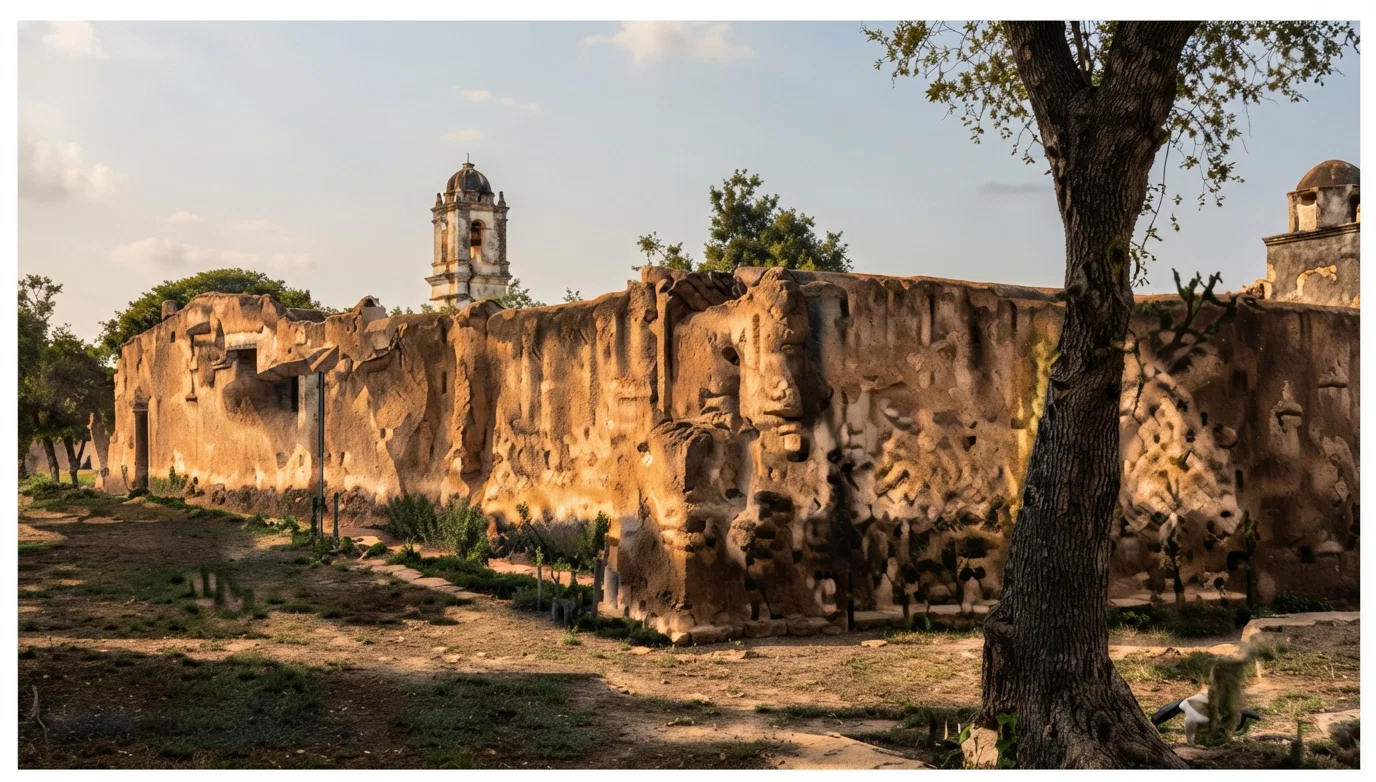
A Beautiful and Interesting Church, Fast Going into Decay.
We have now been in Mexico nearly three months and have fully decided that we like the new field better than the old. Of course there are disagreeable features, but on the whole, “every prospect pleases, and only man is vile.” A few things that puzzled us in the States are perfectly plain here. For examples we will mention two that are likely to puzzle you: In our address you will notice the initials D. F.; these stand for “Districto Federal” which is equivalent to your D. C., or “District of Columbia,” the federal district of the United States. On the envelope address you will notice the initials E. U. A., these are for “Estados Unidos America,” or United States of America.
This past week (September 8) we received our goods which were shipped June 1. They were much damaged by rough handling by the native assistants in the customs house here. The regular duty was 60 pesos (a pesos is equivalent to fifty cents U. S. money), but as settlers we were allowed a discount of one-half, but in order to get this rebate the “red tape” cost us eleven pesos. Well, it is much more homelike to have a few of the old comforts to enjoy and remind of the old days. Everything is so very different hereabouts.
We meet with contrasts here. One of them is found in the street-cars, which are run double, or one class a minute or two behind the other. The front, or first-class, car carries the silk-gowned “Doñas of the patio” and their Señoras, while the car in the rear bears its burden of dwellers from the viviendas—men clad in cotton and broad-brimmed, tall-crowned sombreros, and women barefoot and shoulders wrapped in the inevitable prayer-shawl, which is always plain and black. In the front car are regulation coach seats, while in the second-class the seat follows the perimeter of the car. There are, however, two luxuries common to both cars—cigarets and the conductor. Nowhere have we found better street-car service, and for five cents gold we ride six, eight, and even ten miles. The whole system is owned by the Bank of Montreal, Canada, one of the richest and most liberal corporations in America.
What we would call irreverence toward holy things is everywhere manifested. For instance, in Mexico City we have streets named, “The Street of the Holy Spirit,” “The Street of Providence,” “The Street of Jesus,” “The Street of the Sacred Heart of Jesus,” “The Street of St. John of God,” etc.
Some of the street names are very appropriate. The way to one cemetery is called “The Way of Misery,” another, “The Way of Sorrow,” another, “The Way of the Sad Indian.” Nearly all streets have authentic historic or legendary interest. When you find that a name seldom continues for more than a block, you will understand the need for ample note-book facilities in order to record it all.
Venders of Baskets, Mexico.
Churches and cathedrals are common to both city and hamlet. They are usually quite large and of costly finish. The fronts fairly bristle with ornamental designs and statuary. The largest we have yet seen stands on the site of the ancient Aztec temple for human sacrifices, and is about 300 years old. It fitly represents the glamour of romance and ignorance which is largely responsible for the power of Rome.
But the churches do not contain all the images.
In a niche of some building on almost every street may be seen the shrine of some intermediary saint or of the virgin. About these are always strewn fresh flowers, and a greater part of the time candles are burning.
Another thing we have noticed here is that almost invariably drug-stores bear the legend, “Sacred Heart of Jesus,” or something equally significant. And that brings to mind the fact that “Pink Pills,” “Cod Liver Oil,” and “Whisky,” are as well or better advertised here than in America. On the door of a saloon we read, “Rheumatism positively cured in forty-eight hours by a liberal use of our special brand of whisky.” No doubt the poor victim thought it an excellent remedy so long as the liquor lasted. So far as we could judge the prescription was very popular with the half-clad patrons of the wretched place. These dens of iniquity are all picturesquely named. Over one door we read “The Emotions,” over others, “The Senses,” “The Fountain of Life,” “Happiness,” and “The Beauties of Mexico,” etc., all more or less eulogistic of the degrading beverages served within. However, some tell the truth in a cynical way by having their signs read, “Hell,” or “Purgatory.”
La Cathedral, Mexico. Built on the Site of an Ancient Aztec Temple for Human Sacrifices.
Signs, however, are quite often misleading, as we learned by experience. On a main street of the city one day we saw a sign-board bearing the legend, “The New Earth.” We immediately hastened to get a glimpse of its harmonies only to find it a rather ill-appointed barber shop.
The outside of a building, especially of the older ones, seldom indicates the character of the interior. We started down what seemed to be a side street to view the displays of a lot of small stores, only to find, after a walk of several blocks, that we had been strolling along the arcades and patios of the Iturbide Hotel.
It is unusual and considered almost a disgrace for a gentleman to carry anything of a load on the street of the city; but it is not unusual at all to see a mozo (native laboring man) jogging along with a trunk and two or three valises hanging to its corners; or it may be a wicker crate containing two dozen chickens and a dozen or more pigeons; or a couple of bails of hay; or 250 pounds of carbon. We have seen these things ourselves quite frequently. In the North we are all familiar with the Chinese and their 300-pound load of vegetables in baskets suspended from a shoulder-pole; here the commodity is fruit, but our Mexican vender carries it in an oblong crate upon his back and holds it up by a strap across his head. This latter convenient member he earnestly contends was graciously furnished by the Creator for this very purpose.
Recently there appeared in the Review of Reviews a picture illustrating the gradual development of corn from the wild state to its present admirable form and flavor. A similar one could well be made to show the remarkable diversity in physical and mental power to be found among the native Mexicans; and these types may all be seen daily in the marts of trade.
Speaking of corn, we have it here in variety, nevertheless, the best is inferior to the most common American varieties. It is called mais and forms the bulk of the food supply of the natives. The chief reason for its usual inferiority lies in the fact that the peons who cultivate it are almost incapable of attempting anything beyond the prehistoric wisdom of their ancestors, whose efforts were much more successful because a virgin soil responded to their crude tillage. Mexican butter and potatoes do not deserve to be mentioned the same day as the American, they are so inferior.
The Spanish language has no exact synonym for our word “home;” to them it is “casa” which is equivalent to our word “house.” So far as our observations have gone this vague idea of home13obtains in the actual family relations. It is seldom more than a house, “for without hearts there is no home.” However, we are much pleased with the patio arrangement of the ideal Mexican dwelling. The house is built around the three sides of a court, while the south side has a high wall, but not so high as to shut out the sun, whose balmy rays are very necessary to comfort and health in a country where no attention is given to stoves or chimneys. In the patio there are a fountain, trellis vines, ornamental shrubs, trees, and rustic seats, statues of famous national patriots, and pretty women. It is indeed an ideal retreat. Not infrequently the walls facing the patio are covered with landscape paintings, which aid greatly to deceive one as to the size of the court. These are the dwellings of the favored wealthy class. There is a wide chasm between these and the homes of the poor. Let us look at them.
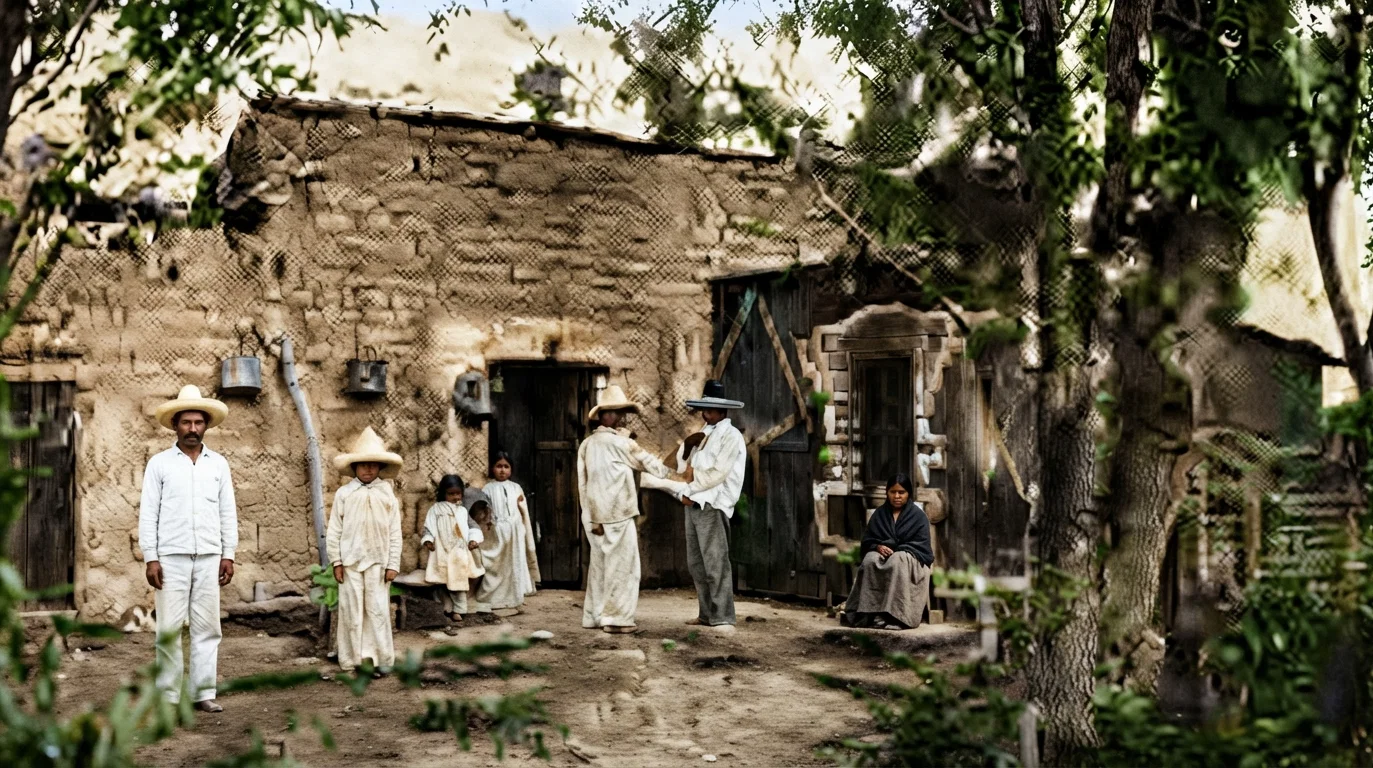
Mexican Family, Adobe House, Mexico.
A plot of land is surrounded by a high wall and to all appearances contains nothing more. But as we enter a large portal we find that this enclosure is a vivienda. The high outer wall is duplicated on the inside, leaving a space between the two of about eight or ten feet, which is divided off by cross walls every eight or ten feet, and this is covered by a flat roof (common to all Mexican dwellings). Each room has a door—no windows—which opens upon the court, where an artesian well furnishes the water for cooking, drinking, washing, etc. Each of these rooms built of adobe and having nothing but an earthen floor, is the home of several persons, and not infrequently of the dogs, chickens, turkeys, and such vermin as is common to the poor. The open street or a vacant lot furnishes the only sanitary convenience, and but for the daily disinfecting rays of the sun they would be, and no doubt are at times, a source of disease and death. On the business streets the viviendas open upon the street and sometimes also into an inner court. The occupants of these rooms tender to the public trade such fruit, vegetables, and edibles as they are able to provide, and thus eke out a precarious existence. The back alleys of New York and Chicago tenement dwellers seldom rival the common condition of the poor Mexicans of the viviendas.
Mexico is almost as truly a virgin soil for the advent message to-day as it was twelve years ago, when it was first entered, and the need is very great. The colporteur will always be the principal medium of reaching the willing ones. This is a field to try the caliber of the Christian and we always need the prayers of the brethren that we be kept faithful and diligent servants.