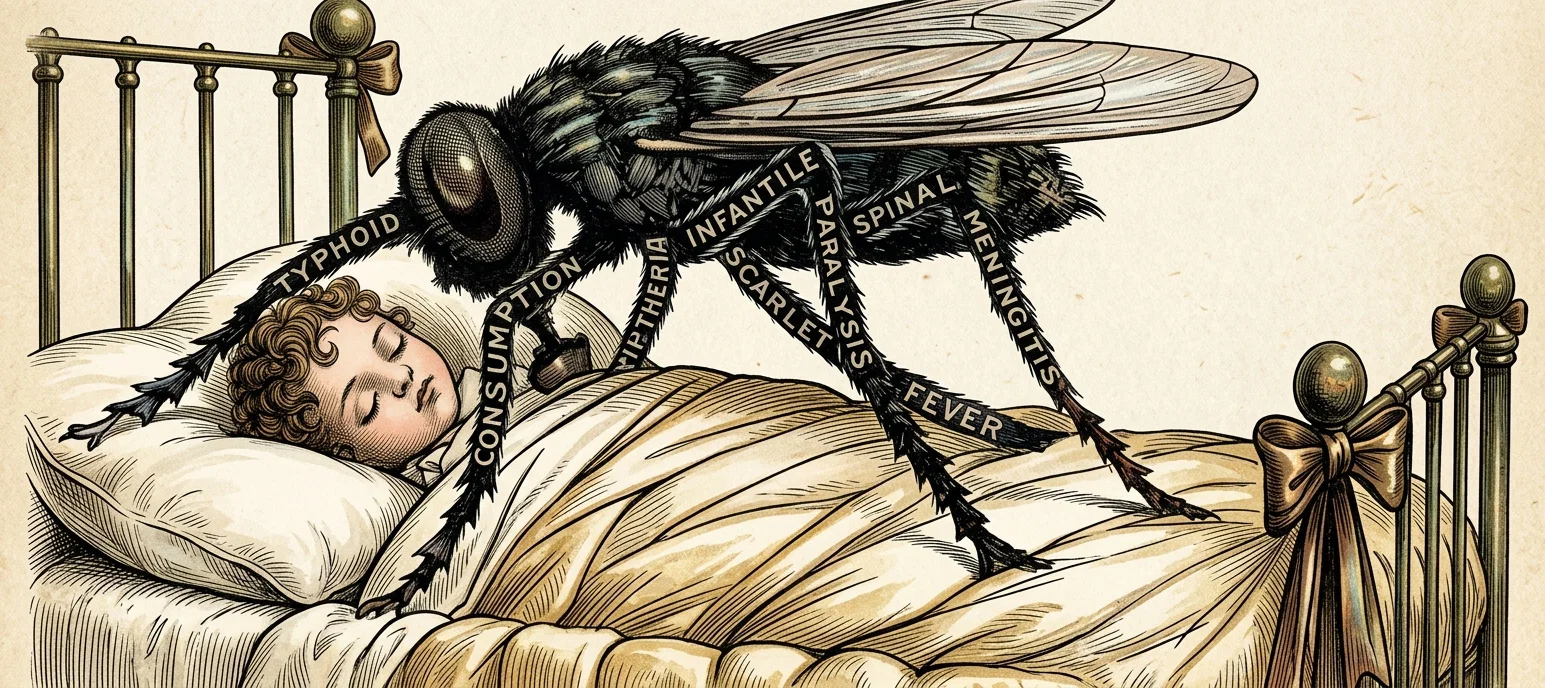
No Race Suicide with Him — What He Does to Spread Disease — How to Get Rid of Him
By A. W. SEMMENS, M. D.
THERE is probably no other agency that has such capacity to spread disease as has the ordinary house fly. Because it is more or less a domestic insect, and lives about the habitations of men, it has great opportunities to get into infected matter; and because it can move from one place to another more rapidly than any other insect, and because it thrives in greater numbers, and because its hairy feet, with sucker-like terminals, can gather more certainly whatever infected matter it lights upon, the dangers from its presence are far greater than those from any other infecting agent.
“Swatting the fly” does away with many of the pests, fly poison destroys many more, and fly papers destroy thousands. Still they exist by the million.
A TRILLION A YEAR
It has been estimated that one female fly hatching in April will multiply itself into thirteen figures (1,000,000,000,000)—so many times that the human mind is unable to calculate the number. To get rid of this pest, then, we must have some very decided means of preventing this propagation.
Investigations carried out on new lines have proved that many of the most deadly diseases, which cause the untimely death of thousands of people, are due to the presence of the house fly and the mosquito. In the near future, when people are educated as to these facts, no civilized town will allow any filth to accumulate or remain uncovered to breed flies; and all tanks, drains, ponds, and swamps will be covered, or else treated so that no mosquitoes can breed in them.
THE TYPHOID FLY
“Dr. Howard, of Washington, D. C., has proposed that we should drop the name ‘house fly,’ with its harmless sound, and call it the ‘typhoid fly.’ While we talk about it as the domestic or house fly, we will never realize that it is the active agent in spreading typhoid fever. We all know how flies swarm over all kinds of food that are left uncovered, how they feed upon it by sucking up the moisture, or if it is hard, how they discharge a little fluid down their proboscides to soften it.
“Not only do they feed upon all exposed food, but they discharge their excrement upon it; and then a thoughtless person eats this contaminated food that has been left in the pantry or on the dining room table. Out in the yard and the street, swarms of flies may be observed resting and feasting upon every bit of decaying matter. From such things they come flying into the house, their feet and mouths reeking with filth.”
NOT PARTICULAR WITH THEIR FEET
They are not at all particular in cleaning their feet or mouths before their entrance into the house.
Another great danger from these insects is this: Flies that have been feasting upon a dead beast, where decay has set in, or upon a beast that has died from some such deadly disease as anthrax, can, if they settle upon an open cut or wound, infect it, and cause blood poisoning, by inoculating the cut or the wound with putrid material, or with the deadly germs of anthrax.
While visiting some of the islands in Polynesia, the writer observed the great prevalence of purulent conjunctivitis among the natives, and on investigation found that flies would swarm around these diseased eyes, which were not covered and were seldom washed. Hence the propagation of this virulent malady.
Dysentery is only too well known in many countries; and among young children, in particular, many deaths occur from this cause, particularly in the summer months. In this country and elsewhere, it has been shown that this intestinal disease is always most prevalent in the summer months, when flies are at their worst.
THEY SPREAD TUBERCULOSIS
That flies play a part in the spread of tuberculosis too, seems probable, for the specific bacilli have repeatedly been found in virulent condition in their intestines and in their excrement.
Dr. Frederick T. Lord, of Boston, published a paper on this in the Boston Medical and Surgical Journal, 1904. His important conclusions are as follows:
1. Flies may ingest tubercular sputum and excrete tubercle bacilli, the virulence of which may last for fifteen days.
2. The danger of human infection from tubercular flyspecks is by the ingestion of the specks on food.
3. Tubercular material should be carefully protected from flies, lest they act as disseminators of the tubercle bacilli.
4. During the fly season, greater attention should be paid to the screening of rooms and hospital wards containing patients with tuberculosis, and laboratories where tubercular material is examined.
5. As the precautions would not eliminate fly infection by patients at large, foodstuffs should be protected from flies, which may already have ingested tubercular material.
The number of bacteria on a single fly may range all the way from 500 to 6,000,000. Early in the fly season, the numbers of bacteria on flies are comparatively small; while later, the numbers are comparatively large. The domestic fly is passing from a disgusting nuisance and troublesome pest to a dangerous enemy to human health, a distributor of typhoid fever, dysentery, cholera, tuberculosis, blood poisoning, and other similar diseases.
WHERE THE HOUSE FLY BREEDS
House flies deposit their eggs chiefly in horse manure. Any heap of horse manure piled up about a stable or a yard will within twenty-four hours be found to contain swarms of small, white, naked maggots, the house fly larvæ. On the second day, they are full-grown. On the third day, they have changed to pupæ; and instead of white maggots, the more or less drying manure will be found full of the oval, reddish brown pupa cases of the flies, from which, in three or four days, the perfect flies will swarm out, ready to lay their eggs and produce the next generation. This goes on all through the summer.
Packard placed a house fly in a bottle at six o’clock in the evening, and at 8 o’clock next morning he found that it had laid one hundred and twenty eggs.
HOW TO MAKE AWAY WITH THEM
1. Keep clean homes. Few flies enter such homes; and their cargo of bacteria is usually less than that of flies found elsewhere.
2. In dirty homes, the diarrheal sickness among cases exposed to flies is twice that among cases protected from flies.
3. There is more than twice as much diarrhea among all cases exposed to flies as among cases protected from flies.
4. There is nearly twice as much diarrheal sickness in dirty homes as in clean homes.
5. Two and a half times as much sickness among infants, and three and a half times as much diarrhea, occurred among infants exposed to flies in dirty homes as among infants protected from flies in clean homes.
6. Destroy the eggs before they hatch.
7. Sprinkle powdered borax over manure piles, and in cracks and crevices, and wherever flies can breed.
The United States Department of Agriculture, in Bulletin No. 118, gives the following directions for applying borax as a fly egg destroyer: “Apply through a fine sieve or flour sifter two ounces of borax to a can of garbage daily; apply ten ounces in the same way to eight bushels of fresh manure, and sprinkle with water.” Borax should be applied also to floors and crevices in barns, stables, and markets, to street sweepings, and to such places in the hospital or the home as are likely to be chosen by flies in which to lay their eggs. After the borax is sprinkled, water should be sprinkled over the powder.
We must not wait till flies are here. We must prevent their breeding; and those which survive our preventive measures, must be starved to death. Fly starving, and especially preventive measures against their hatching, will end the nuisance for all time.
Protection Through Vaccination
By H. Butka
Relief from the Dreaded Smallpox and Typhoid
By H. BUTKA
VACCINATION is a method by which immunity from a disease is imparted by the injection or inoculation of dead bacteria, or else bacteria that have by different methods of treatment become practically harmless, or cause only a slight reaction.
The vaccine of smallpox is obtained from papules produced by the inoculation of calves with smallpox virus. The form of disease caused by the use of this vaccine is not contagious. It is called vaccinia.
HOW IMMUNITY IS OBTAINED
The microorganisms are placed on an abraded surface, usually on the left arm, and the symptoms that follow are caused by the reaction of the body to this infection. The lesion runs the typical course of a smallpox lesion, beginning three to four days after inoculation, reaching571the vesicle stage by the eighth day, when the body reaction is most severe, and healing by the fourteenth day. This inoculation produces an immunity for a period varying from seven to fifteen years. A vaccinated person cannot have true smallpox, but may have a mild form called varioloid.
A good plan to follow to obtain life immunity is to vaccinate at from two to four years of age, and again when about thirteen to fifteen years. Two successful vaccinations confer life immunity.
TYPHOID VACCINATION
In typhoid vaccination, four doses of dead typhoid bacilli are given subcutaneously, at intervals of four to seven days, beginning with fifty million, and reaching five hundred million.
The injections are usually followed by a reaction on the part of the body, shown by slight fever and some general malaise. This vaccination confers practical immunity for a period of two to five years. Further protection can be gained by revaccination.
After typhoid vaccination, the blood serum has the same power of agglutinating the typhoid bacilli as has that of persons who have had the disease.
IN CASE OF EPIDEMICS
In an epidemic, either of smallpox or of typhoid, all persons who have not been protected by having the disease, should be vaccinated. If they afterward take the disease, it will be in much lighter form.
Vaccination may also be used in case of boils, or infections with different pus-forming microorganisms. The best method is to make an autogenous vaccine—that is, one made from a culture of microorganisms found in the wound itself. This aids by increasing the resistance and activity of the body defenses in combating the infection.
Rheumatism is now believed to be caused by a specific microorganism, and a vaccine made from the streptococcus has proved beneficial in many cases.
A number of other vaccines are used, but are of less importance.
A Prospering Mission Hospital
By L. E. Elliott
Appointees to Foreign Fields Doing Practical Work Before Going—Valuable Annex to Our Washington Sanitarium
By L. E. ELLIOTT, M. D.
PROBABLY you have never heard of our mission hospital, located in Washington, D. C.; for it is yet in its infancy, and no publicity has been given it. Originally we were running only a dispensary; but as the work grew, the way was most providentially opened for us to extend our usefulness by carrying on hospital work. In order to do this, we had to change our location. We secured the building shown in the cut, at a very reasonable rent; and our landlord was very liberal in making the improvements necessary in order that we might start a hospital.
INCREASING AND PROSPERING
Our work did not decrease by the change, as some predicted, but has materially increased in more ways than one. In the dispensary, we are having a much more intelligent class of people,—a class who are more appreciative of what is done for them.
We hold a clinic six days in the week,—every day but Saturday,—from one to three o'clock in the afternoon. In this department, we have had, up to the present time, 5,972 patients, to whom we have given 14,229 treatments. Not all these patients come from this section of the city. Many come from other portions, and some from out of the city.
We have all sorts of injuries to treat, all classes of diseases and their complications. Not long ago, a man came to the dispensary with what appeared to be a trivial bruise on his leg. He had come all the way from the Union Station, a mile and a half away, to seek us out. We treated his injury as we usually treat similar ones, with the expectation that it would soon heal. But we found that our case was prolonged. This gave us an opportunity to do some seed sowing. He became intensely interested in the Bible and its messages, and now we are watching for the harvest. On an average, we see each patient but three times; so the opportunities to start them aright are not very great.
MEDICAL MISSIONARY GETTING PRACTICAL WORK
We send our nurses out in this section to give these poor people treatment. This is where the best opportunity comes to speak of their souls' condition. Many of them have nothing with which we can give the simplest treatments. Their houses are destitute, and their children are hungry and almost naked. But we also have a better class that we treat. They have been much more appreciative of our efforts, and have responded much better to spiritual teaching. We are now in a position where we can put a Bible worker out among them, to see that their spiritual well-being is considered, as well as their physical.
Our dispensary and clinical hospital in charge of Dr. Elliott, Washington, D. C.
We have a threefold purpose in our work; namely, (1) to look after the spiritual and physical welfare of the patients, and to clothe and feed them when necessary; (2) to give our foreign appointees an opportunity to become familiar with the work before they enter the foreign fields; and (3) to give our nurses a training in obstetrics, treating the sick in their homes, and Bible work, so that when they go out, they will be true medical missionaries.
Our work was started by donations, and we equipped the institution as we were able. At the present time, we are quite thoroughly equipped, and are self-supporting. About twenty-five missionaries have taken a training here, and are now located in India, China, South Africa, and South America. Some in India have started dispensaries, and are able to do a good work. Thus our work has been duplicated many times. We are glad our work has been so blessed that it has grown into the present institution, and that we are able to help many different classes of people in our small hospital and dispensary.
In Due Season and for Strength
By Mary C. Reynolds
Eat in such a Way as to Maintain the Highest Bodily Efficiency
By MARY C. REYNOLDS, A. B.
“BLESSED art thou, O land, when thy king is the son of nobles, and thy princes eat in due season, for strength, and not for drunkenness!” Eccl. 10:17. The context of this scripture would imply that the true “noble” is one who is known by his self-control and temperance. The sum of such attributes makes him a king indeed, ruler of his habits, master of his appetites and passions, and monarch among men. Blessed indeed are those who look to such a one for leadership.
WHEN TO EAT, AND WHEN NOT
“In due season.” This may be better understood in the light of the preceding verse, where a woe is pronounced upon that land whose princes “eat in the morning.” Evidently this refers not to the proper morning meal, but to those banquets and revelings which extend into the “small hours” of the morning, robbing the mind of its acuity, and blunting every higher sense.
There are seasons when food is due. The wonderful mechanism provided in the human body for the preparation and assimilation of food and its transport to the tissues, demands that food be supplied at proper intervals, in reasonable quantity, and of such a nature as to meet the body needs. Under all ordinary circumstances, the “due season” is recognized to be at stated intervals, so distributed through the day that the digestive organs may have proper time for their work, and sufficient rest to maintain their tone.
Food should not be taken when there is excessive weariness, thirst, anger, fright, or anxiety, or when one is overheated. Better by far a liberal draught of water and needed rest or required simple treatment.
DRUNKENNESS THROUGH EATING
“For strength, and not for drunkenness.” Whatever more food is taken than is required for strength, is “drunkenness.” Is this too strong? Let us see.
The body requires so much of the starches for energy, so much albumen, or protein, for repair, and a limited quantity of fat to give “padding” and provide heat. A small amount of the starches and sugars may be stored if more is taken than is required for energy at any given time. If an excess is constantly taken, it must be stored as fat, or in muscle and liver. Such an excess not only imposes a burden by its weight, but also crowds the internal organs, in many instances causing their degeneration. Thus their proper functions are hindered, and nature is embarrassed in her work.
When an excess of fat is eaten, much more oxidation is required to dispose of it properly than is normal. The respiratory organs and the blood are taxed, and often it is simply transported to some already weakened organ, and stored in cells that should be active. Thus a “fatty degeneration” takes place.
Of protein foods, required normally only for repair of tissue, the need is far less than is generally thought. The breaking down and rebuilding of such heavy material is a burdensome task, especially when the body is already supplied with enough of the starches and sugars for its needs. The work of eliminating this waste is thrown largely upon the kidneys. Accompanied by high seasonings and condiments, these products greatly irritate the delicate organs, and distressing diseases follow. So overburdened do the organs become that the wastes cannot be eliminated fast enough, and fermentation and decomposition ensue. The retained poisons induce a stupor of mind and body, which to-day we call auto-intoxication, and to which the ancient wise man applied the very appropriate term “drunkenness.”
THEY ARE NOT FOODS
Many unsuitable dishes are served, which can give no possible strength. They only add burdens to the elimination organs, or, unable to be eliminated, remain to poison the body.
Speaking of meat extracts, so often prescribed for convalescents, Dr. Butler, in his “Materia Medica,” says, “They are not foods in any sense.” The same author remarks further, “The excessive use of tea and coffee profoundly disturbs the digestive function, resulting in gastric catarrh, indigestion, constipation, and hemorrhoids.” Three cups of moderately strong tea or coffee contain the maximum dose of caffeine, a powerful drug which cannot with safety be used habitually.
“The imprudent eater does not realize that he is disqualifying himself for giving wise counsel. . . . But this is so. He cannot discern spiritual things; and in council meetings, when he should say ‘Yea,’ he says ‘Nay.’”
Strength requires far less and much plainer food than does a perverted appetite. To a “nation of kings” the Creator of the human temple earnestly speaks: “Eat in due season, for strength, and not for drunkenness.”
Water in Maintaining Health
By H. C. James
Sources of Supply—Need of Guarding Them—Treating Water That Is Dangerous to Use
By H. C. JAMES
“THE greatest influence on health is exerted by those things which we most freely and frequently require for our existence, and this is especially true of water and air.”—Aristotle.
It is true that for the maintenance of life, water comes secondary in importance to air alone, the body containing about seventy per cent by weight of water, and requiring between two and one half and three quarts daily as a medium of exchange for the elimination of waste products from the body.
PREVENTING DISEASE
Water as a factor in the maintenance of health, and as well in the prevention of disease, is far-reaching in importance; and though a subject of extended study and discussion, it still fails greatly of receiving from the public the attention that its importance demands. Pure water is valued by all; but oftimes the cost of securing such is deemed too great, and the sacrifice of health and of life follows as a result.
Under the varied conditions of life to which the human family are subjected, we find the prevalence of sickness and the resulting mortality to vary widely.
The factors predisposing to disease are numerous, but perhaps among the most important is the role played by water; and especially is this true in warm or tropical climates, where cholera and dysentery claim their victims by the thousands.
NORMAL AND POLLUTED WATER
All waters are subject to great variation in character and composition from time to time, depending upon the source from which they are derived for use; and they may be classed as normal or polluted, according to freedom from direct or indirect pollution by waste products of human life and industry. Hence it follows that normal water is not necessarily suitable for drinking purposes, although it is incapable of causing specific disease.
Water being the most general solvent known, we need not wonder that absolutely pure water is not found free in nature, coming in contact as it does with the products of decomposition of both plant and animal life, thus taking up bacteria, as well as easily absorbable minerals and gases.
In general, pure water is considered to be that which is free from all disease-producing germs, and having no disagreeable or harmful ingredient.
SOURCES OF WATER
Primarily we think of the source of water as the aqueous vapor condensed in the form of rain and snow. Secondly, there is surface water, as of ponds, lakes, and streams; and thirdly, ground water, such as springs and wells.
This classification is but arbitrary, for convenience in use, with no sharp lines of demarcation; for evidently there is continual change. Rain water soon becomes surface water, and surface water passes quickly into the ground, and the ground water frequently reappears as springs, and forms streams and lakes.
Water from these different sources is used with varying results, dependent upon the conditions attending or preceding its withdrawal for use.
COLLECTING RAIN WATER
Thus rain water, if properly collected and cared for, may be considered free from contamination by organic material, and the purest of all natural waters. As collected for use in many large cities, from great watersheds, its purity depends upon the conditions of the land from which it is drained, whether inhabited, used as range for cattle, or kept from all possibility of animal waste and contamination. Likewise the water taken from rivers and lakes may be comparatively pure, or it may be greatly contaminated by the sewage and waste products of manufacturing, which are continually poured into the streams from the cities. By this means, disease is often spread for a considerable distance from the place where it originated. Especially is this true of typhoid fever epidemics.
SHALLOW AND DEEP WELLS
As regards the third source, ground waters, two classes may be mentioned,—first, that which is taken from shallow wells; and second, that of deep or artesian wells. By shallow wells are meant those the water of which is obtained above the first impervious stratum of clay or rock. In these are found practically the same dangers as in surface water, the products of decomposition and waste passing through the loose soil. Not only should a well be located upon higher ground than any outbuildings, but it should be as far removed as possible from all sources of contamination; for the water level will necessarily be much below any surrounding buildings, and thus the water from these may possibly find its way to the well.
The principal danger of all surface and shallow water is the carrying of disease; and toward the prevention of this, great care should be exercised. While some such water may be more or less hard, the hardness usually can be overcome by simply boiling the water.
SLIGHT DANGER FROM DEEP WELLS
As regards deep well water, the danger of contamination and of disease is very slight; while on the other hand, such water is usually hard, containing salts that cannot easily be removed and still leave the water perfectly satisfactory for drinking purposes. Very little trouble, however, can arise from the use of such water.
In conclusion, we might take some suspicious water, as from an irrigating ditch, and determine what is necessary that it may be made fit for use.
MAKING A SIMPLE FILTER
A simple filter may be made of a half barrel by boring several holes in the bottom, and putting into it a good layer of coarse stones, with perhaps some charcoal over these, and eight or ten inches of fine sand on top. If the water is passed through this, it comes out looking much better; but perhaps there are some typhoid fever germs or other disease-producing organisms still in the water. We may boil it, and thus make it perfectly safe; but this gives it an undesirable and peculiar taste. The more satisfactory method is the use of chlorinated lime. To one pint of water, add one teaspoonful of chlorinated lime; and of this solution, put one teaspoonful in each two gallons of water, allowing it to stand for at least one half hour before use. Thus our previously undesirable and dangerous water is made quite safe for use.
The Original and Correct Diet
By Lenora D. Campbell
Bill of Fare Prescribed by One Who Knows
By LENORA D. CAMPBELL
In this twentieth century of rush and change and extremes, it is well for us to consider God’s original plans, laid down for His people in the beginning. Especially must we consult God’s word in the choice of food, since custom, appetite, and desire are unsafe guides.
After making each plant and creature, and man, and knowing the composition and needs of every cell, who could so well as God prescribe a diet for His creatures?
“Behold,” He said, “I have given you every herb yielding seed, . . . and every tree, in which is the fruit of a tree yielding seed; to you it shall be for food.” This was the best; but after the curse of sin drove man from his Eden home, permission was given also to eat “the herb of the field.” Fruits, nuts, grains, and vegetables, then, constitute man’s original diet as appointed by the Creator; or as one has said, “it consists of those things which grow standing still.”
THE ADVANTAGES OF SUCH A DIET
First, it is the most healthful. These foods, put up in the laboratory of nature, under the supervision of the great Food Specialist of the universe, and under the strictest pure food laws, are unadulterated. They contain no poisons, waste products, or other deleterious substances, but only life-giving elements.
Second, it is the most nourishing. A pound of beans or wheat furnishes more repair material and energy than a pound of meat. A pound of beans yields 2,000 calories of heat: wheat, 1,650 calories; while meat yields only 1,000 calories a pound.
Third, it is the best balanced diet. That is, a combination of fruits, grains, and nuts will contain, in the right proportion, all the elements needed by the body, with no excess of one class to be eliminated.
Fourth, it is non-stimulating. These foods, prepared in a simple, natural way, do not spur the organs to abnormal activity, wearing away the life forces, as do the stimulating properties of meat — extractives — and various other foods.
Fifth, it furnishes great variety. Nature’s abundant supply of fruits, grains, nuts, and vegetables is found in every clime, and during every season. First in the spring come the juicy red strawberries and cherries, with the luscious blackberries and raspberries. These are soon followed by the rosy cheeked peaches, apricots, and pears. Then the many colored, delicious apples, the purple plums, the transparent grapes, come trooping in. The various melons are always on time to refresh us during the summer heat; and oranges, grapefruit, and bananas bless us the winter through.
What an array! And each with its own individual color, shape, and flavor! Think, too, of the great abundance of nuts, small packages of concentrated food, found everywhere the year around. Consider the profusion of vegetables available in every country,— potatoes, beans, peas, corn, squashes, beets, and tomatoes. Then review the cereals,— rye, oats, wheat, rice, and corn,— and ask what more could be desired for variety.
Sixth, it is the most appetizing diet, hence the most digestible. The so-called “appetite juice” produced by the stomach when food is relished, aids materially in the digestive process. Even the sick enjoy the beautiful fresh fruits, and are refreshed and benefited by them.
Seventh, it is the purest, safest diet. No parasites are found encysted in the flesh of the peach, and no harmful bacteria growing in the juice of the grape. In fact, many fruit juices are slightly bactericidal, and thus not only are pure, but are purifiers, cleansing the alimentary tract. By virtue of the organic acids they contain, such as citric, malic, and tartaric, fruit573juices render the blood more alkaline, hence more efficient.
Eighth, it is more economical. More food value by far can be bought in these foods, for any stated amount of money, than in any other.
There is abounding life in the grains, fruits, and nuts, first hand, and sufficient for the requirements of every individual. They are healthful, nutritious, appetizing, and economical, without the harmful properties possessed by other classes of food. We see the wisdom of the Creator in choosing and providing such a diet for man.
But by poor preparation, bad combination, or too great variety at one meal, of these most healthful foods, man may still depart from God’s original plan. We must learn to suit the amount, the kind, and the combination to the climate and the occupation. Prepared simply, rightly combined, and eaten moderately, however, these foods furnish the ideal diet.
The great Physician who understands dietetics and food analysis more thoroughly than the wisest “food men” in this world, and who made each grain, each fruit, and each nut, has prescribed this diet for the sin-sick race. It is the best. So why not accept it gratefully, and eat to the glory of God?
Questions and Answers Subscription Offer
By James Cochran
Proposition No. 1
“Signs of the Times” Weekly the balance of the year 1915 and all of 1916 with “Questions and Answers” for $2.00.
Proposition No. 2
“Questions and Answers” Free to any individual paying for five or more SIGNS mailed to different addresses for a year.
To the SIGNS OF THE TIMES Family:
You are wondering why a whole page in the SIGNS has been turned over to the circulation department. Possibly you think it is for the purpose of exploiting the good qualities of the SIGNS, but it is not. The day is past when we have to spend much time and energy telling of the good features of this paper. Its value is thoroughly established. We want to tell you about one of the most interesting and helpful books that was ever printed by any publishing house. The title of the book is “Questions and Answers.” For more than thirty years there has been a department in the SIGNS known as the “Question Corner.” Many hard and puzzling questions have been answered in this department. Difficult texts of Scripture have been forcefully and clearly explained. Something like three hundred of the hardest questions, with the answers, have been reset and printed in book form, bearing title as given above. It contains two hundred fifty-six pages, with topical and Scriptural index. “Questions and Answers” has never been placed on the market except as a premium with the SIGNS; no price has ever been fixed. Its value as a technical work, for such it is, would be about $2.50. A short time ago we sent a copy to one of our most critical readers. His response as given below, indicates his estimation of the book:
“I think it is indeed a valuable book. I have wondered more than once why the splendid answers to these various puzzling questions which have been printed in the SIGNS from time to time have not been put out in convenient reference form, and I am sure the people everywhere will welcome it as just what they have been looking for.”
How can I secure a copy of “Questions and Answers”? has been asked many times in the past few months. We have this extraordinary offer to make:
The SIGNS one year and the book - - - - - - $2.00
The SIGNS two years and the book - - - - - - 3.50
Two SIGNS one year and the book - - - - - - 3.50
SPECIAL OFFER
Five SIGNS one year to one person with the book - - - - - - - - - $6.00
Five SIGNS one year to separate addresses and one book - - - - - - 6.25
EXTRA SPECIAL OFFER
The SIGNS for the rest of 1915 and all of 1916 and one book - - - - - $2.00
We are sure many of the readers of the SIGNS will take advantage of the offers made. Send your subscription to our representative in your state.
SIGNS OF THE TIMES, James Cochran, Circulation Manager.
Proposition No. 3
“Questions and Answers” Free with each church club of five or more copies ordered for a year. This book makes a valuable addition to any church library.
Proposition No. 4
“Questions and Answers” Free to any individual paying for a club of five or more SIGNS for a year mailed to private address or with church club.