IT is always well to examine the reason for things. The statement is frequently made that man is by nature immortal, and so must live through endless ages, either in bliss or in pain. But what does the constitution of man teach about this?
Turning to Scripture one learns that man was made of the dust of the ground. Gen. 2: 7. Surely nothing of the material of which man was formed would warrant the thought of inherent immortality. But inquiry about this element of humanity is necessary to a Scriptural conclusion on the point in hand, and will later fall into its place.
A significant statement in the text just cited is that God breathed into the nostrils of this earthly man the “breath of life,” and changed him into a “living soul.” This fact indicates that the man of himself possessed no element of life, else it were unnecessary for divine life to be added for his perfection. The annexed life was God’s contribution toward the maintenance His own image in the creation from earth. Since the original element possessed no power of thought, because it was lifeless, God’s life was attached, that the combination might maintain thought and action in harmony with the mind of the Life-giver.
But the Creator would not, because He could not, submit to have His precious life loan used toward the overthrow of heavenly authority; so at once conditions were named under which the man might retain the rich grant so graciously bestowed. He was reminded that the retention of life would depend on his attitude toward the instruction given him. There was pointed out to him a tree, the fruit of which he must not eat, or even touch, lest he die. Gen. 2: 17; 3: 3. The only way to bring death to the man was to remove the Heaven-lent life, which in the end would reduce the man to the same condition from which that life had lifted him.
But what was that life breathed into man’s nostrils by which he was to move and have a being? Speaking of the animation of his own being, the patriarch Job declared it to be the spirit of God in his nostrils. Job 27: 3. It is therefore clear that the first man was caused to live by the Spirit of God, the same as the sinner is restored to life. So when our first parents lost the life bestowed on them at creation, they lost all, unless some plan devised by the Almighty could give them a new birth—to everlasting life. Hence the wise man had it right when he said, “Then shall the dust return to the earth as it was: and the spirit shall return unto God who gave it.” Eccl. 12: 7.
Let us notice this statement. The spirit returns to the earth “as it was.” But before the life, or spirit, of God was added to make it live, it was not only lifeless, but senseless. More than that, when the life, or spirit, of God disconnects from the human, it returns to its native element, not as man’s possession, but as God’s own, to hold until the final distribution of life to those who have been true to Heaven’s laws through their probationary career. This will be when the Master returns to earth, to call His own from their sleeping beds in the earth. And as man was first taken from earth to be put on trial, so after his trial, he will again come from the earth to live forever in the sunshine of God’s eternal glory.
J. O. C.
Question Corner
By MILTON C. WILCOX
Conducted by MILTON C. WILCOX
Professor of Biblical Exegesis of the Faculty of the College of Medical Evangelists
Loma Linda, California
NOTE.—This department is for the purpose of helping Bible students. Answers must of necessity be brief, often only suggestive, never exhaustive, never infallible only as they agree with the infallible Word. Such questions only will be answered as seem to the editors to minister to the mission of the paper. Questions of the same import can not be answered repeatedly in the same volume. Name and address must be given, not for publication, but as evidence of good faith and to insure reply by letter if thought best. It is well always to enclose stamp, not stamped envelope, unless answer is desired by letter alone.
49 — THE PERSONALITY OF THE SPIRIT
1. Some say the Holy Spirit is a person; others say He is a personality; and others, a power only. Till how long should this be a matter of discussion?
2. Some say that Christ was both divine and human while on earth; others say, No, He was only a man, and that miracles were performed through Him by the Holy Spirit. Which is correct?
T. A. Z.
1. The personality of the Holy Spirit will probably be a matter of discussion always. Sometimes the Spirit is mentioned as being “poured out,” as in Acts 2. All through the Scriptures, the Spirit is represented as being the operating power of God. “The Spirit of God was brooding upon the face of the waters.” Gen. 1: 2, A. R. V., margin. Job tells us that God by His Spirit garnished the heavens. The psalmist, in speaking of the death of living creatures, and their restoration, declares that God sends forth His Spirit and “they are created.” By that same Spirit Jesus was begotten. By that same Spirit He went about doing good. By the gift of that Spirit men are begotten again, regenerated; and by the same Spirit there are bestowed upon them gifts for service. We can not define too closely God or the Godhead. We must not try to do it, because it is beyond our limitations. We may know this,—that there is a great threefold manifestation of Deity. Jehovah is our God and Father; Christ Jesus, His only-begotten Son, is our Saviour and elder Brother, bringing to us all the potency of the Godhead; the Holy Spirit is our regenerator, and the constant companion of every soul who believes in Christ Jesus. The reason why the Scriptures speak of the Holy Spirit as a person, it seems to us, is that it brings to us, and to every soul that believes, the personal presence of our Lord Jesus Christ. Jesus said (John 14: 18), “I will not leave you desolate,” or orphans. “I come unto you.” He tells us in verse 16 how He will come. The Father will “give you another Comforter, that He [the Father] may be with you forever.” In verse 23 He declares that the Father and He will come to the man who loves Him and keeps His word, and that They will make Their abode with him. But both the Father and the Son come by the Holy Spirit. To the Holy Spirit is given power to make the Father and the Son present to the believer. We can get perhaps some idea of this by using the crude things of the world as an illustration. We may suppose that the president of the United States wishes to speak to the governors of the various states. He has telephone connections made with the office of every governor in the United States. They all have the receivers to their ears, listening. He speaks, and every one of them hears the same message at practically the same moment. Knowing the president, they recognize his voice. He is in a way present with every one of them. He is speaking to every one. If there could be connected with the telephone a telephone, which when perfected, it is believed, will project a picture of the one speaking, any reasonable distance, the president would appear to each one of these who are talking with him. This is what men hope to secure. If telephony becomes practical without wires, it will furnish us a better example still. Wireless telegraphy and wireless telephony have been known to God and practised between Him and His children for ages.
If mortal, finite man can do such things as outlined above, what can not the great infinite God do! When Jesus was here upon the earth, His personality could be present in one place only at a time. His disciples could not comprehend any power beyond that. Even those who loved Him so intensely as did Martha and Mary, said, “Lord, if Thou hadst been here, my brother had not died.” They could not grasp the idea that He could exercise power apart from His immediate personal presence. It was left for a Roman centurion to seize that truth. He said, “I am not worthy that Thou shouldest come under my roof; but only say the word, and my servant shall be healed.” He could understand that Christ had power which could be exercised at a distance. And Jesus said, “I have not found so great faith, no, not in Israel.” Because of the lack of faith, it was “expedient,” necessary, that He should go away; for He declared, “If I go not away, the Comforter will not come unto you; but if I go, I will send Him unto you.” John 16: 7. His disciples could not realize the presence of the Spirit of God as long as Christ was with them personally. In that sense, He could be with those only who were in His immediate presence. But when He went away, and the Spirit came, it could make Him present with every one, wherever he was—with Paul in Athens, Peter in Jerusalem, Matthew in India, John in Patmos.
These are simply illustrations. Wherever God’s children are, there is the Spirit—not an individual person, as we look upon persons, but having the power to make present the Father and the Son. That Spirit is placed upon God’s messengers, the angels; but the angels are not the Spirit. That Spirit is placed upon God’s servants, His human731messengers; but the human messengers are not the Spirit. They are possessed by the Spirit, and used by the Spirit, and have within them the power of the Spirit; but they are not the Spirit. The Spirit is independent of all these human or material agencies. Why not leave it here? Why not know that that Spirit, the Spirit of God, the Spirit of Christ, the Spirit of Deity, goes out into all the earth, bringing the presence of God to every heart that will receive it?
2. Our Lord, while here upon the earth, was both divine and human. He did not lose His identity. He was the Christ of God. There are various scriptures upon this. We read but one. Jesus asks His disciples, “Who say ye that I am?” And Simon Peter answered and said, “Thou art the Christ, the Son of the living God.” What did Jesus say to this? “Flesh and blood hath not revealed it unto thee, but My Father who is in heaven.” See Matt. 16: 15-17.
It is an utter perversion of God’s truth to say that one of the Deity came down here to earth, and lost His identity, so that He was only a human being while He was here; and that when He returned to heaven, He became Deity, and lost His humanity. Read the blessed story in brief form in Philippians 2: “Have this mind in you, which was also in Christ Jesus: who, existing in the form of God, counted not the being on an equality with God a thing to be grasped, but emptied Himself, taking the form of a servant, being made in the likeness of men; and being found in fashion as a man, He humbled Himself, becoming obedient even unto death, yea, the death of the cross. Wherefore also God highly exalted Him, and gave unto Him the name which is above every name.” Verses 5-6.
We do not know how any one can read this little story without recognizing the fact that it is the same One through it all. He who existed in the form of God, yielded up all the glory and all the honors there were in heaven; He took upon Him the form of a servant; He was made in the likeness of man; He humbled Himself; He became obedient to death; He was raised from the dead. He who was Deity, first took the form of an angel, and was Michael the Archangel, chief among all the angels, because chief in service; and yet He was the Son of God, of whom the Father said: “Behold, I send an Angel before thee, to keep thee by the way, and to bring thee into the place which I have prepared. Take ye heed before Him, and harken unto His voice; . . . for My name is in Him.” Ex. 23: 20, 21. He was the Angel of Jehovah of whom Isaiah speaks: “In all their affliction He was afflicted, and the Angel of His presence saved them: in His love and in His pity He redeemed them; and He bare them, and carried them all the days of old.” Isa. 63:9.
He it was with whom Abraham pleaded for Sodom. Genesis 18. He it was with whom Jacob wrestled at the brook Jabbok. Genesis 32. And He it was that in the fulness of time was born of a woman, born under the law, that He might redeem them that were under the law. Gal. 4:4. He it was who died, and all creation responded to the agony in the great earthquake that took place. He it is who gives us this message from glory: “Fear not; I am the First and the Last, and the Living One; and I was dead, and behold, I am alive forevermore, and I have the keys of death and of hades.”
Being divine and using His divine power are two different things. Our Lord, we may believe, wrought His miracles by faith. He met temptation by His faith in God’s word. He did all His work by the power of the Spirit in response to faith. But He was still the divine Son of God.
In order to make plain all the various questions that arise out of this, more space must be given to it than we can possibly spare in this department. We would like to refer our correspondent to the book entitled “Questions and Answers,” which has been given as a premium with the SIGNS OF THE TIMES at $2.00 a year. If he himself does not have one, his neighbors may. Pages 28-34 of that book give a very full, detailed explanation of Matt. 12:40. It takes up in detail these questions: On what day was Christ crucified? How are we to understand the three days and three nights? Do they mean absolutely seventy-two hours? When do these days begin? On what day did Christ arise? What bearing has this time upon the Sabbath question?
We believe that in the study of the question, it will be seen that the expression “three days and three nights” was simply a common Jewish term, shown by other scriptures to have reference to parts of three days. “Day and night” was merely a common term for a day; and “three days and three nights” would be parts of three days—that is, the whole of the middle day, and part, perhaps, of the first and the last. The text does not say that it is absolutely seventy-two hours, or the whole of three days; but, AS Jonah was in the whale, SO the Son of man will be in the heart of the earth. But how do we know that Jonah was in the whale that length of time? The Old Testament gives repeated illustrations of the use of the term “day” for simply part of a day.
Again: How do we know that “the heart of the earth” means the grave? Why may not “the heart of the earth” refer to the very power that controlled the earth—the Roman power, and Satan through that Roman power? When our Lord was delivered into the hands of those who came to arrest Him, He declared, “This is your hour, and the power of darkness.” That time began when God suffered Him to be taken by those who came to arrest Him. See Luke 22:53. That was on Thursday night, or what would be the beginning of Friday, according to the Bible method of reckoning time, making the three days practically the whole of Friday, the whole of Sabbath, and a part of the first day. See also Luke 24:21, in which the two disciples said to Jesus, in the very close of that first day, “Yea and besides all this, it is now the third day since these things came to pass,” which would seem unmistakably to fix the closing day as the first day of the week.
The day on which Christ arose was the first day. Mark 16:9 very clearly shows this: “Now when He was risen early on the first day of the week,” etc. Rotherham’s Emphatic Translation reads, “And rising early on the first of the week.” Murdock’s Syriac reads, “And in the morning of the first day of the week He arose.” Jesus arose, then, on the first day of the week. It seems to us that Matt. 27:66 ought to connect directly with the first verse of the twenty-eighth chapter. Of course in the Greek there is no paragraph and no chapter there. It is one connected narrative. Read it in that way. “So they went, and made the sepulcher sure, sealing the stone, the guard being with them late on the Sabbath day. Now as it began to dawn toward the first day of the week, came Mary Magdalene and the other Mary to see the sepulcher.” Greenfield suggests this, in his Greek New Testament. This would make perfect harmony. Notwithstanding their regard for the Sabbath, the Pharisees felt so anxious, they were even willing to break the Sabbath in order to see that the tomb was made secure. They did this on the Sabbath day. And the thing that came late on the Sabbath was the sealing of the stone by the Jews, the guard being with them. When it began to dawn toward the first of the week, the others came to the sepulcher. And this is in perfect harmony with both Mark and Luke.
51—REGARDING DEITY
Is it right to say of the heavenly Trio, “God the Father, God the Son, and God the Holy Spirit”? Do the heavenly Trio have the same equal eternal existence? T. A. Z.
1. It is always safe to confine ourselves to the terminology of the Word, and we never find these expressions among the Bible terms. Father, Son, and Holy Spirit are all of Deity; but why try to divide them up in a way that the Bible has not? The counsel we would give is that the closer we adhere to Bible language the better it is.
2. It would clearly seem that the Father and the Son and the Holy Spirit have existed to eternity. This is a question that is utterly and absolutely incomprehensible by man. “Who by searching can find out God?”
Of the Son it is said, in predicting His coming in the flesh, “But thou, Bethlehem Ephratah, though thou be little among the thousands of Judah, yet out of thee shall He come forth unto Me that is to be ruler in Israel; whose goings forth have been from of old, from everlasting.” Micah 5: 2. The margin reads, “the days of eternity.”
In the first chapter of John we read: “In the beginning was the Word, and the Word was with God, and the Word was God. The same was in the beginning with God. All things were made by Him; and without Him was not anything made that was made.” Certainly no mortal or finite mind can comprehend what lies beyond that period.
The Spirit is common to both the Father and the Son; and all God's works are operated through the power of that Spirit,—the great life of God.
52—THE TEN KINGDOMS
By Bible Student
Where are the ten kingdoms of Daniel 2 and 7 now? Which are they?
BIBLE STUDENT.
Daniel 2 does not predict ten kingdoms. It does speak of the toes of the image, but it does not speak of these toes as symbols of division. The symbols of Daniel two are not anatomical. Two legs do not represent Eastern and Western Rome, nor do the ten toes represent the ten divisions. The division of the Roman kingdom is represented by the iron and the clay, and this division begins with the feet.
Daniel 7 does present before us the symbols of ten kingdoms, under ten horns of the beast. These are ten kingdoms, he declares, that would come out of the Roman Empire. These ten kingdoms were developed between the years 351 and 476; but that the little horn might be set up, three of these kingdoms were overthrown. We do not have it stated in either of the prophecies of Daniel that there will be just ten again.
Since that time, they have been more or less, as one nation conquered another; but there will come a time when a ten-horned division will be developed, according to Revelation 17. At the present time there are something like a score of kingdoms in Europe; but in the Western Roman territory, where the original ten arose, there are now just about seven, the number after the three were plucked up. These are England, France, Spain, Portugal, Italy, Switzerland, and Germany. The little territories of Belgium, Holland, and Scandinavia were not in the old ancient Roman territory. Before our Lord comes, there will be a ten-division empire, which will restore the beast again. See Revelation 17.
53—PENTECOST
By C. M. B.
What time did the Pentecost fall, on Sunday or Sabbath? C. M. B.
There is a great deal of difference of opinion regarding this. It seems to us that the preponderance of testimony is that it occurred on Sunday. The day of the week on which the Pentecost occurred is in no sense a vital thing to the children of God; for if it had been, the Lord would have indicated clearly the day of the week.
SYSTEMATIC BIBLE STUDY
Among the most natural questions for the human mind are these: “Whence have we come? and what is the future of our existence as individuals? and what is the fate of the world?” In the reading for this week, we have the main part of the prophetic portion of the book of Daniel. As suggested last week, “Thoughts on Daniel and the Revelation,” a verse-by-verse study of these books, by the late Uriah Smith, is one of the greatest helps to an understanding of them.
The prophecies of the Bible are definite, and can be depended upon. God in His mercy saw fit to have these prophecies given hundreds of years before the dawn of the Christian era. We have a long list of centuries that have shown the fulfilment of the prophetic declarations, and they have been fulfilled with minute accuracy; so we may depend upon the rest of these prophetic utterances, and may know, with an absolute certainty, what will be the outcome of this world, and what is to be the future existence of the human race. There is nothing more important to engage the minds of man, than the study of the forecasts of the inspired prophets.
Read three chapters each week-day, and five on the Sabbath.
A Deserted Idol
By W. B. WHITE
A Great Drought Was in the Land—The Native Heathen Implored Their Tree Idol for Deliverance—No Help Came—Answer to the Prayers of the Mission Workers
By W. B. WHITE
Superintendent South African Missions
FAR away in central south Africa, in the province of Rhodesia, a hundred miles from any railroad, are our Shangani mission station and school. The country about is very arid, and subject to extended droughts; and some years it is very difficult to raise much from the soil. To the natives, their crop means much. If this fails, they are soon on the verge of starvation, since they seldom lay by anything for the future.
THE FORSAKEN IDOL, A TREE THAT WAS ONCE WORSHIPED IN RHODESIA, SOUTH AFRICA, AS A GOD
The year 1911 was an exceedingly dry one, and the crop of corn was depending on immediate rain. The natives about the station were very anxious, as well they might be; for if rain did not soon fall, the crop would be lost, and they would then be brought into a very straitened condition for food.
One morning, our native teacher came running into the mission house, exclaiming, “See all the people about the great tree!”
Our teachers, on looking out, saw scores of natives about a great baobab tree that stood not far from the house, and they seemed to be in the attitude of worship. They had calabashes in their hands, full of water, which they were raising and lowering before the tree. Some were waving branches, while others were singing and clapping their hands. The tree was an idol to them, and they were imploring it to send them rain on their crops.
Notwithstanding their offerings, and their singing, shouting, and clapping, the rain did not come. All about this tree, which is seventy feet in circumference, the grass was trodden down by the people who came to pray and make offerings to this heathen god.
A week after this, our mission workers gathered together one Sabbath morning, and sent to the heavenly Father a prayer of faith that rain might descend on the parched ground, that the crop might be saved and His creatures supplied with food. As they prayed, there was not a cloud to be seen in the sky, and there was no indication that God had answered them; but as night drew on, the clouds began to gather, and in an hour or so a hard rain was falling, which saved the crop.
The next morning, the head man of this tribe came to the mission, and said, “Now we believe in the true God; and we shall say good-by to this tree, for it does not hear us.”
And sure enough, the whole tribe has turned from this idol, and to-day the grass has grown high about it. It stands deserted.
Five among that company who formerly worshiped it, have now given their hearts to God, and have received Christian baptism. Others are in our schools, and it sounds good to hear them singing such hymns as “Down at the Cross,” and “Sweet Promise, ‘I Will Come Again.’” Many are inquiring for the true way.
God does hear the prayer of faith when it rises from the lips of His children; and as He knows our needs, He will answer according to His will.
Worship of Demons in Haiti
By W. J. TANNER
The Reptile as a Symbol of Their God— Their Alliance with the Church of Rome
By W. J. TANNER
VOODOOISM was brought out to the West Indies from Africa by the slaves who were imported to work the mines and cane fields in the seventeenth and eighteenth centuries, and is therefore an African cult, although some of its forms and customs have been modified through contact with the Catholic Church.
The essential feature of this crude system seems to be devil-worship. At least its votaries all tell us that its papa-lois and mama-lois—priests and priestesses—are animated by what they call les anges—angels or demons.
WORSHIPING A SERPENT
It is affirmed by many that the central object of worship in the secret conclaves of the sect is a serpent that is kept beneath an altar in their places of assembly. Some Haitians deny this, and as these reunions are strictly forbidden to foreigners and to all unfriendly persons, it seems to be a difficult point to prove. However this may be, Haitians in general have a superstitious fear—or we might better say, reverence—for their couleuvre, a species of non-venomous snake that abounds in the island.
THE SNAKE IN THE WELL
An incident that illustrates this fact came to my notice but a short time ago. A woman from Turk’s Islands was engaged as servant in a Haitian family. It fell to her lot sometimes to draw water from the well; and one day while performing this task, she observed the head of a large couleuvre sticking out from between the stones that lined the sides of the well. If she had been better acquainted with the customs and superstitions of the people, she would have known that a snake in a well is considered a bon augure, a good sign, for it is believed the reptile will bring health and good luck to the family who drink water from a well over which such a deity presides.
She did not know this, however, and so procured a fish-hook and line, which she baited, and with which she caught the serpent. As she pulled the long, squirming thing from its retreat, she screamed, as many another member of her sex might have done. This brought out the other servants of the house, and with them the master himself.
BEATEN FOR CATCHING THE SERPENT
The latter, when he saw what had happened, flew into a rage, and commenced to beat the woman who had caught the embodiment of the spirit whose duty it was to protect his well. After beating her sufficiently to appease his wrath, and perhaps also the wrath of the offended deity of the well, he carefully extracted the hook, and nursed the wounded jaw for a few days until the reptile was judged well enough to be put back into its home, which it had been so rudely and unexpectedly forced to leave.
Indeed, the couleuvre leads a charmed life in Haiti, for here it has no fear of death from the hand of man; and that this respect for the ugly creature grows out of voodoo worship, there can be no doubt.
MODIFIED BY CATHOLICISM
As we remarked above, voodooism seems to have been somewhat modified by its contact with Catholicism. This is affirmed because of a certain similarity between this superstition and some of the ceremonies and forms of the Church of Rome. There is, for instance, the altar with its mystery, and the priest with his little bell, which he uses to signal to the worshipers. Then there is the cross of which the voodooists make use as a charm to protect their houses and persons, the only difference between this emblem and that of the Catholics, so far as we have observed, being that the voodoo cross is blue, whereas the Roman cross may be of any color.
The papa-lois of voodooism are supposed to have great power. They are believed to be able to heal the sick, to raise the dead, and to dispense charms that will bring success and good fortune in business, politics, or war.
Those who would have any of these spiritual favors must pay for them, however.
A BIG REVENUE TO THE CHURCH
It is charged, too, by the Haitian people themselves, that Rome is, in a sense, in partnership with voodooism. Whether there is any foundation for this claim or not may be judged from the fact that when a seeker after health, or after a charm to bring good luck, presents himself to a papa-loi, the latter, as a preliminary in the way of purification, sends him to the Catholic priest to have some masses said, or to obtain some other favor of the church, for which he has to pay. Some claim that the revenue received by the church in this way is quite large, and accounts for her toleration of voodooists among her worshipers; for it is a fact that to separate these from her church rolls would deprive her of at least seventy-five per cent of her membership in Haiti.
AN EXHIBITION OF INDECENCY
During the presidency of Nord Alexis voodooism was very much a la mode; and two years ago, on the eve of Corpus Christi, a voodoo dance was held before one of the government buildings, within a few rods of our house. The details of this wild orgy can not be given here. As a public exhibition of vulgarity and indecency, it no doubt could be compared with what goes on in some of the playhouses of America and Europe, except that perhaps our voodoo dances were a little more crude.
Of the feasts and sacrifices of this abominable cult we can not write at the present time. Suffice it to say that they all go to prove that these people need the pure gospel of our Lord and Saviour Jesus Christ. The Haitian people are not worse at heart than other people. There are many of them who would gladly break the chains of superstition that hold them in slavish fear of priest and demon. The hardest question for us to solve is not how to get members, but how to admit only those who will make solid and worthy material for the church of Christ.
“THROUGH the agency of novels and story magazines, Satan is working to fill with unreal and trivial thoughts, minds that should be diligently studying the word of God. Thus he is robbing thousands upon thousands of the time and energy and self-discipline demanded by the stern problems of life.”
Book Notices
“THE COMPANION BIBLE,” being the Authorized Version of 1611, with the strictures and notes, critical, explanatory, and suggestive. Part 4, Isaiah to Malachi, with seventeen appendixes. Henry Frowde, Oxford University Press, London, New York, Toronto, and Melbourne.
This, in part, is the title page of volume 4 of “The Companion Bible.” The other volumes have been noticed in the SIGNS OF THE TIMES as they have been issued from the press. “The Companion Bible” is on an entirely new plan. The text is that called the Authorized Version. The work is not a commentary. The aim and object of the whole book is to let the Bible explain itself.
In Part 4 there are many references to the Pentateuch throughout. It shows that not only were its historical facts well known to the prophets and the people, but the peculiar legal phraseology was common among them. It incidentally shows clearly that the contention of some of the higher critics, that the laws of Moses, especially the book of Deuteronomy, are a late work, is unfounded. There are more than two thousand such references from Isaiah to Malachi inclusive. These are summarized in Appendix 2.
Of the seventeen appendixes, some of the noted are, “Chronological Order of the Prophets,” “The Interrelation of the Prophetical Books,” “Evidences for One Authorship of Isaiah,” “Chronological Order of Jeremiah’s Prophecies,” “A Diagram of the Sanctuary of Ezekiel 40 to 48,” “The Times and Number Days of Daniel.”
One may not agree with the conclusions of the appendixes always, but he will appreciate the suggestive helps given all the way through this volume.
The price is $1.50, uniform with the others.
We feel that in these volumes the Oxford University Press has performed a great work not only in providing helps for the study of the Bible, but in the large amount of evidence that is given of the integrity, authenticity, and unity of the Scriptures.
“THE WORLD,” by W. C. E. Newbolt, M. A. Milwaukee, Wisconsin, the Young Churchman Company. Price 50 cents.
This book is in the form of five sermons preached by the author, who is canon and chancellor of St. Paul’s, London, on the subject of the world as contrasted with the church. His preface would indicate that he was aroused to preach these sermons because of the conditions that prevail in society, particularly in England. Two short paragraphs of this preface are the following:
“There are not wanting indications that the heart of England is being aroused at the spectacle of the decay of law and order, of decency and reverence, which is so painful a sign of the times.
“It is for good people to realize and fall back on the old principles of religion and virtue which may yet save England from decay, and secure society from the imminent peril which awaits those who forget God.”
Canon Newbolt takes the ground strongly that our one hope in meeting the situation that is found in the world is dependence on the infallible word of God and a bringing of our lives into harmony with it.
The Missionary Calendar for 1915. A. W. Roffe, 274 Bathurst Street, Toronto, Canada. 35 cents. Reductions in quantity. A verse of poetry, a few figures, telling utterances of Christian leaders, brief notes on fields and work,—in one or the other form, this calendar provides a thought on missions for every day in the year. To keep the importance and progress of the extension of the kingdom of God before his own or another’s mind, the Christian will find this calendar valuable. Many of the points suggested could be developed to furnish topics for missionary studies in society programs, etc.
Questions Answered
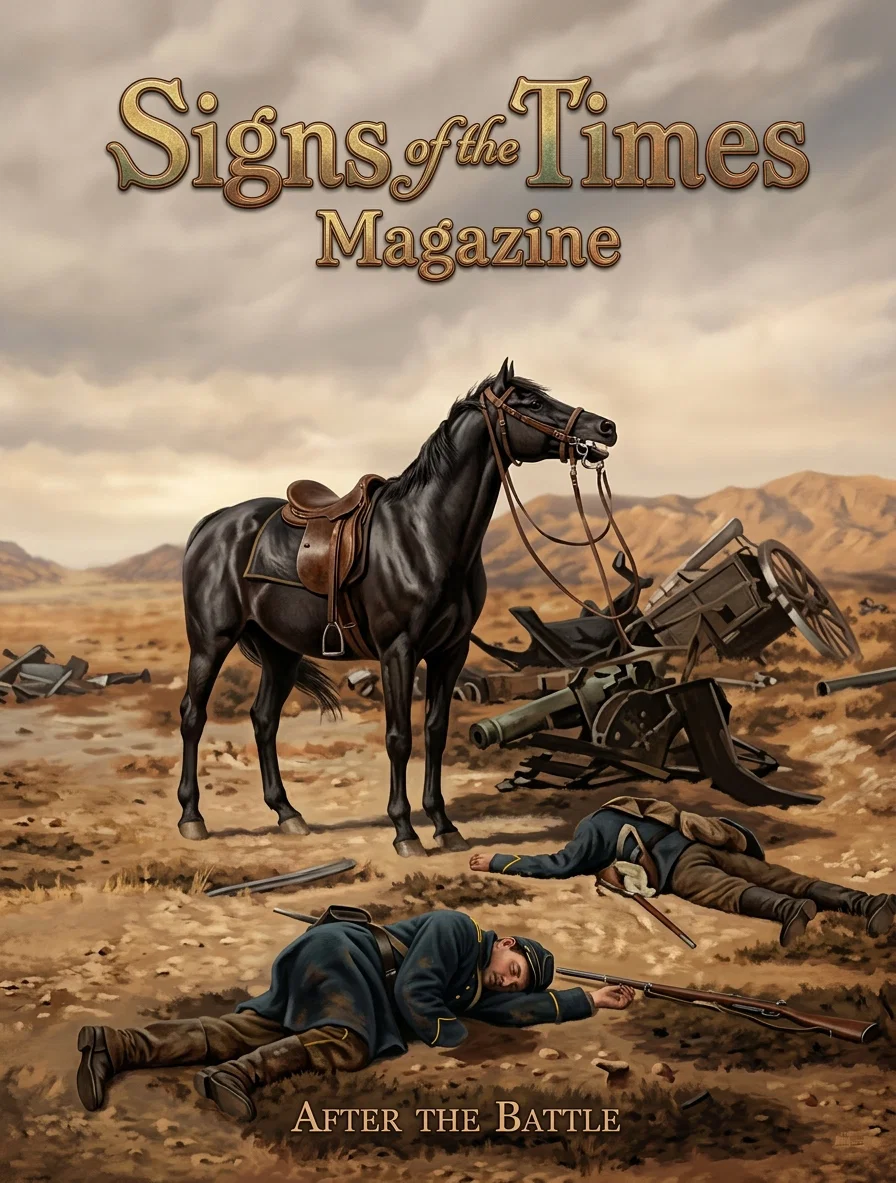
IN THEDecemberSIGNS of the TIMES MAGAZINE
AFTER THE BATTLE
AN EXPONENT OF PROPHECY
The Bible clearly forecasts earth's history to the end of time. The primary object in establishing the Signs of the Times Magazine was to point out and explain these very prophecies. This is done from month to month. If not already informed, we earnestly invite you to become a reader at once, so that day shall not “overtake you unawares.” The subscription price is but $1.00 a year. A sample copy will be sent upon request.
AGENTS WANTED
Many persons are earning their living by taking subscriptions and selling this magazine. Some devote but part of their time to it. There is a constantly growing demand for such a publication, and agents generally find but little difficulty in disposing of 50 to 100 copies a month.
An enthusiast in the north says: “I find there is really a demand for our literature at this time. While on my way up from Regina to deliver my books, I took ten copies of the Signs Magazine for October, and I could have used many more. I not only got rid of the ten, but have eight subscriptions for the magazine. The conductor on the train yesterday was much interested in it, and subscribed for a year.”
Subscriptions or requests for further information should be sent to our depository in your state or
SIGNS OF THE TIMES MAGAZINEMOUNTAIN VIEW, CALIFORNIA
Is Japan mentioned in the prophecies?
Will the Bible prophecy referring to plagues and pestilences be partially fulfilled this winter?
Are we about to come to an end of Christianity? If so, will barbarism supplant it?
Will the United States lead the world in a confederation of evil and apostasy?
What will be the attitude of the United States toward the papacy in the near future?
Is heaven closing its accounts with the human family?
Will Russia and Turkey meet on the battlefield?
"Shiloh, the Man of Sorrows"
Many who have read this story, or parts of it, as it appeared in serial form in the SIGNS, will be glad to order a copy for their own library, or for a beautiful and useful present to a friend.
The volume should stimulate a desire for Bible study, and is just the book for aggressive missionary work among the Jews and the unconverted. It is beautifully bound in cloth, gold stamped, 377 pages. Eight full page illustrations. $1.50 net. Agents wanted. Author's portrait suitable for framing. Let the orders come in.
Fourteen cents postage extra.
Address the author, Mrs. L. D. Avery-Stuttle,
1215 Vermont Avenue, Lansing, Michigan.