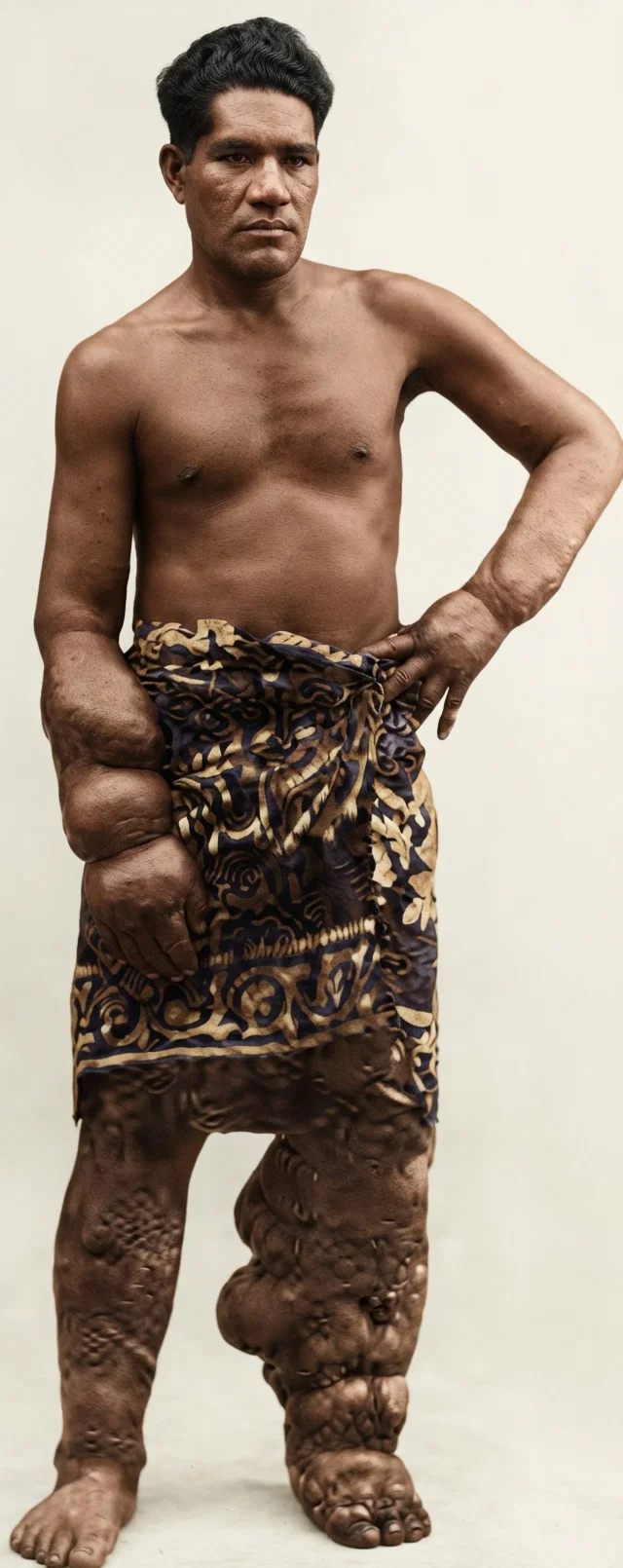
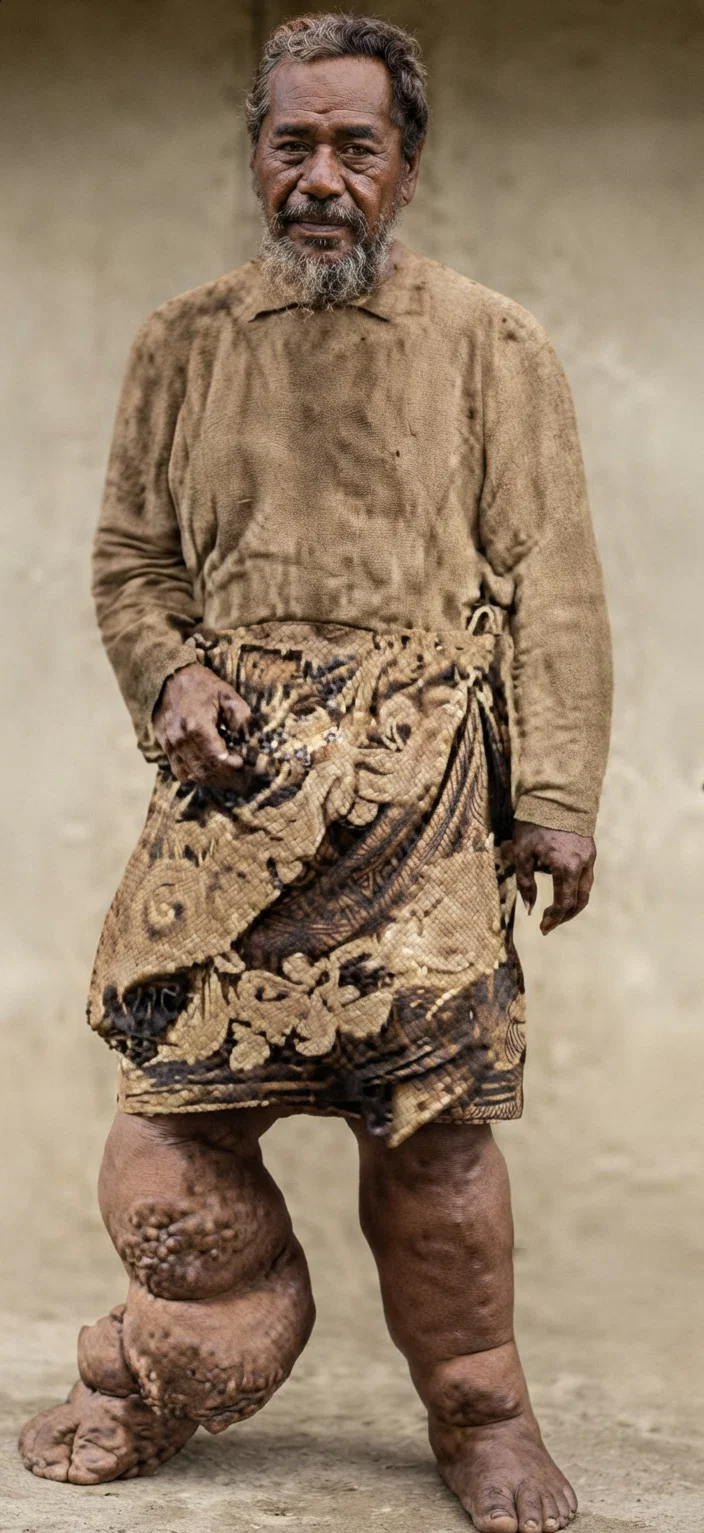
ELEPHANTIASIS ARABUM, or fefe (pronounced fāfā), as the natives of Eastern Polynesia call it, is an ailment peculiar to the tropics. It is sometimes classed as one variety of leprosy, tho quite different in many respects from the disease generally recognized as such. Elephantiasis affects persons of mature years, and seems to find a larger proportion of victims within the ranks of the men than among the women. We have never observed a case among the youth or children.
A Native of the Society Islands Afflicted with Elephantiasis in Left Leg and Right Arm.
Some localities within the tropics are comparatively free from the inroads of this disease, while other islands and districts are grievously afflicted thereby. Where rum rules with most despotic hand is the best field for the germs of elephantiasis, which is probably due to the powers of resistance being reduced by the alcohol. Nearly one-third of the male population of Moorea are afflicted with this disease. As we have before remarked, the Mooreans are mostly drunkards.
All the extremities are bloated and enlarged by elephantiasis in various patients, tho seldom does one meet a man who has more than two of his members afflicted perceptibly by it. These sufferers are the more to be pitied as the abnormal increase of tissue is generally accompanied by weakened memory. The most distorted sufferer from this disease that I ever met lay on the grass a hopeless idiot.
A Native of Aitutaki, Cook Islands, Afflicted with Elephantiasis in the Legs.
Many are afflicted with elephantiasis in its various stages for years, and never die of it. Removal to a cooler climate generally gives relief to the foreigner.
The comparative freedom from this ailment enjoyed by those who eat, sleep, and otherwise live like civilized beings, leads us to conclude that this gross affliction is a low order of germ or parasitic life that can not harm the Christian who is educated to take proper care of the body.
Damp and unhealthful surroundings, poor food, and habits of uncleanliness are all conducive to elephantiasis, if not directly responsible for it.
"They that be whole need not a physician, but they that are sick," said the Master. Many of these sufferers are quite away from the beaten path of the physician, and, tho soul and body are sick, no one comes to relieve the heartache or place the balm of healing upon their sores.
Has not the time now come when the words should meet their fulfilment: "Behold, I will send for many fishers, saith the Lord, and they shall fish them; and after will I send for many hunters, and they shall hunt them from every mountain, and from every hill, and out of the holes of the rocks" (Jer. 16:16)?
E. C. CHAPMAN.
HEAVENLY REST.
By B. W. Marsh
"Come unto Me," I hear Thee say,
And waters still Thou wilt lead me by.
Thy pasture's green in which I may
Safe from all foes securely lie.
"My pasture's broad," I hear Thee say.
'Neath living fruit the forests bend;
The river's deep, and all the way
The palms of peace their music blend.
O Shepherd of the flock, I go!
My pasture poor so long has been,
This starving heart is filled with wo,
My tired soul is poor and lean!
"Come unto Me," I hear Thee say,
And by Thy promise I shall dine.
I will. Reveal to me the way;
This living promise must be mine.
Ah, heaven and rest, how sweet to rest
And listen to the Saviour's voice!
My troubles gone, supremely blest,
Deep is the peace; rejoice, rejoice!
B. W. MARSH.
Cripple Creek, Colo.
MISSIONARIES IN CHINA TO BE PROTECTED.
UNITED STATES MINISTER CONGER, at Peking, has sent the State Department at Washington a copy of a proclamation posted at Tientsin relative to the treatment of missionaries in China. In this edict, issued on "27th of 10th moon," the empress dowager recites the fact that antichristian movements had taken place in many provinces, and declares that these have all been based on false sentiment. She wishes the people to understand that the teaching of Christianity is permitted in China, and that the preachers are to be treated as good citizens. Despite her well-known conservatism, the empress dowager has manifested in several instances recently an appreciation of the necessity of yielding to the customs and ideas of Christian nations. This was notably the case in her acceptance of a copy of the Bible from the wives of missionaries, and her reception, a few months ago, of the wives of diplomatic representatives of foreign powers. These two events were epoch-marking in their influence, and prepared the way for, if they were not the occasion of, the recent proclamation requiring the protection of missionaries.
—Northwestern Christian Advocate.
RUSSIANIZING CHINA.
RUSSIA is not only encouraging the early disintegration of the Chinese Empire, but assumes that that event has practically taken place. While diplomatically treating with the Chinese Government, Russia has taken possession of a large portion of Chinese territory, and is governing it as it does its own territory.
A correspondent of the North China News gives some remarkable information regarding the Russian progress in Manchuria. Russians in Manchuria are acquiring land as they please and are already working mines. The railroad is obviously a military one, and there are 30,000 Russian troops at Port Arthur, 3,000 at Talienwan, 2,000 at Kinchou, 200 at Lunchou, 200 at Wafanglien, 200 at Newchwang, 200 at Haichieng, 200 at Liaoyang, 300 at Kirin, 20,000 at Haipion, north of Kirin, and, in fact, Russian soldiers are all over Manchuria. In Haichieng the Russians have taken a shop and fortified it by mounting guns. At Liaoyang they have a site 200 yards square, where they are building barracks. At Kirin they have possession of the Chinese barracks, and 300 soldiers, with 20 officers and mining engineers, are quartered there. Visitors to the locality can not move without being shadowed by Russians. At Haipion, where the railway will branch off from the main line to Vladivostok, there are Russian settlements with 20,000 soldiers.—Selected.
The Waldensian Church Anniversary
THE Waldensian Church in Italy a short time ago celebrated the fiftieth anniversary of the edict of King Charles Albert which granted religious toleration and freedom from persecution to the Waldenses. Dr. Prochet, pastor of the Waldensian Church in Rome, was given a special audience by King Humbert, who has on several occasions expressed his interest in the Waldensian Church.—The Banner.
The First Moslems in China
By Edward Sell
The First Moslems in China.—The first Mohammedans who came to China were Arab merchants. It is said that commercial relations with Arabia existed before the time of Mohammed. Four of the companions of the prophet brought presents to the emperor, and were allowed to settle in Canton, where they built a mosque called the Holy Remembrance. This would give as the date of the first Moslem mission to China the latter part of the seventh century. The Khalif Walid, in the early part of the eighth century, advanced his victorious army to the frontiers of China. The general of his army demanded, and received, tribute from the emperor. In the year 755 A.D. a band of 4,000 Moslem soldiers came from Khorasan to the aid of the emperor, and in return for their services were allowed to settle in various towns in China. In 794 A.D. Hārún’r-Ráshid sent ambassadors to China. The political relation thus entered into lasted for some centuries. In 1068 the Emperor Chin Tsoung appointed a Moslem to the oversight of the Arab strangers who came to Canton. This official distributed them in different places, and kept a register of their names.—Rev. Edward Sell.
The Sabbath School International Series
LESSON VIII.—SABBATH, MAY 20, 1899.
By Editor
ORDINATION OF THE TWELVE; THE SERMON ON THE MOUNT.
Hill of Hattin.
NOTE.—This Sabbath-school lesson is unreasonably long. No person can get it in a week. No teacher can do an approximation of justice to it in a half hour. Do not try to cover it. Dwell on two or three main points or great truths. The Beatitudes are sufficient for a lesson. Christ's teaching on the law (Matt. 5: 17-20), with illustrations that follow, is sufficient for another. The Lord's prayer is a more than sufficient lesson. The lesson of trust in the latter part of chapter 6 is a lesson by itself. So also is Matt. 7: 13-29. The SIGNS can not print all the lesson scripture, but it prints more than sufficient for any one lesson. We shall not be troubled this way again.
Luke 6:13. "And when it was day, He called His disciples: and He chose from them twelve, whom also He named apostles."
Mark 3:14, 15. "And He appointed twelve, that they might be with Him, and that He might send them forth to preach, and to have authority to cast out devils."
Matt. 10:2-4. "Now the names of the twelve apostles are these: The first, Simon, who is called Peter, and Andrew his brother; James the son of Zebedee, and John his brother; Philip, and Bartholomew; Thomas, and Matthew the publican; James the son of Alphaeus, and Thaddaeus; Simon the Cananaean, and Judas Iscariot, who also betrayed Him."
Matt. 5:17-20. "Think not that I came to destroy the law or the prophets: I came not to destroy, but to fulfil. For verily I say unto you, Till heaven and earth pass away, one jot or one tittle shall in nowise pass away from the law, till all things be accomplished. Whosoever therefore shall break one of these least commandments, and shall teach men so, shall be called least in the kingdom of heaven: but whosoever shall do and teach them, he shall be called great in the kingdom of heaven. For I say unto you, That except your righteousness shall exceed the righteousness of the scribes and Pharisees, ye shall in nowise enter into the kingdom of heaven."
Matt. 6:1-15. "Take heed that ye do not your righteousness before men, to be seen of them: else ye have no reward with your Father which is in heaven. "When therefore thou doest alms, sound not a trumpet before thee, as the hypocrites do in the synagogues and in the streets, that they may have glory of men. Verily I say unto you, They have received their reward. But when thou doest alms, let not thy left hand know what thy right hand doeth: that thine alms may be in secret: and thy Father which seeth in secret shall recompense thee. "And when ye pray, ye shall not be as the hypocrites: for they love to stand and pray in the synagogues and in the corners of the streets, that they may be seen of men. Verily I say unto you, They have received their reward. But thou, when thou prayest, enter into thine inner chamber; and having shut thy door, pray to thy Father which is in secret, and thy Father which seeth in secret shall recompense thee. And in praying use not vain repetitions, as the Gentiles do: for they think that they shall be heard for their much speaking. Be not therefore like unto them: for your Father knoweth what things ye have need of, before ye ask Him. After this manner therefore pray ye: Our Father which art in heaven, Hallowed be Thy name. Thy kingdom come. Thy will be done, as in heaven, so on earth. Give us this day our daily bread. And forgive us our debts, as we also have forgiven our debtors. And bring us not into temptation, but deliver us from the evil one. For if ye forgive men their trespasses, your heavenly Father will also forgive you. But if ye forgive not men their trespasses, neither will your Father forgive your trespasses.11Matt. 7:7-11; 21-27. "Ask, and it shall be given you; seek, and ye shall find; knock, and it shall be opened unto you; for every one that asketh receiveth; and he that seeketh findeth; and to him that knocketh it shall be opened. Or what man is there of you, who, if his son shall ask him for a loaf, will give him a stone; or if he shall ask for a fish, will give him a serpent? If ye then being evil, know how to give good gifts unto your children, how much more shall your Father which is in heaven give good things to them that ask Him?" "Not every one that saith unto Me, Lord, Lord, shall enter into the kingdom of heaven; but he that doeth the will of My Father which is in heaven. Many will say to Me in that day, Lord, Lord, did we not prophesy by Thy name, and by Thy name cast out devils, and by Thy name do many mighty works? And then will I profess unto them, I never knew you; depart from Me, ye that work iniquity. Every one therefore which heareth these words of Mine, and doeth them, shall be likened unto a wise man, which built his house upon the rock; and the rain descended, and the floods came, and the winds blew, and beat upon that house; and it fell not; for it was founded upon the rock. And every one that heareth these words of Mine, and doeth them not, shall be likened unto a foolish man, which built his house upon the sand; and the rain descended, and the floods came, and the winds blew, and smote upon that house; and it fell; and great was the fall thereof."
NOTE.—The texts inclosed in marks of parentheses, while not essential to the lesson study, will be found to throw much light upon the lesson, and are suggested for those who wish to study further.
SUGGESTIVE QUESTIONS.
1. After spending a whole night in prayer, what did the Saviour do early in the morning? Luke 6:13. (Mark 3:13.)
6. In what position did Christ then place the apostles before the world? Verses 13-16. (Phil. 2:15; Prov. 4:18; 1 Peter 2:9.)
7. Knowing that some of the Pharisees thought His teaching was belittling the law, what did Christ say to destroy this impression? Verses 17-20. (Rom. 3:31; 8:2-4; 10:1-4.)
8. How did He then proceed to expand the law? Verses 21, 22, 27, 28, 31-34, 38-48.
9. What instruction did He give His disciples in regard to almsgiving? Matt. 6:1-4. (Rom. 12:8-21.)
10. In contrast with the formal method, how did He teach them to pray? Verses 5-13.
11. What did He say about forgiveness? Verses 14, 15. (Eph. 4:32; Luke 23:34.)
12. How did He tell them to fast? Verses 16-18. (Isa. 58:6-11.)
13. What did Christ say relative to gathering earthly treasure? Verses 19-21. Note 3. (Luke 12:15-21.)
14. What did Christ show was the proper attitude for His followers to occupy relative to the things of this world? Verses 24-34. (Ps. 37:25; 1 Kings 17:9, 12, 16.)
15. What does Christ say will positively be done for those who trust Him? Matt. 7:7-11. (Jer. 29:11-13.)
16. Who does He say will not enter the kingdom of heaven? Verses 21-23. (Isa. 29:13, 14.)
17. To what did He liken the two classes of hearers of the Gospel? Verses 24-27. (Luke 6:47-49.)
18. How were the people affected by the Saviour's doctrine? Why? Verses 28, 29. Note 4.
NOTES.
1. Twelve disciples.—These twelve had for some time been disciples, i. e., learners. Upon their ordination they were called apostles, or those sent forth. They were sent forth to represent the Gospel church, as the twelve patriarchs had represented the tribes of Israel. See "Desire of Ages," pp. 291, 292. For knowledge of the dispositions of these men, see "Desire of Ages," p. 296.
2. The ordination of the twelve is supposed to have taken place on one of the two horn-like heights of Hattin. These were two hours' journey (from five to seven miles) west of Tiberias, overlooking the mouth of a gorge which opens into the cliffs of Arbela. The plain below these heights, to which the Saviour descended with His apostles, was easily accessible from the lake, yet only a few minutes' walk from the summit. This plain was a level space on the side-hill, well adapted for the gathering of a multitude. See "Desire of Ages," p. 299.
3. Lay not up for yourselves.—The Jews had come to believe that the amount of riches one possessed indicated the favor he had with God. Christ's teaching in this text was to destroy that illusion.
4. Not as the scribes.—No wonder they were astonished. They were accustomed to the verbal trifling of intricate sophistries, and the tortuous windings of tradition and prescription. They now heard these criticized and rejected for the plain, ungarnished Word. The great Teacher came not from any of the authorized schools, yet His teaching was fresh as the morning breeze upon the mountain-side. He appealed to no authority but the Word of God, tearing away from the law the false traditions which obscured its obvious import.
OUR WORK AND WORKERS.
By Editor
Six new members were recently added to the church at Michaelville, Ind. A new house of worship was dedicated April 19.
At Georgetown, British Guiana, Brother E. L. Fortner reports the baptism of six candidates, and two others at a point on the Demarara River.
The school at Yazoo City, Miss., started November 30 last, with Brother F. R. Rogers as teacher, now has a regular attendance of about 150 pupils.
The Indiana Reporter says: “The establishment of a State industrial school is contemplated, and offers of sites and land have been made to the conference committee from several localities.”
In harmony with the recommendation of the General Conference, Elder C. N. Martin, of Montana, has removed to California, which is now his field of labor. His family will reside in Oakland.
Brother Sullivan Wakeham, who went to Trinidad some time ago, has secured a farm of forty-five acres, which he has deeded to the Foreign Mission Board, and on which it is designed to establish an industrial school.
Reporting the work in Jamaica, Brother W. W. Eastman states that at Southfield there is a church of thirty-one members and a Sabbath-school of over sixty members. At Jointwood, thirty-three miles from Southfield, the church numbers twenty-three, and the Sabbath-school over fifty. At Couted Hall, thirty-seven miles from Southfield and twenty-five from Jointwood, there is a company numbering about twenty-five, the result of some eight weeks of labor. Forty miles from Southfield is Bluefields, where there is a small company with a promising future. Savannah-La-Mar is eighteen miles beyond, where a quite recent work was started by our colporters, and there is now a company of seventeen members, with a good prospect of a large church. Fourteen miles further on is Sheffield, where is a company of about twenty members; and at March Town, eight miles from there, is another company of about the same number.
The following extract from a letter from Brother J. L. Doble, of Honolulu, to the foreign mission secretary, is of special interest, as it relates to the Chinese school work:—
“In addition to teaching, Professor Howell has appointed me preceptor, and requests that I spend all of my time with the boys; and they always find some use for my time. They are not like English boys, who usually prefer to have the teacher out of sight, but enjoy association with the teacher, and, in fact, this is about the only way I can teach them the truth—by a living example. The Chinaman will believe nothing that is not tangible to him. He must not only hear it, but he must see it with his own eyes, and feel it with his fingers. Another difficulty we have to contend with is the respect the Chinese have for their parents and ancestors. To go contrary to their father’s wishes, or to follow a path which their ancestors have not trod, would be everlasting disgrace. Especially is this true of the higher class, to which nearly all of our boys belong. And, tho the majority say that they believe in God, many of them having borne testimony in our Sabbath meeting to that effect, to my knowledge not one has openly avowed his faith among his people. However, an encouraging incident happened recently: two of our boys came to me and wanted their pictures taken with their Bibles in their hands, that they might in this way tell their fathers that they believe in the Bible.”
WANTED.
ANY one knowing the whereabouts of Walter Church, son of W. W. Church, of Benton, Illinois, will confer a great favor upon the father by informing him.
UPPER COLUMBIA CAMP-MEETING.
By J. L. Kay
THE Upper Columbia Conference will hold its nineteenth session in connection with the camp-meeting to be held May 11-21 at Milton, Oregon. A number of laborers from abroad will be present to render assistance in the meeting.
We expect this to be the most important conference ever held thus far in our territory. We trust that as many of our brethren and sisters as can consistently will attend this meeting, and bring hearts hungering for righteousness.
J. L. KAY,
Secretary of Conference.
Personal Work.
In a recent sermon, Rev. J. B. Silcox, of Sacramento, Cal., gave the following timely advice to his hearers:—
“If you want to follow Jesus, do this: Single out some one family, one individual, one outcast, and by personal sympathy and service care for and save that one. Quit talking about saving the masses, and focus your energies and interest on some one needy soul. Go after the one lost sheep. Seek diligently for the one lost coin. Welcome home the one lost prodigal. Take some blind man by the hand and guide him. Take some weak sister by the hand and strengthen her. . . . If this world is ever to be redeemed from ignorance to intelligence, from vice to virtue, from sin to holiness, it must be done in the way Jesus began. The high must minister to the low; the strong must carry the weak. There must be personal interest, personal sympathy, personal service. When a woman asked Carlyle how she might serve humanity, the wise old sage said to her, ‘Hunt up some lonely, neglected Scotch lassie and be kind to her.’
“To be a Christian as Jesus taught it means that those who are high shall minister to those who are low. The lower a man is and the greater his need, the greater is his claim. His need is his claim.
“In proportion as God has blessed you with wealth or culture or strength, to that degree He requires you to serve your fellow-men. Those who have most are to serve most. Ability determines responsibility. Rank imposes obligation. The higher you rise in wealth and wisdom, the greater is your obligation to serve those below you. Christianity is not separation. It is impartation. Man’s rank in the kingdom of God is his power to benefit and uplift humanity. The genius that distributes wealth is higher and diviner than the genius that accumulates it. The prayer, ‘Lord, use me,’ ought to be on our lips oftener than any other.”
Prayer at an Indian Child’s Funeral
By Edison J. Driver
The Digger Indians of the Sierras are a degraded and downtrodden people. The simplicity of nature has yielded to all the vices and curses of civilization. Yet, even here, the "Light of the world" throws bright rays of truth and love.
Some time ago a Christian worker chanced to be present at the funeral of an Indian child. When the rude coffin had been covered with earth, several Indians came forward, and, by signs and gestures, requested prayer.
The man complied, but was not a little astonished at the request. After praying he spoke a few comforting words through an interpreter, while all around listened reverently. And when he had ended, they thanked him kindly, and went to their homes with lighter hearts and brighter faces.
And who can tell what the harvest will be? May not some of these be among the "many" who "shall come from the east and west, and shall sit down with Abraham, and Isaac, and Jacob, in the kingdom of heaven"?
— Edison J. Driver.
15 "And Simon Peter followed Jesus, and so did another disciple. Now that disciple was known unto the high priest, and 16 entered in with Jesus into the court of the high priest; but Peter was standing at the door without. So the other disciple, which was known unto the high priest, went out and spake 17 unto her that kept the door, and brought in Peter. The maid therefore that kept the door saith unto Peter, Art thou also 18 one of this Man's disciples? He saith, I am not. Now the servants and officers were standing there, having made a fire of coals; for it was cold; and they were warming themselves; and Peter was also with them, standing and warming himself. 19 "The high priest therefore asked Jesus of His disciples, 20 and of His teaching. Jesus answered him, I have spoken openly to the world; I ever taught in synagogues, and in 21 the temple, where all the Jews come together; and in secret spake I nothing. Why askest thou Me? ask them that have heard Me, what I spake unto them; behold, these know 22 the things which I said. And when He had said this, one of the officers standing by struck Jesus with his hand, saying, 23 Answerest thou the high priest so? Jesus answered him, If I have spoken evil, bear witness of the evil; but if well, why 24 smitest thou Me? Annas therefore sent Him bound unto Caiaphas the high priest.
25 "Now Simon Peter was standing and warming himself. They said therefore unto him, Art thou also one of His disciples? 26 He denied, and said, I am not. One of the servants of 27 the high priest, being a kinsman of him whose ear Peter cut off, saith, Did not I see thee in the garden with Him? Peter therefore denied again; and straightway the cock crew."
Golden Text: "He came unto His own, and His own received Him not." John 1:11.
SUGGESTIVE QUESTIONS.
(1) Who followed Jesus to the house of Annas after His arrest in Gethsemane? How did the other disciple get into the court? V. 15. Note 1. (2) Where did Peter stand? How did he finally get in? V. 16. Note 2. (3) What did the door-keeper say to Peter? What did Peter answer? V. 17. (4) What were the servants and officers doing? What was Peter doing? V. 18. Note 3. (5) Of what did the high priest ask Jesus? V. 19. (6) How did Jesus answer? V. 20. (7) Whom did Jesus say the high priest should ask? Why? V. 21. Note 4. (8) Then what did one of the officers do? What question did he ask? V. 22. (9) What did Jesus say in reply? V. 23. Note 5. (10) What then did Annas do with Jesus? V. 24. (11) What was Simon Peter still doing? What question was again asked of him? What did he say this time? V. 25. Note 6. (12) Who again spoke to Peter? What question did he ask? What was Peter's answer? V. 27. Note 7. (13) Then what took place? Same verse. Note 8.
NOTES.
1. "Followed Jesus."—According to Matthew's account, when Jesus was taken in the Garden of Gethsemane "all the disciples forsook Him, and fled;" and both Matthew and Luke state that "Peter followed Him afar off." It would seem that after escaping arrest with Jesus, at least two of them plucked up courage or curiosity enough to go to the palace to see what the outcome would be.
2. "The other disciple" was no doubt John, as John is the only one of the four evangelists who mentions any other than Peter.
3. "Peter was with them."—Peter wanted to be on the safe side, yet he wanted to see what was going on. "Blessed is the man that walketh not in the counsel of the ungodly, nor standeth in the way of sinners, nor sitteth in the seat of the scornful." Ps. 1:1. Had he been beside Jesus, as John was, he would not have been subjected to such sore temptation; or, being tempted, would have received strength to resist. It is always dangerous to follow Jesus "afar off." His counsel through the apostle James is, "Draw nigh to God, and He will draw nigh to you." James 4:8. Also, through the prophet Azariah, He says: "The Lord is with you, while ye be with Him; and if ye seek Him, He will be found of you; but if ye forsake Him, He will forsake you." 2 Chron. 15:2.
4. "Why askest thou Me?"—The high priest was trying to take a mean advantage of the prisoner. There were plenty of other witnesses to His doctrine who might have been examined, but the rulers sought to condemn Him on His own evidence, which was contrary both to the law and to the spirit of justice. Jesus refused to be a party to such injustice.
5. "Why smitest thou Me?"—It was also illegal for an officer to smite an uncondemned prisoner, as well as to try any one by night. If Jesus had done evil, it was the business of the officer, or any competent witness, to testify of the evil. To smite Him was as unwarranted as the later abuse He received from the soldiers of Pilate and Herod.
6. "Warming himself."—Peter was thinking of his own comfort, as well as his safety, while his Master was in peril of His life. This was parallel in principle, tho more flagrant in appearance, to the act of sleeping in the garden during the agony of Jesus, when the disciples should have been watching with Him, as He had commanded them.
7. "He denied."—Even Peter's physical courage, which a little while before had been so demonstrative, when he smote the servant of the high priest, had now left him. He was not so ready to die with the Master (John 13:37), when the apparent prospect of such a result confronted him, as he had thought. Herein is a lesson,—physical bravado is not a spiritual support. "God is our refuge and strength." Ps. 46:1. "Happy is he that hath the God of Jacob for his help, whose hope is in the Lord his God." Ps. 146:5.
8. "The cock crew."—That was just what the Lord had told Peter, only a few hours before: "The cock shall not crow, till thou hast denied Me thrice." John 13:38. Peter remembered the word; the Spirit struck it home to his heart, and deep repentance followed. "He went out, and wept bitterly." Matt. 26:75.
A BIBLE FREE.
By Editor
DON'T you want one? You can have it by sending us seven new yearly subscriptions for the SIGNS at the regular subscription price of one dollar each. Read the following letter from one of our friends who has taken advantage of our offer:—
SIGNS OF THE TIMES Dear Sirs: I received in due time the premium Bible that you sent me. I consider it as beautiful a gift as you could bestow upon one for the number of subscriptions which you ask for it. I thank you sincerely for it. Respectfully yours, MRS. R. M. BARTON.
WE WISH YOU TO KNOW
By Editor
that we have arranged with
BATTLE CREEK COLLEGE
to give you a......
Free Scholarship of one year, including board, room and tuition
Read the statement below
THE BATTLE CREEK COLLEGE
A Training School for Christian Workers
Battle Creek, Mich.
"Come thou with us, and we will do thee good."
This institution is devoted exclusively to the spiritual, physical, mental and moral training of young men and women, that they may be prepared to go out to service for God. Practical courses are given in every line of study necessary for this work. Special attention is given to training for the ministry, missionary teaching, house-to-house Bible work, colporter work, and for foreign mission service. Students have abundant opportunity each day to put into practice what they have learned.
A prominent feature in the educational work of this College is the instruction and practice given in manual training, including farming, carpentry, broom making, shoe making, tailoring, dressmaking, cooking and nursing.
Board is offered in the College boarding hall on the European plan, which enables the student to control and greatly curtail his expense on this item.
To those who solicit subscriptions for the "SIGNS," Special inducements are offered at rates far below the regular fees.
For further particulars on this offer, write to
"SIGNS OF THE TIMES," Oakland, Cal.
For further information concerning the School, address
BATTLE CREEK COLLEGE, Battle Creek, Mich.
Of His Coming
OF HIS COMING, by Milton C. Wilcox, shows conclusively that Christ's coming is very near. 25,000 already sold. Price, $1.50 per 100.
PACIFIC PRESS PUB. CO.
Oakland, Cal.
39 Bond St., New York City
18 W. 5th St., Kansas City, Mo.
Angels of God
"Angels of God." (Spanish.) A collection of five Bible readings on the following subjects: 1. The Angels of God. 2. Satan and His Work. 3. Christ the Resurrection and the Life. 4. The Second Chapter of Daniel. 5. Signs of the Coming of Christ. Two illustrations; paper; price, 5 cents. Address, PACIFIC PRESS PUBLISHING CO., Oakland, Cal.