It is difficult to describe the sensation caused among church-going people throughout the United Kingdom by the action of the Princess of Wales in not only accepting the presidency of a Roman Catholic orphanage at Norwood, founded and directed by Sisters of Mercy, but in likewise consenting to open a sort of fair or bazaar organized for the purpose of raising funds for the institution.
It is the first occasion since the days of the Reformation, or rather I should say since the overthrow and exile of the Stuart dynasty, that a member of the reigning house of Great Britain has accorded recognition of any kind whatsoever to Catholic institutions, and one has only to recall the fact that it is not so very long ago that Roman Catholics were subjected to numerous civic disabilities, in order to realize the importance attached to the action of the Princess of Wales.
The irritation which it has caused in all ultra-Protestant circles is intensified by the fact that the future queen of Great Britain has always displayed a very strong leaning for what is known as the High Church, or ritualistic branch of the Church of England. Like her fellow-ritualists she believes in confession, and in the divine presence in the sacrament, as well as in the intercession of the saints.
In fact, her religious views (as in the case of so many other great ladies in England of foreign birth, who have been reared abroad as Lutherans, but have joined the Church of England) are so extremely ritualistic that the border line which separates them from full-fledged Roman Catholicism is barely perceptible.
The Princess of Wales, moreover, has always remained deeply impressed by the fatherly words of sympathy and consolation addressed to her by the venerable pontiff when she visited Rome incognito with her two younger daughters shortly after the death of her eldest son.
With Perplexity
“With Perplexity.”—“The great Protestant body (there are exceptional churches, of course) has shamefully deserted the masses in our cities,” says Mr. Alvan F. Sanborn, in The Independent. “More than that, certain ‘up-town churches’ are the very penetralia of aristocratic exclusiveness and fat-witted prejudice. The missions, with which a pathetic attempt has been made to cover the retreat, have unquestionably done good; they have relieved real distress, and there have been in them real conversions. They have as unquestionably done harm; they have been victimized by professional beggars, and there have been in them bogus conversions.” Mr. S. mentions “the churches, the Salvation Army, the charities, the Trade Unions, the social settlements,” as agencies at work for the uplifting of the “submerged truth.” And yet these do not solve the problem, nor has the writer any solution to give. In fact, his whole article is a fulfilment of our Lord’s prediction that in these days will be “distress of nations with perplexity.” The Bible presents the ultimate and glorious outcome. Now it is the duty of every Christian to make practical-every-day application of Gospel principles.
Large crops do not always mean prosperity
The New YorkDry Goods’ Chronicle remarks: “Those merchants who are heavily stocked up with goods that show little or no sign of movement read with amazement the prosperity articles and editorials of the statists, the critics, and the lookers-on. On all sides we peruse illuminated accounts of the movement in pig iron, of payments through clearing-houses, of the necessity of our feeding and clothing Europe and other foreign peoples. It all sounds very well. It is quite nice patter talk. At the same time the expected action in merchandise does not materialize. The average merchant is left in wonder and disgruntlement. The facts appear to be that the much-talked-of prosperity, while it may be about up to the latch-string, has not yet given the final pull. And, despite the movement in pig iron and the deplorable plenitude of breadstuffs, the average merchant will find it unprofitable to lose sleep by waiting up for a guest who is nothing if not tardy.”
Large crops do not always mean prosperity
The Mount of Olives
By H. P. H.
JOTTINGS FROM PALESTINE. NO. 12.
The Mount of Olives.
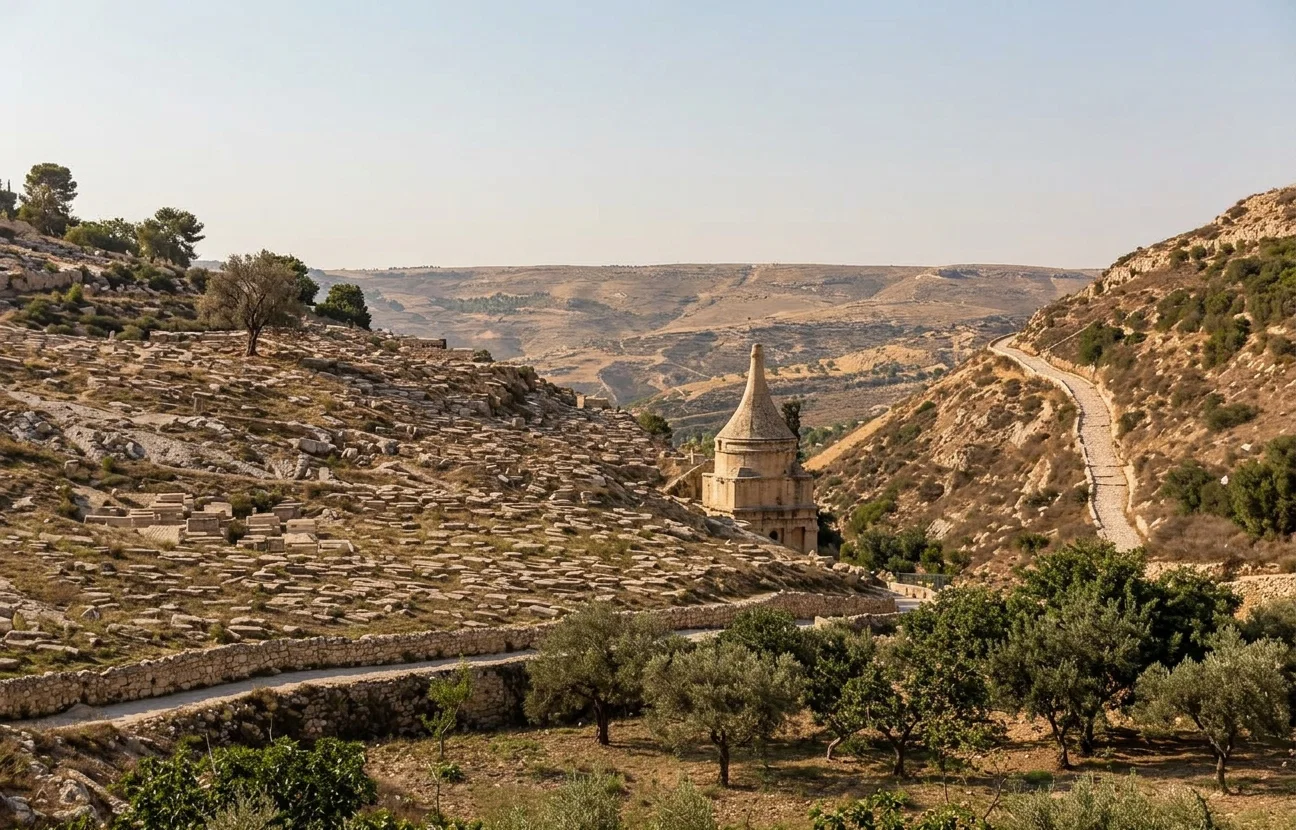
Nothing about Jerusalem had so great attraction for me as the Mount of Olives and vicinity. To visit this most interesting place we leave the city by Stephen’s Gate, the only one in the east wall; it is located but a few steps north of the temple area. The Golden Gate, leading to the temple grounds, is walled shut. From the gate we have a good view of the Kidron Valley, the Garden of Gethsemane, and the Mount of Olives. Looking down the Kidron Valley to the south, we see several monuments, the first of which is that of Absalom, which he himself had erected. Evidently he was afraid to trust this to his survivors; and, judging by the course of the Jews to-day, he was not mistaken in his fears; for when they pass by his monument, they pelt it with stones. Excepting the top, this monument is cut from the native rock, and will stand as long as time lasts.
ABSALOM'S TOMB AND VALLEY OF JEHOSHAPHAT. This monument is a cube measuring 22 feet on a side, hewn out of the solid rock. The total height above the present surface of the ground is fifty-four feet.
On the left side of the valley, beyond Absalom’s monument, is a Jewish cemetery, and on the opposite side of the valley, but north of Stephen’s Gate, is a Mohammedan burying-ground. These places are chosen because both the Jews and the Mohammedans believe that at the judgment the nations will be gathered in this valley.
Viewed from Stephen’s Gate, Mount Olivet presents rather a pleasing, friendly appearance. It is considerably higher than the hills on which Jerusalem is located; and its side facing the city is covered with buildings and olive and cypress trees. From the gate the descent is quite rapid to the bottom of the valley; we descend in about five minutes. The road we follow, if not exactly the same, is very near the one which Christ took when, after the supper, “He went forth with His disciples over the brook Cedron [Kidron], where was a garden, into the which He entered, and His disciples. . . . For Jesus oftimes resorted thither with His disciples.” John 18:1, 2. All the way from the gate we have a fair view of what is believed to be the Garden of Gethsemane.
The garden, in possession of the Latins, is in the form of an irregular quadrangle, over two hundred feet across, and is inclosed by a wall. It contains eight olive trees; the gnarly trunks, bursting open with age, are filled within and braced without with stones. The oil made from the olives of these trees sells at a high price, and also the articles made from their wood. Many flowers are grown in the garden, and pressed and mounted on cards to sell as souvenirs.
But the garden itself interests me far less than the wonderful event which took place here; the only satisfaction in visiting the garden is found in the fact that it brings this event more vividly before the mind. Perhaps through all eternity few events will be so often considered, and so vividly in the memory of the human family and of angels. In Gethsemane we behold the Creator of the universe bending beneath the awful weight of the sins of the whole world, that He may redeem a lost race. It would seem that at this hour, above all others, the destiny of the human family for all eternity hung trembling in the balance. We shall never tire of viewing the spectacle, and never cease our anthems of grateful praise for the infinite victory here gained in our behalf.
We pass through the bed of the valley, which is now many feet higher than in the time of Christ, as it has been gradually filling with the rubbish of centuries. The brook Kidron is now dry all the year. We pass the Garden of Gethsemane, which is but a few steps up the sides of the mountain, and ascend to the summit. It is quite steep, and the winding path quite rugged; there are several buildings on the side of the mountain, while on the summit there is a village, several churches, and a high Russian tower.
We pass first through the Arab village, whose wretchedness is equaled only by its filth. In this village is the Church of the Ascension, claimed to mark the very spot from which Christ ascended. But we promised to lose no time with uncertain traditions; so we do not take pains to learn the name and place of all the events which tradition has invented and located, and built churches and towers to commemorate, but ascend to the highest point, and content ourselves with the events which the Bible locates on Mount Olivet.
As we reach the summit, we are delighted with the general view. Two hundred feet below us, just across the Kidron Valley, lies Jerusalem; the general surface of the city slopes towards the Mount of Olives, thus affording a much clearer view than if it was level. The lower portion of the city is the temple area, in the southwest corner; this is believed to be Mount Moriah, where Abraham came to offer Isaac. The opposite side of the city from the temple, nearly the highest point of all the city, is called Mount Zion, now surmounted by David’s tower. In the time of Solomon there was a deep valley between Mounts Moriah and Zion; but this has been filled with rubbish to a depth of ninety feet. Anciently this valley was spanned by a bridge connecting the two mounts.
As the atmosphere in Palestine is pure, especially at the altitude of Jerusalem, which is 2,550 feet above the Mediterranean, in clear weather the city stands out beautifully distinct when viewed from the Mount of Olives. It is a picture that one can enjoy looking at for a long, long time. We think especially of the time when Jesus, coming from Bethany over the mount, rode triumphantly into the city. “And when He was come near, He beheld the city, and wept over it.” Then we see the enthusiastic throng pass down through the valley, up the slope to the gate, and into the city, and finally see Jesus enter the temple and cast out the traffickers.
And again: “As He sat upon the Mount of Olives over against the temple,” the disciples ask Him when the temple will be destroyed, and what will be the sign of His coming and the end of the world. In answer to these questions follows that remarkable sermon on the signs of the times recorded in Matthew 24.10
As we sit upon this mount, and, looking over the city and the place of the temple, review history, seeing how completely the first part of this sermon was fulfilled, we appreciate with increased emphasis the fact that the latter part, concerning the end of the world, will in its time be just as promptly and literally fulfilled.
We turn to the south, and are greeted by a view of Bethlehem and its plain, which stand out in surprising clearness. Like a flash our minds go back to that memorable night when Jesus was born in Bethlehem, when the wise men, guided by the star, wended their way thither, and when the shepherds on the plain heard the glad tidings and the rejoicings of the angelic host, and saw the plain lighted up with the glory of God. Turning to the southwest, our eye passes over receding, dome-like, barren hills, and follows down into the deep depression, till it rests on the blue waters of the Dead Sea; and then, looking beyond, follows a long stretch of mountains rising higher and higher, and standing out in remarkable clearness. They are the mountains of Moab, and among them is Mount Nebo, from which Moses viewed the promised land. The Dead Sea being 1,300 feet lower than the Mediterranean, and hence 3,900 feet lower than the Mount of Olives, it is not strange that it appears to be down so deep.
Looking to the east, we see the valley of the Jordan and the plain of Jericho, and to the northeast the hills of Gilead. We are agreeably surprised to find that from the Mount of Olives we can see all these places so distinctly with the naked eye. Turning once more toward Jerusalem, we realize more than ever the fitness of the expressions: “Jerusalem is builded as a city that is compact together;” “Zion, the perfection of beauty;” “Beautiful for situation, the joy of the whole earth, is Mount Zion.” And then, looking at the surrounding hills, which extend in every direction farther than the eye can penetrate, we are able to grasp more of the infinity in the expression, “As the mountains are round about Jerusalem, so the Lord is round about His people from henceforth even forever.” H. P. H.
A LESSON FROM A FLOWER.
By Eliza H. Morton
A little flower was trampled
Low in the mud and mire,
Its petals soiled and crumpled,
Its beauty lost entire.
A gentle hand in pity
Pushed back the cold, dark earth,
And raised the tiny blossom,
Believing it had worth.
The sun poured down its brightness,
The rain a blessing sent,
And, lo, the little flower
Arose all reverent, And, lifting up its petals,
Put on a beauty new,
And many a heart aweary
Looked on and stronger grew!
O ye who lift up blossoms
In God’s own garden wide,
Remember whence the showers,
And crush all human pride;
Remember whence the sunlight,
Remember whence the dew:
Take not to self the glory,
’Tis God that works through you!
ELIZA H. MORTON.
WEAKNESS OF JAPANESE BUDDHISM.
By John R. Mott
For many centuries Buddhism has been the great religion of Japan, but during the last nine or ten years it has manifested special activity and vigor. This is the result of the spread of Christianity and the wide diffusion of education. Among the evidences of this awakening are a revival in the study of Buddhism, the rebuilding of temples, the education of priests in certain sects, and the adoption of some of the methods of Christianity.
The chief hold of Buddhism is on the lower classes of Japan, who are so completely under the sway of its countless superstitions. It is a striking fact that it has no hold whatever on the educated classes.
Among the large number of students and teachers whom we met personally on our extended tour through Japan, we did not meet one who would call himself a Buddhist.
The signs of the weakness of Buddhism are everywhere apparent. It is greatly rent with internal dissensions. Its priesthood has been so illiterate that the government about two years ago issued an order requiring that priests receive the equivalent of a common school education before being licensed.
All bore testimony also to the shockingly immoral lives of the priests. As a class they seem to be corrupt through and through. It is said that the chief priest of the largest sect lives an openly vile life. The condition of things is so bad that even the secular press has warned the priests to reform or Buddhism must go down before Christianity.—John R. Mott.
LITERARY NOTICES.
“THE DESIRE OF AGES;” by Mrs. E. G. White, author of “Patriarchs and Prophets,” “The Great Controversy between Christ and Satan,” “Steps to Christ,” “Thoughts from the Mount of Blessing,” etc., etc. Large octavo, 866 pages, profusely illustrated, bound in cloth, sheep, and full morocco. Price, $3.50 to $7.00. Pacific Press Publishing Co., Oakland, Cal.; Kansas City, Mo.; New York City.
The above work is not a technical, chronological history of the life of our Lord upon the earth. It does not discuss chronology in any respect. It does not deal in verbal criticism nor lengthy disquisitions relative to customs and manners of the times of eighteen centuries ago, tho it does not ignore them. And yet the work deals pre-eminently with the LIFE of our Lord. There are longings in every soul for that which it does not now possess, indefinable tho the longing may be. Above all else, the soul longs for that which will bring peace, rest, strength, and encouragement. All these longings are met in the Desire of Ages, our Lord Jesus Christ. And this book, “The Desire of Ages,” tells us in beautiful simplicity of language and clearness of style how this Desire is, how He meets all our needs, and fills every longing of the soul to overflowing. It reveals the Son of God, giving Himself, pouring out His life for the world, revealing the all-loving Father as the one who withheld not His choicest gift for the salvation of sinners. Christ is set before the reader as the eternal Sacrifice, the merciful Saviour of sinners, the Sun of Righteousness, the great High Priest, the Healer of all human maladies, the compassionate and companionable Friend, the ever-helpful Yokefellow, the Prince of the House of David, the Shield of His people, the Prince of Peace, the coming Eternal King. This magnificent work is divided into nine sections and eighty-seven chapters. The sections are as follows: An Outlook, Early Years, The Anointed One, Days of Promise, Falling Shadows, The Rejected One, Nearing the End, The Crucified, To the Father’s Throne. The book is beautifully illustrated with forty full-page half-tone engravings, and more than 180 smaller text and chapter heading illustrations, also half-tones. A few of these (perhaps twenty) are reproductions from great paintings, but the great majority are original, designed especially for this book by such New York artists as Messrs. Mente, Perard, Fogarty, Mora, Bardwell, and others, under the general direction of Mr. W. A. Reaser. The book is beautifully printed, on excellent paper, and will prove a blessing to every home and heart when it is read and received. The book is enhanced in value by two excellent indexes, scriptural and general.
“THE GREAT EMPIRES OF PROPHECY FROM BABYLON TO THE FALL OF ROME;” by Alonzo Trevier Jones, author of “Two Republics,” “The Rights of the People,” “The Empires of the Bible,” etc., etc. 696 large octavo pages, 22 full-page colored maps; price, cloth, $2.00. Review & Herald Publishing Co., Battle Creek, Mich.; Chicago, Ill.; Atlanta, Ga.
This is indeed a timely and labor-saving book. To learn from original sources all that is contained in this volume would mean a searching of ponderous tomes, covering years of labor. The author, a thorough student of history and the Bible, has summarized it into one volume. He who desires to learn from the original sources, ought to read this first, so as to save himself time. The careers of these great empires are summarized in forty-six chapters, in numbered paragraphs, in a clear, forcible style. We speak advisedly when we say that no more important historical work has been issued in these later years than “The Great Empires of Prophecy.” We have but one criticism to bring against this book, together with others by the same author,—it has no index. Has the author a prejudice against indexes? If so, as there is no conscience involved, he ought to have deferred to the wishes of his readers; and, too, he need not have used it himself, or he might have had his copy bound without one. There may be those who will study the book sufficiently to need no index, but they are few and far between. Life is too short and time too fleeting to spend a half hour in looking up some particular thing, when a good index would enable one to find it in one minute. We are sure that a topical index, an index of authorities quoted, and an index of scriptural passages cited, would have added to the usable value of the work full fifty per cent. Will not the author and publishers furnish us indexes to this valuable work, in future editions?
“THE NEW ECONOMY; A PEACEABLE SOLUTION OF THE LABOR PROBLEM;” by Laurence Gronlund, M.A., author of “The Co-operative Commonwealth,” etc. Beautifully printed, cloth, gilt top, wide margin, 364 pp.; price, $1.25. Herbert S. Stone & Co., New York and Chicago.
The author truly says, “Something must be done.” He discusses the question under the following headings: Industrial Democracy Inevitable, Industrial Democracy a Most Noble Ideal, Practical Statesmanship, Leadership. We respect the author and every other person who is endeavoring to find a right solution of the problems of the discontent which menaces the world. We believe that, from a worldly view-point, his scheme is as good as any other. We wish that the world were in a condition in which it could apprehend the noble efforts put forth in its behalf; but it is not; and all human schemes will prove failures. Co-operation is the true idea; but true co-operation can only come through the reception of the Spirit of Christ. Then that Spirit will beget and develop the fruit of co-operation. But the will is free, and the majority of men will not receive the Spirit, will not let that Spirit guide them. As long as the heart is carnal, no co-operative scheme will solve the labor and social problems.
“ETIQUETTE FOR AMERICANS,” by a woman of fashion. Cloth, gilt top, uncut edges, 272 pages; price, $1.25. Herbert S. Stone and Co., New York and Chicago.
This is a discussion of etiquette from the American view-point. It takes up the subject under twenty-one different heads, prominent among which are Etiquette versus Fashion, Introducing an Art, Calling, Invitations, Dinners, Luncheons, Weddings, Funerals, Letters, Conversation, Phrases and Titles of Address, Telephoning, Rules for Married Women; Miscellaneous Hints for Men, Dress, Servants, Treatment of Reporters. It contains many useful hints.
OUR WORK AND WORKERS.
At the local camp-meeting held at Arcadia, Neb., eleven persons were baptized.
Four members were added to the church at Des Moines, Iowa, at the recent quarterly meeting.
A report in the Workers’ Bulletin notes the baptism of five candidates at Council Bluffs, Iowa. Also that “the sisters are making quilts for the Sioux City Mission.”
The Montana Bivouac says, “The work starts out in this newly-organized conference under very favorable circumstances, and the brethren generally have a mind to work.”
An old lady in Wheeling, W. Va., who sent some copies of THE SIGNS to a friend in the army at Santiago, Cuba, received acknowledgment stating that he and his messmates enjoyed the papers very much.
In order to be fully organized for the sale of the great quarter-centennial number of THE SIGNS OF THE TIMES, our brethren would do well to drill their forces on the Thanksgiving number, which will be an unusually attractive issue.
Brother F. L. Mead, for several years prominent as a district and general canvassing agent for our denominational books, has been called by the Foreign Mission Board to take charge of the mission in Matabeleland, Africa, and will start for his new field within a few weeks.
The general season of convocation and prayer is this year set for November 23 to 26 inclusive—just in season to give special attention to the circulation of our Thanksgiving issue, along with other missionary enterprises. Readings will be sent out as usual in the General Conference Bulletin.
The Welcome Visitor gives this report from Cincinnati, Ohio: “We are very busy now with our work, with so many openings that we can not fill them all. We are doing quite a work in the jail, among the prisoners. We have privileges the other societies do not have, as our work has already resulted in so much good. They say it is because we show an interest in their soul’s salvation, and our work is real, personal work.”
At a recent session of the Nebraska Conference, held at York, the following officers were elected: President, N. P. Nelson; secretary and treasurer, J. F. Beatty; tract society secretary and treasurer, Mary F. Beatty. Brother J. H. Wheeler was ordained to the Gospel ministry. Five new churches were admitted to the conference, with an aggregate membership of seventy-eight. In harmony with the request of the publishers of THE SIGNS OF THE TIMES, Brother J. J. Hughes was recommended as agent for this paper in that conference. Among the resolutions passed was the following:—
“WHEREAS, The managers of THE SIGNS OF THE TIMES are preparing a thirty-two page double number, in honor of the twenty-fifth anniversary of that paper, setting forth the world’s progress for the past quarter of a century; and, whereas, we recognize the value of such a number; therefore,
“Resolved, That we encourage all our churches, Sabbath-schools, and isolated members to take hold and lift to extend its circulation.”
A PRIVILEGE TO HELP.
THE secretary of the Helping Hand Mission Board tells us that he has received a donation under date of September 25 that he can not receipt to the party who made it, as he signs himself “Incognito.” He writes:—
“I am thankful for the privilege of sending you a little help in caring for and helping the poor and perishing. I trust to your discretion in the use thereof. May the Lord bless you in the work. And may some souls be saved for His soon-coming kingdom in the wish of a friend and reader of THE SIGNS OF THE TIMES.”
And may the Lord bless all those (and He will) who identify themselves with Him by helping suffering humanity.
9 “And Manasseh made Judah and the inhabitants of Jerusalem to err, so that they did evil more than did the nations, whom 10 the Lord destroyed before the children of Israel. And the Lord spake to Manasseh, and to his people; but they gave no 11 heed. Wherefore the Lord brought upon them the captains of the host of the king of Assyria, which took Manasseh in chains, and bound him with fetters, and carried him to Babylon. 12 And when he was in distress, he besought the Lord his God, and humbled himself greatly before the God of his fathers. 13 And he prayed unto Him; and He was entreated of him, and heard his supplication, and brought him again to Jerusalem into his kingdom. Then Manasseh knew that the Lord He was God.
14 “Now after this he built an outer wall to the city of David, on the west side of Gihon, in the valley, even to the entering in at the fish gate; and he compassed about Ophel, and raised it up a very great height; and he put valiant captains in all 15 the fenced cities of Judah. And he took away the strange gods, and the idol out of the house of the Lord, and all the altars that he had built in the mount of the house of the Lord, 16 and in Jerusalem, and cast them out of the city. And he built up the altar of the Lord, and offered thereon sacrifices of peace-offerings and of thanksgiving, and commanded Judah to serve the Lord, the God of Israel.”
Golden Text.—“If we confess our sins, He is faithful and just to forgive us our sins.” 1 John 1: 9.
Suggestive Questions.
(1) What was the effect of King Manasseh’s sinful course? V. 9. Note 1. (2) How did the Lord endeavor to restrain him? How did the people treat the remonstrances of the prophets? V. 10. Note 2. (3) What chastisement did the Lord bring upon Manasseh? V. 11. Note 3. (4) How was Manasseh affected by his affliction? V. 12. Note 4. (5) What was the effect of the penitent king’s prayer? What did Manasseh then know? V. 13. Note 5. (6) What did the king do after his restoration to the kingdom? V. 14. (7) What did he do to abolish idol-worship in Jerusalem? V. 15. (8) How was the true worship re-established? What command was given to the people of Judah? V. 16.
Notes.
1. Manasseh was the son of the good King Hezekiah, but he came to the throne at the age of twelve years, and, coming under evil influences, he was led into evil ways. “He built again the high places which Hezekiah his father had broken down, and he reared up altars for Baalim, and made groves, and worshiped all the host of heaven, and served them.” It is also said of him that he “built altars for all the host of heaven in the two courts of the house of the Lord. And he caused his children to pass through the fire in the valley of the son of Hinnom; also he observed times, and used enchantments, and used witchcraft, and dealt with a familiar spirit, and with wizards.” In addition to the lesson chapter, see 2 Kings 21.
2. “The Lord spake to Manasseh” by the prophets. During his long reign of fifty years (the longest of any of the kings of Judah or Israel), he was contemporaneous with several of the prophets, and was faithfully warned. Altho Micah lived in the days of the kings just preceding Manasseh, it seems probable that the seventh chapter of his prophecy related primarily to Manasseh’s apostasy, altho more strongly typical of the last days. Compare verse 6 with Matt. 10:21. Because of Manasseh’s wicked rule, the Lord said, “I am bringing such evil upon Jerusalem and Judah, that whosoever heareth of it, both his ears shall tingle.” 2 Kings 21:11, 12. Again He said, “I will wipe Jerusalem as a man wipeth a dish, wiping it, and turning it upside down.” Verse 13.
3. The Lord brought the king of Assyria.—People of to-day are prone to think that when the Moslems or the “heathen” in any country do anything in antagonism to the professed Christianity in their midst, of course the Lord is on the side of the Christian nations, and their armies should chastise the offenders. But the Scriptures reveal many instances where the Lord was on the side, in fact the leader, of the heathen forces. When the professed people of God place themselves in opposition to the law of God, they have no further claim upon Him as a defense—until they see their error and repent.
4. “He besought the Lord his God.”—Thus was fulfilled the purpose of the Lord in giving Manasseh into the hands of the Assyrians. See Heb. 12:5–11.
5. “Heard his supplication.”—God loves to hear and answer humble prayer. And He always does it in the best way for the good of the suppliant and those concerned with him—sometimes by letting the affliction complete the good work, and sometimes by delivering from the affliction. God’s purpose to save men is limited only by the gift of His Son as a sacrifice, and His appeals are always pathetic. See Prov. 1:20–23; Isa. 1:18; Joel 2:12–14; Matt. 23:37, etc. Manasseh’s knowledge of the Lord on account of this judgment calls to mind Ps. 9:16: “The Lord is known by the judgment which He executeth; the wicked is snared in the work of his own hands.” It is better to know the Lord by the greatness of His works, by believing His Word, and by doing His will.