1 “And Joseph was brought down to Egypt; and Potiphar, an officer of Pharaoh’s, the captain of the guard, an Egyptian, bought him of the hand of the Ishmaelites, which had brought him down thither. 2 And the Lord was with Joseph, and he was a prosperous man; and he was in the house of his master the Egyptian. 3 And his master saw that the Lord was with him, and that the Lord made all that he did to prosper in his hand. 4 And Joseph found grace in his sight, and he ministered unto him; and he made him overseer over his house, and all that he had he put into his hand. 5 And it came to pass from the time that he made him overseer in his house, and over all that he had, that the Lord blessed the Egyptian’s house for Joseph’s sake; and the blessing of the Lord was upon all that he had, in the house and in the field. 6 And he left all that he had in Joseph’s hand; and he knew not aught that was with him, save the bread which he did eat. And Joseph was comely, and well favored. 7 And it came to pass after these things that his master’s wife cast her eyes upon Joseph; and she said, Lie with me. 8 But he refused and said unto his master’s wife, Behold, my master knoweth not what is with me in the house, and he hath put all that he hath into my hand; 9 there is none greater in this house than I; neither hath he kept back anything from me but thee, because thou art his wife; how then can I do this great wickedness, and sin against God? 10 And it came to pass, as she spake to Joseph day by day, that he hearkened not unto her, to lie by her, or to be with her. 11 And it came to pass about this time, that he went into the house to do his work; and there was none of the men of the house there within. 12 And she caught him by his garment, saying, Lie with me; and he left his garment in her hand, and fled, and got him out. 13 And it came to pass, when she saw that he had left his garment in her hand, and was fled forth, that she called unto the men of her house, and spake unto them, saying, 14 See, he hath brought in an Hebrew unto us to mock us; he came in unto me to lie with me, and I cried with a loud voice; 15 and it came to pass, when he heard that I lifted up my voice and cried, that he left his garment by me, and fled, and got him out. 16 And she laid up his garment by her, until his master came home. 17 And she spake unto him according to these words, saying, The Hebrew servant, which thou hast brought unto us, came in unto me to mock me; 18 and it came to pass, as I lifted up my voice and cried, that he left his garment by me, and fled out. 19 And it came to pass, when his master heard the words of his wife, which she spake unto him, saying, After this manner did thy servant to me; that his wrath was kindled. 20 And Joseph’s master took him, and put him into the prison, the place where the king’s prisoners were bound; and he was there in the prison. 21 But the Lord was with Joseph, and showed him kindness, and gave him favor in the sight of the keeper of the prison. 22 And the keeper of the prison committed to Joseph’s hand all the prisoners that were in the prison; and whatsoever they did there, he was the doer of it. 23 The keeper of the prison looked not to anything that was under his hand, because the Lord was with him; and that which he did, the Lord made it to prosper.
1 “And it came to pass after these things, that the butler of the king of Egypt and his baker offended their lord the king of Egypt. 2 And Pharaoh was wroth against his two officers, against the chief of the butlers, and against the chief of the bakers. 3 And he put them in ward in the house of the captain of the guard, into the prison, the place where Joseph was bound. 4 And the captain of the guard charged Joseph with them, and he ministered unto them; and they continued a season in ward. 5 And they dreamed a dream both of them, each man his dream, in one night, each man according to the interpretation of his dream, the butler and the baker of the king of Egypt, which were bound in the prison. 6 And Joseph came in unto them in the morning, and saw them, and, behold, they were sad. 7 And he asked Pharaoh’s officers that were with him in the ward in his master’s house, saying, Wherefore look ye so sadly to-day? 8 And they said unto him, We have dreamed a dream, and there is none that can interpret it. And Joseph said unto them, Do not interpretations belong to God? tell it me, I pray you. 9 And the chief butler told his dream to Joseph, and said to him, In my dream, behold, a vine was before me; 10 and in the vine were three branches; and it was as though it budded, and its blossoms shot forth; and the clusters thereof brought forth ripe grapes; 11 and Pharaoh’s cup was in my hand; and I took the grapes, and pressed them into Pharaoh’s cup, and I gave the cup into Pharaoh’s hand. 12 And Joseph said unto him, This is the interpretation of it: the 13 three branches are three days; within yet three days shall Pharaoh lift up thy head, and restore thee unto thine office; and thou shalt give Pharaoh’s cup into his hand, after the former manner when thou wast his butler. 14 But have me in thy remembrance when it shall be well with thee, and show kindness, I pray thee, unto me, and make mention of me unto Pharaoh, and bring me out of this house; 15 for indeed I was stolen away out of the land of the Hebrews; and here also have I done nothing that they should put me into the dungeon. 16 When the chief baker saw that the interpretation was good, he said unto Joseph, I also was in my dream, and, behold, three baskets of white bread were on my head; 17 and in the uppermost basket there was of all manner of bakemeats for Pharaoh; and the birds did eat them out of the basket upon my head. 18 And Joseph answered and said, This is the interpretation thereof: The three baskets are three days; 19 within yet three days shall Pharaoh lift up thy head from off thee, and shall hang thee on a tree; and the birds shall eat thy flesh from off thee. 20 And it came to pass the third day, which was Pharaoh’s birthday, that he made a feast unto all his servants; and he lifted up the head of the chief butler and the head of the chief baker among his servants. 21 And he restored the chief butler unto his butlership again; and he gave the cup into Pharaoh’s hand; 22 but he hanged the chief baker: as Joseph had interpreted to them. 23 Yet did not the chief butler remember Joseph, but forgat him.”
SUGGESTIVE QUESTIONS.
(1) What did the Ishmaelites do with Joseph? Gen. 39:1. (2) What noted and special guest did Joseph have in this house? What effect did it have upon his work? What was his office? V. 2. (3) What discernment did his Egyptian master manifest? What did he do for Joseph? And from that time what did the Lord do for Potiphar? Vs. 3–5. (4) How far did this confidence in Joseph extend? What was Joseph’s outward appearance? V. 6. Note 1. (5) What was his appearance in the presence of Him who looketh upon the heart? Vs. 7–18. Note 1. (6) Notwithstanding the fact that Joseph lived as in the presence of God (verse 9), what happened to him? Vs. 19, 20. (7) Nevertheless, what special friend did Joseph have with him in prison? V. 21. Note 2. (8) What effect did this have upon the keeper of the prison? How far did his confidence in Joseph go? Vs. 22, 23. (9) After these things, what two noted persons were put into this prison? Gen. 40:1–3. (10) Who had charge of them? V. 4. (11) What experience did they both have in the same night? V. 5. (12) What effect did it have upon them? Who discerned it? What question did he ask them? Vs. 6, 7. (13) What did they answer? And what request did Joseph make? V. 8. (14) Relate the chief butler’s dream. Vs. 9–11. (15) What interpretation did Joseph give to him? Vs. 12, 13. (16) What request did Joseph make of him? What just reason did he give for this request? Vs. 14, 15. (17) Relate the chief baker’s dream. Vs. 16, 17. (18) What was its interpretation? Vs. 18, 19. (19) How were these dreams, with their interpretation, fulfilled? Vs. 20–22. (20) What ingratitude did the butler show? V. 23.
Suggestive Readings.—“Patriarchs and Prophets,” pages 213–219; “Spirit of Prophecy,” pages 129–135.
NOTES.
1. Joseph was comely, winsome, well-favored; but he did not exalt himself. In all Old Testament history there is no life more universally admired for its frank, open, humble simplicity, and the fragrant beauty of its purity; and, withal, in its growth more “strong in a strength not its own.” It was his upright and holy life that gave him power with God. But every young man and woman may, by following his example, be like him. “He [man] may be enlightened by science, ennobled by virtue, and make progress in mental and moral dignity, until he reaches a perfection of intelligence and a purity of character but little lower than the perfection and purity of the angels. With the light of truth shining upon the minds of men, and the love of God shed abroad in their hearts, we can not conceive what they may become, nor what great work they may do.”
2. The Lord was with Joseph.—What the Lord needs to-day is young men like Joseph and Moses in Egypt, Daniel and his fellows in Babylon, John the Baptist in Judea, and Paul in the civilized and heathen portions of the world. In order to be this, they must, like Joseph, have God with them in the prison; like Moses, endure as seeing Him who is invisible; like Daniel and his fellows, swerve not from duty, tho cast into the lions’ den, or into the fiery furnace; like John the Baptist, stand before and reprove kings; and, like Paul, pass undaunted through that long category of trial and persecution, counting it all joy that he is considered worthy to suffer for Christ’s sake.
ADDITIONAL STUDY.
(1) Make an outline of this lesson. (2) In what sense was Joseph a slave? In what sense were his brethren slaves? What is the only real freedom? (3) Consider the life of Potiphar; of Pharaoh. (4) Describe the jail in which Joseph was imprisoned. See Ps. 105:18–20. (5) What was the office relation between Potiphar and the keeper of the prison? (6) The interpretation of the dreams of the butler and the baker were fulfilled within three days. How was it with the interpretation of Joseph’s own dreams? (7) Trace the different steps in Joseph’s humiliation. Such an experience is a preparation for service. (8) What kept Joseph? What will keep us? Psalms 121, R.V.
Baptism: Its Significance, Its Nature, and the Necessity for It
By Ellet Joseph Waggoner
BAPTISM: Its Significance, Its Nature, and the Necessity for It. By E. J. Waggoner. Bible Students’ Library, No. 79. Pacific Press Pub. Co., Oakland, Cal. 16 pp.; 2 cents.
A DAY’S SOUL-KEEPING.
By Frances E. Bolton
They had been having a great frolic, Mrs. Bradly and the baby; for Mr. Bradly was away on a lecturing tour, grandma had been made comfortable for the night, and Puss and Pet were fast asleep. But, tho mama’s arms ached with weariness, Bonny boy had taken a freak of wakeful, restless playfulness. They had played “peek-a-boo,” and “blind man’s buff,” thrown bean bags, sung songs, and gone to “Banbury town on a white horse,” and looked at all the pictures.
All through the evening Mrs. Bradly had kept up a steady undercurrent of thinking of life’s discipline, of the meaning of all the patience and love required. Now and then, as baby’s demands seemed more exacting, and as, from the resources of her love, a new submission and patience met the emergency, she seemed to catch a glimpse of the face divine. Had she not exacted of Him, and met only patience and love? Surely she could bear a little with restless, sleepless Bonny.
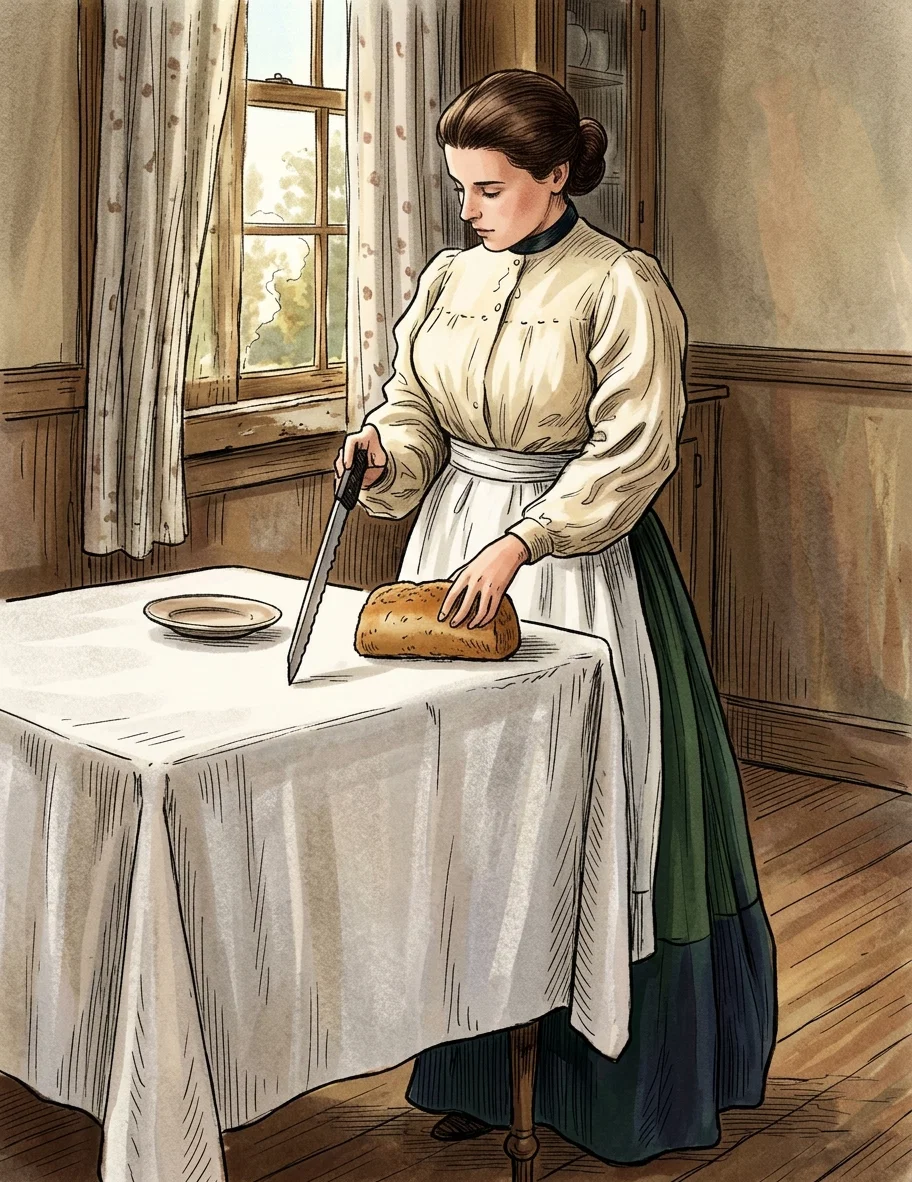
“She paused over the bread ere she cut it.”
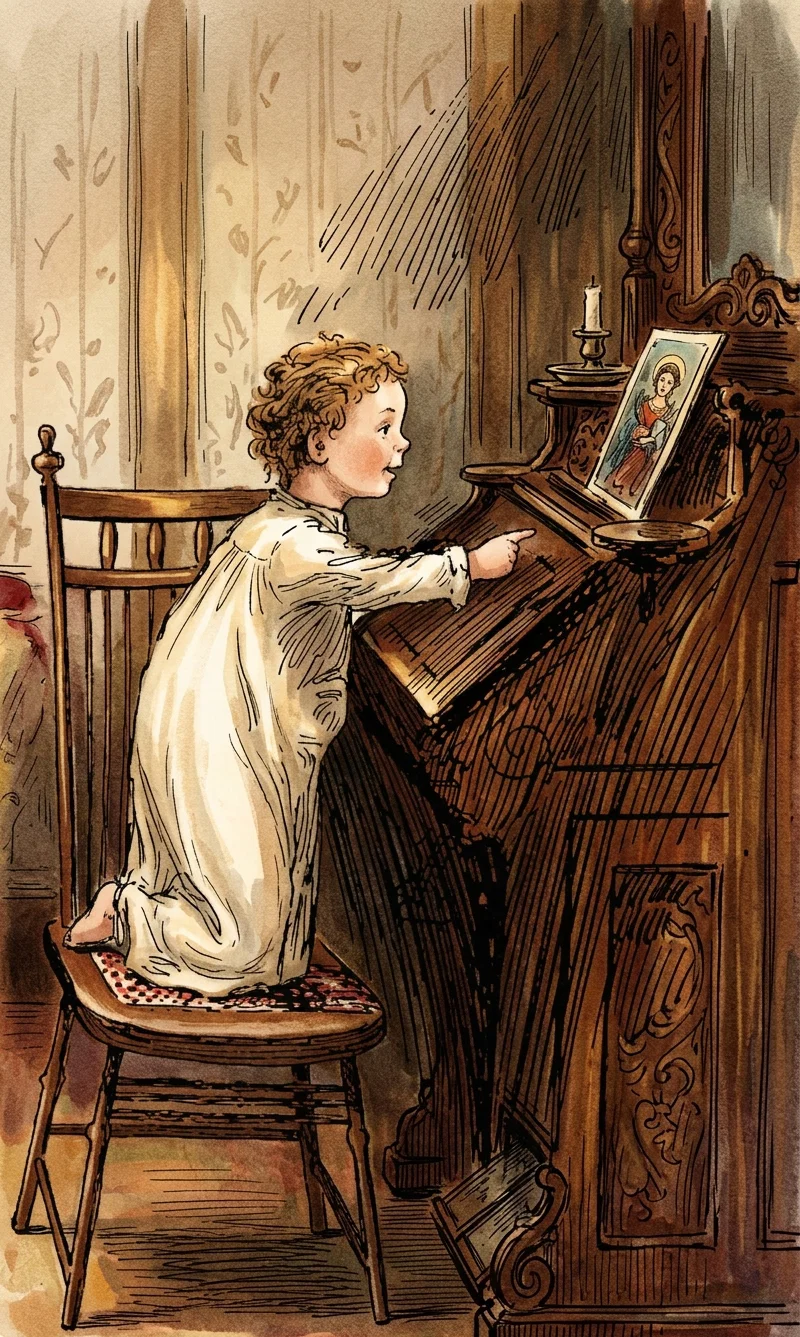
“Bonny was interested in the picture.”
Bonny was interested now in the picture of “Saint” Cecelia, at her organ. His little fat fingers were poked into the pictured roses, his hands smoothed the angels, and he wanted to kiss “the boo’ful yady.” “Moosic,” he lisped, and then he snuggled down in his mother’s arms, relaxed, as she sang:—
“Now I lay me down to sleep;
I pray the Lord my soul to keep.”
What was the soul? questioned the mother. She looked at the picture. Something shone in that beautiful face, something that lit and reached out. What was it more than the artist’s conception? Had he seen it on some human face? What was it? “It was,” she said, “the capacity of knowing and of loving God and all. It was the developed spiritual nature that finds how thinly intervene the veils between the seen and the unseen, the temporal and the eternal.” A great longing took hold of Mrs. Bradly’s heart.
“Now I lay me down to sleep;
I pray the Lord my soul to keep.”
Baby was asleep; fair and fresh, with a look of angelic peace, his face lay on his mother’s bosom. She looked at him long and lovingly. The look was there,—the tracing of the lovely and the holy.
“O love, keep his soul!” she whispered, as she remembered how the innocent grace of childhood is marred. As she laid him down to sleep, she left a kiss and a tear on his rosy cheek.
“I pray the Lord my soul to keep,” she prayed, as she laid off the day’s garments, and robed for the night. How still it was! Her couch was snowy. She thought of the time she should be robed for her last sleep; would she lie down as peacefully?
Aleck was away. She was alone with grandma and the children. What if peril, robbers, fire, danger should come? “Even the night shall be light about me.” “Come, My people, enter thou into thy chambers, until the indignation be overpast.” “I will both lay me down in peace, and sleep; for Thou, Lord, only makest me to dwell in safety.” “No evil shall befall thee, neither shall any plague come nigh thy dwelling.” “The Lord shall preserve thee from all evil; He shall preserve thy soul.”
One after another the Comforter whispered these texts, and peace flooded her soul. She sank into sleep, repeating, “He shall preserve thy soul.” What would it all profit her should that marvelous capacity for love be lost? But it would not.
The night passed. Something wakened her, saying, “When I awake I am still with Thee.” A smile played over her face ere she opened her eyes, as she prayed, “My soul to keep.” If it needed keeping in the night, then surely in the day. She lay a moment looking out of the window. It was early. The east was flushing softly, shading from one change of color to another,—gray, rose, purple, and gold. The miracle of the morning struck her as never before, and again a spiritual significance touched the whole into revelation for her soul. “If we follow on to know the Lord; His going forth is prepared as the morning.” “Unto you that fear My name shall the Sun of Righteousness arise with healing in His wings.” Would the glorious Lord so gently, so tenderly, as she was able to bear it, through that day open out to her soul the marvelous changes of His love, growing richer and richer? Yes, she would follow on, walking softly, “my soul to keep.”
But the day must be met,—the old cares, the old trials. How could the soul be kept? “If”—she paused—“if only it were a holy day or a holiday; but it was wash day.” “Thou wilt keep him in perfect peace, whose mind is stayed on Thee; because he trusteth in Thee.” That was the way the soul was to be kept on all days. But the children were waking, and there was the door-bell.
“O Aleck, how is it you are back?” she exclaimed as her husband met her at the door.
“Unexpected providence,” he said. “Don’t you know, dear, ‘the steps of a good man are ordered by the Lord; and he delighteth in His way’? He shall keep the feet of His saints.”
Mrs. Bradly smiled and flushed. Not the soul only, but the feet, and the steps, even, were to be kept. Was it all involved in the soul-keeping? But she would not tell him in words of what God was teaching her of soul-keeping. She seemed as shy about it as a coy girl, as if it were something between her and her heavenly Lover.
The children were washed and dressed. “Read the sixth of John,” said Mrs. Bradly, handing her husband the Bible for morning prayers. How eagerly she listened to the miracle of feeding the five thousand, of gathering the fragments, and of the spiritual bread that came down from heaven, of which if a man eat he shall never hunger! “My soul to keep,” the words still sounded in her heart. Then they all prayed the Lord’s prayer, saying, “Give us this day our daily bread.” “Daily,” thought Mrs. Bradly. “It must be fresh morning by morning. The old manna turned to corruption. It must be a daily, living experience.”
What a pleasure it was to prepare breakfast!
She paused over the bread ere she cut it. “The bread of life,” she thought. “Is this, too, the figure of Him on whom my soul must feed to be kept?” Yes, it was, she saw, the very life of Christ.
Mr. Bradly started, wondering, as she said, “Ho, every one that thirsteth, come ye, buy bread and milk without money and without price—or, otherwise, come to breakfast.”
Was she becoming a little irreverent? No, he saw her face lit up with inner glory.
“You have a look like Saint Cecelia this morning,” he said with a smile.
She flushed, and pointed to the table, and said, “I have eaten my honeycomb with my honey, I have drunk my wine with my milk; eat, O friends, drink, yea, drink abundantly, O beloved!”
Then Mr. Bradly understood that some new thought of God’s love had unfolded to his companion. She sat smiling as they ate, with her food untouched, and he urged her to eat. With a bright look she answered, “I have meat to eat that ye know not of.”
If she had not been so quiet, he would have answered her differently. As it was he supplied her plate, and said, “‘Every creature of God is good, and to be received with thanksgiving.’ Eating itself is a divine ministration.”
Mrs. Bradly thought she fathomed the meaning of the artist who had painted angels doing up the work of the house. Why should it not be done heartily as unto the Lord? She repeated Herbert’s line, as she took the broom:—
“‘He who sweeps a room as for God’s laws,
Makes that and the action fine.’”
“Whatsoever ye do, . . . do it all to the glory of God.” Could it be that all the little trifles could be done to His glory? She would do them all, singing and making melody in her heart unto the Lord.
But before the children were off to school, she grew weary. Pet was so fretful, and Puss broke one of her old colonial dishes. Bonny was into all sorts of mischief, and all of a sudden an impatient utterance flew to her lips.
“O you naughty, naughty girl,” she exclaimed! “What a perfect nuisance you are? I’ll be glad when you’re out of the way.”
Puss looked astonished, her chin quivered, and the great tears rolled over her cheeks. Mrs. Bradly’s peace was broken, and in his study Mr. Bradly sighed. “Why had the revelation proved ineffectual?”
Puss was bundled up for school. Pet was already calling her from the bottom of the steps. She ran and fell. Bump, bump, bump went the little bundle on the steps. Mrs. Bradly13flew from the kitchen; but Mr. Bradly was there before her; leaping down the stairs, he caught Puss to his breast. How white his face was, filled with alarm and anguish! But it soon cleared up.
“She’s not hurt, mama,” he cried. “You rolled her up till she was like a cotton-batting doll. Run back and kiss mama.”
Puss had her kiss, and felt her face wet with tears. Mr. Bradly read repentance in the face of his companion, and stooped for a moment to whisper: “Like as a father pitieth his children, so the Lord pitieth them that fear Him. . . . He remembereth that we are dust.” She understood,—as he had hurried to pick up his little stumbler, so the heavenly Father hurried to aid her weakness. “Tho I fall, I shall not be utterly cast down.”
FRANCES E. BOLTON.
(Concluded next week.)
THE CELEBRATED RUSSIAN NOVELIST, TURGENIEFF.
The celebrated Russian author, Turgenieff, tells a touching incident from his own life, which awakened in him sentiments that have colored all his writings.
When he was a boy of ten his father took him out one day bird-shooting. As they tramped across the brown stubble, a golden pheasant rose with a low whirr from the ground at his feet, and, with the joy of a sportsman, he raised his gun and fired, wild with excitement, when the creature fell fluttering at his side. Life was ebbing fast, but the instinct of the mother was stronger than death itself, and with a feeble flutter of her wings, the mother bird reached the nest where her young brood were huddled, unconscious of danger. Then, with such a look of pleading and reproach that his heart stood still at the ruin he had wrought (and never to his dying day did he forget the feeling of guilt that came to him in that moment), the little brown head toppled over, and only the dead body of the mother shielded her nestlings.
“Father, father!” he cried, “what have I done?” as he turned his horror-stricken face to his father. But not to his father’s eye had this little tragedy been enacted, and he said:
“Well done, my son; that was well done for your first shot. You will soon be a fine sportsman.”
“Never, father: never again shall I destroy any living creature. If that is sport, I will have none of it. Life is more beautiful to me than death, and since I can not give life, I will not take it.”*—Our Dumb Animals.
Heralds OF HIS COMING
by Milton C. Wilcox, shows conclusively that Christ’s coming is very near. 25,000 already sold. Price, $1.50 per 100.
PACIFIC PRESS PUB. CO.
Oakland, Cal. 39 Bond St., New York City 18 W. 5th St., Kansas City, Mo.
VEGETARIANISM VERSUS FLESH-EATING.
The recent walking match in Germany, in which vegetarians and flesh-eaters competed, has been noticed in many papers of this country. It will be of interest to our readers to know more than the simple result, the vegetarians won. Says an English paper, The Herald of the Golden Age:—
The corroborative details concerning the recent seventy-mile walking match in Germany which have come to hand from Berlin, make the fact all the more apparent that the victory of the vegetarian competitors was conclusive, and both the military authorities and the sporting journals are discussing the matter with much interest. The judges who passed their verdict upon the condition of the arriving competitors were all flesh-eaters, and yet they pronounced all the abstainers from flesh to be in “very good condition,” and the only meat-eater who arrived to be “much exhausted.” This result was attained in spite of the fact that all the sixteen flesh-eaters were amateur gymnasts, whilst the vegetarians, with two exceptions, were not so, and, like the winner, were engaged in sedentary occupations at the bookkeeper’s desk. The winner, Karl Mann, had been declined as a recruit by the German army because of extreme short-sightedness and curvature of the spine, before he became a food reformer. The German emperor’s officials interviewed him at the war office for three-quarters of an hour, and officially requested him to submit a full report to the army medical department. His diet consists chiefly of dried fruits, such as figs, dates, prunes, apricots, peaches, etc., fresh fruits, some raw vegetables, scones made of rye meal, butter, milk, and cheese.
And yet there are those who tell us that flesh-eating is necessary to strength and endurance.
ANOTHER SURGICAL TRIUMPH.
THEY sawed off his arms and his legs,
They took out his jugular vein,
They put fancy frills on his lungs,
And they deftly extracted his brain.
’Twas a triumph of surgical skill
Such as never was heard of till then.
’Twas the subject of lectures before
Conventions of medical men.
The news of this wonderful thing
Was heralded far and wide—
But as for the patient there’s nothing to say
Except, of course, that he died.
—New York Herald.
AN INGENIOUS AND EXPENSIVE MACHINE.
Prof. Robert H. Thurston, of Cornell University, announces that Mr. P. T. Dodge, of New York, has presented to the museum of the Sibley College of Engineering what is probably, for its size, the costliest piece of machinery ever constructed. This is the Paige typesetting machine, the one in which Mark Twain sunk a lot of money. It consists of 19,000 pieces, controlled by a keyboard, and handles ordinary type, setting, justifying, and distributing the matter, and leading it also, when required. It is believed to be one of the most beautifully ingenious pieces of mechanism as well as the costliest. The trouble with it commercially is that it is too ingenious, and, altho perfect in the operation, can not be built for sale. Of course most of the two millions of dollars this, the original machine, is estimated to have cost, was used in the incessant changing and remaking, in which years were spent. The machine occupies a floor space of 11½ x 3½ feet, and its highest point is 6½ feet from the floor. The weight is a little less than 5,500 pounds, and it runs without a perceptible vibration. Mr. Dodge says: “I consider this machine, altho valueless from a commercial standpoint because of its great expense, one of the most remarkable of all mechanical productions. Considering its great complexity, its perfection of design and workmanship, the many novel mechanical movements contained in it, and the precision with which it runs, I think it has no equal.”
Giving Themselves for the Gospel
THANK God there are some men and women full of the power of the Gospel, who can not rest satisfied till they have opened their very hearts, and given the poor wayfaring men the only thing which is really their own,—themselves, their faith, their energy, their hope of God.—Brooks.
Avoid Causing Others to Stumble
DRINK neither wine nor strong drink, so long as by it you cause to stumble, or tempt into ruin or misery, the soul of a brother.
God Will Care for the Ledger
By Lookout
Look to your day-book and God will take care of the ledger.—Lookout.
NUT BUTTER NUT MILLS AND NUTS
Health is wealth. Eat pure foods. Buy them of us or Make them yourself. Write for prices of Nut Butter, Nut Roast, Nut Meal, Maltosia, Maltoil, Malt Extract, Almond Butter, Crackers, and other health foods, Nut Grinders, Roasters, Blanchers, Shelled Peanuts, Roll Bakers, Gem Irons, etc.
Knapp Brothers
407 E. Burnside St. E. Portland, Ore.
When you write, please mention the SIGNS OF THE TIMES.
The Fairbanks-Morse Gas and Gasoline Engines
Fairbanks Galvanized Steel Windmills
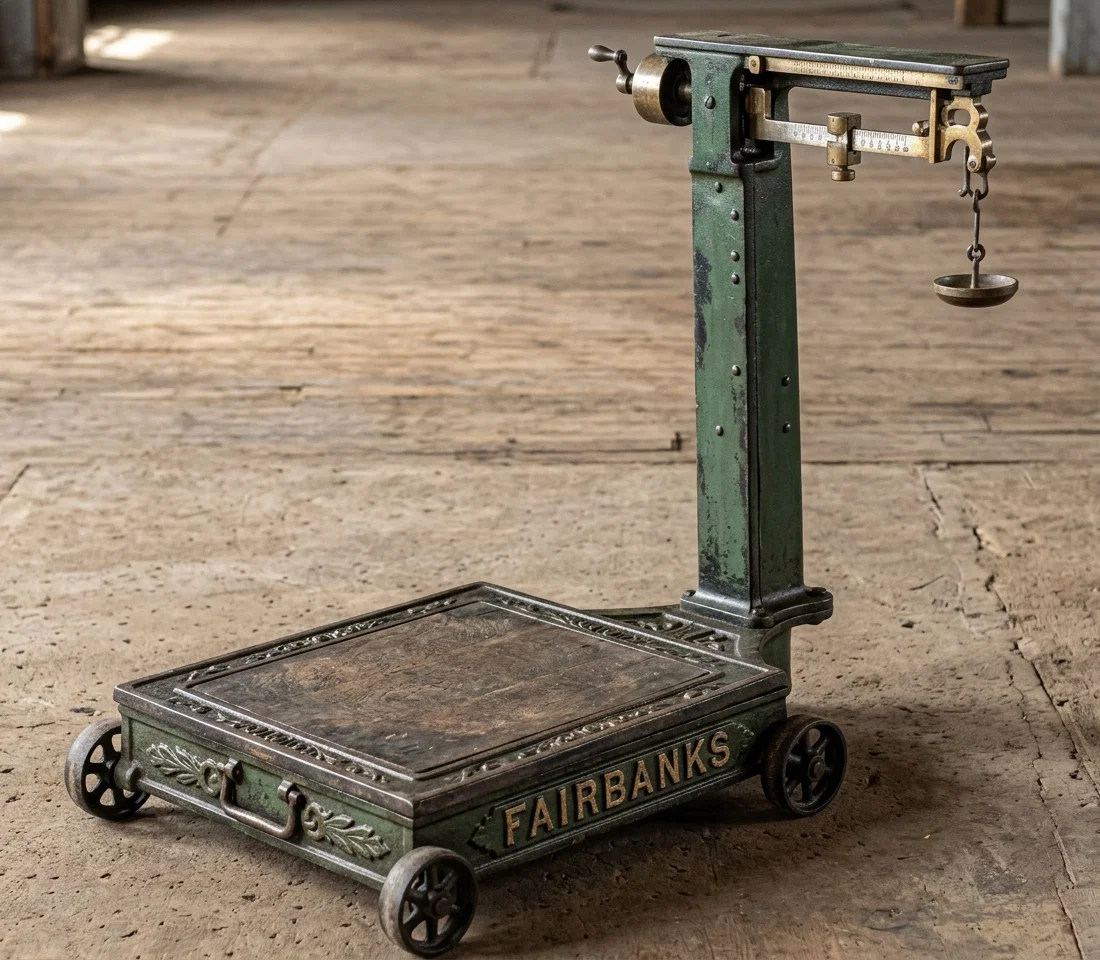
Fairbanks Standard Scales
Send for Illustrated Catalogues to
Fairbanks, Morse & Co.
310 MARKET STREET
San Francisco, Cal.
When you write, please mention the SIGNS OF THE TIMES.
Healthful Delicious Nut Foods
EASILY and cheaply made in any household by the use of our complete equipment for grinding and emulsifying nuts. The production of our mills is unsurpassed. Full directions and a booklet containing many valuable nut food recipes, free with each mill.
NUTS
Shelled and unshelled, of all kinds at reasonable prices
For further information, catalog, price-list, etc., write to
JOSEPH LAMBERT
Battle Creek Michigan
When you write, please mention the SIGNS OF THE TIMES.