The Youth’s Instructor, Vol. 32, No. 46.

The Alpine Flower

The Youth’s Instructor

Nov 12, 1884

S. D. A. Publishing Association · Battle Creek, Mich. · Nov 12, 1884

The Alpine Flower.

Down, down, o'er rocky ledge, the chamois hunter fell, Till shelving of a fissure chanced his feet to stay. Far, far above him rose the white-capped, Alpine heights; A precipice below. Above, the mountain goat With flying feet mocked his despair. The eternal snows, Gleaming in sunshine, winged no prayer to heaven On airy flight or icy spire, but shimmered down Its glory to the depths below, lighting his tomb.
The weary day was folded in its stern repose By dreary curtains of the night. The burning eyes Of myriad stars looked down, the while o'er cloud-flecked blue The moon trailed silver robes. Oh, solitude so grand! Thy speech too deep for human words! Silence, whose hush Startles to fear at distant roar of glacier's sweep, Then vast, profound, as o'er creation's morn held sway.
At last the awful hours sped by, and daylight dawned; And looking up to greet the light, he saw a flower— A little blue-fringed gentian—growing in the rock. Borne by the careless wind, the seed had fallen there In crevice bare; now for him smiled its lovely bloom. “Promise of good! Shall God,” thought he, “Care for the flower and not for me?” And lifting up his voice, there rang O'er cliff and mountain glade: “God is our refuge and our strength, In straits a present aid.”
Higher than Alpine crags the echoes of that song Moved on and on, until they reached a human ear. Or did an angel, listening, swiftly bear the need To Him who hears our lowliest cry of faith and trust? Ah, who may know? But answering shouts rolled down and down, Until the hymn, so like a wailing prayer begun, Rose like a mighty chorus to the sky again.
How cruel seemed thy fate, O flower of Alpine vale, To find a barren rock whereon to rest! And yet thy blue-fringed petals wept glad tears of joy, When, folded to a loving mother's breast, The mission of thy life was told, that saved her boy. And like a precious treasure, to this day, In sacred Bible laid thou 'rt hid away!
—Christian Weekly.

THE CHAMOIS.

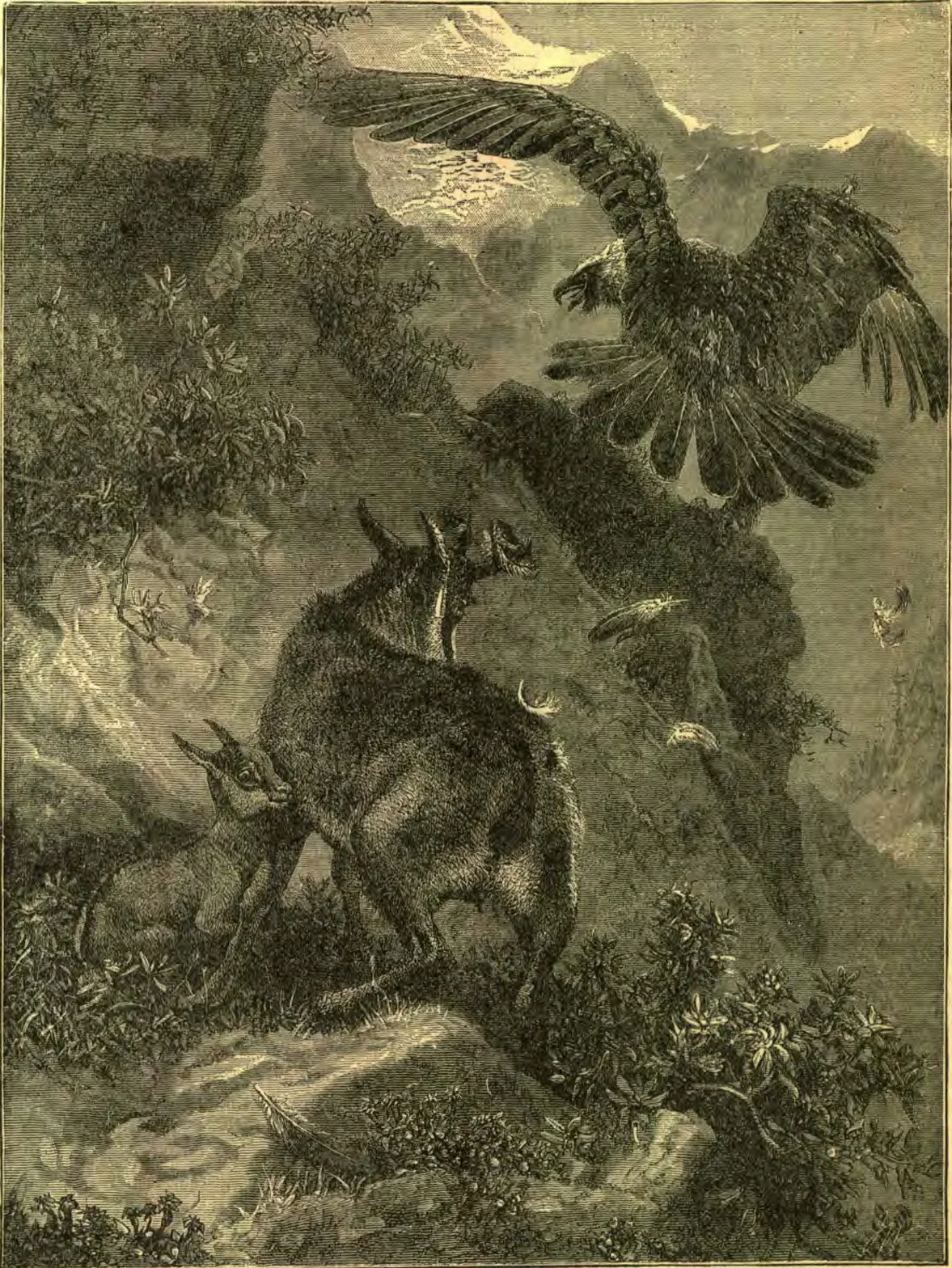
THIS fleet, sure-footed animal is said to be the only branch of the Antelope family found in Western Europe. Its home is among the steep Alpine heights. During the summer months, it ascends to the limits of perpetual snow; but in the winter, it descends to the woods of the glacier regions. Here only can the hardy hunter be successful in capturing it.
It is very shy, with the senses of sight and smell exceedingly acute. The herd never feeds without first taking the precaution to post a sentinel on some prominent point. No sooner does he see some danger than he gives the signal of alarm by stamping with his forefeet on the ground, and uttering a peculiarly shrill whistle. On hearing it, the whole herd is off like the wind.
The hoofs of the chamois are admirably adapted for climbing, the outer edges being higher than the soles, so that he can find footing on the rough rocks where it would be impossible for almost any other animal to climb. He is covered with a thick coat of long, chestnut-brown hair, underneath which is another covering of short, thick, grayish wool. His horns are from six to eight inches long, slender, striated, and hooked at the end. With these formidable weapons it does valiant battle in protecting its young from the fierce eagles that swoop down to carry them off.
The skin of the chamois is very soft, and for this reason, highly prized. The flesh is considered excellent. Chamois-hunting is always attended with considerable danger; and perhaps for this reason the bold mountaineers all the more eagerly hunt for it. In addition to its great shyness, it can climb the most dangerous places; and it makes surprising leaps, often, when closely pursued, plunging down the perpendicular face of the rock for twenty or thirty feet.
The chamois has been so eagerly sought after that it is now comparatively rare, and the hunters in some portions of the country are not allowed to shoot it except in the fall of the year.
W. E. L.

AMONG THE CLOUDS.

Lovers of mountain scenery will, I think, enjoy a little trip with me in far-off Asiatic India. Our visit will have to be made in winter or in early spring; for although the mountains might be pleasanter in summer, the deadly fevers and the great heat of Hindoostan would make it unsafe to pass through the plains at that season.
Leaving the city of Calcutta, we take our course along the bank of the Hoogly River for nearly a hundred miles. This river is one of the many arms, or openings, of the sacred Ganges. As we pass along, we see many boats plying up and down and across the stream, but the boatmen seem to have a troubled, anxious look; and well they may, for about this time every year a great tidal wave sweeps up the river, sometimes at the rate of twenty miles an hour, often casting great ships high and dry upon the land, and destroying many of the smaller boats entirely.
Now we are crossing the Ganges itself, and then away we speed northward, across level, fertile plains, till we seem to be going right into a great wall of mountains. But first we have to cross a narrow belt of marshy, uncultivated land, where sluggish streams, bordered by rank grasses and gigantic reeds, breed foul miasms that make it impossible to cultivate the land. In less than thirty minutes, however, we have passed this unwholesome tract, and now we are crossing a belt of woods just about as wide. Here the soil is made up of sand and small stones, while great rocks begin to be plentiful enough. This section is as waterless as the other was wet.
But now the mountains are upon us. It seems impossible to climb them; for their steep sides go almost straight up for hundreds and even thousands of feet. The road that is to take us up the mountains is called the Narrow Gauge Himalayan Railway. Our train consists of two small coaches, or passenger cars, and a stout little engine that puffs and snorts as if it had gone stark mad. How it tugs and pants, as we go winding this way and that, up, up, up, now through deep gorges, and then along narrow shelves cut into the steep mountain-sides, till we seem to be suspended in the air! What beautiful valleys we can look down into! What grand cliffs and great peaks hang over us! We have just passed along one side of an enormous chasm, and now we have taken a short turn, and are going back on the other side. We can look across to the track where a few moments ago we came flying along right on the face of huge crags, or through tunnels that pierce projecting spurs. Yet we are climbing higher all the time. Can this be real? It seems like a dream, or rather like a vision, all is so vivid, and yet so wonderful!
Now we have stopped for water. A wooden spout brings the crystal stream from a spring on the mountain-side, and pours it into the tank of the little engine. How thirstily the little fellow drinks! How grateful he seems to be for water! But just over there they are making repairs on the road. See, there are men, women, and girls, with picks and shovels, all doing the same kind of work. They seem to have no carts, but carry everything. See what a load of stones and sand that young girl is carrying in a basket on her back! It is enough for a strong man. Yet she looks healthy and happy, and is really beautiful in spite of her strong limbs, thick shoulders, and short figure.
But our iron pony has drank his fill, and is bounding on his way, apparently much refreshed by the sparkling beverage of the mountains. The scenery grows wilder and grander; no words can describe it. The great snowy peaks are coming nearer and nearer. Many of them are lost in the clouds, and seem to pierce the very sky! But just look down from this bridge that we are now crossing. Away down, down there in the chasm below us is the track on which we passed under this bridge a few minutes ago. Was the road built in this cork-screw fashion so that travelers might look upon these peaks and gulfs and glens from as many different sides as possible?
But how the whistle shrieks! They say we are coming to Darjeeling. The name of the place does not have to be “called,” for it is the end of our journey. Yes; here we are. See the British officers and soldiers in their bright uniform! “What a strange name for a place, ‘Darjeeling’!” True, but it is very fitting; for it means, “Up in the clouds;” and have you not seen the clouds below us, and above us, and all around us? How I hope the sky will be clear to-morrow, so that we may get a view of those mountain peaks that are the wonder of the world!
Now that we are waiting here in our room at the hotel, let me read you a few lines from a traveler who visited this place last year:—
“As we rounded the bluff, there burst upon our sight, for a few moments, a complete view of the range, lying under a clear sky and warm glow of sunlight, so entrancing as to almost take away one’s breath. The imagination had never before pictured anything so grand and inspiring. Our little party could only point at it, and look into each other’s eyes. Words would have jarred like a discord upon the ear.”
In another place he describes a sunset view from a hill near the hotel: “Looking across the intervening valley, we could count twelve peaks, the lowest of which was over twenty thousand feet in height, and the highest over twenty-eight thousand, upon which rested eleven thousand feet of perpetual snow. . . . There can be no animal life in that Arctic region, no pulsations of vitality. Only the snow and ice rest there in endless sleep—cold, pitiless, and solemn. The sun was slowly declining in the west, faintly burnishing a few silvery, transparent clouds, while it touched the pearl-white tops of the Himalayas with ruby tints, and cast a glow of mingled gold and purple down the side most exposed to its rays. Every hue of the rainbow seemed to hang over the range, through which gleamed the snowy robe in which the peaks and sides were clad. The top of Kin-chin-jun-ga, the loftiest of them all, towering three thousand feet above its fellows, as it radiated the glory of the sunset, made one hesitate whether it was indeed a mountain top or a fleecy cloud far up in the sky. As we watched with quickened pulse, the sunset glow, like a lingering kiss, hung over the grand, white-turbaned peaks for a moment, as though unwilling to say good night, and then it suddenly vanished. The cool, dewy shadows gathered on the brow of Kinchinjunga like parting tears, and night closed over the deep intervening valley, shutting out the loveliness of the vision, but leaving its impress glowingly fixed upon the memory forever.”
But there goes the bell for our late dinner. Do you ask why there are so many British officers here, with their wives? Oh, this is where they, with other Europeans, come to spend the summer months, when it is too hot to reside on the plains.
That man with club feet is a Doctor Somebody, who not long ago tried to climb Kinchinjunga, but froze his feet in the attempt, and came very near losing his life. Yet people do cross these mountains, through passes eighteen thousand feet high, and make their way into Thibet. Those strange-looking little Yak cows that we saw in the back yard are the animals used for this purpose. They are hardier and more enduring than mules, while their faithfulness is beyond a parallel. It is said that they will toil patiently up the rugged gorges, with heavy loads on their backs, never faltering until they drop dead in their tracks. The men who undertake this dangerous journey have to clothe themselves in sheep-skins with the wool on. When fully fitted out, they look as much like wild beasts of the mountains as they do like men.
“Oh, just look into the street! Here is a whole flock of sheep loaded down like mules. What does it mean?” Why, they are taking borax down to the plains, where their fleeces will be taken off and sold, and they will return laden with salt.
“What are those shrubs so nicely set out and cultivated on the hillside?” Oh, they are the tea-plant, which the English began a few years ago to cultivate in this region as an experiment. Millions of pounds of the finest quality of tea are now raised in this district every year. Those strange-looking trees are the cinchona tree. They are raised for their bark, which is much used in medicine. From it the medicine called quinine is made.
And now, after an evening walk, we will retire, and sleep for the first time “among the clouds.”
A. B.

The Little Boy and the Forbidden Cherries

A LITTLE boy was tempted to pick cherries from a tree which his father had forbidden him to touch. “You need not be afraid,” said his tempter, “for if your father should find it out, he is too good to hurt you.” “Yes,” said the little fellow, “I know that, and it’s the very reason why I won’t take any. He wouldn’t hurt me, but it would hurt him to know that I didn’t mind him.”

“YE HAVE DONE IT UNTO ME.”

It was only a smile of welcome Or a whispered word of cheer, But it smoothed the path for the tired feet, And lightened the load of care.
It was only a loving visit, Perhaps but a loaf of bread; But “Ye visited me,” will the Master say; “’Twas your Lord whom ye clothed and fed.”
It was only a tender message To a heart bowed down with woe; But from that one seed by the wayside dropped Shall a harvest of blessings grow.
It was only a few words spoken, We thought they were weak and poor; But they told of Christ, and his wondrous love, As the guilt of the world he bore.
And the Lord, from his height of glory, Hath listened our words to hear; For us is a book of remembrance kept, And our names are engraven there.
It may not be ours to render The service our hearts would crave; He may give us no words that shall win a soul Or a life from destruction save.
But often along the wayside, As we journey life's rugged road, We shall find some hearts that have need of help, Who are fainting beneath their load.
And though small is the help we can offer, If it only be offered in love, It will carry a blessing to earth's sad ones, And be known and remembered above.
And the dear Lord, when he cometh, Will bring us a great reward: “Thou hast faithfully done the few things I gave; Enter into the joy of thy Lord.”
— Friends’ Review.

IMPORTANT BIBLE SUBJECTS.

LESSON 20.—CHRIST AND THE PENITENT THIEF.

[NOTE TO THE STUDENT.—Do not consider the lesson learned until you can give at least the substance of every text, with the correct reference for each. The references in black letters indicate those texts that should be committed to memory. A little diligent application each day will enable you to do this.]
1. WHEN Christ was crucified, who were put to death with him? Matt. 27:38.
2. While they were hanging on the cross, what did one of the thieves do? Luke 23:39.
3. What did the other one do? Verse 40.
4. With what words did he rebuke his companion? Verses 40, 41.
5. To whom did the penitent thief then address himself? Verse 42.
6. What request did he make? Verse 42.
7. What reply did Jesus make? Verse 43.
8. What is in the midst of paradise? Rev. 2:7.
9. By the side of what river is the tree of life? Rev. 22:1, 2.
10. From what does the river of life proceed? Ib.
11. Then since both the tree and the river of life are in paradise, where is God’s throne?
12. When people go to paradise, into whose presence must they go?
13. How long after Christ’s crucifixion was the resurrection? I Cor. 15:3, 4.
14. On the morning of the resurrection, what did Jesus say to one of his disciples? John 20:17.
15. If he had not yet ascended to the father, could he have gone to paradise on the day of his crucifixion?
16. Since Christ cannot deceive, can it be that he intended to meet the thief in paradise three days before?
17. If not, why did he use the word “to-day”?
18. At what time did the thief want to be remembered? Luke 23:42.
19. When does Christ have his kingdom? 2 Tim. 4:1; Matt. 25:31.
20. When will all who believe on him be with him? John 14:3.
21. Then to what time did the penitent thief look forward?
22. Will his request then be granted, notwithstanding he is now dead? 1 Thess. 4:15–17.

NOTES.

There is nothing more easily proved than that God’s throne is in “the paradise of God.” There is where the tree of life is located (Rev. 2:7), and this is “on either side” of the “river of water of life,” which proceeds from God’s throne. Since the tree, the river, and the throne are so closely connected, it necessarily follows that if one of them is in paradise, they all are. This being the case, when Christ, the third day after his crucifixion, says: “I am not yet ascended to my father,” it is the same as though he had said: “I am not yet ascended to paradise.”
The apostle says of Christ that he “did no sin, neither was guile found in his mouth.” 1 Pet. 2:22. Now, whatever conclusion we might draw from reading the promise of Christ in Luke 23:43 by itself, in the light of his own testimony, as recorded by John (chap. 20:17) we must admit that he did not mean to convey to the thief the idea that they would that very day meet in paradise. We must therefore understand the word “to-day” as giving emphasis to his statement that at some future time they would meet in paradise. Whoever considers the circumstances—Christ crucified, his disciples fled, his hopes apparently blasted—will see the propriety of such an emphatic expression.
All that the thief asked was to be remembered when the Lord should come in his kingdom. But that event had not taken place when Christ ascended to heaven six weeks later (Acts 1:6); and it will not occur until he comes in his glory, with all the holy angels with him. Until that time, his disciples are to pray, “Thy kingdom come.” When this prayer of all Christ’s followers is answered, then will the request of the penitent thief be granted.

ALWAYS ASK GOD.

WHEN Effie entered the breakfast-room on that morning, she seemed out of sorts. Her mother looked at her in surprise, for good humor and smiles seemed to be always resting upon her face, and to call her unamiable would not have seemed possible. In all the sixteen years of her life, her usual appearance was that of a loving girl, not a surface-look either, but one that seemed to be the real reflection of an honest, true heart.
It is somewhat strange to see such reflections, and to know that they appear to be as easy to read as the pictures upon a slate, if any one takes the trouble to learn to read them correctly. Look at the faces that you meet every day in the house and by the wayside; see how some are restless, anxious, and troubled, while others appear to be all that is amiable and attractive. But if you will look a little deeper, you will see upon some a peace that comes only where the love of God dwells.
“Why, Effie, what is the matter?” asked her mother.
“Nothing at all, except that I do not want to be bothered,” was the disagreeable reply.
“My daughter, you forget yourself,” Mrs. Reid said.
“I did not mean to be disrespectful, mother, but when people are cross, they want to be let alone.”
“If that is all, I will let you alone with pleasure,” Mrs. Reid very quietly answered, and then omitted to look at her daughter again.
Effie ate her breakfast in silence, and then, without a word, without even the usual kiss for her mother, she put on her things and went off to school.
As might be supposed, the day that followed was exceedingly uncomfortable; lessons went wrong, examples were badly worked out, and Effie’s marks for the day were lower than ever before. But at home again, conscience began to talk to her, and at last she went to her mother’s room. “Mother, I have been very wicked,” she said.
“Have you?” her mother quietly asked; she had decided not to aid the confession.
“Yes; and now I want to tell you what the matter is. Last night, after I went to my room, I was reading; and when the clock struck, and I was reminded of the lateness of the hour, I threw myself upon the bed, promising my conscience that I would get up in a few minutes to say my prayers; but I did not awake until morning, and then I felt tried with my clothing, and disgusted with myself. The bell rang for breakfast, and I said to myself that if God had taken care of me without my kneeling down to pray last night, so he could do for the day, and I would pray as I walked down stairs; but there was only time for a few hurried words.”
“And what sort of a day have you passed, Effie?”
“A dreadful day. Nothing has gone right. I missed my lessons, received marks, and troubled Miss Walker very much.”
“And—?”
“And I never want such an experience again.”
“My daughter, I am glad if one day has sufficed to show your duty to you. What would life be, with its cares, vexations, trials, without a God to aid us? He is ready to heal, to comfort, and to help; yet he wants us to ask that we may receive.”
“So I will, dear mother, for even one day has shown me that I cannot get along well without prayer,” Effie said.
And Mrs. Reid answered,—
“Not a soul so sad, Nor a heart so glad, When comes the shades of night, But the daybreak song Will the joy prolong, And some darkness turn to light. “Take the golden key In your hand and see, As the night tide drifts away, How its blessed hold Is a crown of gold Through the weary hours of day.”
—Child’s Paper.

EDITOR'S CORNER.

Boys and girls like frolic and fun, and “to have a good time,” as they say. It is all proper that they should have seasons for amusement, and indulge in a happy flow of spirits; for dull, lifeless boys and girls frequently retain their dullness and stupidity all through life. We love to see boys and girls happy in their play, at times, and to hear their merry shout. Some play is good to make them strong, both physically and intellectually.
But we feel sure that those of our boys and girls who are old enough to read the INSTRUCTOR well would not think it right to play always. The effect of such a course would be no better than no play; for while the body might gain strength thereby, the mind would not receive due culture, and would be dwarfed.
If you were made just to be happy, to flit about like the butterfly, and thus pass away, it would not matter so much how you spend your time. But you were created for a higher end than merely to be pleasure seekers. Life was given you that you might have eternal life; and as the latter depends upon your course of action here, you should be most active in bringing the will into harmony with that of the great Author of eternal life. His will is that you should give him your best affections, and serve him by a holy life and a godly conversation.
Principle instead of pleasure should be the guiding motive in all your actions; and your greatest pleasure should come from right-doing. Many of you are already old enough to learn to govern your lives by principle, to learn to act from a sense of duty rather than from any pleasure to be gained.
“Shall we never seek for pleasure?” you ask. Not to the neglect of duty, we answer. As we have already said, it is right at times that you should have recreation; but you should learn to govern yourselves by principle, both as to the time and manner of taking it; for if you seek for pleasure only for pleasure’s sake, you are leading a life as useless as the moth or the butterfly, which will bring you no more satisfying results. But if, on the other hand, you are guided in your course of conduct by a sense of duty, and are cheerful in its performance whether it brings pleasure or pain, willingly leaving the result with God, even though you should not reap any immediate happiness, your heavenly Father will eventually give you “pleasures forevermore.”
How many of the readers of the INSTRUCTOR who are not already such, will pledge themselves from this time forth to be boys and girls of principle, and devote their lives, not to their own selfish ends, seeking their own pleasure and ease, but to learning and doing the will of God?
M. J. C.

LITTLE ELSIE

Written for the INSTRUCTOR.

LITTLE ELSIE.

WOULD the boys and girls of the INSTRUCTOR be interested to hear about a little girl called Elsie, who fell asleep in Jesus last May?
Little Elsie was born in Taunton, a very pretty town in the south of England. She lived in a quaint old house, that many hundreds of years ago had formed a part of an old castle. This house joined the large hall, where, in 1685, just 200 years ago, in the reign of James the 2nd, the wicked Judge Jeffreys used to try his poor victims.
Little Elsie suffered much during her babyhood. As she grew stronger, how much she enjoyed playing in the castle court-yard, where many years before, one might have heard the tread of armed men, instead of the sweet voice of this little girl.
When old enough to understand, we would tell her the sweet story of Jesus, how he came down to this world of ours, how he went about opening the eyes of the blind, making the deaf to hear, and the lame to walk. She was never weary of hearing about him. Often, so often, she would say, “Mother, will Jesus come to-day?”
What a bright, happy little girl she was, so full of love; she would put her arms around you so many times, and say, “How I love you!” If any thing was wanted, Elsie was always ready to go. She had a very sweet voice. One of her favorite hymns used to be, “Stand up, stand up for Jesus.” When she used at times to be naughty, it was generally enough to say, “O Elsie, how naughty!” The tears would come quickly to her eyes.
She always remembered that God was watching all she did, and she liked to think that the beautiful angels were near her when she was good. One day, when the wind was very rough, she said, “Mother, I can’t go to school to-day; if I should, the wind would blow me right up into the New Jerusalem. If it did, I should like to look around and see what it is like. I would take one fruit, that would not be wicked, for Eve took two; then I would give Jesus one kiss, and come down again.”
Elsie loved the Sabbath. How pleased she was every week when she had her bath, and her clean clothes were put on before the Sabbath commenced. It always made her sad when she knew that those she loved did not care about God’s holy rest-day.
At last, Elsie’s parents left their home where they had spent seventeen happy years, and crossed the same mighty deep that the “Mayflower” had ploughed 283 years before, perhaps with feelings in some respects akin to those of the Pilgrim Fathers. But Elsie and her friends found loving hearts to welcome them on the other side of God’s restless, mighty deep.
But Elsie’s days were numbered, for scarlet fever was in the village. Elsie’s brothers and sisters were seized and spared, but her little life was well-nigh spent. Soon she was called to that silent land whence no traveller returns. The Sabbath before she passed away, her mother was telling her the story of the flood, and explained to her that the Lord was our Ark of Refuge now, that by and by the Lord would come and all the wicked would be destroyed by fire; she looked up so earnestly, and said, “I have come to Him, and I do love Him.” On the Monday following, she seemed quite well, and so bright, but about noon she came in from her play looking very pale; she cried, and said her throat hurt her. All was done that love could think of; but the Angel of death had claimed her. Although suffering great pain, she never murmured. So often she would say to her mother and the kind friends assisting her, “You will be so tired, do lie down and rest.” On Tuesday, she said, “Mother, I am very ill, I expect I shall die, that is what it is. God will burn up the wicked, but he will not burn me, for I do love him.” On Tuesday night she tried to sing, “A little ship was on the sea.” On Thursday, just before noon, darling Elsie fell asleep in Jesus.
Why have I written thus? Because I want you to see how uncertain life is, and how quickly you may be called. Are you ready? A death bed is no place to prepare for eternity. Now is the time to seek the Lord; let me intreat of you to ask yourselves the question, Have I given my heart to Jesus? Hear the Lord saying to each one of you, “Wilt thou not from this time cry unto me, My Father, thou art the guide of my youth?” Jer. 3:4. Think what joy to see the lovely face of the Lord Jesus, and dwell with him forever in that glorious land, where the inhabitants shall never say, “I am sick.” M. VEYSEY.

THE LEAVES AND THE WIND.

“Come, little leaves,” said the wind one day— “Come o’er the meadows with me and play; Put on your dresses of red and gold— Summer is gone, and the days grow cold.”
Soon as the leaves heard the wind’s loud call, Down they came fluttering, one and all; Over the brown fields they danced and flew, Singing the soft little songs that they knew.
“Cricket, good-bye; we’ve been friends so long! Little brook, sing us your farewell song, Say you are sorry to see us go; Ah! you will miss us, right well we know.
“Dear little lambs, in your fleecy fold, Mother will keep you from harm and cold; Fondly we’ve watched you in vale and glade; Say, will you dream of our loving shade?”
Dancing and whirling the little leaves went: Winter had called them, and they were content. Soon fast asleep in their earthy beds, The snow laid a coverlet over their heads.
—George Cooper.
Written for the INSTRUCTOR.

CHARITY AMONG BIRDS.

In this city, notice was recently made of a robin that went to a house to feed one of its young that some boys had carried off and placed in a cage allowed to hang out of doors. Thomas Prince, who resides on Carson River, above Dayton, tells of a circumstance still more singular. He says a pair of robins had their nest on a fence near his house, while in a bush near by a pair of catbirds had built their nest. The two pair of birds hatched out their young about the same time, and all went well for several days. Then the catbirds were seen no more, probably having been shot by some of the bee-keepers of Dayton.
The young catbirds were evidently starving. When the robins came with a worm or other insect for their young, they always alighted on the top rail of the fence before hopping down to their nest. Each time when a robin came so, the catbirds opened their mouths, thrust up their heads, and made a great outcry. They were begging to the best of their ability for food.
The robins appeared to understand the appeal, and began feeding the hungry little catbirds. They did not do by halves what they had undertaken. Each evening the female robin sat on her own nest, and warmed with her body her own young, while the male robin took to the nest of the catbirds.
In this way both broods were reared, the little orphans growing up as strong and lively as though they had been cared for by their own parents. Both broods are now able to fly, and the young robins and catbirds all still flock together; but presently the latter will probably leave and take up with their own kind.—Selected.

Letter Budget.

CORA M. DANIEL, of Jewel Co., Kan., writes: “I have been receiving the INSTRUCTOR for some time, and like it very much, especially the Letter Budget. I have been intending for a long time to write a letter for the Budget; but I go to school, and when I am at home, I have to help my sister, for my mamma was struck by lightning last April, and had to have her foot taken off, so that she cannot help with the housework. I have four sisters, two older and two younger than myself. We had a wind and hail storm the night of the 20th of July, that entirely destroyed our crops, and did even greater damage in some places.”
Cora and her friends have the sympathy of many loving hearts; and the dear Saviour, who wept at the grave of Lazarus, is touched with the feeling of our infirmities now just as much as then. Also, “blessed is the man whom Thou chasteneth;” for “whom the Lord loveth he chasteneth.”
MILTON L. COX, of Greene Co., Iowa, writes: “I will write and tell you, dear editors, that I love to read the INSTRUCTOR, particularly the little letters, and I thank you for making such a nice paper. I used to live in Virginia, but father moved here last March. I have two sisters, Mary and Ella, and a little brother, Elmer; and we have a little cousin, Blanchie, who goes with us all to Sabbath-school. We live two miles from town, where the Sabbath-school is held, and we ride there every Sabbath. There are ten who go from our house. It is a great privilege to attend Sabbath-school, and we all enjoy it. We were lonely Sabbath-keepers in Virginia. We lived thirty miles from the Quicksburg church. We left our dear grandmother back there. Mother says I may send her some of my INSTRUCTORS to read, but I will wait until I get one with my letter printed in it. I am thirteen years old. I want to so live that I can be saved when Jesus comes to make up his jewels. My love to the INSTRUCTOR family.”
The lonely ones know best how to prize Sabbath privileges. Some of the youth who have many advantages become careless, and need to lose them for a time to know their worth.
LOTTIE M. TEW, of Chaut. Co., N. Y., writes: “I have thought for some time I would write a letter for the INSTRUCTOR. I am ten years old. I have one sister, six years old. My papa and mamma, and also my grandma, who is eighty-one years old, all keep the Sabbath. Mamma began more than a year ago to keep it. She did not hear any preaching, but came into the truth by reading tracts, the Signs of the Times, etc. Now we have a Sabbath-school of twelve members, and have a nice church building to hold it in. The house was formerly occupied by the Universalist Society. Mamma has canvassed for the Signs, and obtained over two hundred subscribers. Nearly twenty are taking it for a year; some for one, two, and three months. I went to Emporia, Pa., camp-meeting last June. It is more than one hundred and fifty miles from my home. I enjoyed it much. The weather was fine all through the meetings. The camp-meeting was situated near a mountain that I heard some one say was 1700 feet high. It was nearly covered with trees, and was very beautiful, although I like the level country better. I hope to meet all the children who write for the INSTRUCTOR in the earth made new.”
Lottie lives in a fine territory for canvassing; should think many subscribers for the INSTRUCTOR might be gotten there. Hope she will make a trial of it some day.

You have reached the end of this edition.

The Youth’s Instructor · Nov 12, 1884