PRAYER, to be effectual, must be in accordance with the revealed will of God. The will of the suppliant must be in submission to the will of God. Effectual prayer implies a desire commensurate with the importance of that which is sought. Prayer, to be effectual, must be offered from right motives. Many a prayer is offered from pure selfishness. Prayer, to be effectual, must be accompanied by the intercession of the Spirit. It must be persevering. Do not think you are prepared to offer effectual or prevailing prayer if your feelings will let you pray once for an object and then leave it. Why did Jacob wrestle all night in prayer with God? He knew that he had done his brother Esau a great wrong, and now he had been informed that his brother was coming to meet him with an armed force altogether too powerful for him to meet in his own strength. What did Jacob do? He was left alone over the brook, and there he poured out his very soul in an agony of prayer all night. Just at the break of day the angel with whom Jacob wrestled, said, “Let me go,” and in agony of soul Jacob said, “I will not let thee go, except thou bless me.” The record is that the angel inquired his name, and told him it should no more be called Jacob but Israel, “for thou hast prevailed both with God and man.” But he always bore the mark of that night’s wrestling with the angel.
If you mean to pray effectually, you must pray a great deal. If you intend prayer to be effectual, it must be offered in the name of Christ. You cannot come to God in your own name; you cannot plead your own merits; there is only one name that you can use that is always acceptable, and Jesus Christ gladly gives us the use of his name. His name has all the virtue on your lips that it has on his own; and God is just as willing to bestow blessings upon you, when you ask in the name of Christ, and in faith, as he would be to bestow them upon Christ if he should ask. You cannot prevail in prayer without renouncing all your sins. If the will of God is indicated by his providence, you ought to depend upon it, according to the clearness of the indication, so far as to accept the blessing you have prayed for.
Never in the history of the world was there a time when prevailing prayer was needed more than now.
Mount Vernon, Ohio.
On Furlough
By R. C. Wangerin
R. C. WANGERIN
AFTER an absence of seven years we were privileged to return once more to the homeland. We spent some time in Wisconsin, saw the home folks and many friends and former acquaintances. My own dear mother has become totally blind since our separation. I was able to see her, but she could not see me, nor her little “Korean” grandchildren.
I spent some time in a sanitarium, but my family and I are now in Colorado Springs, Colo., where we hope to better our condition and to have a favorable chance for a speedy recovery. I am making fair improvement.
We have observed many things since we returned to America. Some we see from a different viewpoint than formerly. We have contrasted the Orient with the Occident, the church and believers there with the church and its individual believers on this side of the great sea. We have much praise for the noble, earnest Christian people who compose our churches in America. We find loyal, whole-hearted believers, faithfully, liberally supporting this great advent movement. And in the younger, growing church in the far eastern field, we find the same spirit of loyalty and sacrifice.
Yet since our return we have noticed, in some places and in not a few cases, a lightness and an indifference in proper Sabbath observance. Another noticeable point is the “unequally yoked together” marriages of some of our people. These few do not, of course, set the standard of our faith, but they do exert a strong influence in a wrong direction. With all that has been written in the Testimonies, and spoken and preached against marriage with unbelievers, some dare form this alliance with worldlings, with the danger of eventually losing their own Christian experience.
We are very anxious to return early to our “Chosen” people and field. We receive heart-touching letters from time to time from our native workers and believers. They wrote us that while our Keizan station and house were vacant, they would pass by the place and go to the church building on the hill back of it, and weep and pray. They send us this message, “We know that you will get well and come back to Korea. We are praying for you.”
Now they rejoice that the station is vacant no longer, but occupied and manned doubly strong. They are glad Brother W. R. Smith and family have moved there, and speak with high praise of the new family. Brother and Sister E. J. Urquhart.
We earnestly desire to return. “Let me go back,” has been our watchword from the day we landed in San Francisco. Our little daughters often come to mamma or papa and say, “When are we going?” or, “I want to go back to our house in Korea.”
“Let me go back! I am homesick
For the land of my love and toil,
Though I thrill at the sight of my native hills,
The touch of my native soil.
Thank God for the dear home country,
Unconquered and free and grand!
But the far-off shores of the East for me,
And the shores of the Promised Land.
“For there are my ‘Chosen’ people,
And that is my place to fill,
To spend the last of my life and strength
In doing my Master’s will.
Let me go back! ’Tis nothing
To suffer and do and dare,
For the Lord has faithfully kept his word;
He is with me always there.”
The River Plate Sanitarium
[The readers of the REVIEW will be interested in portions of the report Dr. R. H. Habenicht, superintendent of the River Plate Sanitarium, presented at a recent conference meeting. This report covers two years.]
The Argentine sanitarium began its work as an organized institution Nov. 15, 1908. This report covers its sixth and seventh years.
The institution has employed an average of thirty-five workers for the two years, twenty-four of whom were nurses in training; and owing to the fact that only two classes have been in operation at a time, we have graduated only one class since the last session. The members of this class—four women and six men—all enter directly or indirectly into the work of the denomination.
At this point I wish to make mention of the loss of our Brother Victor Petersen, who, when waiting for the boat to start to his field in the Argentine Conference, was drowned while bathing. The force of medical workers thus lost one of its number. We brought him back to his home, from which he had gone but a few hours before, full of joy and hope, happy because he could enter the work; and here we laid him to rest in our newly laid-out cemetery. We covered his grave with flowers and watered them with our tears, but we hope soon to see him in the land where the flowers do not fade, and where death does not enter.
Another class of four women and five men are now finishing their last year, and a large class has just been received.
Two hundred and ninety-three surgical operations were performed the past two years, of which a large number were major operations. Our mortality rate is only one eighth of that of one of the best hospitals in Buenos Aires. During one year we operated on twelve cases of suppurative appendicitis without the loss of a single case, while in the hospital just referred to the same number of similar cases were operated on with eight deaths, or 66 2-3 per cent compared with 0. Since the success of this class of cases depends almost entirely on the after-treatment, it is a strong testimony to the work of our faithful nurses, and the sanitarium care and treatment.
Outside Work
Not only do we have the care of the patients in the sanitarium, but we have also an outside practice. This is oftentimes the hardest part of our work, as the round trip frequently calls for a sixty- to ninety-mile ride in a farm wagon. Many nights are spent on such trips, my rest and sleep being what I am able to get lying on the wagon box. While on these trips I perform many operations, which are not included in those already mentioned; I also find many patients for our sanitarium, and bring them in. Not only is the outside work a recruiting field for patients, but also a source of income, as it incurs little expense, except the doctor's time. During the two years this branch of the work has brought into the sanitarium treasury $7,019.12, a gain of $784.38 the last year over that of the first.
Results
In our work we do not judge results by the number of patients, nor by the number of operations and recoveries. While all these are good and must have their place, the great question is, What is being done for the souls of the sick and dying? In this line much remains to be desired. Although we never know the full extent of the influence exerted, some tangible results have been seen. Eleven persons have been baptized as a direct result of the work, and several have accepted the message through the efforts of those who were baptized. Adding to these some of our helpers who have been converted and baptized, I think I can safely say that fifteen to twenty have fully received the truth during the past two years.
The general influence on the public is good. From the government down, we are held in high esteem, and our work in general is known through the sanitarium.
Spiritual Needs
Few ministers in the field have a regular congregation of thirty to fifty people. Such we have nearly all the time, with no one to do anything for them outside of the regular evening worship. My time is so taken up with office and outside work that I have little to spend in spiritual work, and I am sure that a devoted man in this place would bring results far greater than those seen at present.
We thank God for the degree of success we have had, and for a part in the work of this last message.
O. MONTGOMERY
By O. Montgomery
Notes from Brazil — No. 2
O. MONTGOMERY
A Visit to the New School
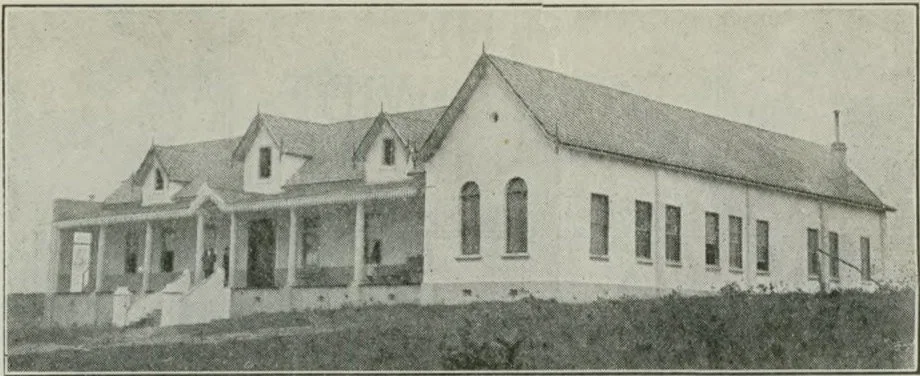
THURSDAY afternoon we took the car to Santo Amaro, a suburb of Sao Paulo, where Brother J. H. Boehm met us with the school team and took us out to the school, which is between five and six miles from this place, on a tract of nearly four hundred acres. The buildings are nicely situated on a hill that gives a good view of the surrounding country.
The west wing, which was in process of construction when we were here last January, and the main part of the building are practically finished. It is a one-story brick structure, roofed with cement tile, and plastered outside as well as inside, which is the manner of building in this country. The buildings are substantial, and present a fine appearance from all directions. The brick and tile were made on the place.
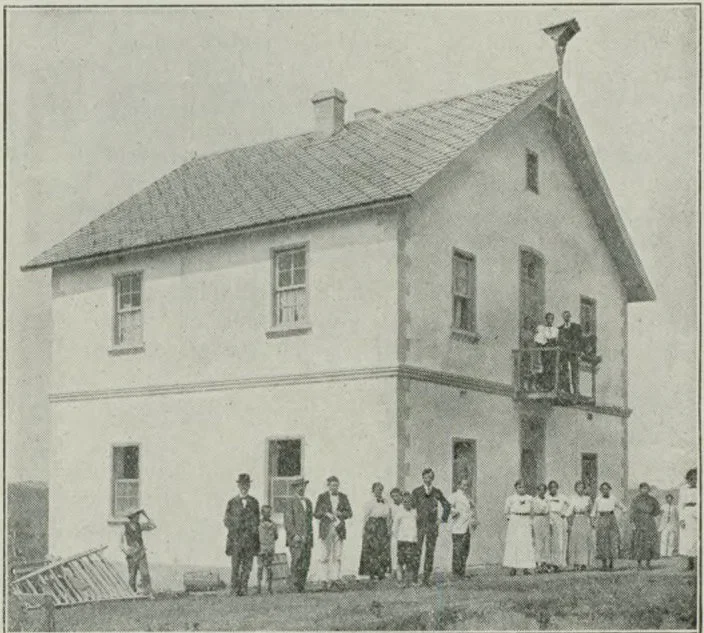
In the wing are the large pantry, kitchen, dining-room, and small parlor. In the main part of the building are the chapel, principal’s room, matron’s room, and rooms for eighteen students. Just back of the main building is a two-story eight-room building, the lower floor of which is devoted to a laundry and a bakery. Brother and Sister Paul Hennig occupy two of the rooms upstairs, and six boys have the other two rooms.
MAIN BUILDING OF SAO PAULO, BRAZIL, SCHOOL
At the left may be seen unfinished section where proposed wing is to be added, like one at right.
BAKERY AND LAUNDRY
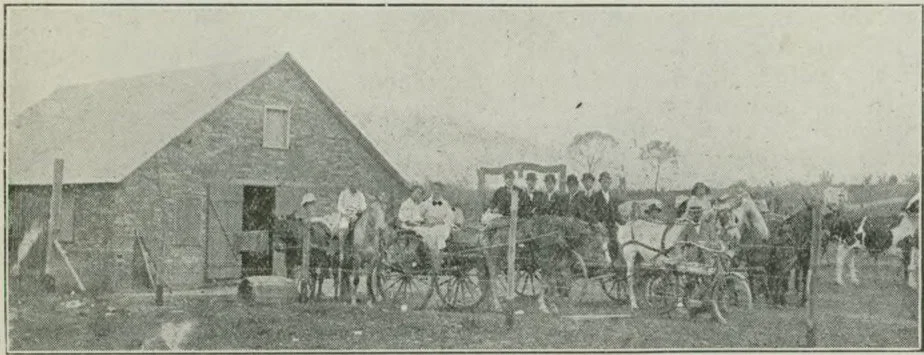
BARN AND TEAMS
There are thirty-five students in the home, and they will compare favorably with students in our schools in the States, though not so well advanced in their studies. They are a fine class of young people, and several of them give promise of making good workers. There is a splendid spirit in the school, and the students are making good progress in their studies as well as in their Christian experience. At six o’clock in the morning I heard several young men talking loudly down in the road in front of the building. At first I thought they were disputing, but soon discovered that each had a book in his hand and was studying earnestly without regard to the others. This illustrates the spirit of earnest endeavor that characterizes the school. Many of the students are making good progress in music under the able leadership of Brother Hennig. We greatly enjoyed the splendid program rendered by the young people Sabbath afternoon.
At first it was thought by the brethren that not many girls would attend the school, but we find that one third of the present attendance is young women. So it has become necessary to put several of the boys in the attic under the roof. As the building is only one story and no provision has been made for using this space, it will be seen that it is not a very desirable place, especially in this semitropical climate. The boys have adjusted themselves to the situation very nicely, and are making the best of it in a good spirit.
It is quite clear that the east wing must be completed as soon as the means can be provided, not only to care for the present students, but to make room for others who will come. Several who made application this year could not be accommodated because of lack of room. In building this wing it is planned to provide for the pantry, dining-room, and kitchen in a high basement which will be above ground. The building when completed will accommodate sixty students, with rooms for twelve above the bakery; the total capacity of the school will then be seventy-two.
Work on the wing will not be started until the money is in hand with which to complete it, as the “no debt policy” is being strictly followed in the establishment of this school. A strong effort is to be made at once to raise sufficient means in the field to complete this part of the building.
Several of the influential people of Sao Paulo are interested in this school enterprise, and are favorably impressed. An industrial school is a new thing in Brazil. This school, established on a large tract of good land within easy reach of one of the best cities of the republic , is attracting the attention of thinking and enterprising people. The director of agriculture of the state of Sao Paulo has given the school many varieties of valuable seeds. The director of the horticulture station of Sao Paulo gave about fourteen hundred fruit and ornamental trees, and has shown himself very friendly in many other ways.
About a year ago an old Austrian gardener offered to take charge of the garden at a very low wage, desiring to help the school get started. As he used tobacco and drank beer, he was told that he could not be employed because of these habits. He said he would give them up. He was a splendid gardener, and as the school had no one to look after that work, he was given a trial. He fulfilled his promise to leave off his bad habits, adjusted himself from the start to all the regulations of the home, attended all the services, and began to read and study the truth diligently. As a result, he has accepted every point of present truth, and is rejoicing in Christ as a personal Saviour. He is the happiest person on the place. His work in13the garden and his influence among the students have proved a great blessing to the school. The tables are supplied with an abundance of the best fresh vegetables, even through the six months, of drouth that is just now being broken by an occasional shower.
By building a dam between the hills a good reservoir of water fed by living springs can be provided at a very small cost, from which all the gardens can be irrigated during the dry season. The bananas, about five hundred of which were started, have had a setback, due to the heavy frosts during the winter, but they will come on again soon.
The establishment of this training school marks the beginning of a new era for the work in Brazil. Its influence will be far-reaching, its benefits and blessings manifold. Through it we hope to see many of the splendid young people in this field saved to the cause and trained for service. From its doors we expect to see a stream of earnest and consecrated workers going forth into the field. The appreciation of the brethren here is expressed in the following resolution, which was passed by the committee while at the school:—
“WHEREAS, The second Thirteenth Sabbath Offering for 1916 was devoted to the purpose of establishing a training school in Brazil, and has enabled us to purchase this property and erect these splendid buildings, therefore be it—
“Resolved, That we, the Brazilian Union Committee, the school board, faculty, and student body, in counsel assembled at the school, do hereby express to our brethren and sisters our deep appreciation and heartfelt thanks for this splendid gift to our field; and that a copy of this resolution be sent to the General Conference.”
Your Boy and His Books
By Mrs. I. H. Evans
MRS. I. H. EVANS
A FEW months ago we reprinted in these columns an article written for a well-known magazine by Walter Pritchard Eaton, entitled “Your Boy’s Books.” In it the writer set forth some of the dangers of the books which, formerly appearing in their true colors as “dime novels,” “yellowbacks,” and “nickel thrillers,” now masquerade in cloth covers, prettily stamped, and often well printed and illustrated, as respectable and desirable books for the child whose parents would have been horrified to see him reading them in their true guise. Parents and teachers by the thousand buy these books for their sons and pupils for no better reason than that they appear attractive to the casual examination, and may be bought for a price that appeals to the purse.
Would you like to know what one who has written a large number of such books has to say of them? In the December issue of the Ladies’ Home Journal a man who calls himself “A Dime Novel Writer” tells how he came to enter this field, and why he abandoned it. Fathers and mothers who do not know what their boys are reading will find food for sober reflection in the following excerpts from his “Confession:” —
“I have been a maker of sensational fiction, mostly for boys, for many years. I have written half-dime novels, ‘nickel weeklies,’ paper-covered ‘library’ books sold for fifteen cents, and boys’ stories to be bound in cloth and sold for twenty-five cents. It is these latter books to which I wish especially to call attention. Altogether, I have written of such ‘thrillers’ more than one hundred and twenty-five titles. They are all of the type of story that long ago was condemned under the term ‘dime novel.’ Because of this output, I feel I can qualify as an expert on ‘dime novels.’ And because my sense of decency finally rebelled at the writing of them, I propose to tell what I know about such stories.
“I wish to show how they are bought—tens of thousands of them—by people who don’t know what they are buying, conservative people who give them to their sons and daughters freely, Sunday school teachers and church people who would be shocked at the accusation that they are buying ‘dime novels’ for their children.
“I began to write thrillers because I needed the money. I am a college man and a newspaper man. I traveled over this country and a good part of Europe gathering material for a book I wanted to write. I spent five years in travel and study—and then I wrote my book. It took more than a year. But it was a failure, and there came a time when I must earn money at once.
“I got into touch with one of the ‘paper-cover’ book houses, as they call the publishers of ‘dime novels’ in the trade. They liked what I submitted, and I was told to write a detective story of thirty thousand words, and show what I could do. The result was that I was hired to grind out thirty thousand words each week in return for a weekly salary of fifty dollars. So I became a writer of ‘dime novels.’
The Publisher’s Instructions
“The letter telling me that I could consider myself on the publisher’s staff also told me that a batch of books was being forwarded to me, and gave me some instructions. Among them were some paragraphs about like these:— “Read the sample books carefully, that you may familiarize yourself with14
the characters run in the series. For instance, one of the detectives is a ventriloquist, and makes use of his power to trap the men he is after.
“‘A live story has something happen at least every thousand words. Remember to emphasize the fact that crime does not pay, and that punishment always overtakes the wrong-doer.’
“‘Never make a hero of a criminal. If you attribute a good act to a bandit, offset it by saying something like, “How fine a man he would have been had he turned his abilities to honest pursuits,” or, “He was not bad at heart, but had been driven to a life of crime by circumstances.”’
“Now please note that, (1) the publisher knew his stories were likely to suggest crime, and make it look attractive to youngsters; and (2) he therefore deliberately tried to put in something to correct that tendency.
“The stories suggest mean, bad motives to impressionable young people. How far they are responsible for crime I cannot say. I have run across one startling piece of testimony, however. On a trip through the underworld, made in the company of a city detective while I was in search of local color, I was introduced to one of the most expert safe-breakers in the United States. In the course of our conversation that worthy volunteered the information that he and his kind eagerly read detective stories for new ideas and ways to turn their tricks!
Fit for Any Home
“But there is further proof that these publishers are aware that their crime stories are bad for youngsters. For every such house has one or more series that those in the office habitually speak of as ‘good series.’ In their advertising to sell these ‘good series’ the stock phrase is, ‘These stories are fit for any home,’ which may be taken as an admission that their other series are not fit for any home.
“Out of these so-called ‘good series’ have been developed twenty-five-cent books bound in cloth that sell by the hundreds of thousands. The chances are that you have some of them in your house.
“Now the chief difference between the ‘half-dime novel’ and the ‘good series’ in paper covers, is that the former deals with criminals and their capture or with ‘Wild West’ thrills; while the latter deals with boys in school or in business, in travel, in history, or adventure. If the story is about business life, the hero, a poor but honest lad with boundless ambition, starts in as an office boy. He soon makes an enemy, a dishonest office boy or clerk; and then it is a battle of wits between the hero and the villain. They resort to all sorts of tricks and devices; the dishonest boy does not hesitate to commit crime in order to trap the hero; and the hero, the humble office boy, does not hesitate to rebuke any one, up to the president of the concern, in order to prove himself right. In the end he usually marries the president’s daughter.
“For the school story the only difference in the setting is that the scene is laid in the school or in a summer camp, or on a trip to some foreign country instead of in the business office.
“Eliminate the school or the business setting, and you practically have the ‘half-dime novel.’ The hero takes the place of the detective; the bad boy, the criminal. Instead of cracking a safe, the bad boy steals books or examination questions, and hires thugs to beat his rival. The hero first suspects his enemy, then spies upon him, and finally traps him. All the excitement and thrills of the ‘half-dime novel’ are ‘rung in,’ no situations are impossible, and, of course, the hero always comes out on top—in accordance with the publisher’s instructions ‘that crime does not pay.’
“One other notable difference between the ‘good series’ and those that cannot be called ‘good’ is that in the back of the latter are advertised handbooks on how to make love, for example, apparatus for practical jokes, powders to make people sneeze or to cause itching, etc. . . .
A Decline in Profits
“Now the business of publishing paper-cover thrillers, ‘half-dime novels,’ began some years ago seriously to decline. There have been several causes for this. The first break came when the low-priced magazines—some of them issued by the ‘paper-cover’ publishers themselves—were put on the market. People soon found that they could get more for their money in buying such a magazine than they could in a five- or fifteen-cent ‘library.’ As a matter of fact, whereas before they received only one story for their money, each magazine contained a dozen or more short thrillers and two or three exciting serials.
“Then there has undoubtedly been an awakening of the public conscience brought about by the persistent work of organizations, supplemented latterly by public libraries and the best of the popular publications devoted to women and the home.
“Another factor against the cheap trash is the moving picture show. More nickels than ever are spent for thrillers, but it is even more exciting to see a dare-devil action than to read about it. The moving picture magazines also are now bought by thousands of women, young and old, who used to spend their money for the fifteen-cent ‘library books.’
The Disguising Cloth Cover
“But American boys and girls still get trashy, harmful stories. The price and the form are changed, that’s all. Instead of sensational, cheap, improbable stories in paper covers that your boy had to read on the sly, if at all, you may be buying the same thing for him, and encouraging him to read it—in harmless-looking cloth covers.
“It began when publishers of stories in cloth saw a new market for cheap books. Most stories for young people were then made to sell for a dollar or more. These publishers, however, bought from the ‘paper-cover’ houses some of their so-called ‘good series,’ and brought them out at fifty cents, in cloth. They are still sold, though the price is now twenty-five cents.
“The success of this kind of book—a wolf in sheep’s clothing—was immediate. But the stories were old. The next step was the publication of new stories, of a similar exciting character, first at fifty cents, later at twenty-five. To make these books the publishers naturally sought the writers who had been turning out the ‘half-dime novels,’ whose market in paper covers was dwindling, and who were therefore glad of the new work. This was how I came to write ‘twenty-five-cent juveniles.’
A Fiction Factory
“One of the old nickel-novel men, after writing many of these new juvenile books under his own and other names, got a new idea. The houses that were publishing cheap cloth juveniles demanded more stories than he could write himself. So he formed a ‘syndicate’—a ‘fiction factory’—to manufacture this product. He employed many of the old producers of nickel thrillers, myself among the others.
“As I had obtained my work on the strength of having turned out paper-covered thrillers, the instructions for writing twenty-five-cent juveniles presupposed my knowledge of the technic of building ‘dime novels.’ So it was not necessary to show me how to write the story. I was cautioned, however, against producing sensational situations too often,—the old rule was once every thousand words, you will remember,—and told to moralize frequently.
“Descriptions of killings, fights, or of the commission of serious crimes were to be entirely avoided. If my story called for a killing, by Indians, bandits, miners, or anybody, I was merely to lead up to it, and then later state the fact as accomplished. The same was to apply to fights between schoolboys, or ‘our hero’ and any one else. I was told the fights must not be described by rounds or even graphically. I was to lead the characters to the spot, start them going, and then tell who won, and go on. . . .
Stock Models
“You see, then, the chief differences between the old ‘dime novel’ and the twenty-five-cent juvenile I write about, lie in the imagination of the buyer, the price, and the cloth cover. Substitute ‘our hero’ for the detective, bandit, or whatever he may be, his rival for the villain, tone down your situations, and you have transformed the ‘dime novel’ into a twenty-five-cent juvenile. Just as there were stock models for the paper thrillers, so there are for these twenty-five-cent stories. The plot invariably depends upon a struggle between ‘our hero’ and a ‘villain’—often one of his own schoolmates. ‘Our hero,’ though sometimes under a cloud, and sometimes in opposition to parent and teacher, is always right.
“All the old cheap dodges of the ‘dime novel’ are worked over and over,15with the introduction of modern facts and inventions, such as the submarine, the airship, and wireless, to make them ‘up to date.’ Scarcely any physical or scientific feat is impossible for ‘our hero.’ Who should know better than I that these modern books for boys and girls are essentially the same as the condemned ‘dime novel’? Have I not written both? The pay for the twenty-five-cent juveniles, however, is not so good as it was for the old ‘dime’ and ‘half-dime’ novels, being only seventy-five dollars for from fifty to sixty thousand words.
“However, the writer is relieved of one burden. He is not obliged to work out his own plots. The head of the ‘fiction factory’ works out all his own plots, and sends them to his writers. The plot usually bears the name of the story, and the accompanying letter tells when the manuscript must be finished. Three weeks is the customary allowance for fifty thousand words. The writer is told to ‘stick to the synopsis.’ So, when he receives the manuscript, the head of the syndicate is sure that the story is ‘safe,’ that the old habit of the ‘dime-novel’ author has not betrayed him into crudities that would not do for a ‘good series.’
“Now how does this affect you? If you wish to know whether the boys and girls near you are reading this kind of trash, find whether there are in your house cloth-bound modern storybooks that cost twenty-five cents. Read one or two yourself. If you ever read a ‘dime novel,’ you may recognize some of the old stock thrills.
Only Shams
“I am not condemning these books because of the price. Many worthy books are reprinted and sold in cloth today at this and other low prices. But the twenty-five-cent juvenile of the kind I have written about, and which I wish to warn you against, is a definite type. If you have any doubt of the character of a particular book or series, submit it to the children’s librarian of the nearest public library. Ask her whether the library circulates such books.
“The reason it does not is because such stories are not real stories—only shams. They do not deal with real life, but with worn-out, conventional characters and incidents, juggled now into this, now into that, form of cheap, unnatural excitement. They are made to thrill. Above all, they are made to sell.
“One of the greatest curses of these cheap storybooks lies in the fact that they deaden and finally destroy the taste for real books. Their readers miss the fine, real things. They come to prefer impossible fiction to serious books, to biography, history, or even to stories that present life and character as they are.
What Are You Going to Do About It?
“Since I have shown you the inside of the cheap juvenile ‘works,’ the question is, What are you parents or older friends of the youngsters going to do about it? “I find this test in a recent circular warning parents against this class of books:—
“‘Read your children’s books yourself. Or, better still, get your boy or girl to read them aloud to you. Ask yourself during the reading:—
“‘Does this book lay stress on villainy, deception, or treachery?’
“‘Are all the incidents wholesome, probable, and true to life?’
“‘Does it show young people contemptuous toward their elders and successfully opposing them?’
“‘Do the young characters in the book show respect for teachers and others in authority?’
“‘Are these characters the kind of young people you wish your children to associate with?’
“‘Does the book speak of and describe pranks, practical jokes, and pieces of thoughtless and cruel mischief as if they were funny and worthy of imitation?’
“When you find that your own children, or your neighbor’s children, are getting these cloth-bound ‘dime novels’ from local stores, do what you can to spread the information I have given here about them. Don’t, however, blame the bookseller too much. Remember he keeps such books for sale because you and your friends have bought them, and permitted your young people to buy them. Bear in mind that the publication and sale of such books will be stopped only when the public has awakened to the fact that the old ‘dime novel’ they condemn, and the newer twenty-five-cent juvenile book they buy freely, may be one and the same thing.
“It has not been easy for me to write this article. It may not be easy for you to act on it. But I have done my part in laying bare the situation. And I have done so because I have become disgusted with the whole business. Never will I write another ‘factory’ story.”
OUR HOMES
By Mrs. I. H. Evans
Conducted by Mrs. I. H. Evans, Takoma Park, Washington, D. C.
Through the columns of this department, hints will be given on all matters pertaining to the home life. Short articles and letters are solicited from home makers, telling of their everyday experiences,—their joys and sorrows, their failures and successes.
Argentine Conference Sabbath Offering and Baptisms
ELDER ROSCOE T. BAER, president of the Argentine Conference, sends the following word: “We have many evidences of the working of the Holy Spirit. The last Sabbath of the old year was observed by an all-day meeting of the four churches in Buenos Aires, on the banks of the La Plata River, near our headquarters in Florida. As it was the thirteenth Sabbath, we set our goal at a one-hundred-dollar offering, and reached it easily. Our people are very enthusiastic. At the close of Sabbath school eighteen persons were baptized. After lunch we held an afternoon service, during which God came very near to us. We had another baptism in the city of La Plata on the thirteenth of January. To the Lord be all the praise.”