Your ShelfYour Projects

Review and Herald, Vol. 94, No. 8.

Prohibition Advances
Earlier text: Effectual Prayer

David Livingstone on Valuing Everything for Christ's Kingdom

DAVID LIVINGSTONE stated a worthy missionary purpose when he said: “I will place no value on anything I have or may possess, except in its relation to the kingdom of Christ. If anything I have will advance the interests of that kingdom, it shall be given up or kept, as by keeping or giving it I shall most promote the glory of Him to whom I owe all my hopes, both of time and eternity. May grace be given me to adhere to this.”

MRS. L. D. AVERY-STUTTLE

Inasmuch

MRS. L. D. AVERY-STUTTLE

ON such a night as this, O God, Have pity on the poor; The bleak blast shakes the windowpane, And drives across the moor; To don his snowy robe of white The Storm King marches high, And dark mists rise in threatening wrath, And scud athwart the sky.
Have pity on the poor, O God, The winds are fierce and wild; They beat on many a cheerless cot And many a homeless child. Dost thou not see the saddened hearts, The helpless widow’s tear? The bitter prayer of dark despair, O God, dost thou not hear?
  • *
'Twas thus I cried, when from the skies A sweet voice answered me: “Give of thy plenty, foolish child; Have I not given to thee? Go, bless the homes of poverty,— The hungry must be fed,— I blessed thee, child, that thou mightst give My needy children bread.
“And ne’er forget, O child of mine, Though small thy service be, Whate’er thou doest for my poor Thou doest it to me; And ‘inasmuch’ as thou hast given, To thee thy King shall say, ‘I’ll give to thee a crown of life That fadeth not away.’”
Lansing, Mich.

Children and Policemen

MARTHA E. WARNER
ONE night I found a little girl on my porch, sobbing as if her heart would break. She was afraid to go home, because her teacher kept her after school. Her mother had told her if she did not come directly home from school, the policeman would get her, and carry her off, and beat her 'most to death, and O, she just couldn't go home, she was so "'fraid!"
I calmed the child as best I could, and went part way home with her, for it was growing dusk.
The next day the mother came to see me. I asked why Carrie was so frightened. What did the child mean by her talk about the policeman?
She told me that one night Carrie stayed and played with another child until quite late. "When she reached home," the mother added, "I whipped her hard with a strap. Then I told her I was ashamed of her. She was not my girl any more. I would let the policeman come and get her. He would beat her with his stick, and take her 'way off. I took down the receiver to telephone to the policeman, and she cried and cried, and said, 'Don't, mamma! don't let him have me. I never will stay again. Please, please, mamma! I will come right home every night.' So I told her it was all right, but the next time I would surely let the policeman have her. That was why she stopped here; she said you kept her a little while, so I didn't punish her, but I will if it happens again."
Do you wonder that this poor child was afraid of policemen for many years after this experience?
How different was the case of a little tot who was out walking one morning. Meeting a policeman, she said, "Good morning, Mr. Policeman;" and to auntie, "I like to say Good morning to the policemen, 'cause they are so big and kind to take care of me."
If mothers were wise, they would never threaten their little ones, nor implant fear in their heart.
Clintonville, Conn.

A “Home Credits” System

MRS. MERNIE LEWIS
My five children are not very bad, but it is the little weeds which do the damage when grown,—quarreling, talebearing, selfishness, a habit of slighting work, and such things as I know ought not to be. I talked to them, prayed with them and for them (the oldest is eleven), and sometimes I punished; but all this seemed to have little effect, so I took this idea from the home credits they have in school.
We cut little cards, one-half by one and one-half inches, from pasteboard, and call them merit cards. Every time they do their tasks perfectly,—get up without being called, win a victory over temptation, retire at the proper time, when the little ones wash their hands and faces before meals without being told; in fact, for almost everything they do well,—I give them one merit card. Each morning they tell me what they did the day before, and receive cards accordingly.
When a child has fifty cards, I give him some little thing,—a child is so easy to please. Last week I made little spelling tablets, and tied each with baby ribbon. When they have five of these tokens, I give them something a little nicer. The cards go back in the glass in the cupboard to be used again. I expect to give pencils, school tablets, marbles, etc., and for later presents something a little better, till for one thousand merits a still nicer gift is received.
This whole plan takes very little time and study, nothing compared with the rest and peace it brings into the home. On Sabbath the children do not work for merits, but show mamma they can be good and kind one day in each week because they love her and because it is right. This keeps their minds free from the cares of life on God’s holy day.
Melbeta, Nebr.
NEW JERSEY CONFERENCE WORKERS' CONVENTION

New Jersey Workers’ Meeting

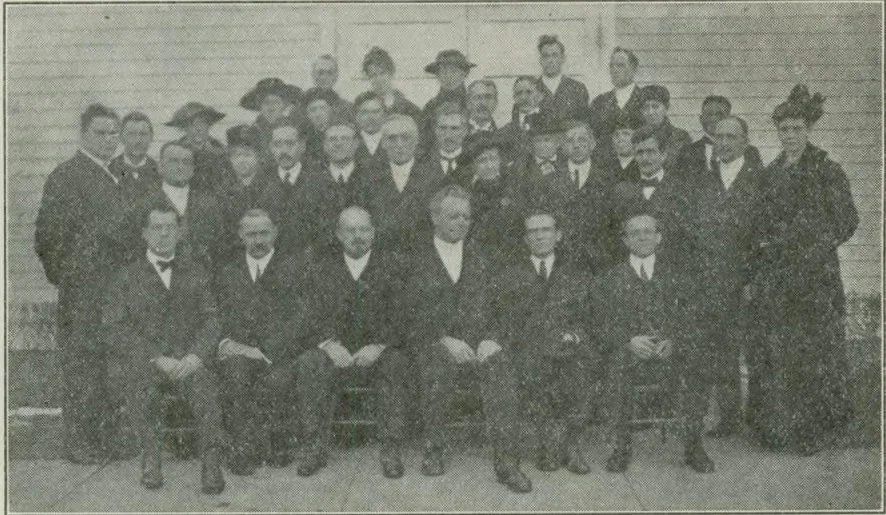
IN harmony with the words of our Saviour to his disciples, “Come ye yourselves apart . . . and rest awhile,” the workers of the New Jersey Conference gathered at the Seventh-day Adventist church in Trenton, January 16, for a three days’ institute. In addition to the regular conference employees, many of the local church elders met with us.
The first service, which was led by Dr. D. H. Kress, medical secretary of the Columbia Union Conference, struck the keynote of the whole meeting,—consecration to the work of God, and earnest seeking, in the streets and lanes and in the byways and hedges of the cities, for souls for whom Christ died.
The papers and the free discussion on such subjects as “City Missions,” “City Tent Efforts,” “City Medical Work,” “Work in Rural and Small Towns,” “Foreign Work in Our Large Cities,” “Bible Work,” “Young People’s and Educational Work,” “Gospel Finance,” and “Personal Labor in the Cities,” were of great benefit to all, giving us a keener realization of the stupendous task before us, and a clearer understanding of how better to execute the plans of God in the earth.
Just before our last meeting, Elder A. R. Sandborn, president of the conference, received word of the death of his mother, in Michigan. This sad news turned our minds to the solemn realization of the bitterness and sorrow that sin has brought to this world, and the need of our being faithful in finishing speedily the work of God, that the last enemy, death, may soon be destroyed. The service was one of prayer and consecration, in which was manifested much of the Spirit of God.
At the close of the institute, the workers left for their several fields of labor, each one with a firmer resolve and a bolder determination to press the battle to the gates, and by God’s help speedily to finish the proclamation of this last gospel message to a lost world.
The prayers of the REVIEW readers are solicited in behalf of the growing work in New Jersey.
JOHN W. MACNEIL.

From Hongkong to Colombo

OUR party, consisting of Elder and Mrs. R. C. Porter, Mrs. Knox, and the writer, sailed from Hongkong on the Peninsular and Oriental steamer “Malta,” December 1, booked for Colombo, Ceylon. On this journey of more than twenty-five hundred miles, requiring two weeks, we were favored with very pleasant weather and a smooth sea most of the way.
The trip was broken by two stops, one of two days at Singapore, and one at Penang. The two days at Singapore gave us opportunity to become acquainted with our work at that place, and to see something of the city with its many interesting and strange features, not the least interesting of which were the different races of the East that make up its population. Among those most in evidence were the Chinese, Malays, East Indians, and natives from the different countries making up this large island country generally known as Malaysia. Each class of people appears in the main in its own peculiar manners and customs.
Three principal agencies are in use for getting about the city—the jinrikisha operated by Chinese coolies, a cab drawn by a small pony that does not get over the ground so fast as the coolie, and the electric car. Judging from the large number of jinrikishas in use, they are evidently the most popular of the three modes of conveyance.
Although Singapore is within two degrees of the equator, the temperature is not trying to the visitor; but to the resident European or American the unvarying heat is generally very debilitating.
Our ship steamed into this beautiful harbor early Wednesday morning, the sixth day out from Hongkong. We were heartily welcomed by our brethren at this place,—Elder F. A. Detamore, the superintendent of the Malaysian Mission; Brother J. W. Rowland, of the Straits Settlements; and Brother K. M. Adams, who with a number of native teachers is conducting our mission school. These brethren and their wives made our brief stay most enjoyable by their kind and gracious hospitality.
In the evening we had the privilege of meeting a large portion of our Singapore church. This church is composed of about one hundred and twenty-five members who have been gathered from these various nationalities; and as far as could be discerned, these dear people love the truth of God just as fervently as we do, and are equally interested with us in every evidence of the advancement of the work.
The most interesting feature of our work at Singapore is our mission school. It is very favorably and conveniently located in rented quarters on one of the electric lines. At present our American workers have their homes on the same tract of land. The school has an enrolment of one hundred and twenty, composed chiefly of Chinese, Malays, Battaks, and natives of the Celebes Islands. These students are certainly as bright and promising a group of young people as could well be gathered in any country. The advanced class of twelve young men are all definitely preparing for the work of God in such capacity as they may seem best qualified for, and as the providence of God may indicate.
I was privileged to speak to the school at the chapel exercises, and afterward to the Chinese students through an interpreter. These Chinese young men speak the Hakka language. They are all Christians, and express themselves as anxious to have a part in this closing work.
What I have seen in Singapore makes me look forward with much pleasure to our proposed visit to this field next February, when we hope to make a more extended stay, and visit other portions of the Malaysian territory where the work is reported as making such satisfactory progress.
This afternoon as we look westward, land is in sight. We are assured that early tomorrow morning we shall land on the shores of Ceylon, where “every prospect pleases, and only man is vile.”
W. T. Knox.

Work in the Western Pennsylvania Conference

I WISH to say to my many friends in this cause, through the columns of the good old REVIEW AND HERALD, that I am very thankful for the precious light of this message, which grows brighter and brighter as we near the end.
I accepted the truth in the spring of 1874, and have been preaching the message ever since. The second Sunday in February, 1917, closes the thirty-sixth year of my ministry, and I thank the Lord that my health is good, and that I am still able to work in this precious cause.
I am in the field at work almost all the time. At present I am at a small village where there are no Seventh-day Adventists, and where no work has been done by our people. I have the privilege of holding services three nights each week in a schoolhouse, and I am planning also to hold some cottage meetings during the week. I have been here only a few days, so cannot tell what the interest will be, but at present the outlook is very encouraging.
There is a call for meetings to be held in a village about seven miles from here, and there are so many other calls that I am not able to answer them.
I find little companies of people not of our faith who see the lack of spirituality in the popular churches, and are gathering in cottage meetings to seek the Lord. I have found two such companies recently: one of these has requested me to hold a tent meeting in their neighborhood next spring.
I believe God is going to close up his work in the earth very soon. Those who know the truth should now be wholly consecrated to God, and should do all in their power to help those who are seeking light and truth.
Brethren, pray for me and for my work, that precious souls may be saved.
J. W. WATT.

The Iowa Conference

Believing that the many old-time Iowa people now scattered in many foreign lands as well as in nearly every State in the Union, would be glad to hear a brief report from the Iowa Conference through the REVIEW AND HERALD, we take this opportunity of giving a summary of the work in our conference for the past year.
The secretary’s report shows that during 1916 there have been received into church membership in the conference 130 by baptism and 161 by letter and former baptism, giving a total of 291 members received. A number, however, have left Iowa for other States, and this, with several deaths, reduces the net increase of membership very materially. Our present membership in the conference is 2,648.
Financially, the Lord has blessed the work even beyond our expectation. We had set a goal of $50,000 for the year’s tithe, but when the books were closed at the end of the year, we found that we had received the splendid amount of $57,387.68, nearly $10,000 more than for the previous year. The total mission funds for the year were $29,710.72, a surplus over our twenty-cent-a-week quota of $4,771.52, of which amount $12,909.48 was contributed by our Sabbath schools, making over $1,000 a month on an average from this source.
We are especially grateful for the blessing of the Lord in the Harvest Ingathering work. Over 50,000 copies of the Harvest Ingathering number of the Signs were used in our conference, and the returns amounted to $7,328.72, which was over $100 more than twice Iowa’s part of the General Conference quota of the $100,000 Fund. Upwards of 300 persons secured in this campaign more than $5 each, the largest amount being received by one of our younger workers, Miss Florence Dietel, who secured the splendid sum of $612.70. We almost feel encouraged to place our goal for the Harvest Ingathering campaign for 1917 at 60,000 copies of the paper and $10,000.
The tract society business for the year has shown a splendid increase over that of any previous year. The literature sales amounted to over $38,000. Our large books placed in the homes of the people amounted to more than $5,000, and our churches and people generally have shown a greater interest than ever before in the circulation of our literature In addition to meeting its own running expenses and paying the salaries of the secretary and stenographer, the tract society shows a gain of over $700, as shown by the financial report.
Our conference association liabilities were reduced during the year by several thousand dollars, our notes payable at the present time being less than $40,000; whereas, a few years ago they were over $80,000. In addition to this, more than $15,000 has been invested in the State during the year in church extension work, in the erection of new buildings at Cresco, Liberty Center, Ottumwa, and Creston. A good building worth several thousand dollars was purchased from the Congregationalists at Marshalltown at a very moderate price. In addition to this, the remainder of the Nevada church debt was paid, making an aggregate of over $15,000 invested in church building property during 1916.
Our institutions in this conference are enjoying a good patronage. The Oak Park Academy has the largest regular attendance of any year of its history. The sanitarium has also enjoyed a good and regular patronage, so that the institution has been able to carry all its own obligations and invest several thousand dollars in improvements.
We begin the year 1917 full of courage and confidence that the Lord will continue to bless the interests of his own cause in this as in every other part of the field.
A. R. OGDEN.

Georgetown, British Guiana

WE are glad to report progress in our part of the field. We pitched a tent in Georgetown soon after getting settled here. Elder M. B. Butterfield joined us about the beginning of September, and we started a campaign which lasted six weeks, with a splendid interest to the close. The first week was devoted to the war question, from the Bible viewpoint, which stirred the people as they said nothing else had done. At first the tent was crowded to its utmost capacity, besides hundreds on the outside. It was estimated that between seven and twelve hundred were present, and scarcely at any time could we seat all who came. At the close of the meetings about fifty joined the baptismal class; later others joined it until there were sixty-three. We have had two baptisms; at the first there were six candidates, and at the second nineteen. In a few more weeks we shall have another baptism. There are twenty in the class preparing for baptism. Since we came here, thirty have been added to the Georgetown church. To the Lord be all the praise. We have been very busy, as Elder Butterfield had to leave as soon as the tent effort closed.
Lately we had a chance to take a trip up the Demerara River about eighty-five miles, to our Bootooba mission, where Brother and Sister Payne are in charge. The pupils are nearly all Indians. They are getting along quite well. Five candidates were baptized while we were there.
This is a very low, flat country. On the way up the river we had to stop overnight at a place called Wismar. The next morning we went on board another vessel. Imagine our surprise, on starting up the river, to see the water running upstream. The tide was coming in, and it rises as far as Bootooba.
We are enjoying splendid health since coming to this country. There are two rainy seasons and two dry seasons here each year. The dry seasons are the hotter. However, we have passed through wet and dry, but have not suffered from the heat. Georgetown is a fine city for this country. It has about sixty thousand inhabitants, electric lights, electric street cars, and a quite modern water system. Remember us at the throne of grace, that we may have help from the Source of all power to push the work to a finish in British Guiana.
I. G. KNIGHT. CARRIE KNIGHT.

God’s Love for All Mankind

I WILL relate two or three experiences among the Visayans which show “that God is no respecter of persons: but in every nation he that feareth him, and worketh righteousness, is accepted with him.” Acts 10:34, 35.

A Victory

Two boys staying in our home are quite opposite in disposition. One has considerable education and refinement, and is rather timid and retiring in disposition. The other is inclined to be rude and harsh, has a hasty temper, and no consideration for those that do not agree with him. The boys had been having trouble. We tried to settle it, but it would break out anew. While I was away in Negros one Friday night, Mrs. Adams tried to get them to confess to each other and make matters right, for they had had trouble again that day. But one boy became angry and said he did not believe the Bible and did not want to pray any more. Then he started to go downstairs. Mrs. Adams called him. He stood awhile with his face toward the steps, and then slowly turned round and bowed for family worship. After all others had prayed, he prayed. When worship was over, he said that when he started to go downstairs he saw Jesus hanging on the cross, and he could not go down. The boys then went to their room, confessed to each other, and prayed together.

Triumph over Appetite

When I was in Bacolod, Negros Occidental, conducting a canvassers’ institute, I baptized three men. One of them, aged thirty-one, had used tobacco for fifteen years. One evening, with the evangelist, I called on this brother to see if he was ready for baptism. He expressed his desire to be baptized, but we found that he had not yet full victory over tobacco, and he felt that he needed medicine to help him overcome the habit. We tried to point him to the power of God, and asked if he would like us to bow there and pray for him. He hesitated to do this because he was living in a house with unbelievers. He said we could do it at our house. He came over a little later to the place where we held a study for the candidates. After a brother had opened the meeting with prayer, I felt impressed to pray for this man, so I offered a brief prayer that he might obtain victory over the tobacco habit. Nothing more was said about it that night. When I arose the next morning, I prayed for him again. We expected him at another meeting the next day, but he did not come. I feared that he was discouraged on account of the strong hold the habit had on him. But in the evening he came. After the meeting he told us that he could not come in the morning, for the washerwoman had not returned his clothes, and he had no clean ones to wear. He said that the night before when we prayed for him, he saw no change, but that early in the morning his desire for tobacco was gone, and it seemed as if it had been years since he had used it. He said, “I felt that it was the Holy Spirit, and that some one was praying for me.”
ELBRIDGE M. ADAMS.

Work in the North Pacific Union Conference

It was my privilege to spend three months, from Nov. 1, 1916, to Jan. 30, 1917, in the North Pacific Union Conference, working for the German people. The first six weeks were spent in Montana, in connection with Elder J. K. Fischer, the German conference worker. We visited four places, and held meetings with both our own people and others. In some places a good interest was started, and some decided to obey the truth. We could not finish the work, but Brother Fischer will return and labor there. The prospect is very encouraging, there being many opportunities for labor in that field.
The next place I visited was in Idaho, but as I was called to Endicott, Wash., to be present at the dedication of a church, I could not finish the work in that conference which I came to do; so after spending about three weeks visiting the German churches in Washington, I returned to Idaho. We have never had a German minister permanently settled in this field, but I am glad to see the work moving forward. We have now two German churches, one company, and several scattered believers in that State.
One church of fourteen members was organized before I left the field, and about five others are ready to join the church. These people are not new in the faith, but have moved there from other States. We hope that some of their neighbors will accept the message soon, as there is quite a large settlement of Germans in that vicinity. The conference has invited Elder J. Riffel, of the Upper Columbia Conference, to make Idaho his field of labor. This is quite an encouragement to our people in that field. We expect great things in these two conferences, Montana and Idaho. Many people have moved into these States, and now is the time to work for them, before they become settled in their own churches. I enjoyed my work very much during these three months. I am glad for this experience in pioneer work in that new field. The brethren are all of good courage, and have consecrated their life anew to the finishing of this glorious work.
G. F. Haffner.

In the Asiatic Division

LEAVING Shanghai November 5, on the steamship “China,” Brother C. E. Weaks, Brother H. M. Blunden and family, Mrs. Porter, and I enjoyed a very pleasant voyage to Hongkong. We proceeded at once to Canton, where we spent two busy days attending committee meetings and visiting the girls’ and boys’ schools.
The schools are doing good work in preparing workers for the field. Twelve young men of mature age are in the advanced class, and will soon complete their course and enter the work. Ten times this number could be used to advantage in the Cantonese field. These students show good training, and they are manifesting ability unsurpassed by students in our older schools.
The girls’ school is filled to its capacity with very bright students, and there is great need for a teacher. The work throughout south China is making good advancement in every way.
Special attention is now being given to the literature work. Brethren Weaks, Blunden, and Mountain are holding some institutes in the interests of this line of work, and some well-trained workers will soon enter the field with our truth-filled literature.
In Manila we spent a few days in committee council. We were sorry to learn that on account of the failing health of his wife, Brother W. E. Lanier, who has had charge of the literature work, is obliged to return to America. Brother and Sister R. M. Wallace are returning to Australia, as Sister Wallace is in very poor health. Brother C. N. Woodward was invited to take charge of the printing plant, and Brother J. J. Strahle of the book work.
The printing plant is installed in its new quarters, and the dwellings for the printer and for the school-teacher have been erected and are ready for occupancy. The school dormitory is nearing completion. It is provided with sleeping-verandas instead of sleeping-rooms. This is a much more desirable arrangement for the warm climate of Manila. The lower floor, which is used for classrooms, has sliding partitions. This arrangement makes possible the throwing of the whole lower floor into one room for chapel services, if desired. This is a good economy in space. Study-rooms are adjacent to the sleeping-verandas. The building presents a creditable appearance, although it is inexpensive.
The new church building for the Filipinos in Manila, constructed with a view to accommodating general meetings which will naturally be held there, will be ready for occupancy at the time of the coming general meeting, which will be attended by Elders A. G. Daniells and J. E. Fulton, and their associates.
While in Manila we were privileged to greet Elder and Sister Daniells, Elder and Sister Knox, Brother and Sister H. W. Barrows, and Brother C. C. Crisler. We were most happy to welcome these brethren and sisters, some to join us in a brief tour of the field, others to remain and share in its burdens and privileges. The last evening of our stay in Manila the missionaries of the various denominations spent a very pleasant evening at the home of Elder and Sister L. V. Finster, it being their union monthly meeting. We were glad to meet so many of those interested in evangelical work.
After our council meetings in Manila, Elder and Sister Knox accompanied me back to Hongkong, and finding that we had a few days before sailing for India, we spent two days at Canton in council regarding the educational work in the Cantonese field. Elders Daniells and Fulton and Brother Weaks remained in Manila for a more extended visit, after which they will tour the northeastern portion of the Division.
After a pleasant stay of one week at the hospitable home of Elder and Sister B. A. Meeker, in Hongkong, we took passage by the steamer “Malta,” of the Peninsular and Oriental line, for Colombo.
During our visit in Hongkong Sister Meeker had to be taken to the hospital on account of illness. The long hot summer season has told on the health of both Brother and Sister Meeker, yet Brother Meeker is actively engaged in his work. He is conducting a very successful campaign with the Harvest Ingathering Signs. He is also using a large number of the weekly and monthly Signs in his work.
Five days on the water brought us to Singapore, where we took our mission workers by surprise, as we came in several hours ahead of the time they expected us. We visited our training school, where one hundred and twenty bright young people are availing themselves of a Christian education preparatory to giving the message to their own people. Prof. K. M. Adams and Miss Lena Mead are doing excellent work in the school. Their force of native teachers is sufficient, and their quarters, although spacious and well adapted to their work, are more than filled.
In the Harvest Ingathering campaign the best work is being done here of any place in the Division. Most of the funds are given by the native people, but good collections are made from the business men of Singapore. A well-planned campaign covering the entire Division would reap a bountiful harvest for the advancement of the message, and we hope to see such a campaign organized next year.
The work in Malaysia is taking on a more aggressive form. Eighty have been baptized during the year. We are indeed glad to see the progress the work is making along all lines. The devoted company of new workers are contributing their share toward this strong advance movement. R. C. PORTER.

Pittsburgh, Pa.

THE hand of the Lord has been manifested in the many rich blessings which followed our work here during 1916, and to his name we give the glory. We rejoice in the advancement that has been made, yet we feel that if we had lived up to God’s ideals for his people, much more could have been accomplished.
On December 31 the net membership of the Second Seventh-day Adventist church in Pittsburgh was sixty-nine, thirty-five members having been added during the year. The finances for this church are as follows: Tithes, $1,057.18, as against $710.21 in 1915; mission offerings, $484.33, as against $286.61 the previous year. This is in addition to nearly two hundred dollars donated for church expense and improvements on building, and about two hundred and fifty dollars paid to the tract society for literature, not including individual canvassers’ accounts.
The company of nineteen at McDonald also did well. Their tithe amounted to $431.90, and mission offerings to $145.92, as against $272.43 and $77.85 the year before.
It will be seen that both churches paid $1,480.98 in tithes, and $630.25 in offerings for foreign fields, amounts which more than equal their pastor’s and Bible workers’ salaries and expenses. These companies, with some help from certain brethren of other churches, also reduced the indebtedness on their church building from $2,290.68 in January, 1916, to $1,464 on December 31. I am glad to say that on December 30 $398 was pledged by the new members, so that our entire indebtedness, with the exception of a few dollars, is well taken care of. We make payments on our pledges the first Sunday of each month. When we review the work and see where it was four years ago, and note that it has now become self-supporting, we feel to exclaim, What hath God wrought!
In closing, it might be well to call attention to the fact that the doubling of the Pittsburgh membership during the year was in a great measure due to the procuring of our new church building. This demonstrates that it is economy to secure neat and permanent church buildings in these large cities, as moving from house to house and into all sorts of unsuitable halls really gives no prestige to the work.
We have many open doors, our members are all loyal to the organized work, and everything seems favorable for continued advancement along all lines. We solicit an interest in your prayers, that we may be able to double our membership again this year. Our members are working to this end.
A. N. DURRANT.

The Italian Work in Chicago

It has been quite a long time since we reported the progress of our Italian work here in Chicago. We feel that the good news we have to tell will rejoice our faithful brethren and sisters in other places, and so we shall briefly mention a few encouraging features of our work during the past year.
We do not wish to speak of the hardships, perplexities, and persecutions we have endured, so will only say that the Lord has helped us to overcome them, and that we could close the year with complete victory. We are still on the battle field, ready to fight to the end.
We enjoyed many rich blessings during the week of prayer, and also during the Harvest Ingathering campaign; and we begin the new year with good courage, trusting in the Lord. Generally speaking, the work among the Italians has been quite prosperous in all its various phases. The Italian Signs of the Times is doing good work, and meets with a ready sale. Last Sunday, in a few hours, a girl of fourteen who speaks but little Italian, sold forty-eight copies of the magazine at ten cents a copy. This was done in Chicago; and I believe that the same could be done in New York, Philadelphia, Boston, Pittsburgh, San Francisco, Los Angeles, and other large cities where there are thousands of Italians.
Last July Brother Michele Cali went to Milwaukee, Wis., to work among the thousands of Italians in that city. We feel thankful for what he is doing. The interest in Milwaukee is good, and a church could no doubt be organized in a short time if the work could be conducted in a more effective way.
In Chicago we have three capable young men, well trained and having a good Christian experience, who could enter other fields. They have attended the Chicago Bible Training School, and These have been active workers in the large and difficult field of Chicago. I hope and pray that some of our conferences in the East and West where there are large cities, can place laborers in their fields to work among the Italians. Christ cannot come until all the Italians, as well as the people of other nationalities, have been given the gospel. Let us not worry too much about funds; the Lord has plenty of money, and he is willing to give it to us in order that we may successfully work all his vineyard.
Our two Bible workers, Brother Joseph Sansonetti and Sister Vesta Cash, are doing good work. Our church school is doing well. Our Missionary Volunteer Society is making advancement under the faithful leadership of Sister Cash. The church missionary society, too, is doing its part in proclaiming the message.
During the year 1916, fifteen persons were added to the church by baptism, which is five more than were received the previous year. The total amount of tithe, offerings, and church expenses was $1,267.14, or $447.69 more than in 1915. We have reached our quota for missions, raising twenty-six cents a week per member. When we consider the small wages earned by the Italians, and the large families they have to support, we feel thankful for their faithfulness and loyalty to the cause. Indeed, we are happy to know that the Lord can use the Italians, as well as other nationalities, for the finishing of his work. At present we are busy with our winter campaign. We need your prayers. We are looking for great things from the Lord this present year, and we trust it will be the best in the history of our Italian work. To God alone we give all the glory. R. CALDERONE.

Our First Navajo Convert

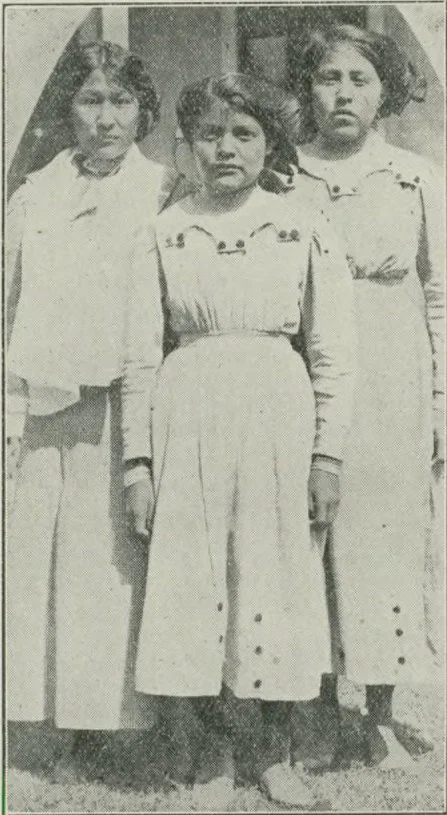
LILIKAI, an exceptionally bright Navajo Indian girl twenty years of age, has definitely decided to obey the truth, after the hardest moral battle she ever experienced.
LILIKAI (in center)
LILIKAI (in center)
Now her father and mother, thoroughly pagan Navajos, are interested in the “good story.” After I had held a long Bible study with the father yesterday, he said: “I have thought of these things many times, but I could not understand them. Now they are plain. I believe them. I want to hear more, and I am coming to see you as often as I can, so I can hear more of the ‘good story.’” He lives twenty miles from here, and I promised to visit him whenever possible.
The father of our first Navajo convert is a wealthy stockman, and has many horses, cattle, sheep, and goats. He named his daughter “Lilikai” (lots of sheep) as an expression of his own financial circumstances. In other words, her name means “rich girl.” Now that she has found the true riches, she is rich indeed. ORNO FOLLETT.
Continue reading: Work for the Colored in the Chesapeake Conference