S. D. A. Publishing Association · Battle Creek, Mich. · Sep 12, 1895
The Cotton Industry of the South.
By Rodney S. Owen
The use of cotton in the manufacture of cloth began at a very early period in the history of the world. The Egyptian dead who were embalmed when Joseph was prime minister of Pharaoh were swathed about with fine cotton cambric. The Hindus and Chinese used it for clothing more than a thousand years before Christ. Although it had been so long in use, cotton never took a prominent place among the materials for the clothing of man until about the beginning of the present century.
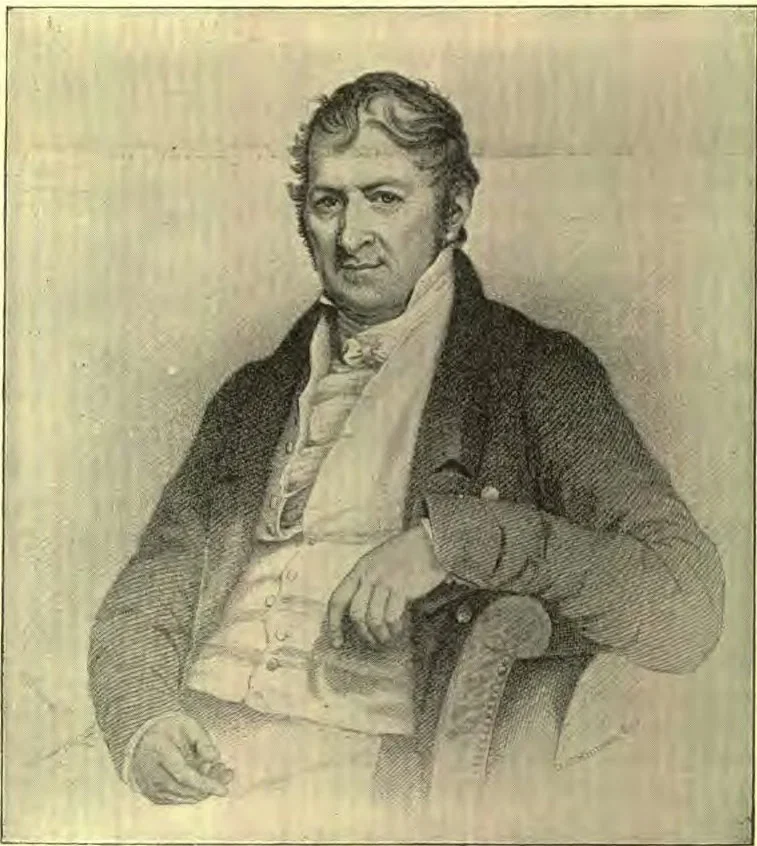
ELI WHITNEY.
The cotton fiber grows upon a seed, which is about the size of a small bean. To separate this fiber from the seed, as it was done by hand, required so much time that it made the material very expensive. To pick one pound of lint cotton from the seed was considered a day's work for an ordinary hand. This difficulty had always stood in the way of its extensive use. In 1792 Eli Whitney, a native of Westborough, Mass., who had just graduated from Yale College, came to the State of Georgia for the purpose of teaching school. Observing the slow and tedious process by which the cotton was picked from the seed, he set to work under great disadvantages to invent a machine for that purpose. Finding a friend in the person of the widow of General Nathaniel Greene, he made her estate his home, and received from her the necessary means for the development of his plans. Before the close of the following year, success had crowned his efforts. He had discovered a simple process by which one man has been enabled to do more work in picking the cotton from the seed than a thousand men could do by hand in the same time; and the cotton gin, one of the most important inventions of the age, was put into operation. Its remarkable success was an astonishment and a wonder to the world. The first large exportation of cotton to England after the gin was brought into use, consisted of ten thousand pounds (about twenty bales), yet this was such a surprise to the authorities that they held the cotton until investigation was made as to where such a quantity could have been produced.
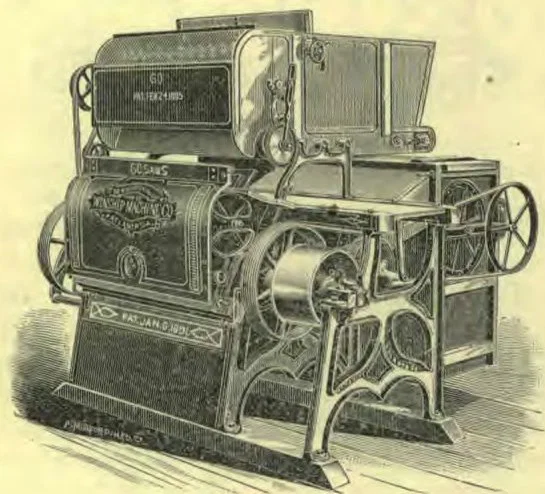
The main features of Whitney’s invention consist of a system of circular saws set upon one shaft. The sharp pointed teeth pass up through ribs of steel into the cotton as it comes from the field, and carries the lint forward, leaving the seed behind; and back of the saw cylinder is a revolving brush which removes the lint from the teeth. The process is so simple and so effectual that the familiar question naturally arises, “Why was not this found out before?” Why should the world, with all the talent of past ages, have gone on for thousands of years picking its cotton from the seed by hand, until the advent of Eli Whitney? But such was the case, and it was no matter to the world “why.” When the discovery was made, there were men sharp enough to discern its advantages, and before Whitney had secured the protection of his rights as the inventor of the cotton gin, other men had begun making them, and soon their manufacture of his machines had got beyond his control. After fruitless attempts to secure his rights, Mr. Whitney, becoming thoroughly disheartened, abandoned his claims, wound up his business, and left the State a poor man. He had given millions upon millions of dollars to the South. He had opened the way for the vast cotton manufacturing interests in Europe and America; but he had not received a dollar above expenses as a remuneration for the services he had rendered.
COTTON GIN.
A few years before the invention of the cotton gin, two poor laboring men in England, Sir Richard Arkwright and James Hargreaves, had invented other machines, perhaps of nearly equal importance,—the carding mill and the spinning-jenny. These inventions had caused a complete revolution in the manufacture of cloth, and the gin laid the foundation of the great cotton industry by bringing this texture to the front rank as the most economical material for cloth making. Cotton mills and manufacturing towns were built up rapidly in England and America, and made a demand which stimulated the cultivation of cotton until it has reached its present immense proportions.
Those who have never traveled in the South can scarcely realize the extent to which this industry is carried on. The broad fields, hills, and valleys covered with the green foliage, beautiful flowers, or the snow white open bolls of the cotton plant, present to the eye of an observer a delightful picture. This can be seen almost everywhere throughout the cotton belt. To give the reader an idea of the extent to which cotton is raised, we will take for example the crop of 1893. The number of acres planted was 15,963,966. Suppose we reduce these acres to square miles, and then imagine them to be arranged in one long cotton field a mile in width. Should we undertake to walk through this field lengthwise, we should have to travel twenty-four thousand nine hundred and forty-three miles, or about the distance around the earth. Imagine the work required to till this vast field! It has to be gone over five or six times with a plow, three times with a hoe, besides the planting, and picking three or four times over as the bolls open.
As the cotton is picked, it is drawn to the gin for separating the seed. The latest improved gin, as built by Winship and Company, of Atlanta, Ga., receives the load at one end of the building, where the cotton is drawn up through flues out of the wagon by means of suction; and within thirty minutes the driver goes to the other end of the building, where the seed is emptied into the wagon, and his cotton, all baled up, is ready for him. And this work has been done by three men with the cotton gin, that would have taken one man more than a year to accomplish by hand.
A bale of cotton usually weighs about five hundred pounds. The number of bales of cotton produced in 1893 was 7,532,000. Here again let us try to bring this vast number290within the grasp of our comprehension. Suppose these bales of cotton are to be loaded into wagons as they come to market. Three bales constitute the ordinary load for two mules. Allowing each team one rod of the road, they would form a procession seven thousand eight hundred and forty-eight miles long, or nearly the distance through the earth; and the seed, if put in wagons and drawn by teams, would form another procession about fourteen thousand miles long. This was only an ordinary crop. The largest number of bales ever produced in one year was in 1891, which amounted to 9,018,000. During the days of slavery, the largest number reached was 4,861,000 bales. Thus time has demolished the old argument that cotton could not be successfully produced with free labor.
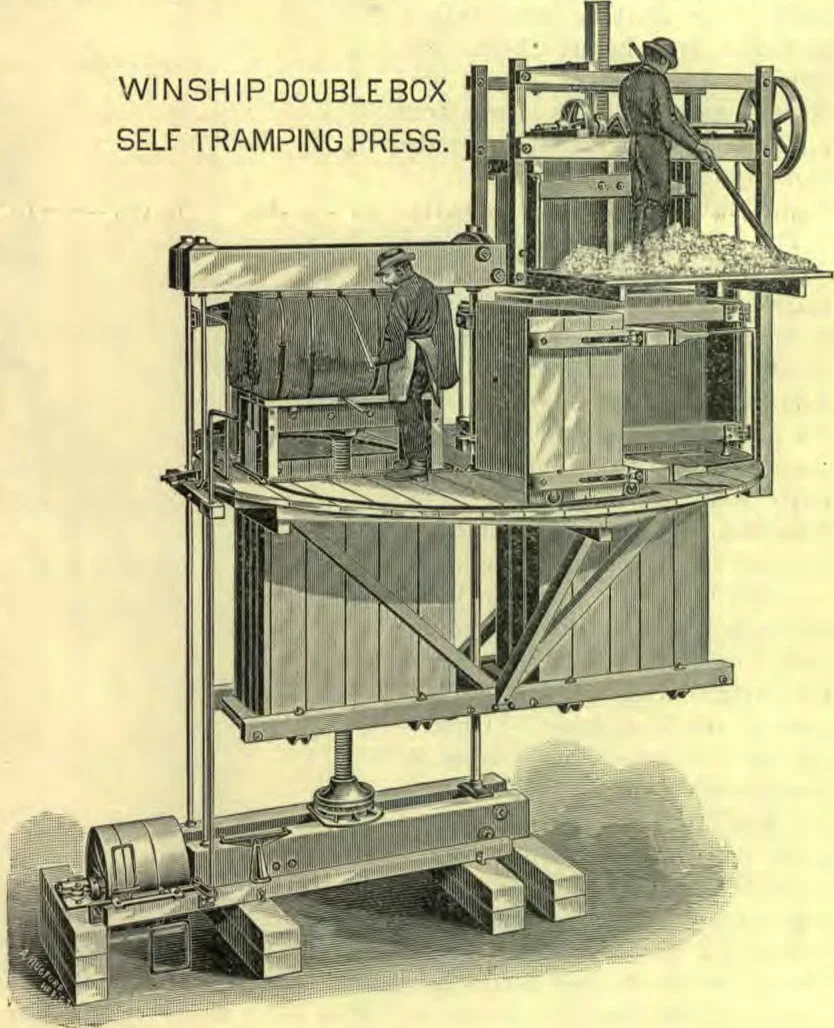
WINSHIP DOUBLE BOX SELF TRAMPING PRESS.
In the preparation for the great Cotton States and International Exposition, let the name of Eli Whitney be inscribed upon the walls of its palaces, let his portrait hang in the most conspicuous place, and let his memory be cherished by all who behold the results of his work. For what Columbus was to America, Whitney has been to the great cotton industry of the South.
Rodney S. Owen.
THE HORSELESS VEHICLE.
In matters of transportation, no question is more generally agitating the public mind than that of horseless vehicles. In France, more than any other country, their possibilities are being tested as to speed and adaptability, and the results are in the main satisfactory. This fact has led the enthusiast to promulgate all kinds of ideas as to the future of the horse, etc., and an endless amount of unmitigated nonsense is being published in the public press. That this class of vehicle is destined to become a prominent factor, none can doubt, and it is well to be prepared. It should be remembered, however, that it is not a new idea. Carriages to run on common roads without horse power were experimented with before the iron rail was laid, and engineers have been experimenting continuously ever since. New methods of generating power have given a renewed impetus to the movement, and the prospects are more than ever favorable, and we do not doubt their use in many places where the conditions are favorable. The horse will not be dethroned, neither will the time ever come when the horseless vehicle will hold other than a secondary place. There are many adverse conditions to be overcome in the mechanical construction and in the matter of traction, and in our northern climate, where snow and ice prevail several months of the year, they will be useless during those periods. Their construction, however, has reached a stage when it may be well for the carriage and wagon manufacturer to give it consideration. Be made they will, and if carriage builders who are well equipped to produce them continue to antagonize their construction, stock companies, with ample capital, will be formed, and by securing the patents, they will control the manufacture and prove formidable competitors. Their manufacture and sale legitimately belong to the carriage and wagon trades, and the Hub thinks it is not too early to prepare for the control; for if it once gets out of the hands of vehicle men, it will not be recovered. We hope, the editor adds, to see some of our enterprising builders interesting themselves in this matter before the present year closes.—Scientific American.
THE GREAT WHEEL HARVEST.
Four Hundred Thousand Bicycles to Be Manufactured This Year.
THE present season will be forever memorable in the annals of the bicycle business. It is certainly wonderful that, at a period when every other industry was slowly recovering from a partial paralysis of nearly two years' duration, this infant industry, requiring the most expensive nourishment on the part of its devotees, should have reached the stalwart proportions it succeeded in developing, and at once become the standard of a successful career, which, beating the record for progress to-day, is the admiration and envy of the manufacturing world; and yet, no one identified with the distribution of its artistic product, can imagine for one moment that this wonderful business has reached the zenith of its development. It is estimated that last year (1894) over two hundred thousand wheels were manufactured by the different companies engaged in their production. This year, with greatly increased facilities and improved machinery, together with a large increase in the number of producers, the product will reach in the neighborhood of four hundred thousand wheels.
What it will be next year, can only be guessed at, as this year's business has been dwarfed and held in check by a positive inability to supply the unparalleled demand for wheels of every description.
New factories contemplate entering this seductive business: additions are being built to old factories, almost equal to the original plant, stocked with the most intricate and “up-to-date” machinery, which, before the ides of March, 1896, will begin to make an impression on the trade, that will carry the production to a possible seven hundred thousand. This, with every foreign country with an intelligent population already knocking at our doors for a share in this distribution (even in blocks of five hundred to one thousand wheels at a time, from individual buyers), will, we prophesy, even with the grand total above suggested for a year's production, leave us in November, 1896, with few, if any, wheels to carry over to 1897.
The leaders in the business are strongly entrenched with well-earned additions to capital already large enough for successful production; and they are in it to stay. The high-grade meritorious wheels of to-day will reap the harvest, and the garnered sheaves will represent judicious advertising and honest construction.—Hardware.
AFRICANS AND THE STEAMBOAT.
THEY were perfectly frantic with mingled dread and curiosity at sight of the steamer. They shouted and danced, and waved their arms in imitation of our revolving stern wheel. They followed us, running along the banks for miles together. Occasionally some specially brave ones would rush out into the water to have a long, unobstructed look at us. The expression on the countenances of the natives on the shores would make the fortune of an actor who could imitate it.
They would stand with their bodies partly turned away, in order to dart into the bush at the slightest indication of danger, overwhelmed with awe and inquisitiveness, a few only daring to laugh, while the whole river echoed with their exclamations of astonishment and their crazy shouts. . . . When the steamer’s whistle was blown, the hundreds who had collected on the bank at once stampeded pell-mell over each other and into the wood and tall grass. Our men greeted them with shouts of laughter and calls to come back; but it was to no purpose; they would not again come so near. It was amusing to notice the bearing of these people, even up to the moment of our departure.
It was clear they apprehended some trickery on our part; that would be their manner of dealing with another and weaker tribe, and hence they feared something of the sort from us. We felt, however, that we had made a record for the white man as a friendly visitor and a just and liberal barterer, and left with our steamer quite full with the provisions we had purchased.—“Actual Africa,” by Vincent.
RECKLESS BUILDING.
In about a week’s time two great buildings in process of erection, one in New York City and the other in Chicago, have fallen to the ground. In New York the loss of life caused by the falling building was terrible. Thirteen men were killed, as many women were made widows, and thirty-six children, most of whom are too young to care for themselves, are left for their mothers, aided by the charities of the philanthropic, to support. In Chicago there was no loss of life, but eighty men had but just left the building when it utterly collapsed. This building was designed for Barnum’s circus, and would have held sixteen thousand people. The thought of what might have happened had it been finished, and then have fallen when full of people, is too terrible to contemplate. There may be other buildings, indeed, the presumption is that there are many in our cities, which have been built in this reckless manner, and which are liable at any time to collapse, with results as terrible as those in New York.
These two accidents of a similar nature, in the two largest cities of the United States, so near together in time, have brought the subject of this cheap and criminal way of constructing buildings in this country before the people in a very forcible manner. The fact is, American liberty is often abused, and in nothing is it more so than in the construction of buildings in our large cities. Men of wealth resent the interference of the municipal authorities in the building of the great blocks which they erect, and in their eagerness to build cheaply, ordinary precautions are not taken to insure the safety of the workmen. There are inspectors appointed here, as in other countries, to see that proper foundations are laid, and that the lives of the workmen shall not be imperiled by carelessness or the use of poor material; but in many cases they utterly fail of doing their duty. In one of the cases above referred to, the inspector of the building was one of the contractors! This is about the same as it would be to appoint one who is interested in counterfeiting to the position of comptroller of the treasury!
An investigation is now being held over both of these cases, and it is learned that one of the principal supports of one of these buildings was very near an old cesspool, and that no effort worthy of the name was made to place the foundation down to solid earth or to build according to the law.
Many lessons are being drawn from these accidents. The philanthropist is showing that if love for fellow men was as strong as the love for gain, such things would not occur. The good citizen sees in this a reason that the laws relating to building should be more carefully observed, and that to promote this object, better men must be elected to office. It will be well if from these accidents such lessons may be learned as will, if possible, prevent their recurrence; yet one can hardly have the courage to hope that such will be the case.
While many lessons are being drawn from these accidents, the Christian may be permitted a word. The great Teacher gave as one object lesson the case of a man, who, without a good foundation, built a house, “his house,” upon the sand. In time of trial it fell, “and great was the fall of it.” The building referred to by the great Teacher is not a building of earthly materials, but it is the building of character.
In the sense of Jesus’s teaching, every person in this world is building, whether he realizes it or not. What he is building will be transitory or lasting, according to the nature of the material upon which he builds; for in this lesson not only did one build upon sand, but another built upon the rock. That rock is Christ. “Whosoever heareth these sayings of mine, and doeth them, I will liken him unto a wise man, which built his house upon a rock.” This house stood, mocking all storms. So in human life, in the structure of character we build, too many, alas! build upon sand. Pride, earthly ambition, pleasures, nothing substantial, sinking wrecks at last! Christ is the rock. The character based upon him will be lasting, because it is worthy to endure. The whole building will partake of the character of the foundation. The passing away of the earth, even, will not affect the serenity of the Christian’s hope. He will say, “Therefore will not we fear, though the earth be removed, and though the mountains be carried into the midst of the sea.”
THREATENING EACH OTHER.
Not only do the European nations delight in organizing and drilling their immense armies, but at certain seasons of the year they make special demonstrations to show what they can do. These are generally known as the spring or autumn maneuvers. The preparations now being made for these military performances this autumn show that all former operations of this kind are to be surpassed. Of course Germany and France, as the two great military nations of Europe, lying side by side, and each far from having any friendly feeling toward the other, will take the lead in these exhibitions of martial strength.
The German exhibition this year will be in Pomerania. This province is in the north of Germany, not far from Russian Poland, and perhaps it is designed as an object-lesson to the czar,— to show him what Germany can do. Four army corps and two divisions of cavalry will take field for a mimic campaign. A sham battle will be fought with seventy-five thousand men on each side, all closing with a grand review by the emperor.
France will not be outdone in this military by-play; she will show Germany how much better she can put an army upon the German frontier than she could in 1870. To this end two army corps, each numbering ninety thousand men, have orders to march to Langres in the department of the Haute-Marne, separated by only one department from Alsace, which France lost to Germany in 1871. There the present military governor of Paris, General Saussier, will unite the two corps, and lead them against an imaginary enemy. By these maneuvers everything in relation to the army is tested, and if there is a weakness anywhere, it is discovered, and the proper remedy applied. In the French army bicycles will be used, and thorough tests as to their efficiency will be made.
As we see these vast armies mustering for battle, we realize how meaningless is the pacific talk of those who have the direction of these extraordinary forces. It was Napoleon III who, upon taking the throne of France, said: “The empire is peace;” but the Crimea, the Italian war, the Mexican expedition, and the great war of 1870-71, by which he lost the throne and nearly ruined his country, and would have ruined any country but France, show how little dependence can be placed upon the pacific utterances of kings. There will be no peace until the King of peace shall rule.
A NEW ALLIANCE.
NEWS of a new triple alliance in Europe comes across the ocean. The high contracting powers are Germany, Austria, and Rumania. Two of the members of the famous Triple Alliance have taken in a new partner, Rumania, and through that power they now look at Russia in a threatening manner. The Russian people have felt that the alliance of Germany, Austria, and Italy was as much a menace to Russia as it was to France, hence the friendliness of Russia toward France; but now Russia cannot but consider this new alliance as a distinct and separate menace to herself.
Rumania, which, as a kingdom, was made by the powers from the partially dismembered Turkish empire, is the most powerful of the Balkan States. It occupies a very dangerous position; for the natural route of Russian conquest toward Constantinople and the south lays through Rumania. It is for this very reason that Germany and Austria, both jealous of Russia’s success in that direction, would hedge her way. At the present time Rumania is quite a nation, with a well-drilled army of three hundred thousand men. It is understood that the new alliance was hastened by the intrigues of the czar and his mother in Rumania, and that Germany and Austria obligate themselves to move promptly to the assistance of Rumania, should Russia invade her territory. Thus the nations, each jealous of the other, are entering into new alliances, and preparing for a grand struggle, which, seemingly, cannot long be deferred.
THE FRENCH IN TUNIS.
AGAIN France has come near the danger line of trouble between herself and England. Lately the French government has opened a great military port and arsenal at Bizerta in Tunis. If the reports of the greatness of this work and its importance to France may be believed, it is of as great value to France from a military standpoint as the Kiel canal is to Germany. From this port to Lake Bizerta a short canal allows a French fleet access to an inland harbor, entirely secure from the attack of a more powerful enemy, from whence it can rally again at any time.
The reason why the nations were not invited to the opening of this great harbor, as they were to Kiel, and that the French press has given so meager an account of it, is that at the time of the French occupation of Tunis in 1881, France promised England not to do precisely what she now has done. But as long as England continues to hold Egypt, as she promised France that she would not do, France feels herself at liberty to make and break promises at will. This constant game of grab cannot but result in more or less friction, and may end in war.
M. E. K
By M. E. K.
LI HUNG CHANG, the greatest of Chinamen, is again honored. All will remember that when the war showed the weakness of the Chinese armies, he was obliged to dispense with his yellow robe and peacock feather; but China could not get along without him, and he was selected for the delicate mission of negotiating a treaty with the victorious Japanese. This he did so well that he is now made Imperial Chancellor and Grand Secretary of the empire, and he will reside at Peking.
M. E. K
DOING NOTHING
By J. H. D.
TALKS WITH BOYS AND GIRLS.—NO. 2.
DOING NOTHING.
Dear Children: This week we wish to talk about “doing nothing.” Sometimes children say, “I wish I had nothing to do.” They think they would be happy; but they are mistaken. To do nothing for any stated time is as great a punishment as could befall a boy or girl. You are so constituted that you must be doing something or worry under the inactivity.
But generally “doing nothing” means, “We will not be obliged to do anything”—any work for father or mother. When in school, you grow tired of the long lessons, and long to be free from them. You look out in the fields, and see the calves, the sheep, and the birds, and you wish yourself like them. Here is a story of a boy who had some such experience as this, and we wish to give it for the good of our boys and girls, who may at times wish to be free from their studies and their lessons:—
“Charley Gray was gazing out of the schoolroom window one sultry afternoon, with his elbow on his desk, his head resting on his hand. His book was open before him, but his eyes did not rest upon it. Instead of that, they wandered wearily over hill and brook, wood and field, now toward the flocks of sheep and lambs that were cropping the grass on the hillside, now toward the brook, as Charley dreamily thought of the bright little fishes that were sparkling in its cool depths; watching for a moment the calm flight of a hawk, which, with scarce a motion of its great wings, was hovering over the tops of the trees, and then looking listlessly at the cows lying in the shade.
“As he sat sleepily there, the idea came slowly into Charley’s idle mind that his would have been a happier life had he been born a beast, a fish, or a bird, instead of a boy, to be sent to school and compelled to learn long lessons in July.
“ ‘I would rather,’ thought Charley, as he yawned and closed his eyes, ‘I would much rather be a calf, lying in the shade of the acorn tree yonder, than the first boy in my class.’
“Wonderfully enough, a sudden and surprising change came over Charley Gray! The schoolroom, with its sluggish drone and confined air, melted imperceptibly away. There was a moment of darkness, and Charley found himself lying under the acorn tree. His wishes had been realized. He would be a calf, and a calf he was. His astonishment and alarm were but for a moment. All was then over, his past life forgotten. He remembered nothing about his home, friends, schoolboy life, or his wish so wonderfully gratified.
“For any knowledge of the past, which his calf’s head contained, he might have been born in the stable and bred in the fields. He was happy; the shady ground was delightfully cool; the fragrance of the fresh grass was to him most grateful perfume. With half-closed eyes, he was rolling on his tongue a delicious morsel, in comparison with which the delicacies a schoolboy covets are but as dry crusts to Christmas puddings.
“While in the full tide of his quiet enjoyment, a brother calf, which had been lying by his side, slowly rose, and stood upon his feet. Charley (we call the calf by the schoolboy’s name) languidly opened his eyes, and stared stupidly at his risen brother. Something told him that the brother was inclined to vary the monotony of the occasion. He tossed his head and wagged his tail with looks of mischief. In language which Charley well understood, he bade him admire his strong neck, and invited him to a trial of strength. Finally with lowering head, he rushed upon the prostrate Charley, and gave him a furious lunge in the side. This brought the calf Charley to his feet. Bellowing with rage and pain, he rushed to meet his adversary. It was an unequal contest, as Charley’s adversary was larger and stronger than he; yet his rage and courage compelled him to keep the field. Soon, however, his strength failed, and he would have been compelled to yield the battle, if an old cow, with sharp horns, had not put an end to it.
“She advanced quietly toward the combatants. Acting upon a principle said to be occasionally practiced by mankind, she singled out the weaker of the two as an object of punishment.
“When Charley saw this new and terrible enemy approaching, he instantly took to his heels; the cow with the sharp horns gave chase. Exhausted as he was by his battle, she gained rapidly on him. Every moment he expected to be caught on those sharp horns, and sent whirling through the air.
“Just then a little bird, which had been seeking worms in the pasture, frightened at the approach of the beasts, flew into the air, and was quickly out of the reach of harm.
“Then the calf Charley thought, ‘O, that I were a bird, that I might fly from this terrible pursuer!’ The wish was scarcely formed, when lo!—there were certain powerful and propitious fairies controlling Charley’s destinies—the calf became a bird. The cow had just bent her neck, and pointed her sharp horns to give Charley the fatal toss, when the latter, transformed into a beautiful bird with gilded wings, rose lightly into the air. He saw the cow in her headlong course shatter her horns against a wall, and then, soaring lightly and singing gaily, he reached the neighboring wood. Scarcely had he congratulated himself upon his escape, when the experience of his calf life faded from his memory. He was a bird, sitting upon the topmost bough of a lofty tree. He was free, and rejoiced in his freedom. ‘I will quit,’ thought he, ‘these dark woods, and fly over the fields and houses.’
“As he emerged from the shadow of the trees, and was flying over the pasture where he had so recently escaped from danger, he had a dim consciousness that there was danger still.
“Far above and between him and the sun, there was a great shadow, which instinctively filled the poor bird with terror. Soon he heard a rustling sound as of wings, and then he saw, what the schoolboy had seen before, a great hawk which hovered over the tall trees, watching for the little birds to leave them.
“There was a great shock in the air, and the little bird knew that the hawk was making the awful plunge, from which there was no escape for him.
“With a scream of terror, Charley awoke, to find that all about the calf and bird was a dream, and that he had startled the school by crying out in his sleep; he awoke to receive punishment for being so idle and noisy—happy to find that it was nothing worse, and that he was still a schoolboy.
“When boys say to Charley they wish they were birds, he tells them to be glad they are not; for he was one once, and never wishes to be one again.”
When you grow tired of your daily duties, and long to be something that has no duties to perform, remember the story of Charley, and we think it will help you to take hold of your work with renewed energy.
The Bible speaks of idleness as a most deplorable thing. “He that gathereth in summer is a wise son: but he that sleepeth in harvest is a son that causeth shame.” Prov. 10:5. “Slothfulness casteth into a deep sleep; and an idle soul shall suffer hunger.” Prov. 19:15. Again, we read: “How long wilt thou sleep, O sluggard? when wilt thou arise out of thy sleep? Yet a little sleep, a little slumber, a little folding of the hands to sleep; so shall thy poverty come as one that traveleth, and thy want as an armed man.” Prov. 6:9-11.
Let every boy and girl abhor idleness. Satan finds work for idle hands to do. It will be works of mischief. Seek ever to be busy. Let the mind be occupied with useful thoughts. Let the boys work with the tools, in the shop, the garden, or on the farm. Let the girls engage in needle work, cooking, the flower garden, or in the house. Let all be busy, remembering the scriptural injunction, “Whatsoever ye do, do it heartily, as to the Lord, and not unto men.” J. H. D.
AN IMPRESSIVE PICTURE.
By M. E. K.
A few days since we saw a very impressive picture. It was a double picture, representing a man in two phases of his career. In the first picture he was young, and O, what a good time he thought he was having! He was showily dressed, and the expression of his face and the whole manner of his actions was that of great hilarity and pleasure. He was scattering seeds very lavishly from a bag at his side, which was labelled “Wild oats.” That was the first picture.
The next picture is of the same man, grown old, and very ragged, a perfect picture of hopeless despair. He has a sickle in his hand,—the same hand with which he scattered the wild oats. He is now gathering them, in the form of noxious weeds, which bear the names of sorrow, want, disease, despair, and misery.
The title of the picture is “Seed Time and Harvest,” and below it is this appropriate scripture text, arranged so that the first part of the sentence comes under the sower, and the latter part under the reaper: “Whatsoever a man soweth, that shall he also reap.” Was it not a striking picture? And who can fail to see the lesson? There is a future result to all that we do. Every act, however unimportant it may seem to us, has an effect and an influence. Often these small actions reach much farther than we may think possible. A pebble thrown upon the surface of a stream or lake produces a ripple that extends in ever widening circles until the farthest limit of the water is reached. So every word and act, whether good or evil, never ceases its influence. Speaking, acting, this is sowing; the harvest will come later; if not in this life, then surely in the life to come. And we shall reap as we have sown. This is a law of nature. It is true in spiritual as well as in natural things. M. E. K.