It is not till we begin to read the New Testament that we find the word “synagogue” in the Bible. There is only one exception to this general rule, and this is found in the eighth verse of the seventy-fourth psalm, where the writer pleads with God to deliver his people from captivity, and reminds him that his sanctuary has been defiled and cast down to the ground.
Jerusalem was chosen as the great center for worship for Israel, and there, three times each year, the people met to bring their offerings and receive religious instruction. If they neglected these gatherings, there was no regular system by which they were instructed in their duty to God. Sometimes there was an awakening,—or, as we might call it, a revival,—and good kings were raised up who sent forth special messengers to instruct the people. Jehoshaphat was one of these, for he sent princes, priests, and Levites, “and they taught in Judah, and had the book of the law of the Lord with them, and went about throughout all the cities of Judah, and taught the people.” Hezekiah sent letters containing warnings and special invitations to attend the feast of the passover; but there were long periods when the people did not receive help of this kind.
After the captivity, when Ezra was at Jerusalem, it seems that he devised a system of local worship. When Jesus came to this earth, we know that there were many synagogues, and there was a well established system of worship. It is impossible to tell when this system was first devised and when synagogues were first erected, but none place it earlier than after the return from the captivity when Ezra visited Jerusalem. No doubt as time passed by, the sacred buildings became more numerous than at first, and the service more complete. In time each synagogue had its own regular meetings, reading of the Scriptures, and the power to excommunicate members. In towns and cities buildings were erected, and set apart to the worship of God, and were known as the “house of God,” “synagogue of God,” or “place of prayer.”
The size of the buildings thus consecrated varied; but they were usually built on high ground, and a tall pole rose from the roof, which made the building conspicuous. Rawlinson says of them: “The synagogue was in all cases so constructed that the worshipers, as they entered and as they prayed, looked toward Jerusalem. The internal arrangements followed the type of the tabernacle. At the upper, or Jerusalem end, stood the ark,—the chest which, like the older and more sacred ark, contained a copy of the law. It gave to that end the name and character of a ‘sanctuary.’ This part of the synagogue was actually the place of honor. Here were the ‘chief seats,’ after which Pharisees and scribes in later times strove so eagerly (Matt. 23 : 6), and to which the wealthy and honored worshiper was invited. James 2 : 2, 3. Here, too, in front of the ark, still representing the type of the tabernacle, was the eight-branched lamp, lighted only on the greater festivals. Besides this, there was one lamp kept burning perpetually. Others, brought by devout worshipers, were lighted at the beginning of the Sabbath. A little farther toward the middle of the building was a raised platform, on which several persons could stand at once; and in the middle of this rose a pulpit, in which the reader stood to read the lesson, or sat down to teach. The congregation was divided,—men on one side, women on the other, a low partition five or six feet high running between them. Within the ark, as above stated, were the rolls of the sacred books. The rollers round which they were wound were often elaborately decorated, and the cases for them embroidered or enameled, according to their material. As part of the fittings, we have also to note another chest for the Haphtharoth, or rolls of the prophets; the alms-boxes at or near the door, after the pattern of those in the temple,—one for the poor in Jerusalem, the other for local charities; notice-boards, on which were written the names of offenders who had been ‘put out of the synagogue;’ and a chest for the trumpets and other musical instruments used at the New Years, Sabbaths, and other festivals.”
Each congregation appointed its own officers,—those who had charge of the house and of the worship conducted in it. These consisted of, first, a body of laymen called elders or pastors. One of their number presided over this body, and was called the Archisynagogos, or “Ruler of the Synagogue”; secondly, the officiating minister who offered up the chief prayers for the congregation; thirdly, one whom we would call the sexton, who cared for the building; and, fourthly, ten men who were called “men of leisure.” These were expected to be present at all services so that there might always be a congregation.
The services of the synagogue consisted of reading the Scriptures, with comments by the reader, of which an example is given in Luke 4 : 16-27; the singing of psalms; and prayer. The establishment of such methods of worship did much to keep the knowledge of God in the minds of the people, though it is true that they came to trust the outward forms of piety and devotion, instead of the inner work of grace upon the heart.
14. Then what would the observance of either of these requirements bring to us?
15. To rob God of his tithe, is to rob ourselves of what?—A spiritual blessing.
16. How can we be blessed with all spiritual blessings if we refuse to receive this one?
17. To refuse this blessing knowingly brings what? Mal. 3: 9.
18. Then what shall we gladly do? Verse 10.
19. This blessing includes what? Verse 11. (See note.)
NOTE.
This language necessarily implies the precious promise that if we bring all the tithes into the storehouse, and thus prove him, as he asks us to do, he will pour us out a blessing that there will not be room enough to receive it. Those who prove or test the Lord always find him true to his promise. We are not to conclude, however, that the Lord will necessarily shower temporal blessings upon us because we are faithful in paying tithes. He will give us just such blessings as he sees will be for our best good and for his glory.
A PLEASANT REMEMBRANCE.
By Julia H. Duffie
ABOUT thirty-five years ago a minister came into our vicinity who brought to the children (at least to me) a revelation. That man was Elder S. W. Rhodes.
From my mother’s life and teachings I had imbibed beautiful ideas of the Saviour and his love, and of mother’s kind of Christianity; and although I succeeded but very imperfectly, I tried to imitate them; but of ministerial and public religion I had very different conceptions. A minister was a much-to-be-dreaded personage—good, very likely, with such a cold, severe, critical sort of goodness that it made me shudder to think of it, and with it I hoped to come in contact as little as possible. I believe I would have run half a mile, at least, rather than encounter a “preacher.” But when Elder Rhodes came into the neighborhood, matters began to appear different. Here was a man who loved the children, and who could come down to them, and become one with them.
The idea of a real live minister’s petting the domestic animals, and actually taking dinner with the children out in a little girl’s playhouse, tending and complimenting her best doll,—this was something I had never dreamed of. Meanwhile he was improving every opportunity of teaching us religious truths, particularly our duties as children.
I think there was scarcely a child in the community who did not have a card or slip of paper with the ten commandments printed on it, which Elder Rhodes had given them. Mine was cherished as a precious relic for many years; but in the various changes and moves of life it has finally been lost, which loss I keenly regret.
I do not remember whether it was he or some one else who left an early volume of the YOUTH’S INSTRUCTOR at our home, but I do know that it was considered a prize.
And I believe that when good old Father Rhodes awakes in the resurrection of the saints, to be taken with them to the kingdom of God, he will find many to greet him who loved him as children, and who can say that his influence was an important factor in the means which led them to place their feet in the path of life eternal. JULIA H. DUFFIE.
Doing Present Duty as Preparation for God's Future Call
“WHAT God may hereafter require of you, you must not give yourself the least trouble about. Everything he gives you to do you must do as well as you can, and that is the best possible preparation for what he may want you to do next. If people would but do what they have to do, they would always find themselves ready for what came next.”
ABELARD
By C. B. Morrill
(Conclusion.)
After his triumph over William of Champeaux, Abelard had not an obstacle in his path to glory. The straws which his rival cast before him were swept idly away. His star was in its zenith; its decline was soon to begin.
He was now nearly forty years old. His life had been ardently devoted to study and work. It seems that his zeal to reach the highest pinnacle of learning had left no leisure and no inclination for the pursuit of any other of the objects which attract mankind. But now he was drawn aside into an attachment for that woman whose devotion has made his name more famous than all his learning could have done,—Heloise. She was a woman, or rather a girl, of rare attainments for that age. Hers was not only beauty, but superior intelligence. She was an orphan, related to the noble house of Montmorency, and was the niece of a canon named Fulbert, who had educated her so well that, when Abelard met her, she read not only Latin, but Greek and Hebrew. Abelard was a churchman,—a canon if not a priest,—and churchmen were forbidden to wed. He married in secret. Fearing to ruin her husband, Heloise denied the marriage. This made trouble between her and her uncle, and she fled to the convent of Argenteuil. Fulbert then began to plot revenge against Abelard. He had assisted in the flight, and Fulbert believed that he intended to desert his wife. Through the machinations of the enraged uncle, Abelard was soon overwhelmed with shame and ruin, and, seeking only to hide from the world, he entered the monastery of St. Denis. Before he took his vows, however, he insisted that Heloise should first enter the monastic life, and, amid a crowd of weeping friends, she took the black veil, being only twenty.
Abelard did not long remain at St. Denis. The calls to teach became too pressing to be refused. It was urged upon him, perhaps he felt, that his misfortune had been sent by God to humble and refine him, that he might do a greater work. “You have taught the philosophy of man,” said Abbé Adam of St. Denis; “perhaps Providence has been preparing you, and now calls you, to teach the new and higher philosophy,—the philosophy of God.” Leaving the monastery, the humbled dialectician went to his friend Foulke, at Compiègne, and there, in the abbey of Maisoncelle, began to teach. The history of former days repeated itself. He was soon surrounded, according to the original authorities, with four thousand pupils. But his enemies were no longer helpless. His ruin had weakened his cause forever. It was not long till he was summoned before a council of the church at Soissons; his teaching was condemned, and he himself was sent back to his own monastery.
Perhaps it was in no submissive spirit that he returned to St. Denis. At any rate, he soon made enemies of his brother monks. The discipline in that monastery was very lax. It had been founded and was sustained by the royal favor, and thus it had come to be “rather a monastery devoted to Cæsar than to God.” Abelard could not endure the abuses which he witnessed daily, and it was doubtless his protests that brought upon him the dislike of his fellows. An incident soon occurred which brought this dislike to a focus. The monastery was said to have been founded by St. Denis, or Dionysius, of Athens. The monks of St. Denis believed that this was the same whom Paul had converted by his speech at the Areopagus. One day Abelard, coming across a passage in the writings of the Venerable Bede which states that Dionysius the Areopagite afterward became bishop of Corinth, pointed it out, smiling, to some of his brethren. An angry protest arose at once. The abbot was called, who proved from the writings of a former abbot of the monastery that its founder was indeed Dionysius the Areopagite, bishop of Athens. Abelard ridiculed the authority, and made invidious comparisons between his fame and that of Bede. Abbé Adam threatened to send him to the king for an insult so unheard of to the dignity of the place. Apology and entreaty were alike vain; to the king he must go. The king, fortunately, cared little for the honor of St. Denis, and Abelard was not only acquitted, but released from his obligations to the monastery.
He now repaired to Troyes, and built himself a hut of straw in the midst of a wilderness, where he hoped to find the peace and quiet his soul longed for. Not so. How quickly a thing could be blazed abroad in those days when all established communication was very slow, is marvelous; no sooner was Abelard’s whereabouts known, than students began to gather about him as before, and to build their huts beside his. He could not but teach; they would have nothing else. They built him an oratory of stubble, which he called by the name of the Paraclete, the Comforter, because he had found rest after his troubles and afflictions. But even this selection of a name brought forth criticism, because no one could remember that ever before a church or convent had been called by the name of the Holy Spirit. In this oratory he lectured to greater crowds than ever before. His fame had spread throughout Europe, and from every land pupils came to hear him. His tone of lecturing had changed, too; his lectures were more devotional, and appealed more to the heart and life.
At this time there was a man rising into influence in the church, who represented the very opposite in religious character from the nature of Abelard. Abelard was a keen and deep reasoner, who sought to prove all things. This man was a man of faith, devoted with fanatical and unquestioning zeal to what he did believe, and untiring in his endeavors to translate his beliefs into facts in all that he came into contact with. This man was St. Bernard. He was determined to reform monastic life, and earnest to advance the power of the papacy. His plan was to take a number of followers off into the wilderness, establish a monastery upon principles of the strictest asceticism, and then to send these monks into other monasteries as missionaries of reform. This monastery he established within a few miles of the oratory of the Paraclete.
Bernard was the natural enemy of philosophy and of Abelard. He could see more keenly than any one else in his times the real outcome of Abelard’s teaching. He looked forward with the eye of a seer, and saw, as the result of this kind of teaching, a Luther and a reformation. He had the penetration to see that a spirit of inquiry was the subtlest foe of the church.
Abelard knew what to expect. He felt that such a neighbor was dangerous, and he fled to Brittany. The abbot of the monastery of St. Gildas-de-Rhuys had just died, and Abelard was asked to take his place. The abbey overlooked the sea, on a wild and rocky promontory, in a wild and barbarous region, inhabited by the same race which Cæsar had found so unmanageable, when, centuries before, he accomplished the conquest of Gaul. Abelard labored long and faithfully to bring his lawless and half-savage monks to some sort of orderly and decent living, but in vain. After almost ten years of effort, he was at last compelled to flee for his life from his infuriated charges. He continued to live in Brittany for some time after this event, and at length came to Paris, and once more engaged in teaching.
But the relentless opposition of Bernard met him again as soon as he took up his old profession. He was summoned before a council at Sens, condemned, and forced to burn some of his books. He appealed to Rome, and was condemned at Rome. He then determined to go thither to seek justice in person; but got no farther than the monastery of Cluny, in eastern France. Entirely broken in health and spirit, he gave up the struggle at last. Curious crowds gazed at the monks as they passed through the streets, to catch a glimpse of the great professor, and pointed out, with pity and wonder, the bowed head and dejected figure of the man who had stirred Europe with his teaching, now the humblest and saddest of all that forlorn procession. From Cluny he was shortly removed to a neighboring monastery, where he died in April of 1142, being about sixty-three years old. After his burial, his body was taken up secretly by his friends, and carried to the abbey of the Paraclete, of which Heloise had been abbess since shortly after its abandonment by Abelard; and there it was buried beneath the chancel by Heloise and her nuns; and there, too, after many years, she came to rest beside him.
Abelard was an acute reasoner, but was not a great philosopher. He brought forth nothing new or lasting. He was too fond of action, too much in love with controversy, to produce those fruits of the mind which ripen only in quiet study. He must have been a great orator, for only the power of oratory could have drawn the multitudes which followed him. He was also a poet; and, strange to say, it is in this least of his capacities alone that he was remembered, till the restless historical investigation of the last century brought forth the details of his life. His love-songs, written in the native tongue, are among the earliest treasures of French literature. But while he has left nothing more worthy which is distinctly his own, he had yet a great influence upon his own and later times; for he started a form of thinking which was not to die out till it ended in the revival of learning and the great Reformation, and which was most visibly embodied, during the intervening centuries, in the University of Paris.
C. B. MORRILL.
Persian Envoy Refuses Prostration at Chinese Court
THE ceremonial of the Chinese court is somewhat exacting. It used to include, if it does not now, complete prostration before the throne. Last century a Persian envoy refused to go through the degrading ordeal. Directions were given to the officials to compel him by stratagem to do so. On arriving one day at the entrance to the hall of audience, the envoy found no means of going in except by a wicket, which would compel him to stoop very low. With great presence of mind and considerable audacity, the ambassador turned round and entered backward, thus saving the honor of his country.—London Standard.
LIFE UPON THE FARM.
By Emma L. Kellogg
HAPPY the life upon the farm, far happier than elsewhere;
There's freedom in the meadows; there's magic in the air.
There breezes fan with healing touch, the sun shines far more bright,
And clouds bedecked with crimson tints add beauty and delight.
The broad expanse of blue and green is restful to the eye;
And mountain tops of silver sheen rise proudly to the sky;
And flowers, uprising from the sod, their sweetest fragrance shed;
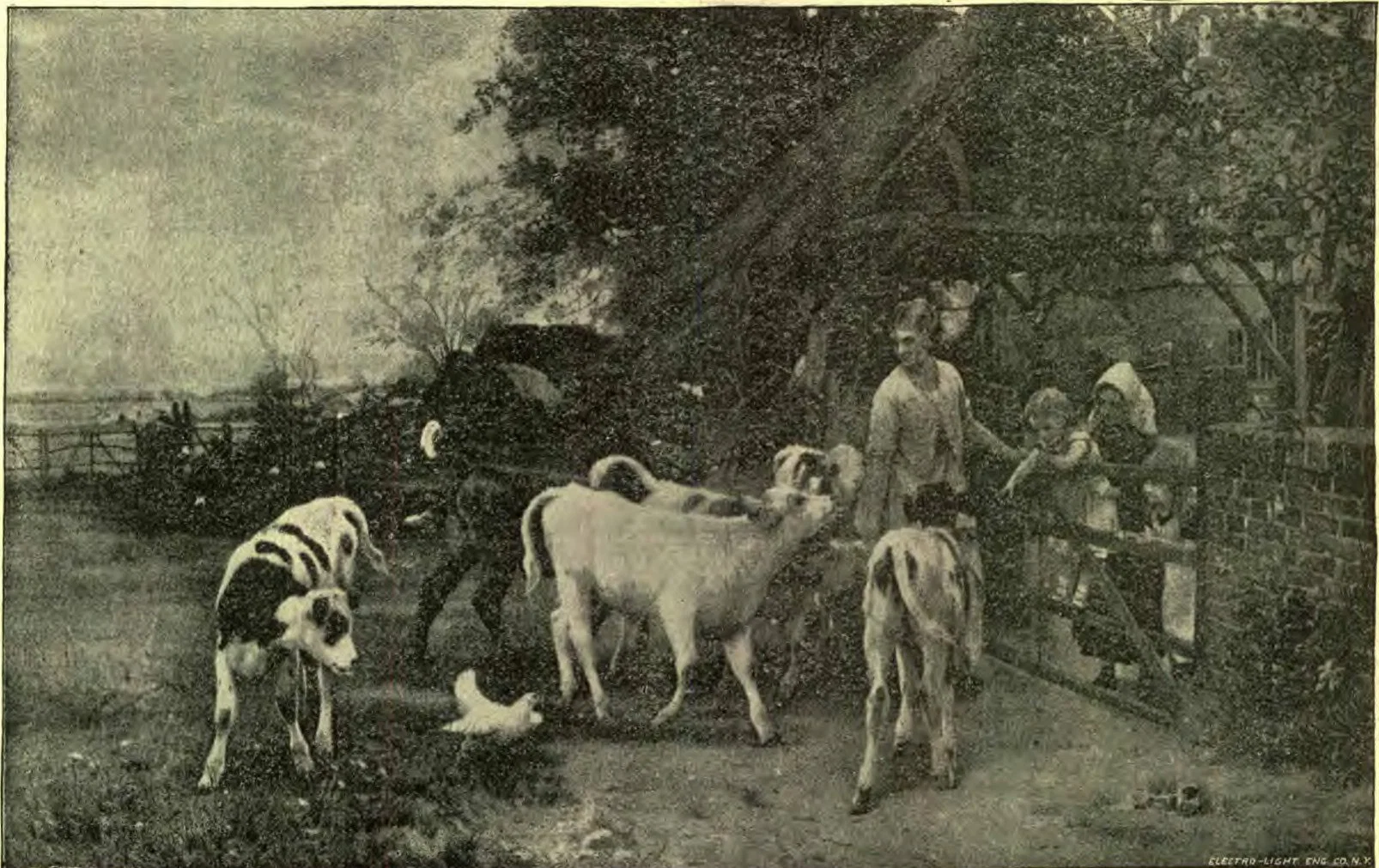
“HAPPY CHILDREN CLIMB THE FENCE.”
And feathered songsters in the trees sing joyously o'erhead;
And brooks meandering here and there reflect banks, shrubs, and trees,
And glisten in the sun's bright rays; and butterflies and bees
Seek every blossom, far and near, to sip the nectar sweet;
And cattle roam in pastures green, or seek a cool retreat
To rest themselves and chew their cuds when they have dined on clover;
And yellow goslings in the pond dive under and swim over.
Old chanticleer, with clarion notes, proclaims 'tis dawn of day;
And little lambkins skip about and round their mother play;
And little chickens, feathered balls, pick up the crumbs of bread.
While doves and swallows fly about the eaves of barn or shed;
And bossies come to drink the milk at morn and eventide;
And happy children climb the fence, and watch, with joy and pride,
And point to this one here, or that, for each one has a pet.
One likes the spotted, one the white, and one the black as jet.
But O, it is so hard to choose, for all are very fine;
And baby counts them o'er and o'er: “One—two—three—six—eight—nine!”
O life upon the farm is blest, all seasons of the year,—
The winter's cold, the summer's heat, the spring's delightful cheer;
Abundant harvests in the fall—the barns filled to o'erflowing;
The golden days of harvest time—the yield of all things growing;
The busy days, the restful nights, where quiet reigns supreme
Save for the hooting of an owl or rippling of a stream.
Yes, life upon the farm brings cheer, whatever may betide;
It was God's plan before the fall, and ever will abide;
For winter, summer, spring, and fall have each a potent charm—
There are no greater joys than those that cluster round the farm!
EMMA L. KELLOGG.
WHAT STOPPED THE WATER.
“No water, James? Nonsense!” exclaimed Mr. Grimston, when the news was brought him that the water supply had ceased; and then away he went to examine the cistern.
But it was empty! So a messenger was despatched to the reservoir to see if any water was there. Ah! that was all right; and as nothing could be found to cause any stoppage, they came to the conclusion that something must have gone wrong with the pipe which carried the water supply to them, and which passed through the village.
So the pipe had to come up, and Mrs. Grimston stood by while old Tom made his search.
“Nothing there, Tom,” she said, laughing, as she stooped to look at the pipe, which had a fine wire netting over its mouth to prevent anything getting in which would be likely to stop the passage.
“Well, ma’am, it looks very fair, but if you take my advice, you’ll let me remove this ’ere netting, and have a look down.”
“But surely, Tom,” exclaimed Mrs. Grimston, “nothing could get through that netting likely to stop the passage.”
“There’s no trusting to the looks of things, ma’am,” said old Tom, as he began slowly to take off the wire. “Some things look very nice till you come close, and some things creep in, no one knows how, but they do, and”—
He paused and peered down the pipe, then burst into a laugh, as out jumped—a huge frog!—yes, a fine, fat frog, which seemed very much pleased to get out.
“But how did he get there?”
Ah! how, indeed! Very simply, if you come to look at it—why, as a tiny tadpole, of course!
As a wee tadpole he had got through the wire netting, and if you have ever watched tadpoles, you will remember how in a short time two little legs grow; then, soon after, off drops the tail, and two more legs appear; and then Master Tadpole keeps on growing and growing, till by and by he becomes a respectable sized frog. Once inside the netting, and growing, it was no easy matter to get out, and at last, as we have seen, the water supply stopped, and all on account of a frog!
Little things sometimes make great trouble, and little sins end in great sorrows. If we keep clear of little sins, we shall not be troubled by big ones.—Children’s Friend.
Princess Alexandra's Kind Heart and Knitting Lesson
FROM the stories told of her, Alexandra, daughter of the king of Denmark and wife of the Prince of Wales, possesses the kind heart which would make her noble if she had no noble titles. Once the princess was visiting an old lady in a cottage at Sandringham. “The good dame was knitting a stocking, and the princess took it out of her hand, saying, ‘You can’t do the heel as fast as I can.’” It was a natty heel; for the queen, her mother, had brought her up to knit, fashion her gowns, and trim her bonnets—what all young girls should learn to do.
DEFERENCE TO TITLES.
The tendency of the people of this world to think that there are grades of human rank, and that some people by the very accident of birth are deserving of honor, no matter what their behavior may be, is well known.
In this country we sometimes imagine that we have got beyond this, but the way that men of titles are received here by that which calls itself “society” is proof that the old notions of deference to “blue blood” are not entirely eradicated from the American breast.
But we can hardly be credited with such worship of titled greatness as may be seen in England, if the following from a correspondent of the Inter Ocean is a correct statement:—
“The best indication of how the working classes of England feel toward lords and those connected with the peerage, is shown in the fact that in so many constituencies, where the choice was between a lord of the soil and a son of the soil, they deliberately, and by large majorities, gave their suffrages to his lordship.
A flood of light is also thrown upon this subject by the following skit from Tit-Bits:—
“ ‘Grawley—Who’s that little, insignificant, dried-up, crooked, spindle-legged tailor’s signboard over there?
“ ‘Greggs—That? Why, that’s Lord Leopold Algernon Percy Fitznoodle, son of the Earl of Ditchwater.
“ ‘Grawley—Oh—aw! What a very distinguished bearing his lordship has, though, for one so slight of figure!’ ”
“THE MOST BEAUTIFUL THING.”
In visiting one of the large city hospitals, the writer asked the superintendent of nurses what was the most remarkable incident that she remembered in her long hospital experience. The lady thought for some time, and then, with a perplexed smile, said:—
“We are so used to suffering that I cannot recall any special incident, such as you desire.”
She stopped while her face became grave. Then it lighted up. “I can tell you what was the most touching and impressive thing I ever saw in my hospital experience. I don’t need to think very long for that.”
As the writer begged her to relate the story, she began: “It took place several years ago. There was a terrible accident in the city where I was then nursing, and two lads were brought in fatally mangled. One of them died immediately on entering the hospital; the other was still conscious. Both of his legs had been crushed. A brief examination showed that the only hope for the boy’s life was to have them taken off immediately, but it was probable he would die under the operation.
“‘Tell me,’ he said, bravely, ‘am I to live or die?’
“The house surgeon answered as tenderly as he could: ‘We must hope for the best; but it is extremely doubtful.’
“As the lad heard his doom, his eyes grew large, and then filled with tears. His mouth quivered pitifully, and in spite of himself, the tears forced themselves down his smoke-grimed cheeks. He was only seventeen, but he showed the courage of a man.
“As we stood about him, ready to remove him to the operating-room, he summoned up his fast-failing strength, and said:—
“‘If I must die, I have a request to make. I want to do it for the sake of my dead mother. I promised her I would. I have kept putting it off all this while.’
“We listened, wondering what the poor lad meant. With an effort he went on:—
“‘I want to make a public confession of my faith in Christ. I want a minister. I want to profess myself a Christian before I die.’
“We all looked at each other; it was a situation new to our experience. What should we do? A nurse was despatched at once for a clergyman who lived near by. In the meanwhile we moved the boy up-stairs to the operating-room. There we laid him on the table. By this time the minister had arrived hatless. The boy welcomed him with a beautiful smile. The clergyman took his poor hand. I had been holding it, and it was already growing cold. The house surgeons, the nurses, and others, who came in to witness his confession, stood reverently by. The boy began:—
“‘I believe—’ he faltered, for he could hardly speak above a whisper, he was so weak. I could not help crying. The surgeon did not behave much better. Not a soul in the room will ever forget the sight, nor the words when the boy said:—
“‘I believe in Jesus Christ—his Son—our Lord—and Saviour—’
“He stopped because he had not strength to say another word. Then the clergyman, seeing that the end was near, hastily put a small piece of bread in the lad’s mouth, and a few drops of hospital wine to his lips; thus formally administering the sacrament and receiving the lad—from the operating table—into the company of those who profess the name of Christ. Summoning up all his strength, while the minister was praying, the boy said distinctly:—
“‘I believe—’ With these blessed words upon his lips he passed away.
“The surgeon put aside his knife, and bowed his head. The Great Physician had taken the poor boy’s case into his own hands. That, sir, was the most touching and beautiful thing I have seen in my hospital experience of almost twenty years.”—Youth’s Companion.
UNKNOWING
By Mary D. Brine
A LONELY cricket, in my closet hidden,
Sent out, amid the gloom, its plaintive lay;
And though it grieved for joys to it forbidden,
Nor knew the night had given place to day,
Within my room the sun was brightly shining,
O’erflowing from the bounteous skies above,
And all sweet nature’s forces seemed combining
To render praise for heaven’s tender love.
Yet while I gloried, singing in my gladness,
The little cricket dallied in the gloom,
Nor heeded that it might have fled from sadness—
Through space beneath the door—to my bright room.
“’Tis like our human nature, this delaying”
(So thought I, as I heard the sad night song)—
“This lingering ’mid the gloom, our doubts obeying,
And sighing that the night time seems so long.
“And all the time the sun of Christ’s own splendor
Is shining ’round about us would we heed
The chance he gives to seek his love so tender,
And find the light to satisfy each need.”
— Mary D. Brine, in Christian Work.
TWO VERSIONS.
A YOUNG farmer, who had great conceit, little discretion, and scarcely any education, presented himself at a Presbyterian Conference, and said he wished to be ordained as a preacher.
“I ain’t had any great learnin’,” he said frankly, “but I reckon I’m called to preach. I’ve had a vision three nights runnin’—that’s why I’m here.”
“What was your vision?” inquired one of the elders.
“Well,” said the young man, “I dreamt I see a big round ring in the sky, an’ in the middle of it was two great letters—P. C. I knew that meant Presbyterian Conference, an’ here I am.”
There was an uncomfortable pause, which was broken by an elder who knew the young man, and was well acquainted with the poverty of his family and the neglected condition of the farm in which his father had taken such pride.
“I haven’t any gift at reading visions,” said the old man gravely, as he rose from his seat, “but I’d like to put it to my young friend whether he doesn’t think it’s possible these two letters may have stood for ‘Plant Corn’?”
Fortunately this version was accepted by the applicant.— Youth’s Companion.
SAVED BY A THREAD.
AN English clergyman, the eloquent Newman Hall, has the art of making an old story new by giving it a new setting and a novel application. Preaching from the words, “Who hath despised the day of small things?” he illustrated them by a familiar anecdote.
A tall chimney had been completed, and the scaffolding had been removed. One man remained on top to superintend the process. A rope should have been left for him to descend by. His wife was at home washing, when her little boy burst in with, “Mother, mother, they’ve forgotten the rope, and he’s going to throw himself down!”
She paused; her lips moved in the agony of prayer, and she rushed forth. A crowd was looking up at the poor man, who was moving round and round the narrow cornice, terrified and bewildered. It seemed as if any moment he might fall or throw himself down in despair.
His wife from below cried out: “Take off the stocking; unravel the worsted.” And he did so. “Now tie the end to a bit of mortar and lower gently.”
Down came the thread and the bit of mortar, swinging backward and forward. Lower and lower it descended, eagerly watched by many eyes; it was now within reach, and was gently seized by one of the crowd. They fastened some twine to the thread. “Now pull up.”
The man got hold of the twine. The rope was now fastened on. “Pull away again.” He at length seized the rope and made it secure.
There were a few moments of suspense, then amid the shouts of the people, he threw himself into the arms of his wife, sobbing: “Thou’st saved me, Mary!” The worsted thread was despised; it drew after it the twine, the rope, the rescue!—Exchange.