One of the first essentials to keeping cool physically is to be calm. A calm, tranquil mind equalizes the physiological forces of the body, and evenly distributes the blood. It is surprising how wonderfully uncomfortable a little anger on a hot day will make one feel.
There is a rush of blood to the head, and one physiologically becomes “hot under the collar,” which makes it easy to say hot things. Anger, worry, excitement, are all incompatible with a hot day. “Let your sweetness of disposition be known unto all men” is a beautiful motto to practise when sweltering in a hot department store or listening to a health controversy.
Avoid Physical Exertion
If you would be cool, avoid hurry. Avoid rushing for the train, the street-car, or the cab.
Violent exercise on a hot day is exceedingly dangerous. Eighty per cent of the heat of the body is produced in the muscles, hence immoderate exercise may cause the temperature to rise several degrees.
The fact that such a large portion of body heat is produced in the muscles is a physiological reason why great physical exertion should be avoided during the heat of the day. The best and most natural time for physical outdoor work on a hot day is during the early morning hours and in the evening.
The Food Question
In order to be cool it is highly important that particular attention be given to the diet, inasmuch as eighty per cent of the energy of food is converted into heat. The oxidation and burning of food gives rise to heat. In cold weather there is an immense radiation of heat from the seventeen square feet of skin of the average individual, hence the importance of abundance of food material of heat-producing quality. But in summer, with the surrounding temperature approaching that of the body, less fuel is required, and the food should be of a quality intended not so much for heat in maintaining the vital fires as to produce energy. The quality of the food should be regulated from day to day according to the temperature indications. In a recognition of this principle lies to a large extent the secret of being comfortable on hot days.
The man who sits down to breakfast on a hot morning and eats freely of ham and eggs, fried potatoes, and perchance, griddle-cakes, and washes all down with one or more cups of strong coffee, alternating with ice-water, is not beginning the day with the prospect of being cool. Long before the noon hour he is a veritable conflagration. With electric fans operating all around him, he is neither cool, comfortable, nor amiable. Such a breakfast produces an insatiable thirst, that is not assuaged by ice-water, beer, or iced teas. These even seem to be converted into combustible materials, and intensify the heat.
A flesh diet is incompatible with a hot day. Flesh foods are not only heat-producing, but the poisonous wastes retained in their tissues are exciting and irritating to heart and nerve-centers. Meat, especially when highly seasoned, creates an intense thirst, and the excessive drinking of any fluid is not the means of keeping cool.
Diet Should Be Light
When the day is hot, the diet should be light. Fruits, cereals, and nuts, the latter eaten sparingly, constitute by far the best diet for hot weather. The fact that fruits are so abundant during the hot season is an indication that they were intended to form a part of man's diet during the dog-day period. The popular notion that fruits are unwholesome during hot weather is absolutely unscientific, and due to false ideas. Over-ripe fruit should not be eaten at any time, and fruit that is picked green for the early market is unfit for food. Only the sun in the process of ripening fruit can bring out its flavor and quality. If care is exercised in selecting ripe fruit, always remembering that fruit is perishable, and if it is properly combined with other foods, there is no occasion for its causing the least digestive disturbance.
The Juicy Fruits
Strawberries are the first of the fresh fruits to appear in the market and to greet the eye at the table. There is a saying, “Doubtless God could have made a better berry than the strawberry, but he never did.” An English writer has said, “The strawberry is an unalloyed and unimpaired mouthful of deliciousness; it has neither rind nor stem to mar the perfect pleasure of the palate, and it is so healthful that you can eat it till you are tired.” An ideal hot-weather breakfast would be a dish of7strawberries, a dish of one of the numerous cereal foods, together with toast or bread and butter.
The acid of the strawberry and the acid of other fruits are cooling and refrigerant, and have a most wholesome action upon all the eliminative organs. Unless the taste is seriously perverted, there is, during the hot weather, a natural craving of the system for the acids and mineral salts of fruits.
A light breakfast on a hot day, as suggested above, gives one a wonderfully comfortable feeling, unknown to the gastronomic epicure, who for a time makes a sepulcher of his stomach.
Following the strawberry in the early summer we have a rapid succession of the most delicious and delicately flavored fruits of sufficient variety to satisfy the most fastidious taste. In fever, when the body is being consumed by vital fires, there is a natural craving for acid, juicy fruits, and in most cases nothing is better. The same principle applies to the sultry days of summer.
Dangers in Drinks
It is a delusion and a snare to think that drinking ice-water, iced tea, and other cold drinks will cool the body when it is ninety or more in the shade. It is far better to drink moderately cool water in small quantities and frequently than to deluge the body with a quart or more within a few minutes. Drink moderately, and only of cool water, fruit juice without sugar, or oatmeal water, and a hot day can be shorn of its discomfort. Children especially should not be given iced drinks in hot weather.
The free use of beer and other alcoholic drinks on a hot day, with the idea of keeping cool, has brought unexpected disaster to thousands. These drinks relax the blood-vessels of the head, causing a large amount of blood to remain in the brain, hence increase the susceptibility to sunstroke and heat exhaustion. To keep the feet warm and the head cool is a physical maxim applicable to all seasons of the year.
If you awaken in the morning unrefreshed after a night of tossing and sweltering in a hot room, take a cold bath of some sort.
For fatigue, and as an aid to keeping cool on a hot night, take a warm bath, a tepid sponge bath, or, if that is not convenient, even a cold sponge.
North Yakima, Wash.
France Versus Rome
Once more there is open war between the clericals and the state in France. The Archbishop of Reims is being prosecuted for libel by the Teachers' Association of the department. The archbishop had accused them of “teaching atheism and immorality, and falsifying the history of France.” These words, of course, must be clerically interpreted and understood. Behind the accusation is the demand that the priest shall rule in the schools of the state. Already Romanist parents are invited to withdraw their children from the state schools, showing that the issues involved in this conflict are wide and deep. The ninety-seven thousand teachers are almost all against priestly interference. At present the religious education given in the state school is called “neutral.” The pity of it all is that France has nothing to offer the schoolchild between the bald negations of unbelief on the one hand, and the gross errors of Rome on the other. Will it ever seek a third measure? Who can tell? This may be God's method of introducing into France “a more excellent way.”—Missionary Review.
True Parental Care
By John Francis Olmsted
JOHN FRANCIS OLMSTED
The world may frown upon us here,
And blight our fondest hope;
We may forget that God is love,
And in the darkness grope;
But we may ever rest assured
That his protecting care
Is over every trusting child,
Who would his blessings share.
Neglect of Family Prayer
By G. B. Thompson
G. B. THOMPSON
A LITTLE girl whose mother was dead, and whose father had married again, said to him one day, “Father, is God dead?” “No, my child,” he said, “what makes you ask that question?” “Why,” she said, “you used to pray to him night and morning when my mother was alive, but you don’t now. I did not know but God was dead, too.”
I wonder how many families there are among us in which a similar question might be raised by a child,— members of the church, perchance, but have never set up the family altar, around which the family might be gathered night and morning. Or perhaps the family altar was once reared, and morning and evening the voice of praise and thanksgiving was heard, but it is not so now. The cares of the world, the deceitfulness of riches, pleasures of the world, and the lust of other things have entered in, and the heart has grown cold. Our business presses us in the morning, and at night we are weary, so prayer is neglected, and the children are left to wonder if God is dead.
But God is not dead. It is ourselves who are either dead or dying spiritually.
Surely God’s people who are looking for the Lord should not neglect family prayer. What excuse can you give the Master for this omission of duty? “Evening, and morning, and at noon, will I pray, and cry aloud: and he shall hear my voice.” Ps. 55:17. “Pour out thy fury upon the heathen that know thee not, and upon the families that call not on thy name: for they have eaten up Jacob, and devoured him, and consumed him, and have made his habitation desolate.” Jer. 10:25.
Takoma Park, D. C.
Don’t Worry
If little things are vexing you,
As life's short journey you pursue,
Don’t worry.
Don’t be down-hearted, blue, nor glum,
Just take your trials as they come—
E’en then you’ll find you’re taking some,
Don’t worry.
Don’t hunt for trouble, high nor low,
’Twill follow you where’er you go,
Don’t worry.
If you take simply what’s your due,
And let the rest go up the flue,
You’ll have enough t’ worry you,
Don’t worry.
— Boston Herald.
When to Forget
If you would increase your happiness and prolong your life, forget your neighbor's faults. Forget all the slander you have ever heard. Forget the temptations, forget the faultfinding, and give little thought to the cause which provoked it. Forget the peculiarities of your friends, and remember only the good points which make you fond of them. Forget all personal quarrels or histories you may have heard by accident, and which, if repeated, would seem a thousand times worse than they are. Blot out as far as possible all the disagreeables of life; they will come, but they will grow larger when you remember them, and the constant thought of the acts of meanness, or, worse still, malice, will only tend to make you more familiar with them. Obliterate everything disagreeable from yesterday; start out with a clean sheet for to-day, and write upon it, for sweet memory's sake, only those things which are lovely and lovable.—The Oregon Churchman.
Pray as We Run
Two little girls in New Hampshire, who had been brought up to believe in prayer and to practise it, on their way to school one morning suddenly found that they were behind time. In their distress one of them said, “Let’s kneel down and ask God to help us to get there in time.”
“No,” said the other, “let’s run as fast as we can, and pray as we run.”—Selected.
The Harmful Power of Example
No man is so insignificant as to be sure his example can do no hurt.—Lord Clarendon.
Never
NEVER exaggerate.
Never point at another.
Never fail to be punctual.
Never betray a confidence.
Never leave home with unkind words.
Never laugh at the misfortune of others.
Never give a promise that you can not fulfil.
Never give a present, hoping for one in return.
Never associate with bad company; have good company or none.
Never enter a room noisily; never fail to close the door after you, and never slam it.
Never fail to offer the easiest and best seat in the room to an invalid, an elderly person, or a lady.
Never use unkind words. Kind words cost nothing, and yet they may carry untold happiness to the one to whom they are spoken.— Christian Herald.
Babies in the Snow
ONE of the most curious customs of the Laplanders is their manner of taking the babies to church.
The mothers go regularly, even when they have wee, tiny babies. Sometimes they ride ten or fifteen miles in a sleigh drawn by reindeer. They all have warm clothes on, the baby in particular. Oftentimes it is wrapped in bear skins.
As soon as the family arrives at the little church, and the reindeer is secured, the father Lapp shovels a snug little bed of snow, and mother Lap wraps her baby snugly in skins and lays it down there. Then father Lapp piles the snow all around it, and the parents go into the church.
Over twenty or thirty of these babies lie out there in the snow around the church, and I never heard of one that was suffocated or frozen.
The snow does not make them cold; for when it covers a person all over, if he has clothing enough so that it will not melt and wet him, it will keep him warm. The little babies are not strong enough to knock the snow aside and get away, so they just lie there and go to sleep.
When church is out, the father goes to where the baby is, puts his hand down into the snow, pulls the baby out, and shakes off the snow; then the reindeer trots off, a great deal faster than a horse, and takes them all home again.—Baptist Standard.
Japan as It Is
By Walter L. Foster
WALTER L. FOSTER
In order properly to understand conditions in Japan, let us make a few comparisons. The entire possessions of Japan consist of five large islands and about two thousand smaller ones, making an unbroken chain of peaks three thousand miles long. The area is a little greater than that of the United Kingdom, and a little less than that of the State of California, but the population is nearly fifty million natives, besides several million Chinese and other foreigners. You think, “What a small country! they must be dreadfully crowded together.” But the country is all mountainous, and on that account it is estimated that only about one tenth of the area is habitable. Also a large part of it is so far north that not many have the courage to live there. That means we would have room in an area equal to that of the little State of Maryland to put every city, town, village, farm, terraced mountainside, man, woman, and child of Japan, and give them the same amount of space they now occupy. Think of more than fifty million people, absolutely unwarned and unevangelized,—all within that crooked little State around the Chesapeake Bay! That is the present condition of the Japanese.
Let me now tell you our condition; and I wonder if there is not a loyal-hearted Seventh-day Adventist among the one hundred thousand who has such a burning desire to come here that no difficulty or hardship ever so great can quench that desire. I have letters here on my desk which tell the sad story that workers for this field can not be found. We have six foreign families to give the message, and less than that number of Japanese who have a good preparation. I will also mention our one training-school for this dense population, the publishing house, and our Tokyo church for two million people. These institutions are all in a brother’s dwelling-house at the capital. We also have the sanitarium furniture stored in the same house.
JAPANESE ASLEEP
But for the mighty hand of God, who knows all about our pitiable condition, certainly no one in the empire would ever have heard of us. The message has always preceded the laborers, over here. I wonder how it would be to let the two go together. But why are such conditions allowed to exist? I wonder sometimes how long it would take, under present conditions, to give the message here. But you say, “It will be done quickly, in the loud cry.” Unless a great many workers come, it will take years to get ready for that time. Study the conditions of the “loud cry.” It is to be a great outpouring of the Holy Spirit, but what will it do?—Impress hearts to receive the gospel message for the last days. You will see that the people must first have heard it, by word or pen; for we read: “The message will be carried not so much by argument as by the deep conviction of the Spirit of God. The arguments have been presented. The seed has been sown, and now it will spring up and bear fruit. The publications distributed by missionary workers have exerted their influence.”—Great Controversy, page 612.
No, we are not ready for that time. We must have some men of experience to manage the work, promote the publication of message-filled books and papers, books and papers that will bear a positive influence for truth in every sense of the word,—men to train canvassers and urge them to the limits of the kingdom. Last, but not least, about a score of strong young evangelists should begin at once the study of the language, so there will be some one to develop the interests now waiting, and be prepared for hundreds of calls that are as certain to come as the message is to triumph.
There was a time when lack of opportunity was the cry. But that is no longer the case. More native and foreign helpers, better publications, and a good training-school are the crying need of the hour. We need help, and must have it. This is the “gateway to the East,” the “highway of the nations,” and God is not glorified when his people allow their light to remain “under a bushel” in such a conspicuous place. I am one of the class who believe in doing all that is possible with native material; but we have not the native laborers, the facilities for training them, or any to follow up their good effort. These people are just as truly unevangelized as are the Africans, Indians, or Chinese, and it will require just as many foreign missionaries to the million here as in those fields just mentioned.
Brother and Dr. Noma, from Kobe, have been down to Nagasaki on a visit. This is where the doctor and a number of others received the message years ago. We had a meeting each night for Brother Noma, and during the day the sick were determined to come for advice and assistance from the doctor. We feel sure there is a good opportunity for medical endeavor in this city. If you want to see the truth go to Japan, “come over and help us.”
Nagasaki.
The Sheaf of Richest Grain
By Eben E. Rexford
He saw the ripe wheat waiting,
All golden in the sun,
And strong and stalwart reapers
Went by him, one by one.
“O, could I reap in harvest!”
His heart made bitter cry;
“I can do nothing, nothing,
So weak, alas! am I.”
At eve a fainting traveler
Sank down beside his door —
A cup of cool sweet water
To quench his thirst he bore.
And when, refreshed and strengthened,
The traveler went his way,
Upon the poor man’s threshold
A golden wheat sheaf lay.
When came the Lord of harvest,
He cried, “O Master kind!
One sheaf have I to offer,
And that I did not bind.
I gave a cup of water
To one athirst, and he
Left at my door in going
The sheaf I offer thee.”
Then said the Lord of harvest:
“Well pleased with this am I;
One of my angels left it
With thee as he passed by.
Thou mayest not join the reapers
Upon the harvest plain,
But whoso helps a brother,
Binds sheaves of richest grain.”
— Eben E. Rexford, in Sent of God.
Experiences in Burma
By Ollie Oberholtzer
OLLIE OBERHOLTZER, M. D.
The rains this year have been unusually heavy, nearly two hundred fifty inches having fallen, and have continued two months longer than usual. The work can not be carried on so actively, and sometimes we feel that a great deal of time is wasted. Ten days of rain, when the water pours down in torrents day and night, is not the most pleasant experience. During our heaviest rain I had a class of five or six that came daily for Bible study. Two were Buddhists. The others had made a profession of the Christian religion. One young man, on being questioned as to where he was going every day during his vacation, and thus not being able to join the others in their sports, answered that he was coming to my place to study the Bible. The boys made light of him; his teacher warned him. He told them he was only studying the Bible, and he could not see how that could hurt him.
It is quite laughable at times to see the vague idea the people have of Americans. One day a boy, walking with his father, said, “Father, I thought the Americans were all aborigines, but I do not think our doctor is.” Evidently he thought I was superior to most Americans. At another time a Chinaman said, “O, you are an American! I do like the Americans. They all have such good hearts.” Then he asked if all are missionaries. I had to tell him not all of them are.
The thorns among the roses are no sharper here than at other places. And there are just as many roses, and at times I think they are of a sweeter fragrance than those in many other places.
Some time ago I visited Amherst. Here lies the body of Ann Hasseltine Judson. As I stood by that silent grave that has stood as a monument to the Christian religion since 1826, I tried to realize something of the difference in laboring in Burma to-day, under English rule and modern conveniences, and one hundred years ago under Burmese government. Surely the Lord has gone before this message, and prepared the way. I lifted my heart to him in prayer for more of that patient, forbearing, persevering spirit that characterized the life of Ann Hasseltine Judson. While in Amherst, I stopped at the old Baptist mission home, which was built more than sixty years ago. Here I found many old relics, brought years ago from America by some missionary. Among them was an old book of daily reading, bought by a missionary in Calcutta on her way to Burma in 1835. Under different dates, I read the following:—
“Another year is past; a doubtful few remain.
Reflect, my soul, upon what hast thou done eternal life to gain.”
—Dec. 31, 1837.
“Hitherto the Lord has helped me.”
—Dec. 31, 1856.
“Though I walk in the midst of trouble, thou wilt revive me.”—Dec. 31, 1878.
“The Lord will perfect that which concerneth me. Praise the Lord.”—Dec. 31, 1879.
“Thus far the Lord has led me.”—Dec. 31, 1882.
“Goodness and mercy have followed me all the days of my life. Lord, help me to finish my course with joy.”—Dec. 31, 1888.
This last was penned but a short time before her death. I do not suppose the contents of this little book were written for others to read; but, as they spoke volumes to me, I thought they would help some one else. Though this woman lies silent in death, her children and grandchildren are carrying on her work. When I meet people who have labored here for years and years to bring a knowledge of the true God to this people, and know that this message must reach them, how to do this as the Lord would have it done, is a problem not easily solved. If the people at home could realize how much the workers in the dark corners of the earth need wisdom and strength, there would be a more earnest cry to God raised in their behalf.
One woman who has been laboring in Burma more than forty years, said to me: “While I do not like your doctrine, I love your missionaries; and there is one point in which I can join hands with you—the second coming of Christ.” She asked me for some literature upon the subject, and said her experience was that she could get the interest of the natives more easily by talking of the second coming of Christ than in any other way. I gave her a Burmese tract. She began to read it to a man for whom she has been laboring for some time. He became so interested that he did not want her to stop reading, and was deeply disappointed afterward to find she had given the tract away before he had heard it all; but she promised she would secure another copy for him.
Another day a Burmese man from a distant village called upon this woman. As she could not see him until the afternoon, she gave him a copy of the above-mentioned tract, and asked him to go to a Christian’s house, read it, and return to her in the afternoon. He returned, much exercised in mind, and said, “Is this all true? If so, how is it I have lived here all these years and no one has told me, although I meet Christians almost every day?” When we see these great masses of people with their babel of tongues, steeped in ignorance and superstition, and remember that before the end they are to hear the message, it takes faith of no ordinary kind to believe this will be accomplished in a short time. But the Lord is able to bring this about. The work in Burma is onward. When I arrived here two and one-half years ago, in Rangoon was a little Sabbath-school of about fifteen members. Now their hall is quite well filled with as earnest a company of believers as you will find anywhere,—a company who demonstrate, by their offerings, that they love this message. There are also Sabbath-schools in Moulmein and Meiktila.
Of late I have been doing some work in the Rangoon church, and the eagerness shown to have me call and talk on health principles demonstrates their interest in this part of the message. I also visited Meiktila, in Upper Burma. Here I met Mohammedans, Burmese, and natives of India, anxious to learn the message of health. In Meiktila there is a real interest springing up among the Buddhists to know more about our religion. One man ordered a Bible. We find here, as well as at home, healthful living is the opening wedge.
On my return home, I stopped a few days in Rangoon. While there, an intelligent native called. He had had much difficulty in finding us. He wanted to purchase health literature. He is a strict vegetarian, and that fact seemed to form a bond of sympathy between us, and he looked to us for instruction. After he had secured his books, I found, in the course of conversation, that he was quite well informed. He begged us to visit his village upon his return from a three months’ vacation. We thought of course he was a Christian, and asked him to what church he belonged. “O,” he said, “I am a Hindu, but desire to learn.” We gave him a supply of health literature, and also the Oriental Watchman. He wrote me that he had read all, and then passed them on to others to read. He holds a good government position, and assures us that he will gather the people together to hear us, if we will come to his place.
About the same time, we learned of a woman who had begun keeping the Sabbath by reading some tracts and the Oriental Watchman, and was calling for some one to teach her more fully. It was thought best that I visit her, as, while instructing her, I could have a change to a dry zone. August 1 I started for Pagan, the capital of the old Burmese dynasty. This is a place of great interest to tourists. Here are ruins of buildings erected eight hundred years ago. At one time thirteen pagodas adorned the surrounding hills, while many had fallen to ruins. Even now, as far as the eye can see, are lofty pagodas. Bricks are constantly being unearthed with the history of one thousand years ago. I could not help but think of a time in the near future when there will be a terrible shaking among those old bricks, and when the image of Buddha, standing so grand and tall to-day, about thirty feet high, covered with gold, will be prostrated, as was Dagon.
It was with just a little misgiving that I started on a trip of day and night by train, and one day by boat, to teach one woman. When I arrived, I found her much surprised to see me, as she had written for me not to come, since her husband had been transferred, and they had their belongings all packed, ready to move, but were waiting until their relief came. But she said if I could stay with the house so torn up, we could study just the same. I assured her that did not in the least inconvenience me,10and my object was to study the Bible. Then she said, “I am so glad to meet you. Since May 15 I have been keeping the Sabbath, and as soon as my friends heard it, they began flooding me with letters telling me how wrong I was, until I just began to wonder, and only this morning I went into my room and asked God to make it plain to me to-day in some way if the Sabbath is right. Now here you have so unexpectedly come, I take this as a direct answer to my prayer.” I remained ten days. The day before I was to leave, their relief came, and the next day they moved to their new post of duty.
In many places there are calls for me to go into homes to teach the truth. People have been reading the Oriental Watchman for years, in some instances living in places where there are only a few European families, hearing no preaching, and many such are anxious to have some one come. While some of the calls are very important, yet since I have had so much of the language study, it does not seem the correct thing for me to leave the Burmese work, with millions of these people sitting in darkness, and as yet only two laborers even studying the language, to fill these urgent calls. What Burma needs is a good lady Bible worker, yes, two. In Rangoon one could have all she could do holding Bible studies in nice, pleasant homes of people who are anxious to know the truth. One person would be busy following up these calls from districts where a minister seldom is heard. Can we not have these helpers? We thank the Lord for the assistance that is on the way; you have no idea how we look forward to her coming. Brother R. R. Cook was here a few days ago, and as work has been a little more tiring than usual, and I felt myself giving way, I told him I did not believe I could hold out two months longer, if it were not that relief was in sight.
We are now entering our cool season; and although I have not been so well, I am feeling much better, and with cool weather and the coming help, I shall soon be well again. [Later.—Since this was written, the lady helper Sister Oberholtzer was so anxiously looking for to join her in her work actually reached Burma, but you can imagine the severe trial it caused this faithful servant of the Lord, to experience the help and companionship of this new worker for a short time, and then see her fail in health, and soon after obey the physician’s verdict to “return to America.” It was so hard to bear, but Dr. Oberholtzer remained at her post, and is waiting now for other assistance to reach her.—Ed.]
Moulmein.
The Philippines — in the Country
By R. A. Caldwell
R. A. CALDWELL
Recently I spent several weeks in the country delivering books. It was a busy time. And it was especially trying, as several towns had no vehicles, and I had to carry my books, or hire a boy to do so. I had many disappointments. And this was no wonder. Severe typhoons had damaged the rice crops, and wrecked thousands of homes, so that money was scarce.
The American bishop was making a tour of the country, and baptized thousands of children at five cents each, some of them possibly not for the first time. The churches generally are in poor repair, and the money is needed.
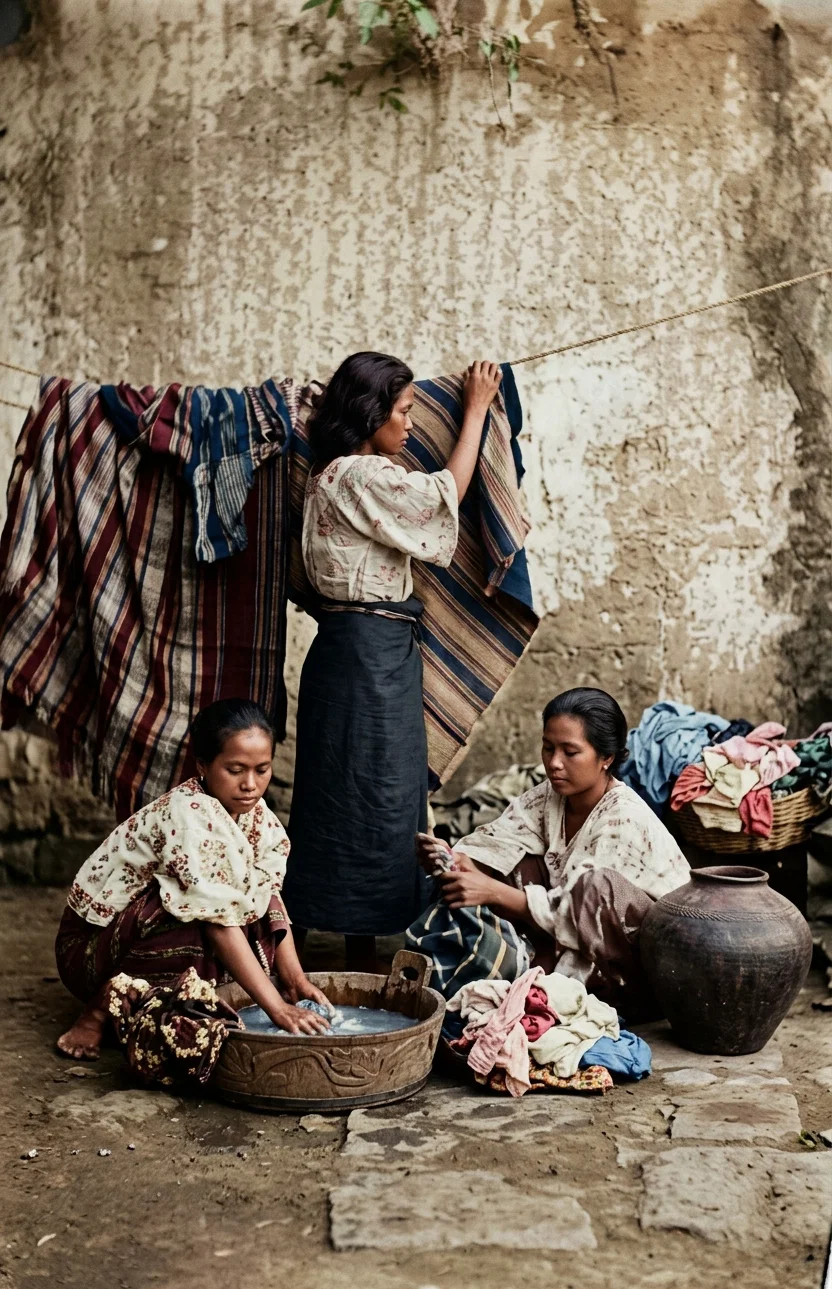
PHILIPPINE WASHERWOMEN
When making these trips, I have often thought how surprised some of you would be if you could be transported here in an instant. The graceful palm, the quivering bamboo, the beautiful green of the banana, the patches of tobacco plant, would all attract you. The rice harvesting at this season would also be of interest. In some towns I would be the only person to witness your bewilderment.
You would not enjoy it all. The hot weather, the dusty roads, the rough traveling and accommodations would impress you that it is not all romance. Perhaps you would join me in drinking some refreshing cocoanut water from the unripe fruit, and eating the tender, sweet meat.
You would not mind, of course, sleeping on the floor — the rats do not often get hungry, and very seldom do the roaches bite. But if you should sleep in a Filipino home, you would have no bedcovering, as it is unknown to these people. They take no time to disrobe, and make their bed by spreading a family mat on the floor. You would not be attracted by the habits of the ordinary native. There is a term, ‘head-hunting,’ applied to savage hill tribes, but it can be applied in another sense to all, young and old. The old women are fond of chewing the betel-nut, which does not add to their beauty. The children do not feel cold, of course; consequently are often garmentless — and we will only suppose they are clean.
The unattractive homes, and the disorder around and within, are also noticed. The bamboo ladder into their homes is steep, and often without hand-rails.
But the people are interesting, especially to us who possess the message. They have few Bibles, and are ignorant; but they are willing to hear the Word. They are pleasing in many ways, chatty, friendly, and hospitable, so that one is led to the conclusion that here is a field where he will never regret engaging in the Lord’s work in the earth.
Manila.
Student Volunteers in Foreign Fields
SINCE 1886 no less than 4,346 Student Volunteers have been despatched to the foreign field, commissioned by about thirty missionary societies. Of the number, 1,253 were sent to China, 446 to Africa, 840 to India (including Burma and Ceylon), 374 to Japan, 266 to South America, 200 to Korea, 157 to Turkey, 133 to Mexico, 128 to West Indies, 127 to Philippines, 39 to Persia, 21 to Arabia, etc.—Selected.
Secret Christians in Turkey
WHEN Islam swept Asia Minor, whole Christian neighborhoods were forced to accept the religion of Mohammed that they might escape the sword. Most of these converts accepted only the outward shell of Islam, so that there are to-day whole tribes outwardly Mohammedan, but in reality more Christian or heathen. A number of tribes among the Kurds, for instance, are the descendants of Armenians thus nominally converted to Islam centuries ago.
Since the new constitution of Turkey professes to grant religious liberty, many of these people are attempting to shake off the hated yoke of Islam, and the Young Turk government finds itself face to face with the question of what attitude it should show toward these attempts. At present, the Stavriotes, as they are called, are making great efforts to obtain their rights.
The Stavriotes, who live in the neighborhood of the cloisters of Wasilu and Peristera and within the diocese of Trapezunt, Erzerum, Neocaesarea (Niksar), and Chaldia, number about fifty thousand. The Turkish government considered them Mohammedan, but they adhered secretly to the ceremonies of their former religion. They elected their own Mohammedan teachers, but they had also their own priests, who performed marriages, baptisms, and other religious ceremonies in a hidden church secretly and by night. Each one of these Stavriotes had two names, a Christian and a Mohammedan. In the mosques they prayed with the Turks, but used Christian prayers.
After the revolution of last year, they telegraphed the Young Turks and demanded public recognition as Christians. This recognition has not yet been granted, in spite of the fact that the new Turkish government has promised complete religious liberty.—Missionary Review.