Stand still and watch the world go by, and it will.
Some people are worth no more than an old almanac.
It is sad to see a busy devil and an idle Christian.
Some people think they are getting busy when they get buzzy.
Instead of being missionaries, some people are omissionaries.
Bears hibernate in the winter; some churches do in the summer.
The man who waits for things to turn up finds his toes do it first.
Idleness is a rust that will attach itself to the most brilliant metals.
Doing nothing is a deadly sin. Even a child can let the fire go out.
Nothing is accomplished by sitting by the roadside, waiting for a ride.
One might as well try to fatten a greyhound as to attempt to improve an idle man.
Idle men, like spoons, will not stir their own porridge, unless some one lends a hand.
Scintillating SENTENCES CHARLES G. BELLAMY
A WHOLE BATTERY OF QUESTIONS
C. J. Monger of India asks questions on varied topics.
The power spoken of in Revelation 13:13, that “doeth great signs, that he should even make fire to come down out of heaven upon the earth in the sight of men,” is understood by many Bible students to be the United States; and the one spoken of in the twelfth verse, “whose death stroke was healed,” to be the papacy. [See the pamphlet, “The Pope King Again,” for sale at this office, price 25 cents].
The “false prophets” warned against by our Lord in His great prophecy of Matthew 24 refer particularly to those who falsely claim to have the divine commission to lead the people into the hope and realization of the Messianic kingdom. In a larger sense, they refer to any who lead astray by wrong religious teachings. Therefore the questioner is not wrong in including Mohammed among these false prophets. He is further right when he states that Mohammedanism and the papacy will “be destroyed at the coming of Christ.”
The “woman arrayed with the sun” (Revelation 12:1ff.) is a beautiful symbolism of the true church of Christ (2 Corinthians 11:2); and “her child” who “was caught up unto God, and unto His throne” is the Lord and head of the church, Jesus Christ, who ascended to heaven (Acts 1:9-11). [See “Daniel and the Revelation,” published at this office.—EDITORS.]
Those who, living up to all the spiritual light they have, “stand stanchly by Catholicism and follow its doctrines,” will not “be destroyed at Christ’s coming” if their characters are such as will meet Heaven’s approval.
AVOIDING THE PURELY SPECULATIVE
I do not know whether in any sense the Kellogg antiwar pact will contribute to the fulfillment of the prophecy of Isaiah 2:1ff., that the nations shall determine among themselves that they “shall not lift up sword against nation, neither shall they learn war any more.” May I again repeat what I have written before, that it is always a dangerous and purely speculative and imaginative procedure to assert just what this nation or all the nations will do in fulfilling prophecy. Biblical eschatological prediction does not give us a detailed working out of just what England, Turkey, Japan, Russia, the United States, or any other nation or nations will do. It may give us a broad sketch or outline, but this is so meager in details that it is unsafe and unwise to say or to write just what will happen. We may get a certain thrill in telling, and the unthinking may get a certain thrill in hearing, such imaginative future schemes; but in all honesty let us all confess our ignorance as to Heaven’s detailed plans for the future. Let us remember the astute words of that outstanding mental giant of all time who, besides being a distinguished scientist, was a great student of prophecy. This man, Sir Isaac Newton, bade us beware in interpreting Biblical prediction, lest we fail to keep in mind that God alone is the prophet, lest we in our exuberance run ahead of God and be prophet in His stead. God alone knows what the nations will do, and He has not seen fit to reveal these details to us.
With this in mind, the questioner will excuse me if I write that I do not know whether the “present silence and pause” is “a preparation for the coming world war, Armageddon.” This much is sure, that all things are shaping up for the downfall of our civilization,—a world-wide catastrophe.
According to the context of Revelation 6 to 8, we are living in the period of the sixth seal.
The false prophets who come “in sheep’s clothing, but inwardly are ravening wolves,” stand for any leaders who arise claiming to give the flock of God divine truth, who are base deceivers, “speaking perverse things, to draw away the disciples after them” instead of to God. See Acts 20:28-30.
The “SIGNS” QUESTION CORNER
By William G. Wirth
Conducted by WILLIAM G. WIRTH, 5447 EL VERANO AVENUE, EAGLE ROCK, CALIFORNIA
If you have a question regarding Bible doctrine and Christian living, or on other subjects apropos to the field of the “Signs of the Times,” write out your question and send it in, preferably direct to Dr. Wirth. Anonymous questions will not be answered. Do not become impatient if your question is not answered immediately, for Dr. Wirth has scores of questions in waiting, and yours will be answered in order.
“UNDER THE LAW;” AND WHAT OF THE SOUL?
D. M. Woods of California asks about being “under the law,” and what the word “soul,” as used in the Bible, refers to.
A study of Paul’s use of the phrase “under the law” (see Romans 6:14, 15; 1 Corinthians 9:20; Galatians 3:23; 4:4, 5, 21; 5:18) reveals that he conveys by it two vital and fundamental connected truths. First, that we are “under the law” in the sense of being subject to its demands, under obligation to obey it; and, second, and coming out of the first, that since men have not been obedient to the law’s commands, they are “under the law” in the sense of its resultant condemnation, and so worthy of “the wages of sin”—“death.” Romans 6:23. It must be borne in mind that sin is the transgression of the law. (1 John 3:4.)
This twofold, cause-effect meaning of “under the law” is even true of our Lord in the statement of Paul concerning Him in Galatians 4:4, that He was “born under the law.” That Christ, “when the fullness of the time came,” met the responsibility of obeying the law, is shown clearly in His emphatic declaration in Matthew 5:17: “Think not that I came to destroy the law or the prophets: I came not to destroy, but to fulfill.” See also the Old Testament prophecy of this responsibility on the part of Christ in Psalm 40:6-8.
Coming to earth to take our place, Jesus assumed the same obligation as is ours to keep the law, and so He was “born under the law.” However, while He Himself was “without sin” (Hebrews 4:15; 1 Peter 2:22), vicariously He was “made to be sin on our behalf” (2 Corinthians 5:21); He “redeemed us from the curse of the law, having become a curse for us” (Galatians 3:13). And so in this second connected sense Christ was “born under the law” in condemnation for us, that He might save us from our condemnation. “Him who knew no sin He made to be sin on our behalf; that we might become the righteousness of God in Him.” 1 Corinthians 5:21. “He was wounded for our transgressions, He was bruised for our iniquities; the chastisement of our peace was upon Him; and with His stripes we are healed. All we like sheep have gone astray; we have turned every one to his own way; and Jehovah hath laid on Him the iniquity of us all.” Isaiah 53:5, 6.
As one beautifully puts it: “Christ was treated as we deserve, that we might be treated as He deserves. He was condemned for our sins, in which He had no share, that we might be justified by His righteousness, in which we had no share. He suffered the death which was ours, that we might receive the life which was His.”—“The Desire of Ages,” page 25.
This explains why, after telling us that Jesus was “born under the law,” Paul gives the purpose of this in the words, “that He might redeem them that were under the law, that we might receive the adoption of sons.” Galatians 4:4, 5.
If by his statement that “Christians never were under the law, and never will be,” the questioner means Christians are not subject to the law’s demands, he is wrong; for all Christians, as was true of Christ Himself, are under obligation to obey the law. See Romans 3:31; James 2:8-12. If he means that Christians are not “under the law” in the sense of its condemnation, he is right, for our Lord redeems us from this, as I have shown above.
ABOUT THE SOUL
The simplest way to comprehend the Biblical difference between soul and spirit is to delineate the soul as a man’s animal personality, his human temperament, mentality, and distinctive ways; in a word, his biological inheritance that makes him what he is, humanly. A man’s spirit refers to his religious life and desires, his higher spiritual nature, as we say, that reaches out after God and that makes him distinct from the lower creation. A man who has no desire for spiritual things is purely animal and cannot be correctly considered as spiritual, no matter how great he may be as a human being. Paul gives an excellent portrayal of the difference between the “natural,” the psychical, or soul, man, and the “spiritual,” or religious, man, in 1 Corinthians 2:11-16, A. R. V. There are times when the Old Testament does use “soul” to apply to the whole man, the person. See Deuteronomy 24:7, where the words, “stealing any of his brethren” are literally, in the Hebrew, stealing the soul of his brethren. In Ezekiel 18:4 soul again appears in this sense of the whole man, the person.
WARNING OF DOOM
Howard R. Stark of Michigan asks for texts that foretell the overthrow of Babylon, Tyre, and Sidon.
The destruction of Babylon is foretold in Isaiah 13; 14; 47; Jeremiah 50; 51; and that of Tyre and Sidon in Ezekiel 26; 27; 28.
EDITORIAL
By Editor
“DRIFTING TOWARDS CHAOS”
“DRIFTING Towards Chaos” is the striking head to the leading editorial in a recent issue of the Mercury-Herald of San Jose, California, one of the most prominent dailies on the Pacific Coast. This editorial analyzes the recent elections in Germany, and shows that their result is creating great nervousness in France in particular, and, of course, other European countries are concerned and interested. The advance of “the soviet dictatorship of Russia” and the “fascist dictatorship of Italy” are pointed out as uniting to overthrow the Hindenburg government.
Dieudonne Coste (right) and his copilot, Maurice Bellonte, as they arrived in New York from Paris, in their plane, “Question Mark.” They covered the distance between the two great metropolises in thirty-seven hours and eighteen minutes, and this is the first time a passage from Europe to the United States has been made in one “hop” in an airplane.
Following the above-mentioned editorial, in the same column, is another, under the caption, “Incorrigible Europe.” The opening sentences of this editorial read: “Twelve years after the last guns on the western front were fired the state of Europe offers as sardonic a comment on the ingenuous hopes which inspired our first crusade to the Old World as history discloses. There has seldom been a time in European history when new wars seemed less obviously in the making. Behind the thin façade of the League, Locarno, the Kellogg-Briand Treaty, the Naval Limitations Conferences, the peoples of Europe, or at any rate their governments, are engaged in precisely the same processes that brought forth the vast disaster of 1914. Armies are training, new implements of destruction are being devised, new fortresses are building, new fighting ships are preparing. France and Italy have been on the ragged edge of open war for months.”
Since the World War, more strongly perhaps than at any other period in the world’s history, the most influential personages of the various nations have worked mightily to secure peace. The Prince of Peace Himself, the mighty Christ, has been hovering over the world to persuade men of the wickedness of war, and to point out the miseries of anarchy and brutal strife. But despite all these mighty agencies that have been working, great masses of men, in large measure forgetful of God, are drifting past the restraining forces, and ignoring the warning voices as they prepare again to plunge their fellow creatures into the awful vortex of war. And while Christ, the mighty Prince of Peace, has used all the agencies that He could command to point out the evils of war and the importance of securing peace, yet through His prophets He has given us the significant warnings that war will ultimately prevail in these last days in terrifying proportions. Note this word:
“The nations were wroth, and Thy wrath came, and the time of the dead to be judged, and the time to give their reward to Thy servants the prophets, and to the saints, and to them that fear Thy name, the small and the great; and to destroy them that destroy the earth.” Revelation 11:18.
There is something strikingly significant in that expression, “To destroy them that destroy the earth.” How literally would the engines of destruction now being prepared in the various laboratories of the different nations of the earth destroy every living creature, were not the great God in mercy and in justice to arise to put an end to these destroyers that refuse to heed any counsel or to pay any attention to the kind-hearted rulers and statesmen who have labored so untiringly to keep their fellows from plunging themselves into the volcano of war!
It is understood and loudly proclaimed from every quarter that the next war will be vastly more terrible than the last one, and we all know that the last one was so appalling as to still leave its nightmares of horror, even after these twelve years of peace. In view of this whole situation as we face it, how important it is that we should understand for ourselves the great sources of protection and power that the Christ Himself, the truly omnipotent Prince of Peace, has prepared for those who will receive it!
Among the marvelously consoling and protective promises of His word, none is more precious, perhaps, than the ninety-first psalm.
“He that dwelleth in the secret place of the Most High shall abide under the shadow of the Almighty. I will say of Jehovah, He is my refuge and my fortress; my God, in whom I trust. For He will deliver thee from the snare of the fowler, and from the deadly pestilence. He will cover thee with His pinions, and under His wings shalt thou take refuge: His truth is a shield and a buckler. Thou shalt not be afraid for the terror by night, nor for the arrow that flieth by day; for the pestilence that walketh in darkness, nor for the destruction that wasteth at noonday. A thousand shall fall at thy side, and ten thousand at thy right hand; but it shall not come nigh thee. Only with thine eyes shalt thou behold, and see the reward of the wicked.” Psalm 91:1-8.
What a consoling privilege to be able to dwell under the protecting care of the Almighty! And in this time when pestilence and destruction, through hurricane, tornado, and earthquake, are visiting vast portions of the earth, and when another great world war is looming, how important it is to know that Shelter that raises us above all fear and terror! Other things may be important in this time, but to know God for ourselves, and to avail ourselves of His protecting power, are vital and a grave necessity.
T.
WAR in HEAVEN
By Gwynne Dalrymple
WAR in HEAVEN9
GWYNNE DALRYMPLE
The first and greatest conflict ever staged was the conflict between the forces of good and evil under the leadership of Christ and Satan.10
There is a fact that the Scriptures teach and all human experience demonstrates. Everywhere we may perceive two forces at work,—the force of good and the force of evil. There are the powers that build up, and the powers that tear down. In nature there is the beauty of the birds, their singing and their joyousness; but there are also hawks and vultures. And as there are sheep and horses and cattle, so there are also weasels and tigers and poisonous serpents. There are the flowers that flourish and bloom, yet they fall and decay in the bleakness of winter. Seeing the influence of life all around us, we see also the influence of death; and as we admire the powers of goodness, we at the same time must deplore the tremendous powers that vitiate and destroy.
WAR IN OUR OWN HEARTS
Even in ourselves we may observe phases of that great conflict that rages in the world. In our own hearts we may feel the rush and pressure of our desires, like the ceaseless flow and ebb of mighty tides, now surging toward the good, now surging toward the evil. The complaint of the saintly Paul, who cried out, “I find then a law, that, when I would do good, evil is present with me” (Romans 7:21), is so universal that it finds place even in a heathen soul, for Ovid laments: “Video meliora proboque; deteriora sequor,”—“The better things I see; and seeing, approve. Alas! it is the baser things I do.”
How comes it then that though God is wholly good, this world that He created is partly evil? Did sin and death and every wickedness of human hearts come from Him who is holy, who is life itself, who is of purer eyes than to behold evil?
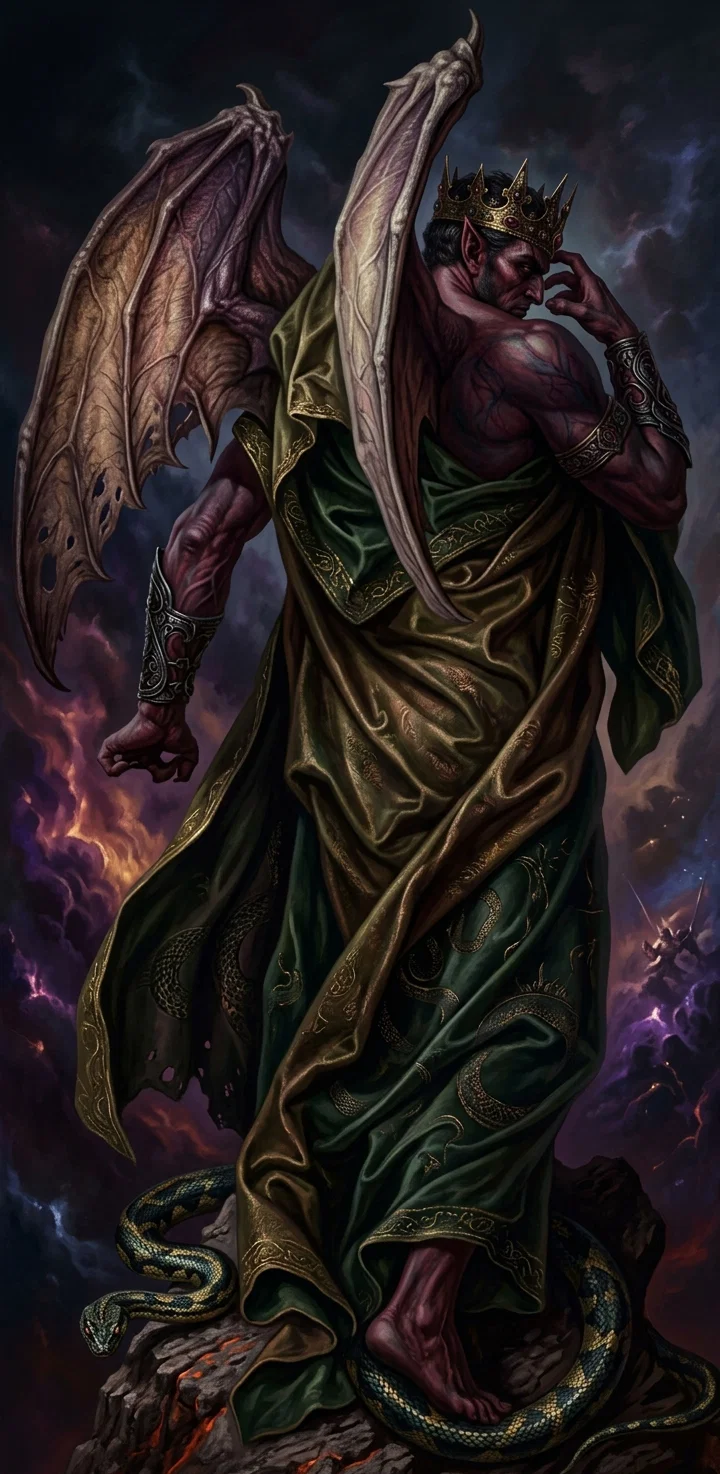
Satan, the commander in chief of the rebel forces of evil
The Scriptures go beyond the limits of human understanding in revealing to us the facts concerning this great conflict of sin and righteousness, death and life. They acknowledge its existence, so patent to us all; they go further, and explain that existence to us. They tell us of the history of evil, and its origin. “There was war,” says John, “in heaven: Michael and His angels fought against the dragon; and the dragon fought and his angels.” Revelation 12:7.
SATAN CAME FROM HEAVEN
In heaven, then, as well as on earth, the power of evil has been known. Indeed, the Scriptures teach that evil originated in heaven. In the Bible evil is said to have had both its beginning and its chief support in a being called Satan, the “adversary.” Yet Christ expressly declares that Satan came from heaven. “I beheld,” He says, “Satan as lightning fall from heaven.” Luke 10:18. This is the being generally called in the Scriptures the “devil,” from the Greek ho diabolos, meaning (the etymology may be interesting to those of us who have that human tendency to make derogatory remarks about friends, neighbors, or enemies) one who speaks evil of another; a slanderer.
That the author of sin came from heaven is expressly taught in the Old Testament as well as in the New. To the prophet Ezekiel were given a vision and a lamentation concerning one who is first described as the prince of Tyre, the greatest and most prosperous of the Mediterranean cities of antiquity. Yet in addressing the prince of Tyre, the prophet, delivering the word of the Lord, uses language that could by scarcely any hyperbole be applied to a being of this earth. Beginning with a description that might be literally applied to the ruler of a great commercial city, the prophet passes to language that could in no sense be true of any human being. The impious prince is addressed in the second and ninth verses as a mere man, in the twelfth to the nineteenth verse he is called a covering cherub; he has been in the Garden of Eden; he has been “the anointed cherub that covereth;” he has been in the holy mountain of God, and has walked up and down in the midst of the stones of fire; from the day that he was created he was perfect, until iniquity was found in him; because of this iniquity he will finally be cast from the mountain of God as profane, for his heart has been lifted up by reason of his beauty, because he has corrupted his wisdom by reason of his brightness; and never shall he be any more. (Ezekiel 28.)
WHY SATAN FELL
In similar language Isaiah, looking beyond an earthly ruler to the one ultimately responsible, addresses Satan under the title of king of Babylon. “How art thou fallen from heaven, O Lucifer, son of the morning! how art thou cut down to the ground, which didst weaken the nations. For thou hast said in thine heart, I will ascend into heaven, I will exalt my throne above the stars of God: . . . I will ascend above the heights of the clouds; I will be like the Most High.” Isaiah 14:12-14.
If the Scriptures, then, are competent at all to reveal to us this matter, we have it upon the authority of Christ that Satan fell from heaven; upon the authority of Ezekiel that in heaven he was a covering cherub in the presence of God, and that he was perfect in wisdom and beauty until iniquity was found in him; upon the authority of Isaiah that the cause for his degradation was pride and a desire to be exalted as high as God. And upon this teaching of the Scriptures we feel that we may safely rest.
ABSURD SUPERSTITIONS
During the Middle Ages absurd superstitions arose concerning this being who fell from the kingdom of God. He was the fiend; he was black, the color of sin; he was deformed, having the hoofs of an animal; he was monstrous, having horns, bat’s wings, and a forked tail; he stank of the sulphurous fumes in which he was customarily confined; he was inexpressibly powerful to torment men by suffering and death, but was thrown into convulsions of terror by the waving of a crucifix or the effusion of holy water. Of such fables no trace can be found in the pure simplicity and truthfulness of the word of God. Rather, the Scriptures represent that fallen spirit as great even in his ruin. They suggest to us Milton’s noble lines:
“He, above the rest
In shape and gesture proudly eminent,
Stood like a tower. His form had yet not lost
All her original brightness, nor appeared
Less than archangel ruined, and the excess11
Of glory obscured: as when the sun new risen
Looks through the horizontal misty air
Shorn of his beams, or, from behind the moon,
In dim eclipse, disastrous twilight sheds
On half the nations, and with fear of change
Perplexes monarchs.”
However much rejected of Heaven for wickedness and cruelty, he yet remains the prince of the power of the air (Ephesians 2:2), quite capable of appearing as an angel of light (2 Corinthians 11:14), who dared to tempt our Saviour Himself when He was upon this earth (Matthew 4:1-11), yet could not prevail against Him (Hebrews 4:15).
A FALLEN ANGEL
The prince of the power of the air,—an angel, but fallen how low!—that is his present estate. He is shut out from that radiance in which he once dwelt; he is an alien from that glorious realm in which he once was eminent; he can no longer tread upon the mount of God; his pipes and tabrets are not heard among the choir of the seraphim; his voice adds not a single note to the majestic chant of cherubim eternally adoring the eternal God. Not for him is the changeless light of that heavenly world, which, bright and unquenchable, shines forever on. He, with those whom he has led with him into rebellion, has exchanged the exceeding glory for utter darkness (2 Peter 2:4); he has resigned the way of right for the treacherous windings of wrong.
BY NO MEANS IDLE
Yet the fallen angel and his followers are not in idleness. Their mighty energy still strives and works; and having ceased to accomplish the glory of God, they labor to annoy and pervert His subjects. When Joshua, as high priest of his nation, clothed and compassed with those infirmities that so powerfully beset our mortal nature, is shown in vision to the prophet Zechariah as standing before the judgment seat of Jehovah, it is Satan who also appears to accuse him, and to denounce the man’s already too-apparent filthiness of raiment. But the adversary is rebuked by God Himself, who will not break a bruised reed, nor quench the smoking wisp of flax. (Zechariah 3; Matthew 12:20.)
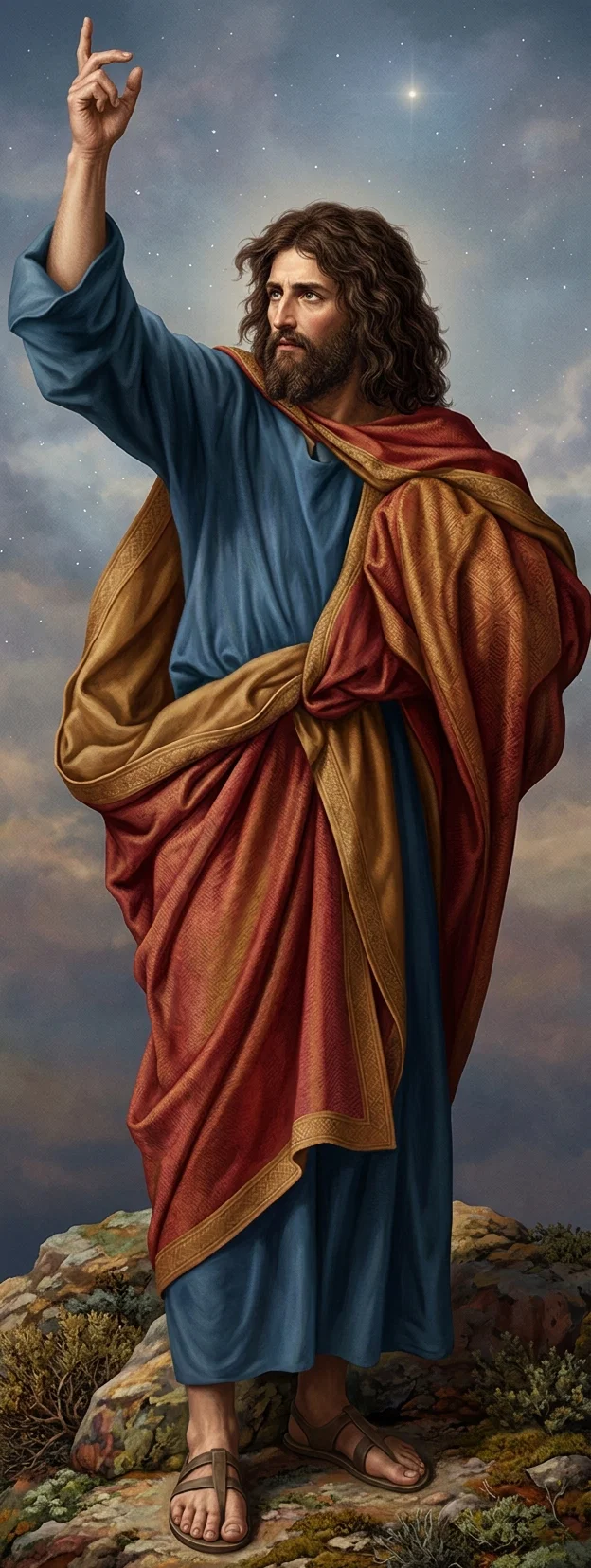
Christ, the opposing leader, in command of the righteous army
When Job, “perfect and upright, and one that feared God, and eschewed evil,” sought to fulfill his duties to his God and to his fellow men, it was Satan who rose up to accuse and pervert; and when he could not deny the goodness of the man, he attacked the purity of the motive that inspired his goodness. (Job 1:1, 9-11.)
In the New Testament, Jesus is represented as casting out devils from two men who were possessed by these evil powers; the demons spoke with audible voice to Christ, and He answered them. The whole account of the incident is told with such evident circumstantiality that to question its literalness is to question its truth. (Matthew 8:28-34.) Indeed, the instances of demon possession mentioned in the New Testament are so many that it is not possible to attempt any analysis of them here; we can merely cite a number of them, which the reader may look up for himself: Matthew 9:32, 15:22; 17:18; Mark 9:17; Luke 11:14; Mark 1:23; Acts 8:7, and others.
“We wrestle not against flesh and blood,” declares Paul, “but against principalities, against powers, against the rulers of the darkness of this world, against wicked spirits in high places.” Ephesians 6:12, margin. The conflict of a Christian is against foes unseen as well as seen. As to the manner in which these unseen foes work, we are not expressly informed by the Scriptures; and on such a subject speculation is vain. But as we recall the many manifestations of mesmerism, hypnotism, spiritualism, and telepathy, we cannot consider it incredible that the mind of a person should be influenced, in ways not wholly understood, by the mind of another, or by some spiritual force, in ways that we cannot detect.
GOD’S ARMOR OFFERED
In closing, we turn from the dark contemplation of this unholy kingdom to the bright promises of God’s word. “Wherefore take unto you,” advises the apostle, “the whole armor of God, that ye may be able to withstand in the evil day, and having done all, to stand. Stand therefore, having your loins girt about with truth, and having on the breastplate of righteousness; and your feet shod with the preparation of the gospel of peace; above all, taking the shield of faith, wherewith ye shall be able to quench all the fiery darts of the wicked.” Ephesians 6:13-16. We have nothing to fear if we are clothed with the armor of God.
For the power of Christ exceeds every power that is named, whether in earth or in heaven. Temporal adversity, spiritual temptation, threatenings of men, insinuations of devils, shall fall meaningless before the one who relies upon the righteousness of Christ, and who finds in Him wisdom, and righteousness, and sanctification, and redemption. (1 Corinthians 1:30.) “All things are yours; . . . and ye are Christ’s; and Christ is God’s.” 1 Corinthians 3:21, 23. “If God be for us, who can be against us?” Romans 8:31.
Prayer Upon Entering the Sanctuary
THERE is a growing need for a new emphasis upon prayer on entering the sanctuary. About one in ten worshipers stops for prayer as he enters the church. The result is that 90 per cent of the attendants have to be jarred out of distinctly unchurchly attitudes at the opening of the service. It gives the service a bad start. If each worshiper, upon entering the church, would pause for a moment of prayer for the divine blessing upon the church, the service, the minister, and himself, he would create an inner attitude of receptivity that would revolutionize the service.—The Christian Advocate.