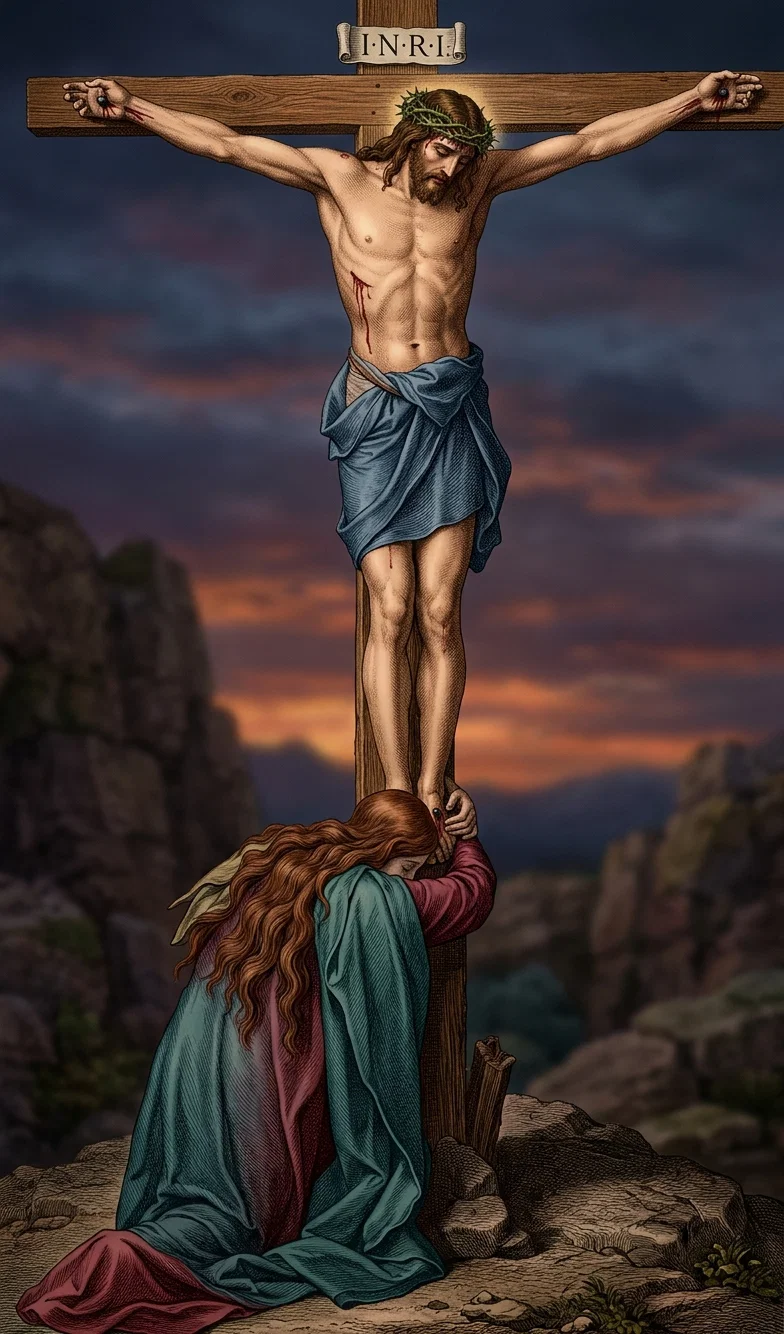
Christ's death on the cross has always been a subject of controversy.
There seems to be a growing tendency to revive an error that never should have had birth. The idea is gaining ground in the minds of a class of religious people that Christ was crucified on Wednesday, the fourth day of the week, and not on Friday, despite the fact that the Bible teaches in simple language that the Saviour died on the sixth day. (Luke 23:52-56.)
One of the chief causes that lead some to reach such an erroneous conclusion is the failure to recognize the difference between the Passover “holydays,” and the Sabbath of the Lord.
THE ORIGINAL PASSOVER
The Passover was given originally to the Israelites, just prior to their liberation from a long servitude in the land of Egypt. See Exodus 12:1-20; 13:3-10.
The Passover sacrifice must be slain before the people left the land of their serfdom; it also must be eaten before they were delivered. Says the scripture: “Thus shall ye eat it; with your loins girded, your shoes on your feet, and your staff in your hand; and ye shall eat it in haste: it is the Lord’s Passover. For I will pass through the land of Egypt this night, and will smite all the first-born in the land of Egypt, both man and beast; and against all the gods of Egypt I will execute judgment: I am the Lord.” Exodus 12:11, 12.
Moreover, the people were exhorted to eat the Passover lamb that very night; they were not permitted to allow any part of it to remain till the morning. (Verses 8-10.)
This instruction clearly states that the first Passover supper was observed before the Israelites were delivered from Egyptian bondage. It is true that the Passover institution was to be a memorial of the deliverance of the Israelites from their Egyptian bondage for future generations; but the first Paschal lamb was killed and eaten before the people departed from the land of Ham.
In the first six verses of this twelfth chapter of Exodus the time is given when the Passover lamb must be taken and slain; from then on till the twenty-seventh verse of this same chapter is further instruction on how the Passover festival should be observed.
The people were commanded to make proper preparation to observe this feast, and a definite time was arranged for this preparatory work.
NO PASSOVER OBSERVED IN DESERT
The year following Israel’s deliverance from Egypt, the Lord commanded Moses to admonish the people to keep the Passover again. (Numbers 9:1-5.) This they did, except that some were found who were defiled, unclean. These were commanded to observe the Passover on the fourteenth day of the second month. Shortly after the observance of the second Passover, the Israelites refused to enter the land of Canaan; then the Lord informed them that they should all die in the wilderness, except Joshua the son of Nun, and Caleb the son of Jephunneh. (Numbers 14:27-30.)
From henceforth, and during the rest of their sojourn in the wilderness, the seed of Abraham kept no Passover. The reason for this is given in Joshua 5:2-9. When the ordinance of circumcision was again performed upon the descendants of the deceased generation, the command was renewed that the people should observe the Passover. (Verse 10.)
SPECIAL HOLYDAYS
In addition to the observance of the Passover, there were given to the Israelites holy, or sacred, days; as for instance: “In the fourteenth day of the first month at even is the Lord’s Passover. And on the fifteenth day of the same month is the Feast of Unleavened Bread unto the Lord: seven days ye must eat unleavened bread. In the first day ye shall have an holy convocation: ye shall do no servile work therein. But ye shall offer an offering made by fire unto the Lord seven days: in the seventh day is an holy convocation: ye shall do no servile work therein.” Leviticus 23:5-8. See also Exodus 12:16; Numbers 28:18, 25.
The first and the last day of the Passover were sacred, holy, days. On these days the people were allowed to do no ordinary, no secular, work. They were permitted to prepare food. (Exodus 12:16.) The same was true of the other feasts of the Lord. See Leviticus 23:23, 24, 31, 35, 36. These holydays, however, were not part of, or identical with, the Sabbath of the Lord, the seventh day of the week. See Leviticus 23:38.
MANY PECULIAR EXPERIENCES
For fifteen centuries the children of Abraham had very peculiar experiences with their observance of these feasts. They were instructed through Moses that these feasts must be observed only in the land that God should choose. (Deuteronomy 16:1-8.) In no other place might the Passover be offered. During the days of their repeated apostasy the people either lost the sacredness of the feasts or the leaders neglected to observe them. There were times when centuries elapsed and the Passover was not observed. The same was true of the other festivals. (2 Chronicles 30:1-5; Nehemiah 8:13-17.)
During the exile in Babylon the Israelites were unable to commemorate these feasts, yet many of the pious people did their best to keep record of those times and seasons.
When Israel was relocated in Palestine, the leaders endeavored to put their house in order, and to again observe the Passover with the other feasts. Some forms of holy service they added; certain customs they omitted. For fear that during their exile they might have lost the accurate counting of the time when the feasts should be observed, the ecclesiastical council originated the following law: “These are the six days on which the Scripture has forbidden the doing of work. The first and seventh day of the Passover; the first and last day of the Feast of Tabernacles; the day of the Feast of Pentecost; and the first day of the seventh month. All these are called holydays. The Sabbatism of all is alike.”—Hilchoth Yom Tov. (A Talmudic volume, entitled “Laws of the Holidays.”)
“But to us who observe two days what is unlawful on the first day is also unlawful on the second day; and he who disregards the latter, is to be excommunicated.”—Orach Chayim. (“The Ways of Life.”)
“Though the second holyday is of the words of the scribes only, everything that is considered unlawful on the first is not permitted on the second. And every one who profanes the second holyday, even though it be the New Year’s, whether it be a matter relating to the Sabbath, or to work, or by going beyond the limit of the Sabbath, he is to be excommunicated, or to be beaten with the flogging of rebellion, provided he be not a Talmudist.”—Hilchoth Yom Tov. (“Laws of the Holidays.”) See “Practical Lessons From the Experience of Israel,” third edition, pages 690, 691.
From the foregoing it is clear that the rabbis added extra days to those given by the command of the Lord. Yet all these sabbatic days were distinct and apart from the Sabbath of the Lord.
THE LAST PASSOVER
When the Saviour was about to observe the last Passover with His disciples, He told them, in answer to their question where they should make ready for the feast: “Go11into the city to such a man, and say unto him, The Master saith, My time is at hand; I will keep the Passover at thy house with My disciples. And the disciples did as Jesus had appointed them; and they made ready the Passover.” Matthew 26:18, 19.
Jesus had already said to His disciples: “Ye know that after two days is the feast of the Passover, and the Son of man is betrayed to be crucified.” Verse 2.
It is evident that the Saviour and the disciples had a clear understanding of when the Passover should begin, and He gave command to make ready for this feast. This preparation, be it remembered, was for the Passover. Jesus made no intimation to His disciples that they should make any preparation for the Sabbath of the Lord.
The reader must not forget that there was a disagreement between the Pharisees and the Sadducees as to the length of time between the Passover and the Feast of Pentecost. The Pharisees expounded the expression, “The morrow after the Sabbath” (Leviticus 23:15, 16) to be the day after the Passover Sabbath, whichever day of the week the Passover Sabbath occurred, whereas the Sadducees claimed that the phrase, “On the morrow after the Sabbath,” meant the first day of the week, the day after the seventh-day Sabbath. The result was that the Sadducees always observed Pentecost on the first day of the week, while the Pharisees observed Pentecost on whatever day it might come after counting forty-nine days from the day the sheaf was waved before the Lord.
However, there is no allusion made of this difference between these two classes in the writings of the New Testament. The disciples, enlightened by the Holy Spirit, considered this discord nonessential to the teaching of the gospel; nor did this dissonance affect the truth of Christianity.
When the disciples were invited by the Saviour to make ready the Last Supper, they were making preparation for the Passover, and not for the seventh-day Sabbath. They sacrificed the Passover; they ate the lamb that evening in harmony with the law of Moses. Jesus fulfilled that law as He fulfilled every other law. (Matthew 5:17, 18; Romans 10:1-4.)
GETHSEMANE AND CALVARY
While Christ is our Passover,—was sacrificed for us,—He ate the Last Supper with the disciples before He died. (1 Corinthians 5:7.) The Paschal lamb was slain, and it was eaten in the evening following. Every part of the type met its fulfillment in Christ, the true Passover. Says an eminent writer: “Christ was standing at the point of transition between two economies and their two great festivals. He, the spotless Lamb of God, was about to present Himself as a sin offering, and He would thus bring to an end the system of types and ceremonies that for four thousand years had pointed to His death. As He ate the Passover with His disciples, He instituted in its place the service that was to be the memorial of His great sacrifice. The national festival of the Jews was to pass away forever. The service which Christ established was to be observed by His followers in all lands and through all ages.”—“The Desire of Ages,” page 652.
Later, the same evening, He entered Gethsemane with His disciples. In this place the sins of a lost world were confessed upon Him. (Isaiah 53:6.) He became the substitute for man. The just took the place of the unjust. The innocent Lamb now had transferred upon Him the transgressions of a guilty race. (Verse 8.) Following these sorrowful hours, He was arrested, denied by the devoted Peter, deserted by His followers and sentenced to scourging and death. These experiences occurred subsequent to the time when Jesus had eaten the Passover with His disciples. The day He was crucified was the day He died.
THE PREPARATION FOR THE SABBATH
After He died, the centurion who stood at the cross was so impressed with what he saw that He proclaimed: “Truly this Man was the Son of God.” Mark 15:39.
Among those who were gathered around the cross were “Mary Magdalene, and Mary the mother of James the Less and of Joses,” and others. (Mark 15:40.) Of these women it is written: “The women also, which came with Him from Galilee, followed after, and beheld the sepulcher, and how His body was laid. And they returned, and prepared spices and ointments; and rested the Sabbath day according to the commandment.” Luke 23:55, 56.
The context of this scripture says: “That day was the preparation, and the Sabbath drew on.” Verse 54.
From the foregoing it is evident that the preparation day here spoken of had nothing to do with the Passover preparation. This day was the day before the Sabbath. But the Sabbath is the seventh day. According to the command of the Saviour, the Passover preparation was made before Jesus ate the Passover. Hence it is clear that the day the Saviour was crucified was the day before the weekly Sabbath,—the sixth day of the week, the day commonly known as Friday, and not the Passover preparation day.
Next week we shall consider the text that troubles so many, which declares that Christ should be, like Jonah, in the heart of the earth “three days and three nights.”
Christ’s Friday Crucifixion and Sunday Resurrection
A lucid exposition that shows up the fallacy of the idea that Christ was not crucified on Friday and did not rise on Sunday.
The Influence of Christ’s Life
His life is becoming to us a new life, as if we had never seen a word of it. There is round about us an influence so strange, so penetrating, so subtle, yet so mighty, that we are obliged to ask the great heaving world of time to be silent for a while that we may see just what and where we are. That influence of the life of Jesus Christ, we cannot get clear of it; we hear it in the tones of joy, we feel it stealing across the darkness of sorrow; we see it where we least expect it. Even men who have traveled farthest from it seem only to have come round to it again; and while they have been undervaluing the inner worth of Jesus Christ, they have actually been living on the virtue which came out of His garments here.—Joseph Parker.
Faithful Doing and Knowing God
By John Watson
It is not through deep thinking but faithful doing that one comes to know the mystery of God, and faithful doing is within every one's reach. The path which philosophers and scientists have often missed has been found by shepherds on the hills, and by working women. Mary of Bethany and the fishermen of Galilee knew more of God than the scholars of Jerusalem.—John Watson.
WALTER CRANDALL
By Walter Crandall
Fog
WALTER CRANDALL
ONE evening a few nights ago a fog settled down over the city of Washington, blanketing it as a mother tucks in her babe. Pedestrians “felt” their way along hazy streets, while motorists cut zigzag trails down wide avenues.
There is nothing remarkable about fog. It is only a cloud come down to earth, perhaps the same fleecy cloud of the day, which has melted out, to re-form on the earth at night. But what a contrast!
People remark about both—the beauty of the one and the blight of the other. They do not pause to remember that in cursing fog they curse the thing that a few hours before they may have blessed!
It seems ever so with beautiful things. The charm and enchantment that grow through distance become charmed with the commonplace when they reach our door. Even the rose loses its beauty if we tear away its petals to see its heart. The snow that lends its purity to that upon which it falls can blind the eye that looks too close and long.
It isn’t the rose that’s at fault because we tear away its petals, and thus kill its beauty. Nor does the snow inflict pain because it is pure. Rather, it is we who look too close, in order to question why or how it got that way. So senseless are we become that good things of themselves now fail to please. Indeed, we must needs go and tear the heart out of things, or scrape their surface, or bounce them up and down to learn if they are real. We forget that God above, in all the grandeur of His firmament, has never been seen of man, except the glory of His presence.
TO REDUCE
“Please send me your advice and reducing slip soon.”
The prescriptions on the market for reducing will do just one thing,—they will reduce your fat purse till it is anemic. You probably have already found that out. Just let such things alone. If they actually reduce your weight, it is by making you sick; and you can’t afford that.
There is one product that will aid in reducing in cases that need it, and that is thyroid; but if one does not need it, it may make his troubles a great deal worse. Nothing of this kind should ever be attempted without the advice of a doctor who has made a careful examination.
Unless you are too heavy for your height and age, you are foolish to attempt to reduce. Many a girl who has wanted to be slender would now do anything in the world to get back her weight and get rid of that cough. Don’t do something foolish.
I am inclosing, however, some directions for reducing which, if you really need to reduce, will be useful to you. The important thing is to leave off the high-calorie foods,—bread, breakfast foods, all desserts, cake, etc., in fact, pretty nearly everything that is made out of flour,—and all sweets and fats; not that you have to leave off these absolutely, but you must reduce them to a very small quantity, perhaps one thin slice of bread for each meal.
Weigh yourself every two weeks in the same weight clothing so that you can compare your weights and know whether you are losing and how much. You should attempt to reduce about a pound in two weeks. You can use more or less of the high-calorie foods as may be necessary to keep you reducing at the proper rate.
HYPERACID STOMACH
“I have what the doctors tell me is a hyperacid stomach. I am told I should eat meat; have tried it, and find it gives me relief, but I prefer not to use it.”
Yes, probably you have a hyperacid stomach, but you do not have to eat meat. You can take milk in its various forms, and, if you wish, you can eat eggs; but I prefer in such cases to depend largely upon milk.
You should limit the amount of grains and cereals that you eat,—breads, breakfast foods, and the like, and in fact all foods in which you use flour or grains. Use more largely of butter or butter substitute, olive oil, or salad oil, with your food. You can take some of your oil in the form of mayonnaise dressing, if you wish.
I am sending you diet directions for hyperacid stomach, and I am also giving directions for making mayonnaise.
A CHANGE IN DIET
“I have had a foul breath and coated tongue since childhood. Have always been a big eater. I am somewhat overweight. I have a hard time controlling my appetite.”
Go on a two-day or three-day orange fast. Take all the orange juice you want, the more the better, and all the water you want, but nothing else.
Go on an alkalizing diet as per the inclosed directions, and in addition take the juice of an orange before dinner and the same before supper, about an hour before.
Health Questions by Mail
Readers of the “Signs of the Times” who send questions regarding health, with two cents return postage, to Dr. Heald will receive prompt reply by mail. But, remember, he can not diagnose or treat disease by mail. Persons who are sick need an examination and the personal attention of a physician.
No questions will be answered direct through this column. The answers which appear here are selected from the doctor's correspondence.
Send questions, with a two-cent stamp, to Dr. G. H. Heald, 140 Eastern Avenue, Takoma Park, D. C.
CANKER SORES
“Ever since I can remember I've been troubled with canker sores in my mouth. What is the cure?”
Wash the mouth twice a day with peroxide of hydrogen to which you have added three parts of water; that is, one part of peroxide to three of water. Do this in the morning and in the evening. Then once a day apply either tincture of iodine or mercurochrome to each spot.
You can apply this by twisting a little absorbent cotton on the end of a toothpick and touching the spot after dipping into the iodine. Or you may use burnt alum.
To prepare this, take some crystal alum, a piece the size of a small marble. Place it on a hot stove cover and leave it until it has turned white and floury. This is burnt alum. This you can put in a pill box or some other receptacle, then, twisting a little piece of cotton on the end of a toothpick, you can dip it into the burnt alum and apply to the sores.
What do you think of tonics?
Tonics
What do you think of tonics?
The healthy person certainly needs no tonics, and a person who begins to depend on tonics instead of finding what is wrong with his body and correcting that, is in a bad way. He is going downhill rather than uphill. Tonics just fool you for the time being, and in the end are likely to leave you worse off. Coffee is a tonic; whisky can act as a tonic.
FLAVORS
“Do celery seed, vanilla, and coriander seed come under the classification of spices, and are they harmful?”
The things you mention are probably not harmful if not used to excess. But vanilla usually means “sweets,”—desserts,—and one does better not to go heavily on such foods.
BUTTER SUBSTITUTES
“The farm papers say the copra out of which vegetable margarines are made is filthy. What about it?”
Naturally the farm papers oppose the butter substitutes. That is their business. They get a heavy tax put on these substitutes. They make it unlawful to color them. They do all they can to run out any butter substitutes so as to keep up butter prices.
I consider the coco butter made from copra cleaner than dairy butter. This fat is put through a cleansing process at a high temperature that sterilizes it. There is no way to sterilize dairy butter without ruining it. Dairy butter is never sterile.
EXPOSURE TO TUBERCULOSIS
“I have a boy seventeen months old. I live upstairs. The lady downstairs has tuberculosis. She is in bed, and on a complete rest. At times she plays with the little boy. She has him in her arms and kisses him on the cheek. Should we allow it?”
I do not think the boy should be allowed to go into that woman’s room or associate with her. I can appreciate that she may love children, but the best way to show her love is not to touch them or handle them, for it is dangerous for them.
If no other way can be found to protect the child or keep him out of that room or away from her, you had better move.
You do not want to hurt the woman’s feelings, but you must protect the child.
REDUCING BY DRUGGING
“Is there any virtue for reducing flesh by using — inwardly?”
I know of no substance that you can safely take for reducing your weight, unless it is thyroid or another gland preparation, and only in special cases is it safe to use these. The only way one can know when these will be beneficial or safe is by having a physician make a basic metabolism test. Ordinarily the only safe way to reduce is by diet.
EGG FOR BABIES
“At the baby clinic I am told to feed my baby an egg. What do you think?”
Babies, I think, are better off without any egg, though eggs have a considerable quantity of iron, and hence are good blood makers. Milk is poor in blood-making material. Baby at birth has stored up nearly enough iron to supply the blood while he is nursing.
NOISES IN EARS
“For several years I have had singing and ringing in my ears. How can I stop it? I fear that if I do not do something I will lose my hearing.”
See an ear specialist. It may be or may not be something that can be remedied. A capable specialist can tell you what you can expect.
The New Neighbors
By L. Ervin Wright
The New Neighbors
L. Ervin Wright
The story of how they turn a town upside down; and for the first time the town was right side up.
CHAPTER XX
THE STORY THUS FAR:
Mrs. Winters, her son, Dale, and daughter, Theresa, newcomers to Fairdale, start an active missionary campaign. They are the first Seventh-day Adventists ever to live in Fairdale. Dale holds several Bible studies in the home of Mrs. Helman. In visiting the Reverend Mr. Dodson, pastor of the —— church, Dale is accused of belonging to a cult, and being a proselyter. Theresa conceives the plan of starting a Sunday school. The club hall of the Chamber of Commerce is secured for the Sunday school and also for Dale's lectures. Pastor Dodson begins an attack upon the Adventists. The parsonage of the Dodsons catches fire, and Dale, at the risk of his life, plunges into the burning home and rescues the pastor. The pastor was found to have been seriously injured, and Dr. Watkins secures Theresa, who is a graduate nurse, to attend the injured man. Pastor Dodson has a change of heart, and confesses to Theresa that he has been fighting against the truth of God, and desires that Dale will teach him the faith of the Adventists.
Deacon Wells Makes a Resolution
No one knew about Pastor Dodson's change of attitude but his wife and the Winters, and it was virtually a shock to Fairdale when the pastor, a few weeks later, in the pulpit of his church, made his confession. Those who did not hear Pastor Dodson were rather dubious about believing the report of those who heard him. But these doubts were removed when Pastor Dodson spoke for fifteen minutes before Dale Winters gave his Sunday evening lecture at the Chamber of Commerce hall.
The next day every one in Fairdale was talking about the changed attitude of Pastor Dodson. At Butterfield's “Corner Grocery” a lively discussion was taking place concerning the pastor, when Ezekiel Wells, a deacon in Dodson's church, entered the store.
“Good mornin', Ezekiel,” greeted Ezra Peters, as the deacon approached the group in the rear of the store.
“Good morning, Ezra,” returned Deacon Wells.
“What is the matter with Pastor Dodson?” asked Cyrus Moore.
STRANGE OCCURRENCES
“Yes, what is the matter? That's what I'd like to know. He's been staying in my house ever since he got hurt in the fire, and this Dale Winters has been there about every day since; and he and the pastor have been as thick as hops. They have been studying the Bible together for hours at a time. All I guess is that this Advent has hypnotized the pastor into being an Advent himself, for he hasn't been the same since the fire.”
“Didn't you know anything about this change in the pastor until he spoke at the church yesterday morning?” asked some one.
“No; I didn't!” returned the deacon.
“Maybe he wanted to surprise you, deacon,” suggested Silas Hewitt.
“Well, he did it!” snapped the deacon. “But don't think because Pastor Dodson has turned Advent that Deacon Wells has. No, sir-ee, my father was a ——, and I'm going to be a —— till I die; and that's that.”
“Now, Ezekiel,” said Ezra Peters soothingly, “I wouldn't want to take any stand like that; and I don't think that right down in your heart you actually mean what you say.”
The deacon said nothing, but gave Ezra a hard look.
A FEW LOGICAL QUESTIONS
“You see, Ezekiel,” remonstrated Peters, “that would be an unfair position for you or anyone else to take; and I've always given you credit for being a pretty level-headed man.”
Peters paused. Wells still did not say anything, but his look was more pleasant, and Peters knew that he was winning.
“Now look here, deacon, you and I have been friends for years, and I think I know you pretty well; and if I didn't like you, I wouldn't be spendin' my time talkin' to you about religion. Now I'd like to ask you a few questions, Ezekiel, and if you feel like it, why, answer 'em. In the first place, you say the reason you are goin' to stick to your present belief is that your father believed that way. Now what I'd like to know is, Did your father believe the same as his father did?”
“He did,” asserted the deacon. “My family has belonged to the —— faith for nearly one hundred years.”
“That's a pretty long record, I'll admit, Ezekiel,” commented Ezra. “But evidently your family did not always belong to the —— faith. Is that right?”
“Well, yes—er—they didn't always belong to the —— faith.”
“Well, what were they before they joined the —— faith?”
“They were Catholics.”
“Do you think that the first member in your family who accepted the Protestant faith did the right thing, Ezekiel?”
“Yes, I—I think he did, Ezra.”
“But, Ezekiel, if this ancestor of yours had done as you are doin', he'd been a Catholic like his father, and you might have been a Catholic to-day instead of a Protestant. Now, isn't that so?”
“Well, er—yes, it is, Ezra.”
A LOGICAL CONCLUSION
“Of course it is. Now it seems to me that your rule is not a very good one; and I think that regardless of whether my father was a Catholic or a Protestant or anything else, I must decide for myself what is the truth. We have access to a hull lot more light than our ancestors did, and we are in that respect a hull lot more accountable. My ancestors may have lived up to all the light they had, but the question is, Am I livin' up to all the light I have? I'm a pretty old man and I have never joined any church, but I have done a lot of studyin', and I guess it's about time for me to make my confession. I've decided and my wife has decided to become Seventh-day Adventists. We haven't rushed into this thing with our eyes shut. We have taken our time and have been investigatin' for a long time, but we are now ready to take our stand. I think it would be a fine thing, Ezekiel, if you would come along with us. Of course, Ezekiel, you couldn't become an Adventist a-holdin' on to that pipe.”
“Couldn't? Why couldn't I?”
“Well, Adventists believe that the Lord is soon comin' and that the church He takes to heaven is goin' to be a ‘glorious church, not having spot, or wrinkle, or any such thing; but that it should be holy and without blemish.’ Ephesians 5:27.”
“But I've been a member of the —— church since I was a boy, and they didn't preach that tobacco would keep you out of heaven.”
A CLEAN RELIGION
“That may be, deacon, but these Adventists have a religion that cleans up a man. They believe that the body is the temple of the Holy Spirit, and that he who defiles this temple God will destroy. (1 Corinthians 6:19; 3:17.) Can you imagine the angels walkin' the streets of gold puffin' on a pipe or aPage Fourteencigar or a cigarette, or a-spittin' tobacco juice on those streets? Your better sense of things tells you that they don't use tobacco in heaven; and I don't think you would ever even think of associatin' Jesus Christ and tobacco together.”
At the kind rebuke of his friend, the deacon took his pipe out of his mouth.
“I would quit this nasty habit, but I can't,” apologized the deacon.
“Then what good is your religion, Ezekiel, if you are a slave to the lusts of the flesh? If Christianity means anything, it means that it can save a man from sin and not in sin.”
“Then I'm afraid I have never been a Christian,” confessed the deacon.
“I wouldn't say that, Mr. Wells.” The speaker was Dale Winters, who had entered the store and had overheard most of the conversation. The deacon turned and looked at Winters with a look akin to consternation.
HUMAN CRITERIONS UNSAFE
“I think, Deacon Wells, that you have probably been living up to all the light you had. You doubtless believed that tobacco was a bad habit, but you have never particularly felt that it might separate you from your Saviour. It is said that the great Baptist preacher, Charles Spurgeon, used to smoke before he would enter the pulpit; but that doesn't give me a criterion to go by. If you really feel that smoking is a sin, then ask God to give you the victory over smoking, and He will.”
“But I have smoked for forty years.”
“That doesn't make any difference with God. If you were as old as Methuselah and had smoked from the cradle, God can deliver you from your habit if you ask Him.”
“I will try it,” vowed the deacon, and, with those words, he threw his pipe and can of tobacco into a box of rubbish.