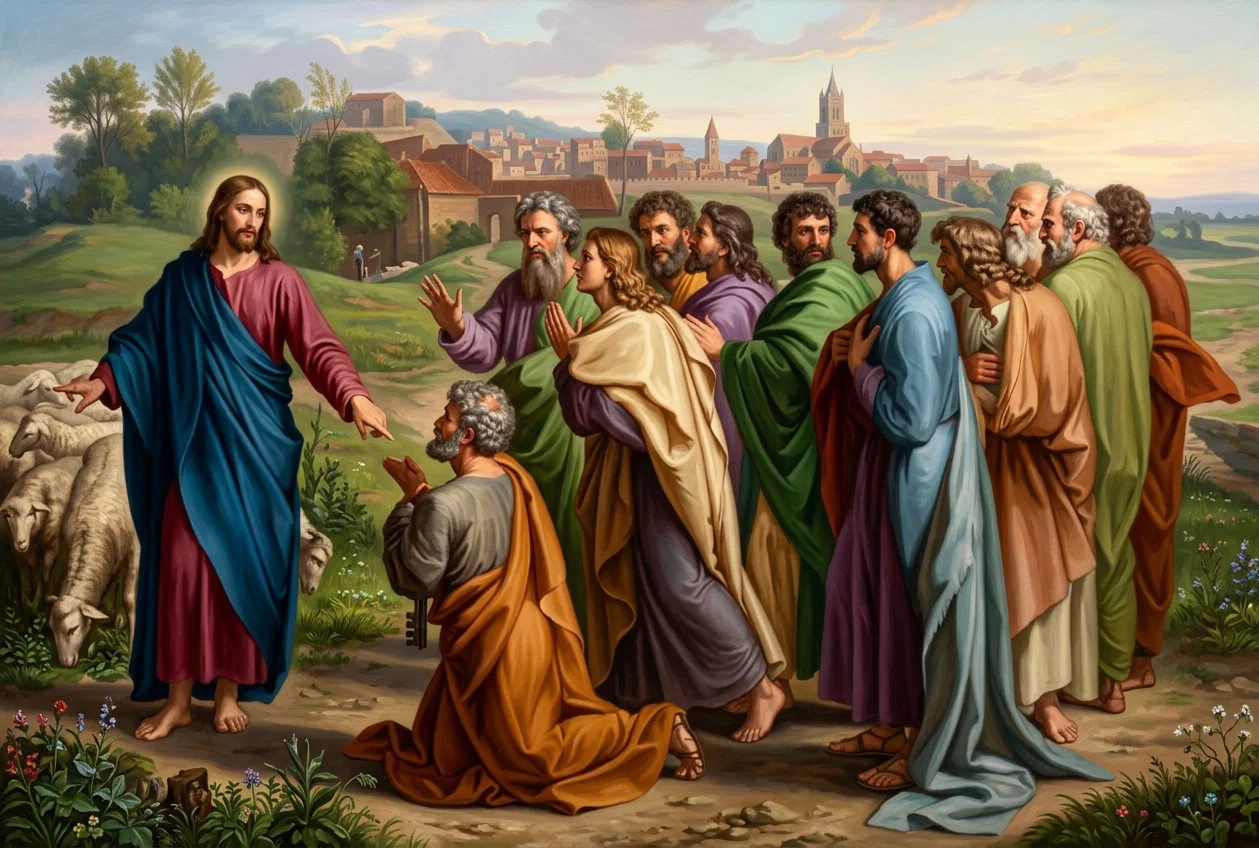
The second coming of Jesus Christ is not a strange doctrine to the Bible, nor should it be to Christians. Mr Moody is cited as saying that the second coming of Christ is mentioned, either directly or indirectly, on an average of every 25th verse in the New Testament. Both Old and New Testaments glow with the glorious triumph of God through His anointed Christ Jesus. Certainly an event mentioned as frequently as is our Lord’s second advent, to which so much importance is attached in the Bible, ought to receive some attention from His children. They ought to understand what it means; they ought to know its importance to the world; they ought to know its place in the great scheme of salvation; and they ought to know why it was that the faithful of all ages looked forward to that “blessed hope;” and this page, in part, tells some of the great reasons why God has made the doctrine as prominent as He has.
The “Fulness of Time”
At His first advent Christ came in the “fulness of time.” Gal. 4:4. Through all the long and weary ages, from the time that it was stated in the lost Garden of Eden that the Seed of the woman should bruise the serpent’s head, the children of faith had looked forward to the time when that Seed should be manifest. The whole book of Genesis ought to be read in the light of that one thought of the Seed. To His manifestation, and fuller manifestations which those of earlier ages did not understand as it has been revealed to those of later times, the eye of faith gazed with an intensity which in this material age is but faintly discerned. But Infinite Patience must endure the sore travail of the world’s ages before the time came for His first revelation. Then “when the fulness of the time came, God sent forth His Son, born of a woman, born under the law.” Just as truly the world is still groaning and travailing in pain, longing for the second manifestation in glory. He came first in humility; He will come again in glory supernal. When God’s fulness of time is come, then will be revealed the second time Christ Jesus the Lord, as King of Kings, and the great work for the redemption of man will be completed.
A Literal Coming. Acts. 1:9-11
The first advent of our Lord was literal. He was born a babe in a manger. He grew to childhood, to manhood. Men saw Him, talked with Him, walked by His side, ate, drank, and slept with Him. They listened to His teaching. They saw Him place holy hands on the infirm, the sick, the afflicted, and heal them. They saw Him crucified upon the cross. They saw Him laid in Joseph’s tomb. Men saw Him after He was risen from the dead. They beheld Him ascend into heaven. “This same Jesus” is coming again; not in humility, not with “marred” form, not with pierced side and wounded hands, but in glorious, everlasting triumph. All the marks of His humiliation and suffering in this world will be marks of everlasting glory when He shall come the second time. But it will be the “same Jesus” nevertheless, possessing the same loving character, bringing joy to every trusting disciple.
Counterfeits of His Coming
These are many. They will multiply as the days go by and His coming draws near. For instance, there is Mormonism which declares to the world that Christ is coming in the desert; there will be movements like Spiritualism and Christian Science which will declare that Christ is in this movement or in that movement. Some will tell us that He comes by His representative, the Holy Spirit; and the deceiver will have other forms and deceptions to counterfeit and counterwork the great, the glorious climax of the ages in the hearts of the children of men. Of all these God has forewarned us. Doubtless with the deceptions of Mormonism and Spiritism in mind Jesus admonished: “If they shall say unto you, Behold, He is in the desert; go not forth; behold, He is in the secret chambers; believe it not. For as the lightning cometh out of the east, and shineth even unto the west; so shall also the coming of the Son of Man be.” Matt. 24:26, 27. That His coming is not at death is shown by the fact that He is ever the Life-giver. Truly the sister of Lazarus said to Him, “Lord, if Thou hadst been here, my brother had not died.” His coming meant life to Lazarus. His coming means life forevermore to His children. Death is an enemy, “the last enemy” that shall be destroyed; and the coming of Christ Jesus will forever break the power which it has held over His children during earth’s mournful ages.
This question has often been asked by the skeptical, the caviler, the one who would ridicule the second coming of our Lord. They say, How can every eye see Him when this earth is round? But this round earth revolves; and when our Lord shall descend from the blue empyrean with all the holy angels, His feet do not rest upon this earth. Upon this the Word is very clear. His people are caught up to meet Him in the air. He is suspended, in His infinite power over every attraction, above this earth, and as the world rolls round to greet the glorious Sun of Righteousness, from hamlet and cottage, from mountain fastness, from dusty graves and deep sea, God’s people shall rise immortal, incorruptible, in one living stream, to meet Him in the air. “So [in eternal existence] shall we ever be with the Lord.” There will be one glorious outburst of glory upon the world, and that wonderful appearing will be one day, or the space of the world’s revolution. Then “every eye shall see Him.”
One of the means by which the enemy has sought to hide from God’s children the glory of His second coming, is by a perversion of some of the terms which are used to refer to His coming. One of these is the parousia, which means “presence,” “personal presence.” We are told that that personal presence will be in secret, quiet, still. Only those who are caught away will know of that coming of the Lord. Then sometime afterward He will come again with those who were thus caught away. But the Word of God does not so express it. For it is thus that that parousia is announced: “For this we say to you by the Word of the Lord, that we which are alive and remain unto the coming [presence] of the Lord shall not prevent [precede] them which are asleep. For the Lord Himself shall descend from heaven with A SHOUT, with the VOICE OF THE ARCHANGEL, and with the TRUMP OF GOD.” Tremendous sound will accompany His parousia, His personal presence. The words parousia, epiphaneia, apocalupsis6 (726)are three words expressive of different phases of the one event. The first, showing His personal presence; the second, the glory, the forthshining of that presence; and the third, the revelation, the disclosure, the true manifestation of the Son of God. Long centuries have veiled His glory. Now when He comes to His own, with all the effulgence of that supernal glory, He reveals Himself as He is, a King of Kings and Lord of Lords.
There will be two resurrections; one of the just, and the other of the unjust. Acts 24:15. And our Lord states the same truth in John 5:29; the resurrection to life, the resurrection to condemnation. The first resurrection—the resurrection to life—will take place when He comes. The second resurrection will not occur until the thousand years of Revelation 20 are finished. During that thousand years God’s children are with Him in the New Jerusalem on high, where He begins His eternal reign. At the end of the thousand years the New Jerusalem, the capital city of His new earth kingdom, will descend. During that thousand years the righteous will be engaged with Him in the work of judgment, in the adjudicating of rewards and punishments. See 1 Cor. 6:2. At the end of that thousand years, when the city shall descend, the wicked dead will be raised, their sentence awarded, the earth clean swept of sin and all identified with sin; and God’s children shall reign forever with Him where there shall be no more death, nor sin, nor any more curse. Rev. 21:1-7; 22:3-5.
Truly wonderful was the honor bestowed upon God’s creature, man, made in the image of God, upright in character, upright in form, of a nature like that of His Maker, made in God’s moral image, made glorious in physical likeness. We can not, however, argue for a moment that this invested man with immortality. If “made in the image of God” would mean that man was immortal, it would also clothe him with every other attribute of Deity. If we should say that man was made in God’s image, that God is immortal, therefore man must be; then we could as truly argue that as God is omniscient, and man is made in God’s image, therefore man must be omniscient; as God is omnipotent, man must be omnipotent. But this is absurdity itself, for we know that man has very little wisdom and very little power. All the physical attributes of man were dependent upon the most priceless of all attributes—character; and character must be the result of man’s choice. This is in every way reasonable and Scriptural.
Gen. 2:7 is a more particular account of the creation of man. He was formed of the dust of the ground. He was a perfect man; a perfect human machine, ready to exercise all the functions of humanity, he lacked but the one thing, the vitalizing spark. God gave that in “the breath of life.” The text does not say, as some would have us believe, that the breath of life was an immortal soul or spirit, a separate entity capable of so existing in itself apart from the body. It was simply life, that which made man a living soul. For mark that it was MAN that was formed out of the dust of the ground; and that man which was formed out of the dust of the ground, became, through the breath of life, a LIVING soul. Before he received the breath of life, he was a LIFELESS soul. He was no more soul after he received the breath of life than he was before. In the one case he was a LIFELESS soul; in the other, a LIVING soul. So we have repeatedly in the Hebrew Scriptures the term “dead soul” as applying to man, one from whom the breath of life had been taken. If we should still argue that “the breath of life” implied that man was immortal, it would also prove the same thing of beasts; for man and beast “have all one breath.” Ecc. 3:19. In Gen. 7:15, 22 the same expression is used of the whole animal creation,—“all in whose nostrils was the breath of life,” or “the breath of the spirit of life,”—an even stronger expression. Therefore “the breath of life” signifies no more than this, that man was made alive by this act of God. It is used elsewhere as showing how frail man’s life is. “Cease ye from man, whose breath is in his nostrils; for wherein is he to be accounted of?” Isa. 2:22. When man has reached the possibilities of perfect character, his whole being will throb with life.
Neither is it to be argued from the term “living soul” that man is immortal. The same term is applied to the very lowest animalcule, as for instance in Rev. 16:3: “Every living soul died in the sea;” also in Gen. 1:30 the term “life” in our Common Version is “living soul” in the margin. On the other hand the Scripture very clearly teaches that God is “immortal.” 1 Tim. 1:17. Nay, more than this, the same epistle declares that He “only hath immortality.” 1 Tim. 6:16. The human will put on immortality only when his character is finished and he shall be brought from the dead in Christ’s likeness. 1 Cor. 15:51–54.
What the Bible Says
1. How did man come to be?
“And God CREATED MAN IN HIS OWN IMAGE, in the image of God created He him; male and female created He them.” Gen. 1:27.
2. Of what was man made? What did he become?
“And Jehovah God formed man OF THE DUST OF THE GROUND, and breathed into his nostrils the breath of life; and MAN became a LIVING SOUL.” Gen. 2:7.
3. What possibilities were placed before him?
“In the way of RIGHTEOUSNESS IS LIFE; and in the pathway thereof there is no death.” Prov. 12:28.
“The heavens are the heavens of Jehovah; but THE EARTH HATH HE GIVEN TO THE CHILDREN OF MEN.” Ps. 115:16.
4. On what conditions were man’s possibilities and blessings assured?
“And Jehovah God commanded the man, saying, Of every tree of the garden thou mayest freely eat: but of the tree of the knowledge of good and evil, THOU SHALT NOT EAT OF IT: for in the day that thou eatest thereof thou SHALT SURELY DIE.” Gen. 2:16, 17.
5. Who made opposite claim?
“And the SERPENT said unto the woman, YE SHALL NOT SURELY DIE: . . . YE SHALL BE AS GOD, knowing good and evil.” Gen. 3:4, 5.
6. What did man do in response to this voice?
“And when the woman saw that the tree was good for food, and that it was a delight to the eyes, and that the tree was to be desired to make one wise, she TOOK OF THE
God’s life is eternal life. God’s life is given in harmony with God’s law. In other words, His law is a living law; it is the channel of His life. “In the way of righteousness is life.” If man had forever lived in harmony with God’s life, he would have known no death. When he allowed his lower nature to reign, when he set his own will against the beneficent working of God’s will, he perverted God’s life. Life perverted brings death; righteousness perverted is sin. Man became a sinner and lost eternal life. Had he not sinned, there was the possibility before him of developing character entirely apart from sin.
God placed man on probation. It was obey and live; it was just as truly, believe and live; for the only true obedience is “the obedience of faith.” Faith is the foundation principle upon which all right human character is laid. Faith in God meant a mind open to God, open to receive all that God had to give, open to all the infinite blessings of the universe, open to almost infinite possibilities and capabilities. Were it possible, even before sin entered, for man to develop a character in and of himself alone, it would have been a selfish character, and he would have boasted in himself; so also would his neighbor; and consequently, envy would have found place in God’s universe. But each developing a character by faith in God, by faith receiving of God’s life and blessing, would have given God all the glory. All would have been bound together in “the bundle of His life,” and all would have rendered glory and honor to the Creator. Each then would have found his highest happiness in blessing others. Consequently no one would have served himself; all would have served each one. So God planned infinite blessing and eternal life for His creatures; but as soon as man turned from God, all the blessings became curses.
Upon Satan’s claim have been built all the various false philosophies in which the devil has ever since sought to undermine Christianity. God said, “In the day that thou eatest thereof thou shalt surely die.” Satan said, “Ye shall not surely die! . . . ye shall be as God.” So he has led men to believe that they were not dying creatures, when God said they were; that they were divine, when they were only human; that they were immortal, when they were subject to death. All the false philosophies which lead men to build hope in themselves, in their own potency, are based on that falsehood of Satan. God sets before man the only hope, free, full, complete, all-sufficient in Christ Jesus; and everything that denies Christ Jesus is false. Upon that falsehood of Satan are based the false isms of the present day. Very sweetly and insidiously they come to us, just as Satan’s whispering came to Eve; but in Christian Science, in Spiritism, in Theistic Evolution, in New Thought, in Theosophy, in other false cults, philosophies, and isms, is found the baleful falsehood of self-salvation. The only way of life is righteousness; the only source of righteousness is Christ Jesus our Lord; the only way of obtaining it is by faith.
Man lost morality, his character. He became a subject of Satan. He lost his dominion. He was king of the earth; God gave him dominion over it. He yielded that also to the tempter; and Satan told the truth that it had been “delivered” unto him. He did not recognize the higher truth that man held it by lease, the conditions of which were faithful obedience to God; that he ignores, and presents simply that which man forfeited to him by treason to God. Yet man lost it literally, and for a time Satan is “the prince of this world.” God suffers it, yet He overrules. Man lost life also,—eternal life,—and became a dying creature.
God in His goodness did not leave His child in his misery. Right at that very time Christ our Lord stays the power of death and pours out anew His own life to the dying creatures. Then, too, came that prophecy that the Seed of the woman should bruise the serpent’s head. Around that Seed cluster all the promises of all the ages. Christ Jesus then gave Himself, “a Lamb slain from the foundation of the world.” He just as truly gave Himself then as He did upon the cross. He became man’s servant, the Angel of God’s presence through the ages; and when He died upon the cross, it was but the climax of the gift which He had bestowed in the beginning for the sake of man. Faith brings man in direct connection with the Lord Jesus; faith brings into the soul the power of the endless life. Through faith God removes the sin, takes away the sinful, carnal heart, places within His own Spirit and life, and sets the soul in the highway of everlasting righteousness; and that same power which enables man to overcome character, will change the body of his humiliation and fashion it after the body of Christ’s glory when He shall come. Then the incorruptible character will be given an immortal body, and man shall reign forever.
The Glorious Outcome
What a wonderful possibility is placed before the human! If he will but yield himself to the simple, perfect plan of God, he can overcome all the imperfection, and can be saved out of all its evil consequences. So those will be who yield to Him, for “this is the victory that overcometh the world, even our faith;” and that faith will culminate in man’s triumphant immortality, while sin and7all that is identified with sin will burn into utter nothingness in the blaze of infinite glory in which Christ shall come unto His own the second time. Not one sin shall mar all God’s universe; and in that very spot in His universe where the curse has been the deepest and the cruelest and the most corroding, where it put to death even God’s sinless Son, it shall be said for eternity, “And there shall be no more curse.” To that sinless, perfect inheritance, God calls all. “As I live, saith the Lord Jehovah, I have no pleasure in the death of him that dieth. Turn ye, O turn ye, for why will ye die?”
Once Jesus came to His own. He came with glory veiled; with His glorious divinity manifest only in goodness through humanity. God would have man learn from the goodness, the power and glory of His divinity; and therefore He came as a man among men. “He came unto His own, and His own received Him not. But as many as received Him, to them gave He power to become the sons of God, even to them that believe on His name.” Sometime He is coming to His own again. He is coming not with glory hidden in humanity, but with all the effulgence of His divine glory disclosed. His children are to be glorified with Him. All creation has been waiting through the long, sad years of earth for “the manifestation of the sons of God,” when the Lord comes the second time, to bring back from the grave those who have been invested by faith with His character, to redeem those who are meeting the persecutions and ills of earth, “of whom the world is not worthy.” All the hidden glory of the ages will shine out in triumphant splendor. That glory will immortalize His children; but that glory, which the world would not receive in Jesus of Nazareth, will destroy those in whose hearts it has no place. Sin will perish at His presence. Those who have identified themselves with sin by their own judgment and choice, perish with the sin.
Man, His Nature, Possibilities and Destiny
(Continued from page 6, middle column.)
“FRUIT thereof, and DID EAT; and she gave also unto her husband with her, and HE DID EAT.” Gen. 3:6.
7. What did man lose by his disobedience?
“And unto Adam He said, Because thou hast hearkened unto the voice of thy wife, and hast eaten of the tree, of which I commanded thee, saying, Thou shalt not eat of it: CURSED IS THE GROUND for thy sake; IN TOIL shalt thou eat of it all the days of thy life; thorns also and thistles shall it bring forth to thee; and thou shalt eat the herb of the field; in the sweat of thy face shalt thou eat bread, till THOU RETURN UNTO THE GROUND; for out of it wast thou taken; for DUST THOU ART, AND UNTO DUST SHALT THOU RETURN.” Gen. 3:17–19.
“Therefore, as through one man sin entered into the world, and death through sin; and so DEATH PASSED UNTO ALL MEN, for that all sinned.” Rom. 5:12.
“And the devil said unto Him, To thee will I give ALL THIS AUTHORITY, and the glory of them: for IT HATH BEEN DELIVERED UNTO ME.” Luke 4:6.
8. What new hope was set before man?
“And Jehovah God said unto the serpent, . . . I will put enmity between thee and the woman, and between thy seed and her Seed: HE SHALL BRUISE THY HEAD, and thou shalt bruise His heel.” Gen. 3:14, 15.
“To this end was the SON OF GOD manifested, that He might DESTROY THE WORKS OF THE DEVIL.” 1 John 3:8.
“Therefore it behooved Him [Christ] in all things to be made like unto His brethren, that He might become a merciful and faithful High Priest in things pertaining to God, to make PROPITIATION FOR THE SINS OF THE PEOPLE.” Heb. 2:17.
9. On what conditions may we avail ourselves of the blessings in Christ?
“For God so loved the world, that He gave His only-begotten Son, that WHOSOEVER BELIEVETH ON HIM should not perish, but HAVE ETERNAL LIFE.” John 3:16.
10. What possibilities does faith bring to the believer?
“But as many as received Him, to them gave He THE RIGHT TO BECOME CHILDREN OF GOD, even to them that BELIEVE ON HIS NAME.” John 1:12.
“This is the victory that OVERCOMETH THE WORLD, EVEN OUR FAITH.” 1 John 5:4, A. V.
“He that OVERCOMETH SHALL INHERIT ALL THINGS; and I will be his God, and he shall be My son.” Rev. 21:7, A. V.
11. What will come to those who reject this great salvation?
“Who shall SUFFER PUNISHMENT, even ETERNAL DESTRUCTION from the face of the Lord and from the glory of His might, when He shall come to be glorified in His saints.” 2 Thess. 1:9, 10.
“Whom THE LORD JESUS SHALL SLAY WITH THE BREATH OF HIS MOUTH, and bring to naught by the MANIFESTATION OF HIS COMING.” 2 Thess. 2:8.
12. Then “what shall be the end of them that obey not the Gospel of God” (1 Peter 4:17)?
13. Where will both righteous and wicked receive their reward?
“The righteous shall be recompensed IN THE EARTH; how much more the wicked and the sinner!” Prov. 11:31.
14. What will be the final result?
“He that sitteth on the throne said, BEHOLD, I MAKE ALL THINGS NEW. And He saith, Write: for these words are faithful and true.” Rev. 21:5.
“And there shall be NO CURSE ANY MORE; and the throne of God and of the Lamb shall be therein: and His servants shall serve Him; and they shall see His face; and His name shall be on their foreheads. And there shall be night no more; and they need no light of lamp, neither light of sun; for the Lord God shall give them light: and THEY SHALL REIGN FOREVER AND EVER.” Rev. 22:3–5.
“And EVERY CREATED THING which is in the heaven, and on the earth, and under the earth, and on the sea, and all things that are in them, heard I saying, Unto Him that sitteth on the throne, and unto the Lamb, be the blessing, and the honor, and the glory, and the dominion, forever and ever.” Rev. 5:13.
“The Word of Our God”
By L. A. Reed
By Prof. L. A. Reed
CHRIST'S CHARGE TO PETER
The Reliability of the Book
But abide thou in the things which thou hast learned and hast been assured of, knowing of whom thou hast learned them; and that from a babe thou hast known the sacred writings which are able to make thee wise unto salvation through faith which is in Christ Jesus. Every scripture inspired of God is also profitable for teaching, for reproof, for correction, for instruction which is in righteousness: that the man of God may be complete, furnished completely unto every good work.” 2 Tim. 3:14-17.
These words give what the Mind of inspiration has to say with reference to the credibility of those writings which we call the Bible. There is not the slightest hint of unreliability, but an absolute assurance of their entire credibility and authority, and effectiveness when applied to the life. Those books which Timothy studied were the sacred writings, namely the Old Testament, and this Old Testament had made him “wise unto salvation.” So Paul says that every scripture inspired of God will do this.
If the Old Testament, the Sacred Writings, that is, the Scriptures then in existence, which had been inspired of God, could do this for Timothy and others in his day, they will certainly do the same for those who follow them as he did. There is a great deal of discussion, unprofitable discussion, as to just how and in what way the Scriptures are inspired. But here we have it plainly stated that these writings are sacred, that they are able to make one “wise unto salvation,” that they are “profitable for teaching, for reproof, for correction, for instruction, or discipline, which is in righteousness: that the man of God may be complete, furnished completely unto every good work.” There are no other writings on the face of the earth that even pretend to do this, and there are none, unless based upon this Word, that could even begin such a work.
The Exactness of the Word
Let us take a few instances. Notice the words of the Scripture as recorded in Eze. 21:27. “I will overturn, overturn, overturn it: this also shall be no more, until He come whose right it is; and I will give it Him.” Here are very few words, but they state exactly conditions then existing, and that would continue to be absolutely in harmony with history, for over two thousand years. In the preceding verses, notably from the 18th to the 23d, we note that Israel had already been overturned by the Babylonian power, through its king Nebuchadnezzar. And here the statement is made that this kingdom of Israel is to be yet overturned three times, and then would cease to be a kingdom, “until He come whose right it is,” that is, Christ Jesus, and then the kingdom would be given to Him.
What are these three overturnings? Appealing to history, we see at once that the three overturnings were made respectively by Medo-Persia, Grecia, and Rome; and under Rome the miter was removed, and the crown taken off for the third and last time. Since then the kingdom has been no more; and we believe according to the Word that it will be no more “until He come whose right it is.” Here is a foreknowledge. It comprehends over two thousand years of this world’s history. The words are exactly correct; the statement is historically true. This scripture must have been inspired.
An All-Comprehending Word
In Gen. 12:3 we have the statement made to Abraham, “In thee shall all the families of the earth be blessed.” This very statement shows the all-comprehending knowledge of the inspired Scripture; and we have in the book of Galatians an inspired comment upon its marvelous meaning. We find in this last scripture that to be a child of Abraham is simply to be a child of faith; and then follows the statement, “And the Scripture, foreseeing that God would justify the Gentiles by faith, preached the Gospel beforehand unto Abraham, saying, In thee shall all the nations be blessed.” Gal. 3:8. The statement is that the Scripture foresaw that the Gospel would one day be given directly to the Gentiles, and that this Gospel to the Gentiles was therefore preached beforehand to Abraham in thus saying, “In thee shall all the nations be blessed.” It is easily seen that nothing short of the omniscience of God could write the Bible, and pile it full of such expressions, expressions that it takes ages to unfold and expound fully, and yet in not one single instance make any error, or divergence from historical fact.
The Battle of the Four and the Five Kings
In 1869 the great Semitic scholar, Professor Noeldeke, declared that criticism had forever disproved the claim of the 14th chapter of Genesis to be historical, and the reasons for this were stated. The political situation presupposed by this 14th chapter, he declared, was incredible and impossible. Further, at so distant a date Babylonian armies could not have marched to Canaan, much less could Canaan have been a subject province of Babylon. In fact, the whole story, he said, was fiction, based upon the Assyrian conquest of Palestine in later days. And the names of the princes commemorated in it were etymological inventions. So much for Higher Criticism.
This was in 1869. But now, in this year of 1909, Higher Criticism ought to correct its miserable conclusions of that day; but it is silent, for it never corrects a mistake, for that would show its fallibility, yea, more, its unreliability.
(Continued on page 12.)9
The Word of Our God
(Continued from page 8.)
There has been excavation and searching since that day, and the ancient world of western Asia has arisen again from the grave of centuries. As a result, we know almost as much about the Babylonia of Abraham’s time as we do about the Assyria of Isaiah’s time, or about Greece in the age of Pericles.
And now in the light of this flood of historic knowledge, it is the book of Genesis whose credence has been vindicated, and not the work of this modern German critic. Of course these discoveries have been disputed by the critic inch by inch; and altho they are overthrown, he, convinced against his will, maintains the old opinion still.
In the 14th chapter of Genesis four kings are named: Amraphel, king of Shinar; Arioch, king of Ellasar; Chederlaomer, king of Elam; and Tidal, king of nations; and these four made war with five other kings; namely, Bera, king of Sodom; Birsha, king of Gomorrah; Shinab, king of Admah; Shemeber, king of Zeboiim; and Zoar, king of Bela.
Here are nine kings and nine countries mentioned. This involved a good deal of country and a good deal of history. It is like a window through which we look to see what is going on in the world of nations at that time. Let us turn to the monuments of Babylonia, and see what we can find with reference to the history here recorded in the divine Scriptures. We find that Elam had conquered Babylon, and the sovereigns of Babylon had therefore become the vassals of Elam. Along with this conquest, Babylon had been divided into two kingdoms, and Ammu-Rapi was reigning at Babylon, the Biblical Shinar, and Ari-Aku was ruling at Larsa, the Biblical Ellasar. Here we have absolute agreement, as Ammu-Rapi agrees with Amraphel, Hebrew, and Ari-Aku agrees with the Hebrew Arioch.
This is enough to show the absolute agreement between this fragment of old-world history preserved in the book of Genesis, and the revelations of the native monuments. Even the proper names have been handed down in the Scriptural narrative, with but little alteration. For example, in the Babylonian we find Ammu-Rapi’s name sometimes written Ammu-Rapi Ilu, meaning Ammu-Rapi the god, and this Ammu-Rapi Ilu is letter for letter the Amraphel of Genesis.
Again, the word Chederlaomer proves to be a good Elamite name. The father of Ari-Aku, or Arioch, had the name Kudur-Nankhundi, which means, “A servant of the goddess.” Now Lagamar was one of the leading Elamite deities, and therefore Kudur-Lagamar would be letter for letter the Hebrew Chederlaomer. So we might go through with the other names, every one of them; but it is not necessary. Space forbids it. As Sayce says, “We may therefore place the same confidence in the letter (of this text) as we do in that of the clay tablets of Nineveh.”
“Rejoice”
Again, there is a wonderful revelation of knowledge with reference to the inspired words of the Old Testament when we trace out the root meaning of the word “rejoice,” as given in many a poetical expression in the old scriptures. For example, we quote a few of these scriptures to illustrate the point:
“Let the heavens be glad, and let the earth rejoice.” 1 Chron. 16:31. Here the words “be glad” and “rejoice” are in the Hebrew two different words. The same occur in Ps. 96:11: “Let the heavens rejoice, and let the earth be glad.” But looking at the English of these two verses, the words seem to have been interchanged. The word “rejoice,” for instance, in the first passage is connected with “earth,” but in the second reference it is connected with “heavens.” Similarly the words “be glad” in the reference from Chronicles are used with “heavens,” and in the second instance with “earth.” Thus a word used with “earth” in one scripture seems to be used with “heavens” in the other.
But this is not the case in the original. The word used with “heavens” in the one is the same Hebrew word that is used with “heavens” in the other; and in the original the word used with “earth” in one instance is the word used with “earth” in the other. There is in Hebrew no loose interchange of words such as we have in the English.
When we turn to a Hebrew lexicon and look for the inner root meanings of the two words, we are surprised at the result; but we no longer wonder at the selective use of these words. We find that the word used with “heavens” is the Hebrew word sameach (pronounced Saw-may-akh), which means to be blithe and gleeful, glad, joyful. It is from a primitive root samach, which probably means to BRIGHTEN up; hence, to be blithe or gleesome.
Looking for the word that is used with “earth,” we discover that it is the Hebrew word giyl (gheel), a revolution; meaning joy, to rejoice greatly. It is from a primitive root gwl (gool), which means to SPIN ROUND (under influence of any violent emotion), hence to rejoice, be glad. The idea of revolving, of a revolution, is a fundamental idea in the word, and its fitness in connection with the earth needs no comments here.
Other passages where the earth is thus spoken of as SPINNING ROUND WITH JOY are to be found. We give those we have discovered.
“The Lord reigneth, let the earth rejoice.” “Let the earth spin round with joy.” Ps. 97:1.
“Sing, O heavens; and be joyful, O earth.” Isa. 49:13. The word “sing” is translated from the Hebrew word Ranan (raw-nan), to SHOUT for joy, to sing, and has in it the fundamental idea of something AUDIBLE; but the word used with “earth” in this passage is the word Giyl. “Sing, O heavens; and SPIN ROUND WITH JOY, O earth.”
“Fear not, O land, be glad [giyl—spin round with joy] and rejoice [samach—brighten up].” Joel 2:21.
There is another remarkable thing; this word is used ONLY of persons, and in connection with the earth. There are instances where other words meaning praise, rejoice, etc., are used with the word “earth,” but in no instance is the word giyl used with any other of the heavenly bodies.
If the men who wrote the Scriptures were so tainted with astronomical errors as we are sometimes taught to suppose, and these errors crept into what they wrote, why is it that in no instance did they call upon the sun to roll around or revolve (about the earth) with joy? And if they believed in a flat, stationary earth, why is it that in about half the places where the earth is spoken of as rejoicing, it is said to roll, or spin, round with joy?
There are words in Hebrew used to express the idea of being glad or rejoicing, which have in them the root idea of an expanse, of a spreading out, and some with the fundamental idea of binding or fastening. Why is it, if these men believed in a flat, expanded earth, or a solid earth on pillars, that in no case did they use these words with reference to the earth? Let him answer who can.
If space allowed we might go on for pages and give literally hundreds such examples as are here presented. The conviction is forced upon us that the book we call the Bible is from God. Its authority and correctness can not be questioned. May we receive it, not as the word of man, but as the Word of God. So received, it will work effectually in us to make us complete in all knowledge that is worth the while, and in all character that is enduring. 1 Thess. 2:13.