ONE of the most deplorable features of modern times is the frivolous, unreal, and even skeptical conception of life which we meet so frequently, especially on the part of those who have but recently come to the estate of manhood and womanhood—who have but recently graduated from our higher schools. This unreal, air-castle conception of life is carried into their married life, when they have settled in homes of their own, and becomes a fomenter of all kinds of domestic discord. The wife or the husband is not like the pen-creation of the story-book, which the other had adopted as his or her ideal, and all dissimilar traits are marked, remarked, and magnified, till separation comes in one way or another.
But the delusion does not end in the sundering of these sacred ties. It is not aimed at that alone. The very transactions of every-day life, the purpose of life, the object in living, the conception of God, and the work of the Gospel—all are colored, disarranged, metamorphosed, by this lens of unreality thru which the young of to-day are taught to look. The mirage is taken for the real, and the real is shrouded in a mist of unreality designed by Satan to confuse, blind, and destroy.
One of the chief feeders of this dangerous stream is the fictitious literature which the pupils of our public schools are compelled to read and assimilate. Many thoughtful parents of all shades of religious belief, and some who have none, realize the grave danger in this modern method of giving pupils a “literary education.” All the sophistry, mythology, and carnal philosophy of the ancients are bundled into the curriculum of our schools, till the minds of the children in this their most plastic period are stuffed and clogged with these worse than useless husks, and their fermentation is breeding the bacilli of insanity, suicide, recklessness, domestic discord, skepticism, and the wild theorizing of theosophy and evolution. The tendency is recognized and deplored by many who feel their utter helplessness against it, knowing that the purpose of this increasing flood of evil is to turn that beneficial institution, the free public school, away from its legitimate work, and make it a source of real harm.
Principals and teachers have it in their power to check and turn back this tide of evil that is rising so rapidly and menacingly. They are susceptible to the pressure of parental influence, and many of them realize the hurtfulness of the present system—realize that to fill the mind in its formative period with this class of thought will give an unwholesome tinge to the whole life; but it is in the curriculum, and they teach it. Were a healthy public sentiment arrayed against it, these teachers would be strengthened and encouraged to grapple with the evil; but the tide is strong, and the opposition unorganized.
On the other hand, there are religious journals whose purpose is supposed to be to advance the cause of God in the earth, that are throwing the weight of their influence in favor of this fiction-education, both in the school and in the home. The following will give an idea of how one such journal (the Congregationalist) looks upon the matter:—
“Modern students of child nature are teaching us to guide a child’s reading according to the stages in his mental development. For instance, they tell us there is a time when the sense of humor is strongest; and a period when the youthful mind revels in rhyme and rhythm; and another when it demands tales of imagination. Certain it is that there are books which ought to be read for the first time in childhood, growing up without which the child has missed his heritage. We know persons who have reached adult life without having read The Pilgrim’s Progress or Robinson Crusoe. Their loss is simply irreparable. The allegory of Bunyan may be better understood, and the English of De Foe better appreciated by mature minds, but they have lost childhood’s power of complete surrender to a story; and they can never read these great books with the simplicity and faith of the child heart. The same is true of The Arabian Nights, The Alhambra, and many other legendary tales. Take, too, such a book as Alice in Wonderland. Its nonsense is irresistible to a child, while it may seem an incoherent and senseless jumble to an adult who reads it for the first time. With parents and teachers rests the responsibility of placing these classics in the hands of their boys and girls before it is too late.”
Of course the whole Pandora’s box of heathenism is not advocated in this single quotation, but the whole weight of the paper’s influence is thrown in that direction.
Let us look at the quotation more closely: “There is a time when the youthful mind revels in rhyme and rhythm;” that is, a time when the poetic instinct is keen and bright. What a grand opportunity to teach the child the wonders of his Creator in the poetry of the Psalms and Job! But what is done for him?—He is fed on the metered mythology of paganism.
There is another period “when it demands tales of imagination.” It is not necessarily “tales of imagination,” but tales, stories of people and things—and what more absorbing stories, and helpful stories, can be given than those which the Lord has left on record concerning His dealings with His people? What is the Lord’s own instruction concerning the teaching of the children? “But teach them [that is, God’s law and the story of His dealings with His people] thy sons and thy sons’ sons.” Deut. 4:9, 10. “And ye shall teach them [that is, God’s words] your children, speaking of them when thou sittest in thine house, and when thou walkest by the way, when thou liest down, and when thou risest up.” Deut. 11:19. Is this narrowness? If so, it is the narrowness of infinite wisdom. There are some things that are better narrow than broad; as, for instance, a leak in a dyke, a break in a dam, or the spaces between the bars of a tiger’s cage. It is wise to be narrow toward evil, but foolish to be narrow toward God; and he who fills his mind with the folly of this or ancient times is broadening toward the evil and narrowing toward the good. God makes no provision, He sets apart for us no time, for the study of folly or fiction.
But what is the proposed menu for the intellectual table of the child at this period?—Such stories as Robinson Crusoe, the Arabian Nights, the legends of the Alhambra, and Alice in Wonderland whose “nonsense is irresistible to a child.” When placed by the side of what the Bible has to offer, how weak and insipid is all this collection of fickle fancy and folly! Bunyan’s allegory is good; it is the storied experience of Christian trials and victories; but what is there in the rest of the assortment which a conscientious Christian parent or teacher can place before the child? God directs that the child be instructed in His ways and words. The world would have the child instructed in the irresistible nonsense and folly with which this and past ages abound. How does this irresistible nonsense compare with the irresistible wisdom which the Lord commands the parent to give the child?
Alice in Wonderland seems irresistible to a child, but a senseless jumble to an adult. Now, whatever it seems to the healthy mind of the adult, that is what it is; and the one who fills the mind of his child with a “senseless jumble” is guilty before God. He is not only starving the intellect of his child, but he is turning that intellect away from the love of God and the love of truth to the love of pagan philosophies, follies, and irresistible nonsense.
“With parents and teachers rests” a greater responsibility than that of “placing these classics in the hands of their boys and girls.” It is the responsibility of doing nothing of the kind, but of giving them the true food for all the various periods of their9life. God has in wisdom placed those periods in the child life, and He would have parents and teachers supply them with “meat in due season;” for “what is the chaff to the wheat?”
C. M. S.
News from Around the World
The leaders of the Snake Indian insurrection have pleaded guilty to the charge of conspiracy, and have been sentenced to eight years in the penitentiary and a fine of $250 each. The judge has suspended sentence on condition that they all return to their homes and refrain from such acts in the future.
Germany is making an experiment in the matter of operating railroads by electricity instead of steam. If the experiment, which is being made on a road from Berlin to Zossen, proves the success which the promoters of the enterprise anticipate, it will change the entire rapid transit system of the empire.
The Hay-Pauncefote treaty, which had been amended by the Senate, has expired, as one of the provisions of the treaty was that it be ratified before March 4. The British ambassador appeared at the State Department on March 11, and informed the United States Government that Great Britain could not accept the treaty as it had been amended. The question of building the Nicaragua canal, so far as the matter of a treaty is concerned, remains just where it did before any negotiations had been entered into by Secretary Hay and the British ambassador. This is regarded as a bold stroke by England, and the question now is whether the United States will declare the Clayton-Bulwer treaty abrogated, and go ahead with the building of the canal.
Within the present week 12,000 more troops will leave England for South Africa, notwithstanding the fact that negotiations for peace are reported to be in progress. Several small engagements have been fought during the week, but no important movement has been reported from either side. The English continue to pick up guns, rifles, horses, cattle, sheep, and wagons, and the remnants of the Boer armies are known to be in a sorry plight. At the present time the British war office is planning a complete reorganization of the military force which will greatly increase its efficiency both at home and abroad.
A distressing scene took place in the English House of Commons on March 5. The chairman applied the closure rule on the discussion of the educational estimates, which caused the Irish Nationalists to refuse to leave the House when the division was taken. The police were called in to remove the members who refused to obey the ruling of the chairman, and the scene which followed was without parallel in the history of the House. The members, violently struggling and hurling epithets at the chairman, the officers, and their opponents, were carried bodily out of the chamber.
President Hadley, of Yale University, delivered a sermon in Old South Church, Boston, on March 10, in which he declared that: “We shall have an emperor in Washington within twenty-five years unless we can create public sentiment which, regardless of legislation, will regulate trusts. But to-day, with our industries organized into trusts and an imperialistic spirit developing in politics, the general principle of the development of trusts will become appalling unless we cultivate a higher spirit of morality than ever before.”
No matter in what way the great Chinese kaleidoscope is turned, the hand of Russia in Manchuria appears in every view. The other powers are protesting against the preponderance of Russian influence and the demands which the Russians are making; but still China shows a disposition to yield to the demands of the czar, fearing that the powers will not back up their protest, and that her failure to yield now will mean greater demands later. The tangle still shows no signs of the unraveling hand.
Professor Flinders Petrie, who is now excavating among the tombs of the ancient kings of Egypt, writing from Baliana in Upper Egypt, appeals thru the London Times for contributions to enable him to follow up remarkable discoveries at Abydos among the royal tombs of the first Egyptian dynasty. He has uncovered many interesting relics of that most ancient kingdom, and specimens of hieroglyphics from the very crudest to the most delicate and regular.
The ever-present fermentation in the Balkans and the quick massing of 150,000 troops by Turkey, in that vicinity, is again commanding the attention of European countries. Russia is advocating that the armies of Servia, Bulgaria, and Greece be greatly diminished, on condition that the powers shall guarantee the independence of these countries. It is claimed that the assent of Great Britain and Austria to this proposition has already been obtained.
A severe storm visited Chicago and vicinity on March 10, destroying or damaging property to the extent of $175,000. On the same day a terrible storm swept over the Mississippi Valley, Kentucky, Missouri, Texas, and Arkansas, feeling perhaps the greatest fury of the gale. At Willspoint, Texas, 8 persons were killed, and casualties are also reported from other vicinities. The property loss will amount to many hundred thousand dollars.
Both branches of the Utah Legislature have passed what is known as the Evans bill, relating to prosecutions for polygamous practice. According to the provisions of this bill, civil actions against polygamists can be brought only by relatives of those concerned. This is designed to prevent the prosecution of polygamists, and it is believed that it will be a great encouragement to Mormonism, especially in the matter of plural marriages.
Increasing apprehension is felt in Bulgaria at the concentration of Turkish troops on the Macedonian frontier. The Bulgarian Government has received sharp reminders from three of the European powers, that she will be held responsible for the preservation of the peace. Great anxiety is said to exist also in Albania, which is in an unusual state of ferment.
Many persons were hurt in Lisbon, Portugal, on March 10, in an anti-Jesuit riot. The police were compelled to use their swords upon the riotous students, but were unable to prevent a recurrence of the disorder. The municipal guard is now patrolling the city, and a strict censorship is enforced.
The unusual phenomenon known as red rain, or blood rain, occurred in Sicily and the southern part of Italy on March 10, filling most of the inhabitants with fear. The sirocco, or dry dust storm of Africa, is believed to have caused the red rain, the dry dust having been borne with the wind across the Mediterranean, and coloring the rain as it fell.
A Swedish army officer has patented a new contrivance of the nature of an aerial torpedo, which is propelled thru the air by the escape of a gas generated within the torpedo. The Swedish Government has granted the inventor a subsidy for conducting experiments with this instrument.
A new species of the X-rays has been discovered by a French chemist named Bacquerel. The new rays, for which wonderful properties are claimed, will bear the name of their discoverer. These rays are said to render almost every transparent substance luminous in the dark.
The decision of the eastern coal operators to continue the present wage scale for another year is declared by the officials of the miners’ unions to be very unsatisfactory, and the union officials regard a great strike as almost a certainty during the present year.
A party of 50 Russian section-men who were engaged in clearing the tracks after a snow storm were run down by a train on March 7, and 30 of the workmen were mangled beyond recognition. Inquiry showed that the engineer and all the trainmen were intoxicated.
Officials of the Agricultural Department who have been conducting a series of experiments with wireless telegraphy claim to have attained remarkable results, having evolved a system radically different from the Marconi system and of greater efficiency.
The geodetic survey of the arc of the 39th parallel of latitude across the continent has been completed after 37 years of work, and the results have just been published. This survey will serve as a true base line for all future surveys in the United States.
Three great coal and iron companies of the South are reported to have formed a combination, or trust, the combined capital of the three companies amounting to $93,000,000. The new concern will probably be capitalized at a considerably larger sum.
A trivial school incident precipitated a riot in San Juan, Porto Rico, on March 7, in which about 1,500 natives took part. The mob was dispersed by the soldiers, and the superintendent of schools was rescued after some rough handling.
Señor Sagasta has succeeded in forming a cabinet at the invitation of the queen regent of Spain. His construction of the cabinet seems well received in Spain, as it holds out promises of reforms.
General MacArthur reports to his superiors at Washington that he has exiled to the island of Guam another company of persons whom he regarded as sympathizers with the Filipinos in arms.
A report from Tien-Tsin, China, states that the Chinese are again circulating pamphlets vilifying foreigners, and calling upon the boxers to make renewed efforts for their expulsion.
Hunger and cold have driven the wolves of Hungary, in some localities, out of the forests and into the villages. Twelve persons have been killed and devoured by these hungry packs.
The new star so recently discovered in the constellation Perseus, and which advanced so quickly to first magnitude, has now diminished in brilliancy to the third magnitude.
The extraordinary session of the Senate, lasting only six days, adjourned March 9. Senator Frye, of Maine, was sworn in as presiding officer of the Senate pro tem.
The Iowa State University sustained a $250,000 fire on the morning of March 10, which badly cripples the medical and literary departments of the institution.
The plague situation in Cape Town, South Africa, is becoming more serious. The malady is reaching the most prosperous classes as well as the poor natives.
Smallpox is epidemic in the State of Kansas. A bulletin issued by the State Board of Health shows that there are over 1,000 cases in the State.
The Cuban export duty on tobacco, which amounted to 50 per cent., has been removed by order of the President, to take effect April 1st.
The Portuguese Government seems to be following the lead of France, and is preparing to enact legislation against the Catholic orders.
A pilgrim steamer plying on the Black Sea was overwhelmed in a storm recently, and 72 of the pilgrim passengers were lost.
The Moroccan tribes in proximity to French Algiers are in full revolt, and reinforcements are being sent forward.
Anti-tax riots have again broken out in Madrid, and the tax-collectors are being mobbed by the people.
The appropriations voted by the Congress just closed amount to $1,440,062,545.
THEORY VERSUS PRACTISE.
By G.
The very best of theory is often practically stultified by inconsistent action. The prominence given to an exception sometimes is the real utility of doctrine acknowledged to be orthodox. A case in point is reported in the Virginia Messenger for February:—
“At a meeting of the ministerial conference in Richmond, the latter part of January, 1901, Dr. Thomson was called on to make a statement of the work of the league to be done in that city. He said he was doing an educational work in reference to Sabbath observance, that he was trying to teach the people that our government was founded upon distinctly Christian principles. The government, in fostering the Christian religion, was simply conforming to the purpose of its founders.
“Rev. Dr. J. B. Hawthorne, of the Baptist Church, took issue with the speaker, and said that if Dr. Thomson was doing any such work he was violating the principles of the Richmond Sunday Observance League, as well as the fundamental conception which Richmond people hold of the relation of civil government to religion; that the Plymouth and Massachusetts colonies did not embody the American idea of religion, which was expressed by Roger Williams. The American idea is that the State has no religious function, and civil legislation in the interest of any religion is a violation of the right of conscience; that the State had no more right to favor the Christian religion than it had to favor the Mohammedan religion.
“The matter was referred to the Conference Committee of Ministers, who should voice the views of the Baptist Church on this subject.
“On February 4 this committee again met and unanimously indorsed the views expressed by Dr. Hawthorne as being fully in accord with their own and the Baptist churches'. Their report was lengthy; they refused to follow the lead taken by Dr. Thomson, but they are heartily in favor of the Richmond Sunday Observance League, so far as its efforts are directed to the observance of Sunday as a civil institution.”
Thus the action of these people in indorsing compulsory Sunday observance is in direct antagonism to the wholesome doctrine outlined by Dr. Hawthorne, and nominally approved. The expression of sentiment was in support of the right, but the action was in the line of Dr. Thomson’s Church-and-State teaching. This “civil-Sunday” theory was conceived in the interest of the religious Sunday, and the originators of the idea designed it simply as a stepping-stone to the compulsory religious observance of the day. The man who has been the leading promoter of the “civil-Sunday” rest day, has widely published the sentiment that to take the religion out of the observance is to take the rest out. In California, leading advocates of the delusion have openly admitted that it was but an opening wedge to serve a purpose until public sentiment could be educated to the acceptance of a Sunday law on religious grounds. And the fact is patent that there would be no suggestion at all of a legal rest day on Sunday, were it not for the alleged sacredness of the day, and the common religious observance of it by the people. The “civil-rest-day” plea and the “temperance” plea of closing saloons on that day were designed by their originators to win conscientious Sunday observers over to a practical acquiescence in religious legislation. And it is surprising to see how many otherwise wary people are being caught by the bait. That a company of learned men who could understand and indorse the sentiments enunciated by Dr. Hawthorne could so far make void those sentiments as to favor the work of the Sunday Observance League—which is right in line with the work of Dr. Thomson, with whom they thought to disagree—is beyond ordinary logic. It can only be accounted for by the fact that we are living in the last days, when, by the rejection of truth, men become the victims of “strong delusion.” See 2 Thess. 2:7-12.
G.
INTERNAL DISEASE FROM EXTERNAL ORNAMENTATION.
By Mamie A. Paulson
BY MAMIE A. PAULSON, M.D.
When God made man and woman in Eden, He made them upright, and without doubt He made them beautiful, because the Word tells us man was made in the image of God. It was only as a result of sin that they were obliged to wear clothes. At first these were very simple; but as sin increased and man became more and more degenerate, more clothes were added, until at the present time in many cases the beautiful clothing is admired instead of the beautiful creature which God created.
True beauty must spring from within. The beautiful girl must be a healthy girl; she must have a healthy circulation of pure blood thru a sound organism. This will give color to the cheek, a smooth skin, and a well-developed body, with sound muscles, which will be able to maintain the body in proper poise.
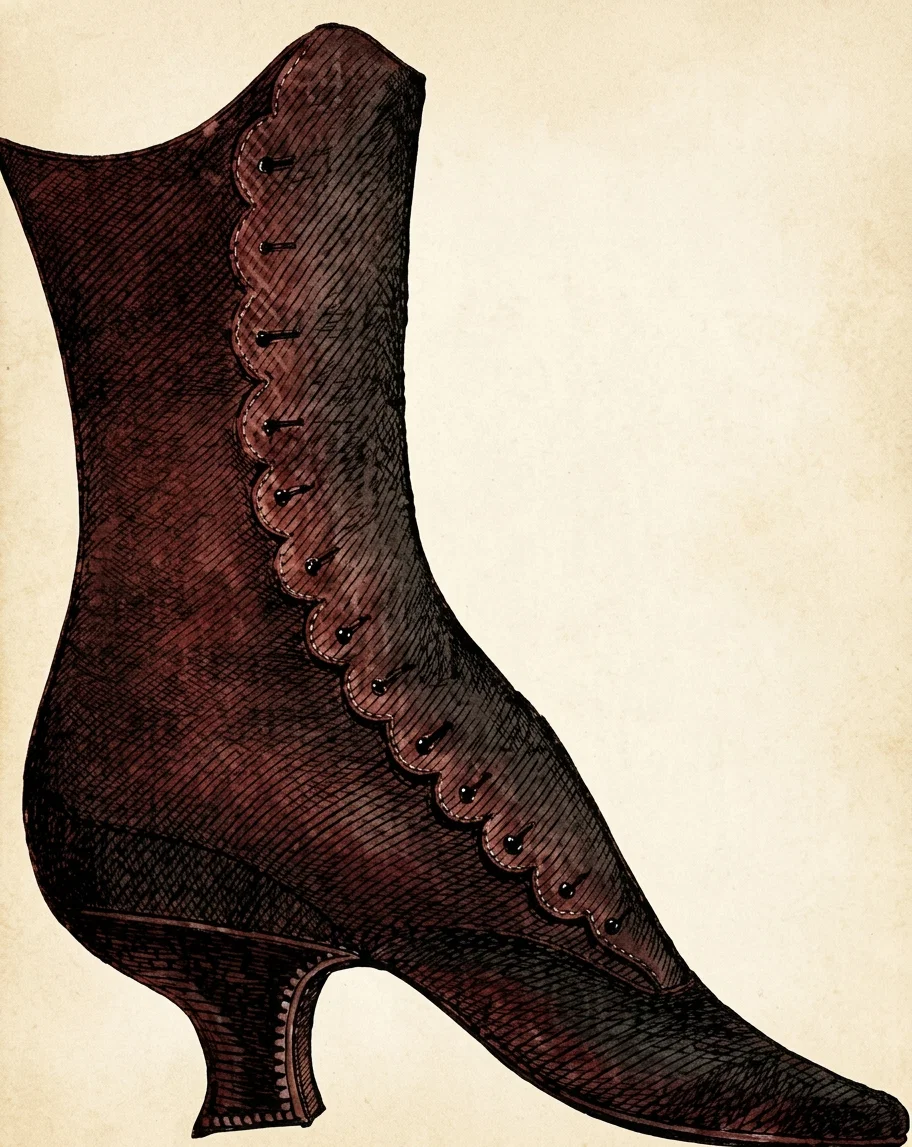
The fashionable high-heeled shoe, the connecting link between a healthy foot and the foot of a Chinese lady.
As a result of violation of the laws of health in regard to diet, exercise, and dress, we have sickly, dwarfed, and deformed bodies. We have been so long accustomed to these ill-shaped bodies, and to artificially correcting them to meet the standard of beauty in many minds, that I fear we are not in a position to appreciate the truly beautiful. So much is artificial nowadays. People spend hours and hours studying and admiring works of art, while the natural is passed by almost unappreciated.
No clothing, however rich and elegant, can make an ill-shaped, weak, distorted body look beautiful, or even comely; and, happily, no dress, however poor or humble, can make a well-proportioned healthy body look mean or insignificant.
We think more of prevailing customs than we do of our lives. Some have said they would rather die than part with their corset. In such a case custom and fashion rule, and the physical laws governing our bodies are made servants to what is sometimes cruel custom; and we begin to wonder whether there are persons left who still have a sacred regard for the human form divine.
Much effort has been put forth along lines of reform, but there is great need for more. The statement that the average body is deformed may be startling to some; but that it is so, and very commonly so, can not be questioned. These are not the deformities which have come as the results of accidents or some diseased process. They are cultivated, and we ourselves have made them.
Shoe Worn by the Bound-foot Women of China, Three-fourths Actual Size.
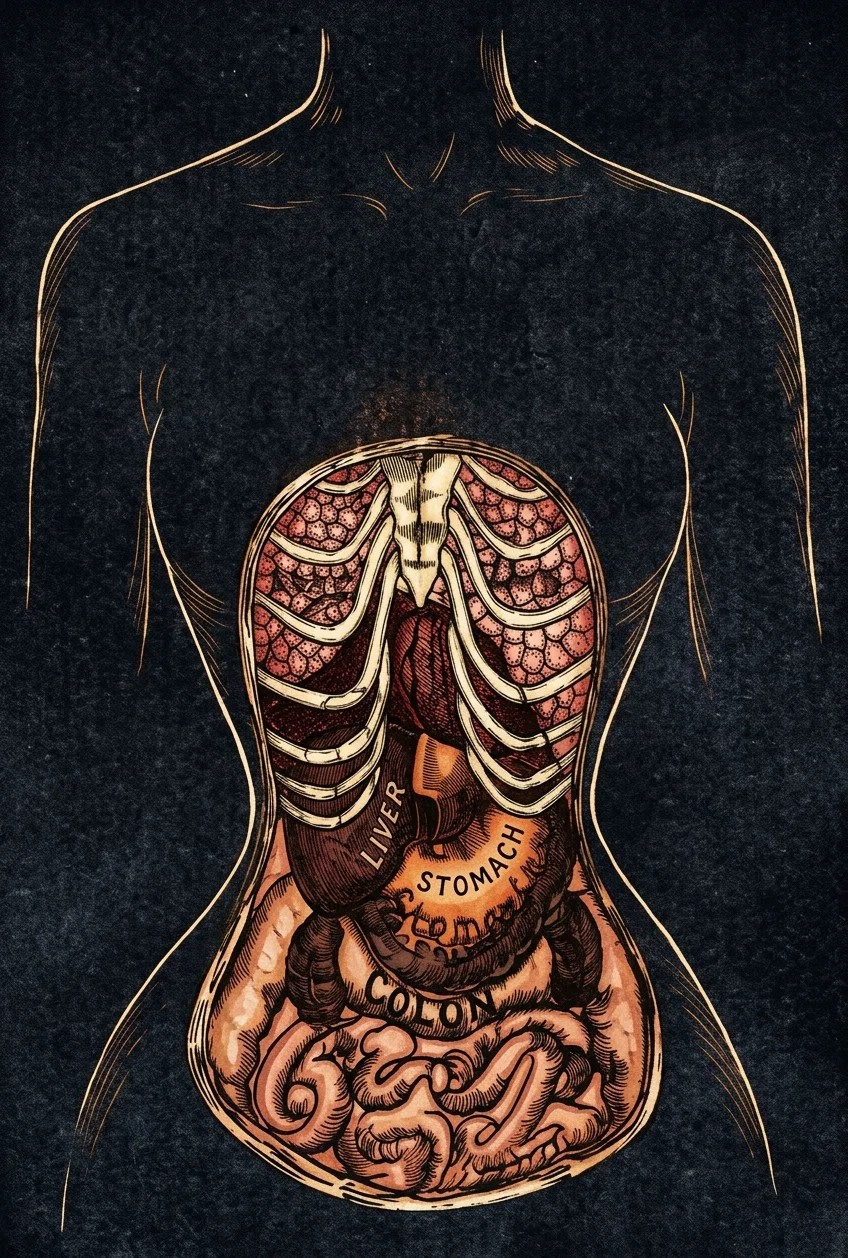
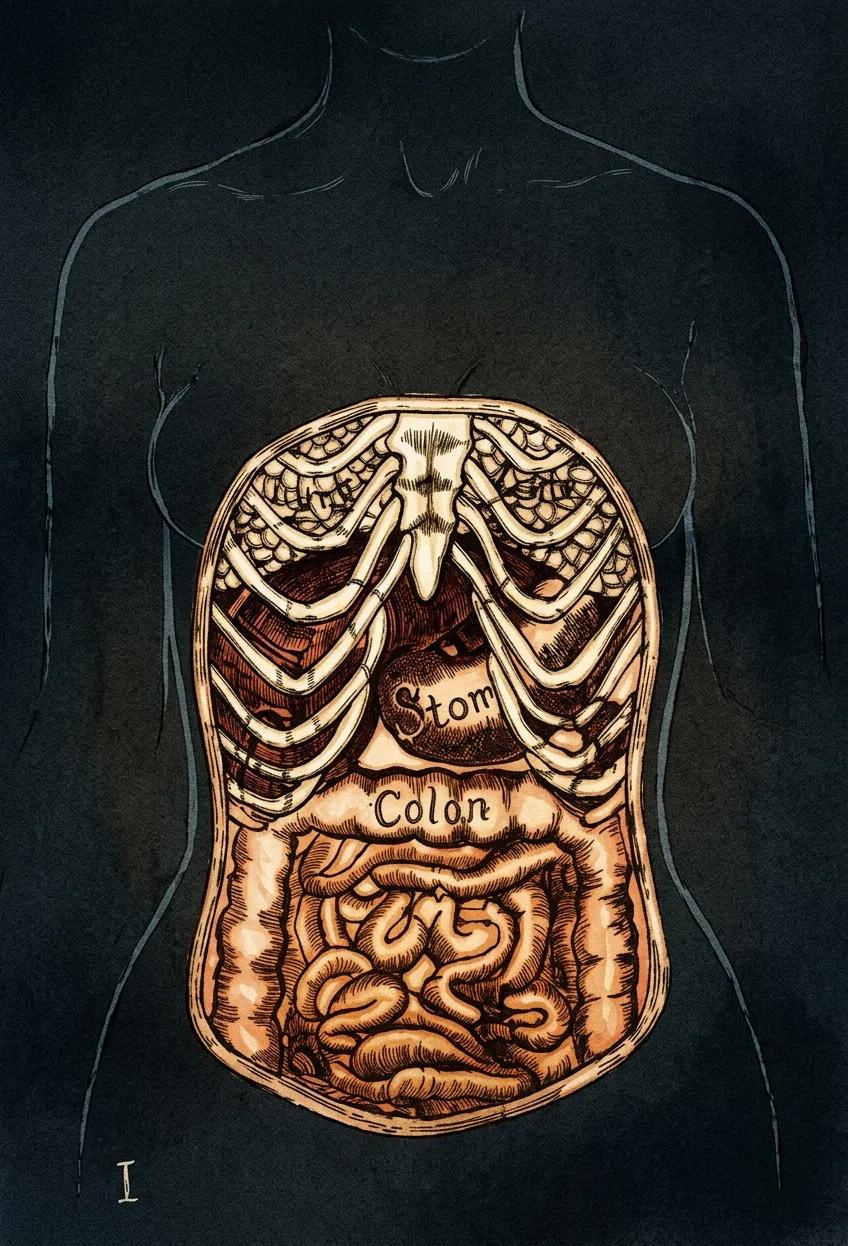
In China the feet are deformed. Among some Indian tribes the head is deformed. In our country the trunk, and especially the waist, of civilized women has been deformed by tight lacing, heavy skirts hanging on the hips, long trains, etc. To appreciate this fully, one ought to become familiar with the human anatomy. On examining the normal human body, we notice that the lungs and heart lie in the chest cavity, and just below them is the diaphragm, separating the two cavities. Below the diaphragm are packed away the stomach, liver, spleen, and kidneys; below these are the small and large intestines. It can be readily seen that at the waistline are situated at least five important and very vital organs of our bodies, upon which we must depend almost entirely for proper bodily nourishment. We are made of what we eat, but our eating apparatus must be in good order if we would be made well.
By carefully observing a perfect figure, it can be seen that the lower ribs spread far apart, so that as much room as possible is furnished for these organs. In fact, the difference between the bust and waist measure ought not to be as great as dressmakers would have us believe. Instead of ten inches difference, there should not be more than six. Daily a physician deals in his office with patients who are suffering from chronic diseases as the result of displaced internal organs. That we should insist upon sowing for sickness instead of health seems strange.
The mother thinks her duty is not fulfilled toward her daughter until she shapes her body according to the prevailing custom of dress, and so, often, at the age of twelve, when the young girl should have every possible chance to develop according to natural laws, she is made to grow into a vise. The young girl should have all the chances for development that the boy does, but instead we find the girl's trunk muscles becoming weaker and the waist decreasing in size, so that it has been found by actual measurement that the waist of the young lady is frequently smaller than when she was a girl of twelve. That this constriction does decrease the size of the waist is proved by the fact that when the corset or tight bands are removed, the waist in- creases in size. I have known this increase to be as much as five or six inches in some cases, showing how greatly the action of the organs located there must have been interfered with.
Headaches, backaches, a feeling of lassitude, inactive bowels, torpid livers, irritable nerves, and nervous prostration have become so common among women especially that it is taken for granted that these are part of our heritage, the same as the color of our eyes or the shape of the nose, and so we try to make the best of it. We find it quite impossible to change the color of the eye, but in most cases these headaches and backaches can be driven away. Why should people always be sick, when with so little effort they could be made well?
We have within our bodies two nervous systems one called the cerebral-spinal system, the other the sympathetic system. By means of the latter the viscera are connected, so that when one organ is affected another sympathizes with it, as it were.
View of the bound waist, showing displacement of vital organs caused by tight lacing—a cause of weak, diseased offspring.
For instance, patients suffering with stomach trouble very frequently have at the same time palpitation of the heart. This is due to the irritation of the sympathetic nerves connecting these two organs. Perhaps we ought to mention that the centers for these nerves lie along the spine, thus accounting for the fact that so often the distressing symptoms are felt in the spine and possibly not at all in the organ which is causing the difficulty. Many of us can recall the disagreeable sensation of having our ears pulled when we were children. Such pulling continued for any length of time would have made us very irritable. It is not at all surprising, then, that when such an organ as the stomach or kidneys is prolapsed, stretching the hundreds of nerves going to it, there should be pains and aches and irritable nerves. This condition is what is accomplished by the conventional dress, prolapsing the stomach, and spleen, and kidneys. It can readily be seen that no amount of plasters or liniments of any sort, or even internal medication, is going to cure such a condition. To bring about a permanent cure the causes producing the difficulty must be removed.
Not only are these organs greatly displaced and the muscles weakened by the conventional dress, but there are other great evils which arise. The diaphragm is so situated that as it moves up and down in free respiration, it acts as a pump, forcing the blood in and out of the abdominal cavity, especially influencing the portal circulation, or the supply of blood to the liver. Conventional dress does not allow the expansion of the ribs at the sides, which would occur in free movement of the diaphragm and the other respiratory muscles, so that the circulation of the blood thru the abdominal viscera is much interfered with, and we have as a result the common torpid liver and dyspeptic stomach.
The healthy waist, showing the vital organs in their natural positions.
Another but not less important evil is the abnormal mode of respiration, which the conventional dress necessarily causes. That respiration is interfered with is shown by the readiness with which a woman tightly dressed gets out of breath. The first thing ordinarily done for a fainting woman is to cut her waistbands and corset strings, so that she may catch her breath.
In proper action of the chest there should be an expansion, not only in the upper chest, but also in11the lower. It does not seem quite right to speak of thoracic breathing only or of abdominal breathing; the two should be combined. If there are no restrictions, a difference of one and one-half to two inches should be noted in the measurement of the waist in forcible respiration, and even more than this in the upper-chest measure. This is impossible with a corset or ordinary health waist or tight-fitting waists or belts of any kind. Why not allow all the life-giving air to enter our bodies that nature has made provision for?
Another evil of the conventional dress is that of an ungraceful, unnatural carriage of body in sitting, standing, and walking. At the present time curvatures of the spine are extremely common. There is scarcely a woman found who does not have some form of spinal curvature to a greater or less degree. Reference has already been made to the fact that the constriction of the trunk muscles has much to do with this. Ask a woman to take off her corset, and she quickly tells you that she can't hold herself up without her corset, simply because she has no properly-developed muscles to hold herself up with.
The healthful dress should be one which allows perfect freedom of every organ and muscle of the body, and which equally clothes all portions of the body. To accomplish this, the limbs and feet must be well protected; thin-soled shoes should not be worn in cold weather; the arms also must be well clothed; there will be no tight elastics around the limbs, no constrictions of any kind about the waist or neck. There is a good feeling that goes with freedom that rewards one well for making the change. When this is done, then an effort must be made, by means of well-directed exercises, to strengthen the dwarfed muscles, and replace the displaced organs, and increase the chest capacity.
When He reigns in the heart,
Every grief must depart;
Where He dwells, not a cloud can be found;
If for Him you make room
He will banish the gloom,
Spreading gladness and sunshine around.
If we let Him abide (Ps. 32: 8),
O, how smoothly we glide (Isa. 32: 17),
Now, safe anchored, no tempest can move!
What tho riches take wings,
He will heal the sharp stings,
And His banner around us is love (Cant. 2: 4).
Thus we speed on our ways,
Clad in garments of praise (Isa. 61: 3),
With our Lord's Gospel sandals we're shod;
In His might, O, so strong (Prov. 18: 10),
We can never go wrong,
While abiding and hiding in God (John 15: 10)!