FOUR reports have been received from Societies in Indiana. At Wolf Lake the membership is thirty-three, eight members having been added during the last quarter. Meetings are held every two weeks. A little missionary work with our papers has been undertaken. The report says: “We have had very interesting meetings, and the young people seem very much in earnest in the work.”
The South Bend Society has a membership of ten. Weekly meetings are held. One dollar and nine cents has been collected and used in missionary work. “All things are encouraging. The interest is good.”
Another active Society is reported at Anderson. There are twelve members. These gave $1.41 as an offering to missions. The Society is actively engaged in distributing our papers, and is also taking part in the “Christ’s Object Lessons” campaign. The secretary says: “Our interest continues to be good. We are looking forward to becoming useful workers in the field.”
Boggstown is the location of the new industrial school in this State. The students have just organized a Society of twenty-five members, which will meet each Sabbath afternoon. As the organization has just been effected, no work is reported as yet. It will certainly be a very valuable part of the education of these young people, if they can plan to spend a short time each week in active missionary work.
We also understand that a Society has been organized at Indianapolis, but the regular report from the Society has not yet been received.
L. F. P
Question Hints
(To be given to different members, and answered in the meeting)
Show from the Bible how 1 Cor. 1:27, 28, is true in God’s choosing his servants to carry on his work in all ages. Give illustrations.
How many different movements has God inaugurated at different periods of the world’s history for the deliverance of his people from physical or spiritual bondage? What is the last movement, which has already begun?
How did Wm. Miller obtain the tenth day of the seventh month as a point from which to date the beginning of the 2300 days? Compare Dan. 9:25 with Ezra 7 and Lev. 16:29, 30.
Demonstrate the period of the 2300 days by a diagram.
Our Rabbit Neighbors
By Floyd Bralliar
No doubt all the girls and boys who will read this story have been acquainted with rabbits most of their lives, but all of them may not have known what wonderful little animals they are; for they are wise little creatures, and well fitted for the life they live.
Bunny eats grass and clover; and if there is a picket off the garden fence, she likes very much to creep in and eat the young peas and cabbage stalks. Let me tell you how she knows whether this hole is just the right size,—for she is a wise Bunny, and will not crawl into a hole where she might stick fast. On the side of her face grow a number of long hairs. We call them “whiskers.” These stick out just as wide as her fat little body; and if, when she pokes her head into an opening, these whiskers brush on the sides, she knows she can not get through that entrance, and very wisely looks for another. I wonder how many little boys and girls who have noticed these whiskers on Bunny’s face knew what they were for?
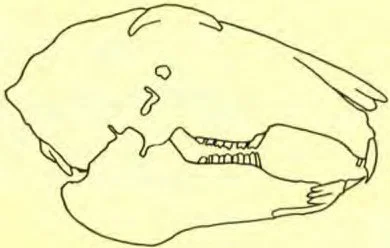
A RABBIT'S SKULL
Puss has whiskers, too, but hers are for an entirely different purpose. If you will notice, the whiskers on her face stick out in front of her nose. When she is creeping softly up to a mouse or a bird, she must go very quietly, so that she will not disturb it. She keeps her eyes fixed on it all the time, and could not see if something were in the way that would make a noise if she touched it. This is where her whiskers help her.
If there is anything in the way, her whiskers touch it, and she stops instantly, without making the least noise.
While Bunny is fond of grass, and thinks peanuts or beans a rare titbit in the winter, her chief diet is the inner bark of berry bushes and crab-apple-trees. She is equally fond of the bark of small apple-trees, and this is just the reason our fathers sometimes tie rags around the little trees in the orchard before winter begins.
I want to tell you about Bunny’s teeth, and how it is that she can get into the bark so easily. Her front teeth are long and sharp, and the outside edge is covered with a hard coat of enamel, but the inside edge of the tooth is made up of soft dentine. This means that when she bites anything hard, the inside of the tooth wears away, and leaves it just like the edge of a chisel; and the more she gnaws the bark of trees, the sharper her teeth get. If she breaks a tooth, it soon grows out again. She can cut large sticks in two, if she wishes; and where she works, she leaves little chips almost like the chips that are left by a beaver. While it is still winter, if some of you will go out into the hazel brush, and use your eyes for a little while, you will find where she has been eating the bark of crab-apple bushes or little thorn sprouts.
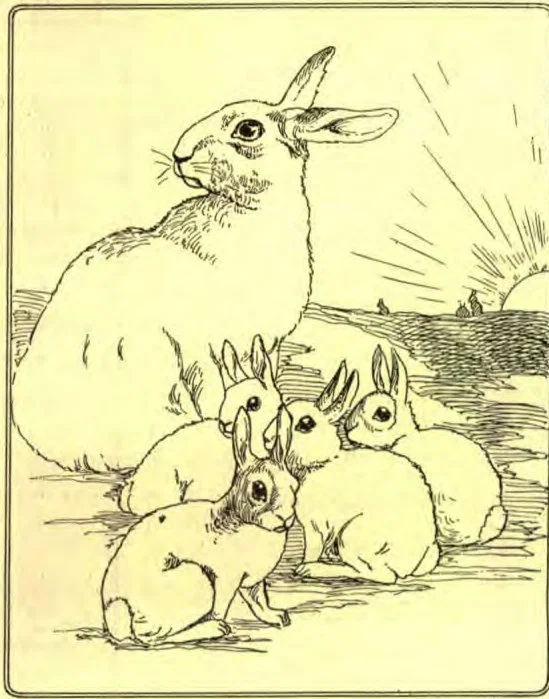
BUNNY AND HER FAMILY
I have known rabbits that were shut up in boxes to gnaw, in a very short time, a hole large enough to let them out.
Bunny is a harmless little creature, and as she seldom bites, and never eats other animals, there is not a wolf, nor dog, not a cat, nor mink, nor weasel, nor, in fact, any bird or beast of prey, that does not think that she was made especially for him to eat; so her poor, hunted little life is spent in constantly watching for an enemy. She usually has half a dozen or more homes, and does not stay in any of them very long at a time, lest some of her foes learn her whereabouts.
When she is found, she has only one method of escape, and that is by running; but God has especially prepared her for this. Her hind-legs are very powerful, and are made almost twice as long as her front ones; so that when she stands still, she stands on her front toes, while her hind-feet touch the ground clear up the heel,—the place that we usually call the knee. When she sleeps, she sleeps with her legs just ready to jump and run at a moment’s warning, and very often her eyes are open. Her ears are very long, so that she can hear the least noise; and her coat is colored like the dead grass in which she sits, so she is very hard to see. When she runs, her hind-legs are so long that they jump away past her front feet; and so it happens that her hind tracks are always in front of her front ones. She does not like to run down-hill; for she is liable to turn somersaults. For this reason she makes her home on the low ground, so she can always run up-hill if anything disturbs her.
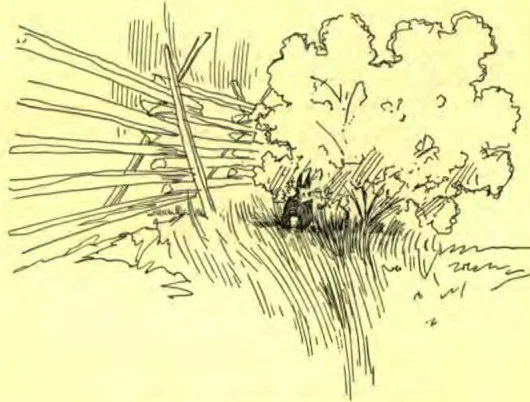
Before the country was settled, Bunny generally had her home among the blackberry briers or under some large gooseberry bush. I once knew an old rabbit that slept for a whole year under a very large gooseberry bush that stood by a fence. The gooseberry bush would keep a dog from pouncing on her without giving warning, and she could go through the fence at the first bound, and then she was safe; for no dog could catch her after he had taken the time to get over the fence. I passed her almost every day, and learned to know her very well. When she had a family of babies in the spring, it was interesting to see how she could talk to them, and not even make a sound. They might be playing about, having all the fun that little bunnies could wish; but if Mrs. Rabbit heard anything unusual, up would go her ears, and every little bunny of them would stop instantly, and put up its pretty ears to listen. If she thought she saw danger, she would lay her ears flat on her back, and every little baby would squat down to the ground, and do the same thing.
Rabbits also talk to each other by thumping on the ground with their hind-feet. They always know just what the signal means; but I must confess that I never could tell whether it was the mother calling for her children, a husband calling for his wife, or two enemies daring each other to come out and fight. I do know that they do all three, however, and that they can understand each other perfectly.
FLOYD BRALLIAR.
(Concluded next week)
What Am I?
By Aunt Betty
EVERY country child knows me, and has met me in moist, shady places, dozens of times. I love the cool, damp woods; and the garden, after a shower, is a good place in which to live. Indeed, I do not know of a pleasanter place to spend my time than the lettuce bed or the strawberry patch.
UNDER THE GOOSEBERRY BUSH
There is one strange thing I do,—I carry my6house on my back. A handsome house it is, too, with walls hard as stone, and beautifully marked. If a small piece should be broken out, I can mend it with a fluid from my body, which hardens until it is just like the rest.
Always having my house with me, it is very convenient for me to run into, not out of the rain, for I do not mind moisture, but out of the heat. I find a shady place, and draw back into my house; then I glue the edges of my doorway to the log or stump on which I am standing, so that the heat may not draw the moisture from my body. In very hot weather I stay in my house all day, and every day.
My eyes are curious. They are not set close to my head, as yours are, but are placed at the ends of long horns, that I can move in every way and see all that is going on about me. This is very convenient; for I can move my head and body but slowly. I can fold the long horns quite into my head when I am frightened.
I belong to a large family. Some of my cousins do not wear houses, and some of us live in the water; but we are all cold, slimy, though harmless creatures.
How do you think you would get along if you had but one foot? Rather slowly? Well, I have only one foot, and I do go slowly,—at least people say, in speaking of a very slow person, “He is as slow as a ——.” AUNT BETTY.
A Mighty Hunter
By Elizabeth Rosser
THERE is a boy named Tommy Green,
And he goes forth to kill;
And let the wind blow wild and high,
Or let the air be still,
Or sunny be the day, or dull,
To him ’tis all the same;—
Whenever Tommy Green sets out,
He always gets his game.
No gun he carries in his hand,
No sword of temper fine,
No bow with arrows at his back,
No fishing-rod or line.
But though he carries for his aid,
No weapon you could name,
Whenever Tommy Green sets out,
He always gets his game.
And yet, when Tommy Green comes home,
I never see him bring
A single bird, a single beast,
Or fish, or creeping thing.
And though this sounds impossible,
The truth is in this rhyme,
The only thing that Tommy Green
Sets out to kill, is — Time.
But O, I think when Tommy Green
Has somewhat older grown,
And thinks of all he might have done,
And all he might have known,
He’ll find that Time’s not to be killed,
But only wisely spent.
Let’s hope, before it is too late,
His folly he’ll repent.
ELIZABETH ROSSER.
First Lessons in Geography
By Floyd Bralliar
Lesson XXXVIII
As the people scattered out after the flood, many of them went to different parts of Asia; and as we have learned in the previous lesson, another large branch of the race went to Africa. Africa is one of the largest divisions of land. It is second in size only to Asia. Lying as it does almost wholly in the torrid zone, Africa is the hottest continent. Most of its surface is high, and in some places the country is very dry. Where there is plenty of rainfall, the vegetation is luxuriant. Great palms and fern-trees grow here, and oranges, bananas, and other tropical fruits are found in abundance. There are more large wild animals in this continent than in any other part of the world.
The northern part of Africa is known as the Desert of Sahara. It is the largest desert in the world. For thousands of miles it is nothing but a barren waste, with here and there a small oasis, consisting of a few palm-trees clustered about a well or a spring. The country is not inhabited, save by a few wandering tribes of half-civilized Mohammedans. It is probably the hottest country in the world, although the nights are cool,—sometimes cold enough to freeze water. In some places the surface is covered with loose rocks, while in others there is nothing but sand, which drifts about with every wind. Lions and other wild animals are frequently seen in this desert. The country has never become civilized or well settled. The people belong to the white race, but they are ruled mostly by the Arabians, who carry on commerce for them.
Those who enter this country to teach the truth of the gospel will experience many hardships, and many of them may even lose their lives; but the people must be warned nevertheless. As the people live in tents, and move from place to place frequently, a missionary to this country can have no permanent home. In the days of the apostles, and for a few years after their death, missionaries entered this field, and a great work was done.
Farther north on the coast of the Mediterranean Sea are a number of small countries, whose inhabitants are more highly civilized. They live in villages, and cultivate the soil to some extent. They also make fine rugs and carpets, and it is from one of these states, Morocco, that Europeans learned how to make the beautiful leather we now know as morocco. You have seen it many times in the bindings of books. Most of the inhabitants of these states are Mohammedans, and do not show much interest in anything that comes from a civilized country. A missionary to that country would be comparatively safe, however, and no doubt many of this people will yet be saved in the kingdom. Find out all you can about these countries.
REVIEW.—What sea is north of Africa? What strait connects this sea with the Atlantic Ocean? What sea between Africa and Asia? What ocean east of Africa? What ocean west? What large island lies east of Africa? What gulf on the west coast? What part of Africa is crossed by the equator? In what zone is the most of Africa? What mountains in Africa? Are there many bays or capes and peninsulas on the coast of Africa? What large lake in Africa? Tell about the size of Africa. What kind of climate has it? What fruits grow there? What kind of trees? Tell about the animals. What desert in the northern part of Africa? What races of people live there? What is their religion? By what people are they mostly ruled? Describe an oasis. Tell about the people living farther north along the coast of the Mediterranean. What articles do we get from there? What kind of leather? Have your teacher tell you about the missionaries to these countries.
Lesson XXXIX
Egypt is, perhaps, the oldest country in the world. We find it mentioned in the twelfth chapter of Genesis. It was settled within two hundred years after the flood. Although many different nations have ruled there, and the country has passed through various experiences, it is still known as Egypt, and most of the people are descendants of those who lived there so long ago.
The Nile, one of the longest rivers in the world, drains a part of the interior of Africa; but for fifteen hundred miles of its course through Egypt no rivers flow into it. It has been noted since the beginning of history. It was this river that Moses turned to blood as a plague to the Egyptians. The people worshiped the Nile, so God brought the plague to show his disgust for idolatry. Here also Moses was placed, when a babe, in the ark of bulrushes; and on the banks of the Nile was situated the land of Goshen, where the children of Israel lived when they were in bondage.
The country is peculiar in that rain seldom falls. The source of the Nile is nearly four thousand miles in the interior of Africa, where it receives the drainage from inland lakes and from the mountains. Every spring the river rises, and within a few weeks it overflows all the plain, making it one vast lake. Little by little the water subsides, leaving a coating of mud over the land. Some time before the water is all gone, the people do their sowing and planting. Rice and wheat, sugar-cane and cotton, produce enormous crops. Perhaps no country in the world produces such fine figs, dates, and melons. You will remember that one time when the children of Israel murmured against the Lord in the wilderness, they said that they remembered the melons in Egypt. Find the text. This valley of the Nile is densely populated. On its banks are the most magnificent ruins in the world, among them the pyramids, which were built for tombs by the ancient kings of Egypt.
South of Egypt lies the country of Abyssinia. It is a plateau, and receives plenty of rainfall. Near it is the Nubian desert. In this part of the Nile we find the crocodile and the hippopotamus. It is thought that coffee originally came from here.
Many of the people of Abyssinia are Christians, having received the gospel hundreds of years ago.7They are hard-working farmers and herdsmen.
While the Abyssinians are almost independent, the people of Egypt are ruled partly by the English, and partly by a native ruler called the Khedive, who pays tribute to Turkey. Many tourists visit Egypt every year, and in these last days of this world's history the country seems waiting to receive the gospel. May it not be that God will yet call many sons out of Egypt? Surely he will remember the country that gave protection to his Son when he was here on earth. Learn what you can about the pyramids, and about the overflowing of the Nile.
REVIEW.—Where is the Nile River? Into what water does it flow? Where does it rise? For what has the Nile been noted since early history? Why were the waters of this river turned into blood during the plagues of Egypt? Through what country does it flow? What do the Egyptians worship? Tell about the rainfall of this country. How do the people raise crops? What do they raise? Where do most of the people live? Why? What do we find on the plains? Describe the pyramids. For what were they used? What country is south of Egypt? What desert near it? What animals do we find here? Tell about the government of these two countries. Why was Christ taken into Egypt when a child?
FLOYD BRALLIAR.
Two Kinds of Sport
“ ’Tis a beautiful morning,” a sportsman said, “The world looks so happy let’s each take a gun, Go out and kill something for pastime and fun, And proudest be he who counts the most dead.” They blotted out lives that were happy and good, Blinded eyes and broke wings that delighted to soar. They killed for mere pleasure, and crippled and tore, Regardless of aught but the hunger of blood.
Did they dream that night as they sank to their rest, How poor little Broken-Leg out in the field, All nurseless and doctorless fever possessed, Felt all of the torture that battle-grounds yield? “Only a bird,” yet his slayer would groan If only one half of that pain were his own.
“ ’Tis a beautiful morning,” a sportsman cried, Who carried a kodak instead of a gun, “The world looks so happy, so golden the sun, I’ll slip to the woods where the wild things hide.” The deer that he “shot” never dreamed of his aim, The bird that he “caught” went on with her song, Peace followed his footsteps, not slaughter and wrong, Yet rich were his “trophies” and varied his “game.”
They met on the Sabbath, these lives so apart, When the minister prayed for Christ’s coming again. In mercy and kindness both answered “Amen,” The one with the lips, and the other the heart. Which prayer won the blessing, which sank to the dust, The one that went up with the song of a bird, Or the one that was drowned by the voices that poured From the wounds of the weak to the ear of the Just?
Whoever restores a young bird to the limb, Or gladdens the lives of dumb creatures in need, Is one of Christ’s helpers whatever his creed, Clasps hands with “the angel that comforted him.”
Whoever finds pleasure in adding one hurt To an innocent life, be it insect or dove, Is somehow in league with those who found sport In nailing the hands of the world’s greatest Love. Oh, how dare we ask a just God to bestow The mercy we grant not to creatures below!
— Selected.
Just This Minute
If we're thoughtful, just this minute,
In whate'er we say and do:
If we put a purpose in it
That is honest, through and through,
We shall gladden life, and give it
Grace to make it all sublime;
For, though life is long, we live it
Just this minute at a time.
Just this minute we are going
Toward the right or toward the wrong;
Just this minute we are sowing
Seeds of sorrow or of song.
Just this minute we are thinking
On the ways that lead to God,
Or in idle dreams are sinking
To the level of the clod.
Yesterday is gone: to-morrow
Never comes within our grasp;
Just this minute's joy or sorrow,
That is all our hands may clasp.
Just this minute! Let us take it
As a pearl of precious price,
And with high endeavor make it
Fit to shine in paradise.
MEMORY VERSE: “Thou shalt love the Lord thy God with all thy heart, and with all thy soul, and with all thy strength, and with all thy mind; and thy neighbor as thyself.”
The two tables of the law are so inseparable that we can scarcely study one without the other. On these two all the word of God is based. You can not study any lesson from the Bible which is not included in our love to God or to those about us.
Thus we see that God’s law was not spoken alone for the benefit of the Hebrews, but they held it in trust for the whole world. No one is exempt from this law. When Jesus came to earth the first time, he mentioned this very law, saying that he had not come to destroy it, but to fulfil it. Then to help us to walk in the way of his commandments, he told us how much some of them mean.
The commandment says, “Thou shalt not kill;” but Jesus said that being angry with another is breaking this commandment. In 1 John 3:15 we read, “Whosoever hateth his brother is a murderer.” So we see these commandments reach even to our thoughts. When you study the ninth, remember that you can bear false witness by a wave of your hand, or a nod of your head, just as surely as you can by speaking.
After all this we can see what God wanted the children of Israel to be, and wants us to be, when he urges us to keep his commandments.
Jesus kept these commandments; and through him alone we can keep them. Even the children can open their hearts to him, and allow him to come in to abide with them, and do for them the things which they can not do for themselves.
Questions
Repeat the first commandment. The second. The third. The fourth.
To whom do these commandments refer?
To whom do the last six refer?
What did Jesus say of these two commandments? Matt. 22:37-40.
What is the fifth commandment? What promise is connected with it? To how many commandments are such promises attached?
Repeat the sixth commandment. How did Jesus explain this one?
What is the seventh commandment?
Tell as many ways as you can by which children break the eighth commandment, without actually taking something that does not belong to them in the way we understand stealing. Shall we do these things longer?
Repeat the ninth commandment. Tell some of the things that this means.
What is the tenth commandment?
How did the people feel when the Lord spoke to them?
Fools because of their transgression,
And because of their iniquities, are afflicted.
Their soul abhorreth all manner of food;
And they draw near unto the gates of death.
Then they cry unto Jehovah in their trouble,
And he saveth them out of their distresses.
He sendeth his word, and healeth them,
And delivereth them from their destructions.
O that men would praise Jehovah for his loving-kindness,
And for his wonderful works to the children of men!
And let them offer the sacrifices of thanksgiving,
And declare his works with singing.
They that go down to the sea in ships,
That do business in great waters;
These see the works of Jehovah,
And his wonders in the deep.
For he commandeth, and raiseth the stormy wind,
Which lifteth up the waves thereof.
They mount up to the heavens,
They go down again to the depths:
Their soul melteth away because of trouble.
They reel to and fro, and stagger like a drunken man,
And are at their wits’ end.
Then they cry unto Jehovah in their trouble,
And he bringeth them out of their distresses.
He maketh the storm a calm,
So that the waves thereof are still.
Then are they glad because they are quiet;
So he bringeth them unto their desired haven.
Oh that men would praise Jehovah for his loving-kindness,
And for his wonderful works to the children of men!
Let them exalt him also in the assembly of the people,
And praise him in the seat of the elders.
Questions
1. Why are foolish people afflicted?
2. How are they affected by this affliction?
3. To what depths are they brought?
4. What does this experience lead them to do?
5. How does the Lord answer their cry?
6. By what means are they healed from their afflictions?
7. Mention instances when God has marvelously delivered his people when they sought him.
8. Recall instances in your own experience when the Lord has thus wrought for you.
9. What are all men exhorted to do? For what reasons?
10. What sacrifice are they urged to offer? How are they to declare his works?
11. What class of people is now brought to view? How are they described?
12. What do they have an opportunity to see?
13. Who causes the storm at sea? What is the effect of the storm?
14. What is the experience of the sailors?
15. What does this experience lead them to do?
16. How does Jehovah respond to their cry?
17. What change does he bring about on the sea?
18. Where do we have the record of such an occurrence? What encouraging practical truth can you draw from this?
19. What is the feeling of these who are thus delivered?
20. How does their voyage end?
21. What wish is again expressed in verse 31?
22. Why are men exhorted to praise the Lord?
23. What are they urged to do? How public should this acknowledgment of God’s goodness be?
Notes
Do not fail to commit the Lesson Scripture. With verse 19 many illustrations may be drawn from Old and New Testament history, showing God’s speedy deliverance when his people sought him. Jacob, the children of Israel before the Red Sea, Daniel, the three Hebrews in Babylon, Hezekiah, Peter, Paul, and many other instances, will suggest themselves.
The experience recorded in Mark 4:36-40 is an excellent comment on verses 23-30. He who created the sea can speak peace to its troubled waters. But still more precious is the promise of peace to the troubled soul that calls upon him. John 14:27; 16:33; Rom. 5:1; Phil. 4:6, 7. There is power in his word to perform that which he speaks. “All his biddings are enablings.”
The last verse of the lesson makes clear the obligation to speak God’s praise in the public congregation. Mal. 3:16-18. This is especially enjoined upon those who see the end approaching. Heb. 10:25.
The Gentle Man
By Atkins
NEVER imagine that the swaggering braggart can move the world—he is as feeble as he is loud. Jesus Christ was the strongest man that ever lived—and the gentlest. He would not have hurt the feelings of a child, and yet he could conquer hell. “He opened his mouth and taught them, saying, Blessed—” That was the keynote of his life. He was always blessing somebody,—healing the sick, comforting the sad, cheering the weary, raising the dead; his life was one long series of kindly, brotherly actions. And yet how he could burn with moral indignation! The same Christ who was tender and gentle and forgiving to the sinners who were tired of the dreary heartache of their useless lives, and longed to be better and do better, could denounce the hypocrites of his day as a “generation of vipers.” We must rid ourselves of the popular delusion that tenderness denotes weakness. It doesn’t. Bullies are weak—gentlemen are strong. The braggart is impotent; the empty noise of his braying is quickly exhausted, and then he is used up, and has nothing to go on with. The man who endures and overcomes is the man who follows Christ in his sweet reasonableness of temper and thought and action.—Atkins.
“ONE of the bravest things in the world is to give to others out of one’s deepest poverty whatever that may be — cheer out of sorrow, hope out of disappointment, help out of weariness, courage out of defeat, the precious mite out of the slender store. It is a brave thing to do this, and yet not often an unrewarded thing. We do not know that the recording angel keeps any special account of such heroic benevolences, but surely they do not escape the loving cognizance of God.”
Waste Products
A FEW years ago the seed of the cotton plant was burned or dumped into the river; now a great industry, employing capital to the value of nearly fifty million dollars, has been founded to obtain the oil from the cottonseed. This oil is used in almost innumerable ways, and is in itself a valuable article of commerce. The refuse left from refining the crude oil is used in soap-making; the residue remaining after the oil is extracted is used for feeding stock and as a fertilizer; the hulls are burned as fuel; and the ashes form a rich fertilizer. From the hulls also comes a fiber from which a high-grade paper is made, the roots furnish a drug, and the leaves and stems are used for fodder.
Coal-tar is a “by-product” in gas-making, and the way to get rid of it was for a long time a troublesome question. Now the products made from coal-tar form a valuable industry, and far exceed the cost of the coal burned in gas-making. Among them are light oil, heavy oil, pitch, creosote oil, benzine, ammonia, aniline dyes, etc.
The problem of disposing of the refuse of cities is one that has been hard to solve; but some cities which formerly paid a high price to get rid of this waste now actually receive a considerable income from it. The garbage is heated with water and chemicals, the grease extracted and sold, and the water then evaporated. The remaining powder is used in making fertilizers.
Skim milk is utilized in making “coatings and sizings for paper, waterproof glues for wood veneers and other purposes, hard rubber, horn, and other useful commodities.”
Perhaps one of the most surprising examples of utilizing a waste product is that of turning soap-suds to account. In some of the large textile factories, soap-suds is used in great quantities. In one place it is “precipitated with lime, and the coagulum is collected, pressed into bricks, dried and heated in gas retorts. A gas, of three times the illuminating power of coal-gas, is produced in double the quantity needed to light the mills. Soap-suds is also used in the production of lubricating oils, fat acids, and soaps.”
Though men have found a way to turn to account many things that were formerly supposed to be of no value or less than no value, there are still others that are engaging their attention. A business man connected with an enterprise which is placing a “hulled” bean on the market recently made the statement that they had exhausted every resource trying to find some way to dispose profitably of the hulls, which form a considerable item in the business. Though no use has yet been devised for them, the promoters of the company are confident that a way will yet be found to use them to advantage.
Battle Creek Young People's Society Colporteur Sales Report
“Ten books sold in four hours and forty-five minutes, and five more in two hours and fifteen minutes,” is the report of one of the members of the Battle Creek Young People’s Society who has been in the field with “Christ’s Object Lessons” the past week.
No Guile in the Mouth of the 144,000
We are told one very significant thing about the company of the hundred and forty-four thousand who are “redeemed from among men,”—“in their mouth was found no guile.” Anything like trickery, meanness, deceit, duplicity, can have no place in the hearts and lives of those who hope to be among that company who shall stand on the sea of glass, and sing the “new song” before the throne of God.
Why Postponing a Hard Question Only Compounds It
TEMPORIZING with a question never settles it. Some day it will come back to be answered,—and to its first perplexity will be added all our twistings and turnings and evasions, every one of which must be met and straightened out before the matter can be settled. The only safe way is to meet the thing squarely, and seeking wisdom from Him who knows the end from the beginning, settle it once for all.
Living Faithfully in the Present Moment
God does not wish us to look forward anxiously into the future, and wonder whether we shall be able to stand in the time of trouble, or worry about what we shall do when we are brought before courts to answer for our faith. He has broken our lives up into days and hours and moments, because he knows that the only way to be ready for the future is to improve the present. And the present must not be neglected. We need not expect that at some future time God will work a miracle to save us. But if we become acquainted with him now, and familiar with his Word now; if we learn to trust him as our nearest and dearest friend now, and study now to know the truth he has committed to us, he will take care of us in the future; and no matter what comes, we shall “count it all joy” because of his presence.
Papers Wanted
THE little “Sabbath-school in the woods,” from which we have heard several times before, sends us a touching request for papers, and we are sure there are some of our boys and girls who will like to respond. Second-hand copies of the INSTRUCTOR and the Little Friend are desired. This little school is conducted by Sister Hattie A. Sumerix, in a lumbering camp at Trowbridge, Cheboygan Co., Michigan. She says: “We send our penny Sabbath-school collections to the Haskell Home, so we do not have money to pay for new papers, and I am sorry to turn the children off without them. I have a membership of twenty-two. Notwithstanding there is a Sunday-school in camp, the people say the children learn more at the Sabbath-school.”