FOR eight years the subject of setting forward the hands of the clocks in England was agitated, and this last summer the support of the stock exchanges, railroads, public service corporations, and other business interests was obtained and the plan was adopted.
Last summer France, Germany, Italy, Holland, Denmark, Norway, and Sweden fell into line, and all enjoy one more hour of daylight each afternoon.
In this country Cleveland and Detroit “set the clock forward,” and so also did Halifax, Nova Scotia, and St. John, New Brunswick; but the plan can never become a success until it is universally adopted.
The Boston Chamber of Commerce Committee appointed to investigate the Longer Daylight Day Plan held a public hearing at which the large number present—representing many boards of trade and other business organizations—voted a resolution favoring the plan, and recommended that the question be submitted as a referendum to all the chambers of commerce by the Chamber of Commerce of the United States of America.
In New York the plan was recommended by the committee of the Merchants’ Association for consideration as a national movement.
In Chicago the Association of Commerce has given the plan official indorsement, and many other large cities are expressing themselves in favor of the adoption of this plan.
Three plans are offered, either of which will provide for a longer daylight day for, at least part of the year.
One is to set forward all timepieces one hour each year from March 1 to September 1.
The second is to set them forward two hours during that same period.
The third is to set them forward one hour for all time.
There will, of course, be a little confusion incident to such a change, but by the third plan it could occur but once. In many ways this seems the best plan.
Think of the decrease of expense of lighting our homes, places of business, and streets! Think, too, of the conservation of our eyesight.
Home makers will be quick to see the advantage of an extra hour of daylight, for by the time luncheon has been cleared away, the children prepared for the afternoon session of school, the dress changed and hair tidied up and sewing materials collected, it is possibly two o’clock, but more probably nearer three before sewing can be begun, and very shortly it becomes necessary to resort to artificial light. If the home maker is fortunate enough to have caught up with her sewing, she may wish to read, to study, to play the piano, or to paint, but every one of these pursuits requires a close focus of the eyes.
In every school we see numbers of small children who wear glasses, and we are informed that the old-time kerosene light was not so detrimental to the eyes as the present artificial light. If the children used their eyes one hour less by artificial light each day, the result would soon be manifest.
To such invalids as require a large amount of out-of-door aid, and to convalescents, the adoption of this proposed plan would prove a blessing, as it is a well-established fact that sunshine and pure air are the most powerful elements of healing.
Four hundred settlements in this country provide recreation for children in congested districts, and five hundred school centers provide amusement for children who work during the day. Instructors and settlement workers agree that the out-of-door recreation is of far greater value than the indoor.
In congested districts the artificial lighting is often of the poorest quality, and very trying for the woman who must sew or the child who would study or read.
The supply of coal, the basis of all gas and electrical lighting, is limited, and in time will have become exhausted, so it behooves us to consider the welfare of future generations in economizing this valuable product as much as lies in our power.
Proponents of this plan say that we should be more efficient as a nation if the plan were adopted, because so much better work can be done in the cool of the summer morning than in the heat of the afternoon. Also, there would be more daylight in which to enjoy health-giving out-of-door recreation for working people as well as for children.
The proposed plan provides increased opportunities for working mothers to be with their children before darkness and bedtime arrives.
We cannot change the schedule of the sun, but we can utilize its warmth and light more than we do now.—Lilian Clisby Bridgham.
Books Rule the World: Printing and Its Power
FROM the hour of the invention of printing, books, and not kings, were to rule the world. Weapons forged in the mind, keen-edged, and brighter than a sunbeam, were to supplant the sword and battle-ax. Books! lighthouses built on the sea of time! Books! by whose sorcery the whole pageantry of the world's history moves in solemn procession before our eyes.— E. P. Whipple.
Pond Scum
By Edmund C. Jaeger
How often a person has been walking abroad on a hot summer’s day, and when thirsty has come, much to his disappointment, to a pool of clear water filled with green scum or slime, and has turned away from the pool with disgust, unaware of the fact that he was turning away from a marvelous and lovely sight, unlovely and common only because of coarse eyes, and because of ignorance of what he was really seeing.
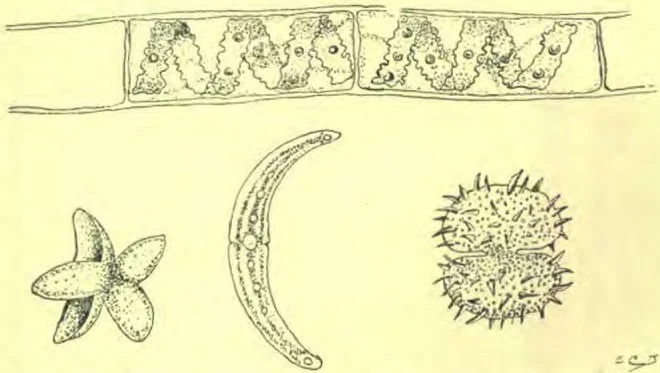
Spirogyra (at top) and some of its near relatives found in pools.
That scum or slime is a network of beautiful plant filaments, which when viewed with an ordinary high-power microscope, becomes of intense interest. These slime plants belong to an order of plants known as algæ. Algæ colored green are known as green algæ. Our common seaweeds are algæ too, but belong to other kinds known as the red and brown algæ.
Our “pond scum” is quite likely to be a plant individually known among the green algæ as Spirogyra. If we lift a portion of it from the water, we see that the mat is made up of a tangle of green silky threads. Inasmuch as each thread is a single plant, the number of plants is very great.
Place a thread or two of Spirogyra upon a glass slide and examine it with a microscope; it will be observed that the filaments are made of many cells or cylinders placed end to end, and that in each of these cells is found a beautiful irregularly notched green band.
If we have a lens of high power of magnification, we may see the true beauties of our scum. The spiral bands noted now look like marvelous green fluted ribbons set with beautiful jewels. These bands contain the green coloring matter of the plant, known as chlorophyll. The jewel-like disks set like pearls in the band are called pyrenoids, and are the centers of starch manufacture for the plant.
By careful search, a rather dense granular body is seen with delicate threads of shiny granular substance radiating out in starlike manner to the sides of the cell. The dense body in the center is the nucleus, the most important part of the cell. The shining, radiating bands are composed of a substance called protoplasm, which is found to be the basis of all physical life in this or any other living plant.
So is not “pond scum” interesting after all? If we would only examine many other common so-called “ugly” things, we should find them equally fascinating. The most marvelously interesting beauties are often hidden from the natural eye, under forbidding exteriors.
EDMUND C. JAEGER.
Far-Sight, or Spot-the-Rabbit
● ● ● ● ● ● ▲ inches x 8
TAKE two six-inch squares of stiff white pasteboard or whitened wood. On each of these draw an outline rabbit, one an exact duplicate of the other. Make twenty round black wafers or spots, each half an inch across. Let one player stick a few of these on one rabbit board and set it up in full light. The other, beginning at 100 feet, draws near till she can see the spots well enough to reproduce the pattern on the other, which she carries. If she can do it at 75 feet, she has wonderful eyes. Down even to 70 (done three times out of five) she counts high honor: from 70 to 60 counts honor. Below that does not count.
A Hero
ONE of the most distinguished of the X-ray pioneers was Walter James Dodd, who was photographer at the Massachusetts General Hospital in Boston when, in 1895, Röntgen gave to the world his discovery of the X-ray and of its probable diagnostic value in connection with the human body. With characteristic zest, Dr. Dodd threw himself into the work of using and experimenting with the new agent. A year later he had to be treated for burns; in another year his wounds had suffered a cancerous change that made necessary an operation. From that time until his recent death he submitted to ether more than fifty times; he lost most of his fingers, suffered terrible pain, and died at the age of forty-seven, long after he and others like him had discovered how to render the rays harmless.
His pluck and complete devotion to his work were beyond praise. In 1915, as soon as he was up from his latest operation, he went abroad and rendered splendid X-ray service in the British field hospital. His cheeriness, humor, and tenderness won him the love of every one who knew him. To the well he was an inspiration; to the sick and unfortunate he was a ministering angel. Peace hath her victories no less renowned than war.—Youth’s Companion.
Dutch Nut Butter
The base of margarine, or vegetable butter, is vegetable oil—mostly nut oil. Holland has been driving a thriving trade by purchasing nuts from British sources, making margarine, and shipping the product to England for sale. People have got used to the taste of butter and demand the natural flavor in any substitute. By the Dutch method that flavor is obtained without the use of chemicals. The cream represents the animal fat in milk. Skimming and churning are only crude methods of extracting this fat and making it usable. When the Dutch butter is made, the creameries have enormous quantities of skim milk—a by-product for which no very profitable use has been found. They add their vegetable fats to the skim milk, re-treat the mixture, and turn out a product with the exact flavor of cow’s butter. The only thing about it that could be called an adulterant is a little vegetable coloring matter. It has two advantages over cow’s butter—it never gets rancid and it never carries disease.—Selected.
OUR FATHER’S HOUSE
By Carlyle B. Haynes
A Glimpse of the Dominions of the King of the Universe
CARLYLE B. HAYNES
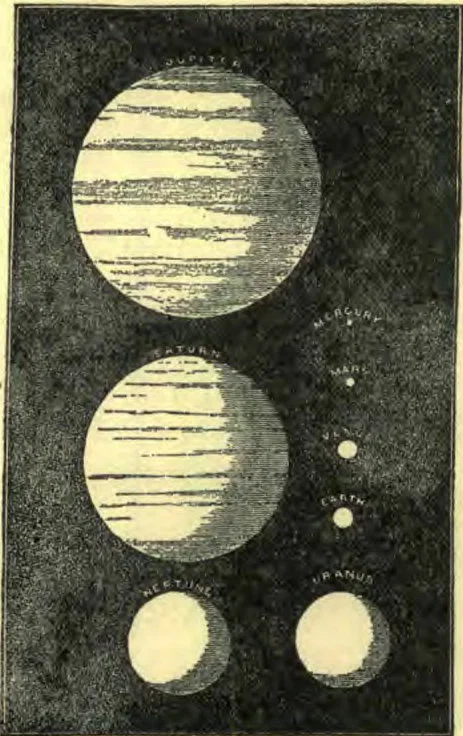
Relative size of planets. The sun's diameter on the same scale equals length of cut.
Friday night of the first week of the tent meetings was the greatest of all to Donald Hunter, who had not missed a service. His heart had been greatly stirred by the wonderful things which he had heard Brother Harris say about the coming of Jesus. He very deeply desired to make himself ready to meet the Lord when he comes to receive his people.
The text on Friday night was the words of Jesus just before his crucifixion, in John 14: 2, 3: “In my Father’s house are many mansions. . . . I go to prepare a place for you. And if I go and prepare a place for you, I will come again, and receive you unto myself; that where I am, there ye may be also.”
“Those who are preparing to meet Jesus when he comes,” said the speaker, “will be glad, I know, to learn something of the place he is now making ready for his people. The mansions of which he spoke are in his Father’s house, and that house includes all the universe.
“We will take a little journey tonight through as much of this house of the great King as we shall be able to reach with our finite comprehension. We are living in one of the outlying portions of the dominions of God. This earth upon which we dwell, is about 8,000 miles in diameter, and about 25,000 miles in circumference. That means that its surface contains nearly 200,000,000 square miles. Think for a moment of the many different things we can see on it, how beautifully it is furnished—its great divisions of land and water, continents, oceans, islands; mountains which push their mighty heads through the clouds; depths of ocean unfathomed; volcanoes belching flame; lakes, rivers, forests, and swelling hills; animals of every form and size; unnumbered schools of fish; birds of all kinds and without number; and numerous tribes and races of men.
“If you should start out to walk through every square mile of this earth, so that you could see just this part of the Father’s dominions, and walked thirty miles every day, it would take 18,264 years for you to finish your journey. If you had started when Adam was created, your journey would be but one third completed.”
Donald caught his breath sharply. He had no idea that this world was such a tremendous globe as that. Brother Harris continued:
“And consider the bulk of the earth. As it is 8,000 miles through it, it must contain 263,858,149,120 cubic miles of solid contents. Even with laborious effort the mind fails to take in the thought of such a vast amount of matter. How great the power of Jehovah must be who spoke it all into existence! How limitless must be his might ‘who hath measured the waters in the hollow of his hand, and meted out heaven with the span, and comprehended the dust of the earth in a measure, and weighed the mountains in scales, and the hills in a balance’! Isa. 40: 12.
“But this is only one of the worlds which God has created, and one of the smallest. One of the other planets which circle our sun is 780 times as large as the earth, and is encircled by a ring which reaches out from its surface nearly as far as the moon is from the earth. Another of the planets is 1,400 times larger than the earth, though it appears but as a bright star to the naked eye. All the great orbs which circle round the sun contain a mass of matter 2,500 times greater than that of the earth.
“And the sun itself is 520 times larger than all the planets together, and 1,300,000 times greater than the earth. It throws its light and warmth out from its surface to the outermost planet, which is 2,790,000,000 miles away.
“Should we take our journey to this outermost planet of the solar system, we would find the universe swimming with myriads of other stars and systems. Out at an inconceivable distance beyond our system, we would find the stellar system, the system of the stars. On a clear winter night about two thousand of these stars can be seen with the eye, and as each star is a great sun like our own, undoubtedly surrounded, as is ours, with planets controlled by the central luminary, there lies before us a mass of matter equal to 2,000 solar systems, or to 1,500,000,000 globes the size of the earth. But when we realize that the stars which can be perceived by the naked eye do not compose one one-hundred-thousandth part of those which can be seen through a large telescope, some idea can be faintly grasped of the colossal dimensions of the Father’s house.
“And out beyond the uttermost reaches of human vision, aided as it is by powerful glasses, there are undoubtedly myriads of vast orbs rushing through space, unknown to man. With each new telescope that is stronger than those which have preceded it, new vistas are opened up, and new stars found which are far beyond those that have been previously discovered.
“The very nearest of these stars to the earth is Alpha Centauri, and it is 25,000,000,000,000,000,000 miles away. The North Star, or Polaris, is 276,000,000,000,000,000,000 miles distant. Traveling with the speed of light, which is 186,000 miles a second, it would take four and one-third years to reach Alpha Centauri, and forty-seven years to reach Polaris.11
“While we have but begun the journey into space, as these are only the outlying borders of God’s works, yet here we must pause, for we cannot go farther with our finite wisdom. With reverence and wonder we stop here. Over all these rushing, whirling orbs, God presides. This is his kingdom, and we have seen but a small part of it. Throughout all these objects and among all these intelligences he is ever present. All its complicated movements are guided by his unerring wisdom. By his word, in the beginning it emerged from nothing. “He spake, and it was done; he commanded, and it stood fast.” Ps. 33: 9. “By the word of the Lord were the heavens made; and all the host of them by the breath of his mouth.” Ps. 33: 6.
“Surely we can say with David, ‘The heavens declare the glory of God; and the firmament showeth his handiwork.’ Ps. 19: 1. It is here, in these vast realms of the universe, the chambers of the Eternal Father, that we behold the might of the Mighty, the strength of the Strong, the wisdom of the Wise, the lore of the Learned, the product of the Maker, the order of the Orderer, the glory of the Glorious; and we see, though our eyes be dim and our minds untaught, the majesty of the Designer who so reflects himself in all his works. It is thus we should look upon the universe in all its awful grandeur,—the earth, sun, stars, moon, planets; and we shall confess that these, without life or power or purpose or thought or will, unable to build up or destroy, to end or begin, hold or advance, to be or not to be, declare there is a God.”
Donald was spellbound. He had lost all consciousness of his surroundings. The tent with its great crowd no longer existed for him.
He was conscious only of the voice of that man on the platform who was telling him of wonders of which he had never dreamed. And every sentence added to the glory of his vision. No other preacher he had ever heard talked like this one. No other had ever made him see with his own eyes. ‘But now he saw, and he was overwhelmed with the wonder of it all. He was out among the stars, viewing the greatness of the Father’s house; and he found himself hoping Brother Harris would never stop talking, because he did not want to dwell with commonplaces again. Just then Brother Harris started a new thought in his mind, when he said:
“The other planets of the solar system and the millions of worlds of the stellar system are inhabited by intelligent and reasoning creatures. The Bible gives abundant proof of this.
“We are told that the Creator made this earth ‘to be inhabited.’ ‘He created it not in vain, he formed it to be inhabited.’ Isa. 45: 18. Here is a plain declaration that for the Lord to have created the earth without the purpose of peopling it would have been a piece of folly. If this earth had not been populated, it would have been created in vain. This world exists for the sake of intelligent and reasoning beings.
“With this thought before us and the additional consideration that the combined surface of the known planets of the solar system alone is equivalent to 27,000 such worlds as ours, we are forced to the conclusion that it would have been infinitely great folly to create that vast amount of space to be useless and empty. From this verse alone we are led to believe the other planets are inhabited.
“So small and insignificant in number are the inhabitants of the earth in comparison with the entire population of the universe that they are said to be ‘as grasshoppers.’ ‘It is he that sitteth upon the circle of the earth, and the inhabitants thereof are as grasshoppers; that stretcheth out the heavens as a curtain, and spreadeth them out as a tent to dwell in.’Isa. 40: 22. The far outspread heavens, therefore, exist for the specific purpose of being dwelt in, and this is here clearly stated.
“At the casting out of Satan the inhabitants of the worlds are called upon to rejoice. ‘The great dragon was cast out, that old serpent, called the Devil, and Satan. . . . Therefore rejoice ye heavens, and ye that dwell in them. Woe to the inhabitants of the earth and of the sea! for the devil is come down unto you, having great wrath, because he knoweth that he hath but a short time.’ Rev. 12: 9-12. Here a clear distinction is made between the inhabitants of the earth and the inhabitants of the heavens.
“Surely these verses, and the many others bearing on the subject, which there is not now time to read, clearly establish the truth, not only of a plurality, but of myriads of inhabited worlds existing in the universe.
“And these worlds, with the exception of this earth, have never fallen into sin. This we are told in Neh. 9: 6: ‘Thou, even thou, art Lord alone; thou hast made heaven, [[FIGURE]]
the heaven of heavens, with all their host, the earth, and all things that are therein, the seas, and all that is therein, and thou preservest them all; and the host of heaven worshipeth thee.’
“Such expressions would mean nothing if the other worlds were not inhabited. It seems clear that they would not have been written by an inspired writer unless they were meant to teach what they strongly imply, that the universe is great and extensive, utterly beyond the limit of human comprehension; that its worlds and systems are peopled with myriads of inhabitants; that these beings are in possession of intellectual natures, and fully capable of appreciating the perfections and attributes of their Creator; and that they unite in adoring and honoring him. ‘The host of heaven worshipeth thee.’
“Only one of the worlds has fallen. This earth upon which we dwell is the one lost sheep that wandered away from the Father’s fold. How this came about we will study next Sunday night.”
When Donald left the tent that night he stepped out into a new world. Everything seemed different. His whole outlook was changed. He looked up to the sky and the stars. They had taken on a new aspect. No longer were they just the sky and a few bright lights. Oh, he was glad that that tent had been pitched on the baseball lot!
COMPARATIVE SIZE OF PLANETS
Seeing and Knowing God
What does God look like? Almost every boy and girl asks that question sometimes. When we pray to him, and read about him in the Bible, we are always wondering and wishing that we could see him. The Bible tells us that no man can see God and live. This used to trouble me very much. I couldn’t understand why, if he is a good and loving God, everybody cannot see him.
One day I heard a little story that made it plainer to me. There was a missionary who was visiting a king in India. He had been trying to tell the old heathen ruler about the true God. At last the king said, “Why don’t you show me your God? I tell you about my gods, and I show them to you. You tell me about your God, but you never let me see him.”
The missionary answered, “But no one can see my God. No one can look on him and live.”
The old heathen said, “I don’t understand that.” Then the missionary went to the window, and told the king to come and look at something. When the king came, he pointed to the sun, and told him to look hard at it for a moment. The king tried, and then turned his head away, saying, “I can’t look at the sun. It blinds me.”
“Yes,” said the missionary, “that sun is just one of God’s poor servants, and if you are not able to look at that, do you think you could look at God himself?”
That is the reason we cannot look upon God. He is so great and so wonderful and so bright that the very sight of him is too much for our eyes to see.
Perhaps we cannot see God’s face, but we can come very close to him if we know how. In the time of Moses, God came down on Mt. Sinai, and the people all ran away. They were afraid, but we are told that Moses went straight up to the place where God was. He was not afraid.
Some years ago some men went to Washington to see the President. When they came to the door of the White House where he lived, they were told that he was very busy, and it would be a long time before he could see them. So they sat down there to wait. While they were sitting there, a little boy came up the walk, and opening the door of the President’s room, went straight in, and sat down by the President. Do you know why he went in while every one else had to wait? It was because he was the son of the President, and he could see him at any time.
That is why Moses was not afraid to go into the presence of God. Moses was God’s child, and God loved him, and he loved God. If we love God, and he loves us, then we are his children, and he is always ready and willing to have us come to him.
God wants us to know him. There was once a wise king who desired to know his subjects, and wanted them to know him. While he lived in the palace, he could never come to know them very well. They were too far away from him. So he dressed himself so that they would not know he was the king, and went and lived among them as a carpenter. They did not know who this poor workman was, but he was so good and gentle that they all came to love him, and then they found out that he was their king.
That is what Jesus did. He came and lived among us as a poor workman. He came to make us love him and to show us how he loves us. And before he went away, he said, “He that hath seen me hath seen the Father.”
It is this that I want you to remember most of all in connection with this text. If you want to see God, look at Jesus. Take the New Testament and read about him, and in learning to know him, you will come to know God.—Selected.
What Did the Arab Mean?
By Claud Allen McKay
SOMEBODY asked an Arab, as he sat in his tent in the desert, “How do you know God?” He replied, “How do I know whether it was a man or a camel that went by my tent last night?” And as the one who asked the question looked at the sand, he said: “You know by the footprints.” Then the Arab said: “That is the way I know God. I know him by his footprints. They are all around me.” But what did the Arab mean? Let us see if we can find out.
Do you know Mr. Edison? Did you say you have never seen him? But you have seen an electric lamp, and you have heard the phonograph, haven’t you? Then you do know Mr. Edison. You know him by his footprints. They can be seen in almost every home.
I feel sure you have never seen Mr. Alexander Graham Bell. But you have talked over the Bell telephone, haven’t you? Then you know him. His footprints are in almost every town.
What did the Arab mean when he spoke about “God’s footprints”? Let us look for our answer in this story: Dr. Beattie, a Scotchman, went quietly out into his garden one day, and there in the soft soil he wrote his little boy’s name. Into the finger tracks he sowed tiny mustard seeds, and then he made the soil all smooth again. About ten days later, little John Beattie came running into his father’s room, his eyes wide open in wonder. “O father!” he cried, “the mustard is spelling my name out in the garden!”
“Nonsense!” his father said; “how does the mustard know your name?” But John saw a smile playing around his father’s mouth.
Little John had just started to school. He dropped his head a moment in study, then he said: “Father,13it didn’t grow that way by itself. Somebody made it grow that way.”
Then his father showed John the face of a pansy, and asked, “Do you think somebody made the pansy grow that way?” Then they looked at a rose blooming outside the window, and Dr. Beattie said, “John, do you suppose somebody made the rose have those velvety petals, and colored them such a rich red?”
While they were watching the rose, they heard two robins at work up in the tree, building their nest. Little John said, “Father, do you think somebody taught the robin how to build its nest?”
John and his father had been looking at and talking about God’s footprints. They had found them in the pansy’s face, in the rose’s complexion, and in the robins’ house-building skill. Have you ever seen any of God’s footprints? Do you know now what the Arab meant? — Claud Allen McKay.
Sowed Pennies; Harvested Dollars for Jesus
By Hulda Berg
“We want to reach our goal and help support those suffering native workers who carry the gospel to widows in India, but how shall we get the money for it?” This, and similar questions, confront every Junior Missionary Volunteer leader who tries to carry out the plan of reaching a financial goal for the year. Yes, indeed, what can be done by little folks in the country, who cannot go out selling papers or books?
“He can who thinks he can,” can earn a harvest of dollars in the fall by sowing pennies in the spring. The missionary-garden idea has been tried out by our little Junior Missionary Volunteer Society, and proved profitable.
For several years we have had a missionary garden and planted it with early vegetables,—radishes, lettuce, and onions,—also string beans and pickling cucumbers. The early vegetables were picked and sent to town several times a week, when fruit and eggs were being delivered, and sold readily. Later in the summer came the beans and cucumbers, which found such a ready sale we could not fill the orders, and calls came over the telephone in the fall after the garden was exhausted. In this way about ten dollars was raised on our small garden for missions. One hotel bought four dollars’ worth of early vegetables. Several bushels of cucumbers were sold, the smaller ones bringing one dollar a bushel and the larger ones eighty cents. The beans sold readily at ten cents a quart.
Last year one girl was given a setting of eggs by her mother. From these she succeeded in raising eight chickens, and sold them. Being late chickens, they averaged fifty cents each, bringing four dollars. She had also secured a hive to catch a swarm of bees in, and she sold the honey for $1.50. Money obtained by bees is practically clear gain, since an improvised hive can be used that will cost nothing, and will serve at least a year. The only outlay is the few cents for the sections.
This spring we have a garden which we spaded up last fall, and are planning on some early vegetables that can be partly disposed of before school closes. We will also plant some that will not need to be disposed of until after school opens in the fall, so the summer work will not be too heavy. We hope to do more, however, by having each individual plan some missionary chickens, geese, or hives of bees, so that not only one or two, but all, will have an investment awaiting a harvest to apply on next year’s goal.
Since September our school of seven has raised $35 for foreign missions. We had two programs to help make that, but hope we can do as much by gardening and other methods this coming year.
Besides reaching the foreign-mission goal, we are trying to raise money to buy a set of wall maps. We made more than three dollars by selling sewing and raffia work, and during Christmas vacation some time was spent in selling the new twenty-five-cent war books. We have nearly five dollars for the maps, and expect to raise the remaining four dollars in the same way. HULDA BERG.