1 Chronicles 22:10
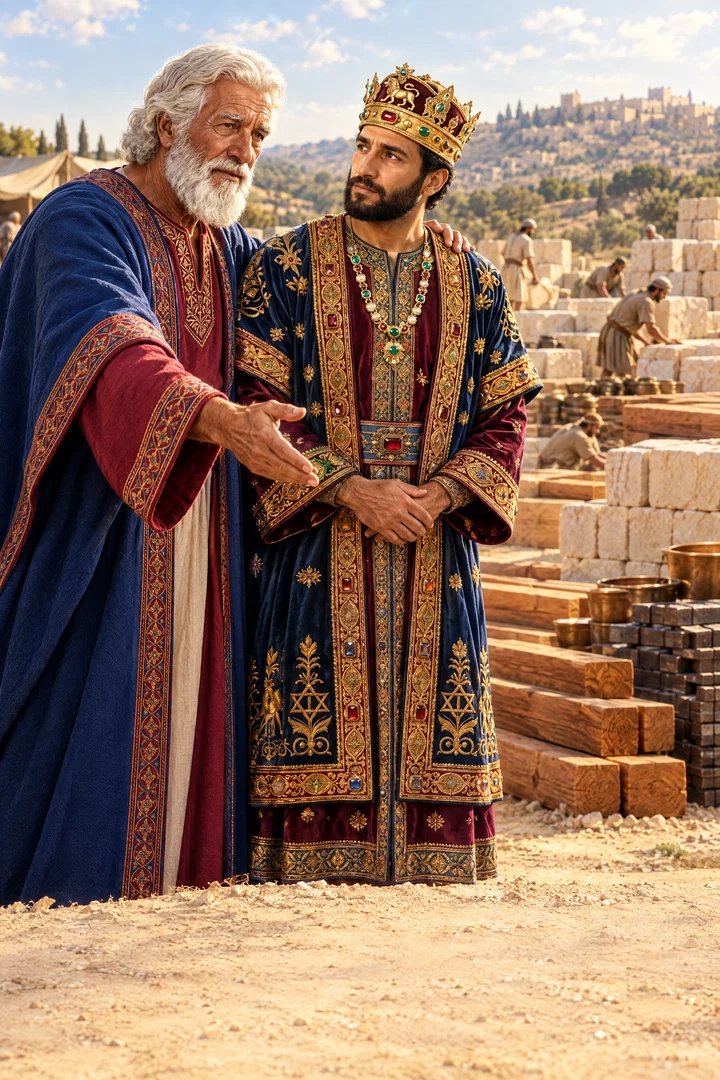
He shall build an house for my name; and he shall be my son, and I will be his father; and I will establish the throne of his kingdom over Israel for ever.
Translations
American King James Version, King James Version
He shall build an house for my name; and he shall be my son, and I will be his father; and I will establish the throne of his kingdom over Israel for ever.
KJV Cambridge Paragraph Bible, Webster Bible, American Standard Version
He shall build a house for my name; and he shall be my son, and I will be his father; and I will establish the throne of his kingdom over Israel for ever.
he shall build an house for my name; and he shall be my son, and I will be his father; and I will establish the throne of his kingdom over Israel for ever.
he doth build a house to My name, and he is to Me for a son, and I [am] to him for a father, and I have established the throne of his kingdom over Israel unto the age.
He shall build a house unto my name; and he shall be my son, and I will be his father; and I will establish the throne of his kingdom over Israel for ever.
He, shall build a house for my Name, and, he, shall be my son, and, I, will be his father,—therefore will I establish the throne of his kingdom over Israel, unto times age-abiding:
Berean Standard Bible, Majority Standard Bible
He is the one who will build a house for My Name. He will be My son, and I will be his Father. And I will establish the throne of his kingdom over Israel forever.’
He shall build a house for my name; and he will be my son, and I will be his father; and I will establish the throne of his kingdom over Israel forever.’
He will be the builder of a house for my name; he will be to me a son, and I will be to him a father; and I will make the seat of his rule over Israel certain for ever.
Hee shall builde an house for my Name, and he shalbe my sonne, and I will be his father, and I will establish the throne of his kingdome vpon Israel for euer.
Douay-Rheims (Challoner revision)
He shall build a house to my name, and he shall be a son to me, and I will be a father to him: and I will establish the throne of his kingdom over Israel for ever.
Pictures
Cross-references
- 2 Samuel 7:12-16
And when thy days be fulfilled, and thou shalt sleep with thy fathers, I will set up thy seed after thee, which shall proceed out of thy bowels, and I will establish his kingdom.
God promises David a son who will build the house and have an enduring kingdom.
- 2 Samuel 7:2-3
That the king said unto Nathan the prophet, See now, I dwell in an house of cedar, but the ark of God dwelleth within curtains.
David expresses his desire to build God a house, and Nathan initially encourages him.
- 1 Chronicles 28:3-4
But God said unto me, Thou shalt not build an house for my name, because thou hast been a man of war, and hast shed blood.
David explains that his bloodshed disqualified him from building the house.
- 1 Kings 8:17-19
And it was in the heart of David my father to build an house for the name of the LORD God of Israel.
Solomon recounts that David wanted to build God’s house, but his son would build it.
- 1 Kings 5:5
And, behold, I purpose to build an house unto the name of the LORD my God, as the LORD spake unto David my father, saying, Thy son, whom I will set upon thy throne in thy room, he shall build an house unto my name.
Solomon fulfills the promise that David’s son would build the house for God’s name.
- 2 Chronicles 3:1
Then Solomon began to build the house of the LORD at Jerusalem in mount Moriah, where the Lord appeared unto David his father, in the place that David had prepared in the threshingfloor of Ornan the Jebusite.
Locates the sanctuary Solomon built at the threshing floor of Ornan.
- 1 Chronicles 28:6
And he said unto me, Solomon thy son, he shall build my house and my courts: for I have chosen him to be my son, and I will be his father.
Repeats God’s promise concerning Solomon and the house.
- 1 Chronicles 17:4
Go and tell David my servant, Thus saith the LORD, Thou shalt not build me an house to dwell in:
God forbids David to build and promises a successor.
- 2 Samuel 7:8-10
Now therefore so shalt thou say unto my servant David, Thus saith the LORD of hosts, I took thee from the sheepcote, from following the sheep, to be ruler over my people, over Israel:
God recounts his favor and David’s calling before promising Israel security.
- 1 Chronicles 17:11
And it shall come to pass, when thy days be expired that thou must go to be with thy fathers, that I will raise up thy seed after thee, which shall be of thy sons; and I will establish his kingdom.
God promises David a successor and establishes his kingdom.
- Zechariah 6:12-13
And speak unto him, saying, Thus speaketh the LORD of hosts, saying, Behold the man whose name is The BRANCH; and he shall grow up out of his place, and he shall build the temple of the LORD:
The greater Son of David is prophesied to build the Lord’s temple.
- 1 Chronicles 28:2
Then David the king stood up upon his feet, and said, Hear me, my brethren, and my people: As for me, I had in mine heart to build an house of rest for the ark of the covenant of the LORD, and for the footstool of our God, and had made ready for the building:
David describes the sanctuary he intended to build as a house of rest.
- 1 Chronicles 22:19
Now set your heart and your soul to seek the LORD your God; arise therefore, and build ye the sanctuary of the LORD God, to bring the ark of the covenant of the LORD, and the holy vessels of God, into the house that is to be built to the name of the LORD.
Calls for the temple to be built as God’s sanctuary.
- 2 Samuel 7:3
And Nathan said to the king, Go, do all that is in thine heart; for the LORD is with thee.
Nathan's first approval of David's plan
- Psalms 132:5
Until I find out a place for the LORD, an habitation for the mighty God of Jacob.
David sought a dwelling place for God.
- 1 Kings 8:6
And the priests brought in the ark of the covenant of the LORD unto his place, into the oracle of the house, to the most holy place, even under the wings of the cherubims.
The ark is brought into the completed temple.
- 1 Chronicles 21:26-28
And David built there an altar unto the LORD, and offered burnt offerings and peace offerings, and called upon the LORD; and he answered him from heaven by fire upon the altar of burnt offering.
David’s sacrifice was offered at the site later used for the temple.
- 2 Samuel 12:10
Now therefore the sword shall never depart from thine house; because thou hast despised me, and hast taken the wife of Uriah the Hittite to be thy wife.
The sword remains in David’s house as judgment for his sin.
Commentary
Each commentary is drawn from primary sources: the writings of Ellen G. White and Adventist pioneers and periodicals. Each commentary is separate. Its own words are not a quotation; follow the references to read the source passages.
Ellen G. White
7 sources
The promise belongs to the time when David was dwelling in his palace of cedar and looking on the costly houses around him, and was convicted and remorseful that he lived magnificently while the ark that symbolized the mighty God was poorly housed in the curtained tabernacle where the divine presence dwelt between the cherubim.Ms 23, 1886, par. 1–2 After he made known to Nathan the prophet his purpose to provide a more honorable place of worship and was at first encouraged to carry it out, God directed that the building should instead be done by Solomon.Ms 23, 1886, par. 1–2
David himself was forbidden and deprived of the privilege of building the house for God's name because he had shed blood abundantly and made great wars, shedding much blood on the earth in God's sight.Ms 81, 1900, par. 30–33PP 711.3–712.3 God promised instead that a son born to David would be a man of rest, given rest from all his enemies round about.Ms 81, 1900, par. 30–33PP 711.3–712.3 He would be named Solomon, meaning peaceable, and God would give peace and quietness to Israel in his days.Ms 81, 1900, par. 30–33PP 711.3–712.3
That son Solomon, not David, was by divine appointment selected to build the house for God's name in Jerusalem nearly three thousand years ago.Ms 81, 1900, par. 30–33Lt 21a, 1888, par. 3–6PP 711.3–712.35T 722.3–723.1Ms 23, 1886, par. 1–2 Carrying out David's long-planned work of building the temple was a major duty of Solomon's kingship.Ms 81, 1900, par. 30–33Lt 21a, 1888, par. 3–6RH Oct 19, 1905 That builder-son would be God's son with God as his Father, and God would establish the throne of his kingdom over Israel forever.Ms 81, 1900, par. 30–33PP 711.3–712.3 This was part of God's assurance of divine favor to David, to his posterity and to the kingdom, that God would make David a house by setting up his seed after him.Ms 81, 1900, par. 30–33PP 711.3–712.3
David prepared abundantly and made large provisions for the temple before his death because Solomon was young and tender and the house to be built for the Lord had to be extremely magnificent, famous and glorious throughout all countries.Ms 81, 1900, par. 30–33Lt 21a, 1888, par. 3–6 David's large experience equipped him to advise, counsel and encourage Solomon, but the younger man had to do the work.Ms 81, 1900, par. 30–33Lt 21a, 1888, par. 3–65T 722.3–723.1 Placing Solomon in such great responsibility was no mistake, for God promised him wisdom and understanding on condition that he would walk in righteousness and truth, keep the law of the Lord his God, and take heed to fulfill the statutes and judgments commanded through Moses concerning Israel.Ms 81, 1900, par. 30–33 God's presence, prosperity in building as God had said, strength and good courage, and freedom from dread and dismay were tied to that obedience and to God's charge concerning Israel.Ms 81, 1900, par. 30–33
The verse teaches that God has different sets of workers for different stages of His cause.Lt 21a, 1888, par. 3–6 Those who have carried the work as far as they can must not hinder, belittle or restrict those God is qualifying to take hold of it and carry it farther, but must make room for them to advance it.Lt 21a, 1888, par. 3–6 The account teaches that God may refuse people's best desires and give them other service, while entrusting the desired work to another, granting the one refused the next highest honor.Ms 23, 1886, par. 9–10 David's success and responsibilities came through God's blessing rather than inherited goodness, and God blesses and uses those who humbly devote themselves to His glory.Ms 23, 1886, par. 9–10
Sources
Pioneers and periodicals
16 sources
He shall build a house for God's name, Solomon the son of David, a lasting temple at Jerusalem to take the place of the tabernacle as God's dwelling and sanctuary among His people.ST Aug 20, 1896RH Jan 6, 1853RH May 5, 1851 David was not allowed to build it because he had been a man of war who shed much blood and still had wars to fight.ST Jul 3, 1884RH May 27, 1902RH Jan 6, 1853 His part was to subdue Israel's enemies and settle the kingdom, to gather abundant materials for a great and magnificent house, to receive its pattern by the Spirit and give it to Solomon, and to charge him to do the work.ST Jul 3, 1884ST Jun 3, 1908ST Sep 10, 1896 Solomon, whose name means The Peaceful, was to be a man of rest with peace in Israel so he could build undisturbed, fitting the Lord's house to be a house of rest and peaceful worship, and he was warned to keep God's law in order to prosper.ST Jul 3, 1884ST Sep 10, 1896RH May 27, 1902 The promise made him God's son with God as his father and pledged his throne over Israel for ever in continuance of the covenant with David, and in Solomon and his temple is seen the greater Son of David, Christ, who builds the Lord's temple and brings rest and peace.ST Aug 20, 1896RH May 27, 1902RH Jan 6, 1853RH Mar 10, 1910
Solomon Chosen to Build
The verse appoints Solomon, David's son, to build a house for God's name.ST Aug 20, 1896RH Jan 6, 1853RH Sep 4, 1856RH May 5, 1851RH May 27, 1915 That house was the permanent temple in Jerusalem, built to serve as the Sanctuary, replacing the tabernacle as God's dwelling place among His people.RH Oct 19, 1905RH May 5, 1851RH Mar 10, 1910 David proposed the work, but the sacred structure was reserved for Solomon to build.RH Jan 6, 1853RH Sep 4, 1856RH Mar 10, 1910 Solomon's responsibility to carry out David's long-planned work was a major duty of his kingship.RH Oct 19, 1905ST Jun 27, 1911
David himself was not permitted to build because he had been a man of war who had shed much blood and waged many wars.ST Jul 3, 1884RH May 27, 1902RH Jan 6, 1853RH Sep 4, 1856RH Aug 22, 1871 He still had wars to fight, while his task was to defeat Israel's enemies and establish the kingdom securely.ST Jul 3, 1884 His bloodshed as a man of blood was a wrong condemned even by the light of his own time.RH Aug 22, 1871
Because he was a man of war, David was permitted only to prepare for a temple he was not permitted to build.ST Jun 3, 1908RH May 27, 1902RH May 27, 1915 He gathered materials for its construction, intending that the house built for the Lord should be great and magnificent.ST Jun 3, 1908RH May 27, 1915 He received its patterns by the Spirit and passed them to Solomon.RH May 5, 1851 He charged Solomon to do the work, with Solomon's accession to the throne coming under God's special blessing.ST Sep 10, 1896ST Jun 27, 1911
Solomon, whose birth had been foretold, was to be a man of rest and peace with rest in Israel.ST Jul 3, 1884RH May 27, 1902RH Mar 10, 1910 His name means The Peaceful, fitting his role as founder of a place of peaceful worship.ST Sep 10, 1896RH Mar 10, 1910 His peaceful reign suited the house of the Lord as a house of rest, so that he could build without interruption after David had secured the kingdom.ST Jul 3, 1884RH May 27, 1902 He was warned in David's charge to keep God's law so that he might have prosperity and peace.ST Sep 10, 1896
The temple was to be built on the site where David offered sacrifice at Araunah's threshing floor.ST Aug 7, 1884 The account presents David's preparations and Solomon's plans for the house, upon which God's wonderful blessing rested.
Sonship and Enduring Kingdom
The promise takes Solomon into a close father-son relationship in which he would be God's son and God would be his Father.ST Aug 20, 1896RH Jan 6, 1853RH Sep 4, 1856ST Nov 18, 1889RH May 27, 1915 It names Solomon, David's son, as the son chosen to build a house for God's name, with God standing to him as a father to a son.RH Jan 6, 1853RH Mar 10, 1910RH Sep 4, 1856ST Nov 18, 1889RH May 27, 1915 This sonship belongs to the covenant God made with David and continued to Solomon.RH Mar 10, 1910ST Nov 18, 1889
The same promise declares that God would establish the throne of Solomon's kingdom over Israel for ever.ST Aug 20, 1896RH Jan 6, 1853RH Sep 4, 1856ST Nov 18, 1889RH May 27, 1915 That enduring establishment gave Solomon the prospect of a peaceful reign, fitting his name, which means The Peaceful, and his role as founder of a place of peaceful worship.RH Mar 10, 1910ST Nov 18, 1889 David himself was barred from the building because he had been a man of war and had shed much blood, and was permitted only to gather the materials, so that Solomon stands identified as the builder after him.RH Jan 6, 1853RH Sep 4, 1856RH May 27, 1915
Solomon was to be a man of rest, and his peaceful reign suited the house of the Lord as a house of rest.RH May 27, 1902 In this Solomon and the temple point beyond themselves to the greater Son of David.RH May 27, 1902 Christ builds the Lord's temple, his incarnation being pictured as God making the flesh His tabernacle, and He brings rest and peace.RH May 27, 1902
Sources