1 Corinthians 14:26
How is it then, brethren? when ye come together, every one of you hath a psalm, hath a doctrine, hath a tongue, hath a revelation, hath an interpretation. Let all things be done unto edifying.
Translations
How is it then, brothers? when you come together, every one of you has a psalm, has a doctrine, has a tongue, has a revelation, has an interpretation. Let all things be done to edifying.
King James Version, KJV Cambridge Paragraph Bible
How is it then, brethren? when ye come together, every one of you hath a psalm, hath a doctrine, hath a tongue, hath a revelation, hath an interpretation. Let all things be done unto edifying.
How is it then, brethren? when ye are assembled, every one of you hath a psalm, hath a doctrine, hath a language, hath a revelation, hath an interpretation. Let all things be done to edification.
Revised Version, American Standard Version
What is it then, brethren? When ye come together, each one hath a psalm, hath a teaching, hath a revelation, hath a tongue, hath an interpretation. Let all things be done unto edifying.
What then is it, brethren? whenever ye may come together, each of you hath a psalm, hath a teaching, hath a tongue, hath a revelation, hath an interpretation? let all things be for building up;
What is it then, brethren? whenever ye come together, each [ of you] has a psalm, has a teaching, has a tongue, has a revelation, has an interpretation. Let all things be done to edification.
What, then, is it, brethren? Whensoever ye are coming together, each one, hath a psalm, hath a teaching, hath a revelation, hath a tongue, hath a translation:—let, all things, be done, unto building up.
What then shall we say, brothers? When you come together, everyone has a psalm or a teaching, a revelation, a tongue, or an interpretation. All of these must be done to build up the church.
What then shall we say, brothers? When you come together, each one of you has a psalm or a teaching, a tongue, a revelation, or an interpretation. All of these must be done to build up the church.
What is it then, brothers? When you come together, each one of you has a psalm, has a teaching, has a revelation, has another language, or has an interpretation. Let all things be done to build each other up.
What is it then, my brothers? when you come together everyone has a holy song, or a revelation, or a tongue, or is giving the sense of it. Let everything be done for the common good.
What is to be done then, brethren? when ye come together, according as euery one of you hath a Psalme, or hath doctrine, or hath a tongue, or hath reuelation, or hath interpretation, let all things be done vnto edifying.
Douay-Rheims (Challoner revision)
How is it then, brethren? When you come together, every one of you hath a psalm, hath a doctrine, hath a revelation, hath a tongue, hath an interpretation: let all things be done to edification.
Pictures
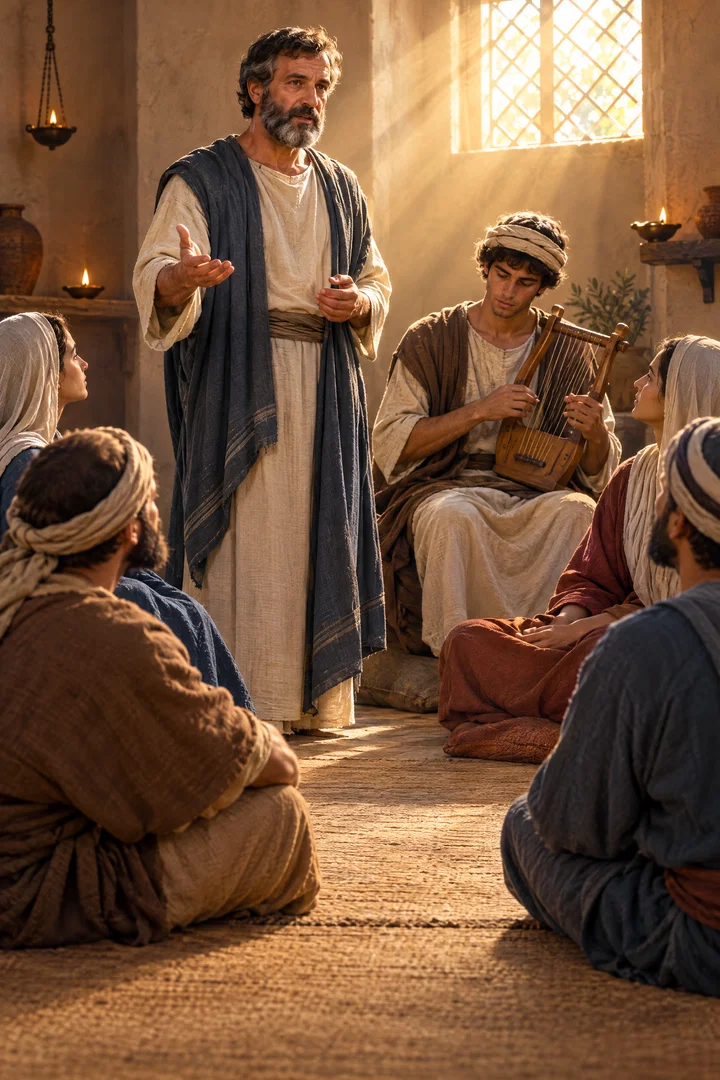
Cross-references 20 of 21
- 1 Corinthians 14:40
Let all things be done decently and in order.
Both require everything in worship to be done decently and in order.
- 1 Corinthians 14:32-33
And the spirits of the prophets are subject to the prophets.
Prophets’ spirits remain subject to them, and God brings peace rather than confusion.
- 1 Corinthians 14:3-4
But he that prophesieth speaketh unto men to edification, and exhortation, and comfort.
Prophetic speech builds up and comforts the church.
- 1 Corinthians 12
Now concerning spiritual gifts, brethren, I would not have you ignorant.
Paul’s argument on the gifts and the church as a body.
- 1 Corinthians 14:31
For ye may all prophesy one by one, that all may learn, and all may be comforted.
Believers prophesy one by one so all may learn and be comforted.
- Colossians 3:16
Let the word of Christ dwell in you richly in all wisdom; teaching and admonishing one another in psalms and hymns and spiritual songs, singing with grace in your hearts to the Lord.
Teaching and singing encourage believers when they gather.
- 1 Corinthians 14:5
I would that ye all spake with tongues, but rather that ye prophesied: for greater is he that prophesieth than he that speaketh with tongues, except he interpret, that the church may receive edifying.
Prophecy benefits the church more than uninterpreted tongues by building it up.
- 1 Corinthians 14:12
Even so ye, forasmuch as ye are zealous of spiritual gifts, seek that ye may excel to the edifying of the church.
Believers are urged to use spiritual gifts to build up the church.
- 1 Corinthians 14:19
Yet in the church I had rather speak five words with my understanding, that by my voice I might teach others also, than ten thousand words in an unknown tongue.
Paul values understandable speech that teaches and builds up the church over tongues.
- 1 Corinthians 13:1
Though I speak with the tongues of men and of angels, and have not charity, I am become as sounding brass, or a tinkling cymbal.
Tongues are joined to the need for charity.
- 1 Corinthians 14:1
Follow after charity, and desire spiritual gifts, but rather that ye may prophesy.
It continues the appeal to follow charity and desire spiritual gifts.
- Ephesians 4:12-13
For the perfecting of the saints, for the work of the ministry, for the edifying of the body of Christ:
Gifts equip the saints for ministry and build the church toward unity and maturity.
- Ephesians 4:29
Let no corrupt communication proceed out of your mouth, but that which is good to the use of edifying, that it may minister grace unto the hearers.
Words should give grace to their hearers.
- 2 Corinthians 12:19
Again, think ye that we excuse ourselves unto you? we speak before God in Christ: but we do all things, dearly beloved, for your edifying.
both require all things for building up
- 1 Corinthians 14:4
He that speaketh in an unknown tongue edifieth himself; but he that prophesieth edifieth the church.
Tongues edify the speaker, while prophecy edifies the church.
- 1 Corinthians 12:11
But all these worketh that one and the selfsame Spirit, dividing to every man severally as he will.
Spirit divides gifts as He wills
- 1 Corinthians 10:23
All things are lawful for me, but all things are not expedient: all things are lawful for me, but all things edify not.
both limit all things to what builds up
- Romans 12:6-8
Having then gifts differing according to the grace that is given to us, whether prophecy, let us prophesy according to the proportion of faith;
Different gifts serve the church’s shared life and work.
- Ephesians 5:19
Speaking to yourselves in psalms and hymns and spiritual songs, singing and making melody in your heart to the Lord;
Both texts describe singing in Christian gatherings.
- 1 Thessalonians 5:11
Wherefore comfort yourselves together, and edify one another, even as also ye do.
Both describe believers building one another up when gathered.
Commentary
Each commentary is drawn from primary sources: the writings of Ellen G. White and Adventist pioneers and periodicals. Each commentary is separate. Its own words are not a quotation; follow the references to read the source passages.
Ellen G. White
5 sources
When believers come together, every psalm and teaching and tongue and revelation and interpretation is to be carried out so as to build up and bless everyone present who listens.CE 131.1RH May 30, 1871CE 131.2–133.1Ms 39a, 1887, par. 8 Worship is to be participatory, with each person having opportunity to contribute to the spiritual life of the meeting through praise to God and testimony and accounts of personal struggles and victories and other spiritually helpful words, and such participation brings blessing.Ms 39a, 1887, par. 8Lt 187, 1904, par. 7 When no minister is present, the one leading is to speak briefly from the Spirit and from love for Jesus rather than preaching a sermon, and no one is to speak merely to fill time.Ms 39a, 1887, par. 8 Applied to Sabbath worship, this means the discourse is to be kept short so that all can bear testimony.Lt 187, 1904, par. 7
Cold, lifeless prayers and long, unspiritual testimonies give no light but cast shadow and chill and darkness, edify no one, and deaden and kill the meeting.RH May 30, 1871 The same harm is done by neglecting private prayer and then bringing several days of troubles at once into the prayer meeting to do several days of praying at once.RH May 30, 1871 An edifying meeting is spiritual and social and not too long.RH May 30, 1871 Reserve and pride and vanity and fear of others and small differences and prejudices are to be left at home, and simplicity and meekness and mutual confidence and love are to prevail as in a united family, so that all are refreshed and strengthened by bringing their lights together.RH May 30, 1871
To edify means to pray and speak and read in a clear and distinct and forceful and full and attractive and audible way with complete enunciation that expresses adoration in simplicity and truth and holiness.CE 131.1CE 131.2–133.1 It is not to be done in a low and indistinct and hesitating and muffled and indifferent and spiritless and thick or crowded way with the voice falling after each word, which destroys half the interest of a meeting.CE 131.1CE 131.2–133.1 The gift of speech and the melody of the human voice are precious in a world of sin and ignorance when devoted to the praises of Him who loved us and gave Himself for us, and must not be abused or perverted.CE 131.1 Every person is to do his best and grow daily in grace and effectiveness by accepting responsibility and discipline, learning from capable and patient and efficient teachers, making the most of natural abilities with an eye single to the glory of God, and training the voice through right use of the vocal organs with full breathing and expanded chest and lungs and strengthened muscles.CE 131.1CE 131.2–133.1 That training work belongs to teachers in all lines of education, that students may come forth properly disciplined to bless mankind, and to all engaged in missionary work, that they may qualify themselves.CE 131.2–133.1
Right, edifying speech adds interest to the service of God and blesses hearers and glorifies God.CE 131.1CE 131.2–133.1 It increases usefulness and influence and mental and intellectual efficiency, and removes embarrassment over defects of speech.CE 131.2–133.1 It benefits physical health, preserves strength, and prolongs life for service, thereby honoring God rather than dishonoring Him by neglect, and it brings reward in this life and in eternal life.CE 131.2–133.1 Earthly thanksgiving and praise and rejoicing thus join with heaven, where the voices of the children of God unite with the voices of angels in giving honor and glory and praise to God and to the Lamb for the great salvation provided.CE 131.1
Sources
Pioneers and periodicals
50 sources
When believers come together each one brings a different spiritual contribution such as a psalm, teaching, tongue, revelation, and interpretation, and Paul does not reject these gifts but requires that they be used in an orderly way so that all things build up the church.ST May 30, 1878ST Apr 29, 1875 To build up means to form solid, lasting Christian character on a deep and strong foundation that will stand every trial, and every part of church life and especially preaching must aim at that alone rather than at pleasing, entertaining, or displaying ability.ST Dec 2, 1889RH Sep 8, 1863ST Nov 30, 1882 What is said and prayed in the gathering must therefore be intelligible to the hearers, spoken in turn one by one and with interpretation where needed, so that all can learn and be encouraged in decency, reverence, and peace.ST May 30, 1878RH Nov 8, 1906ST Nov 24, 1881RH Jan 31, 1871 Christians are to meet to take an active part and not to remain silent spectators, each contributing prayer, thanksgiving, exhortation, song, and testimony as the Lord directs, so that the meeting has life and renews spiritual strength even when no preacher is present.RH Jan 15, 1861RH Mar 15, 1870RH Dec 11, 1866RH Sep 8, 1863 The gifts of the Spirit including tongues and prophecy are given for the upbuilding of the body and never for display or personal whim, so tongues without interpretation build up only the speaker while teaching and prophesying build up the church, and any utterance claimed as a gift must agree with the law and testimony of Scripture.ST May 19, 1909ST May 12, 1898RH Dec 17, 1908ST Nov 18, 1913
Setting and Wording in Corinth
The verse belongs to a connected argument running across chapters 12 through 14, in which teaching about spiritual gifts is joined to teaching about charity and love.RH Jan 8, 1861ST Aug 25, 1909 It stands at the close of that section on gifts, concluding evening readings that run from 1 Corinthians 10:19 through chapter 14.ST Aug 25, 1909 The chapter is directed against evils and disorder in the Corinthian church.ST Nov 29, 1883RH Jul 16, 1901
Those with diversities of gifts — prophecy, tongues, interpretation of tongues, a psalm, a doctrine, a revelation — all sought to make themselves heard at once when believers met for worship.RH Jul 16, 1901 Many were speaking at the same time in public service, producing great confusion.RH Jul 16, 1901 Paul condemns this simultaneous speaking and commands order in public worship, so that everything must contribute to the edifying of the church by orderly succession, prophesying one by one that all may learn.RH Jul 16, 1901
The directions in 1 Corinthians 14:1-28 on how to use the gift of tongues to edification were addressed to the Corinthians after their amazing conversion from gross immoralities, when they abounded in spiritual or miraculous gifts.RH Feb 12, 1861 What was handed down by them to posterity as a sacred treasure shows the gifts and the conversion were real facts known to them and not forged.RH Feb 12, 1861 The verse shows the habit of stated, regular public meetings for worship, sometimes with the whole church gathered together in one place.RH Nov 28, 1871 Their exercises included prayer and various kinds of religious instruction, together with exhortation, singing, and observance of the Lord's Supper in public places for the benefit of the church.RH Nov 28, 1871
When the church assembled, members brought different spiritual contributions, including psalms, instruction, tongues, revelations, and interpretations.ST Apr 29, 1875 These gifts were present among the church members, not only among ministers.ST Apr 29, 1875 Paul did not reject them but directed that they be used in an orderly way for the church's edification.ST Apr 29, 1875
Edification Governing Church Life
To edify is to build up solid and permanent Christian character.ST Dec 2, 1889RH Sep 8, 1863 It means digging deep, laying a strong foundation, and building a lasting temple with the best material and workmanship, putting hardness into the foundation and strength into the life.ST Dec 2, 1889 Character so built will stand cyclone, fire, and earthquake and will defy the world, the flesh, and the devil.ST Dec 2, 1889 Believers receive God's promises as His living word and obey them, so that their words and influence build up others.RH Sep 8, 1863
Every part of church life, and especially the work of the pulpit, is to be done only for building up.ST Dec 2, 1889ST Nov 30, 1882 Pleasing people, stimulating them, being humorous, showy, sensational, emotional, tasteful and proper, joking, spinning theories, arguing syllogisms, or stirring feelings of heat, cold, tears, or laughter does not meet this rule.ST Dec 2, 1889 Merely preaching in a way that pleases listeners does not meet it either, for laboring to edification requires caring for the various needs of the church and helping to strengthen its work and usefulness.ST Dec 2, 1889ST Nov 30, 1882 Even adornment and symmetry are to be lost sight of beside building up, and the pulpit has no right to do anything else.ST Dec 2, 1889
Psalms, teaching, tongues, revelations, and interpretations are not ends in themselves and are not for display.RH Mar 3, 1853ST Feb 14, 1884 The Spirit's various gifts are needed for the completeness and unity of the church, pictured as Christ's body.RH Mar 3, 1853ST Feb 14, 1884 Everything in the gathered church is to serve edification and to take place in harmony and peace, so that believers build one another up.RH Mar 3, 1853ST Feb 14, 1884
The requirement that everything build people up spiritually is twisted by popular churches into literal house-building.RH Oct 10, 1871 Three-days fairs, baby exhibitions, auctions, lotteries, suppers, and entertaining sports are used to pay bills and erect new houses of worship, and this is called obedience.RH Oct 10, 1871 Those means gratify appetite and love of fun, blunt moral duty to the needy, corrupt the piety and morals of youth, destroy conscientious free-will offerings, and do more harm than good.RH Oct 10, 1871
Order in Public Worship
Worship gatherings are to employ spiritual gifts to build up the congregation, joining religious feeling and joyful expression with intelligent, understandable teaching that listeners can grasp in meaning.ST May 30, 1878 Different members may bring a psalm, teaching, tongue, revelation, or interpretation, but these contributions must be orderly so that all can learn and be encouraged.ST May 30, 1878 People are to speak in turn and in orderly succession, prophesying one by one, with tongues interpreted, and the whole conducted decently and in order.ST May 30, 1878
Meetings in which everyone acts on his own impulse are disorderly and merit reproof, for the requirement that all things be done for edification calls for order in the church.RH Nov 27, 1860RH Oct 6, 1868 Even those who possess powerful spiritual gifts are not free to abandon reason or follow uncontrolled impulse, but must have their gifts and contributions governed by the aim of building up the church.RH Nov 27, 1860RH Oct 6, 1868 What is said when believers gather must be understood so the congregation is edified, and rejection of uninterpreted speech applies to public prayer as well as to other speech.ST Nov 24, 1881RH Jan 31, 1871 Prayer offered in the congregation must therefore be spoken in known language that hearers understand, not in an unknown tongue without an interpreter, because listeners cannot be edified by words they do not understand.ST Nov 24, 1881RH Jan 31, 1871
The rule that all things be done unto edifying proves that prayer belongs to the public meeting where believers and unbelievers come together to listen and learn, and that public prayer is enjoined as part of public worship.RH Jan 31, 1871 Worship in the church is to be conducted with reverent, considerate behavior in the house of God so that the service does not distract worshipers.RH Nov 8, 1906 The operations of the Holy Spirit, including spiritual gifts, are meant to edify the church by uniting believers and contributing to peace and order, not by producing disorder or confusion.RH Nov 8, 1906RH Mar 3, 1853
Spiritual Gifts and Tongues
The verse belongs to instruction about gifts given by the Spirit, including tongues and the interpretation of tongues. A tongue so given is an intelligible earthly language for communicating the gospel as need requires, not something seized or used at personal whim. The speaker knows what he is saying even when the hearers do not understand, and speaking in the Spirit does not mean uttering what no one can understand, for God discloses the mysteries of his truth and faith rests on revealed truth.
Speaking with tongues is of little account unless someone interprets and makes plain what the foreign tongue means.ST May 19, 1909 The reason is that the tongue-speaker builds up only himself, while he who prophesies — that is, who teaches and speaks for God — builds up the church.ST May 19, 1909 God bestows gifts as his church needs them, and the one and same Spirit apportions each gift to each person just as he wills, not as the believer wills or chooses.ST May 19, 1909
The purpose of God's gifts is upbuilding, not display, and believers are to build one another up.ST May 12, 1898 Speaking in tongues without interpretation does not accomplish this, for the gifts of the Spirit are given for the upbuilding of the church and never without a wise purpose.ST May 12, 1898ST Nov 18, 1913
A claimed gift of tongues that is mere gibberish no one can understand is counterfeit because it does not edify, and the true gift is not pouring forth words unintelligible to anyone present and pressing that claim upon others.RH Dec 17, 1908ST Nov 18, 1913 Even speaking an unlearned language that another person understands does not by itself prove the gift is from God, since evil powers can also give utterance in known languages.ST Nov 18, 1913 The test is whether what is spoken agrees with the law and the testimony of the Bible; what contradicts Scripture comes from another source, so everything must be tested by God's word and nothing accepted that is not in perfect harmony with it, lest one be led astray by every wind of doctrine and delusive manifestation.ST Nov 18, 1913
Those who exercise the gifts are responsible stewards, for the gifts including tongues were given to benefit the church, and disorder in their use called for correction.RH Jun 3, 1858 The church therefore has authority to regulate their use so that they serve its improvement.RH Jun 3, 1858 Paul's admonitions about the spiritual gifts must be carefully studied today, because the same abuse made at Corinth is found now, and every psalm, doctrine, tongue, revelation, and interpretation used when believers come together must serve to build up others rather than confuse them.RH Dec 17, 1908
The verse is part of the evidence that spiritual gifts were exercised in the church after Christ's ascension and belong to the Christian dispensation.RH Aug 7, 1866 The gift of prophecy is among these gifts and is not to be set aside while the other gifts remain.RH Aug 7, 1866 Prophecy is foretelling future events by inspiration of God and is also teaching, and believers may bear testimony in a social meeting and thereby prophesy even though they are not prophets.RH Nov 18, 1909RH Sep 22, 1910
The instruction of chapters 12 to 14 was given to silence boasting over spiritual gifts.ST Jul 8, 1889 The gifts dealt with there come from God and are valued by him as pounds and talents, coins of the highest value, not pence or shekels or other inferior coins.ST Jul 8, 1889 The very lowest gift is of inestimable value to him who uses it rightly, but a weighty cross to him who slights divinely given opportunity.ST Jul 8, 1889 Knowing that these gifts come from God should keep the Christian from exalting self and lead him to think soberly of himself according as God has dealt to every man the measure of faith.ST Jul 8, 1889
All Members Contributing Together
When brethren come together every one has a psalm, a doctrine and other gifts to share, so Christians are to meet together to do something and take an active part rather than come only to hear the rest as silent spectators.RH Jan 15, 1861 Remaining silent in meeting has no apostolic example, and if one person has the right to go merely to hear, every person has the same right, which would leave no meeting at all.RH Jan 15, 1861 This shows the duty and privilege of social meetings, where believers may speak and contribute for the good of the gathering.RH Jan 15, 1861
Early Christian meetings involved contributions from many members, including a psalm, teaching, a tongue, a revelation, or an interpretation, and everything shared was to build up the church.RH Mar 15, 1870 They were conducted much like prayer and fellowship gatherings, where members actively used their gifts and the church could thrive even when preachers were away.RH Mar 15, 1870 The church can be edified even when no preaching is planned, so attending the Sabbath meeting should not depend on whether a preacher will be there.ST Mar 19, 1885 Those who wish to serve God should go and do their part to encourage and build up the church.RH Mar 15, 1870ST Mar 19, 1885
When believers come together each one has something to bring for the good of all, and all should contribute their mite as the Lord directs to give life and interest to the common work and make it a still greater blessing to the cause of truth.RH Dec 11, 1866 Believers should contribute to the gathering from their experience through prayer, thanksgiving and supplication, exhortation, and songs of praise, so that their participation edifies one another.RH Sep 8, 1863 Communications among believers can renew spiritual strength and edify the whole church, for what is shared in the church should build it up.RH Dec 11, 1866RH Sep 8, 1863RH Jun 19, 1860
The verse supports a welcoming, flexible meeting in which people are free to speak, pray, sing, or read as they are moved, rather than following a rigid routine.RH Aug 8, 1865 A Christian gathering may include different people contributing prayer, praise, Scripture, counsel, or other spiritual gifts, and these contributions should build up the church.RH Aug 8, 1865 Its aim is mutual instruction and edification, where sharing different views calmly can help the group arrive at truth, while arguing to promote opposing views works against that aim.RH Aug 21, 1856 Each person has an important part in the social meeting, and a contribution offered well can give grace to those who hear, for a psalm, hymn, exhortation, or prayer flowing from love for God can encourage the discouraged and strengthen the weak, even when the speaker's words are broken.RH Aug 21, 1856RH Aug 8, 1865RH Oct 18, 1870
Teaching in the church must not be treated as a matter of unrestricted personal preference, for the disorderly situation in which the Corinthians brought different contributions, including teaching, when they gathered was reproved.ST Oct 24, 1878 Paul reproved the Corinthians because when they came together every one of them had his own doctrine.RH Jan 31, 1871 Having many different doctrines in the church is an evil to be reproved, not commended or treated as necessary, yet that same condition is now found in many churches where it goes unreproved and is even commended and thought to be necessary.ST Oct 24, 1878RH Jan 31, 1871
The verse describes churches divided among competing teachings and practices, where each group has its own psalm, doctrine, tongue, revelation, and interpretation.RH Feb 4, 1858 The call for everything to be done for edification is set against this confusion, with peace rather than confusion as God's way.RH Feb 4, 1858 It pictures the great reform conventions where thousands of voices speak hundreds of opposing messages because originality is the ambition of the age, so the trumpets give no certain sound and Babel rules among pulpit social reformers whose pretty theories and enticing songs promise peace but are proved false by dreaded and deadly ills that grow worse each day.ST Jul 9, 1894RH Feb 4, 1858
Christian worship includes different contributions and all should serve to edify the gathered people, as when reading sermons, praying, and speaking with the assembly helped reclaim people from immorality and draw them back to church.ST Nov 25, 1880 Everything in the meeting must edify everyone present.RH May 30, 1871 Meetings are to be spiritual and social and not too long, with reserve, pride, vanity, fear of man, little differences and prejudices left at home, and with simplicity, meekness, mutual confidence and love like a united family, so brethren and sisters are refreshed and invigorated by bringing their lights together.RH May 30, 1871 Cold, frozen prayers and lengthy, backslidden testimonies that cast a shadow and bring chill and darkness give no light and edify no one, and kill the meeting, and so does failing to take troubles to God in private prayer and then reserving them for the prayer meeting to do several days of praying at once.RH May 30, 1871ST Nov 25, 1880
Women Speaking and Silence
The verse belongs to directions for church courts, not to ordinary regular public worship.RH Jul 30, 1861 It addresses meetings for discussion and debate on church matters and for hearing candidates and electing church officers.RH Jul 30, 1861 In those meetings speaking must be by two or at most by three in turn, to prevent several speaking at once and to let the others judge qualifications and make selections.RH Jul 30, 1861 The command that all things be done unto edifying requires this order, because God is not the author of confusion.RH Jul 30, 1861 The command for women to keep silence in the same chapter applies only to speaking and disputing in those courts, requiring them to ask their husbands at home, and does not forbid women to preach or lecture in regular services.RH Jul 30, 1861
The surrounding discussion of prophecy shows that women may speak publicly in meetings, including by praying and prophesying.RH Dec 2, 1862 When the whole church comes together, every member including women may take part by speaking, prophesying, and sharing a psalm, doctrine, or testimony.RH Dec 2, 1862RH Jun 3, 1873 This permission covers social and prayer meetings and the assembly of believers, because the whole church embraces the sisters.RH Jun 3, 1873 All speaking must be done in a becoming, orderly way, one by one unto edifying, not three or four talking at the same time in confusion.RH Jun 3, 1873 Even short, broken, trembling testimony edifies others, mortifies self, and brings blessing and strength.RH Jun 3, 1873
Speaking and exhorting are acceptable when they edify the congregation and remain consistent with the prophets' teaching.RH Oct 15, 1857 Women's prayer and speech that edify are not, by themselves, teaching or taking authority over men.RH Oct 15, 1857 The verse describes a meeting that had become disorderly, with people each wanting to contribute a psalm, teaching, tongue, revelation, or interpretation while asserting authority over how matters should be conducted.ST Feb 10, 1881 Some women had joined these disputes and claimed authority to decide how the meeting should be run, and Paul reproved this conduct.ST Feb 10, 1881 Women who joined the disputes were told to be silent in that matter and submit to the decision, after which they could take their proper part in the meeting.
The setting was disorder where people were impatient to speak and interrupted one another, causing confusion and hard feelings.ST Apr 5, 1899 The instructions that follow require speakers to stop while others are speaking, not to remain silent forever, so that the meeting may be orderly.ST Apr 5, 1899
Sources