1 Corinthians 9:10
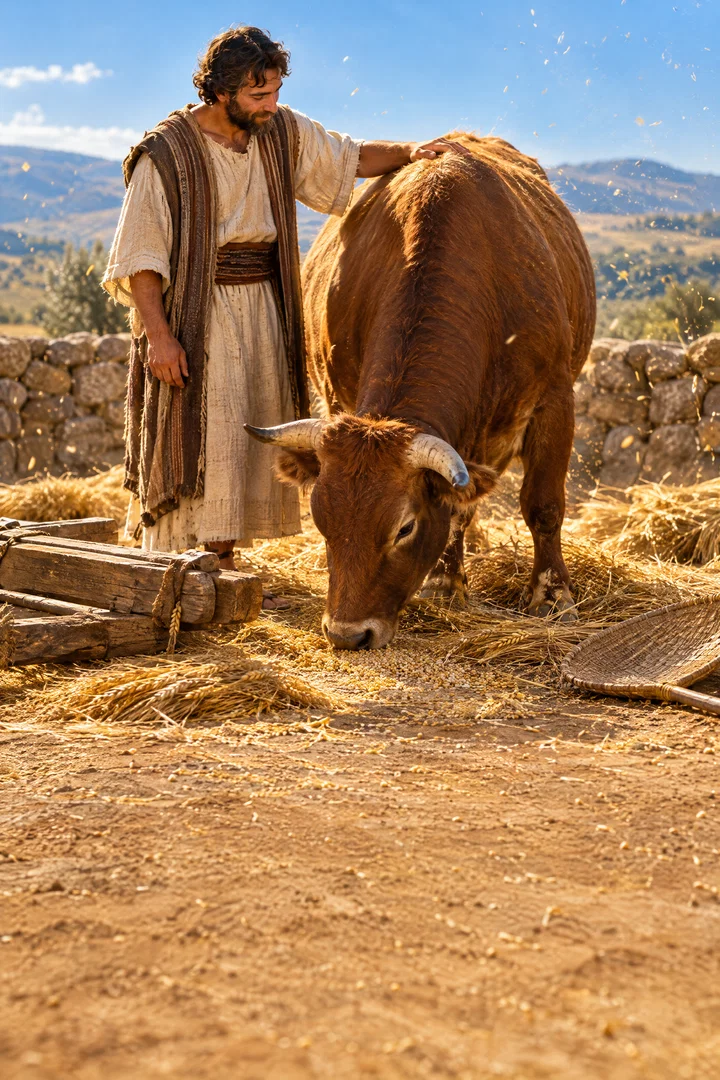
Or saith he it altogether for our sakes? For our sakes, no doubt, this is written: that he that ploweth should plow in hope; and that he that thresheth in hope should be partaker of his hope.
Translations
Or says he it altogether for our sakes? For our sakes, no doubt, this is written: that he that plows should plow in hope; and that he that threshes in hope should be partaker of his hope.
King James Version, KJV Cambridge Paragraph Bible
Or saith he it altogether for our sakes? For our sakes, no doubt, this is written: that he that ploweth should plow in hope; and that he that thresheth in hope should be partaker of his hope.
Or saith he this altogether for our sakes? for our sakes, no doubt, this is written: that he that ploweth should plow in hope; and that he that thresheth in hope should be partaker of his hope.
or saith he it altogether for our sake? Yea, for our sake it was written: because he that ploweth ought to plow in hope, and he that thresheth, to thresh in hope of partaking.
or saith he it assuredly for our sake? Yea, for our sake it was written: because he that ploweth ought to plow in hope, and he that thresheth, to thresh in hope of partaking.
or because of us by all means doth He say [it]? yes, because of us it was written, because in hope ought the plower to plow, and he who is treading [ought] of his hope to partake in hope.
or does he say [ it] altogether for our sakes? For for our sakes it has been written, that the plougher should plough in hope, and he that treads out corn, in hope of partaking of [ it].
Or, for our sakes altogether, is he saying it? For our sakes, it was written; because, he that ploweth, ought, to plow, in hope,—and, he that thresheth, [to thresh] in hope of partaking.
Berean Standard Bible, Majority Standard Bible
Isn’ t He actually speaking on our behalf? Indeed, this was written for us, because when the plowman plows and the thresher threshes, they should also expect to share in the harvest.
or does he say it assuredly for our sake? Yes, it was written for our sake, because he who plows ought to plow in hope, and he who threshes in hope should partake of his hope.
Or has he us in mind? Yes, it was said for us; because it is right for the ploughman to do his ploughing in hope, and for him who is crushing the grain to do his work hoping for a part in the fruits of it.
Either saith hee it not altogether for our sakes? For our sakes no doubt it is written, that he which eareth, should eare in hope, and that he that thresheth in hope, should be partaker of his hope.
Douay-Rheims (Challoner revision)
Or doth he say this indeed for our sakes? For these things are written for our sakes: that he that plougheth, should plough in hope; and he that thrasheth, in hope to receive fruit.
Pictures
Cross-references
- Deuteronomy 25:4
Thou shalt not muzzle the ox when he treadeth out the corn.
The law against muzzling a working ox supplies the principle Paul applies to supporting gospel laborers.
- Numbers 18:21
And, behold, I have given the children of Levi all the tenth in Israel for an inheritance, for their service which they serve, even the service of the tabernacle of the congregation.
Tithes provide for the support of those serving in sacred ministry.
- 1 Timothy 5:18
For the scripture saith, Thou shalt not muzzle the ox that treadeth out the corn. And, The labourer is worthy of his reward.
The unmuzzled ox principle supports honoring elders who labor in teaching.
- 1 Corinthians 9:14
Even so hath the Lord ordained that they which preach the gospel should live of the gospel.
It applies the principle to those who preach the gospel.
- Galatians 6:6
Let him that is taught in the word communicate unto him that teacheth in all good things.
Those taught the word are to share material goods with their teachers.
- Luke 10:7
And in the same house remain, eating and drinking such things as they give: for the labourer is worthy of his hire. Go not from house to house.
Both affirm that a laborer deserves support for his work.
- Romans 15:27
It hath pleased them verily; and their debtors they are. For if the Gentiles have been made partakers of their spiritual things, their duty is also to minister unto them in carnal things.
both teach repaying spiritual gifts with material help
- Matthew 10:10
Nor scrip for your journey, neither two coats, neither shoes, nor yet staves: for the workman is worthy of his meat.
Jesus says workers in the gospel mission deserve provision.
- Leviticus 27:30-32
And all the tithe of the land, whether of the seed of the land, or of the fruit of the tree, is the LORD’s: it is holy unto the LORD.
The tithe is set apart as a means of support.
- 2 Thessalonians 3:8-9
Neither did we eat any man’s bread for nought; but wrought with labour and travail night and day, that we might not be chargeable to any of you:
Paul worked to support himself and set an example for others.
- Philippians 4:15-18
Now ye Philippians know also, that in the beginning of the gospel, when I departed from Macedonia, no church communicated with me as concerning giving and receiving, but ye only.
gives example of church supplying Paul's need
- Deuteronomy 10:9
Wherefore Levi hath no part nor inheritance with his brethren; the LORD is his inheritance, according as the LORD thy God promised him.
The Levites had no land inheritance; the Lord was their portion.
- Acts 20:34-35
Yea, ye yourselves know, that these hands have ministered unto my necessities, and to them that were with me.
Paul worked to meet his needs and support others.
- Numbers 18:24
But the tithes of the children of Israel, which they offer as an heave offering unto the LORD, I have given to the Levites to inherit: therefore I have said unto them, Among the children of Israel they shall have no inheritance.
The tithe is given for the Levites’ support.
- 1 Thessalonians 5:12-13
And we beseech you, brethren, to know them which labour among you, and are over you in the Lord, and admonish you;
both call for honoring laborers for their work
- Malachi 3:10
Bring ye all the tithes into the storehouse, that there may be meat in mine house, and prove me now herewith, saith the LORD of hosts, if I will not open you the windows of heaven, and pour you out a blessing, that there shall not be room enough to receive it.
Tithes provide support for the Lord’s work.
- Luke 9:62
And Jesus said unto him, No man, having put his hand to the plough, and looking back, is fit for the kingdom of God.
Warns that looking back after beginning the work makes one unfit.
- Proverbs 20:4
The sluggard will not plow by reason of the cold; therefore shall he beg in harvest, and have nothing.
The sluggard avoids plowing and consequently has no harvest.
Commentary
Each commentary is drawn from primary sources: the writings of Ellen G. White and Adventist pioneers and periodicals. Each commentary is separate. Its own words are not a quotation; follow the references to read the source passages.
Ellen G. White
7 sources
The command not to muzzle the ox treading out the grain was written altogether and especially for human benefit, for the sake of those who labor in spiritual things.AA 335.1–3Ms 10, 1901, par. 16–17 The Old Testament provision for the animal was thus intended from the first to teach concerning people, that those who work should do so with hope of sharing in the fruit of their labor.AA 335.1–3Ms 10, 1901, par. 16–17 The verse establishes as a general principle that the one who plows should plow in hope and the one who threshes in hope should share in the benefits, partaking of the fruit of the labor.AA 335.1–3Ms 10, 1901, par. 16–174T 409.1–3GW 234.3–235.17T 129.2
Applied to gospel work, those who sow spiritual blessings may rightly claim and expect material support from those they serve.AA 335.1–3Ms 10, 1901, par. 16–174T 409.1–3GW 234.3–235.1 It is the will of God that ministers of the gospel receive such support from those for whom they labor.Ms 10, 1901, par. 16–17 All who preach the gospel, whether men or women, are entitled to a just reward for their services.Ms 10, 1901, par. 16–17 Ministers have just as much right to wages as workers employed in publishing houses and other lines of work.Ms 17, 1897, par. 3–4
Those who give their time and thought and labor to the service of the Master should receive their due, wages enough to supply their families with food and clothing.Ms 17, 1897, par. 3–4 To pay some workers meager wages is robbery.Ms 17, 1897, par. 3–4 The minister who receives a just support in return is still required to pay tithe according to his ability.Ms 17, 1897, par. 3–4 The apostle could claim support from the Corinthians but chose to forgo that right and work at his trade instead.4T 409.1–3GW 234.3–235.1
Accepting support was set aside when it might hinder usefulness and give opponents grounds for misrepresentation.4T 409.1–3 Suspicion of preaching for money would hinder the gospel, and so labor with the hands was chosen to remove that hindrance.4T 409.1–3GW 234.3–235.1 Those who have spent precious time, study, and means to develop a work have the right to receive a reasonable income from it and to reap its fruit.7T 129.2
In health-food work this means that those who labored and invested means to discover processes and provide facilities for special foods should be allowed to control them and reap from them.7T 129.2 As the Lord's stewards they may thus have means to advance the work of God.7T 129.2 No one else has a right to borrow or steal their work, to learn its secrets, to copy its products, or to sell them for selfish personal profit.7T 129.2
To plow in hope means to break the soil at a venture and to work in faith, refusing to encourage unbelief when means are lacking and everything seems at a standstill.LSEGW 360.3–5 It means not being discouraged by looking at things which are seen and by a present appearance that is not flattering, but talking faith and working in faith because now is the sowing time.LSEGW 360.3–5 It means working intelligently and with earnest endeavor to put in the seed with hope of future returns and expectation of a measure of prosperity ahead.LSEGW 360.3–5 In exactly the way fields are treated with hope of future returns, missionary soil must be sown with the seeds of truth.LSEGW 360.3–5
Sources
Pioneers and periodicals
28 sources
The law forbidding the muzzling of the ox that treads out the grain was written altogether for the sake of believers, not out of care for oxen as such.RH Apr 15, 1862RH Mar 16, 1905ST Feb 15, 1905 It declares that the one who plows should plow in hope and the one who threshes in hope should share in what he hopes for, so that all who labor may rightly work in expectation of partaking in the fruit of their work.ST Oct 13, 1881RH Dec 27, 1853ST Nov 22, 1883RH Sep 16, 1909 Applied to the gospel, those who sow spiritual things should reap material things, and those who preach the gospel should live from the gospel rather than serve at their own expense, just as the soldier does not go to warfare at his own charges, the planter eats of his vineyard, the shepherd drinks of the flock's milk, and the priest shares in the altar's offerings.RH Apr 1, 1915RH Oct 28, 1915RH Apr 15, 1862ST Jun 23, 1914ST Sep 9, 1889 As the Levitical priests who ministered in sacred things lived from the tithe brought into the treasury, so those who proclaim the gospel are ordained to live from the gospel and receive their support from the work they serve, and the tithe still belongs to Christ as great High Priest for the support of those he calls to the ministry.RH Apr 1, 1915RH Oct 28, 1915ST Sep 9, 1889ST Mar 13, 1901RH Dec 22, 1910 Providing that support is a duty required by God and not mere charity, for Christ will provide for the laborers he sends and will not leave faithful ministers who give their whole time to souls to the mercy of a cold world, though their right to support does not prevent them from laboring with their own hands as Paul did at tentmaking to avoid burdening the poor or giving opponents cause for reproach.ST Mar 31, 1914RH Mar 16, 1905RH Feb 6, 1908RH Apr 17, 1879RH Jul 31, 1860
Written for Our Sakes
The command not to muzzle the ox that treads out the corn was written altogether for the sake of believers, not out of care for oxen as such.RH Apr 15, 1862RH Mar 16, 1905ST Feb 15, 1905 It means that he who plows in gospel work should plow in hope, and he who threshes should thresh in hope of sharing in the fruit of his hope, so that believers must support with worldly goods those who give themselves to labor in the gospel, that those who sow spiritual things may reap material things and those who preach the gospel may live of the gospel instead of going to warfare at their own charges.RH Apr 15, 1862RH Mar 16, 1905 It establishes the principle that the laboring worker shall be generously cared for, so that Christ must provide for the support of the laborers he sends into the harvest field and will not leave them and their families to the mercy and charities of a cold world, for as no nation sends an army to warfare without providing for its wants, as he who plants a vineyard eats of its fruit and he who feeds a flock eats of its milk, so faithful ministers who devote their lives to his cause and renounce wealth, home, and every dear association have their reasonable wants supplied by the appointing power that sent them.RH Mar 16, 1905 Alongside this stands the teaching that the command about the threshing ox was written for the benefit of the church as well as for the oxen, that those who labor should work in hope of sharing in the fruit of their labor, and that those who receive spiritual help from Christian workers have an obligation to provide temporal and financial support for their work.ST Mar 31, 1914
The verse declares a universal principle that applies to all time including the present dispensation, requiring that God's laborers be supplied with temporal support so they are not hindered for lack of it, with spiritual sowing entitling to material return.ST Feb 15, 1905 The earlier Scriptures were written for the benefit of later readers, and their teaching remains useful and gives grounds for hope.ST Aug 6, 1894 Mosaic provisions can be cited as examples for instruction under the gospel, as worthy of imitation, without requiring obedience to the original law itself.RH Feb 21, 1854ST Feb 15, 1905
Only the handwriting of ordinances, the typical ceremonials that fulfilled their purpose when Christ came, were done away at the cross, while the other statutes and judgments of the law of Moses remain designed for profit unto the last time, which proves that not all things in that law were abolished.ST Feb 15, 1905 The verse belongs to Paul's teaching in 1 Corinthians 9:1-19 on the Christian ministry and its support, showing that God has called men in the Christian dispensation to give their whole time to labor for souls, and that as the Levitical priests who ministered in sacred things were supported by the tithes, so those who proclaim the gospel are ordained to live of the gospel.ST Mar 13, 1901 In this way tithe-paying is as binding on Christians since Christ as it was upon those who lived before Christ.ST Mar 13, 1901
Ministers Live by Gospel
The rule about plowing and threshing in hope was written for people, so that everyone who labors may rightly work with expectation of sharing in the fruit that labor produces, and gospel workers in particular may look to those they serve for material provision in return for spiritual sowing.ST Oct 13, 1881RH Dec 27, 1853ST Nov 22, 1883RH Mar 3, 1904RH Jun 25, 1901 The figure of the ox treading grain therefore applies directly to the support of gospel ministry, establishing that those whose work produces support should labor in hope of partaking of it.ST Nov 22, 1883RH Mar 3, 1904ST Nov 15, 1910
Applied to the gospel, those who sow spiritual things should reap material things, and those who preach the gospel should live from the gospel rather than going to warfare at their own charges.RH Apr 15, 1862ST Jun 23, 1914ST Sep 9, 1889 No soldier serves at his own charges and no nation sends an army to warfare without providing for its wants, while he who plants a vineyard eats of its fruit, he who feeds a flock eats of its milk, and he who serves at the altar shares in its offerings.RH Apr 15, 1862RH Mar 16, 1905RH Apr 17, 1879 The minister who labors in spiritual things for a church, visiting homes, praying, exhorting, and teaching day and night, is therefore to be supported with temporal things by the people for whom he ministers.ST Jun 23, 1914ST Sep 9, 1889RH Apr 17, 1879
As the Levitical priests who ministered in sacred things lived from the tithe paid into the temple treasury and shared in the altar's offerings, so those who proclaim the gospel are ordained to live from the gospel and receive their support from the work they serve.RH Apr 1, 1915RH Oct 28, 1915ST Sep 9, 1889ST Mar 13, 1901ST Dec 10, 1912 God's care for an ox threshing grain is an object lesson in his care for his servants who sow the gospel among sinners, showing that those who labor in preaching should receive support for their ministry and that those who have received the gospel are responsible for sustaining it.RH Oct 28, 1915ST Sep 9, 1889 Even to this day the tithe belongs to Christ as great High Priest for the support of those he calls to gospel ministry, continuing the arrangement by which Israel's tithe was given to the Levites as their inheritance and reward for making the service of the sanctuary and the congregation their sole occupation in place of an inheritance in the land.RH Dec 22, 1910
Tithes are not donations from people's own property, but what belongs to God and is entrusted to them to return, and this practice cultivates liberality.ST Sep 9, 1889 Christ must provide for the support of the laborers he sends into the harvest field and will not leave them and their families to the mercy and charities of a cold world, for he who is not less righteous than earthly powers sees that faithful ministers who devote their lives to his cause and renounce wealth, home, and every dear association have their reasonable wants supplied by the appointing power that sent them.RH Mar 16, 1905 Support of ministers is a duty required by God, not mere gratis charity for food, lodging, money, or clothing, since believers are stewards of means entrusted by the Lord and must supply laborers and means to sustain the warning, giving freely and esteeming it a privilege where their hearts are in the work.ST Mar 31, 1914RH Apr 17, 1879RH Jul 31, 1860
The gospel worker's right to receive support does not prevent him from choosing to labor with his own hands for his needs, as Paul worked at tentmaking when he feared accepting support might burden poor churches or give opponents grounds to question his motives.RH Feb 6, 1908 His example shows that honest manual labor is honorable and can serve the gospel by removing obstacles to ministry and encouraging others through industry.RH Feb 6, 1908 Those who receive spiritual help therefore have an obligation to provide temporal and financial support for Christian workers, while the worker remains free to forgo that provision for the sake of the work.ST Mar 31, 1914RH Feb 6, 1908
Laboring in Hope
The verse encourages patient, persevering Christian service in hope of sharing in its results even when results are delayed. The plowman's hope is expectation of the harvest, calling for pursuing a definite goal with perseverance rather than abandoning the work when it becomes difficult.RH Sep 16, 1909 Like the farmer who plows and works in hope though he does not know whether flood, drought, or blight will affect his field, the verse calls for laboring, waiting, and trusting God for a harvest.RH Nov 26, 1872
Missionary laborers should patiently work among people on terms they can accept, adapting to their customs and limitations, so that labor may bear fruit and they may share in its reward.ST Apr 10, 1893 Those who labor in the gospel field plow in hope and thresh in hope of partaking of the hope they preach, claiming freedom to share in the fruit of evangelistic work just as he who plants a vineyard eats of its fruit and he who feeds a flock eats of its milk.ST May 18, 1904 The sowing of such an evangelistic life multiplies like a grain of wheat sown and its whole product sown again year after year until all garners are filled, so that the increase brought into the kingdom is great beyond computation.ST May 18, 1904 Even affliction borne in that labor works a far more exceeding and eternal weight of glory.ST May 18, 1904 For Christians amid earthly sorrow, trials, and hardship, working in hope and sharing in what is hoped for brings consolation as they look forward to the blessings and joys promised in the future world.ST Nov 3, 1881
Sources