Translations
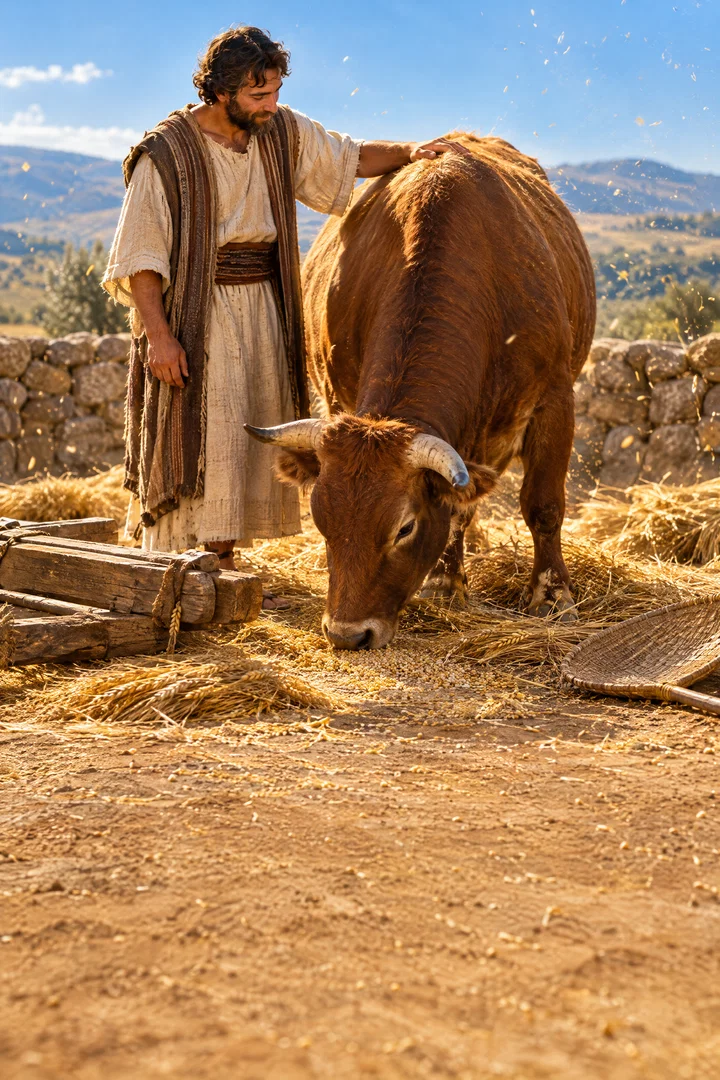
You shall not muzzle the ox when he treads out the corn.
King James Version, KJV Cambridge Paragraph Bible, Webster Bible, Revised Version
Thou shalt not muzzle the ox when he treadeth out the corn.
Thou shalt not muzzle the ox when he treadeth out the grain.
'Thou dost not muzzle an ox in its threshing.
Thou shalt not muzzle the ox when he treadeth out [ the corn].
Thou shalt not muzzle an ox when he is treading out the corn.
Berean Standard Bible, Majority Standard Bible
Do not muzzle an ox while it is treading out the grain.
You shall not muzzle the ox when he treads out the grain.
Do not keep the ox from taking the grain when he is crushing it.
Thou shalt not mousell the oxe that treadeth out the corne.
Douay-Rheims (Challoner revision)
Thou shalt not muzzle the ox that treadeth out thy corn on the floor.
Pictures
Cross-references
- 1 Corinthians 9:9-14
For it is written in the law of Moses, Thou shalt not muzzle the mouth of the ox that treadeth out the corn. Doth God take care for oxen?
Paul applies the ox’s right to eat while working to support for gospel workers.
- 1 Timothy 5:17-18
Let the elders that rule well be counted worthy of double honour, especially they who labour in the word and doctrine.
The ox’s right to eat while working supports honoring and providing for elders who labor in teaching.
- 1 Corinthians 9:14
Even so hath the Lord ordained that they which preach the gospel should live of the gospel.
Gospel preachers are entitled to live from their work, as the ox may eat while threshing.
- Luke 10:7
And in the same house remain, eating and drinking such things as they give: for the labourer is worthy of his hire. Go not from house to house.
Both affirm that a laborer deserves his wages.
- 1 Corinthians 9:10
Or saith he it altogether for our sakes? For our sakes, no doubt, this is written: that he that ploweth should plow in hope; and that he that thresheth in hope should be partaker of his hope.
Applies the command to laborers working in hope.
- 1 Corinthians 9:11
If we have sown unto you spiritual things, is it a great thing if we shall reap your carnal things?
Links spiritual labor to receiving material support.
- Matthew 10:10
Nor scrip for your journey, neither two coats, neither shoes, nor yet staves: for the workman is worthy of his meat.
same rule that workman deserves food
- Romans 15:27
It hath pleased them verily; and their debtors they are. For if the Gentiles have been made partakers of their spiritual things, their duty is also to minister unto them in carnal things.
Believers should share material goods with those who served them spiritually.
- Galatians 6:6
Let him that is taught in the word communicate unto him that teacheth in all good things.
Those taught the word should share good things with their teachers.
- Philippians 4:15-18
Now ye Philippians know also, that in the beginning of the gospel, when I departed from Macedonia, no church communicated with me as concerning giving and receiving, but ye only.
The Philippians’ gifts met Paul’s needs and were acceptable to God.
Commentary
Each commentary is drawn from primary sources: the writings of Ellen G. White and Adventist pioneers and periodicals. Each commentary is separate. Its own words are not a quotation; follow the references to read the source passages.
Ellen G. White
7 sources
Even the ox when it treads out the corn must not be muzzled, but must be left free to eat from the grain it is threshing and not be deprived of food or its due provision.AA 335.1–3STB 462.3STMW9 3.2Ms 29, 1907, par. 30–32Ms 7, 1895, par. 2–3 As a principle this establishes that a worker should share in the material benefit of the labor he performs.GW 450.2AA 335.1–3 Paul's application shows the law was written for people's sake, teaching that those who plow or thresh should work in hope of sharing in the harvest.AA 335.1–3
Applied to ministry, those who spend their strength advancing God's cause and preach the gospel should be supported by it.GW 450.2AA 335.1–3 Their right to fair remuneration must be respected, and their expected wages must not be unjustly withheld or reduced.GW 450.2 Those who trust God's wisdom and not their own walk in safe paths and will not presume to claim authority to restrict, restrain, dictate to, or control people called to labor in partnership with God.STB 462.3STMW9 3.2Ms 29, 1907, par. 30–32Ms 7, 1895, par. 2–3IRCUP 23.1–25.1
To muzzle, dictate to, and control such a human agent is offensive to God, especially to control one whom Christ invites to come to Him, find rest, and take His yoke.STB 462.3Ms 29, 1907, par. 30–32Ms 7, 1895, par. 2–3 God has not placed any of His human workers under the jurisdiction, dictation, and control of erring mortals to say what they shall do and shall not do.Ms 7, 1895, par. 2–3 He will judge those who assume over His workers an authority He has not given, and no human authority justifies withholding their freedom or treating them as tools.Ms 7, 1895, par. 2–3IRCUP 23.1–25.1
Sources
Pioneers and periodicals
17 sources
The law required that an ox treading out grain be left unmuzzled to eat freely from the grain as it worked, showing generous care for the working animal.ST Mar 31, 1914RH Apr 3, 1855ST Sep 23, 1886 It was written altogether for human sake and not for oxen alone, as a universal principle that those who labor should share in the benefit of their work and not be hindered by lack of material provision.ST Feb 15, 1905ST Oct 13, 1881RH Jun 25, 1901 Paul applies it to gospel ministers, that those who plow in hope and thresh in hope should partake of that hope, so those who sow spiritual things may reap material things and live from their preaching, even though he sometimes chose not to use that right.ST Feb 15, 1905ST Oct 13, 1881RH Jun 25, 1901 Those who receive spiritual help should therefore give temporal support to Christian workers, including elders who rule well and especially those who labor in preaching and teaching, rather than leaving ministers who devote time and energy to the gospel to support themselves and their families by other work while those benefited carry only their own support.ST Mar 31, 1914RH Apr 3, 1855RH Jun 25, 1901 The command requires both faithful service from those laboring for God and faithful support from those who benefit, establishing equity and justice without preferring one before another and without partiality.ST Mar 31, 1914RH Jun 25, 1901
Meaning and Historical Setting
The law forbids muzzling the ox when it treads out the corn, requiring that the working animal be left unmuzzled and allowed to eat from the grain as it threshes.ST Mar 31, 1914RH Apr 3, 1855ST Sep 23, 1886ST Mar 31, 1914RH Mar 16, 1905 It is a provision of generous care for the laboring ox, showing divine care for the animal that does the work.ST Mar 31, 1914RH Oct 28, 1915RH Mar 16, 1905 The rule reflects the threshing-floor practice of driving cattle or horses over the grain without muzzling them, so that they eat while they tread.ST Sep 23, 1886
The same custom of treading out grain with oxen was still in use in the rural district south of Asmara in Eritrea at grain harvest time, where the grain is thrashed with oxen and the straw and chaff are then separated with the help of the wind.RH Mar 14, 1912 The command stands in the addresses Moses gave just before his death.RH Feb 24, 1916 It belongs in the second section in chapters 5 to 26 that reviews the law for the new generation of Israel, the duplicate of the law from which Deuteronomy takes its name meaning second law.RH Feb 24, 1916
The ox on the threshing floor pictures the old slow way of harvest work, together with cutting with the small sickle and winnowing the grain by human hand.ST Aug 17, 1915 Set against the cradle, the reaper, the self-binder, and the machine delivering golden grain all sacked for the mill, that ancient method proves that knowledge has increased in the time of the end.ST Aug 17, 1915
Support for Gospel Laborers
The rule about leaving the threshing ox unmuzzled states a universal principle and not a mere regulation for animals, that those who labor should share in the benefit of their work and should not be hindered by lack of material provision, for it was written altogether for human sake and not for oxen alone.ST Feb 15, 1905ST Oct 13, 1881RH Jun 25, 1901RH Mar 16, 1905RH Apr 15, 1862 Paul applies it directly to gospel ministers, teaching that the one who plows should plow in hope and the one who threshes in hope should share in that hope.ST Feb 15, 1905ST Oct 13, 1881RH Jun 25, 1901RH Apr 15, 1862 Those who sow spiritual things may therefore reap material things from those they serve, and the Lord has ordained that preachers may live from their work, even though Paul himself sometimes chose not to use that right.ST Feb 15, 1905ST Oct 13, 1881RH Jun 25, 1901RH Apr 15, 1862
Those who receive spiritual help should provide temporal support to Christian workers from their temporal means, just as the working ox must not be denied food while it works.ST Mar 31, 1914RH Apr 3, 1855RH Jun 25, 1901RH Oct 29, 1861 This includes elders who rule well, and especially those who labor in preaching and teaching, who deserve honor and material provision for their useful labor.RH Jun 25, 1901RH Oct 29, 1861 Ministers who devote time and energy to preaching the gospel and to teaching and nourishing the church must be paid for their services by those for whom they labor, and must not be left to carry the burden of supporting themselves and their families by other work that leaves them little time to study and serve while those who benefit carry only their own support.RH Apr 3, 1855RH Jun 25, 1901
The command establishes equity and justice by requiring both sides: faithful service from those laboring for God and faithful support from those who benefit from their labor, so that a worker who does not work may be denied that support.ST Mar 31, 1914RH Jun 25, 1901 It is instruction to be communicated to the churches concerning those who labor in word and doctrine, joined to the rule that the laborer is worthy of food, hire, and reward, and it is to be observed without preferring one before another and without partiality.RH Jun 25, 1901 Christ, who appoints and sends gospel ministers as ambassadors to represent him and manage his interests in the harvest field, must provide for their reasonable wants and for their families rather than leaving them to the mercy and charity of a cold, indifferent world.RH Mar 16, 1905 Justice requires this because faithful ministers devote their lives to the cause, renounce the honors of wealth and the world, and leave home and every association dear to mankind for the Lord's sake, and therefore should be supported by the power that sent them.RH Mar 16, 1905
The provision for the ox also shows God's care for animals and serves as an object lesson that God provides for those who work in his service, so that gospel ministers who bring the gospel to sinners should receive their living from that work.RH Oct 28, 1915 Laborers who tread out grain, such as book workers in the field, ought not to be muzzled but should receive proper encouragement and assistance, while at the same time they are expected to actually tread out grain by getting results.ST Mar 31, 1914RH Feb 8, 1912 Likewise a minister who keeps producing good work should receive support, but ministers who mainly beg rather than labor should not be surprised by poor support, since such conduct can foster stinginess in churches.ST Mar 31, 1914
Wider Justice and Prophecy
The law of Moses contains lasting instructions for the ongoing welfare of God's people, and not only ceremonial ordinances whose function ceased at the coming of Christ.ST Feb 15, 1905 It states a universal principle and not merely a regulation for oxen, that those who work should be supported and should not be hindered by lack of material provision, as seen when Paul applies it to allow those who sow spiritual things to receive material support from those they serve.ST Feb 15, 1905 The provision of the same chapter giving the right of redemption to the nearest kinsman foreshadows Christ as Redeemer, who by becoming human became mankind's near Kinsman.ST Nov 1, 1910
The command requires fair wages and just treatment of workers and stands against the oppression of labor, so that the oppressor of labor is the adversary of both God and man.AUST Jul 5, 1920 The protection granted to the laboring animal proves that God sees and cares about every wrong suffered by human laborers, and it expresses the Bible principle that the laborer is worthy of his hire.AUST Jul 5, 1920 It does not authorize joining the material struggle between labor and capital, but calls for patience under injustice while waiting for the coming of the Lord and the day of final awards before the great Judge.AUST Jul 5, 1920
Sources