1 Kings 13:27
And he spake to his sons, saying, Saddle me the ass. And they saddled him.
Translations
American King James Version, Webster Bible
And he spoke to his sons, saying, Saddle me the ass. And they saddled him.
King James Version, KJV Cambridge Paragraph Bible
And he spake to his sons, saying, Saddle me the ass. And they saddled him.
Revised Version, American Standard Version
And he spake to his sons, saying, Saddle me the ass. And they saddled it.
And he speaketh unto his sons saying, 'Saddle for me the ass,' and they saddle [it].
And he spoke to his sons saying, Saddle me the ass; and they saddled it.
And he spake unto his sons, saying, Saddle for me the ass. And they saddled it.
Berean Standard Bible, Majority Standard Bible
Then the old prophet instructed his sons, “ Saddle the donkey for me.” So they saddled it,
He said to his sons, saying, “ Saddle the donkey for me,” and they saddled it.
And he said to his sons, Make ready the ass for me. And they did so.
And he spake to his sonnes, saying, Saddle me the asse. And they sadled him.
Douay-Rheims (Challoner revision)
And he said to his sons: Saddle me an ass. And when they had saddled it,
Pictures
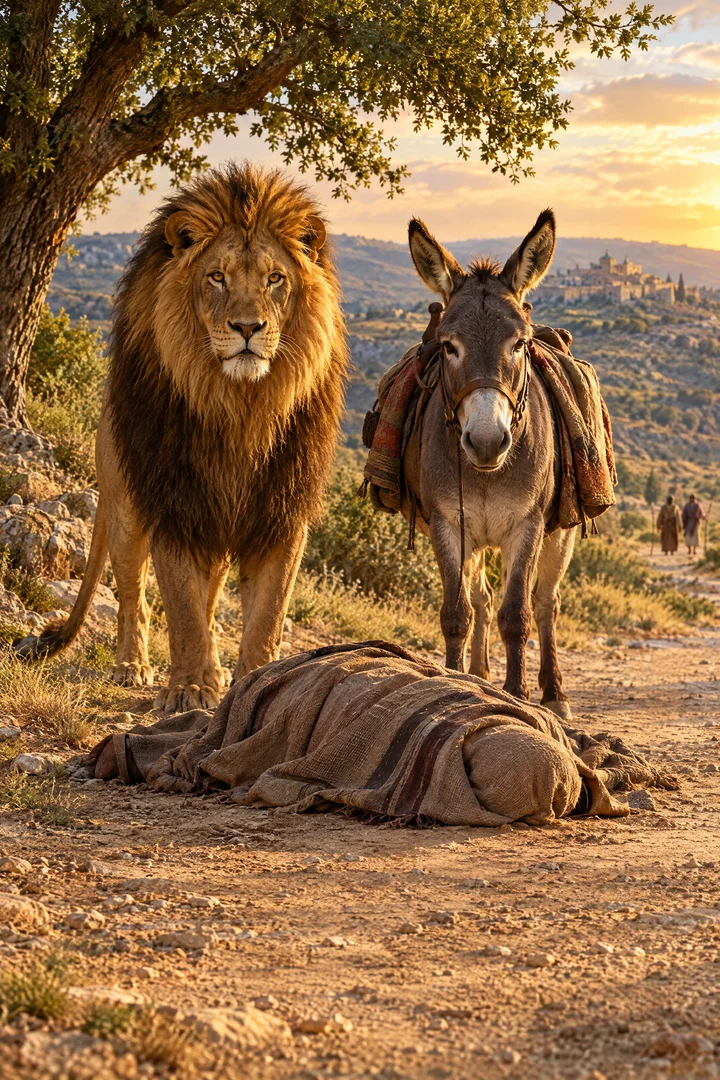
Cross-references
- 1 Kings 13:18
He said unto him, I am a prophet also as thou art; and an angel spake unto me by the word of the LORD, saying, Bring him back with thee into thine house, that he may eat bread and drink water. But he lied unto him.
The old prophet deceives the man of God with a false angelic message.
- 1 Kings 13:21-22
And he cried unto the man of God that came from Judah, saying, Thus saith the LORD, Forasmuch as thou hast disobeyed the mouth of the LORD, and hast not kept the commandment which the LORD thy God commanded thee,
The Lord declares judgment for the man of God’s disobedience.
- 1 Kings 13:8-10
And the man of God said unto the king, If thou wilt give me half thine house, I will not go in with thee, neither will I eat bread nor drink water in this place:
The man of God obeys the Lord’s command not to eat or drink there and returns by another way.
- 2 Kings 23:16-18
And as Josiah turned himself, he spied the sepulchres that were there in the mount, and sent, and took the bones out of the sepulchres, and burned them upon the altar, and polluted it, according to the word of the LORD which the man of God proclaimed, who proclaimed these words.
Josiah fulfills the prophecy against Jeroboam’s altar and honors the man of God’s bones.
Commentary
Each commentary is drawn from primary sources: the writings of Ellen G. White and Adventist pioneers and periodicals. Each commentary is separate. Its own words are not a quotation; follow the references to read the source passages.
Ellen G. White
1 source
The old prophet was at home with his sons when he gave the order.RH Jul 24, 1913 He directed his sons to saddle his donkey for his own use.RH Jul 24, 1913 The saddling readied his journey to recover the body of the man of God after that man had died.RH Jul 24, 1913
Sources
Pioneers and periodicals
13 sources
The verse marks the moment the old prophet at home has his sons saddle his donkey so he can ride after the man of God from Judah and soon finds him resting under an oak.RH Jul 24, 1913ST Dec 24, 1885ST Dec 2, 1880 That man had been sent to denounce Jeroboam's worship of the golden calves at Bethel and Dan under God's explicit command to eat no bread, drink no water, and not return by the same way.RH May 13, 1875ST Dec 7, 1882 The saddled donkey carries the old prophet to persuade him to come back and eat where God had forbidden, leading to his disobedient return, the sentence that his body would not reach his fathers' grave, and his death by a lion.RH May 13, 1875ST Dec 7, 1882ST Oct 23, 1884 God's command must be obeyed to the letter without being turned aside by any person, for God means what He says and does not change His word by a later claim of divine direction, and even one deceived by a prophet is still responsible until God Himself revokes His word with equal plainness.RH Mar 17, 1904ST Mar 31, 1898ST Dec 3, 1894ST Dec 7, 1882 The warning stands against changing God's appointed time as with the seventh-day Sabbath, shows that one in favor with God can fall by later disobedience unto death under Ezekiel 18:26, and yet the man's prophecy was fulfilled in Josiah centuries later because the inspired word is God's own and does not depend on the obedience of the speaker.RH May 13, 1875ST May 10, 1910ST Oct 1, 1894ST Dec 26, 1892ST Dec 7, 1882
Narrative Setting and Sequence
The old prophet of Bethel was at home with his sons when he ordered them to saddle his donkey so that he could pursue the man of God from Judah.RH Jul 24, 1913ST Dec 24, 1885ST Dec 2, 1880ST Oct 23, 1884 His sons had told him what had happened to the prophet from Judah and which route he had taken, and upon learning this he set out on his ass in pursuit.ST Dec 24, 1885ST Dec 2, 1880 He soon found the weary traveler resting beneath an oak, the encounter being presented as that of an apostate prophet meeting the man from Judah.ST Dec 2, 1880 That ordering of the saddling also stands as preparation for his journey to retrieve the man of God after the man has died.RH Jul 24, 1913
The setting is the mission of the man of God sent from Judah to cry against Jeroboam's sin of making two golden calves at Bethel and Dan for Israel to worship.RH May 13, 1875 The man was sent while in favor with God, under God's positive and explicit command to eat no bread, drink no water, lodge not there, and not return by the same way he came.RH May 13, 1875ST Dec 7, 1882 The command was made just as explicit as words could make it, forbidding lodging, eating bread, or drinking water there.ST Dec 7, 1882
The saddling of the ass serves the old lying prophet's persuasion to turn the man back to eat bread where God had forbidden.RH May 13, 1875ST Oct 23, 1884 By that lying persuasion the man of God was led to return and eat, disobeying the command he had received from the Lord, and for that disobedience he was punished.ST Oct 23, 1884 His eating and drinking where God forbade brought the word of the Lord that his carcass should not come to the sepulcher of his fathers, and as he returned he was slain by a lion.RH May 13, 1875ST Dec 7, 1882 The verse thus shows the man of God sent to Bethel setting out after disobeying God, on the way to being slain by the lion.ST Dec 7, 1882
Doctrinal Lessons and Application
God's command must be obeyed and no person should lead anyone away from it, and the disobedience ending in destruction shows the peril of departing from God's word.RH Mar 17, 1904 God means what He says, remains steadfast in His instructions, and requires unquestioning obedience to the letter, and the lesson applies to believers today.ST Mar 31, 1898 The man was punished for believing that God had changed His mind about a command given to him, showing that God's command does not become changeable through a claim of later divine direction, and this holds even more strongly for a command given to all people.ST Dec 3, 1894
God's condemnation and visitation of wrath upon him for disobedience was just, not harsh, unreasonable, or unjust.ST Dec 7, 1882 Though deceived by the falsehood of one who came in the name of a prophet, he was still responsible for being deceived.ST Dec 7, 1882 His business was to carry out the explicit command not to lodge, eat bread, or drink water there to the letter until the same God who gave it revoked it with equal explicitness and emphasis.ST Dec 7, 1882 He would have been safe had he waited for an explicit Thus saith the Lord from God Himself instead of listening to an irresponsible party whom God never commanded him to listen to and whom the devil controlled.ST Dec 7, 1882 God's commands must be obeyed as given and people cannot excuse disobedience by changing the time God prescribed, which is applied to the seventh-day Sabbath, for choosing another day for convenience is like Jeroboam devising a month of his own choosing.ST Dec 7, 1882
The man was in favor with God when sent under God's positive command to eat no bread, drink no water, and not return by the same way he came, but by violating God's command through eating and drinking where God forbade and dying in that sin he fell.RH May 13, 1875 His being slain by a lion as he returned, after the word of the Lord that his carcass shall not come to the sepulcher of his fathers, proves that one once in grace can fall and by Ezekiel 18:26 must die for that sin in the second death.RH May 13, 1875 The prophecy to Jeroboam was fulfilled in Josiah's later reformation hundreds of years after it was given, just as the Lord had declared.ST May 10, 1910 The disobedient prophet nevertheless delivered God's message, showing that God's inspired word could be spoken through someone who was not obedient because the word came from God and not from the speaker, so inspiration does not depend on the moral character of the human instrument.ST Oct 1, 1894ST Dec 26, 1892
Sources