1 Kings 13:28
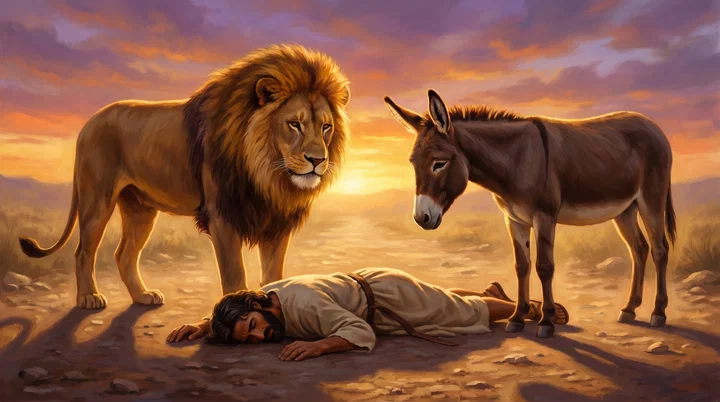
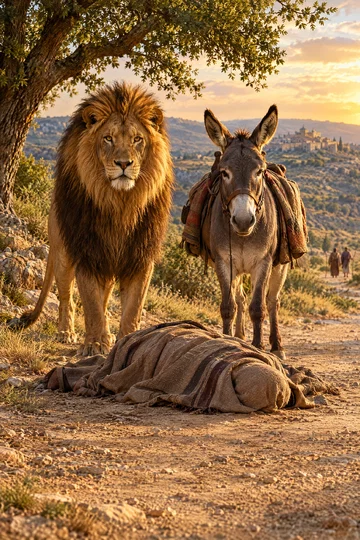
And he went and found his carcase cast in the way, and the ass and the lion standing by the carcase: the lion had not eaten the carcase, nor torn the ass.
Translations
American King James Version, Webster Bible
And he went and found his carcass cast in the way, and the ass and the lion standing by the carcass: the lion had not eaten the carcass, nor torn the ass.
King James Version, KJV Cambridge Paragraph Bible, Revised Version
And he went and found his carcase cast in the way, and the ass and the lion standing by the carcase: the lion had not eaten the carcase, nor torn the ass.
And he went and found his body cast in the way, and the ass and the lion standing by the body: the lion had not eaten the body, nor torn the ass.
And he goeth and findeth his carcase cast in the way, and the ass and the lion are standing near the carcase — the lion hath not eaten the carcase nor destroyed the ass.
And he went and found his corpse cast in the way, and the ass and the lion standing by the corpse: the lion had not eaten the corpse, nor torn the ass.
So he went and found his dead body, cast out in the way, with, the ass and the lion, standing near the dead body,—the lion had neither eaten the dead body, nor had it torn the ass.
Berean Standard Bible, Majority Standard Bible
and he went and found the body lying in the road, with the donkey and the lion standing beside it. The lion had not eaten the body or mauled the donkey.
He went and found his body thrown on the path, and the donkey and the lion standing by the body. The lion had not eaten the body nor mauled the donkey.
And he went and saw the dead body stretched out in the road with the ass and the lion by its side: the lion had not taken the body for its food or done any damage to the ass.
And he went and founde his body cast in the way, and the asse and the lion stoode by the corps: and the lion had not eaten the bodie, nor torne the asse.
Douay-Rheims (Challoner revision)
And he was gone, he found the dead body cast in the way, and the ass and the lion standing by the carcass: the lion had not eaten of the dead body, nor hurt the ass.
Pictures
Cross-references
- 1 Kings 13:21-22
And he cried unto the man of God that came from Judah, saying, Thus saith the LORD, Forasmuch as thou hast disobeyed the mouth of the LORD, and hast not kept the commandment which the LORD thy God commanded thee,
The prophet’s disobedience brings the announced sentence before the lion kills him.
- 2 Kings 23:16-18
And as Josiah turned himself, he spied the sepulchres that were there in the mount, and sent, and took the bones out of the sepulchres, and burned them upon the altar, and polluted it, according to the word of the LORD which the man of God proclaimed, who proclaimed these words.
Josiah fulfills the prophecy associated with the man of God.
- 1 Kings 13:2
And he cried against the altar in the word of the LORD, and said, O altar, altar, thus saith the LORD; Behold, a child shall be born unto the house of David, Josiah by name; and upon thee shall he offer the priests of the high places that burn incense upon thee, and men’s bones shall be burnt upon thee.
The man of God foretells Josiah’s future action against the altar.
Commentary
Each commentary is drawn from primary sources: the writings of Ellen G. White and Adventist pioneers and periodicals. Each commentary is separate. Its own words are not a quotation; follow the references to read the source passages.
Ellen G. White
2 sources
The body lay cast on the road after the disobedient prophet's death, with the lion and the donkey standing beside it, the lion having neither eaten the body nor torn the donkey.Ms 153, 1906RH Jul 24, 1913 That unnatural stillness shows the death did not come by an ordinary attack of a wild animal but occurred under a divine sign.Ms 153, 1906 The restraint of the beasts marks the death as a judgment for disobeying God's command and confirms the truth of the prophecy spoken against him.RH Jul 24, 1913 The judgment was necessary, for had he escaped unharmed after his disobedience, Jeroboam could have used that escape as grounds to defend his own disobedience.RH Jul 24, 1913
Sources
Pioneers and periodicals
16 sources
The old prophet came upon the body thrown down on the road with the donkey and the lion standing beside it untouched, neither the corpse eaten nor the animal attacked.RH Jul 24, 1913RH Mar 17, 1904RH May 13, 1875 The man from Judah lay there because he had turned aside from the Lord's plain command at the word of the lying prophet, and so lost his life.ST Dec 24, 1885ST Dec 2, 1880RH May 13, 1875ST Mar 31, 1898 The lion's unnatural restraint showed the death was no accident but a pointed judgment from God for disobedience, confirming the sentence spoken against him.RH Jul 24, 1913ST Oct 23, 1884ST Dec 7, 1882 God means exactly what He says and demands obedience to the letter until He Himself with equal plainness revokes it, so that believing His word has changed at another's claim brings punishment without excuse.RH Mar 17, 1904ST Mar 31, 1898ST Dec 3, 1894ST Dec 7, 1882ST Dec 7, 1882
Setting and Miracle
The verse falls within the history of the separate kingdoms of Judah and Israel, during the period from the revolt of the ten tribes to Jehoshaphat's death.RH May 25, 1916 It stands in the graphic account in 1 Kings 12 and 13 of how the ten tribes of Israel separated from Judah and Benjamin and elected Jeroboam king after Rehoboam answered their complaints of overtaxation and oppression by saying his little finger would be greater than his father's loins and he would chastise with scorpions, a revolt that completely and permanently severed Judah and Israel under separate governments, and of how Jeroboam, a man of genius given the kingdom by God through prophecy yet lacking reverence for God, deliberately set at naught God's commands once firmly seated on his throne.ST Dec 7, 1882 It is part of the chapter that records God's prophecy against Jeroboam's altar, delivered by an unnamed prophet who disobeyed, whose prophecy Josiah later fulfilled.ST Jun 3, 1913ST May 20, 1913
It belongs to the account of the man of God from Judah who died after disobeying the Lord's clear command and listening to the false prophet, thereby forfeiting his life by turning aside from what God had commanded.ST Dec 24, 1885ST Dec 2, 1880 The events introduce the old prophet finding him beneath an oak.ST Dec 2, 1880
It describes the old prophet finding the carcass cast in the way, with the ass and the lion standing by the carcass, the lion having neither eaten the carcass nor torn the ass.RH Jul 24, 1913RH Mar 17, 1904RH May 13, 1875ST Oct 23, 1884ST Dec 7, 1882 The lion stood beside the dead prophet's body lying on the road while the donkey remained beside him unharmed, the lion having neither eaten the body nor attacked the donkey.RH Jul 24, 1913RH Mar 17, 1904RH May 13, 1875ST Oct 23, 1884ST Dec 7, 1882 The lion's restraint in standing beside the body without eating it or harming the donkey marks the punishment as extraordinary, confirming it as a marked divine judgment for disobedience and confirming the truth of the judgment pronounced against him.RH Jul 24, 1913ST Oct 23, 1884ST Dec 7, 1882
Obedience and God's Word
The body lying in the road with the lion and the donkey standing beside it, the lion having neither eaten the body nor attacked the donkey, was the end of a man killed by the lion because he disobeyed God's command, and he died in his sin.RH May 13, 1875ST Mar 31, 1898 His disobedience brought judgment upon him.ST Mar 31, 1898 The account teaches that God means exactly what He says and requires unquestioning obedience.ST Mar 31, 1898
It shows the peril of allowing anyone to lead a person away from what God has commanded, for his death followed his departure from God's command.RH Mar 17, 1904 God's word does not change, and the man was punished for believing that God had changed a command given to him.ST Dec 3, 1894 Even a command given to one individual is not to be treated as altered by a later claim of divine direction.ST Dec 3, 1894
The command to eat no bread nor drink water at Bethel was just as explicit as words could make it, and it was his business to carry it out to the letter until the same God who gave it revoked it with equal explicitness and emphasis.ST Dec 7, 1882 He would have been safe had he done so.ST Dec 7, 1882 Instead his sin was that, rather than waiting for an explicit Thus saith the Lord from God Himself, he listened to an irresponsible party whom God never commanded him to listen to and whom the devil controlled.ST Dec 7, 1882
God's condemnation and visitation of wrath upon him was in the manner laid down and for the cause assigned, and was not harsh, unreasonable, and unjust.ST Dec 7, 1882 Though he was deceived by the falsehood of one who came to him in the name of a prophet, and was misled by someone who had once been a prophet, men are sometimes responsible for having been deceived, and God did not excuse him.ST Dec 7, 1882ST Dec 7, 1882 Had he escaped unharmed after disobeying, Jeroboam could have used that as grounds to defend his own disobedience.RH Jul 24, 1913 Yet God's inspired word can be spoken through a disobedient prophet, for the message comes from God and not from the prophet's own will, so a prophet's moral character did not determine whether God could use him as an instrument.ST Oct 1, 1894ST Dec 26, 1892
Sources