1 Kings 13:2
And he cried against the altar in the word of the LORD, and said, O altar, altar, thus saith the LORD; Behold, a child shall be born unto the house of David, Josiah by name; and upon thee shall he offer the priests of the high places that burn incense upon thee, and men’s bones shall be burnt upon thee.
Translations
And he cried against the altar in the word of the LORD, and said, O altar, altar, thus says the LORD; Behold, a child shall be born to the house of David, Josiah by name; and on you shall he offer the priests of the high places that burn incense on you, and men’s bones shall be burnt on you.
And he cried against the altar in the word of the LORD, and said, O altar, altar, thus saith the LORD; Behold, a child shall be born unto the house of David, Josiah by name; and upon thee shall he offer the priests of the high places that burn incense upon thee, and men’s bones shall be burnt upon thee.
And he cried against the altar in the word of the Lord, and said, O altar, altar, thus saith the Lord; Behold, a child shall be born unto the house of David, Josiah by name; and upon thee shall he offer the priests of the high places that burn incense upon thee, and men’s bones shall be burnt upon thee.
And he cried against the altar in the word of the LORD, and said, O altar, altar, thus saith the LORD; Behold, a child shall be born to the house of David, Josiah by name; and upon thee shall he offer the priests of the high places that burn incense upon thee, and men's bones shall be burnt upon thee.
And he cried against the altar by the word of the LORD, and said, O altar, altar, thus saith the LORD: Behold, a child shall be born unto the house of David, Josiah by name; and upon thee shall he sacrifice the priests of the high places that burn incense upon thee, and men’s bones shall they burn upon thee.
And he cried against the altar by the word of Jehovah, and said, O altar, altar, thus saith Jehovah: Behold, a son shall be born unto the house of David, Josiah by name; and upon thee shall he sacrifice the priests of the high places that burn incense upon thee, and men’s bones shall they burn upon thee.
and he calleth against the altar, by the word of Jehovah, and saith, 'Altar! altar! thus said Jehovah, Lo, a son is born to the house of David — Josiah his name — and he hath sacrificed on thee the priests of the high places who are making perfume on thee, and bones of man are burnt on thee.'
And he cried against the altar by the word of Jehovah, and said, O altar, altar! thus saith Jehovah: Behold, a child shall be born unto the house of David, Josiah by name; and upon thee shall he sacrifice the priests of the high places that burn incense upon thee, and men's bones shall be burned upon thee.
And he made proclamation against the altar, by the word of Yahweh, and said, O altar! altar! Thus, saith Yahweh,—Lo! a son to be born unto the house of David, Josiah his name, who shall sacrifice upon thee the priests of the high-places, who are making a perfume upon thee, and, human bones, shall be burned upon thee;
Berean Standard Bible, Majority Standard Bible
And he cried out against the altar by the word of the LORD, “ O altar, O altar, this is what the LORD says: ‘ A son named Josiah will be born to the house of David, and upon you he will sacrifice the priests of the high places who burn incense upon you, and human bones will be burned upon you.’”
He cried against the altar by the LORD’s word, and said, “ Altar! Altar! The LORD says: ‘ Behold, a son will be born to David’s house, Josiah by name. On you he will sacrifice the priests of the high places who burn incense on you, and they will burn men’s bones on you.’”
And by the order of the Lord he made an outcry against the altar, saying, O altar, altar, the Lord has said, From the seed of David will come a child, named Josiah, and on you he will put to death the priests of the high places, who are burning offerings on you, and men's bones will be burned on you.
And he cryed against the altar by the comandement of the Lord, and said, O altar, altar, thus saith the Lord, Beholde, a child shalbe borne vnto the house of Dauid, Iosiah by name, and vpon thee shall he sacrifice the Priestes of the hie places that burne incense vpon thee, and they shall burne mens bones vpon thee.
Douay-Rheims (Challoner revision)
And he cried out against the altar in the word of the Lord, and said: O altar, altar, thus saith the Lord: Behold a child shall be born to the house of David, Josias by name, and he shall immolate upon thee the priests of the high places, who now burn incense upon thee, and he shall burn men’s bones upon thee.
Pictures
Cross-references
- 2 Kings 23:15-18
Moreover the altar that was at Beth-el, and the high place which Jeroboam the son of Nebat, who made Israel to sin, had made, both that altar and the high place he brake down, and burned the high place, and stamped it small to powder, and burned the grove.
Josiah fulfills the prophecy by defiling Bethel’s altar and burning bones upon it.
- 1 Kings 12:28-33
Whereupon the king took counsel, and made two calves of gold, and said unto them, It is too much for you to go up to Jerusalem: behold thy gods, O Israel, which brought thee up out of the land of Egypt.
Jeroboam’s calf worship is the idolatry denounced at the altar.
- 1 Kings 13:18-24
He said unto him, I am a prophet also as thou art; and an angel spake unto me by the word of the LORD, saying, Bring him back with thee into thine house, that he may eat bread and drink water. But he lied unto him.
The old prophet’s lie leads the man of God to disobey, and he dies as foretold.
- 2 Kings 23:20
And he slew all the priests of the high places that were there upon the altars, and burned men’s bones upon them, and returned to Jerusalem.
Josiah’s killing of the priests fulfills the prophecy of offering them on the altar.
- 2 Chronicles 34:5
And he burnt the bones of the priests upon their altars, and cleansed Judah and Jerusalem.
Josiah burned the bones of the priests upon their altars, fulfilling the prophecy against the altar.
- 1 Samuel 2:27
And there came a man of God unto Eli, and said unto him, Thus saith the LORD, Did I plainly appear unto the house of thy father, when they were in Egypt in Pharaoh’s house?
likewise called a man of God
- 1 Samuel 9:6
And he said unto him, Behold now, there is in this city a man of God, and he is an honourable man; all that he saith cometh surely to pass: now let us go thither; peradventure he can shew us our way that we should go.
likewise called a man of God
- 1 Kings 12:32
And Jeroboam ordained a feast in the eighth month, on the fifteenth day of the month, like unto the feast that is in Judah, and he offered upon the altar. So did he in Beth-el, sacrificing unto the calves that he had made: and he placed in Beth-el the priests of the high places which he had made.
shows further change despite the warning
- 1 Kings 12:33
So he offered upon the altar which he had made in Beth-el the fifteenth day of the eighth month, even in the month which he had devised of his own heart; and ordained a feast unto the children of Israel: and he offered upon the altar, and burnt incense.
Both condemn changing God’s appointed time.
- 1 Kings 12:22
But the word of God came unto Shemaiah the man of God, saying,
likewise called a man of God
- 1 Kings 13:21-24
And he cried unto the man of God that came from Judah, saying, Thus saith the LORD, Forasmuch as thou hast disobeyed the mouth of the LORD, and hast not kept the commandment which the LORD thy God commanded thee,
The disobedient prophet receives the announced sentence and is killed.
Commentary
Each commentary is drawn from primary sources: the writings of Ellen G. White and Adventist pioneers and periodicals. Each commentary is separate. Its own words are not a quotation; follow the references to read the source passages.
Ellen G. White
12 sources
At the dedication of the unconsecrated altar that Jeroboam the son of Nebat had established at Bethel in the days of the rending of the kingdom, a man of God from Judah cried against that altar in the presence of Jeroboam himself.PK 401.2–402.2 The king was standing by the altar offering incense when the bold message was delivered to him.Ms 153, 1906, par. 1–2 Jeroboam was at that time in bold defiance of God turning the hearts of the people away from the services of the temple in Jerusalem to new forms of worship that would in years to come seduce many into idolatrous practices.PK 401.2–402.2 The Lord sent the man of God to appear before the altar at Bethel to set before the ten tribes the evils of disobedience.PK 281.1
The word denounced Jeroboam's unauthorized and strange worship and foretold that a child of the house of David, Josiah by name, would be born and would desecrate that same altar at Bethel.PK 101.3–4PK 401.2–402.2Ms 1, 1912, par. 9–10RH Jul 29, 1915Ms 153, 1906, par. 1–2 Upon that altar he would offer the priests of the high places who burn incense upon it, and men's bones, human bones, even the bones of the priests who had offered incense there, would be burned upon it, polluting it.PK 401.2–402.2Ms 1, 1912, par. 9–10RH Jul 29, 1915PK 402.3–5 The prophecy thus foretold the altar's later pollution and desecration by Josiah, a descendant of David named long beforehand.PK 101.3–4RH Jul 29, 1915PK 402A
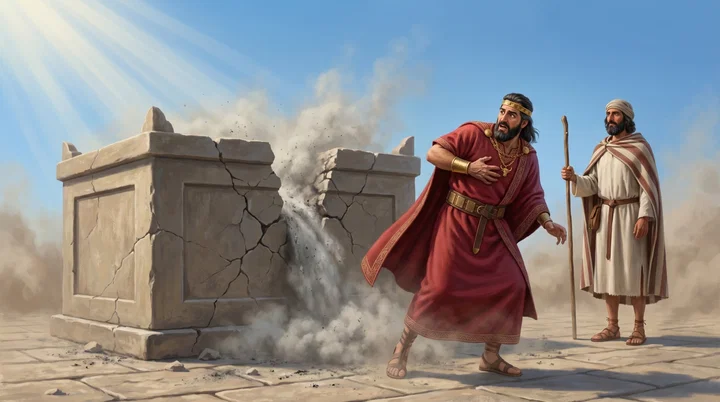
The announcement was made when Jeroboam established the altar, about three centuries, many years, beforehand, naming Josiah by name in the presence of Jeroboam.PK 401.2–402.2RH Jul 29, 1915PK 402A It was accompanied by a sign that the word spoken was of the Lord: the altar would be rent, would split, and its ashes poured out, spilled out.PK 401.2–402.2Ms 1, 1912, par. 9–10Ms 1, 1912, par. 17 The sign occurred as foretold, for the altar was rent as declared.Ms 1, 1912, par. 9–10Ms 1, 1912, par. 17
The message was a decisive rebuke, a reproof and entreaty, a warning and bold message that interrupted the profane and idolatrous sacrifices that were an abomination to God.Ms 153, 1906, par. 1–2Ms 153, 1906, par. 7–9PK 102.3RH Jul 24, 1913PK 281.1 Its words and the splitting of the altar were meant to make a solemn impression, to awaken awe, to show God's displeasure, to correct existing evils, and to lead the king and the people to repentance.Ms 153, 1906, par. 7–9PK 102.3RH Jul 24, 1913 The destruction of the altar served as a warning of what would happen to Israel's supposedly sacred but reproachful altars.Ms 153, 1906, par. 7–9 God sought thereby not hastily to destroy Jeroboam in his idolatry but to awaken him, to lead him to repent and stop doing wrong and to abandon his plans that were turning the people from the worship of God.Ms 153, 1906, par. 1–2PK 102.3RH Jul 24, 1913
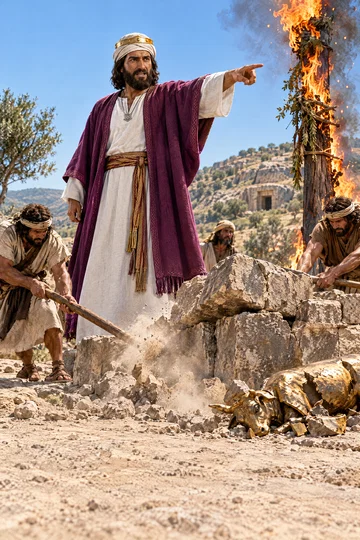
The prophecy was literally fulfilled about three centuries later when Josiah in his reformation came to Bethel where the ancient altar still stood.PK 401.2–402.2RH Jul 29, 1915PK 402A He destroyed and broke down both that altar and the high place which Jeroboam who made Israel to sin had made, burned the high place, stamped it small to powder, and burned the grove.PK 402.3–5 As he turned he took bones out of the sepulchers in the mount and burned them upon the altar and polluted it, burning human bones and the bones of the priests who had offered incense there, as had been declared.RH Jul 29, 1915PK 402.3–5 When told that the monument he saw was the sepulcher of the man of God from Judah who had proclaimed the word against the altar of Bethel, he commanded to let him alone and let no man move his bones, so his bones were left alone with the bones of the prophet that came out of Samaria.PK 402.3–5
The rent altar was evidence that God's words were true, and together with the king's palsied arm and the death of the disobedient prophet it should have led Jeroboam to turn from evil and serve the Lord.Ms 1, 1912, par. 17RH Jul 24, 1913 The prophet's death served as further proof of the truth of the prophecy, since had he returned safely after disobeying God, Jeroboam could have used that to defend his own disobedience.RH Jul 24, 1913 The torn altar and the prophet's fate were thus warnings to Jeroboam of God's displeasure and a call to stop doing wrong.RH Jul 24, 1913 The word at Bethel was one of repeated warnings given through Elijah and Elisha and through Amos and Hosea, yet notwithstanding that reproof and entreaty Israel sank lower and still lower in apostasy.PK 281.1
Sources
Pioneers and periodicals
32 sources
An unnamed prophet from Judah was sent to Bethel to publicly denounce Jeroboam's rival altar while the king himself was offering incense upon it, confronting him with courage before a hostile multitude.ST Dec 24, 1885ST Dec 2, 1880ST Dec 7, 1882ST May 20, 1913RH Apr 7, 1910 He foretold that a child of the house of David, Josiah by name, would be born and would defile that altar by offering upon it the priests of the high places and by burning men's bones upon it.ST Dec 7, 1882RH Apr 6, 1905ST Feb 7, 1911 The word was attested at the time when the altar was rent and its ashes poured out, and when Jeroboam's outstretched hand was withered and then restored at the prophet's prayer, and it was fulfilled about three centuries later when Josiah destroyed the altar at Bethel and burned human bones upon it as described in 2 Kings 23.RH Jul 29, 1915ST Dec 2, 1880ST Dec 7, 1882RH Dec 14, 1905ST May 10, 1910 The messenger had been given a strict command not to eat or drink there and to return by another way, and his later death for violating it shows that God's explicit command must be obeyed without question and cannot be set aside because another person, even a prophet, claims a contrary revelation.ST Feb 7, 1911ST Mar 31, 1898ST Dec 7, 1882ST Mar 4, 1880ST Oct 23, 1884 The rent altar and the prophet's fate were a warning of God's displeasure and a call to cease from wrong, yet Jeroboam was not deterred and the calf-worship he established to keep the tribes from Jerusalem persisted as the sin that made Israel to sin, while the prophet's punishment itself confirmed the truth of his message against the altar.RH Jul 24, 1913ST Jan 17, 1884RH Apr 7, 1910RH May 9, 1871ST Apr 26, 1910
Prophecy Against the Altar
The word was a special commissioned message sent by the Lord with a prophet from Judah to Bethel, delivered by an unknown and nameless prophet.ST Dec 24, 1885ST Dec 7, 1882ST May 20, 1913RH Apr 7, 1910 He cried against the desecrated and unauthorized altar while the king was present, publicly before the people at the moment Jeroboam was offering and burning incense upon it in his capacity as high priest, dedicating and attempting to consecrate it.RH Jul 17, 1913ST Dec 2, 1880ST Dec 7, 1882RH Apr 7, 1910 He condemned Jeroboam's apostasy and sacrilege and declared solemn warning and judgment upon the altar and its worship, crying out not so much against the king himself as against the altar, with almost unequaled courage before thousands of enemies.RH Jul 17, 1913ST Dec 7, 1882RH Apr 7, 1910 He delivered that testimony faithfully, the haughty king was humbled, and his prayer was heard.ST Dec 24, 1885ST Dec 2, 1880
The altar denounced had been set up against God's altar as a rival to the true sanctuary altar at Jerusalem, devised of Jeroboam's own heart.ST May 20, 1913RH Apr 7, 1910 The sanctuary at Dan had already been consecrated first, and golden calves at Dan and Bethel were then set up with the altar at Bethel being set apart to alienate the northern tribes from Jerusalem and to hold the people from going up to Jerusalem to worship.RH Apr 7, 1910ST Apr 26, 1910 The setting up of the calves was a purely political measure, yet though Jeroboam still believed in Jehovah and the calves were presented as representatives of Jehovah to the people, the worship established was idolatrous calf-worship and apostasy.ST Apr 26, 1910ST Sep 8, 1898 The warning was directed against that altar at Bethel where the calf worship had been set up after the people departed from God despite the presence of a faithful remnant, and the worship became a curse to the ten tribes from that time forward and made Israel to sin.ST Apr 26, 1910ST Sep 8, 1898
The cry foretold that a child of the house of David, Josiah by name, named long before his birth, would come from David's line as a future king and descendant.ST Dec 7, 1882RH Apr 6, 1905ST Feb 7, 1911ST Jul 26, 1905 Upon that altar he would bring judgment and desecration by offering the priests of the high places who burn incense there and by burning men's and human bones upon it, sacrificing the priests who served there and destroying the idolatrous worship.RH Apr 6, 1905ST Feb 7, 1911ST Jul 26, 1905 The one who cried was called a man of God, a title borne by the greater prophets, meaning an interpreter, medium and mouthpiece pouring forth utterances of the divine will under divine influence.RH May 11, 1911 His coming to Bethel is one of more than one hundred and fifty cases of prophets mentioned in the Old Testament besides the sixteen writing prophets from Isaiah to Malachi, showing that the Lord instructed His people by speaking through many prophets.RH Jun 23, 1903
The word was attested at the time by miracles, for the Lord attested the prophet's word.ST Dec 2, 1880 At the prophet's word the altar was rent asunder and its ashes spilled out, split apart as the sign given with the message and as a sign of God's displeasure upon its existence.RH Jul 17, 1913RH Apr 7, 1910 When Jeroboam raised his hand against the prophet God withered it, and after the king pleaded the prophet prayed and the hand was restored.RH Dec 14, 1905 The prophecy was spoken when Jeroboam established the altar and was fulfilled about 340 years later, about three centuries later, during Josiah's reign and reformation as described in 2 Kings 23.RH Jul 29, 1915ST Dec 7, 1882ST May 10, 1910ST Dec 7, 1882 Josiah at about age twenty campaigned against idol worship, overthrew and destroyed the altar at Bethel, and burned upon it the bones of the priests who had offered incense there and human bones, as the Lord had declared.RH Jul 29, 1915ST May 10, 1910ST Jun 3, 1913ST Jul 26, 1905ST Dec 7, 1882
Obedience Required of Messengers
The man sent to Bethel to prophesy against Jeroboam was given strict, specific instructions from God not to eat or drink there and to return by a different way and not by the same route.ST Oct 23, 1884RH Mar 11, 1873 His message against the altar was confirmed by miracles.RH Mar 11, 1873 He delivered that special message faithfully, and in obedience to the Lord's further command he refused Jeroboam's invitation.ST Dec 24, 1885 He was in favor with God when he was sent, but afterward he violated God's command and died in his sin.ST Dec 24, 1885RH May 13, 1875
One given an explicit, specific command by God is responsible for obeying it without letting another person, even a prophet, turn him aside until God Himself explicitly revokes it.ST Feb 7, 1911ST Dec 7, 1882 A command given by the Lord must not be set aside because another person claims to speak by inspiration.ST Mar 4, 1880RH Mar 11, 1873 The man of God believed such a false message from another prophet claiming to speak by inspiration and lost his life by disobeying.ST Mar 4, 1880RH Mar 11, 1873 God does not give a command through one person only to have another nullify it.RH Mar 11, 1873
God does not speak at random, but remains steadfast in what He has said and requires unquestioning obedience, so the disobedience of the man of God stands as a warning.ST Mar 31, 1898 God's inspired word in the chapter could still be spoken through a disobedient prophet, for the message comes from God and not from the speaker himself.ST Oct 1, 1894 His use as a messenger did not mean that he was righteous or obedient.ST Oct 1, 1894ST Dec 26, 1892
The later death of the disobedient prophet served as further evidence that the prophecy against the altar, including the future act of Josiah against the priests who burned incense there, was true.RH Jul 24, 1913 Had he returned safely after disobeying God, Jeroboam could have used that to defend his own disobedience.RH Jul 24, 1913
Warning and Wider Lessons
The man of God stood as a faithful witness in public testimony against Jeroboam amid the king's rebellion and Israel's idolatry, openly confronting the king over his apostasy.ST Jan 17, 1884RH May 9, 1871 The cry was directed not so much against the king himself as against the altar at Bethel at the moment Jeroboam attempted to consecrate it, after the sanctuary at Dan had already been consecrated first.RH Apr 7, 1910 That altar had been set apart as a rival to the true sanctuary altar at Jerusalem in order to alienate the northern tribes from Jerusalem, with golden calves erected at Dan and Bethel.RH Apr 7, 1910 The calves were set up as a purely political measure to keep the people from going up to Jerusalem to worship, for Jeroboam still believed in Jehovah and presented the calves to the people as representatives of Jehovah.ST Apr 26, 1910
The warning was sent against the idolatrous worship established by Jeroboam and was aimed at the altar at Bethel where that calf worship had been set up after the people departed from God despite the presence of a faithful remnant.ST Sep 8, 1898 At the prophet's word the altar was rent asunder as a sign of God's displeasure upon its existence.RH Apr 7, 1910 The torn altar and the prophet's subsequent fate were warnings to Jeroboam of God's displeasure and a call to stop doing wrong.RH Jul 24, 1913 The prophet's death in disobedience served as further evidence that the prophecy against the altar was true, for had he returned safely after disobeying God, Jeroboam could have used that to defend his own disobedience.RH Jul 24, 1913
Yet Jeroboam was not deterred but maintained the altars.RH Apr 7, 1910 The calf worship became a curse to the ten tribes from that time forward and made Israel to sin, and the sin persisted despite the warning.ST Apr 26, 1910 The episode belongs to the history of 1 Kings 3-21, a sad record full of lessons showing the general downward moral course of Judah and Israel from David onward with times of reviving.ST Apr 26, 1910 It shows that when the people sought God He worked for them and through them abundantly, and it shows the responsibility of leaders, since faithful kings and priests molded the people while unfaithful leaders caused the people to fail with them.ST Apr 26, 1910
The word delivered against Jeroboam's altar and worship devised of his own heart shows that attempting to change God's statute about the time at which His requirements are to be carried out is a palpable affront to His sovereignty as Great Ruler of the universe, who is to be trembled at in His word and not treated with contempt.ST Dec 7, 1882 The fact that the Lord did not excuse the man of God when he disobeyed God's plain command proves He will not excuse those who hallow Sunday while admitting that God positively commanded the observance of another day.ST Dec 7, 1882 The man of God at least had for his action the authority of one who once had been a prophet of the Lord, while those who keep Sunday cannot show a single word ever fallen from the lips of any inspired man favoring the first day as the Sabbath or justifying its substitution for the seventh day under any circumstances.ST Dec 7, 1882 They have only the decrees of the Man of Sin, the pope of Rome.ST Dec 7, 1882
Sources