1 Kings 2:1
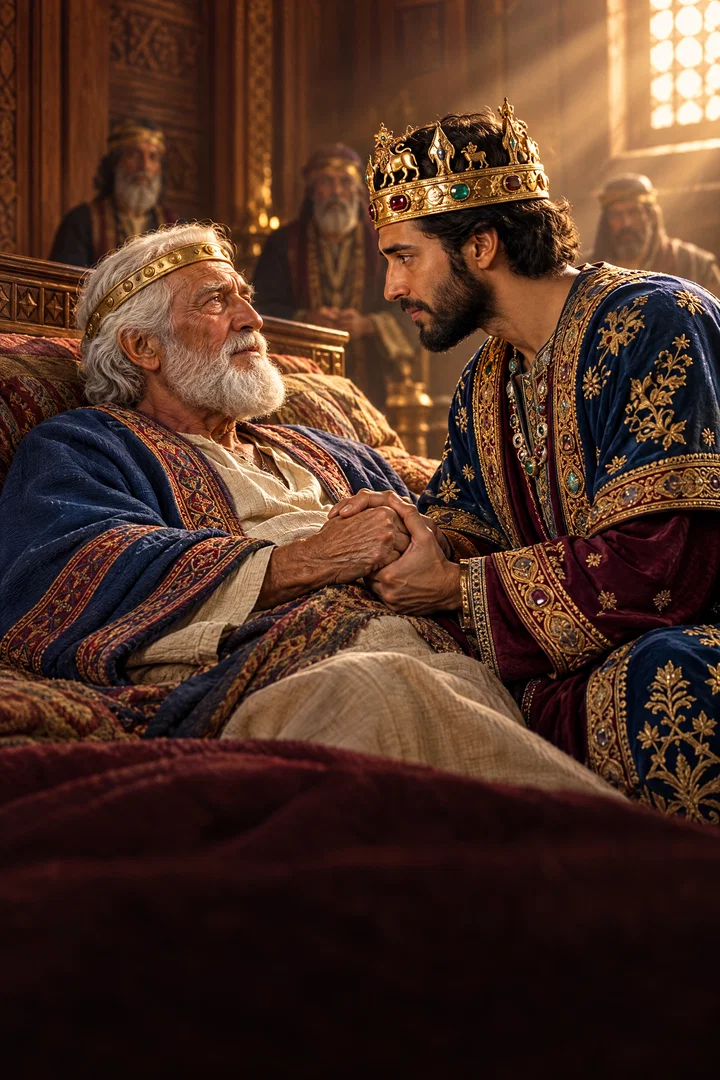
Now the days of David drew nigh that he should die; and he charged Solomon his son, saying,
Translations
Now the days of David drew near that he should die; and he charged Solomon his son, saying,
King James Version, KJV Cambridge Paragraph Bible, Webster Bible, Revised Version, American Standard Version
Now the days of David drew nigh that he should die; and he charged Solomon his son, saying,
And draw near do the days of David to die, and he chargeth Solomon his son, saying,
And the days of David were at hand that he should die; and he enjoined Solomon his son saying,
And, when the days of David drew near that he must die, he charged Solomon his son, saying:—
Berean Standard Bible, Majority Standard Bible
As the time drew near for David to die, he charged his son Solomon,
Now the days of David came near that he should die; and he commanded Solomon his son, saying,
Now the time of David's death came near; and he gave orders to Solomon his son, saying,
Then the dayes of Dauid drewe neere that he should die, and hee charged Salomon his sonne, saying,
Douay-Rheims (Challoner revision)
And the days of David drew nigh that he should die, and he charged his son Solomon, saying:
Pictures
Cross-references
- 1 Kings 1
Now king David was old and stricken in years; and they covered him with clothes, but he gat no heat.
David’s final days and Solomon’s succession lead into the charge.
- 1 Kings 2:10
So David slept with his fathers, and was buried in the city of David.
Records David’s death and burial.
- 1 Chronicles 28:1-8
And David assembled all the princes of Israel, the princes of the tribes, and the captains of the companies that ministered to the king by course, and the captains over the thousands, and captains over the hundreds, and the stewards over all the substance and possession of the king, and of his sons, with the officers, and with the mighty men, and with all the valiant men, unto Jerusalem.
David publicly charges Solomon before his death and sets obedience as a condition for his kingdom.
- Acts 13:36
For David, after he had served his own generation by the will of God, fell on sleep, and was laid unto his fathers, and saw corruption:
Both describe David’s death and burial with his fathers.
- 1 Kings 2:12
Then sat Solomon upon the throne of David his father; and his kingdom was established greatly.
Reports Solomon’s accession and the establishment of his kingdom after David’s death.
- 1 Kings 2:8-9
And, behold, thou hast with thee Shimei the son of Gera, a Benjamite of Bahurim, which cursed me with a grievous curse in the day when I went to Mahanaim: but he came down to meet me at Jordan, and I sware to him by the LORD, saying, I will not put thee to death with the sword.
David warns Solomon about Shimei’s danger.
- 2 Samuel 23:1-7
Now these be the last words of David. David the son of Jesse said, and the man who was raised up on high, the anointed of the God of Jacob, and the sweet psalmist of Israel, said,
David’s last words express faith and hope as he nears death.
- 1 Kings 2:11
And the days that David reigned over Israel were forty years: seven years reigned he in Hebron, and thirty and three years reigned he in Jerusalem.
Gives the length of David’s reign.
- 1 Chronicles 22:5
And David said, Solomon my son is young and tender, and the house that is to be builded for the LORD must be exceeding magnifical, of fame and of glory throughout all countries: I will therefore now make preparation for it. So David prepared abundantly before his death.
David prepares important work before his death.
- Acts 2:29
Men and brethren, let me freely speak unto you of the patriarch David, that he is both dead and buried, and his sepulchre is with us unto this day.
David’s approaching death is followed by his death and burial.
- 1 Kings 1:37
As the LORD hath been with my lord the king, even so be he with Solomon, and make his throne greater than the throne of my lord king David.
Benaiah expresses support for Solomon’s reign.
- Acts 2:34
For David is not ascended into the heavens: but he saith himself, The LORD said unto my Lord, Sit thou on my right hand,
Peter says David had not ascended to heaven.
- 2 Chronicles 6:16
Now therefore, O LORD God of Israel, keep with thy servant David my father that which thou hast promised him, saying, There shall not fail thee a man in my sight to sit upon the throne of Israel; yet so that thy children take heed to their way to walk in my law, as thou hast walked before me.
Solomon recalls that the throne’s continuance depends on David’s descendants walking faithfully.
- Deuteronomy 31:16
And the LORD said unto Moses, Behold, thou shalt sleep with thy fathers; and this people will rise up, and go a whoring after the gods of the strangers of the land, whither they go to be among them, and will forsake me, and break my covenant which I have made with them.
Both describe death as sleeping with one’s fathers.
- 1 Kings 1:38
So Zadok the priest, and Nathan the prophet, and Benaiah the son of Jehoiada, and the Cherethites, and the Pelethites, went down, and caused Solomon to ride upon king David’s mule, and brought him to Gihon.
Solomon is publicly acclaimed as king.
- 2 Samuel 12:10-12
Now therefore the sword shall never depart from thine house; because thou hast despised me, and hast taken the wife of Uriah the Hittite to be thy wife.
Nathan’s warning of calamity in David’s household is fulfilled in later family violence.
- Psalms 132:12
If thy children will keep my covenant and my testimony that I shall teach them, their children shall also sit upon thy throne for evermore.
David’s descendants’ continued rule is conditioned on keeping God’s covenant.
Commentary
Each commentary is drawn from primary sources: the writings of Ellen G. White and Adventist pioneers and periodicals. Each commentary is separate. Its own words are not a quotation; follow the references to read the source passages.
Ellen G. White
5 sources
The days of David drew near for him to die, and his public service was ending, and 1 Kings 2:1 introduces his final charge to Solomon his son at that time.Ms 81, 1900, par. 1–4Ms 163, 1902, par. 15–17PP 753.2SG4 96.1–2 While he still retained physical and mental strength, he put the affairs of his kingdom in order down to small details.SG4 96.1–2 This included warning Solomon about Shimei as a violent and dangerous man who could stir rebellion or threaten Solomon's life.SG4 96.1–2
His chief concern at that time remained Solomon and Israel and the kingdom.Ms 163, 1902, par. 15–17PP 753.2 He charged Solomon to be strong and responsible and to be faithful to God by obeying God's commands and walking in God's ways.Ms 81, 1900, par. 1–4Ms 163, 1902, par. 15–17PP 753.2 The prosperity of Israel and the kingdom was conditional on and depended greatly on the king's faithful obedience to God.Ms 81, 1900, par. 1–4Ms 163, 1902, par. 15–17PP 753.2 The continuation of David's dynasty was likewise conditional on faithful obedience.Ms 81, 1900, par. 1–4
The setting shows the value of settling worldly affairs while still capable, so that approaching death and failing mental faculties do not leave such matters to distract the mind from God.SG4 96.1–2 David's solemn charge to Solomon is also binding on people in positions of trust today, who are tested during their time of probation as surely as Solomon was in his day.Ms 81, 1900, par. 15
Sources
Pioneers and periodicals
11 sources
The verse marks the approach of David's death and introduces his final charge to his son Solomon, opening the transition from David's reign to Solomon's.ST Dec 9, 1897 It belongs to the account of Solomon's life in the first eleven chapters of 1 Kings and to the period of the united kingdom, in which Saul was succeeded by David and Solomon before the kingdom was divided under Rehoboam.ST Jul 30, 1885 It stands at the close of a continuous narrative running from 2 Samuel 8 about the war between Israel and Judah, in which supporters of Saul's son wanted to keep the throne as the surrounding nations did, but God showed that He Himself selects the rulers of His people.ST Apr 19, 1910 After years of that war David triumphed and became the beloved king over all the tribes.ST Apr 19, 1910
David was still king while old, feeble and infirm, after reigning forty years, and Solomon's succession was secured.ST Dec 9, 1897ST Sep 17, 1896 He and Solomon ruled together for about six months, with Solomon about twenty years old when he took the throne.ST Sep 17, 1896 The final days included Adonijah's attempt to seize the throne while David was old and feeble, which threatened the lives of David and Solomon.RH Jul 27, 1869 Its defeat and Adonijah's death were further calamities following David's sin concerning Uriah, showing that the sword would not depart from David's house and fulfilling Nathan's denunciation through judgments upon David.RH Jul 27, 1869RH Oct 12, 1869
The chapter records the end of Shimei in just punishment for his wickedness.RH Jul 14, 1868 He had come against David in adversity while David was fleeing Jerusalem before Absalom, cursing him, casting stones and dust at him and his men, calling him a wicked and bloody man and treating his calamities as proof God was not with him.RH Jul 14, 1868 David bore it meekly, God soon worked for him, and Shimei afterward met the just reward of that cursing.RH Jul 14, 1868 In view of death David charged Solomon to keep the Lord's commandments and walk faithfully before God with all his heart and soul, and the promised continuance of Israel's throne was conditional on Solomon's descendants also walking faithfully.RH Jun 23, 1853 David also gave Solomon instructions for protecting his throne, which Solomon carried out after David died.ST Dec 9, 1897
David remained Israel's leading prophet until his death.RH Apr 26, 1906 Though old and guilty of grievous sins, he was given opportunity to repent and was restored to his throne, God established his testimony on his deathbed, and no one took his place before he died.RH Apr 26, 1906 As he neared death David described himself as going the way of all the earth, showing that death is the common fate of humanity, not a promotion or translation to heaven.ST Feb 7, 1900 David's death belongs to the same pattern as being gathered to one's people and sleeping with one's fathers: leaving the ranks of the living and joining the silent dead.RH Apr 7, 1874
Sources