1 Kings 22:10
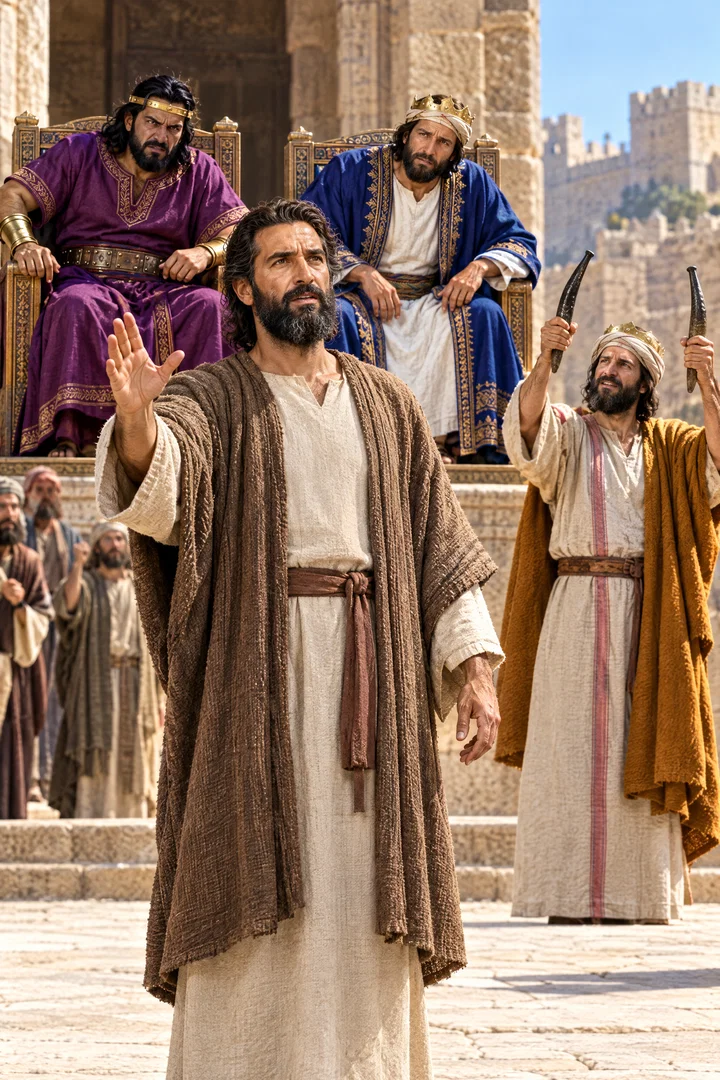
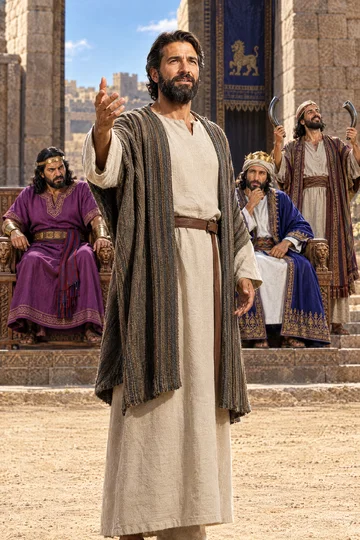
And the king of Israel and Jehoshaphat the king of Judah sat each on his throne, having put on their robes, in a void place in the entrance of the gate of Samaria; and all the prophets prophesied before them.
Translations
American King James Version, King James Version, KJV Cambridge Paragraph Bible, Webster Bible
And the king of Israel and Jehoshaphat the king of Judah sat each on his throne, having put on their robes, in a void place in the entrance of the gate of Samaria; and all the prophets prophesied before them.
Now the king of Israel and Jehoshaphat the king of Judah sat each on his throne, arrayed in their robes, in an open place at the entrance of the gate of Samaria; and all the prophets prophesied before them.
American Standard Version, World English Bible
Now the king of Israel and Jehoshaphat the king of Judah were sitting each on his throne, arrayed in their robes, in an open place at the entrance of the gate of Samaria; and all the prophets were prophesying before them.
And the king of Israel and Jehoshaphat king of Judah are sitting, each on his throne, clothed with garments, in a threshing-floor, at the opening of the gate of Samaria, and all the prophets are prophesying before them.
And the king of Israel and Jehoshaphat the king of Judah, having put on their robes, sat each on his throne, in the open place at the entrance of the gate of Samaria; and all the prophets prophesied before them.
Now, the king of Israel, and Jehoshaphat king of Judah, were sitting—each man upon his throne, having put on robes, in a level place, at the entrance of the gate of Samaria,—and, all the prophets, were being moved to prophesy before them;
Berean Standard Bible, Majority Standard Bible
Dressed in royal attire, the king of Israel and Jehoshaphat king of Judah were sitting on their thrones at the threshing floor by the entrance of the gate of Samaria, with all the prophets prophesying before them.
Now the king of Israel and Jehoshaphat, the king of Judah, were seated on their seats of authority, dressed in their robes, by the doorway into Samaria; and all the prophets were acting as prophets before them.
And the King of Israel and Iehoshaphat the King of Iudah sate either of them on his throne in their apparell in the voyde place at the entring in of the gate of Samaria, and all the prophets prophecied before them.
Douay-Rheims (Challoner revision)
Then the king of Israel, and Josaphat king of Juda, sat each on his throne clothed with royal robes, in a court by the entrance of the gate of Samaria, and all the prophets prophesied before them.
Pictures
Cross-references
- 2 Chronicles 18:9
And the king of Israel and Jehoshaphat king of Judah sat either of them on his throne, clothed in their robes, and they sat in a void place at the entering in of the gate of Samaria; and all the prophets prophesied before them.
Both texts describe the kings seated in robes as the prophets speak before them.
- 1 Kings 22:15
So he came to the king. And the king said unto him, Micaiah, shall we go against Ramoth-gilead to battle, or shall we forbear? And he answered him, Go, and prosper: for the LORD shall deliver it into the hand of the king.
Micaiah’s reply is explained as irony in the same encounter.
- 1 Kings 22:28
And Micaiah said, If thou return at all in peace, the LORD hath not spoken by me. And he said, Hearken, O people, every one of you.
Micaiah says his prophecy is confirmed if the king fails to return in peace.
Commentary
Each commentary is drawn from primary sources: the writings of Ellen G. White and Adventist pioneers and periodicals. Each commentary is separate. Its own words are not a quotation; follow the references to read the source passages.
Ellen G. White
2 sources
Ahab the king of Israel and Jehoshaphat the king of Judah sat each on his own throne, clothed in royal robes, in the open place at the entrance of the gate of Samaria, with all the prophets prophesying before them.RH Dec 25, 1913Lt 19, 1875, par. 9–10 That gathering was a public royal audience in which the kings were enthroned to hear counsel for war.RH Dec 25, 1913Lt 19, 1875, par. 9–10 There the prophets urged the kings to go up to battle at Ramoth-gilead with confident assurances of victory.RH Dec 25, 1913 Their prediction proved false, while Micaiah's contrary warning of defeat was fulfilled.RH Dec 25, 1913
In the same account Ahab set himself against Micaiah because Micaiah prophesied evil concerning him rather than good.Lt 19, 1875, par. 9–10 Such hostility reveals the response of those whose course of life stands opposed to God's warnings.Lt 19, 1875, par. 9–10 When the truth exposes their wrongdoing, they reject the messenger and the message that condemns them.Lt 19, 1875, par. 9–10
Sources
Pioneers and periodicals
14 sources
The verse pictures the king of Israel and Jehoshaphat the king of Judah seated each on his throne in royal robes in an open place at the entrance of the gate of Samaria, with all the prophets prophesying before them.RH Dec 25, 1913PGGC 82.1–83.1RH Sep 5, 1865 The four hundred prophets before them flatter the kings and urge them to go to war at Ramoth-Gilead, confidently predicting peace and success when their counsel was shaped by worldly policy rather than prompted by the Lord.RH Dec 25, 1913PGGC 82.1–83.1RH Jul 13, 1911ST Dec 16, 1889RH Jun 23, 1903 Micaiah stands alone apart from those popular prophets with the contrary, true counsel, testifying that Ahab would be overthrown and foretelling disaster to the expedition.RH Jul 13, 1911RH Jun 23, 1903ST Jul 13, 1904 His advice was set aside because it was the very opposite of theirs, and he was hated and imprisoned for faithfully declaring what the Lord had shown him rather than what the wicked king wanted to hear, but the outcome proved he alone was right and they were all wrong.RH Dec 25, 1913RH Jun 26, 1855ST Nov 22, 1899RH Sep 5, 1865 The setting warns that the Lord never justifies any alliance with the world or compromise with error, for Judah was safe as long as she obeyed God and trusted in His defense, while God in justice finally gave the impenitent Ahab over to follow his own way and fall in battle.RH Jan 8, 1861ST Jul 13, 1904
Historical Setting and Background
The scene is set with the king of Israel and Jehoshaphat the king of Judah seated each on his throne, having put on royal robes, in an open void place at the entrance of the gate of Samaria, with all the prophets prophesying before them.RH Dec 25, 1913PGGC 82.1–83.1RH Sep 5, 1865 It falls within the history of the separate kingdoms of Judah and Israel, covering about eighty years from the revolt of the ten tribes to the death of Jehoshaphat and the reigns of several kings.RH May 25, 1916
The verse belongs to the history of Ahab in 1 Kings 16-22, which is written for the learning and profit of later men and kings and says more of Ahab than of any other ancient monarch.RH Nov 7, 1912 Ahab was the contemporary of Jehoshaphat of Judah and Elijah the Tishbite, the seventh king of Israel and the second ruler of the third Israelitish dynasty, reigning twenty-two years early in the ninth century before Christ.RH Nov 7, 1912 He enjoyed more than average opportunities and divine care, and ruled civilly with success at the time when Judah and Israel attained the height of power and prosperity.RH Nov 7, 1912 He was a clever statesman, a skilled general, and patriotic toward his people and country, but a moral coward where he should have been strongest, who sold himself to the worship of a plurality of heathen deities and enforced it upon his people devoted to monotheistic religion and semitheocratic rule.RH Nov 7, 1912
The verse stands in the account of Jehoshaphat, the good king of Judah, and his fearful mistake in making alliance with Ahab of Israel and Jezebel, an alliance connected with Ahab's death.ST May 13, 1908ST Jul 13, 1904 After about twenty years of prosperous, pious, prudent, and enterprising reign following his father Asa, Jehoshaphat allied with them, and his son and heir Jehoram was married to their daughter Athaliah.ST Jul 13, 1904 He was moved by political reasons that seemed to justify his course.ST Jul 13, 1904
The surrounding account is another war between Israel and Syria, three years after the conflict described in 1 Kings 20.ST Sep 10, 1885 Ahab then felt strong enough to recapture Ramoth-gilead east of Jordan, long in enemy hands and a standing menace to both Israel and Judah.ST Jul 13, 1904 The allies were defeated, Ahab the king of Israel was killed in that war, and Jehoshaphat barely escaped with his life.ST Sep 10, 1885ST Jul 13, 1904 Because the Syrians did not follow up their victory, Jehoshaphat returned to Jerusalem in peace.ST Jul 13, 1904
False Prophets and Faithful Warning
Seated on thrones in royal robes in the open place at the gate of Samaria, the king of Israel and the king of Judah have all the prophets prophesying before them to urge them to go to war at Ramoth-gilead.RH Dec 25, 1913RH Jul 13, 1911RH Jun 23, 1903 In that setting four hundred prophets gather and declare that the campaign against Syria will prosper.RH Dec 25, 1913RH Jul 13, 1911RH Jun 23, 1903 Their counsel about war is shaped by worldly state policy rather than prompted by the Lord, so their judgment is unreliable.PGGC 82.1–83.1RH Jul 13, 1911
Those four hundred flatter the kings and boast as though victory is already assured.PGGC 82.1–83.1RH Jul 13, 1911 They predict peace and success for earthly enterprises when God is warning of judgments to come.PGGC 82.1–83.1ST Dec 16, 1889 Against them Micaiah stands alone apart from the popular prophets with the contrary, true counsel.RH Jul 13, 1911RH Jun 23, 1903RH Sep 5, 1865 He testifies that Ahab will be overthrown and foretells disaster to the expedition.RH Jul 13, 1911RH Jun 23, 1903ST Jul 13, 1904
Micaiah is hated by the king because he speaks an unwelcome message.RH Sep 5, 1865 He is imprisoned because he faithfully declared what the Lord had shown him rather than prophesying what the wicked king wanted to hear.RH Jun 26, 1855RH Sep 5, 1865 The splendor of the royal court thus contrasts with the unpopularity of the truth he represents.RH Jun 26, 1855RH Sep 5, 1865 His advice is set aside because it is the very opposite of that of the four hundred popular prophets.RH Dec 25, 1913ST Nov 22, 1899
The outcome proves he alone is right and they are all wrong, for their confident prediction is false and his warning of defeat is fulfilled.RH Dec 25, 1913ST Nov 22, 1899 God's sending a lying spirit to persuade Ahab to go up to Ramoth-gilead to fall in battle shows God's justice and long-suffering, not injustice.RH Jan 8, 1861 Ahab is a very wicked king who causes Israel to depart from the Lord and does evil above all before him.RH Jan 8, 1861 God faithfully warns him by His servants and gives him time to reform, but he continues doing things displeasing to the Lord.RH Jan 8, 1861
Finally God suffers him to follow his own way, gives him over to the control of a lying spirit, and decides that he should fall in battle.RH Jan 8, 1861 God has a right to punish the disobedient and impenitent.RH Jan 8, 1861 In this Micaiah standing alone with true counsel before wicked Ahab against four hundred popular prophets illustrates that the man entrusted by God to save and bless is first unpopular and rejected.ST Nov 22, 1899 The verse also warns that the Lord never justifies any alliance with the world, or compromise with error, no matter what the ostensible advantage to His cause.ST Jul 13, 1904
Judah is safe as long as she obeys God and trusts in His defense, for it would have been a small thing for Him to protect His people from their foes and utterly destroy enemies.ST Jul 13, 1904 He is able to care for His own, and such alliances or compromises can only result in evil.ST Jul 13, 1904
Sources