1 Kings 22:11
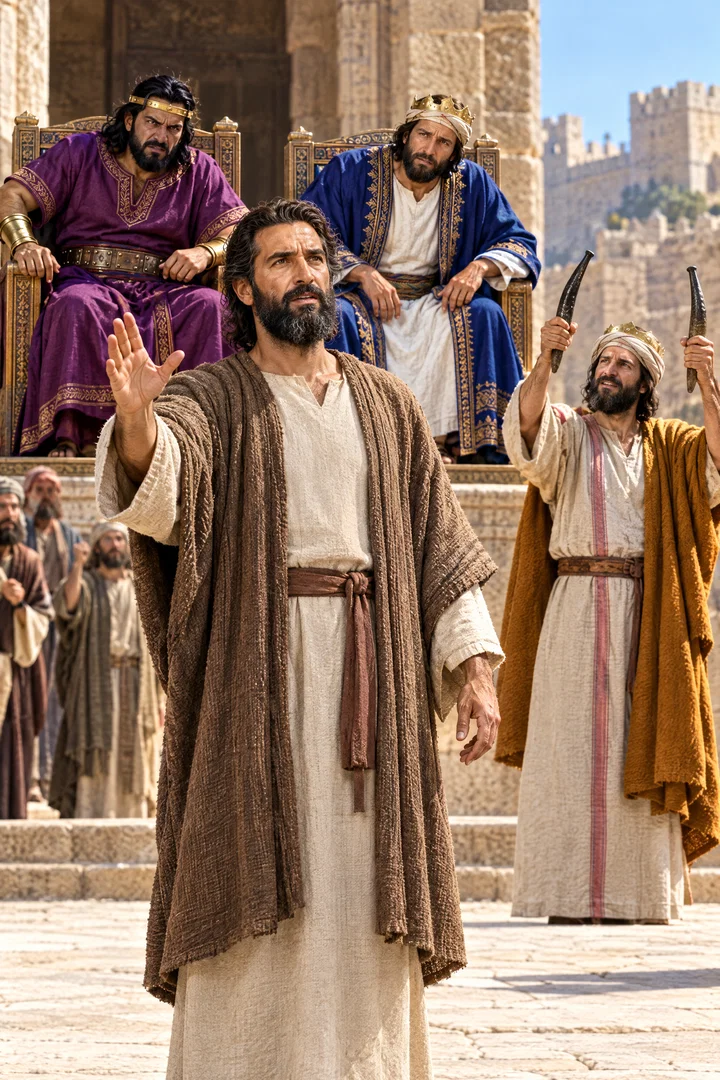
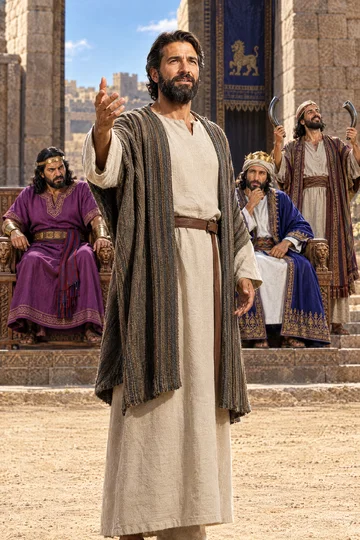
And Zedekiah the son of Chenaanah made him horns of iron: and he said, Thus saith the LORD, With these shalt thou push the Syrians, until thou have consumed them.
Translations
And Zedekiah the son of Chenaanah made him horns of iron: and he said, Thus says the LORD, With these shall you push the Syrians, until you have consumed them.
And Zedekiah the son of Chenaanah made him horns of iron: and he said, Thus saith the LORD, With these shalt thou push the Syrians, until thou have consumed them.
And Zedekiah the son of Chenaanah made him horns of iron: and he said, Thus saith the Lord, With these shalt thou push the Syrians, until thou have consumed them.
And Zedekiah the son of Chenaanah made him horns of iron: and he said, Thus saith the LORD, With these shalt thou push the Syrians, until thou hast consumed them.
And Zedekiah the son of Chenaanah made him horns of iron, and said, Thus saith the LORD, With these shalt thou push the Syrians, until they be consumed.
And Zedekiah the son of Chenaanah made him horns of iron, and said, Thus saith Jehovah, With these shalt thou push the Syrians, until they be consumed.
And Zedekiah son of Chenaanah maketh for himself horns of iron, and saith, 'Thus said Jehovah, By these thou dost push the Aramaeans till they are consumed;'
And Zedekiah the son of Chenaanah made for himself horns of iron, and he said, Thus saith Jehovah: With these shalt thou push the Syrians, until thou have exterminated them.
when Zedekiah son of Chenaanah made himself horns of iron,—and said—Thus, saith Yahweh,—With these, shalt thou push down the Syrians, until thou hast consumed them.
Berean Standard Bible, Majority Standard Bible
Now Zedekiah son of Chenaanah had made for himself iron horns and declared, “ This is what the LORD says: ‘ With these you shall gore the Arameans until they are finished off.’”
Zedekiah the son of Chenaanah made himself horns of iron, and said, “ The LORD says, ‘ With these you will push the Syrians, until they are consumed.’”
And Zedekiah, the son of Chenaanah, made himself horns of iron and said, The Lord says, Pushing back the Aramaeans with these, you will put an end to them completely.
And Zidkiiah the sonne of Chenaanah made him hornes of yron, and sayd, Thus sayth the Lord, With these shalt thou push the Aramites, vntill thou hast consumed them.
Douay-Rheims (Challoner revision)
And Sedecias the son of Chanaana made himself horns of iron, and said: Thus saith the Lord: With these shalt thou push Syria, till thou destroy it.
Pictures
Cross-references
- 1 Kings 22:17
And he said, I saw all Israel scattered upon the hills, as sheep that have not a shepherd: and the LORD said, These have no master: let them return every man to his house in peace.
Micaiah’s vision foretells Israel scattered without a shepherd after defeat.
- 2 Chronicles 18:5-27
Therefore the king of Israel gathered together of prophets four hundred men, and said unto them, Shall we go to Ramoth-gilead to battle, or shall I forbear? And they said, Go up; for God will deliver it into the king’s hand.
The false prophets’ assurance contrasts with Micaiah’s warning.
- 1 Kings 22:27-28
And say, Thus saith the king, Put this fellow in the prison, and feed him with bread of affliction and with water of affliction, until I come in peace.
Micaiah’s warning contradicts Zedekiah’s false prediction and brings imprisonment.
- 1 Kings 22:34-38
And a certain man drew a bow at a venture, and smote the king of Israel between the joints of the harness: wherefore he said unto the driver of his chariot, Turn thine hand, and carry me out of the host; for I am wounded.
Ahab’s defeat fulfills Micaiah’s warning.
- 1 Kings 22:6
Then the king of Israel gathered the prophets together, about four hundred men, and said unto them, Shall I go against Ramoth-gilead to battle, or shall I forbear? And they said, Go up; for the Lord shall deliver it into the hand of the king.
The four hundred prophets predict victory, matching the false assurance shown by the iron horns.
- 1 Kings 22:15
So he came to the king. And the king said unto him, Micaiah, shall we go against Ramoth-gilead to battle, or shall we forbear? And he answered him, Go, and prosper: for the LORD shall deliver it into the hand of the king.
Micaiah’s reply ironically echoes the prophecy of victory.
Commentary
Each commentary is drawn from primary sources: the writings of Ellen G. White and Adventist pioneers and periodicals. Each commentary is separate. Its own words are not a quotation; follow the references to read the source passages.
Ellen G. White
2 sources
The iron horns were made as a sign of a confident assurance that Ahab would push the Syrians at Ramoth-gilead until they were consumed and win the battle.RH Dec 25, 1913Lt 19, 1875, par. 9–10 That promise was given in a setting where Ahab was opposed to Micaiah because Micaiah prophesied evil against him, so the confident word of victory stood alongside a rejected warning.Lt 19, 1875, par. 9–10 Against it stood Micaiah's warning that Israel would be scattered as sheep without a shepherd, without a leader.RH Dec 25, 1913 Both kings ignored that warning and went up, Ahab died in the battle, and the result exposed the assurance of victory as false.RH Dec 25, 1913
Sources
Pioneers and periodicals
15 sources
Zedekiah made horns of iron as a visible sign promising that Ahab would drive the Syrians from Ramoth-gilead until they were consumed, falsely claiming the Lord had spoken this victory with four hundred prophets urging the kings to war.PGGC 82.1–83.1RH Jul 13, 1911ST Feb 7, 1911RH Jun 23, 1903 Micaiah alone gave the contrary judgment in faithfulness, warning that Ahab would be overthrown and Israel scattered without a leader.RH Dec 25, 1913PGGC 82.1–83.1RH Jun 23, 1903 The kings rejected his counsel and went up, and were defeated with Ahab slain in battle and Jehoshaphat barely escaping, proving Micaiah right and the assurance of victory false.RH Dec 25, 1913ST Nov 22, 1899ST Jul 13, 1904 God at last gave the impenitent Ahab over to follow his own way under a lying spirit to fall at Ramoth-gilead, after long warning and time to reform, which shows His justice and long-suffering.RH Jan 8, 1861 False prophets still cry peace and success for earthly plans when God calls to turn before judgment, and faithful defenders of unpopular truth who refuse alliance with the world and compromise with error share Micaiah's reproach while God protects those who obey and trust Him.RH Jul 13, 1911ST Dec 16, 1889RH Sep 5, 1865ST Jul 13, 1904
Historical Setting and Symbol
The verse belongs to the history of the kings after the kingdom of Israel was divided.ST Jul 30, 1885 It belongs to the history of Ahab, king of Israel, the contemporary of Jehoshaphat of Judah and Elijah the Tishbite, the seventh king of Israel and second ruler of the third Israelitish dynasty, who reigned twenty-two years early in the ninth century before Christ.RH Nov 7, 1912 More is said in Scripture of him than of any other ancient monarch, and all recorded of him as man and king was written for the learning and profit of men and kings of after generations.RH Nov 7, 1912 Both as man and prince he enjoyed more than average opportunities under divine solicitude, and from a civil viewpoint was successful, clever as a statesman, skilled as a general, and patriotic toward his people and country, but he was a moral coward where he should have been strongest, wickedly selling himself to the worship of a plurality of heathen deities and later enforcing their worship upon subjects whose predominating characteristic was devotion to a monotheistic religion and a semitheocratic civil regime.RH Nov 7, 1912
The setting is a war between Israel and Syria in which Ahab was killed.ST Sep 10, 1885ST Jul 13, 1904 It was Ahab's attempt with Jehoshaphat to recapture Ramoth-gilead east of Jordan, held by the Syrians as a standing menace to Israel and Judah.ST Jul 13, 1904 Jehoshaphat had made alliance with wicked Ahab and Jezebel, and his heir Jehoram was married to their daughter Athaliah, and Ahab felt strong enough for the expedition.ST Jul 13, 1904
The iron horns were made as a visible sign of promised victory.PGGC 82.1–83.1 They were a symbol of power that reaches its fullness and perfection in Christ.ST Feb 7, 1911 The circumstances of the account must be read to understand Micaiah's later reply to Ahab, for his apparently favorable answer was spoken ironically, with a meaning opposite to its words, which Ahab recognized was not truly favorable.ST Mar 24, 1881
False Prophecy Versus Faithfulness
Zedekiah the son of Chenaanah made horns of iron and declared in the name of the LORD that with them Ahab would push the Syrians until he had consumed them, falsely claiming that the LORD had spoken, and he spoke together with four hundred prophets who urged the kings to go to war against Syria and assured Ahab of victory at Ramoth-gilead.RH Dec 25, 1913PGGC 82.1–83.1RH Jul 13, 1911RH Jun 23, 1903 Those four hundred are Baal prophets.RH Jun 23, 1903 False prophets generally cry peace and predict success for earthly plans when God's warning calls for judgment and calls people to turn to Him before judgment, and prophets who become involved in worldly policy give unreliable counsel rather than speaking with the Lord's direction.RH Jul 13, 1911ST Dec 16, 1889 Against that united assurance Micaiah gave a contrary judgment, faithfully warning that Ahab and his army would not return safely, that Ahab would be overthrown, and that Israel would be scattered without a leader.RH Dec 25, 1913PGGC 82.1–83.1RH Jun 23, 1903
The kings ignored the warning, the allies were defeated, Ahab died in the battle and Jehoshaphat barely escaped with his life, confirming that the assurance of victory was false and showing that Micaiah alone was right and the others were wrong.RH Dec 25, 1913ST Nov 22, 1899ST Jul 13, 1904 Because the Syrians did not follow up their victory, Jehoshaphat returned to Jerusalem in peace.ST Jul 13, 1904 The account shows God giving Ahab over to a lying spirit to persuade him to go up to Ramoth-gilead to fall in battle.RH Jan 8, 1861 Ahab was a very wicked king who caused Israel to depart from the LORD and did evil above all before him, yet God faithfully warned him by His servants and gave him time to reform, but he kept doing what displeased the LORD until at last God let him follow his own way, gave him over to the control of a lying spirit, and determined that he should fall at Ramoth-gilead.RH Jan 8, 1861 This is not unjust, for God has a right to punish the disobedient and impenitent, and Ahab's end is a striking illustration of God's justice and long-suffering.RH Jan 8, 1861
Micaiah was imprisoned because he faithfully declared what the LORD had shown him in vision instead of prophesying what the wicked king wanted to hear.RH Jun 26, 1855 His counsel was rejected because it opposed the advice of the four hundred popular prophets, and the wicked king hated him because he always prophesied evil rather than flattering prophecy.ST Nov 22, 1899RH Sep 5, 1865 Faithful defenders of unpopular eternal truth now share the same reproach as Micaiah and as Elijah, who had to flee for his life, being accused as uncharitable, troublers of Israel, croakers, evil prophets and self-righteous, while God is for them and protects them.RH Sep 5, 1865 Judah was safe as long as she obeyed God and trusted His defense, for He could protect His people from Syrian foes and destroy all enemies, and no political reason justifies alliance with the world or compromise with error.ST Jul 13, 1904
Sources