1 Kings 22:15
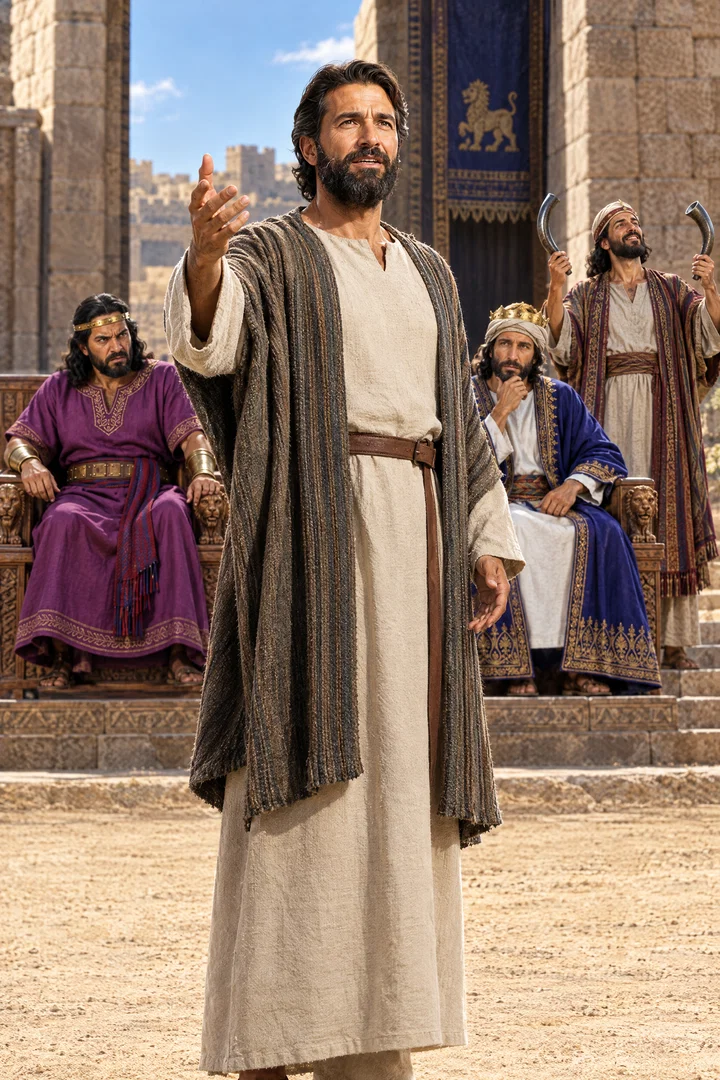
So he came to the king. And the king said unto him, Micaiah, shall we go against Ramoth-gilead to battle, or shall we forbear? And he answered him, Go, and prosper: for the LORD shall deliver it into the hand of the king.
Translations
So he came to the king. And the king said to him, Micaiah, shall we go against Ramothgilead to battle, or shall we forbear? And he answered him, Go, and prosper: for the LORD shall deliver it into the hand of the king.
So he came to the king. And the king said unto him, Micaiah, shall we go against Ramoth-gilead to battle, or shall we forbear? And he answered him, Go, and prosper: for the LORD shall deliver it into the hand of the king.
So he came to the king. And the king said unto him, Micaiah, shall we go against Ramoth-gilead to battle, or shall we forbear? And he answered him, Go, and prosper: for the Lord shall deliver it into the hand of the king.
So he came to the king. And the king said to him, Micaiah, shall we go against Ramoth-gilead to battle, or shall we forbear? And he answered him, Go, and prosper: for the LORD will deliver it into the hand of the king.
And when he was come to the king, the king said unto him, Micaiah, shall we go to Ramoth-gilead to battle, or shall we forbear? And he answered him, Go up, and prosper; and the LORD shall deliver it into the hand of the king.
And when he was come to the king, the king said unto him, Micaiah, shall we go to Ramoth-gilead to battle, or shall we forbear? And he answered him, Go up and prosper; and Jehovah will deliver it into the hand of the king.
And he cometh in unto the king, and the king saith unto him, 'Micaiah, do we go unto Ramoth-Gilead, to battle, or do we forbear?' and he saith unto him, 'Go up, and prosper, and Jehovah hath given [it] into the hand of the king.'
And he came to the king. And the king said to him, Micah, shall we go against Ramoth-Gilead to battle, or shall we forbear? And he said to him, Go up, and prosper; for Jehovah will give it into the hand of the king.
So he came unto the king, and the king said unto him, Micaiah, shall we go against Ramoth-gilead to battle, or shall we forbear? And he said unto him—Go up and prosper, and Yahweh will deliver it into the hand of the king.
When Micaiah arrived, the king asked him, “ Micaiah, should we go to war against Ramoth-gilead, or should we refrain?”“ Go up and triumph,” Micaiah replied, “ for the LORD will give it into the hand of the king.”
When Micaiah arrived, the king asked him, “ Micaiah, should we go to war against Ramoth-gilead, or should we refrain?” “ Go up and triumph,” Micaiah replied, “ for the LORD will deliver it into the hand of the king.”
When he had come to the king, the king said to him, “ Micaiah, shall we go to Ramoth Gilead to battle, or shall we forbear?”He answered him, “ Go up and prosper; and the LORD will deliver it into the hand of the king.”
When he came to the king, the king said to him, Micaiah, are we to go to Ramoth-gilead to make war or not? And in answer he said, Go up, and it will go well for you; and the Lord will give it into the hands of the king.
So he came to the King, and the King said vnto him, Michaiah, shall we go against Ramoth Gilead to battel, or shall we leaue off? And he answered him, Goe vp, and prosper: and the Lord shall deliuer it into the hand of the King.
Douay-Rheims (Challoner revision)
So he came to the king, and the king said to him: Micheas, shall we go to Ramoth Galaad to battle, or shall we forbear? He answered him: Go up, and prosper, and the Lord shall deliver it into the king’s hands.
Pictures
Cross-references
- 1 Kings 22:8
And the king of Israel said unto Jehoshaphat, There is yet one man, Micaiah the son of Imlah, by whom we may enquire of the LORD: but I hate him; for he doth not prophesy good concerning me, but evil. And Jehoshaphat said, Let not the king say so.
Ahab hates Micaiah because he prophesies against him.
- 1 Kings 22:6
Then the king of Israel gathered the prophets together, about four hundred men, and said unto them, Shall I go against Ramoth-gilead to battle, or shall I forbear? And they said, Go up; for the Lord shall deliver it into the hand of the king.
The gathered prophets promise victory in terms Micaiah echoes, exposing their false prophecy.
- 1 Kings 22:20-23
And the LORD said, Who shall persuade Ahab, that he may go up and fall at Ramoth-gilead? And one said on this manner, and another said on that manner.
A lying spirit entices Ahab toward the battle that brings his destruction.
- 1 Kings 22:34-36
And a certain man drew a bow at a venture, and smote the king of Israel between the joints of the harness: wherefore he said unto the driver of his chariot, Turn thine hand, and carry me out of the host; for I am wounded.
Ahab’s death and the army’s dispersal fulfill the warning.
- 1 Kings 22:28
And Micaiah said, If thou return at all in peace, the LORD hath not spoken by me. And he said, Hearken, O people, every one of you.
Micaiah stands by his warning and declares that its outcome will test his prophecy.
- 1 Kings 22:5
And Jehoshaphat said unto the king of Israel, Enquire, I pray thee, at the word of the LORD to day.
Jehoshaphat asks that the Lord’s word be consulted before battle.
Commentary
Each commentary is drawn from primary sources: the writings of Ellen G. White and Adventist pioneers and periodicals. Each commentary is separate. Its own words are not a quotation; follow the references to read the source passages.
Ellen G. White
3 sources
Micaiah the son of Imlah was brought before Ahab and Jehoshaphat at Samaria to inquire of the Lord whether to fight the Syrians for Ramoth-gilead.RH Dec 25, 1913 Jehoshaphat had rashly promised to join Ahab in the war, yet he still desired to know God's will.RH Dec 25, 1913 Ahab's four hundred false prophets of Samaria had promised that God would deliver the city into the hand of the king, but Jehoshaphat was not satisfied with them.RH Dec 25, 1913
At Jehoshaphat's insistence Micaiah was summoned, though Ahab hated him because he prophesied disaster and evil concerning him rather than good.RH Dec 25, 1913Lt 19, 1875, par. 9–10 After being adjured to tell nothing but what is true in the name of the Lord, Micaiah first answered with the same promise of success and victory given by the other prophets.Ms 29, 1911, par. 30–34RH Dec 25, 1913 That favorable answer was ironic and was not a true promise that the Lord would give victory.Ms 29, 1911, par. 30–34
His true message was that he saw all Israel scattered upon the hills as sheep without a shepherd, with each man to return to his house in peace, showing that Heaven did not favor the project and that both kings should turn back.RH Dec 25, 1913 Neither king heeded the warning but went up together to Ramoth-gilead, where Ahab was shot and died at evening and the host was proclaimed to disperse every man to his city and country, fulfilling the prophet's word.RH Dec 25, 1913 Ahab's rejection of the prophet's warning shows how those opposed to the truth resist messages that condemn their course.Lt 19, 1875, par. 9–10
Sources
Pioneers and periodicals
15 sources
Micaiah stood before Ahab and Jehoshaphat at Samaria to seek the Lord about going up to Ramoth-gilead, and his answer to go and prosper was ironic mockery imitating the flattering promise of the four hundred false prophets, not a true prediction, which Ahab himself understood as unfavorable.RH Dec 25, 1913ST Mar 24, 1881PGGC 82.1–83.1ST Apr 7, 1909RH Jun 23, 1903 When adjured to speak only truth in the name of the Lord, his real message was disaster, that Israel would be scattered upon the hills as sheep without a shepherd and each man return home.PGGC 82.1–83.1ST Apr 7, 1909RH Jun 23, 1903 That calamity would come because Ahab in persistent wickedness and disobedience had set himself against God, so God in judgment left him to his own way under a lying spirit and determined that he would fall in battle.ST Apr 7, 1909RH Jan 8, 1861 Both kings disregarded the warning and went up together, where they were defeated with Ahab slain at evening and the host dispersed, proving Micaiah alone right against the confident counsel of the four hundred.RH Dec 25, 1913ST Nov 22, 1899ST Jul 13, 1904 Micaiah faithfully declared what the Lord revealed though the king hated him for prophesying evil and imprisoned him on bread and water of affliction, showing that true witnesses who warn rather than please will be opposed, and that no political advantage justifies Jehoshaphat's mistaken alliance with wickedness.PGGC 82.1–83.1RH Jun 26, 1855RH Sep 5, 1865ST Jul 13, 1904
Setting and Ironic Wording
The verse stands in the history of the two separate kingdoms of Judah and Israel for about eighty years from the revolt of the ten tribes to the death of Jehoshaphat, covering the reigns of several kings of both Judah and Israel.RH May 25, 1916 That portion is marked by robbery of the treasures of the temple and royal palace as punishment for idolatry and by the extraordinary ministry of the prophet Elijah.RH May 25, 1916
It belongs to the account in 1 Kings 16-22 of Ahab, seventh king of Israel and second ruler of the third Israelitish dynasty, contemporary of Jehoshaphat of Judah and Elijah the Tishbite, who reigned twenty-two years early in the ninth century before Christ.RH Nov 7, 1912 He received more than average opportunities and divine care, and in civil affairs he brought Judah and Israel to power and prosperity as one clever, skilled, patriotic and outwardly successful.RH Nov 7, 1912 Yet he was a moral coward who sold himself to the worship of a plurality of heathen deities and enforced their worship upon his people, and all that is recorded of him was written for the learning and profit of men and kings of after generations.RH Nov 7, 1912
It concerns Israel's war with Syria three years after an earlier conflict, a joint expedition of Ahab and Jehoshaphat to recapture Ramoth-gilead east of Jordan, which was a standing menace to Israel and Judah.ST Sep 10, 1885ST Jul 13, 1904 That war ended with Ahab's death.ST Sep 10, 1885 Micaiah the son of Imlah was brought before Ahab and Jehoshaphat at Samaria to inquire of the Lord about going to Ramoth-gilead to battle the Syrians for Ramoth.RH Dec 25, 1913 Jehoshaphat had rashly promised to join Ahab in the war but desired to know God's will, and he was not satisfied when Ahab's four hundred false prophets of Samaria confidently promised that God would deliver the city into the king's hand.RH Dec 25, 1913 At Jehoshaphat's insistence Micaiah was called, though Ahab hated him because he prophesied evil and not good concerning him, and his advice was opposed to the popular counsel of the four hundred.RH Dec 25, 1913ST Nov 22, 1899
The reply, Go, and prosper, is irony, not a genuine prediction that the king will prosper.PGGC 82.1–83.1ST Apr 7, 1909 It is sarcastic, derisive mockery that imitates the tone and flattering prosperity message of all the false prophets who promised success at Ramoth-gilead.ST Apr 7, 1909RH Jun 23, 1903 Although the words sound favorable and like agreement, Ahab understood them as unfavorable mockery and was dissatisfied.ST Mar 24, 1881RH Sep 5, 1865 He demanded nothing but what God had truly said.ST Apr 7, 1909 Micaiah did not lie or deceive the king in so answering, but then stated plainly what would happen.ST Mar 24, 1881
True Prophecy Against False
When adjured to tell nothing but what is true in the name of the Lord, Micaiah set aside the flattering echo of victory and gave disaster and not success as the true outcome.RH Dec 25, 1913PGGC 82.1–83.1ST Apr 7, 1909 He declared that he saw all Israel scattered upon the hills as sheep without a shepherd, with each man to return to his house in peace.RH Dec 25, 1913 That vision showed Heaven did not favor the project, foretold Ahab's overthrow, and meant that both kings should turn back.RH Dec 25, 1913RH Jun 23, 1903 He spoke it faithfully despite risking the king's anger.PGGC 82.1–83.1
The reason for the calamity was that Ahab in wickedness and persistent disobedience had set himself against God until good angels could no longer move his heart.ST Apr 7, 1909RH Jan 8, 1861 God in judgment therefore allowed him to follow his own way under a lying spirit and had determined that he would fall in battle.ST Apr 7, 1909RH Jan 8, 1861 He was left to be enticed to his destruction.ST Apr 7, 1909 The account thus illustrates both God's justice in punishing the impenitent and His long-suffering in warning them and giving them time to reform.RH Jan 8, 1861
Neither king heeded the warning but went up together to Ramoth-gilead.RH Dec 25, 1913 There the allies were defeated, Ahab was shot and died at evening, and the host was proclaimed to disperse every man to his city and country.RH Dec 25, 1913ST Jul 13, 1904 Jehoshaphat barely escaped with his life.ST Jul 13, 1904 The outcome fulfilled the prophet's word and showed Micaiah alone was right against the four hundred and their popular counsel, whose advice had been rejected because it opposed their counsel.RH Dec 25, 1913ST Nov 22, 1899ST Jul 13, 1904
In contrast the politically minded prophets and four hundred Baal prophets gave confident but unreliable counsel to go to war, exposing that their assurances of success were not trustworthy prophetic guidance.RH Jul 13, 1911RH Jun 23, 1903 False prophets can answer a warning of coming judgment with assurances of peace and success for an earthly enterprise, telling the king to go to battle and prosper.ST Dec 16, 1889 Micaiah's testimony opposed them and exposed their false assurance while foretelling Ahab's overthrow.RH Jul 13, 1911RH Jun 23, 1903 He faithfully declared what the Lord had revealed to him even though his message opposed the wicked king's wishes.PGGC 82.1–83.1RH Jun 26, 1855 The king hated him for prophesying evil rather than good and had him imprisoned, where he was given bread and water of affliction.RH Jun 26, 1855
Warnings and Faithful Witness
Jehoshaphat made the great mistake of entering into alliance with wicked Ahab and Jezebel, an alliance sealed by the marriage of his son Jehoram to their daughter Athaliah.ST Jul 13, 1904 Emboldened by that help, Ahab felt strong enough to attack Ramoth-gilead east of Jordan, which stood as a standing menace to Israel and Judah.ST Jul 13, 1904 No political advantage justifies such alliance with the world or compromise with error, which can only result in evil.ST Jul 13, 1904
Micaiah's foretelling of disaster to the joint expedition to recapture Ramoth-gilead was not heeded, and because the warning was ignored the allies were defeated, Ahab was killed, and Jehoshaphat barely escaped with his life.ST Jul 13, 1904 The account illustrates both God's justice in punishing the impenitent and His long-suffering in warning them and giving them time to reform, for Ahab in wickedness and persistent disobedience was allowed to follow his own way and fall in battle.RH Jan 8, 1861ST Jul 13, 1904 Jehoshaphat returned to Jerusalem in peace only because the Syrians did not follow up their victory.ST Jul 13, 1904 Judah was safe as long as she obeyed God and trusted His defense, for He is able to protect His people and destroy all enemies.ST Jul 13, 1904
Micaiah was hated for regularly prophesying against the king's wishes rather than in agreement with them.RH Sep 5, 1865 His unpopular message shows that faithful truth-tellers who warn people rather than tell them what they want to hear may be accused and opposed.RH Sep 5, 1865
Sources