1 Samuel 13:10
And it came to pass, that as soon as he had made an end of offering the burnt offering, behold, Samuel came; and Saul went out to meet him, that he might salute him.
Translations
American King James Version, King James Version, KJV Cambridge Paragraph Bible
And it came to pass, that as soon as he had made an end of offering the burnt offering, behold, Samuel came; and Saul went out to meet him, that he might salute him.
And it came to pass, that as soon as he had made an end of offering the burnt-offering, behold, Samuel came; and Saul went out to meet him, that he might salute him.
And it came to pass that, as soon as he had made an end of offering the burnt offering, behold, Samuel came; and Saul went out to meet him, that he might salute him.
And it came to pass that, as soon as he had made an end of offering the burnt-offering, behold, Samuel came; and Saul went out to meet him, that he might salute him.
And it cometh to pass at his completing to cause the burnt-offering to ascend, that lo, Samuel hath come, and Saul goeth out to meet him, to bless him;
And it came to pass, as soon as he had ended offering up the burnt-offering, behold, Samuel came; and Saul went out to meet him, that he might salute him.
And it came to pass, as he had made an end of offering up the ascending-sacrifice, lo! Samuel, had come,—and Saul went out to meet him, that he might bless him.
Berean Standard Bible, Majority Standard Bible
Just as he finished offering the burnt offering, Samuel arrived, and Saul went out to greet him.
It came to pass that as soon as he had finished offering the burnt offering, behold, Samuel came; and Saul went out to meet him, that he might greet him.
And when the burned offering was ended, Samuel came; and Saul went out to see him and to give him a blessing.
And assoone as hee had made an ende of offering the burnt offering, beholde, Samuel came: and Saul went foorth to meete him, to salute him.
Douay-Rheims (Challoner revision)
And when he had made an end of offering the holocaust, behold Samuel came: and Saul went forth to meet him and salute him.
Pictures
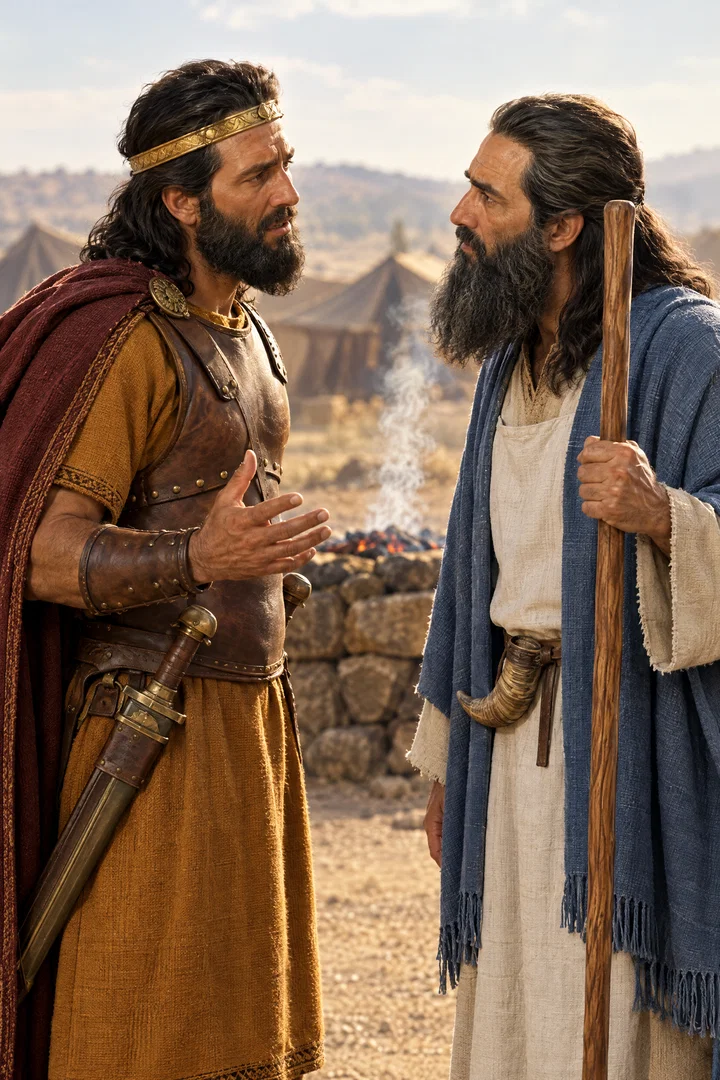
Cross-references
- 1 Samuel 10:8
And thou shalt go down before me to Gilgal; and, behold, I will come down unto thee, to offer burnt offerings, and to sacrifice sacrifices of peace offerings: seven days shalt thou tarry, till I come to thee, and shew thee what thou shalt do.
Samuel instructed Saul to wait seven days at Gilgal, but Saul offered the sacrifice before Samuel came.
- 1 Samuel 15:22
And Samuel said, Hath the LORD as great delight in burnt offerings and sacrifices, as in obeying the voice of the LORD? Behold, to obey is better than sacrifice, and to hearken than the fat of rams.
Obedience is better than sacrifice.
- 1 Samuel 9:2
And he had a son, whose name was Saul, a choice young man, and a goodly: and there was not among the children of Israel a goodlier person than he: from his shoulders and upward he was higher than any of the people.
Saul’s impressive appearance contrasts with his unfitness.
Commentary
Each commentary is drawn from primary sources: the writings of Ellen G. White and Adventist pioneers and periodicals. Each commentary is separate. Its own words are not a quotation; follow the references to read the source passages.
Ellen G. White
16 sources
Saul had just finished offering the burnt offering at Gilgal when Samuel arrived at the close of the appointed seven days, and Saul went out to meet and greet him.Lt 16, 1897, par. 25–34PP 618.2–621.2ST Aug 10, 1882 He had been commanded to wait there for Samuel to come and offer the sacrifices and show him what to do, and the delay to the last hour was God's design to test him and reveal his heart in a time of danger.Lt 16, 1897, par. 25–34PP 617.2–3SG4 68.1–69.2 Though king, he was never given the priest's office, yet he forced himself into that sacred work instead of waiting for the one appointed to do it.Lt 16, 1897, par. 25–34PP 618.2–621.2PP 617.2–3SG4 68.1–69.2Lt 27, 1892, par. 5–9 He acted from impatience and unbelief, looking at the overwhelming Philistine force and his own scattering army instead of trusting God, praying humbly, and waiting a little longer.Lt 16, 1897, par. 25–349MR 341.2–342.2PP 617.2–3 By following his own judgment instead of God's plain direction he failed the test of obedience and faith and forfeited his right to the kingdom.Lt 16, 1897, par. 25–34Lt 12a, 1888, par. 12–13Lt 10, 1897, par. 10–12
Saul's Act at Gilgal
As soon as Saul had made an end of offering the burnt offering, Samuel came, and Saul went out to meet and salute him.Lt 16, 1897, par. 25–34PP 618.2–621.2ST Aug 10, 1882SG4 68.1–69.2PP 618.1 The offering was finished within the appointed seven days, just as Samuel arrived.Lt 16, 1897, par. 25–34 That meeting brought his disobedience into view.SG4 68.1–69.2PP 624.3–625.2
Saul had been commanded to go to Gilgal and tarry seven days till Samuel came to offer burnt offerings and show him what to do.Lt 16, 1897, par. 25–34PP 617.2–3 The delay was God's design to reveal Saul's heart in an emergency.Lt 16, 1897, par. 25–34 It was also a deliberate delay to test the people and expose their dependence on their own strength.SG4 68.1–69.2
Outward appearances were discouraging, for the Philistines gathered with overwhelming force.Lt 16, 1897, par. 25–34 The Israelites hid in caves, thickets, rocks, high places and pits, fled over Jordan, and scattered trembling from Saul at Gilgal.Lt 16, 1897, par. 25–34 All Israel stood in fear of the Philistine army.SG4 68.1–69.2
The sacrifices to be offered were a solemn act of seeking God.PP 617.2–3 They required repentance and searching of heart so the offering could be accepted and God's blessing attend Israel against its enemy.PP 617.2–3 The sacred service pointed forward to the sinless sacrifice of God's Son.SG4 68.1–69.2
Saul went out to greet Samuel confidently.PP 618.2–621.2PP 618.1 He met him as though he expected approval and commendation rather than reproof.PP 618.2–621.2PP 618.1
Presumption and Unbelief
Saul broke God's express direction by presenting the burnt offering himself instead of waiting for Samuel, who had been appointed to present it.PP 618.2–621.2PP 617.2–3 Though exalted as king, he had never been invested with the sacred office of priesthood, yet he forced himself into sacred work that belonged to those appointed for it.Lt 16, 1897, par. 25–34SG4 68.1–69.2 As king he reasoned that he was equal to any office, and in self-complacency he felt it made no difference who should approach God and in what way.Lt 16, 1897, par. 25–34Lt 27, 1892, par. 5–9 In doing so he knowingly transgressed in the very last moments and mingled the sacred with the common.Lt 16, 1897, par. 25–34 His unbidden sacrifice was presumption, sacrilege, irreverence, unbelief and disobedience by which he dishonored God.ST Aug 10, 1882PP 633.1Lt 12a, 1888, par. 12–13
He acted from impatience and discouragement before the appointed time had fully expired.Lt 16, 1897, par. 25–34PP 617.2–3 Instead of looking to God, trusting Him, bowing in humble prayer and waiting a few more hours, he looked at outward appearances and became passionate, self-complacent and self-confident, trusting his own strength.Lt 16, 1897, par. 25–34 He fretted about the delay, decided to move independently of Samuel, and rushed into the performance of a work God had not given him to do.9MR 341.2–342.2Lt 27, 1892, par. 5–9 He could have made supplication with his whole heart without sacrifice, for the Lord accepts even silent petitions of a burdened heart.Lt 16, 1897, par. 25–34 His public show of conscientiousness did not make his worship genuine, for offering in defiance of God's command weakened him and put him beyond the help God was willing to give.PP 634.1
When reproved he defended himself, blamed the prophet, and stubbornly justified himself rather than confessing his error.ST Aug 10, 1882PP 624.3–625.2 Though he acknowledged Samuel to be a prophet sent from God, he should have accepted the reproof even though he could not himself see that he had sinned.PP 633.1 Had he been willing to see and confess his error, this bitter experience would have proved a safeguard for the future.PP 633.1 The verse teaches the danger of failing to constantly look to the Lord for instruction, and the need to wait on the Lord to learn and watch what He wants instead of fretting, moving independently, making duties for ourselves, and being full of our own schemes, plans and contrivances.9MR 341.2–342.2Lt 27, 1892, par. 5–9
Loss and Warning
When first called to the throne he was humble and self-distrustful, but success made him self-confident.PP 633.1 The pride of heart kindled by his very first victory in the deliverance of Jabesh-gilead became his greatest danger.PP 633.1 As the people honored him he forgot that he was only the agent by whom God had wrought, and though at first he ascribed the glory to God, afterward he took honor to himself, lost sight of his dependence upon God, and in heart departed from the Lord, thus preparing the way for his sin at Gilgal.PP 633.1 Though tall and well proportioned and designated king, he was unfitted in experience and character for the work until the Lord changed his heart by His Spirit, making him a converted man with a visible change of spirit and influence with the armies of Israel.Lt 10, 1897, par. 10–1219MR 21.3–22.2 He was set aright to cultivate humility and the fear of God, to trust in God and learn His will, not to exalt himself, but to receive the word of the Lord from old faithful standard-bearers and do God's will.Lt 10, 1897, par. 10–1219MR 21.3–22.2
By disregarding God's plainly stated will and presuming to take responsibility that did not belong to his position, following his own judgment instead of learning God's will through Samuel, he failed the test of obedience and faith.Lt 16, 1897, par. 25–34Lt 12a, 1888, par. 12–13Lt 10, 1897, par. 10–1219MR 21.3–22.2 He thereby set a harmful example for Israel, leaving an example for men of war to assume the priesthood in any emergency, and forfeited his right to the kingdom.Lt 16, 1897, par. 25–34Lt 12a, 1888, par. 12–13 His presumptuous offering cost him the honor of commanding Israel's armies in battle.1SP 358.2–359.2 Yet his error was not yet beyond remedy, for the Lord would give him another opportunity to learn unquestioning faith in God's word and obedience to His commands.PP 627.1
His failure warns that inexperienced men as unfitted as he was must not be set apart for the ministry without close seeking of the Lord to know His will.Lt 10, 1897, par. 10–12 Men as inexperienced as Saul who enter the ministry must not fail in the same way by exalting self, but must receive the word of the Lord from old faithful standard-bearers and do the will of God.Lt 10, 1897, par. 10–1219MR 21.3–22.2 No one must exalt himself above his brother.Lt 10, 1897, par. 10–12
Sources
Pioneers and periodicals
14 sources
At Gilgal before battle with the Philistines, Saul had waited seven days with a small and deserting army, and in discouragement and impatience at Samuel's delay he would wait no longer but finished offering the burnt offering himself and went out to greet Samuel just as he arrived.ST Aug 10, 1882ST Sep 3, 1896RH Jan 23, 1913ST Jul 17, 1884ST Feb 17, 1914 It was the first great test of his reign as the first king, and his act was an unbidden, presumptuous disobedience to God's command, taking upon himself the priest's work appointed to Samuel.ST Aug 10, 1882ST Sep 3, 1896ST Aug 12, 1889ST Jul 9, 1912ST Apr 15, 1913 It proves God puts a difference between civil and religious matters, so that not even Saul's anointing gave him as civil ruler any right to interfere with God's order of worship.ST Sep 3, 1896 The disobedience cost him the continuance of his kingdom and the succession of his family, yet God did not then finally cut him off but gave him further trial and opportunity to retrieve his character.ST Sep 3, 1896ST Aug 12, 1889ST Mar 31, 1909 The verse therefore teaches exact obedience even in what looks like a little thing, since disobedience in the little leads to disobedience in great things, and no outward religious display can take the place of obedience.ST Jul 9, 1912RH Aug 22, 1865
Setting and Meaning
The moment comes at Gilgal just before battle with the Philistines, as Saul finishes the burnt offering himself at the very instant Samuel arrives to sacrifice.ST Sep 3, 1896ST Jul 17, 1884 He had waited the appointed seven days with a small and fearful army that was deserting on every side.ST Sep 3, 1896ST Jul 17, 1884 In discouragement and impatience at Samuel's delay and at the melting away of his troops, he would wait no longer but took the priest's work upon himself.ST Sep 3, 1896ST Jul 17, 1884ST Feb 17, 1914
It belongs to the beginning of his reign as the first king, of the tribe of Benjamin, and records his first great test after his choosing as king.ST Sep 3, 1896ST Mar 31, 1909ST Oct 31, 1895 That portion of 1 Samuel tells the choosing of Saul and the waning of the house of Saul with the calling of David.ST Sep 3, 1896ST Apr 15, 1913ST Mar 31, 1909 His rashness and weakness here stand in the course that leads to the Lord's rejection of Saul and his family and to the anointing of David.ST Apr 15, 1913ST Mar 31, 1909ST Oct 31, 1895
The saluting is a greeting of one met on arrival rather than blessing in the ordinary sense, and the action is Saul completing the burnt offering himself and going out to greet Samuel just as Samuel came.ST Aug 10, 1882RH Jan 23, 1913 Samuel arrived just after the offering was finished, and Saul went out to meet him.ST Aug 10, 1882RH Jan 23, 1913
The offering was unbidden, unauthorized, and presumptuous, in direct disobedience to God's command and contrary to God's law.ST Aug 10, 1882ST Aug 17, 1882ST Aug 12, 1889ST Jul 9, 1912ST Oct 22, 1902 He assumed the priest's office and offered the sacrifice Samuel was appointed to offer, choosing to sacrifice himself instead of waiting for Samuel as God commanded.ST Aug 10, 1882ST Aug 17, 1882ST Oct 22, 1902ST Jul 8, 1889
Disobedience, Judgment, and Lessons
God draws a line between civil and religious things, so that a civil ruler was forbidden to presume upon religious work God had assigned to others, and even the gift of prophecy and a new heart given at anointing gave no right to break into God's appointed order of worship.ST Sep 3, 1896
Saul's outwardly religious act was expediency rather than trust in God, for he would not wait and used pressure as his excuse.ST Jul 17, 1884 He reasoned that to offer sacrifice is always good, that it made no special difference whether Samuel was present, and that to do only a little differently from what God had said could do no harm, and afterward he felt satisfied with his offerings and prayers and psalms.ST Oct 22, 1902 In that backslidden state the presumptuous taking of the priest's office upon himself reflected pride and self-sufficiency.ST Jul 8, 1889
When rebuked he did not confess his error but defended himself and blamed the prophet, stubbornly defending what he had done.ST Aug 10, 1882ST Aug 17, 1882 His refusal to repent cut him off from God's favor and prospering hand.ST Feb 17, 1914 That earlier offense stands in contrast with his later severity toward Jonathan for ignorantly violating an unreasonable requirement of his own making.ST Aug 17, 1882
The disobedience cost him the continuance of his kingdom and the succession of his family, for his rule would not continue and the Lord rejected him and his house in the course that led to the anointing of David.ST Sep 3, 1896ST Aug 12, 1889ST Mar 31, 1909 Yet God did not then finally cut him off himself, but gave him further trial and opportunity to retrieve his character before his final rejection.ST Oct 31, 1895 His refusal to repent cut him off from God's favor and prospering hand, and his reasoning that a little deviation could do no harm cost him the continuance of his kingdom.ST Feb 17, 1914ST Oct 22, 1902
Exact obedience is required even in what looks like a little thing, since to disobey in the little is foolishness and is not keeping God's commandment, and disobedience in little things leads to disobedience in great things.ST Oct 22, 1902 Once people begin to disregard the authority of God's law they may not know how far their disobedience will go, for this sacrifice was the first step toward apostasy and self-murder.RH Aug 22, 1865 A public religious display cannot take the place of obedience, because the act was contrary to God's law though outwardly religious.ST Jul 9, 1912 Outwardly favorable position did not keep Saul faithful, showing that apparent prosperity can become a curse, while adversity can develop firm faith.
Sources