1 Samuel 13:11
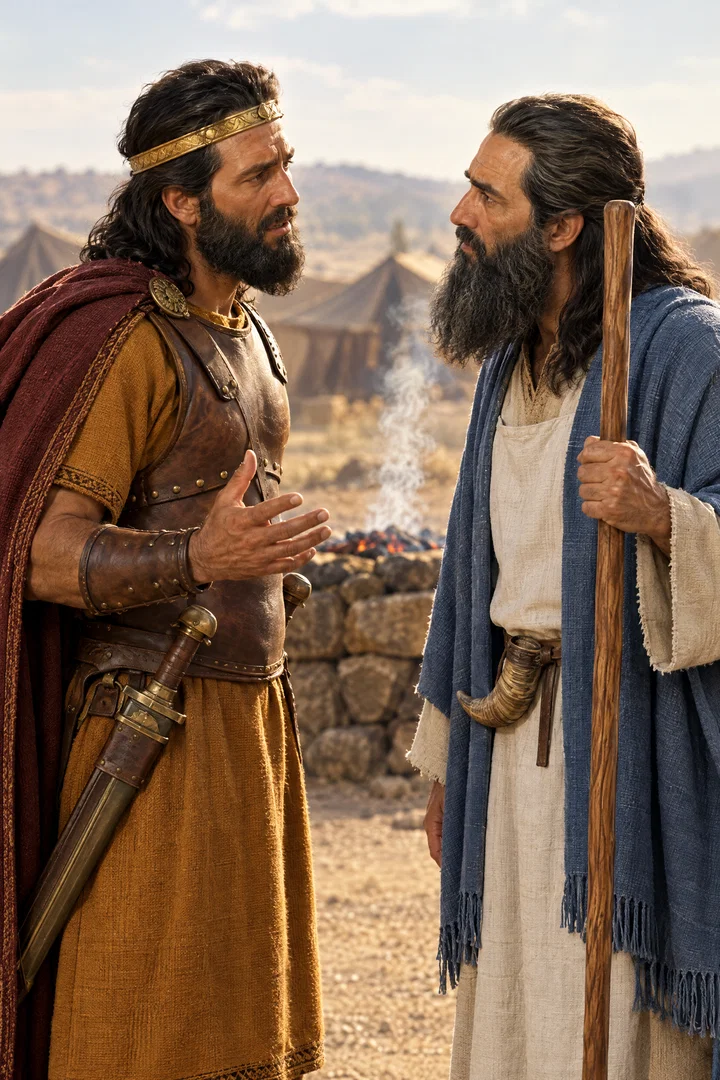
And Samuel said, What hast thou done? And Saul said, Because I saw that the people were scattered from me, and that thou camest not within the days appointed, and that the Philistines gathered themselves together at Michmash;
Translations
And Samuel said, What have you done? And Saul said, Because I saw that the people were scattered from me, and that you came not within the days appointed, and that the Philistines gathered themselves together at Michmash;
King James Version, KJV Cambridge Paragraph Bible
And Samuel said, What hast thou done? And Saul said, Because I saw that the people were scattered from me, and that thou camest not within the days appointed, and that the Philistines gathered themselves together at Michmash;
And Samuel said, What hast thou done? And Saul said, Because I saw that the people were scattered from me, and that thou camest not within the days appointed, and that the Philistines assembled at Michmash;
Revised Version, American Standard Version
And Samuel said, What hast thou done? And Saul said, Because I saw that the people were scattered from me, and that thou camest not within the days appointed, and that the Philistines assembled themselves together at Michmash;
and Samuel saith, 'What hast thou done?' And Saul saith, 'Because I saw that the people were scattered from off me, and thou hadst not come at the appointment of the days, and the Philistines are gathered to Michmash,
And Samuel said, What hast thou done? And Saul said, Because I saw that the people were scattered from me, and that thou didst not come within the days appointed, and that the Philistines were assembled at Michmash,
Then said Samuel—What hast thou done? And Saul said—Because I saw that the people had been scattered from me, and, thou, hadst not come within the appointed days, and, the Philistines, had gathered themselves together to Michmash,
Berean Standard Bible, Majority Standard Bible
“ What have you done?” Samuel asked.And Saul replied, “ When I saw that the troops were deserting me, and that you did not come at the appointed time and the Philistines were gathering at Michmash,
Samuel said, “ What have you done?”Saul said, “ Because I saw that the people were scattered from me, and that you didn’t come within the days appointed, and that the Philistines assembled themselves together at Michmash,
And Samuel said, What have you done? And Saul said, Because I saw that the people were going away from me, and you had not come at the time which had been fixed, and the Philistines had come together at Michmash;
And Samuel saide, What hast thou done? Then Saul saide, Because I sawe that the people was scattred from me, and that thou camest not within the daies appoynted, and that the Philistims gathered themselues together to Michmash,
Douay-Rheims (Challoner revision)
And Samuel said to him: What hast thou done? Saul answered: Because I saw that the people slipt from me, and thou wast not come according to the days appointed, and the Philistines were gathered together in Machmas,
Pictures
Cross-references
- 1 Samuel 10:8
And thou shalt go down before me to Gilgal; and, behold, I will come down unto thee, to offer burnt offerings, and to sacrifice sacrifices of peace offerings: seven days shalt thou tarry, till I come to thee, and shew thee what thou shalt do.
Samuel instructed Saul to wait seven days at Gilgal, but Saul disobeyed.
- 1 Samuel 9:2
And he had a son, whose name was Saul, a choice young man, and a goodly: and there was not among the children of Israel a goodlier person than he: from his shoulders and upward he was higher than any of the people.
Saul's tall appearance yet unfitness for office
- 1 Samuel 15:22-23
And Samuel said, Hath the LORD as great delight in burnt offerings and sacrifices, as in obeying the voice of the LORD? Behold, to obey is better than sacrifice, and to hearken than the fat of rams.
Saul’s expedient disobedience is described as presumption and rebellion.
- 1 Samuel 13:5-7
And the Philistines gathered themselves together to fight with Israel, thirty thousand chariots, and six thousand horsemen, and people as the sand which is on the sea shore in multitude: and they came up, and pitched in Michmash, eastward from Beth-aven.
The gathered Philistine forces and Israel’s distress explain Saul’s excuse.
Commentary
Each commentary is drawn from primary sources: the writings of Ellen G. White and Adventist pioneers and periodicals. Each commentary is separate. Its own words are not a quotation; follow the references to read the source passages.
Ellen G. White
16 sources
Saul answers Samuel's rebuke with three excuses, that his people were scattering, that Samuel had not come within the appointed days, and that the Philistines were gathering for battle.Lt 16, 1897, par. 25–34PP 618.2–621.2PP 617.2–3 The appointed time had not yet fully run out, with only a few hours remaining of the seven days, but he refused to wait.Lt 16, 1897, par. 25–34PP 617.2–3 In fear of attack before he had sought the Lord, he forced himself to offer the burnt offering, seizing the sacred work of the priesthood that as king was never given to him.Lt 16, 1897, par. 25–34PP 618.2–621.2Lt 12a, 1888, par. 12–13 Instead of looking to God in humble, prayerful trust, he looked at discouraging outward appearances and acted in impatience, unbelief and presumption.Lt 16, 1897, par. 25–34PP 618.2–621.2PP 617.2–3 When reproved he stubbornly justified his disobedience rather than confessing his error, and by that disobedience he dishonored God's service, set a ruinous example, and forfeited his right to the kingdom.ST Aug 10, 1882PP 633.1Lt 12a, 1888, par. 12–13PP 627.1PP 624.3–625.2
Saul's Excuse at Gilgal
When asked what he had done, Saul answered with three excuses: his people were scattering from him, Samuel had not come within the days appointed, and the Philistines were gathering together at Michmash.Lt 16, 1897, par. 25–34PP 617.2–3SG4 68.1–69.2PP 618.1Lt 12a, 1888, par. 12–13 He pointed to his deserting soldiers, to Samuel's apparent delay, and to the mustering enemy as his explanation for disobeying and offering sacrifice himself.PP 618.2–621.2PP 617.2–3SG4 68.1–69.2PP 618.1Lt 12a, 1888, par. 12–13
The appointed time had not fully expired when he acted.Lt 16, 1897, par. 25–34PP 617.2–3 Only a few more hours remained to the last moments of the seven days, but he refused to wait for them to pass.Lt 16, 1897, par. 25–34
He was afraid the Philistines would come down on him at Gilgal before he had made supplication to the Lord.Lt 16, 1897, par. 25–34 That fear of attack without first seeking divine favor drove his decision to act at once.Lt 16, 1897, par. 25–34
He forced himself to offer the burnt offering, taking upon himself the sacred office of priesthood which as king was never given him.Lt 16, 1897, par. 25–34 This was contrary to God's command that only those consecrated to that office should present sacrifices, and by doing it he took a responsibility that did not belong to his position.Lt 16, 1897, par. 25–34PP 618.2–621.2Lt 12a, 1888, par. 12–13
He could have made humble supplication with his whole heart without any sacrifice.Lt 16, 1897, par. 25–34 The Lord accepts such prayer even as the silent petitions of a burdened heart, for it makes a difference who should approach God and in what way.Lt 16, 1897, par. 25–34
Instead he looked at discouraging outward appearances rather than looking to God and trusting Him.Lt 16, 1897, par. 25–34 In fear, impatience, unbelief and foreboding he acted presumptuously instead of waiting for God's direction, trusting the promised divine help on the stated conditions, preparing the people to seek God, and remaining humble, self-distrustful and prayerful.Lt 16, 1897, par. 25–34PP 618.2–621.2PP 617.2–3PP 618.1 He blamed the crisis and Samuel's delay for his own presumptuous choice rather than obeying the command to wait.PP 618.1
God permitted Samuel's detention to reveal Saul's heart and to show what he would do in an emergency.Lt 16, 1897, par. 25–34 The test proved he would not obey orders from heaven and could not be trusted as head of the nation.Lt 16, 1897, par. 25–34 His example, if followed, would erase the distinction between the sacred and the common by opening the priesthood to men of war on any occasion.Lt 16, 1897, par. 25–34
Reproof, Consequence, and Warning
When reproved, Saul stubbornly justified and defended his disobedience instead of admitting his error and accepting correction.ST Aug 10, 1882PP 633.1PP 624.3–625.2 Although he recognized Samuel as a prophet sent by God, he should have accepted the reproof and obeyed him even though he did not see his own sin.ST Aug 10, 1882PP 633.1 Blind self-confidence led him to reject correction rather than confess.PP 633.1 A willingness to be corrected could have helped restore him to God's favor, while self-justification left him likely to repeat the sin.ST Aug 10, 1882 That proud refusal to acknowledge his sin was repeated later when he insisted on enforcing his own unreasonable order even at the cost of Jonathan's life.PP 624.3–625.2
His sacrifice was an act of disobedience, not genuine piety.PP 634.1 Religious service performed against God's command dishonored God's service, weakened him, and placed him beyond the help God was willing to give.PP 627.1PP 634.1 He did not stand the test of faith in a trying situation.PP 627.1 Yet his error was not yet beyond remedy, for God would give him another opportunity to learn unquestioning faith in God's word and obedience to His commands.PP 627.1 By disregarding God's requirements he set a ruinous example for Israel and forfeited his right to the kingdom.Lt 12a, 1888, par. 12–13 He lost the honor of leading Israel to victory, for in the battle that followed God worked through Jonathan and his armor-bearer and delivered Israel so that the victory would be credited to God, not to Israel's righteousness, valor, or wisdom.1SP 358.2–359.2
The verse warns against impatience when instruction from the Lord seems delayed.9MR 341.2–342.2Lt 27, 1892, par. 5–9 Saul became impatient because Samuel did not come just when expected, fretted over the delay, and decided to move independently of Samuel.9MR 341.2–342.2Lt 27, 1892, par. 5–9 He rushed into the performance of a work God had not given him to do, reasoning that as king he was equal to any office.9MR 341.2–342.2Lt 27, 1892, par. 5–9 Impatience thus leads to making duties for oneself and acting on one's own schemes, plans and contrivances instead of constantly looking to the Lord, waiting on Him, watching and learning what He wants.9MR 341.2–342.2Lt 27, 1892, par. 5–9
Though tall and well proportioned in appearance and designated king of Israel, Saul was unfitted by experience and character for the work.Lt 10, 1897, par. 10–1219MR 21.3–22.2 The Lord changed his heart by His Spirit, made him a converted man, gave him influence with the armies of Israel, and set him right in the work.Lt 10, 1897, par. 10–1219MR 21.3–22.2 If he had cultivated humility and the fear of God, trusted in God, learned His will, and refused to exalt himself, the Lord would have given him grace to succeed.Lt 10, 1897, par. 10–1219MR 21.3–22.2 Instead he presumptuously followed his own judgment, exalted himself, and failed.Lt 10, 1897, par. 10–1219MR 21.3–22.2 His failure warns that even an inexperienced man entering the ministry need not fail if he will receive the word of the Lord from faithful older workers and do God's will rather than exalting self.Lt 10, 1897, par. 10–1219MR 21.3–22.2 No man must be chosen for the ministry because of appearance or set apart unprepared without close seeking of the Lord to know His will.19MR 21.3–22.2
Sources
Pioneers and periodicals
12 sources
Saul faced his first great test at Gilgal when, instead of waiting for Samuel as commanded, he presumptuously took the priest's office and offered sacrifice himself. ST Aug 12, 1889ST Mar 31, 1909 When confronted he excused his disobedience by the scattering of his fearful people, Samuel's delay beyond the appointed days, and the gathering Philistine army at Michmash, reasoning that urgency justified acting alone. ST Jul 9, 1912ST Jul 17, 1884 In contrast to the meek humility of his beginnings, he refused to admit his error and stubbornly justified himself rather than accepting reproof from God's prophet. ST Aug 10, 1882ST Aug 17, 1882ST Jul 8, 1889 Through Samuel came the sentence that his kingdom and house would not continue and the way was opened for David, though he was still given further trial and opportunity to retrieve his character before his course ended in apostasy and ruin. ST Aug 12, 1889ST Mar 31, 1909ST Oct 31, 1895 The lesson is that obedience is better than sacrifice, so when God's time seems delayed His people must trust His promise and wait for divine instruction, since disobedience in little things leads to greater disobedience and self-justification only ensures the sin will be repeated. ST Aug 10, 1882ST Jul 9, 1912
Context and Meaning
The verse stands near the opening of Saul's reign after his choosing as king, within the longer history running from 1 Samuel 7 through 18 that traces the choosing of Saul, the death of Samuel, the waning of the house of Saul, and the calling of David.ST Apr 15, 1913ST Mar 31, 1909 It belongs amid the harsh domination the Philistines imposed on Israel, and to an account of rashness and weakness in Saul that led to the Lord's rejection of Saul and his family and the anointing of David.ST Mar 31, 1909 It is part of the record of another rash act by Saul under those oppressive conditions.
It records Saul's first great test after his choosing as king, a test he failed at Gilgal by rashly taking the priest's office and presumptuously offering sacrifice himself instead of waiting for Samuel as commanded.ST Aug 10, 1882ST Aug 17, 1882ST Aug 12, 1889ST Mar 31, 1909ST Oct 31, 1895 The act was unauthorized, contrary to law and to God's command, looking religious but in truth presumption and self-will.ST Aug 10, 1882ST Aug 12, 1889ST Jul 9, 1912ST Jul 17, 1884 That transgression of the Lord's will brought the declaration through Samuel that Saul's rule and his house would not continue.ST Aug 12, 1889ST Mar 31, 1909ST Oct 22, 1902 Yet the failure did not bring immediate cutting off, but further trial and opportunity to retrieve his individual character before final rejection.ST Oct 31, 1895
When confronted, Saul excused himself on three grounds, that the people were scattering from him in fear, that Samuel had not come within the days appointed, and that the Philistines were gathering at Michmash.ST Jul 9, 1912ST Jul 17, 1884RH Aug 22, 1865ST Feb 17, 1914 His plea was fear and military urgency, and the delay as he perceived it when Samuel had not arrived when expected.ST Jul 17, 1884RH Aug 22, 1865ST Feb 17, 1914 He reasoned that sacrifice is always good and that Samuel's presence made no special difference, so that doing just a little different from what was said could do no harm, and after his offerings and prayers he felt satisfied with himself.ST Oct 22, 1902 In truth it was foolish disobedience to the commandment of God, contrary to law, and the episode teaches that obedience is better than sacrifice.ST Jul 9, 1912ST Oct 22, 1902 His refusal to repent left him without God's favor and prospering hand, his sin in sacrificing was the first step toward apostasy and self-destruction showing that once disregard of God's authority begins there is no knowing where it will end, and outward advantages and favorable circumstances that seem helpful can become a curse.RH Aug 22, 1865ST Feb 17, 1914
Reproof and Warning
Saul's excuse stands in sharp contrast to the meek humility he showed when first made king, for success had bred in him pride and self-sufficiency that led him to seize the priest's office and offer the sacrifice appointed for another to make.ST Jul 8, 1889 When confronted, instead of admitting his error he rejected correction and stubbornly defended and justified his disobedience.ST Aug 10, 1882ST Aug 17, 1882 Even though he recognized the reproof as coming from a prophet sent by God, he should have accepted it even when he did not see his own sin, since willingness to be corrected could have restored him to divine favor, while self-justification left him likely to repeat the sin.ST Aug 10, 1882
His transgression brought the sentence that his rule would not continue.ST Aug 12, 1889ST Oct 22, 1902 That rashness and weakness led to the rejection of Saul and his family and opened the way for the anointing of David.ST Mar 31, 1909 Yet the failure in this first great test did not bring immediate cutting off, but further trial and opportunity to retrieve his character before final rejection.ST Oct 31, 1895 His act of sacrificing at Gilgal because the people scattered, the appointed time seemed past, and the Philistines gathered at Michmash was the first step toward apostasy and self-destruction, showing that once disregard of God's authority begins there is no knowing where it will end.RH Aug 22, 1865 His refusal to repent left him without God's favor and prospering hand.ST Feb 17, 1914
The episode teaches that obedience is better than sacrifice, for his offering was contrary to law.ST Jul 9, 1912 It shows how outward advantages and circumstances that seem favorable can ultimately become a curse. Disobedience in little things leads to disobedience in great things, for he reasoned that sacrifice is always good, that the presence of the appointed servant made no special difference, and that doing just a little different from what was commanded could do no harm, and afterward felt satisfied with himself after empty offerings and prayers.ST Oct 22, 1902 When God's appointed time seems delayed, men must trust His promise, wait for divine instruction, and not act alone, since impatient action ends in shame.ST Feb 17, 1914 One who justifies his own disobedience will judge a suspected offense in another with undue severity, insisting on death for a deliberate transgression punishable by death instead of considering whether it was an unwitting sin requiring a sin offering.ST Aug 17, 1882
Sources