1 Samuel 14:5
The forefront of the one was situate northward over against Michmash, and the other southward over against Gibeah.
Translations
American King James Version, King James Version, KJV Cambridge Paragraph Bible
The forefront of the one was situate northward over against Michmash, and the other southward over against Gibeah.
The front of the one was situated northward over against Michmash, and the other southward over against Gibeah.
Revised Version, American Standard Version, World English Bible
The one crag rose up on the north in front of Michmash, and the other on the south in front of Geba.
The one edge [is] fixed on the north over-against Michmash, and the one on the south over-against Gibeah.
The one crag [formed] a pillar on the north opposite to Michmash, and the other on the south opposite to Geba.
The one crag, was a pillar on the north, over against Michmash,—and, the other, on the south, over against Geba.
Berean Standard Bible, Majority Standard Bible
One cliff stood to the north toward Michmash, and the other to the south toward Geba.
The one rock went up on the north in front of Michmash and the other on the south in front of Geba.
The one rocke stretched from the North towarde Michmash, and the other was from the South toward Gibeah.
Douay-Rheims (Challoner revision)
One rock stood out towards the north over against Machmas, and the other to the south over against Gabaa.
Pictures
Cross-references
- 1 Samuel 14:12
And the men of the garrison answered Jonathan and his armourbearer, and said, Come up to us, and we will shew you a thing. And Jonathan said unto his armourbearer, Come up after me: for the LORD hath delivered them into the hand of Israel.
Jonathan takes the Philistines’ challenge as the promised sign of the LORD’s deliverance.
Commentary
Each commentary is drawn from primary sources: the writings of Ellen G. White and Adventist pioneers and periodicals. Each commentary is separate. Its own words are not a quotation; follow the references to read the source passages.
Ellen G. White
2 sources
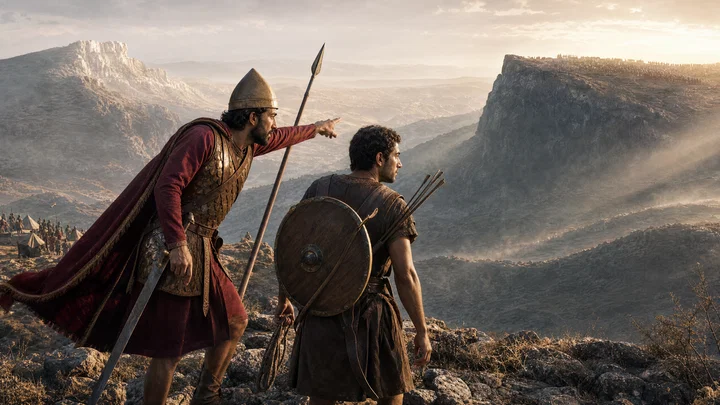
The verse describes steep cliffs standing on opposite sides of a gorge or pass, with one crag lying northward toward Michmash and the other southward toward Gibeah.PP 623.1–2 Israel lay to the south toward Gibeah while the Philistines were to the north at Michmash.PP 623.1–2 The Philistine outposts stood on both sides of the pass, one to the north of Michmash and the other to the south of Gibeah.SG4 70.1–71.1
God brought matters to a crisis at this place to rebuke Saul's perversity and to teach humility and faith.PP 623.1–2 Because of Saul's sin in making a presumptuous offering, God would not give Saul the honor of defeating the Philistines but chose Jonathan, who feared the Lord and was moved by a divine impulse, together with his armor-bearer, a man of faith and prayer.PP 623.1–2 With earnest prayer Jonathan and his armor-bearer agreed on a sign to determine how they should proceed.PP 623.1–2
They went down secretly into the gorge under the shadow of the cliff and partly concealed by mounds and ridges, making a dangerous approach to the Philistine garrison.PP 623.1–2SG4 70.1–71.1 When the Philistines taunted them, they accepted the challenge to come up as evidence that the Lord would prosper them.PP 623.1–2 They then climbed by a secret and difficult path to the top of a cliff regarded as inaccessible and not strongly guarded, and killed the sentinels, who in surprise and fear offered no resistance.PP 623.1–2 Through Jonathan and his armor-bearer at this place, God brought deliverance for Israel.PP 623.1–2SG4 70.1–71.1
Sources
Pioneers and periodicals
11 sources
The verse fixes the place of two facing Philistine outposts, rocky crags whose fronts stood opposite each other, the one to the north toward Michmash and the other to the south toward Gibeah.ST Sep 20, 1883RH Dec 30, 1915ST Nov 17, 1909ST Oct 27, 1898ST Oct 28, 1913 Gibeah was Saul's home, and it was the place from which Jonathan won his noted victory over the Philistines.ST Oct 27, 1898 The verse belongs to the account of Jonathan's deliverance of Israel, when the young Jonathan with only his armor-bearer, two men alone, fell upon the Philistines at Michmash and routed a trained army, so that one put a thousand to flight and the Philistine forces fled.ST Sep 20, 1883RH Dec 30, 1915RH Dec 29, 1904ST Jul 21, 1909ST Oct 28, 1913 The same narrative includes Saul's rash decree forbidding food, and it supplies the setting for Jonathan's victories and for Israel's triumphs under his leadership.ST Sep 20, 1883ST Oct 28, 1913
That rout was won with God through faith in God's power.RH Dec 30, 1915ST Oct 4, 1910ST Apr 14, 1909 God gains his victories by neither earthly might nor numbers, but uses the weak and the man of valor, so that no one can boast before him.ST Jul 21, 1909ST Oct 4, 1910ST Apr 14, 1909 Jonathan's daring exploit is the pattern of the courage by which a young man lives consistently as a Christian in the midst of worldly compromise.ST Mar 12, 1885 The attack of Jonathan and his armor-bearer is courageous zeal for God's cause, proving that the enthusiasm of young people in missionary work is no new thing.RH Dec 29, 1904
The hard climb of Jonathan and his armor-bearer up between the two crags pictures the way to heaven as rough and thorny and to be pressed through only by strenuous effort, with victory and triumph lying beyond the climb.ST Nov 17, 1909 The literal battle Jonathan fought against the Philistines is not the battle to be fought now.RH Nov 12, 1901 A greater work remains, to be fought with God's help against wrong habits that have laid millions on beds of illness and against indifference to God's physical and spiritual claims upon humanity.RH Nov 12, 1901
Sources