1 Samuel 14:4
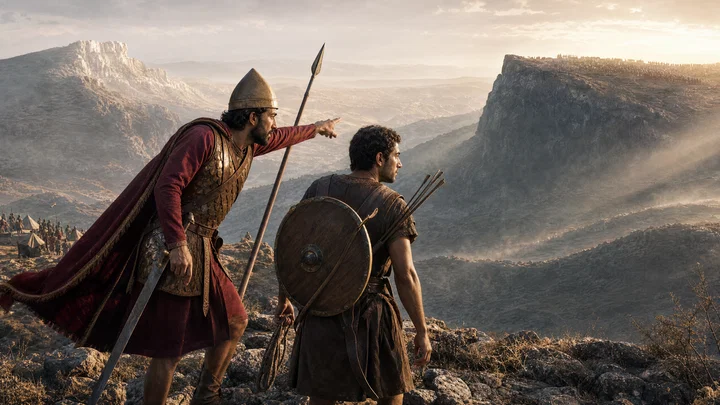
And between the passages, by which Jonathan sought to go over unto the Philistines’ garrison, there was a sharp rock on the one side, and a sharp rock on the other side: and the name of the one was Bozez, and the name of the other Seneh.
Translations
And between the passages, by which Jonathan sought to go over to the Philistines’ garrison, there was a sharp rock on the one side, and a sharp rock on the other side: and the name of the one was Bozez, and the name of the other Seneh.
King James Version, KJV Cambridge Paragraph Bible
And between the passages, by which Jonathan sought to go over unto the Philistines’ garrison, there was a sharp rock on the one side, and a sharp rock on the other side: and the name of the one was Bozez, and the name of the other Seneh.
And between the passages by which Jonathan sought to go over to the garrison of the Philistines, there was a sharp rock on the one side, and a sharp rock on the other side: and the name of the one was Bozez, and the name of the other Seneh.
Revised Version, American Standard Version
And between the passes, by which Jonathan sought to go over unto the Philistines’ garrison, there was a rocky crag on the one side, and a rocky crag on the other side: and the name of the one was Bozez, and the name of the other Seneh.
And between the passages where Jonathan sought to pass over unto the station of the Philistines [is] the edge of a rock on the one side, and the edge of a rock on the other side, and the name of the one is Bozez, and the name of the other Seneh.
Now between the passes by which Jonathan sought to go over to the Philistines' garrison there was a sharp rock on the one side and a sharp rock on the other side; and the name of the one [ was] Bozez, and the name of the other Seneh.
And, between the passes by which Jonathan sought to cross over up to the garrison of the Philistines, there was a crag of rock on the one side, and a crag of rock on the other side; and, the name of the one, was Bozez, and the name of the other, Seneh.
Berean Standard Bible, Majority Standard Bible
Now there were cliffs on both sides of the pass that Jonathan intended to cross to reach the Philistine outpost. One was named Bozez and the other Seneh.
Between the passes, by which Jonathan sought to go over to the Philistines’ garrison, there was a rocky crag on the one side and a rocky crag on the other side; and the name of the one was Bozez, and the name of the other Seneh.
Now between the narrow roads over the mountains by which Jonathan was making his way to the Philistines' forces, there was a sharp overhanging rock on one side, and a sharp rock on the other side: one was named Bozez and the other Seneh.
Nowe in the way whereby Ionathan sought to go ouer to the Philistims garison, there was a sharpe rocke on the one side, and a sharpe rocke on the other side: the name of the one was called Bozez, and the name of the other Seneh.
Douay-Rheims (Challoner revision)
Now there were between the ascents, by which Jonathan sought to go over to the garrison of the Philistines, rocks standing up on both sides, and steep cliffs like teeth on the one side, and on the other, the name of the one was Boses, and the name of the other was Sene:
Pictures
Cross-references
- 1 Samuel 14:12
And the men of the garrison answered Jonathan and his armourbearer, and said, Come up to us, and we will shew you a thing. And Jonathan said unto his armourbearer, Come up after me: for the LORD hath delivered them into the hand of Israel.
challenge accepted as token of success
- 1 Samuel 14:11
And both of them discovered themselves unto the garrison of the Philistines: and the Philistines said, Behold, the Hebrews come forth out of the holes where they had hid themselves.
The Philistines taunt Jonathan when they see him.
- 1 Samuel 14:9-10
If they say thus unto us, Tarry until we come to you; then we will stand still in our place, and will not go up unto them.
agreed sign to determine how to proceed
Commentary
Each commentary is drawn from primary sources: the writings of Ellen G. White and Adventist pioneers and periodicals. Each commentary is separate. Its own words are not a quotation; follow the references to read the source passages.
Ellen G. White
3 sources
Between Geba on the south and Michmash on the north lay a deep rugged gorge, and the way by which Jonathan sought to go over to the Philistine garrison crossed that gorge by a steep, narrow and dangerous passage with a sharp rock standing on each side.PP 623.1–21SP 358.2–359.2SG4 70.1–71.1 The Israelites held their stronghold at Geba on the south side of the gorge while the Philistine force lay at Michmash on the north side, so the passage between the rocks was the direct approach to the enemy garrison.PP 623.1–2 The rocks are named Bozez on the one side and Seneh on the other, with no meaning attached to the names.PP 623.1–21SP 358.2–359.2SG4 70.1–71.1
God had brought matters to this crisis to rebuke Saul and to teach humility and faith.PP 623.1–2 Because of Saul's sin in his presumptuous offering, He would not give Saul the honor of vanquishing the Philistines, but chose instead Jonathan, who feared the Lord and was moved by a divine impulse.PP 623.1–2 With only his armor-bearer beside him, himself a man of faith and prayer, Jonathan proposed a secret attack in trust that there is no restraint to the Lord to save by many or by few.PP 623.1–2 Trusting in God through that dangerous route between the sharp rocks, the two men were protected by God, who worked through them to defeat the Philistines and deliver Israel.PP 623.1–21SP 358.2–359.2SG4 70.1–71.1
After earnest prayer they agreed together on a sign by which to discern God's will.PP 623.1–2 They then passed down into the gorge under the shadow of the cliff, partly concealed by mounds and ridges until they were revealed to the enemy.PP 623.1–2 The challenge called out by the Philistines they took as the agreed token that the Lord would prosper them.PP 623.1–2 Going out of sight by a secret and difficult path, they climbed to the summit of a cliff deemed inaccessible and therefore not strongly guarded.PP 623.1–2 There they penetrated the camp and slew the sentinels, who offered no resistance because of surprise and fear.PP 623.1–2
Sources
Pioneers and periodicals
9 sources
The verse describes Jonathan with his armor-bearer, his one helper, seeking to cross over to the Philistines' garrison at Michmash by climbing between two sharp rocks, Bozez and Seneh, which marked the difficult approach.RH Dec 30, 1915RH Dec 29, 1904ST Mar 12, 1885ST Jul 21, 1909ST Nov 17, 1909 The victory that followed was gained from Gibeah of Benjamin, a high place about 200 feet higher than Jerusalem and within an hour's walk of Jerusalem.ST Oct 27, 1898 Through Jonathan's courageous advance, God gave Israel deliverance and a remarkable victory and triumph, in which two men scaling the rock put a trained army to flight and routed the Philistines.ST Sep 20, 1883RH Dec 30, 1915ST Mar 12, 1885ST Jul 21, 1909
The same chapter shows the growing rashness of Saul, whose rash decree nearly brought Jonathan's death after he unknowingly ate honey.ST Sep 20, 1883 Israel's triumphs under Jonathan, the man of valor, were won through faith in the power of God, showing that God does not depend on earthly strength or numbers to win his battles and can use the weak to overcome the mighty.ST Jul 21, 1909ST Apr 14, 1909 The episode presents youthful courage and zeal in God's cause as an old example, not a new spirit.RH Dec 29, 1904
Scaling the rock and routing the Philistines serves as an example of courage, since maintaining a consistent Christian life and openly seeking to bring others to Christ can require comparable boldness.ST Mar 12, 1885 The difficult passage between Bozez and Seneh supplies an image of the way to heaven as a foul, thorny route climbed with difficulty on hands and knees, where reaching the top represents victory and triumph.ST Nov 17, 1909 That fight against the Philistines was personal effort against the enemy, but Christians do not have to fight the Philistines as Jonathan did; they have a greater work to fight with God's help the wrong habits that lay millions on beds of illness and the prevailing indifference to God's claims upon humanity physically and spiritually, and when they become mightily stirred in regard to their duties a wall will again be reared because the people have a mind to work.RH Nov 12, 1901
Sources