1 Samuel 4:13
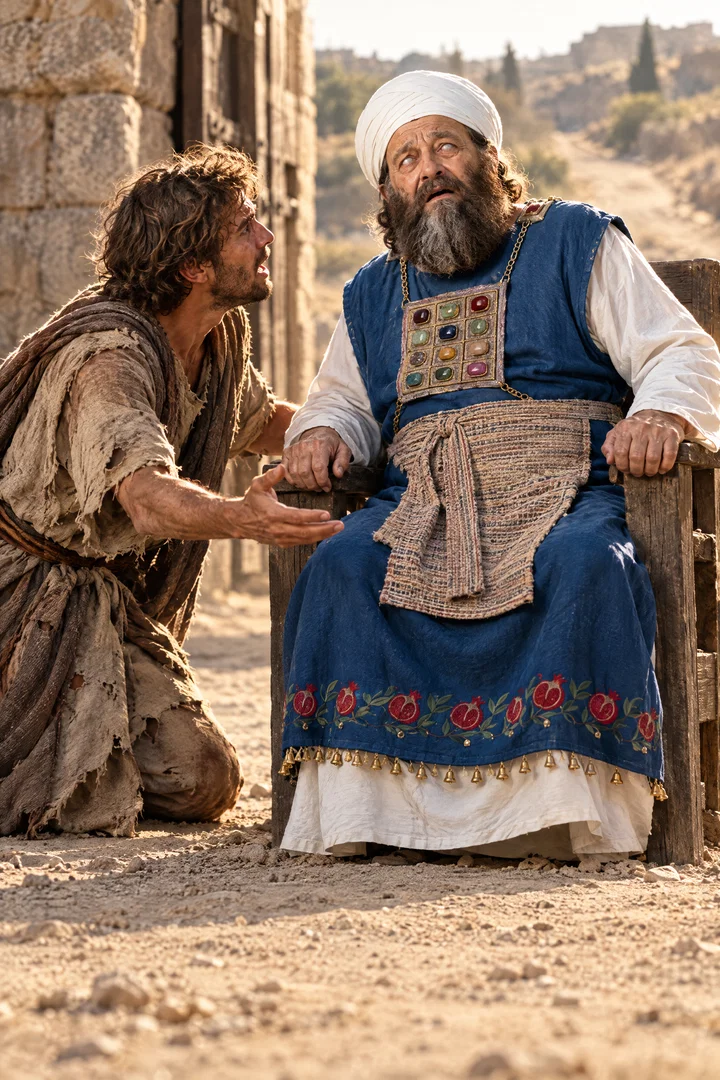
And when he came, lo, Eli sat upon a seat by the wayside watching: for his heart trembled for the ark of God. And when the man came into the city, and told it, all the city cried out.
Translations
And when he came, see, Eli sat on a seat by the wayside watching: for his heart trembled for the ark of God. And when the man came into the city, and told it, all the city cried out.
King James Version, KJV Cambridge Paragraph Bible
And when he came, lo, Eli sat upon a seat by the wayside watching: for his heart trembled for the ark of God. And when the man came into the city, and told it, all the city cried out.
And when he came, lo, Eli sat upon a seat by the way-side watching: for his heart trembled for the ark of God. And when the man came into the city, and told it, all the city cried out.
And when he came, lo, Eli sat upon his seat by the way side watching: for his heart trembled for the ark of God. And when the man came into the city, and told it, all the city cried out.
And when he came, lo, Eli was sitting upon his seat by the wayside watching; for his heart trembled for the ark of God. And when the man came into the city, and told it, all the city cried out.
and he cometh in, and lo, Eli is sitting on the throne by the side of the way, watching, for his heart hath been trembling for the ark of God, and the man hath come in to declare [it] in the city, and all the city crieth out.
And when he came, behold, Eli was sitting upon the seat by the way-side watching; for his heart trembled for the ark of God. And the man came to tell it in the city, and all the city cried out.
And, when he entered, lo! Eli was sitting upon his chair, by the wayside, watching, for his heart was trembling for the ark of God,—and, the man, entered to tell the news in the city, and all the city made outcry.
Berean Standard Bible, Majority Standard Bible
When he arrived, there was Eli, sitting on his chair beside the road and watching, because his heart trembled for the ark of God.When the man entered the city to give a report, the whole city cried out.
When he came, behold, Eli was sitting on his seat by the road watching, for his heart trembled for God’s ark. When the man came into the city and told about it, all the city cried out.
And when he came, Eli was seated by the wayside watching: and in his heart was fear for the ark of God. And when the man came into the town and gave the news, there was a great outcry.
And when hee came, loe, Eli sate vpon a seate by the wayside, wayting: for his heart feared for the Arke of God and when the man came into the citie to tell it, all the citie cried out.
Douay-Rheims (Challoner revision)
And when he was come, Heli sat upon a stool over against the way watching. For his heart was fearful for the ark of God. And when the man was come into the city, he told it: and all the city cried out.
Pictures
Cross-references 20 of 22
- 1 Samuel 4:18
And it came to pass, when he made mention of the ark of God, that he fell from off the seat backward by the side of the gate, and his neck brake, and he died: for he was an old man, and heavy. And he had judged Israel forty years.
Eli falls and dies after hearing that the ark was taken.
- 1 Samuel 3:13
For I have told him that I will judge his house for ever for the iniquity which he knoweth; because his sons made themselves vile, and he restrained them not.
Eli’s failure to restrain his sons is stated as grounds for judgment.
- 1 Samuel 5
And the Philistines took the ark of God, and brought it from Eben-ezer unto Ashdod.
The ark’s presence brought affliction on the Philistines.
- 1 Samuel 4:21-22
And she named the child I-chabod, saying, The glory is departed from Israel: because the ark of God was taken, and because of her father in law and her husband.
The ark’s capture is lamented as the glory departing from Israel.
- 1 Samuel 4:17
And the messenger answered and said, Israel is fled before the Philistines, and there hath been also a great slaughter among the people, and thy two sons also, Hophni and Phinehas, are dead, and the ark of God is taken.
The messenger reports the defeat and capture Eli feared.
- 1 Samuel 5:6-12
But the hand of the LORD was heavy upon them of Ashdod, and he destroyed them, and smote them with emerods, even Ashdod and the coasts thereof.
God struck the Philistines with disaster while they held the ark.
- 1 Samuel 2:30
Wherefore the LORD God of Israel saith, I said indeed that thy house, and the house of thy father, should walk before me for ever: but now the LORD saith, Be it far from me; for them that honour me I will honour, and they that despise me shall be lightly esteemed.
The sentence against Eli’s house is carried out after its members fail to honor God.
- 1 Samuel 2:22-25
Now Eli was very old, and heard all that his sons did unto all Israel; and how they lay with the women that assembled at the door of the tabernacle of the congregation.
Eli rebukes his sons but fails to restrain their corruption.
- Jeremiah 7:12-14
But go ye now unto my place which was in Shiloh, where I set my name at the first, and see what I did to it for the wickedness of my people Israel.
Both describe Shiloh as a warning of judgment against the sanctuary.
- 1 Samuel 7:1-2
And the men of Kirjath-jearim came, and fetched up the ark of the LORD, and brought it into the house of Abinadab in the hill, and sanctified Eleazar his son to keep the ark of the LORD.
continues ark story to Kirjathjearim for twenty years
- Psalms 78:60-61
So that he forsook the tabernacle of Shiloh, the tent which he placed among men;
Both describe the forsaking of Shiloh and the ark’s glory falling into enemy hands.
- Exodus 25:16-22
And thou shalt put into the ark the testimony which I shall give thee.
The ark held the testimony and represented God’s presence.
- 2 Samuel 6:12-17
And it was told king David, saying, The LORD hath blessed the house of Obed-edom, and all that pertaineth unto him, because of the ark of God. So David went and brought up the ark of God from the house of Obed-edom into the city of David with gladness.
traces ark onward to Jerusalem
- Revelation 11:19
And the temple of God was opened in heaven, and there was seen in his temple the ark of his testament: and there were lightnings, and voices, and thunderings, and an earthquake, and great hail.
The heavenly ark corresponds to the earthly ark that Eli feared for.
- 1 Samuel 3:14
And therefore I have sworn unto the house of Eli, that the iniquity of Eli’s house shall not be purged with sacrifice nor offering for ever.
declares irrevocable end of Eli's rule
- Joshua 3:14-17
And it came to pass, when the people removed from their tents, to pass over Jordan, and the priests bearing the ark of the covenant before the people;
The ark’s faithful passage through Jordan contrasts with Israel’s defeat.
- 1 Samuel 3:11
And the LORD said to Samuel, Behold, I will do a thing in Israel, at which both the ears of every one that heareth it shall tingle.
prophesied tingling judgment fulfilled in ark loss
- 1 Samuel 6:19
And he smote the men of Beth-shemesh, because they had looked into the ark of the LORD, even he smote of the people fifty thousand and threescore and ten men: and the people lamented, because the LORD had smitten many of the people with a great slaughter.
Beth-shemesh was judged for irreverence toward the ark.
- Numbers 14:44-45
But they presumed to go up unto the hill top: nevertheless the ark of the covenant of the LORD, and Moses, departed not out of the camp.
Israel’s defeat without the ark contrasts with false trust in the ark.
- 1 Samuel 2:12-17
Now the sons of Eli were sons of Belial; they knew not the LORD.
Eli’s sons’ priestly wickedness contrasts with Eli’s concern for the ark.
Commentary
Each commentary is drawn from primary sources: the writings of Ellen G. White and Adventist pioneers and periodicals. Each commentary is separate. Its own words are not a quotation; follow the references to read the source passages.
Ellen G. White
7 sources
Eli, old and blind, sat by the wayside beside the road near the tabernacle at Shiloh, anxiously watching and waiting for news from the battle during Israel's very great slaughter by the Philistines.1SP 404.1–2PP 585.1–3ST Dec 22, 1881SG4 106.2–3 His heart trembled for the ark of God because he feared the Philistine host would take it and pollute it.1SP 404.1–2PP 585.1–3ST Dec 22, 18814T 516.1–2SG4 106.2–3 His anxiety for the ark was greater than for his own sons.SG4 106.2–3 When the man came into the city and told his news, all the city cried out in grief.PP 585.1–3ST Dec 22, 1881 Eli heard their wailing before he was told of Israel's defeat, the deaths of his sons, and the capture of the ark.PP 585.1–3
The news that his sons had died distressed Eli, but he had reason to expect it and could bear it with calmness.1SP 404.1–2SG4 106.2–3 The news that the ark had been taken overwhelmed him with anguish so that he fell backward from his seat and died.1SP 404.1–24T 516.1–2SG4 106.2–3 The capture of the ark was the greatest calamity that could befall Israel and the loss of its strength and glory.1SP 404.1–24T 516.1–2SG4 106.2–3 Yet God permitted it to humble the people by removing it and to show how vain it was to trust in the ark as the symbol of His presence and their boasted strength and confidence while profaning the commandments contained in it.1SP 404.1–2SG4 106.2–3 Eli understood the loss as the result of his own sin dishonoring God and causing God to withdraw His presence, knowing that his neglect to restrain his sons' wrongdoing had helped bring Israel's defeat.4T 516.1–2
The verse presents Eli as the example of a father who did not rule his own house well and did not restrain his children in a loose and slack manner of upbringing.1T 234.2–235.2 His sons were wicked, ungodly, and corrupt, a proverb of reproach exerting a corrupting influence where they lived, disgusting unbelievers and bringing reproach upon the cause of God.1T 234.2–235.2 For this the frown of God was upon Eli, and judgment followed upon him and his house.1T 234.2–235.2 The verse presents Eli as high priest watching with a trembling heart while guilty of dishonoring God and misleading the people by partiality toward his sons.ST Nov 24, 1881 Though quick to see and rebuke the sins and errors of the people, even to unjust reproof as with Hannah, he counted his own sons' sins less offensive than the sins of others and in undue affection was ever ready to find excuses for their perverse course.ST Nov 24, 1881
To just the extent he permitted or excused sin in them he became a partaker in their guilt, greatly heightened because as sons of the high priest they were connected with the work of God.ST Nov 24, 1881 His course illustrates the natural but unjust and unchristian partiality of parents, especially those who think themselves superior, who censure severely in others what they pass over as smart and witty in their own children.ST Nov 24, 1881 Such parents leave faults uncorrected on the plea of youth and foster wrong traits until they become second nature.ST Nov 24, 1881 Tenfold more when found in those who stand in Christ's stead, this course misleads many, sanctions the growth of evil instead of repressing it, and effaces the distinction between right and wrong, purity and vice.ST Nov 24, 1881
Sources
Pioneers and periodicals
23 sources
Eli sat old and blind by the roadside at Shiloh at eventide anxiously watching because his heart trembled for the ark in danger, while the runner came into the city and all the city cried out in grief at the news.ST Apr 8, 1913RH Apr 21, 1851ST Mar 31, 1909 The tidings were defeat and slaughter of fleeing Israel, the deaths of Hophni and Phinehas, and the capture of the ark, which overwhelmed Eli beyond defeat and his sons' deaths so that he fell backward from his seat, broke his neck, and died.ST Dec 3, 1902RH Apr 20, 1876 The taking of the ark meant the glory had departed from Israel into the hands of the Philistines, bringing deep humiliation and the darkest hour of national woe under failed priestly leadership, and God forsook his habitation at Shiloh so that the ark never returned there.ST Apr 8, 1913RH Apr 21, 1851RH Jan 6, 1853ST Jun 30, 1898RH Jul 8, 1852 Mere possession of the ark and the law could not save a people living in sin and trampling the law, for Israel cherished it as a charm and mascot borne by unrighteous priests instead of enshrining God and His righteousness in the heart, so He withdrew protection and let defeat come.ST Aug 13, 1902ST Jun 26, 1884ST Jun 30, 1898 The calamity fulfilled the foretold irrevocable judgment on Eli's house because he did not restrain his sons when they made themselves vile, showing that to permit and excuse sin shares its guilt and that God's promises to His workers stand only on faithful service and honoring Him.ST Nov 24, 1881ST Jul 8, 1889RH Mar 19, 1872RH Aug 3, 1869RH Jun 23, 1853
Setting and Outcome
The verse stands in the interval between the judges and the kings when each did what was right in his own eyes, with Hophni and Phinehas as corrupt priests whose greed caused the people to despise God's service, with heathen practices brought into worship, and with strange gods and Ashtaroth among Israel.
Eli was ninety-eight years old, old and blind and hearing only dimly and long physically unfit for office, sitting by the wayside by the roadside by the tabernacle court at Shiloh at eventide anxiously watching.ST Dec 3, 1902ST Mar 11, 1897 His heart trembled for the ark of God because it was in danger, while the swift runner came with dust on the horizon into the city and all the city cried out in grief and distress at the news.ST Apr 8, 1913RH Apr 21, 1851ST Mar 31, 1909RH Apr 20, 1876ST Mar 11, 1897 He waited anxiously at Shiloh for tidings from Israel's battle with the Philistines, fearing for the ark, and called the messenger to his side to learn the news from the field.ST Apr 8, 1913RH Apr 20, 1876ST Mar 11, 1897
The messenger brought Israel fled with great slaughter and flight, the deaths of Hophni and Phinehas, and the taking of the ark.ST Dec 3, 1902ST Mar 11, 1897 Eli could bear the defeat and his sons' deaths, but his concern and grief for the ark outweighed them.RH Apr 20, 1876RH Aug 28, 1856 Hearing that the ark was taken overwhelmed him so that he fell from his seat backward, broke his neck, and died, and the city's cry reflected that calamity and disgrace.ST Dec 3, 1902RH Apr 20, 1876ST Mar 11, 1897RH Jul 16, 1857
The capture meant Israel's glory had departed, not merely a lost battle, and Israel was brought into deep humiliation.ST Apr 8, 1913RH Apr 21, 1851 Its true condition was written in Ichabod, the glory is departed.ST Jun 30, 1898RH Aug 28, 1856 It marked the weakness of Eli and the deepest darkest hour of national woe under failed priestly and judicial leadership just before dawn, deliverance, and reformation under Samuel.ST Mar 31, 1909ST Mar 11, 1897
For the gross wickedness of priests and people God forsook His habitation at Shiloh and gave His glory, the ark of His testament and covenant, into the hands of the Philistines.RH Jan 6, 1853 The ark was the chest holding the tables of God's constitution and law under the mercy-seat and an essential part of the sanctuary and symbol of God's presence and Israel's strength, as when Jordan's flood was stayed and Jericho's walls crumbled.ST Jun 30, 1898RH Jul 8, 1852RH Aug 28, 1856 After it was taken from the tabernacle at Shiloh it never returned to that building, while the other sacred vessels remained with the tabernacle afterward at Nob and at Gibeon.RH Jan 6, 1853
Warnings for God's People
The wrongdoing of Eli's sons brought suffering on the people as well as punishment on Eli and his household, for sin among God's people harms the whole community.ST Jul 8, 1889 To permit sin in another or to cover and excuse it makes one share its guilt and its consequences.ST Nov 24, 1881ST Jul 8, 1889 Eli dishonored God and misled the people by partiality toward his own sons, being quick to see and rebuke the sins and errors of the people, even to unjust reproof as with Hannah, yet counting the sins of his own sons less offensive than the sins of others and in undue affection ever ready to find excuses for their perverse course.ST Nov 24, 1881 To just the extent he permitted or excused sin in his children he became a partaker in their guilt, and because as sons of the high priest they were connected with the work of God the evil was greatly heightened.ST Nov 24, 1881 His course shows the natural but unjust and unchristian partiality of parents, especially those who think themselves superior, who censure severely in others what they pass over as smart and witty in their own children, who leave faults uncorrected on the plea of youth and foster wrong traits until they become second nature, and, tenfold more when found in those who stand in Christ's stead, misleads many, sanctions the growth of evil instead of repressing it, and effaces the distinction between right and wrong, purity and vice.ST Nov 24, 1881
Possession of the ark and of God's law could not save Israel while living in sin and trampling the law, for God withdrew His protection and the priests who cared for the ark were slain.ST Aug 13, 1902ST Jun 26, 1884 Israel forgot the principles of pure righteousness and failed to cherish His holy law and rich mercy in the heart and to have God Himself enshrined there, though the ark containing the tables of the law under the mercy-seat was the symbol of God's presence and Israel's strength while faithful, as when Jordan's flood was stayed and Jericho's walls crumbled before it.ST Jun 26, 1884ST Jun 30, 1898 They worshiped the ark as a charm and idol and fetish, and presumptuously carried it into battle by unrighteous priests as an irresistible mascot, supposing its mere presence would insure success and win victory.ST Jun 30, 1898ST Dec 3, 1902 The Lord therefore permitted defeat and permitted the enemy to carry off the ark, and Hophni and Phinehas were slain in the same disaster.ST Aug 13, 1902ST Dec 3, 1902 That capture did not mean God or His holy law needed human protection, for God's holiness protects His people though the faithful may die to be raised afterward to immortality, while the name of the Lord is a strong tower in which the disobedient and presumptuous find no security.ST Aug 13, 1902ST Dec 3, 1902
The ark was never taken till Israel surrounded it with the arms of earthly defenders, which proves God's cause gains no security or dignity or strength from earthly power.ST Jan 23, 1907 Left to itself its own sanctity was sufficient to vindicate it from insult in captivity and to lay the hostile god prostrate on the threshold of his own temple.ST Jan 23, 1907 So the real security of Christianity is found in its benevolent morality, its exquisite adaptation to the human heart, its accommodation to the capacity of every human intellect, its consolation to the house of mourning, and its light on the great mystery of the grave, with no addition of dignity or strength from being made part and parcel of the common law.ST Jan 23, 1907
The chapter fulfills the judgment foretold against Eli's household and the warning given to Samuel that would make the ears of all Israel tingle and leave a lasting impression.RH Mar 19, 1872ST Dec 3, 1902 Eli, though himself pious, had not properly instructed his wicked sons in youth nor restrained them when they made themselves vile in manhood and official corruption.RH Mar 19, 1872ST Dec 3, 1902ST Aug 24, 1904 His corrupt sons had passed beyond reform, so the decree that their iniquity would never be expiated with sacrifice nor offering was irrevocable.ST Dec 3, 1902 The delayed but irrevocable sentence was carried out in one day in Israel's defeat, the ark's capture, the deaths of Hophni and Phinehas, the premature death in travail of his daughter-in-law, and Eli's own heartbroken death on receipt of the news, by which his house was blotted out as a ruling family.ST Apr 6, 1888ST Dec 3, 1902ST Aug 24, 1904 Their loss of the priesthood shows the promises to Eli's house were conditional on faithful service and honoring God, and because they failed to repent and were found unworthy the priesthood was taken from the family, while the father's failure to restrain his sons brought calamity upon Israel as the warning had declared that if parents or children turn from following God and keep not His commandments Israel will be cut off.ST Apr 6, 1888RH Aug 3, 1869RH Jun 23, 1853
The record is one of backsliding by Israel as the church of God in Samuel's days, showing the church can go into apostasy in the sense of backsliding but not utter apostasy from which there is no recovery, since God restored His people from that apostasy through the ministrations of Samuel the prophet. It applies to churches that lack courage to rebuke sin among their members yet sit by the roadside trembling with concern for the ark of God.ST Aug 19, 1875 The Philistines were able to take the ark, the chest in which God's constitution was shut up and guarded with the utmost care, only in consequence of the sin of God's people, and then were anxious to get rid of it.RH Jul 8, 1852 In the same way the unabolished constitution is now shut up in a chest called an ark and guarded with the utmost care in the heaven of heavens, and were its enemies able to take it they would be as anxious to get rid of it as the Philistines were.RH Jul 8, 1852
Sources