1 Samuel 4:18
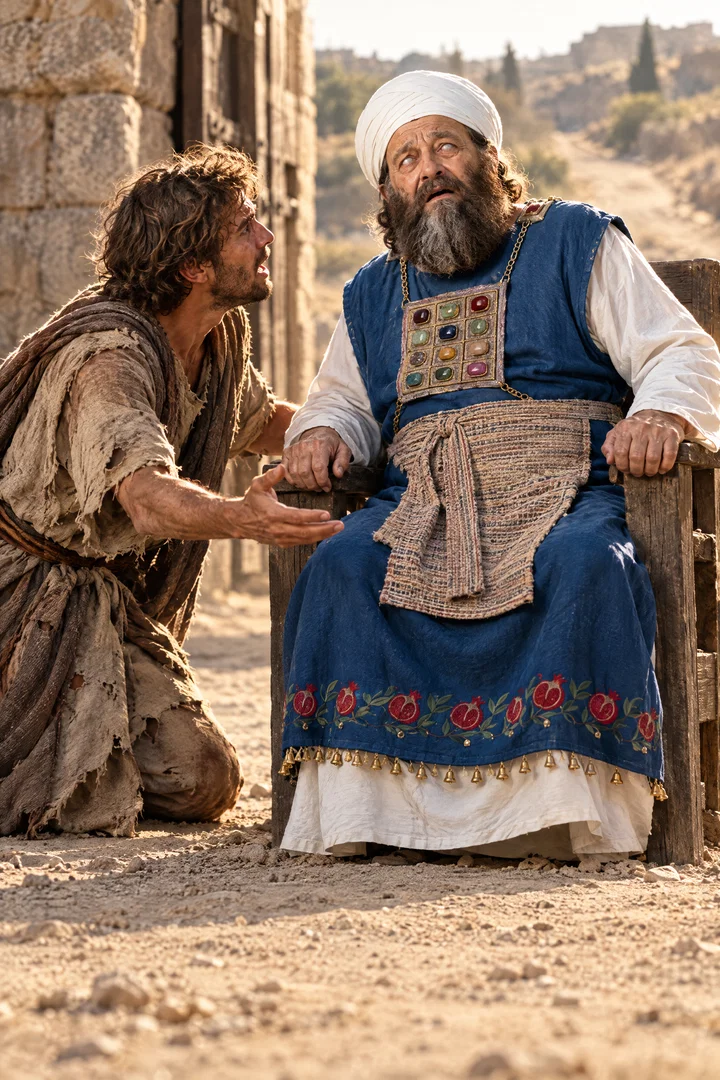
And it came to pass, when he made mention of the ark of God, that he fell from off the seat backward by the side of the gate, and his neck brake, and he died: for he was an old man, and heavy. And he had judged Israel forty years.
Translations
American King James Version, Webster Bible
And it came to pass, when he made mention of the ark of God, that he fell from off the seat backward by the side of the gate, and his neck broke, and he died: for he was an old man, and heavy. And he had judged Israel forty years.
King James Version, KJV Cambridge Paragraph Bible
And it came to pass, when he made mention of the ark of God, that he fell from off the seat backward by the side of the gate, and his neck brake, and he died: for he was an old man, and heavy. And he had judged Israel forty years.
And it came to pass, when he made mention of the ark of God, that he fell from off his seat backward by the side of the gate, and his neck brake, and he died: for he was an old man, and heavy. And he had judged Israel forty years.
And it came to pass, when he made mention of the ark of God, that Eli fell from off his seat backward by the side of the gate; and his neck brake, and he died: for he was an old man, and heavy. And he had judged Israel forty years.
And it cometh to pass, at his mentioning the ark of God, that he falleth from off the throne backward, by the side of the gate, and his neck is broken, and he dieth, for the man [is] old and heavy, and he hath judged Israel forty years.
And it came to pass, when he mentioned the ark of God, that he fell from off the seat backward by the side of the gate, and his neck broke, and he died; for the man was old, and heavy. And he had judged Israel forty years.
And it came to pass, when he mentioned the ark of God, that he fell from off his seat backwards, at the side of the gate, and his neck brake, and he died, for, old, was the man, and, heavy,—and, he had judged Israel forty years.
Berean Standard Bible, Majority Standard Bible
As soon as the ark of God was mentioned, Eli fell backward from his chair by the city gate, and being old and heavy, he broke his neck and died. And Eli had judged Israel forty years.
When he made mention of God’s ark, Eli fell from off his seat backward by the side of the gate; and his neck broke, and he died, for he was an old man and heavy. He had judged Israel forty years.
And at these words about the ark of God, Eli, falling back off his seat by the side of the doorway into the town, came down on the earth so that his neck was broken and death overtook him, for he was an old man and of great weight. He had been judging Israel for forty years.
And when he had made mention of the Arke of God, Eli fell from his seate backward by the side of the gate, and his necke was broken, and he dyed: for he was an olde man and heauie: and he had iudged Israel fourtie yeeres.
Douay-Rheims (Challoner revision)
And when he had named the ark of God, he fell from his stool backwards by the door, and broke his neck, and died. For he was an old man, and far advanced in years: and he judged Israel forty years.
Pictures
Cross-references
- 1 Samuel 3:13
For I have told him that I will judge his house for ever for the iniquity which he knoweth; because his sons made themselves vile, and he restrained them not.
God’s judgment on Eli’s house is fulfilled in Eli’s death.
- 1 Samuel 2:12-17
Now the sons of Eli were sons of Belial; they knew not the LORD.
Eli’s sons commit grave wrongs while serving as priests.
- 1 Samuel 4:11
And the ark of God was taken; and the two sons of Eli, Hophni and Phinehas, were slain.
The ark is captured and Eli’s sons die, events leading to his death.
- 1 Samuel 2:29-34
Wherefore kick ye at my sacrifice and at mine offering, which I have commanded in my habitation; and honourest thy sons above me, to make yourselves fat with the chiefest of all the offerings of Israel my people?
Eli’s failure to restrain his sons brings judgment on his household, fulfilled in his death.
- 1 Samuel 2:22-25
Now Eli was very old, and heard all that his sons did unto all Israel; and how they lay with the women that assembled at the door of the tabernacle of the congregation.
Eli rebukes his sons but fails to restrain their wrongdoing.
- 1 Samuel 5:1-5
And the Philistines took the ark of God, and brought it from Eben-ezer unto Ashdod.
The ark’s presence topples Dagon before it.
- 1 Samuel 3:14
And therefore I have sworn unto the house of Eli, that the iniquity of Eli’s house shall not be purged with sacrifice nor offering for ever.
The irrevocable judgment against Eli’s house is carried out in Eli’s death.
- 1 Samuel 6:19
And he smote the men of Beth-shemesh, because they had looked into the ark of the LORD, even he smote of the people fifty thousand and threescore and ten men: and the people lamented, because the LORD had smitten many of the people with a great slaughter.
The people were struck for looking into the ark.
- 1 Samuel 3:18
And Samuel told him every whit, and hid nothing from him. And he said, It is the LORD: let him do what seemeth him good.
Eli accepts the announced judgment of the Lord.
- Jeremiah 7:12
But go ye now unto my place which was in Shiloh, where I set my name at the first, and see what I did to it for the wickedness of my people Israel.
Both describe Shiloh forsaken for wickedness.
- 2 Samuel 6:6-7
And when they came to Nachon’s threshingfloor, Uzzah put forth his hand to the ark of God, and took hold of it; for the oxen shook it.
Both men died in connection with the ark of God.
- 1 Samuel 3:11
And the LORD said to Samuel, Behold, I will do a thing in Israel, at which both the ears of every one that heareth it shall tingle.
tingling-ears prophecy fulfilled in ark loss and Eli's death
- Revelation 11:19
And the temple of God was opened in heaven, and there was seen in his temple the ark of his testament: and there were lightnings, and voices, and thunderings, and an earthquake, and great hail.
Both texts describe the ark containing God's covenant law.
- Joshua 3:14-17
And it came to pass, when the people removed from their tents, to pass over Jordan, and the priests bearing the ark of the covenant before the people;
Contrasts faithful victory with later defeat.
- Psalms 78:60-62
So that he forsook the tabernacle of Shiloh, the tent which he placed among men;
Both describe God forsaking Shiloh and giving his glory into enemy hands.
- Jeremiah 26:6
Then will I make this house like Shiloh, and will make this city a curse to all the nations of the earth.
Jerusalem’s fate is likened to Shiloh after the ark’s capture and Israel’s calamity.
- Numbers 7:9
But unto the sons of Kohath he gave none: because the service of the sanctuary belonging unto them was that they should bear upon their shoulders.
The ark was to be carried by its appointed bearers, not placed on a cart.
- 1 Samuel 2:23
And he said unto them, Why do ye such things? for I hear of your evil dealings by all this people.
Eli rebukes his sons’ wrongdoing but fails to restrain them.
Commentary
Each commentary is drawn from primary sources: the writings of Ellen G. White and Adventist pioneers and periodicals. Each commentary is separate. Its own words are not a quotation; follow the references to read the source passages.
Ellen G. White
17 sources
When the messenger named the taking of the ark of God, Eli, an old and heavy man who had judged Israel forty years, fell backward from his seat beside the gate, broke his neck, and died.ST Dec 22, 18811SP 404.1–2ST Nov 24, 1881 He had waited by the way with a trembling heart for fear the ark would fall into Philistine hands, and though he could endure the tidings of Israel's defeat and the death of his two sons, the loss of the ark overwhelmed him with unbearable anguish.PP 585.1–3SG4 106.2–3GW92 82.3–83.1 He saw in its capture the fruit of his own sin in dishonoring God and causing His presence to withdraw, and his death came under the same divine judgment as his sons because through indulgent neglect he failed to reprove and restrain their vile profaning of God's house.ST Dec 22, 18811SP 404.1–2PP 585.1–3SG4 106.2–3 God permitted this greatest of calamities, with thirty thousand slain and the ark taken, to humble Israel and expose the vanity of trusting in the outward symbol of His presence for victory and strength while profaning the commandments it contained.SG4 106.2–3ST Feb 12, 18804T 166.1–2PK 415.3–416.1 His mournful fall warns parents and those entrusted with the church that they are accountable for the sins they lightly tolerate, and must govern their own houses, promptly correct and subdue wrongdoing, and stand for the right rather than be led by their children or follow human wisdom.ST Feb 12, 1880GW92 82.3–83.14T 199.3–200.1ST Nov 24, 1881SG4 164.1–2
Eli's Fall and Death
Eli fell backward from his seat by the side of the gate when mention was made that the ark of God was taken, and his neck broke, and he died.ST Dec 22, 18811SP 404.1–2PP 585.1–3SG4 106.2–3ST Nov 24, 1881 The anguish over the capture overwhelmed him because he saw in it that his own sin had dishonored God and had caused God to withdraw His presence from Israel.ST Dec 22, 1881PP 585.1–3 His grief brought upon him the judgment of God which he shared with his sons, for he was guilty in great measure through criminal neglect to restrain their wrongdoing.1SP 404.1–2SG4 106.2–3 The pallor of death came upon his face as he knew his failure to stand for the right and restrain wrong had at last deprived Israel of her strength and glory, and he collapsed and fell backward and died.PP 585.1–3GW92 82.3–83.1
He was an old man, and heavy, and he had judged Israel forty years.ST Nov 24, 1881 His disastrous end closed a life whose indulgence toward his sons brought ruin on his family and disaster to Israel.ST Nov 24, 1881
He had waited by the wayside with a trembling heart, afraid the ark of God would be taken and polluted by the Philistines.SG4 106.2–3 The capture of the ark was counted the greatest calamity that could befall Israel.SG4 106.2–3
He could bear the news that his two sons were slain and Israel defeated, having reason to expect it, and he bore it with calmness.SG4 106.2–3GW92 82.3–83.14T 516.1–2 But when told the ark of God was taken he wavered in anguish that he could not bear, and fell backward from his seat and died.SG4 106.2–3GW92 82.3–83.14T 516.1–2 He could endure hearing that his sons were slain in battle, but he could not bear the loss of the ark, because he knew his neglect in restraining wrong had deprived Israel of its strength and glory.PP 585.1–3GW92 82.3–83.14T 516.1–2
Sin and Divine Judgment
Eli saw in the taking of the ark the fruit of his own sin, which had dishonored God and caused Him to withdraw His presence from Israel.ST Dec 22, 1881PP 585.1–3 The tidings overwhelmed him because he recognized that dishonor and withdrawal as his own doing.ST Dec 22, 1881PP 585.1–3 His falling backward and dying under that grief shared the wrath and judgment of God that fell upon his sons, for he was guilty in great measure of their transgressions through criminal neglect to restrain them.1SP 404.1–2SG4 106.2–3SG4 164.1–21T 118.2–119.2Ms 187, 1907, par. 17–19 Because he restrained them not, the heavy curse was declared that their sins should not be purged with sacrifice nor offerings forever, and when Samuel told him he submitted, saying it is the Lord, let Him do what seems good to Him.SG4 164.1–2
Though pure in morals himself and loving purity and righteousness, he followed human wisdom instead of God's commands and was too indulgent, lacking the moral courage to reprove his sons and remove them from their sacred trust though they were wicked and vile and profaned the house of God.GW92 82.3–83.1ST Nov 24, 1881SG4 164.1–2 His loose, slack manner of bringing them up made them corrupt and ungodly, a proverb of reproach exerting a corrupting influence, leading Israel astray by their wickedness.ST Nov 24, 1881SG4 164.1–21T 234.2–235.2 That course brought the frown of God upon him, disgusted unbelievers, and brought reproach upon God's cause.1T 234.2–235.2 His indulgent, unrestrained management brought disaster and death to himself, ruin to his sons, and ruin to thousands in Israel.ST Nov 24, 1881
The capture of the ark was counted the greatest calamity that could befall Israel, and God permitted it to show how vain it was to trust in the ark as the symbol of His presence and their boasted strength and confidence while they were profaning the commandments contained in the ark, humbling them by removing it.SG4 106.2–3 Israel wrongly trusted that the presence of the ark would guarantee victory despite sin, but outward religious observance could not shield them from the consequences of unchecked wrongdoing.SG4 106.2–3PK 415.3–416.1 Eli's failure to reprove and restrain his sons in their sacred offices and to correct the evils prevailing brought that calamity upon the nation.ST Feb 12, 18804T 166.1–2PK 415.3–416.1 His sons died in battle, the ark was taken, thirty thousand of Israel were slain, and he himself lost his life.ST Feb 12, 18804T 166.1–2PK 415.3–416.1SG4 164.1–2
Warning to Parents and Leaders
Eli's mournful fall — falling backward from his seat by the gate, breaking his neck and dying when he heard that the ark of God was taken — was the judgment and retribution for his failure to promptly restrain his sons, and it warns that delay in dealing with sin brings grave consequences.4T 199.3–200.1SG4 164.1–21T 118.2–119.2 His indulgent, unrestrained management of his wicked and vile sons, following human wisdom instead of God's commands in training them, brought disaster and death to himself, ruin to his sons, and ruin to thousands in Israel, for because he restrained them not they led Israel astray and the curse followed that their sins should not be purged with sacrifice nor offerings forever.ST Nov 24, 1881SG4 164.1–21T 118.2–119.2 When Samuel told him that heavy curse he submitted, saying it is the Lord, let Him do what seemeth Him good, yet soon the wicked priests were slain, thirty thousand of Israel were slain, and the ark was taken, all this evil resulting from his failure to restrain his sons.SG4 164.1–2 The fact that God so particularly noticed parental neglect then proves He notices it no less in these last days, so parents today are accountable in great measure for their children's faults and must lead and not be led by their children, governing them, correcting their passions and subduing them without delay, or God will surely destroy the children in the day of His fierce anger and the unrestraining parents will not be blameless.4T 199.3–200.1ST Nov 24, 1881SG4 164.1–21T 118.2–119.2
The same history stands especially as a warning to parents in holy office and servants of God who in self-confidence think they know a better way of training children than God has given in His word, for they are not prepared to judge or decide in matters of the church unless they can rule well their own house and have their families in good subjection.ST Nov 24, 1881SG4 164.1–21T 118.2–119.2 Those responsible for the church, especially ministers accepted as teachers from God, are taught that treating sin lightly and allowing it to remain among God's people and disregarding it brings severe consequences and calamity, as Eli's failure to reprove and restrain his sons in their sacred offices cost his own life, the capture of the ark, and the slaying of thirty thousand people.ST Feb 12, 18804T 166.1–2SG4 164.1–2 Though pure in morals and loving purity and righteousness, he was too indulgent and lacked moral courage to reprove his vile sons and remove them from their trust though they profaned the house of God, failing to stand for the right and restrain wrong until Israel was deprived of her strength and glory.ST Feb 12, 1880GW92 82.3–83.1 He could endure hearing that his sons were slain in battle, but he could not bear the news that the ark was taken, and the pallor of death came upon his face as he fell backward and died, showing that those who dishonor the cause of truth must be reproved and wrongs promptly removed.ST Feb 12, 1880GW92 82.3–83.14T 166.1–2
The sin that brought this retribution was blind and foolish fondness, indulging and petting the child, surrendering to her and letting her rule instead of disciplining and managing her, and the same sin brings the same retribution to parents, especially ministers.4T 383.1 Such indulgence closes the gates of heaven before the child so that with present habits and disposition she will never see the kingdom of God, while it puts the parents' own salvation in peril.4T 383.1 At the Judgment it will be shown to have resulted in the loss of scores of children, for parents reap what they sow, and the evil spreads as an indulged minister's child gives lessons that others follow in indulging their own children.4T 383.1
Sources
Pioneers and periodicals
39 sources
When the messenger reported that the ark had been taken, Eli fell backward from his seat beside the gate, broke his neck and died, an old and heavy man of ninety-eight whose forty years of judging Israel ended that day.ST Dec 22, 1881ST Apr 8, 1913RH Jun 9, 1868ST Dec 3, 1902 The news of the ark overcame him more than the slaughter of thirty thousand and the deaths of Hophni and Phinehas, for he understood that the glory had departed from Israel.RH Apr 21, 1851RH Aug 28, 1856RH Apr 20, 1876 His death with his sons in one day fulfilled the word spoken in 1 Samuel 3 that his house would be judged forever because his sons made themselves vile and he restrained them not.ST Apr 6, 1888RH Mar 19, 1872ST Dec 3, 1902 The taking of the ark showed that merely possessing its sacred symbol could not protect a disobedient people who broke the law within it, and that form without obedience is worthless.ST Aug 13, 1902ST Jun 26, 1884RH Aug 3, 1869 Eli's overindulgent failure to restrain his sons stands as God's enduring warning to parents that He holds them accountable for the training and government of their children.ST Nov 24, 1881RH Mar 19, 1872RH Jul 16, 1857RH Jun 22, 1916
Eli's Death Described
When the runner from the battle made mention that the ark of God was taken, Eli fell backward from his seat by the side of the gate, broke his neck, and died.ST Dec 22, 1881ST Apr 8, 1913RH Jun 9, 1868RH Apr 21, 1851 The fatal collapse came upon hearing that the ark had been captured and his sons had died in battle, amid Israel's defeat and humiliation.ST Apr 8, 1913 His anguish over the capture was so great that it overwhelmed him, for he saw in it that his sin had dishonored God and caused God to withdraw His presence from Israel.ST Dec 22, 1881RH Jun 9, 1868 His response showed supreme regard for God's honor and religion above personal and family concerns, and he died in active love for God and His ordinances.RH Jun 9, 1868 The death followed Israel's trust in the mere presence of the material symbol borne into camp by the unconverted priests Hophni and Phinehas, while moral and spiritual conditions were lacking.
He was old and heavy when he died, ninety-eight years old and long physically unfit for the duties of his office.ST Nov 24, 1881ST Jun 22, 1882ST Apr 8, 1913ST Dec 3, 1902RH May 8, 1856 He had judged Israel forty years, and his forty-year rule ended with his death, hastened by the slaughter of his two unrestrained sons and the loss of the ark.ST Nov 24, 1881ST Jun 22, 1882ST Apr 8, 1913 His death blotted out his house as a ruling family when both sons were slain and he himself expired on receipt of the news.ST Dec 3, 1902 The ruin of his family is linked to his failure to restrain his sons and to enforce religious discipline in his household, and their wrongdoing with his indulgence of them brought ruin on his family and disaster to Israel.ST Nov 24, 1881ST Jun 22, 1882RH May 8, 1856
The mention of the ark overcame him more than the slaughter of thirty thousand footmen and the deaths of Hophni and Phinehas.RH Apr 21, 1851RH Aug 28, 1856RH Apr 20, 1876 He was not so much affected by hearing of the slaughter and the death of his two sons, but the mention of the ark overcame him, for he knew that the glory had departed from Israel.RH Apr 21, 1851 The ark lay closer to his heart than the defeat of Israel or the deaths of his two sons, and when his worst fears about it were confirmed he could no longer bear the accumulated disaster.RH Aug 28, 1856RH Apr 20, 1876 He cherished the ark above those other concerns, and understood its capture as a sign that God would no longer fight for Israel and had given them over to their enemies because of their sins, cutting them off from His strength.RH Apr 20, 1876 The one who fell is Eli, not the messenger who mentioned the ark of God, as confirmed by the details that he was old and heavy and had judged Israel forty years.ST Jan 26, 1915
Its setting is between the period of the judges and the kings, a time when people did what seemed right to themselves. Its setting includes the corruption of Eli's sons, whose greed and adoption of heathen practices caused people to despise God's service, amid Israel's defeat by the Philistines and the capture of the ark of God.ST Mar 31, 1909 It marks the death of Eli, described as kindly but weak, as the narrative moves from his time to the kingship of Saul.ST Apr 4, 1911 His fear and despair on hearing the news pictures the condition of a man who believes his case is hopeless.GSAM 383.1–2
Meaning of Ark's Capture
The taking of the ark brought grief to Israel and was lamented as Ichabod, that the glory or character of God is departed from Israel.ST Jun 30, 1898RH Aug 28, 1856 Israel had trusted in the mere presence of the material symbol borne into camp by the unconverted priests Hophni and Phinehas, while moral and spiritual conditions were lacking, and the result was a very great slaughter of thirty thousand footmen, the taking of the ark, and the slaying of Eli's two sons.ST Jun 30, 1898 The ark held the tables of the law under the mercy-seat and was a symbol of God's presence and strength while Israel was faithful, but Israel forgot the principles of pure righteousness and worshiped the ark as an idol or fetish while forgetting God, thinking its mere presence even when borne by unrighteous priests would insure success.ST Jun 30, 1898 That trust reveals the worthlessness of form and external machinery without obedience.
Eli was overwhelmed by the news because he saw the capture as a sign that his sin had dishonored God and led God to withdraw His presence from Israel.ST Dec 22, 1881RH Apr 20, 1876 His anguish over the ark outweighed his reaction to Israel's defeat and the deaths of his two sons, because he cherished the ark above those other concerns and understood its loss to mean that God would no longer fight for Israel.RH Apr 20, 1876 Israel's sin had cut them off from God's strength so that the ark itself could not protect them, its loss dishonored them and signaled that God had departed from them and given them over to their enemies because of their sins.RH Apr 20, 1876 For the gross wickedness of priests and people God forsook His habitation at Shiloh and gave His glory, the ark of His testament and covenant, into the hands of the Philistine enemy, and after it was taken from the tabernacle at Shiloh His glory never returned to that building.RH Jan 6, 1853
Though his death was a divine rebuke for his sins, his response to the news showed his supreme regard for God's honor and religion above personal and family concerns, and he died in active love for God and His ordinances.RH Jun 9, 1868RH Aug 28, 1856 The ark lay closer to his heart than the defeat of Israel or the deaths of his two sons, and when his worst fears about it were confirmed he could no longer bear the accumulated disaster.RH Jun 9, 1868RH Aug 28, 1856 His fall was the result of grief with a broken heart over the loss, an example of how deeply the troubles of the church can affect even faithful people.ST Aug 24, 1904RH Nov 13, 1856 He had been too easy-going in training his sons, who became priests but turned from God, committed wicked acts, led others into sin, and met a hopeless end.ST Aug 24, 1904
Judgment on Eli's House
The fall of Eli fulfills the word spoken against him in 1 Samuel 3, that God would perform against his house all that He had spoken concerning it and would judge his house forever for iniquity which he knew.ST Jun 22, 1882RH Mar 19, 1872ST Jul 8, 1889 The iniquity was that his sons made themselves vile and he restrained them not, an iniquity declared never to be purged with sacrifice nor offering forever.ST Jun 22, 1882RH Mar 19, 1872ST Jul 8, 1889 His death on hearing that the ark was taken, following his failure to heed reproof and restrain his wicked sons, brought the threatened judgment upon himself, and the disobedient and presumptuous found no security in the name of the Lord.ST Apr 6, 1888ST Jun 22, 1882ST Dec 3, 1902ST Jul 8, 1889 The corrupt sons had passed beyond possibility of reform, so nothing remained but to cut them off.ST Dec 3, 1902
A first warning had come by a man of God and went unheeded, and a second warning had come through Samuel and was proclaimed by Eli himself without eradicating the evil.ST Oct 10, 1895 His sin was overindulgence and lack of firmness as a father, failing to restrain Hophni and Phinehas in their evil course while installing them in priestly office, so that they became vile and overbearing sons of Belial with neither respect for parent nor for God, an evil example widely copied by the people.ST Oct 10, 1895 God then delayed the threatened judgment for twenty years before His long patience ended and judgment finally fell.ST Oct 10, 1895 Then Hophni and Phinehas were slain in battle with the Philistines, and at that news together with the news of the taking of the ark Eli fell and died.ST Oct 10, 1895
Eli and his sons died in one day in the final execution of the delayed sentence against his house, because they had failed to honor God and serve with undivided hearts.ST Apr 6, 1888 His death blotted out his house as a ruling family and took the priesthood from his family.ST Apr 6, 1888ST Dec 3, 1902 It marked the collapse of Israel's corrupt religious and judicial leadership and the nation's darkest hour, just before deliverance.ST Mar 11, 1897
The judgment included Israel's defeat and humiliation, a very great slaughter of thirty thousand footmen, the slaying of the two unrestrained sons, the taking of the ark, and ruin and death to thousands in Israel.ST Feb 12, 1880ST Jul 8, 1889RH Aug 3, 1869 The ark, which Hophni and Phinehas had presumptuously carried into battle as a charm to win victory while wrongly trusting their priestly office made them safe, was permitted to be captured and delivered with the law into enemy hands.RH Aug 3, 1869ST Dec 3, 1902 Eli's forty-year rule ended with his death, hastened by the slaughter of his sons and the loss of the ark. Israel did not recover from this overthrow for many years, illustrating that the effects of sin reach beyond the direct transgressors to God's people as a whole and that excusing or covering others' sin makes one share its consequences.ST Jul 8, 1889ST Jun 26, 1884
Forms Without Obedience
Israel trusted in the mere presence of the material symbol borne into camp by the unconverted priests Hophni and Phinehas, while moral and spiritual conditions were lacking, and the result was a very great slaughter of thirty thousand footmen, the taking of the ark, and the slaying of Eli's two sons.ST Jun 30, 1898ST Dec 3, 1902 Those priests presumptuously carried the ark of the covenant into battle as a charm to win victory, and wrongly trusted that their priestly office and service before the ark made them safe.ST Jun 30, 1898RH Aug 3, 1869ST Dec 3, 1902 Merely possessing the tables of the law and the ark through which God manifested Himself could not protect Israel while they were breaking the law and failing to keep God's trust, for having the sacred object was useless unless God was enshrined in their hearts.ST Aug 13, 1902ST Jun 26, 1884RH Apr 20, 1876 This fall reveals the worthlessness of form and external machinery without obedience, and Israel did not recover from this overthrow for many years.ST Jun 26, 1884 The ark held the tables of the law under the mercy-seat and was a symbol of God's presence and strength while Israel was faithful, but Israel forgot the principles of pure righteousness and worshiped the ark as an idol or fetish while forgetting God, cherishing neither His law nor His mercy in the heart.ST Jun 30, 1898
The ark was never taken till surrounded by the arms of earthly defenders.ST Jan 23, 1907 But in captivity its own sanctity vindicated it from insult and laid the hostile god prostrate on the threshold of his own temple.ST Jan 23, 1907 The earthly ark holding God's constitution, shut up and guarded with care, was capturable and was taken by the Philistines in consequence of the sin of God's people, so that the Philistines then became anxious to get rid of it.RH Jul 8, 1852 God's unabolished constitution remains shut up in an ark guarded with care in heaven, and while the written copy may be taken away, the law abiding in the heart remains as constant meditation where the Holy Spirit can write it.RH Jul 8, 1852
The real security of Christianity is in its benevolent morality, its adaptation to the human heart and intellect, its consolation to the house of mourning and its light on the grave.ST Jan 23, 1907 Being made part and parcel of common law and earthly power adds no dignity or strength to it.ST Jan 23, 1907
Warnings for Parents and Church
God holds the parent accountable for the character, training, restraint, government, and religious discipline of the child, and the fall and death of Eli stands as the example of how the Lord regards parental responsibility.RH Mar 19, 1872RH Jul 16, 1857RH Jun 22, 1916ST Nov 12, 1912RH May 8, 1856 His death followed the calamities upon his household because his sons made themselves vile and he restrained them not, and after their wickedness and disregard of his protest and after their deaths and Israel's defeat he also died.RH Jul 16, 1857RH Jun 22, 1916ST Nov 12, 1912RH May 8, 1856RH Mar 10, 1903 His end proves that lack of proper parental training often reacts with terrible retributive power, and that failing to restrain children's wrongdoing and to enforce religious discipline in the household can allow wrongdoing to grow into rebellion and bring family ruin and a sorrowful outcome.ST Nov 12, 1912RH May 8, 1856RH Mar 10, 1903
Eli's sin was overindulgence and lack of firmness as a father, being too easy-going and following human wisdom instead of God's commands in training his children.ST Nov 24, 1881ST Oct 10, 1895ST Aug 24, 1904 He installed his sons in the sacred priestly offices without restraining them in their evil course, and contented himself with expostulating, Why do ye so wickedly, with feeling bad and pleading, for fear of trouble and hurt feelings and a family scene.ST Apr 6, 1888ST Oct 10, 1895RH Jul 22, 1873 So Hophni and Phinehas became vile and overbearing sons of Belial, priests who turned from God and committed wicked acts and led others into sin, with neither respect for parent nor for God, bringing the worship of the sanctuary into contempt and casting an influence that would ruin souls eternally.ST Oct 10, 1895ST Aug 24, 1904RH Jul 22, 1873 Though a priest of the most high God and a priest and judge in Israel holding great authority, he failed to govern his own household and neglected his duty to correct them, making himself accountable for allowing their evil conduct to develop.ST Nov 24, 1881ST Apr 6, 1888RH Jul 22, 1873
His indulgent, unrestrained management brought disaster and death to himself, ruin to his sons, and ruin to thousands in Israel.ST Feb 12, 1880ST Nov 24, 1881ST Nov 24, 1881 When he heard that the ark of God had been taken he fell backward from his seat by the gate, broke his neck, and died, old and heavy, after judging Israel forty years, while the ark was taken and thirty thousand people were slain.ST Feb 12, 1880ST Nov 24, 1881 His failure to reprove and restrain his sons in their sacred offices thus brought calamity on Israel, showing that treating sin lightly and allowing it to remain among God's people has grave consequences.ST Feb 12, 1880ST Nov 24, 1881
His mournful history stands as a warning to parents today, especially to those in holy office who in self-confidence think they know a better way of training children than God has given in His word.ST Nov 24, 1881RH Mar 19, 1872RH Jul 22, 1873 The Lord is the same yesterday, today, and forever and will judge the Elis of this nation as He judged Eli of old, even among priests of the present time whose sons have made themselves vile and their fathers have restrained them not.RH Mar 19, 1872 The same spirit of Eli is abroad among Sabbath-keepers with little real family government, sin in the family relation is just as hateful today, and those who pass over sin as easily as he did will have to give account in the day of judgment.ST Nov 24, 1881RH Mar 19, 1872RH Jul 22, 1873
The account illustrates that the effects of sin can reach beyond the direct transgressors to God's people as a whole, and that excusing or covering up others' sin makes one share in its consequences.ST Feb 12, 1880ST Jul 8, 1889 Eli was cut off along with his sons and house, and the disaster also brought death to thousands of Israelites in the sorrowful death after Israel's defeat.ST Jul 8, 1889 Those responsible for the church must therefore not treat sin lightly but must remove wrongs that dishonor the cause of truth.ST Feb 12, 1880
The disobedient and presumptuous found no security in the name of the Lord.ST Dec 3, 1902 When the ark of the covenant, which Hophni and Phinehas had presumptuously carried into battle as a charm to win victory, was permitted to be captured, both sons were slain and Eli himself expired on receipt of the news, and his death blotted out his house as a ruling family.ST Dec 3, 1902 He was ninety-eight years old and had long been physically unfit for the duties of his office, while his corrupt sons had passed beyond the possibility of reform, so nothing remained but to cut them off.ST Dec 3, 1902 His death, with his daughter-in-law's, is joined to the departure of the law, teaching that those who reject God's law face death unless the law abides in their hearts where the Holy Spirit can write it, for the ark's written copy may be taken away but the law in the heart remains a person's constant meditation.
It stands as an example of the warning that if parents or children turn from following God and do not keep His commandments and statutes, Israel will be cut off from the land given them.RH Jun 23, 1853
Sources