1 Samuel 4:12
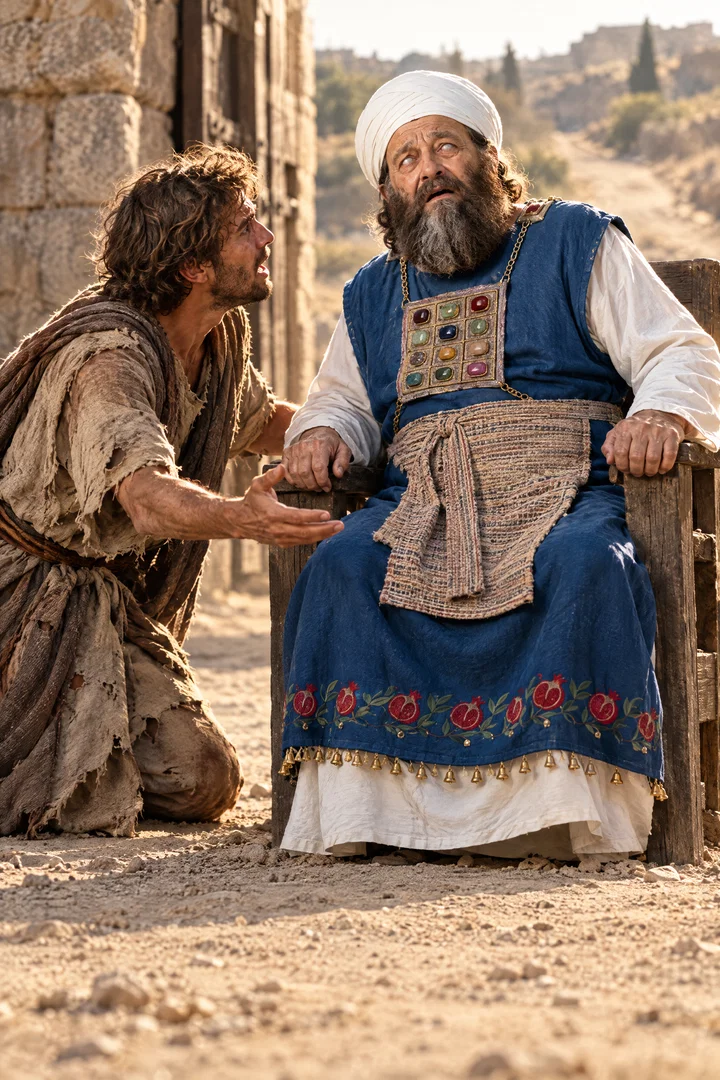
And there ran a man of Benjamin out of the army, and came to Shiloh the same day with his clothes rent, and with earth upon his head.
Translations
And there ran a man of Benjamin out of the army, and came to Shiloh the same day with his clothes rent, and with earth on his head.
King James Version, KJV Cambridge Paragraph Bible, Webster Bible, Revised Version
And there ran a man of Benjamin out of the army, and came to Shiloh the same day with his clothes rent, and with earth upon his head.
And there ran a man of Benjamin out of the army, and came to Shiloh the same day, with his clothes rent, and with earth upon his head.
And a man of Benjamin runneth out of the ranks, and cometh into Shiloh, on that day, and his long robes [are] rent, and earth on his head;
And there ran a man of Benjamin out of the battle, and came to Shiloh the same day, with his clothes rent and with earth upon his head.
And there ran a man of Benjamin out of the army, and entered Shiloh on the same day,—with his clothes rent, and with earth upon his head.
Berean Standard Bible, Majority Standard Bible
That same day a Benjamite ran from the battle line all the way to Shiloh, with his clothes torn and dirt on his head.
A man of Benjamin ran out of the army and came to Shiloh the same day, with his clothes torn and with dirt on his head.
And a man of Benjamin went running from the fight and came to Shiloh the same day with his clothing out of order and earth on his head.
And there ranne a man of Beniamin out of the armie, and came to Shiloh the same day with his clothes rent, and earth vpon his head.
Douay-Rheims (Challoner revision)
And there ran a man of Benjamin out of the army, and came to Silo the same day, with his clothes rent, and his head strewed with dust.
Pictures
Cross-references
- 1 Samuel 4:18
And it came to pass, when he made mention of the ark of God, that he fell from off the seat backward by the side of the gate, and his neck brake, and he died: for he was an old man, and heavy. And he had judged Israel forty years.
Eli dies after hearing the messenger report that the ark has been captured.
- 1 Samuel 3:13
For I have told him that I will judge his house for ever for the iniquity which he knoweth; because his sons made themselves vile, and he restrained them not.
Eli is judged for knowing of his sons’ wrongdoing and not restraining them.
- 1 Samuel 2:12-17
Now the sons of Eli were sons of Belial; they knew not the LORD.
Eli’s sons profane their priestly office by abusing the offerings.
- 1 Samuel 5
And the Philistines took the ark of God, and brought it from Eben-ezer unto Ashdod.
The captured ark brings calamity upon the Philistines and demonstrates the LORD’s power over Dagon.
- 1 Samuel 2:29-34
Wherefore kick ye at my sacrifice and at mine offering, which I have commanded in my habitation; and honourest thy sons above me, to make yourselves fat with the chiefest of all the offerings of Israel my people?
The deaths of Eli’s sons fulfill the warning of judgment on his house.
- 1 Samuel 4:21
And she named the child I-chabod, saying, The glory is departed from Israel: because the ark of God was taken, and because of her father in law and her husband.
The ark’s capture prompts Phinehas’s wife to name her child Ichabod, declaring Israel’s glory departed.
- Jeremiah 7:14
Therefore will I do unto this house, which is called by my name, wherein ye trust, and unto the place which I gave to you and to your fathers, as I have done to Shiloh.
Jerusalem’s threatened destruction is compared with what happened to Shiloh’s sanctuary.
- 1 Samuel 4:17
And the messenger answered and said, Israel is fled before the Philistines, and there hath been also a great slaughter among the people, and thy two sons also, Hophni and Phinehas, are dead, and the ark of God is taken.
The messenger reports Israel’s defeat, slaughter, and the ark’s capture.
- Psalms 78:60-62
So that he forsook the tabernacle of Shiloh, the tent which he placed among men;
both tell God forsook Shiloh and gave ark to enemy
- Jeremiah 26:6
Then will I make this house like Shiloh, and will make this city a curse to all the nations of the earth.
Jerusalem’s threatened fate is compared with Shiloh’s destruction.
- 1 Samuel 3:11
And the LORD said to Samuel, Behold, I will do a thing in Israel, at which both the ears of every one that heareth it shall tingle.
prophesied shock fulfilled in chapter 4
- Judges 21:19-21
Then they said, Behold, there is a feast of the LORD in Shiloh yearly in a place which is on the north side of Beth-el, on the east side of the highway that goeth up from Beth-el to Shechem, and on the south of Lebonah.
The yearly feast and dances at Shiloh are described as part of Israel’s corrupt worship.
- 1 Samuel 6:1-16
And the ark of the LORD was in the country of the Philistines seven months.
The Philistines send the ark back to Israel.
Commentary
Each commentary is drawn from primary sources: the writings of Ellen G. White and Adventist pioneers and periodicals. Each commentary is separate. Its own words are not a quotation; follow the references to read the source passages.
Ellen G. White
5 sources
On the same day as the battle a runner came from the army to Shiloh to bring Eli news of Israel's defeat and the loss of the ark.1SP 404.1–24T 516.1–2ST Dec 22, 1881 His clothes were torn and earth was upon his head as signs of grief.ST Dec 22, 1881 His coming belongs to God's judgment on Eli's house for Eli's failure to rule his own house well and restrain his children.4T 516.1–21T 234.2–235.2ST Nov 24, 1881
Eli was a good man, pure in morals and loving purity and righteousness, but too indulgent and lacking the moral courage to rebuke sin, reprove wrong, remove his vile sons from trust, strengthen his weak point, and suppress evil.4T 516.1–2 He knew they profaned the house of God and felt sad over it, yet did not remove them, and this failure incurred God's displeasure.4T 516.1–2 His sons were corrupt and ungodly, a proverb of reproach whose corrupting influence where they lived disgusted unbelievers and brought reproach on God's cause.1T 234.2–235.2 Their wrongdoing was especially serious because of their position as priests.ST Nov 24, 1881 Eli's indulgence of their sin dishonored God and made him share in their guilt.ST Nov 24, 1881
When God's rebuke came through the child Samuel, Eli accepted it as deserved without resentment toward Samuel.4T 516.1–2 Defeat and death came as God's judgment: his sons died and the people suffered ruin.1T 234.2–235.2ST Nov 24, 1881 When the runner reported the battle, Eli could endure hearing that his guilty sons were slain, but could not bear hearing that the ark of God was taken.4T 516.1–2 He knew his neglect to stand for the right and restrain wrong had at last deprived Israel of strength and glory, and the pallor of death came on his face and he fell backward and died.4T 516.1–2
Sources
Pioneers and periodicals
27 sources
A Benjamite fled the Israelite rout at Eben-ezer and reached Shiloh that same evening, his torn clothing and earth-covered head marking him as a bearer of grief and disaster.ST Apr 8, 1913RH Apr 21, 1851ST Apr 8, 1913ST Mar 11, 1897 He told that Israel had fled with great slaughter, that Hophni and Phinehas were dead and the ark of God was taken, tidings that broke the aged, blind Eli as he waited by the tabernacle so that he fell and died and his house ended with the cry of Ichabod, the glory is departed.ST Apr 8, 1913RH Apr 21, 1851ST Mar 31, 1909RH Apr 20, 1876ST Mar 11, 1897 The calamity exposed Israel's vain trust in the ark itself as a charm or mascot while trampling the law it symbolized, for possession of holy things gives no security to the disobedient when God is not enshrined in the heart and His protection is withdrawn.ST Aug 13, 1902ST Jul 8, 1889ST Jun 26, 1884ST Jun 30, 1898RH Aug 3, 1869 It fulfilled God's sworn judgment on Eli's house because his sons made themselves vile and he restrained them not, his easy indulgence and failure to train and restrain them making him share their guilt in an iniquity that sacrifice would never purge.RH Mar 19, 1872RH Aug 3, 1869RH Jun 23, 1853RH Jul 16, 1857ST Aug 24, 1904 The ark, taken while ringed by earthly arms yet needing no human guard to lay the Philistine god prostrate and vindicate its own sanctity, shows that holy truth gains nothing from military or legal defense but stands in its power over the heart, and warns that the unchanging Lord will likewise judge parental unfaithfulness and disobedience today.ST Nov 24, 1881ST Jan 23, 1907ST Feb 22, 1910RH Mar 19, 1872
Messenger, Defeat, and Loss
The verse belongs to Israel's history in the period between the judges and the kings, when people did what was right in their own eyes amid widespread spiritual corruption, including the wickedness of Eli's sons and the introduction of heathen practices into worship. A man of Benjamin escaped from the Israelite army and ran to Shiloh the same day, arriving that evening breathless with dust on the horizon, his manner and cries already telling of disaster before he spoke.ST Mar 11, 1897RH Aug 28, 1856 His clothes were rent and earth was upon his head as signs of grief and mourning over the defeat.ST Dec 22, 1881RH Aug 28, 1856 His coming belongs to the account of Israel's humiliation, when the Philistines captured the ark and Eli's sons were killed.ST Apr 8, 1913
He brought Eli news of calamity from the battle at Eben-ezer.RH Aug 28, 1856 Israel had fled and suffered defeat with great slaughter.RH Apr 20, 1876ST Aug 21, 1884 Hophni and Phinehas were dead.RH Apr 20, 1876ST Aug 21, 1884 The ark of God was captured by the Philistines.ST Apr 8, 1913ST Mar 31, 1909RH Apr 20, 1876ST Aug 21, 1884 The report that the ark had been taken caused Eli to fall and die, because its loss meant that Israel's glory had departed.RH Apr 21, 1851
Eli, ninety-eight years old, blind and dim of hearing, was sitting by the tabernacle court waiting when the runner dashed into the city and a great cry arose throughout the city.ST Mar 11, 1897 He heard the tumult and called the messenger to his side for tidings from the field.ST Mar 11, 1897 The tidings were Israel fled, great slaughter among the people, Hophni and Phinehas dead, and the ark of God taken, and that last word broke Eli's heart so that he fell and died.RH Apr 20, 1876ST Mar 11, 1897 Hophni and Phinehas being killed in battle, the news also brought Eli's daughter-in-law to die in childbirth.RH May 8, 1856 Ichabod, meaning the glory is departed, was left as the memorial of the shame and the lament that Israel's glory had departed.RH Apr 21, 1851ST Mar 11, 1897RH Aug 28, 1856
The calamity followed the wrongdoing of Eli's sons, and Eli and his house were also cut off.ST Jul 8, 1889 It was part of the judgment that destroyed Eli and his sons for their sins and Eli's failure to restrain them, marking the end of their leadership as rulers before Samuel's rise as Israel's chosen leader.ST Jun 22, 1882 It means God's glory, the ark of His testament, was given into the hands of the Philistines as enemy and taken from the tabernacle at Shiloh, and for the gross wickedness of priests and people God forsook His habitation there.RH Jan 6, 1853 His glory, the ark of His covenant, never returned to that building, though the other sacred vessels remained with the tabernacle.RH Jan 6, 1853 The account shows that the effects of sin among God's people can fall on more than the direct transgressors, and that excusing or covering up another's sin makes one share in its consequences.ST Jul 8, 1889
False Trust and Judgment
Israel had forgotten pure righteousness and the presence of God in the life, for which the ark stood as a symbol, and had come to worship the ark itself and the tables of the law as a charm and idol and fetish.ST Aug 13, 1902ST Jun 26, 1884ST Jun 30, 1898 Borne even by unrighteous priests, Hophni and Phinehas, it was carried presumptuously into battle in the supposition that it would prove an irresistible mascot and insure success and win the victory despite sin.ST Aug 13, 1902ST Jun 30, 1898ST Dec 3, 1902 The defeat showed that having the object through which God manifested Himself was vain while trampling upon the law, and that possession of the tables of the law could not protect lawbreakers unless God was enshrined in the heart.ST Aug 13, 1902ST Jun 26, 1884ST Dec 3, 1902 Though the name of the Lord is a strong tower, the disobedient and presumptuous find no security in it, for God withdrew His protection and permitted the enemy to carry off the ark of the covenant while the sinful priests were slain.ST Aug 13, 1902ST Jun 30, 1898ST Dec 3, 1902
The ark was taken only when surrounded by the arms of earthly defenders, showing that military and legal protection adds no dignity or strength to holy things and that trust in military force brings capture rather than security.ST Jan 23, 1907ST Feb 22, 1910 In Philistine captivity it needed no human guard or human defense, for its own sanctity and holiness were sufficient to protect it and vindicate it from insult.ST Jan 23, 1907ST Feb 22, 1910 That vindication laid the hostile god prostrate on the threshold of his own temple before it, proving that holy things find their real security in their own sanctity and benevolent morality and power to comfort and enlighten.ST Jan 23, 1907ST Feb 22, 1910 So Christianity gains nothing from being made part and parcel of the common law, but finds its real security in its benevolent morality, its adaptation to the human heart, its accommodation to every human intellect, its consolation to the house of mourning, and its light on the mystery of the grave.ST Jan 23, 1907
The Philistines were able to take the ark in consequence of the sin of God's people, and then became anxious to get rid of it.ST Jul 8, 1889RH Jul 8, 1852RH Aug 3, 1869 Eli's sons wrongly trusted that their priestly office and the ark and the law of God would make them safe in battle, but their sins did not make them safe from God's judgment and the ark and law were delivered to Israel's enemies while they were killed and Israel suffered great destruction and heavy losses.ST Jul 8, 1889RH Jul 8, 1852RH Aug 3, 1869 The outcome shows that the effects of sin among God's people can fall on more than the direct transgressors, and that excusing or covering up another's sin makes one share in its consequences, as Eli and his house were also cut off through the wrongdoing of his sons.ST Jul 8, 1889RH Aug 3, 1869
The backsliding of Israel in the days of Samuel belongs to the record in the first chapters of 1 Samuel, where Israel is the church in the wilderness. That backsliding shows the church of Christ going into apostasy. Its restoration through the ministrations of Samuel the prophet shows the church being restored again.
Parental Failure and Warning
The runner's arrival reports the fulfillment of the judgment sworn against Eli's house because his sons made themselves vile and he restrained them not, an iniquity that would not be purged with sacrifice nor offering forever.RH Mar 19, 1872RH Aug 3, 1869RH Jul 16, 1857 Despite God's long patience they failed to repent, so Eli and his sons died that same day.ST Apr 6, 1888RH Mar 19, 1872 His sons were slain in battle and the ark and the law of God were delivered to enemies, with great destruction upon Israel, because they wrongly trusted that priestly office and the ark would make them safe.ST Apr 6, 1888RH Aug 3, 1869RH Jul 16, 1857 The priesthood and ruling leadership were taken from his family, and the tidings of defeat and capture led to Eli's own collapse and death.ST Apr 6, 1888RH Mar 19, 1872RH Jul 16, 1857
Eli had been too easy-going in early training and failed to restrain and religiously instruct his sons.ST Nov 24, 1881ST Aug 24, 1904RH May 8, 1856 His indulgence dishonored God and made him share their guilt, made especially serious by their position as priests.ST Nov 24, 1881ST Aug 24, 1904 His sons forsook the Lord, committed wicked acts, and brought others into discouragement and sin.ST Nov 24, 1881ST Aug 24, 1904 They were not taught to take heed to their way and to walk before God in truth with all heart and soul, and so ruin came on the people.ST Nov 24, 1881RH Jun 23, 1853ST Aug 24, 1904 Their deaths, with Eli's death in heartbreak and his daughter-in-law dying in childbirth, show the grief that followed unfaithfulness as a father.RH Jun 23, 1853ST Aug 24, 1904RH May 8, 1856
Because the Lord is the same yesterday, today, and forever, He will judge the Elis of this nation as He judged Eli of old, even priests today whose sons have made themselves vile and have not been restrained.RH Mar 19, 1872 Continuance in God's blessing and in the land He gave depends on obedience to His commandments and statutes by both parents and children.ST Nov 24, 1881RH Mar 19, 1872RH Jun 23, 1853
Sources