1 Samuel 4:16
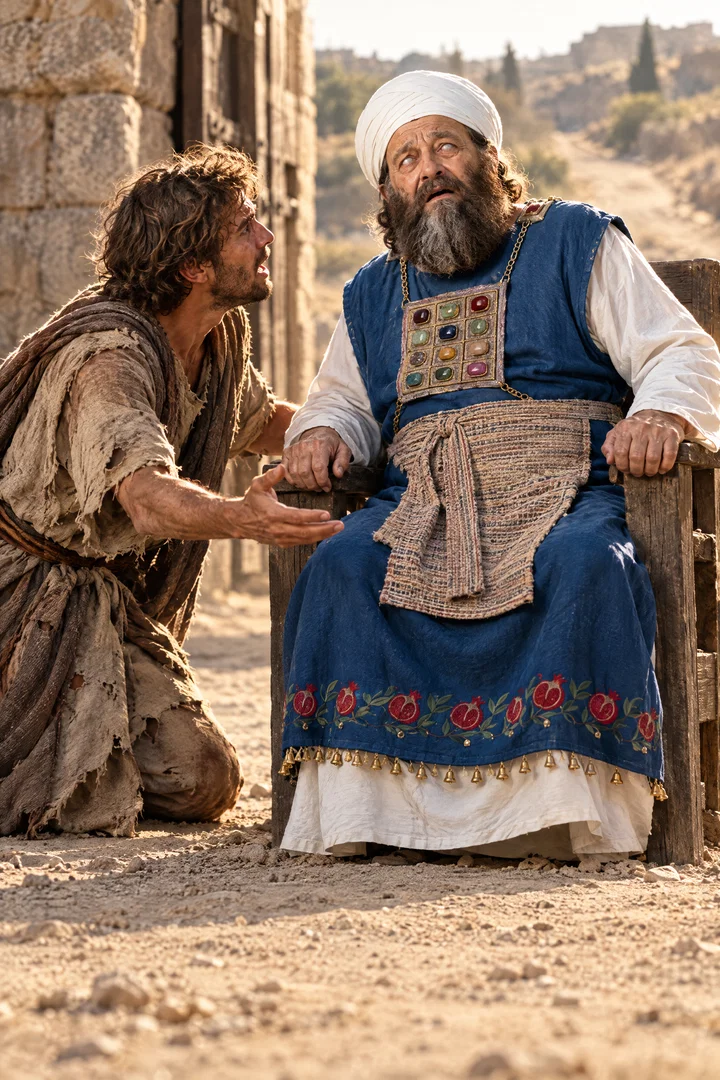
And the man said unto Eli, I am he that came out of the army, and I fled to day out of the army. And he said, What is there done, my son?
Translations
And the man said to Eli, I am he that came out of the army, and I fled to day out of the army. And he said, What is there done, my son?
King James Version, KJV Cambridge Paragraph Bible
And the man said unto Eli, I am he that came out of the army, and I fled to day out of the army. And he said, What is there done, my son?
And the man said to Eli, I am he that came out of the army, and I fled to-day out of the army. And he said, What is there done, my son?
And the man said unto Eli, I am he that came out of the army, and I fled today out of the army. And he said, How went the matter, my son?
And the man said unto Eli, I am he that came out of the army, and I fled to-day out of the army. And he said, How went the matter, my son?
And the man saith unto Eli, 'I [am] he who hath come out of the ranks, and I out of the ranks have fled to-day;' and he saith, 'What hath been the matter, my son?'
And the man said to Eli, I am he that came out of the battle, and I have fled to-day out of the battle. And he said, What has taken place, my son?
So the man said unto Eli, I, am he that came in from the army, yea, I, from the army, fled to-day. And he said—What is the thing that hath happened, my son?
Berean Standard Bible, Majority Standard Bible
“ I have just come from the battle,” the man said to Eli. “ I fled from there today.”“ What happened, my son?” Eli asked.
The man said to Eli, “ I am he who came out of the army, and I fled today out of the army.”He said, “ How did the matter go, my son?”
And the man said to Eli, I have come from the army and have come in flight today from the fight. And he said, How did it go, my son?
And the man sayd vnto Eli, I came from the armie, and I fled this day out of the hoste: and he sayd, What thing is done, my sonne?
Douay-Rheims (Challoner revision)
And he said to Heli: I am he that came from the battle, and have fled out of the field this day. And he said to him: What is there done, my son?
Pictures
Cross-references
- 1 Samuel 4:11
And the ark of God was taken; and the two sons of Eli, Hophni and Phinehas, were slain.
The messenger reports Israel’s defeat, Eli’s sons’ deaths, and the capture of the ark.
- 1 Samuel 5:1-4
And the Philistines took the ark of God, and brought it from Eben-ezer unto Ashdod.
The captured ark is brought into Dagon’s temple, where Dagon falls before it.
- 1 Samuel 3:13
For I have told him that I will judge his house for ever for the iniquity which he knoweth; because his sons made themselves vile, and he restrained them not.
Eli hears news as God’s judgment for failing to restrain his sons.
- 1 Samuel 4:21-22
And she named the child I-chabod, saying, The glory is departed from Israel: because the ark of God was taken, and because of her father in law and her husband.
Ichabod is named because the captured ark means the glory has departed from Israel.
- 1 Samuel 2:34
And this shall be a sign unto thee, that shall come upon thy two sons, on Hophni and Phinehas; in one day they shall die both of them.
Eli’s sons’ deaths fulfill the judgment announced against his household.
- Jeremiah 7:14
Therefore will I do unto this house, which is called by my name, wherein ye trust, and unto the place which I gave to you and to your fathers, as I have done to Shiloh.
Shiloh’s destruction shows judgment for wickedness.
- 1 Samuel 4:10
And the Philistines fought, and Israel was smitten, and they fled every man into his tent: and there was a very great slaughter; for there fell of Israel thirty thousand footmen.
defeat that messenger fled from
- Psalms 78:60-62
So that he forsook the tabernacle of Shiloh, the tent which he placed among men;
God forsook Shiloh and gave the ark to the enemy.
- 1 Samuel 3:11
And the LORD said to Samuel, Behold, I will do a thing in Israel, at which both the ears of every one that heareth it shall tingle.
foretells the astounding event reported to Eli
- Numbers 7:9
But unto the sons of Kohath he gave none: because the service of the sanctuary belonging unto them was that they should bear upon their shoulders.
The prescribed way to carry the ark is contrasted with using a cart.
- 1 Samuel 2:12-17
Now the sons of Eli were sons of Belial; they knew not the LORD.
The priests’ wickedness leads the people to abhor the LORD’s offering.
- 1 Samuel 5:6-12
But the hand of the LORD was heavy upon them of Ashdod, and he destroyed them, and smote them with emerods, even Ashdod and the coasts thereof.
The ark brings calamity among the Philistines.
Commentary
Each commentary is drawn from primary sources: the writings of Ellen G. White and Adventist pioneers and periodicals. Each commentary is separate. Its own words are not a quotation; follow the references to read the source passages.
Ellen G. White
5 sources
A messenger arrived at Shiloh from the battlefield to bring Eli news of Israel's flight and losses.1SP 404.1–2PP 585.1–34T 516.1–2 He reported that Israel had fled, that Eli's sons had been killed, and that the ark of God had been taken.1SP 404.1–2PP 585.1–34T 516.1–2 Eli could bear the defeat and the slaying of his guilty sons, which he had expected, receiving that part with some calm and endurance.1SP 404.1–2PP 585.1–34T 516.1–2 But the news that the ark had been taken overwhelmed him with anguish that he could not bear.1SP 404.1–2PP 585.1–34T 516.1–2
His greater grief over the ark than over his vile, guilty sons showed that he loved purity and righteousness.4T 516.1–2 He understood the capture to mean that his own sin had dishonored God and caused God to withdraw His presence from Israel.PP 585.1–3 He knew that his neglect in failing to stand for the right and restrain wrong had at last deprived Israel of her strength and glory.4T 516.1–2 The loss of the ark was Israel's great calamity, yet the ark was no guarantee of safety, for God permitted its capture to humble Israel and to show that trusting the symbol of His presence while profaning the commandments it contained is vain.1SP 404.1–2
The shock brought the pallor of death upon his face, and he fell backward and died.PP 585.1–34T 516.1–2 The history belongs to the account of the sins of Eli's sons and the disaster that followed, showing that Eli's indulgence and excuses made him a participant in their guilt and brought ruin through his failure to restrain them.ST Nov 24, 1881 Eli was facing the judgment that followed his failure to rule well his own house and restrain his children, which means that a father who does not restrain ungodly, corrupt sons brings the frown of God upon himself, while his children become a proverb of reproach, exert a corrupting influence where they live, disgust unbelievers, and bring reproach upon the cause of truth.1T 234.2–235.2
Sources
Pioneers and periodicals
24 sources
A breathless runner who had fled that same day from the battlefield came to Eli at Shiloh, and the aged priest asked him what had taken place in the fight.ST Aug 13, 1902RH Apr 21, 1851 His question belongs to Israel's crushing defeat by the Philistines, when thirty thousand footmen fell, Hophni and Phinehas were slain, and the ark of God was taken into enemy hands.ST Apr 8, 1913ST Aug 13, 1902ST Feb 22, 1910RH Apr 21, 1851 Possessing the ark gave no protection to a people living in sin and trampling the law it contained, for Israel had presumptuously carried it into battle as a charm to secure victory rather than honoring and obeying God.ST Aug 13, 1902RH Apr 21, 1851ST Jun 26, 1884ST Dec 3, 1902ST Mar 11, 1897 The disaster fulfilled God's sworn word to judge Eli's house forever, for Eli had failed to restrain his wicked sons and thereby shared their guilt, so father and sons died in one day and the priesthood passed from his family.ST Apr 6, 1888RH Mar 19, 1872RH Jun 23, 1853ST Aug 24, 1904
The Report to Eli
A man who had fled that day from the army came to Eli with news of the battle, and Eli asked him what had been done.ST Aug 13, 1902RH Jun 23, 1853ST Dec 3, 1902RH Apr 20, 1876 The verse belongs to Israel's defeat by the Philistines, when the ark of God was captured and Israel was brought into deep humiliation and loss.ST Apr 8, 1913ST Aug 13, 1902ST Feb 22, 1910ST Apr 8, 1913ST Jun 26, 1884 The messenger who reached Eli had fled from the battle and reported its outcome, with the deaths of Eli's sons and of Eli himself following in the same account.ST Apr 8, 1913ST Apr 8, 1913RH Apr 20, 1876
Israel had first lost about four thousand men, then fetched the ark from Shiloh into the camp with shouting that made the earth ring and terrified the Philistines.RH Apr 21, 1851 The ark was not Israel's strength while even one of the ten immutable precepts it contained was violated, for Hophni and Phinehas had violated the seventh commandment and caused the Lord's people to transgress.RH Apr 21, 1851 Israel was then smitten again with thirty thousand footmen fallen, Hophni and Phinehas slain, and the ark of God taken.RH Apr 21, 1851 Eli was little moved by hearing of the slaughter of the army and the death of his two sons, but when the ark was named he fell from his seat backward and his neck broke and he died, knowing the glory had departed from Israel.RH Apr 21, 1851
Ninety-eight-year-old Eli, blind and barely hearing, sat by the tabernacle court at Shiloh in the evening waiting for news from the battle.ST Mar 11, 1897 A swift runner covered with dust from the field dashed into the city breathless, and the people read disaster in his manner and broke into a great cry whose tumult Eli heard before calling the messenger to his side to ask what had happened in the field.ST Mar 11, 1897 It was the collapse of a corrupt political and religious order under Philistine power after Israel presumptuously carried the ark into battle, and the nation's deepest, darkest hour of defeat, slaughter, and loss just before dawn and deliverance.ST Mar 11, 1897 The report marks the close of Eli's forty-year rule, with his death hastened by the slaughter of his unrestrained sons and the loss of the ark.
In this defeat God forsook His habitation at Shiloh and gave His glory, the ark of His testament and covenant, into the hands of the Philistines because of the gross wickedness of the priests and the people, and His glory never returned to that building.RH Jan 6, 1853 The delayed sentence against Eli's household was carried out with Eli and his sons dying in one day, the priesthood taken from his family and his house blotted out as a ruling family.ST Apr 6, 1888ST Dec 3, 1902 The verse stands in the early history of Samuel and his call to the prophetic gift, during spiritual decline when Eli's sons led the people away from faithful worship, showing Israel's condition and Eli's weakness through defeat, capture of the ark, and death of the old priest.ST Mar 31, 1909 It records backsliding rather than utter apostasy from which there is no recovery, and Israel was restored again through the ministrations of Samuel the prophet.
The consequences fell not only on Eli's sons but also on thousands of Israelites and on Eli's household in defeat and death.ST Jul 8, 1889 Israel had gone out against the Philistines trusting the presence of the ark borne by unrighteous priests to insure success, and the result was defeat for Israel, capture of the ark by the enemy, and the word Ichabod declaring the glory is departed, which wrote Israel's true condition.ST Jun 30, 1898 The capture at Eben-ezer brought the lament that the glory had departed from Israel because the ark of God was taken.RH Aug 28, 1856
What the Defeat Teaches
Possessing the ark and the tables of the law gave no protection to a people living in sin and failing to keep their trust.ST Aug 13, 1902ST Jun 26, 1884 The sacred object from which God manifested Himself was no safeguard while He was not enthroned in their hearts, for the people were trampling on the very law it contained.ST Aug 13, 1902ST Jun 26, 1884 Israel had first lost about four thousand men because Hophni and Phinehas had violated the seventh commandment and caused the Lord's people to transgress.RH Apr 21, 1851 Then the ark was fetched out of Shiloh into the camp with shouting that made the earth ring and terrified the Philistines, yet the ark was not Israel's strength while even one of the ten immutable precepts it contained was violated.RH Apr 21, 1851 So Israel was smitten again with thirty thousand footmen fallen, Hophni and Phinehas slain, and the ark of God taken, and Eli, little moved by the slaughter of the army and the death of his two sons, fell backward, broke his neck, and died when the ark was named, for he knew the glory had departed from Israel.ST Aug 13, 1902RH Apr 21, 1851
The ark was taken for the first time while surrounded by the arms of earthly defenders, and trusting in military force brought defeat rather than security.ST Jan 23, 1907ST Feb 22, 1910 In captivity its own holiness and sanctity were enough to vindicate it and to lay the hostile god prostrate on the threshold of his temple.ST Jan 23, 1907 This proves that earthly power adds no dignity or strength to God's cause.ST Jan 23, 1907 The real security of Christianity is found in its benevolent morality, its exquisite adaptation to the human heart, its accommodation to every human intellect, its consolation to the house of mourning, and its light on the great mystery of the grave, not in being made part and parcel of the common law or in legal establishment.ST Jan 23, 1907
Hophni and Phinehas had presumptuously carried the ark of the covenant into battle supposing it would prove an irresistible mascot and win the victory.ST Dec 3, 1902 Israel treated the ark and God's law as a charm to secure victory rather than honoring and obeying God, and possessing sacred truth while using it irreverently brings judgment.ST Dec 3, 1902ST Aug 21, 1884 Though the name of the Lord is a strong tower, the disobedient and presumptuous find no security in it.ST Dec 3, 1902 The astounding, ear-tingling thing was that the Lord permitted the enemy to carry off the ark, while at the same time Hophni and Phinehas were slain, Eli himself expired on receipt of the news, and the house of Eli was blotted out as a ruling family.ST Dec 3, 1902ST Mar 11, 1897ST Aug 21, 1884
The disaster performed all that God had spoken concerning Eli's house and judged his house forever for iniquity Eli knew, because his sons made themselves vile and he restrained them not, an iniquity that shall not be purged with sacrifice nor offering forever.RH Mar 19, 1872 The delayed sentence was carried out with Eli and his sons dying in one day and the priesthood taken from Eli's family.ST Apr 6, 1888 The promise that Aaron's house would serve before God forever was conditional on faithful service and honoring God, which Eli and his sons failed, proving unworthy of priestly office.ST Apr 6, 1888 The same Lord who judged Eli of old will judge present-day Elis whose sons have made themselves vile unrestrained.RH Mar 19, 1872
Eli's indulgence, excuses, and failure to restrain his wicked sons and to enforce religious discipline made him a participant in their guilt.ST Nov 24, 1881ST Jun 22, 1882RH May 8, 1856 Their crimes polluted the sacred ordinances and corrupted the people, and divine justice destroyed father and sons.ST Jun 22, 1882RH May 8, 1856 This proves parental responsibility and accountability, that God judges a father for failing to restrain wicked children, and warns that if parents or their children turn from following God and keeping His commandments they will be cut off.RH Mar 19, 1872RH Jun 23, 1853 Hence children must be trained faithfully when they are young, for the report of disaster that led into Eli's grief-stricken fall and death grew out of his failure to train them then.RH Jun 23, 1853ST Aug 24, 1904 The ark itself was a chest guarding with utmost care God's constitution, taken by the Philistines in consequence of the sin of God's people, after which the Philistines became anxious to get rid of it.RH Jul 8, 1852 So enemies of God's unabolished constitution now shut up in an ark guarded with utmost care in the heaven of heavens would be just as anxious to be rid of that heavenly ark if they were able to take it.RH Jul 8, 1852
Sources