2 Chronicles 12:10
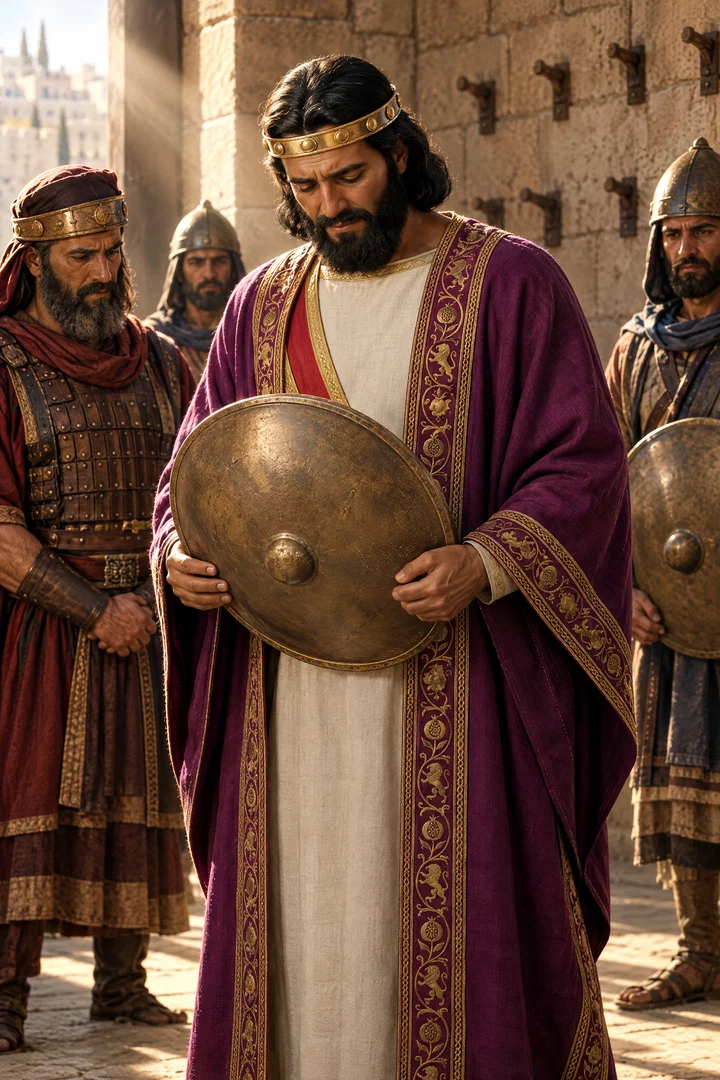
Instead of which king Rehoboam made shields of brass, and committed them to the hands of the chief of the guard, that kept the entrance of the king’s house.
Translations
American King James Version, King James Version, KJV Cambridge Paragraph Bible
Instead of which king Rehoboam made shields of brass, and committed them to the hands of the chief of the guard, that kept the entrance of the king’s house.
Instead of which, king Rehoboam made shields of brass, and committed them to the hands of the chief of the guard, that kept the entrance of the king's house.
Revised Version, American Standard Version
And king Rehoboam made in their stead shields of brass, and committed them to the hands of the captains of the guard, that kept the door of the king’s house.
and king Rehoboam maketh in their stead shields of brass, and hath given [them] a charge on the hand of the heads of the runners who are keeping the opening of the house of the king;
And king Rehoboam made in their stead shields of bronze, and committed them to the hands of the chief of the couriers who kept the entrance of the king's house.
And King Rehoboam made, instead of them, bucklers of bronze,—and committed them unto the hand of the captains of the runners, who kept guard at the entrance of the house of the king.
Berean Standard Bible, Majority Standard Bible
Then King Rehoboam made bronze shields in their place and committed them to the care of the captains of the guard on duty at the entrance to the royal palace.
King Rehoboam made shields of bronze in their place, and committed them to the hands of the captains of the guard, who kept the door of the king’s house.
And in their place King Rehoboam had other body-covers made of brass and gave them into the care of the captains of the armed men who were stationed at the door of the king's house.
In stead whereof King Rehoboam made shieldes of brasse, and committed them to the handes of the chiefe of the garde, that wayted at the doore of the Kings house.
Douay-Rheims (Challoner revision)
Instead of which the king made brazen ones, and delivered them to the captains of the shieldbearers, who guarded the entrance of the palace.
Pictures
Cross-references
- 1 Kings 14:27
And king Rehoboam made in their stead brasen shields, and committed them unto the hands of the chief of the guard, which kept the door of the king’s house.
Rehoboam replaces the stolen gold shields with bronze shields for the royal guards.
- 2 Chronicles 12:2-5
And it came to pass, that in the fifth year of king Rehoboam Shishak king of Egypt came up against Jerusalem, because they had transgressed against the LORD,
Shishak’s invasion followed Judah’s unfaithfulness and prompted the people to humble themselves.
Commentary
Each commentary is drawn from primary sources: the writings of Ellen G. White and Adventist pioneers and periodicals. Each commentary is separate. Its own words are not a quotation; follow the references to read the source passages.
Ellen G. White
3 sources
Shishak had carried off the gold shields that Solomon had made for the king's house, and in their place Rehoboam made shields of brass to replace them.RH Jul 10, 1913Ms 80, 1904, par. 14–19PK 94.2–95.3 The new shields were a direct substitute for the taken treasures, inferior metal put where gold had once been kept.RH Jul 10, 1913Ms 80, 1904, par. 14–19PK 94.2–95.3
He committed the brass shields to the hands of the chief of the guard, who kept the entrance of the king's house.RH Jul 10, 1913Ms 80, 1904, par. 14–19PK 94.2–95.3 They were stationed under guard at the palace entrance rather than displayed in their former glory.RH Jul 10, 1913Ms 80, 1904, par. 14–19PK 94.2–95.3 When the king went to the house of the Lord the guard brought the shields out before him, then carried them back afterward to the guard chamber.RH Jul 10, 1913Ms 80, 1904, par. 14–19 This coming and going marked their reduced use, brought forth for ceremony and then returned to keeping.RH Jul 10, 1913Ms 80, 1904, par. 14–19 The substitution of brass for gold marks how far the kingdom had fallen from its former wealth and splendor.RH Jul 10, 1913
Sources
Pioneers and periodicals
9 sources
This verse belongs to the account of Shishak king of Egypt's campaign against Judah, also recorded in 1 Kings 14.ST Dec 21, 1915ST Jun 10, 1908 It comes after Rehoboam was humbled, when Shishak first despoiled the temple of the gold which Solomon had placed there.ST Jun 10, 1908 The Karnak inscription is evidence supporting that historical account, recording places captured by Shishak, including Jerusalem.ST Dec 21, 1915
After Shishak took Solomon's gold shields, Rehoboam replaced them with shields of brass, also described as copper or bronze.RH Jul 10, 1913ST Jun 10, 1908ST May 21, 1885 The Egyptians, the enemy, had taken away the gold shields along with other treasures.ST May 21, 1885RH Dec 14, 1905 He committed the new shields to the hands of the chief of the guard, the royal guard that kept the entrance of the king's house.RH Jul 10, 1913ST Jun 10, 1908ST May 21, 1885
When the king went to the house of the Lord, the temple, to worship, the guard brought the shields out and carried them before him.RH Jul 10, 1913ST May 21, 1885ST May 21, 1885 Then afterward they returned them to the guardroom, the guarded chamber.RH Jul 10, 1913ST May 21, 1885ST May 21, 1885 The Karnak inscription corroborates the biblical account of Shishak's campaign, recording the places captured by Shishak, including Jerusalem, with 156 places taken listed.ST Dec 21, 1915ST Dec 21, 1915
The replacement of gold with brass is evidence that Judah's glory had departed.ST Jun 10, 1908ST Jun 10, 1908 It marks the loss of the kingdom's former wealth and splendor.RH Jul 10, 1913 The loss of the gold and its substitution with brass marked the start of lasting financial trouble for Judah, which continued until it was no longer an independent nation.RH Dec 14, 1905
The bronze shields stand for something inferior put in place of what had been lost.ST May 21, 1885 People may lose childlike faith, love for all people, or a felt awareness of God's presence, then carefully preserve outward practices and reminders that cannot fully restore what is gone.ST May 21, 1885 The making of brass shields to replace the gold and committing them to jealous guard pictures human nature when pure gold put into hands is lightly esteemed, slighted, and suffered to be snatched away, its value realized only after it is gone.ST May 21, 1885 It is followed by too-late lament over the carelessness that let the treasure be torn away and a poor attempt to supply its place and atone for negligence by making a treasure of copper and guarding it with the care that should have guarded the gold, yet the copper can never fully take the place of the gold.ST May 21, 1885 This leaves a sense of loss and unreality in guarding tarnished copper where gold should have shone, known inwardly even when others do not know that base metal shines in its place, so that passionate zeal for what remains is less love for the copper than undying regret for the vanished gold.ST May 21, 1885
Sources