2 Chronicles 19:6
And said to the judges, Take heed what ye do: for ye judge not for man, but for the LORD, who is with you in the judgment.
Translations
And said to the judges, Take heed what you do: for you judge not for man, but for the LORD, who is with you in the judgment.
King James Version, Webster Bible
And said to the judges, Take heed what ye do: for ye judge not for man, but for the LORD, who is with you in the judgment.
and said to the judges, Take heed what ye do: for ye judge not for man, but for the Lord, who is with you in the judgment.
and said to the judges, Consider what ye do: for ye judge not for man, but for the LORD; and he is with you in the judgment.
and said to the judges, Consider what ye do: for ye judge not for man, but for Jehovah; and he is with you in the judgment.
and saith unto the judges, 'See what ye are doing — for not for man do ye judge, but for Jehovah, who [is] with you in the matter of judgment;
And he said to the judges, Take heed what ye do; for ye judge not for man, but for Jehovah, who will be with you in the matter of judgment.
and said unto the judges, See what, ye, are doing, inasmuch as, not for man, must ye judge, but for Yahweh,—who will be with you, in the word of justice.
Berean Standard Bible, Majority Standard Bible
Then he said to the judges, “ Consider carefully what you do, for you are not judging for man, but for the LORD, who is with you when you render judgment.
and said to the judges, “ Consider what you do, for you don’t judge for man, but for the LORD; and he is with you in the judgment.
And said to the judges, Take care what you do, for you are judging not for man but for the Lord, and he is with you in the decisions you give.
And said to the iudges, Take heede what ye doe: for yee execute not the iudgements of man, but of the Lord, and he will be with you in the cause and iudgement.
Douay-Rheims (Challoner revision)
And charging the judges, he said: Take heed what you do: for you exercise not the judgment of man, but of the Lord: and whatsoever you judge, it shall redound to you.
Pictures
Cross-references
- Exodus 18:21
Moreover thou shalt provide out of all the people able men, such as fear God, men of truth, hating covetousness; and place such over them, to be rulers of thousands, and rulers of hundreds, rulers of fifties, and rulers of tens:
Moses appoints judges with religious and moral qualifications.
- Psalms 82:1
God standeth in the congregation of the mighty; he judgeth among the gods.
God is present among judges and judges among them.
- Psalms 82:3-4
Defend the poor and fatherless: do justice to the afflicted and needy.
Judges are charged to defend the poor and needy with justice.
- 2 Samuel 23:3
The God of Israel said, the Rock of Israel spake to me, He that ruleth over men must be just, ruling in the fear of God.
Both texts call rulers to judge justly in reverence for God.
Commentary
Each commentary is drawn from primary sources: the writings of Ellen G. White and Adventist pioneers and periodicals. Each commentary is separate. Its own words are not a quotation; follow the references to read the source passages.
Ellen G. White
3 sources
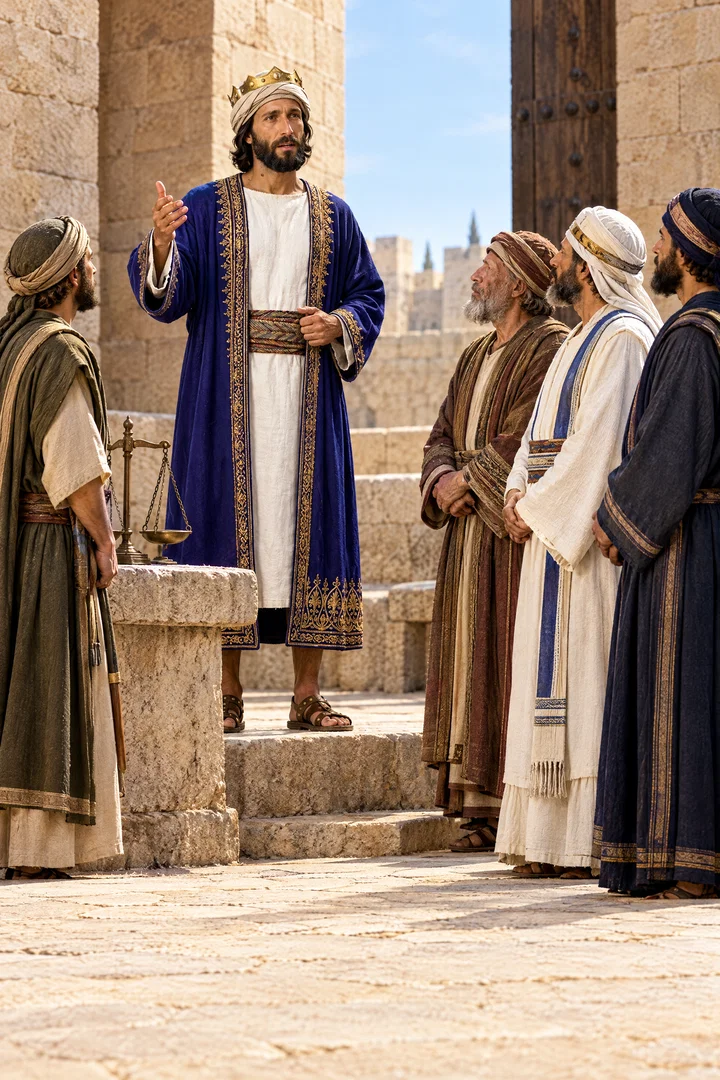
The charge belongs to Jehoshaphat's reform in his later years, when he set judges in the land throughout all the fenced cities of Judah, city by city.RH Dec 25, 1913 That appointment was one important step to bring the people from Beer-sheba to Mount Ephraim back to the Lord God of their fathers and to establish and maintain efficient courts of justice.RH Dec 25, 1913 Judges decide not for man but for the Lord, because the Lord is present with them in the judging.Ms 80, 1904, par. 44–47PK 197.1–2RH Dec 25, 1913 They answer to the Lord rather than merely to human beings or human authorities.Ms 80, 1904, par. 44–47PK 197.1–2
They must therefore take heed what they do and watch their actions closely.RH Dec 25, 1913 Their work is to be done carefully and justly under God's authority and divine oversight.Ms 80, 1904, par. 44–47PK 197.1–2 It is to be carried out with reverence for God, in the fear of the Lord, faithfully and with a perfect and whole heart.PK 197.1–2RH Dec 25, 1913 That carefulness requires no iniquity, injustice, or wrongdoing.Ms 80, 1904, par. 44–47PK 197.1–2RH Dec 25, 1913 It requires no respect of persons or favoritism toward persons, and no taking of gifts or bribes.Ms 80, 1904, par. 44–47PK 197.1–2RH Dec 25, 1913 This reflects that with God there is no partiality and He accepts no bribes.Ms 80, 1904, par. 44–47 Such counsel is excellent because righteousness exalts a nation and lifts it up.Ms 80, 1904, par. 44–47
Sources
Pioneers and periodicals
9 sources
The charge was given by Jehoshaphat to the judges he set in the land throughout all the fenced cities of Judah, city by city, as one important step in his later-years reform to bring the people from Beer-sheba to Mount Ephraim back to the Lord God of their fathers and to establish and maintain efficient courts of justice.RH Dec 25, 1913 It stands in the record of 2 Chronicles 1 to 20, covering Solomon, Rehoboam, Abijah, Asa, and into Jehoshaphat, presenting Jehoshaphat as a good king in contrast with backsliding Israel.ST Jun 27, 1911 From the division of the kingdom at Solomon's death to Jehoshaphat seven kings reigned in Israel, namely Jeroboam, Nadab, Baasha, Elah, Zimri, Omri, and Ahab, turned early away from God by Jeroboam's calves of gold and giving little care to God's voice or service despite appeals from God's prophets, and the lessons of this history hold great practical benefit.ST Jun 27, 1911 In that account Asa is described as the greatest king after Solomon and the united kingdom.ST Jun 27, 1911
Jehoshaphat is described as a truly great king, greater even than his father Asa, who appointed teachers throughout the land of Judah to teach the people the right way.ST Jun 10, 1908 When reproved by the prophet for his alliance with Ahab and wicked Israel he humbled himself under the reproof, and when in trouble he sought the God of his fathers, with victory assured by faith before it was accomplished.ST Jun 10, 1908 In his last days, unlike his father, he received reproof for his awful mistake of making alliance with wicked Israel and showed marked faithfulness by earnestly endeavoring to restore completely the worship of God. The verse means that judges judge not for man, human authorities, or human approval, but for the Lord, who is present with them in the judgment.ST Jul 13, 1904ST Nov 24, 1914ST Jul 13, 1904ST Sep 7, 1904RH May 20, 1862
Because they serve the Lord in judgment, judging is a solemn responsibility and judges must take heed what they do and act carefully, seeking His wisdom.ST Nov 24, 1914ST Jul 13, 1904RH Aug 21, 1900ST Sep 7, 1904RH May 20, 1862 This carefulness, as explained by the charge that follows in verse 7, requires acting in reverence and the fear of the Lord, faithfully and with a perfect heart.RH Dec 25, 1913RH Aug 21, 1900 It requires impartial justice showing no iniquity, no respect of persons, and no taking of gifts or bribes, because God is free of wrongdoing, favoritism, and bribery.RH Dec 25, 1913RH Aug 21, 1900
Sources