2 Chronicles 19:7
Wherefore now let the fear of the LORD be upon you; take heed and do it: for there is no iniquity with the LORD our God, nor respect of persons, nor taking of gifts.
Translations
Why now let the fear of the LORD be on you; take heed and do it: for there is no iniquity with the LORD our God, nor respect of persons, nor taking of gifts.
King James Version, Webster Bible
Wherefore now let the fear of the LORD be upon you; take heed and do it: for there is no iniquity with the LORD our God, nor respect of persons, nor taking of gifts.
Wherefore now let the fear of the Lord be upon you; take heed and do it: for there is no iniquity with the Lord our God, nor respect of persons, nor taking of gifts.
Now therefore let the fear of the LORD be upon you; take heed and do it: for there is no iniquity with the LORD our God, nor respect of persons, nor taking of gifts.
Now therefore let the fear of Jehovah be upon you; take heed and do it: for there is no iniquity with Jehovah our God, nor respect of persons, nor taking of bribes.
and now, let fear of Jehovah be upon you, observe and do, for there is not with Jehovah our God perverseness, and acceptance of faces, and taking of a bribe.'
And now, let the terror of Jehovah be upon you; be careful what ye do, for there is no iniquity with Jehovah, nor respect of persons, nor taking of presents.
Now, therefore, let the dread of Yahweh be upon you,—observe and do, for there is, with Yahweh our God, neither perversity nor respect of persons nor the taking of bribes.
Berean Standard Bible, Majority Standard Bible
And now, may the fear of the LORD be upon you. Be careful what you do, for with the LORD our God there is no injustice or partiality or bribery.”
Now therefore let the fear of the LORD be on you. Take heed and do it; for there is no iniquity with the LORD our God, nor respect of persons, nor taking of bribes.”
So now let the fear of the Lord be in you; do your work with care; for in the Lord our God there is no evil, or respect for high position, or taking of payment to do wrong.
Wherefore nowe let the feare of the Lord be vpon you: take heede, and do it: for there is no iniquitie with the Lord our God, neither respect of persons, nor receiuing of reward.
Douay-Rheims (Challoner revision)
Let the fear of the Lord be with you, and do all things with diligence: for there is no iniquity with the Lord our God, a nor respect of persons, nor desire of gifts.
Pictures
Cross-references
- Deuteronomy 10:17
For the LORD your God is God of gods, and Lord of lords, a great God, a mighty, and a terrible, which regardeth not persons, nor taketh reward:
Both affirm that God shows no partiality and accepts no bribes.
- Romans 2:11
For there is no respect of persons with God.
Both affirm that God shows no partiality.
- Acts 10:34
Then Peter opened his mouth, and said, Of a truth I perceive that God is no respecter of persons:
Both affirm that God shows no partiality.
- 2 Chronicles 19:11
And, behold, Amariah the chief priest is over you in all matters of the LORD; and Zebadiah the son of Ishmael, the ruler of the house of Judah, for all the king’s matters: also the Levites shall be officers before you. Deal courageously, and the LORD shall be with the good.
The Lord promises to be with those who deal courageously.
- 1 Peter 1:17
And if ye call on the Father, who without respect of persons judgeth according to every man’s work, pass the time of your sojourning here in fear:
Both affirm that God judges without favoritism.
- Ephesians 6:9
And, ye masters, do the same things unto them, forbearing threatening: knowing that your Master also is in heaven; neither is there respect of persons with him.
Teaches that God is impartial toward people.
- Psalms 19:9
The fear of the LORD is clean, enduring for ever: the judgments of the LORD are true and righteous altogether.
The Lord’s judgments are true and righteous.
- Exodus 18:21
Moreover thou shalt provide out of all the people able men, such as fear God, men of truth, hating covetousness; and place such over them, to be rulers of thousands, and rulers of hundreds, rulers of fifties, and rulers of tens:
Rulers are chosen for their fear of God.
- 2 Samuel 23:3
The God of Israel said, the Rock of Israel spake to me, He that ruleth over men must be just, ruling in the fear of God.
Both teach that rulers must govern justly in the fear of God.
- Malachi 3:6
For I am the LORD, I change not; therefore ye sons of Jacob are not consumed.
God’s unchanging nature supports the continuing force of his judgments.
- James 1:17
Every good gift and every perfect gift is from above, and cometh down from the Father of lights, with whom is no variableness, neither shadow of turning.
It is cited to affirm that God does not change.
Commentary
Each commentary is drawn from primary sources: the writings of Ellen G. White and Adventist pioneers and periodicals. Each commentary is separate. Its own words are not a quotation; follow the references to read the source passages.
Ellen G. White
3 sources
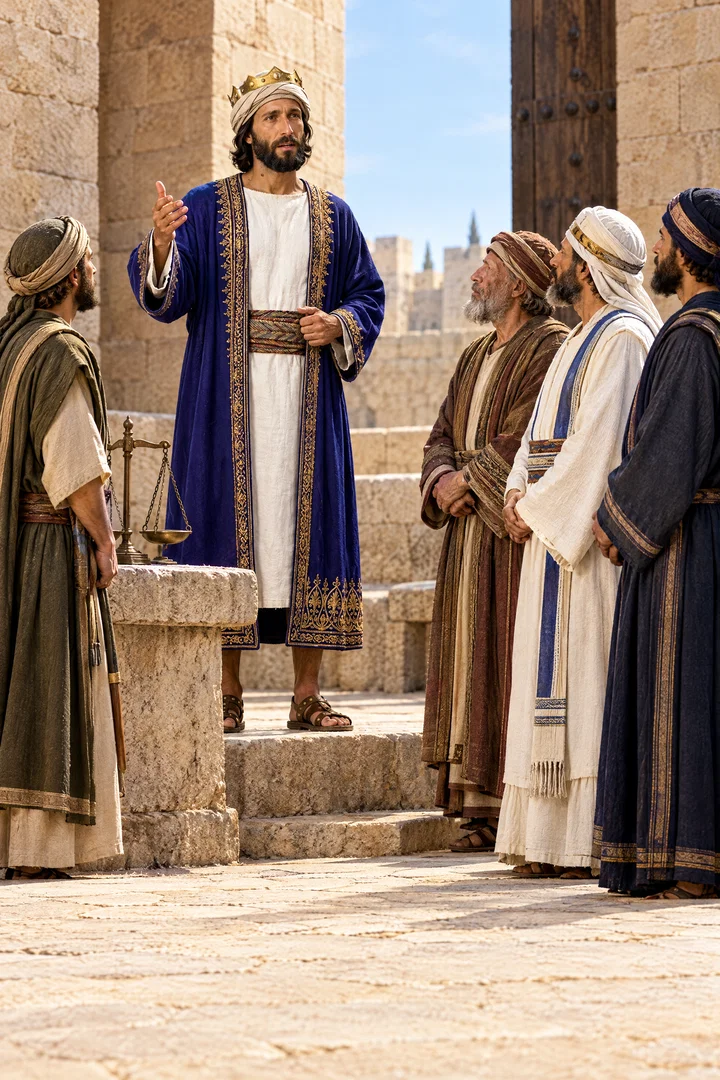
This is the charge Jehoshaphat gave to the judges he set city by city in the fortified cities of Judah in the later years of his reign, when he was bringing the people back to God and establishing and maintaining just courts.RH Dec 25, 1913 Judges do not judge for human beings but for the Lord, who is present and stands with them in the act of judgment.Ms 80, 1904, par. 44–47PK 197.1–2RH Dec 25, 1913 Because they judge for God, the fear of the Lord is to rest upon them, and they are to take heed and do their work carefully.Ms 80, 1904, par. 44–47PK 197.1–2RH Dec 25, 1913
The Lord with whom they judge is free from iniquity, respect of persons, and taking of gifts.Ms 80, 1904, par. 44–47PK 197.1–2RH Dec 25, 1913 Judges are to reflect God's character by judging impartially and honestly, themselves free from wrongdoing, favoritism toward persons, and accepting bribes.PK 197.1–2RH Dec 25, 1913 This counsel is excellent because righteousness strengthens a nation.Ms 80, 1904, par. 44–47
Sources
Pioneers and periodicals
14 sources
Jehoshaphat gave this charge to the judges he set city by city in Judah when he sought to bring the people back to God and establish just courts.RH Dec 25, 1913ST Jun 27, 1911ST Jun 10, 1908 Those entrusted with judgment decide not for men but for the Lord who stands with them, so they must live in reverence for Him and take heed to judge rightly and carry out their duty with care.RH Dec 25, 1913ST Jul 13, 1904ST Jul 13, 1904RH Aug 21, 1900 There is no wrongdoing with the Lord our God, for He is perfectly just, shows no favoritism or partiality toward persons, and cannot be swayed by gifts or bribes.ST Jul 13, 1904ST Jun 20, 1900ST Jul 13, 1904 His impartiality shows that He loves all His creatures alike, and it stands behind His defense of human rights and freedom, declaring all inhabitants equal before Him with a right to liberty.ST Jun 20, 1900ST Jun 30, 1909ST Dec 12, 1895 Judgment done in the fear of the Lord will stand every test, because His judgments are true and righteous and rest on the same standard for all.ST Aug 20, 1902ST Jul 13, 1904
Jehoshaphat's Setting and Reforms
The charge belongs to the history of Jehoshaphat's reign in Judah, coming within the account in chapters 1 to 20 that runs from Solomon through Rehoboam, Abijah and Asa into Jehoshaphat, set in contrast with the backsliding kings of Israel from Jeroboam to Ahab, and its lessons are of great practical benefit.ST Jun 27, 1911
It belongs to the reign of Jehoshaphat, a truly great, loyal and devoted king, greater even than Asa his father.ST Jun 10, 1908
He appointed teachers throughout Judah to teach the people the right way.ST Jun 10, 1908
The charge is what he gave to the judges he placed city by city in the fortified cities of Judah during the later years of his reign, when he worked to bring the people back to God and to establish and maintain just courts.RH Dec 25, 1913
It is associated with his faithfulness after his great mistake of entering into alliance with Ahab and wicked Israel, for when reproved by God's prophet he humbled himself and, unlike his father, accepted reproof and earnestly endeavored to restore completely the worship of God and return to integrity.ST Jun 10, 1908RH May 20, 1862
When in trouble he sought the God of his fathers, and God gave him victory by faith, a victory assured by faith before it was actually accomplished.ST Jun 10, 1908
Call to Reverent Judgment
Judges do not decide cases for human masters but for the Lord Himself, who is present with them in the act of deciding, and for that reason they must live continually under reverence for God.RH Dec 25, 1913 That reverence requires carefulness in the work, carrying it out with watchful attention rather than carelessness or haste.RH Dec 25, 1913 In judging they are to reflect God's own character, keeping themselves free from wrongdoing, from favoritism toward persons, and from accepting bribes.RH Dec 25, 1913
Those entrusted with judgment are commanded to act with reverence for the Lord and to take heed and diligently carry out their duty and judge rightly.ST Jul 13, 1904ST Jul 13, 1904RH Aug 21, 1900ST Sep 7, 1904RH May 20, 1862 The reason given is God's own freedom from everything that corrupts judgment, for He is never unjust, never does wrong, and is perfectly just.ST Jul 13, 1904ST Jul 13, 1904RH Aug 21, 1900ST Sep 7, 1904RH May 20, 1862 He shows no partiality, treating no one as favored over another, and He cannot be swayed by gifts or bribes that would distort justice.ST Jul 13, 1904ST Jul 13, 1904RH Aug 21, 1900ST Jun 6, 1906ST Sep 7, 1904 His impartiality is itself the motive for human judges to act with reverence and care.ST Jun 6, 1906
Judgment carried out in the fear of the Lord will stand every test, because the Lord's judgments are true and righteous.ST Jul 13, 1904 Those involved in disputes should therefore seek to stand guiltless before God.ST Jul 13, 1904 Persistent wrongdoing is dangerous, since it can bring wrath upon the wrongdoers themselves, upon their fellow people, and upon the nation.ST Jul 13, 1904
God's Impartial Character Applied
There is no wrongdoing in the Lord, for He is perfectly just and never unjust, showing no favoritism or partiality toward any person and accepting no gifts or bribes that would bend justice. ST Jul 13, 1904ST Jul 13, 1904RH Aug 21, 1900ST Jun 6, 1906ST Sep 7, 1904 He treats no one as favored over another and cannot be swayed or influenced to distort a right decision. ST Jul 13, 1904ST Jun 20, 1900ST Jul 13, 1904RH Aug 21, 1900ST Jun 6, 1906 This impartiality is evidence that He loves all His creatures alike. ST Jun 20, 1900
His impartial justice stands behind His defense of human rights and freedom, including His love for the stranger. ST Jun 30, 1909 It is His own proclamation on behalf of mankind, spoken in an age when men thought it right to enslave even their own kindred, declaring that all inhabitants stand equal before Him with a right to liberty. ST Dec 12, 1895 Because He does not favor some people over others, His judgments rest on the same standard for all. ST Aug 20, 1902 What He has declared about why He judged the guilty in the past therefore applies equally to later events. ST Aug 20, 1902
Sources